TV: The Underlying Message in Glee’s “Asian F” Episode.


Despite the racism of the title (is it racist if the two token Asian characters and their tiger parents say it?), last night’s episode of Glee was all about girl power, with some political undertones.

Brittany is continuing her race for class president, performing “Run the World (Girls)” by Beyonce to a standing ovation in the gym. It’s not the first time Brittany’s done a Beyonce song (remember “Single Ladies [Put a Ring On It]” when Kurt was trying to pass her and Tina off as his girlfriends?), and the episode was pretty Bey-heavy, with lots of Dreamgirls songs to boot.

If you haven’t seen this video from NineteenPercent, I wholeheartedly recommend you watch it. “Run the World” “lulls girls into a false sense of achievement and distracts them from doing the work it takes to actually run the world.” Hence Brittany performing in the halls of William McKinley in a leather miniskirt and suspenders, when she should really be working on her campaign promises. But she does look damn fine!

The whole Brittany versus Kurt (versus Rachel) thing evokes feelings of the Barack Obama/Hillary Clinton democratic primary race of 2008, not to mention the Sarah Palin-as-feminist debate.

Santana, Brittany’s right-hand campaign woman, tells Rachel that if she votes for “Jimmy Fallon’s butch daughter”, Kurt, “it would only empower another Frankenbeans,” whatever that means. (A Google search for both “Frankenbeans” and “Frank & Beans” yielded no relevant results.)

Brittany follows this up with all the shit male leaders have gotten America into lately: “double digit inflation, economic freefall, oil spills, the war in Afghanistan.”

But to make women feel like they have to vote for their political counterpart just because they’re a woman isn’t the way it should go. Palin is a perfect example of this: the only reason John McCain chose her as his running mate was because of the close upset of Clinton by Obama in the primaries. Upon further inspection, it was revealed that Palin didn’t know jack about most things. Perhaps Brittany’s run for senior class president is intended to reflect Palin’s vice-presidency bid, or her possible 2012 presidential candidacy, as Brittany isn’t the sharpest tool in the shed.

When Rachel realises Mercedes might beat her for the role of Maria in McKinley’s production of West Side Story, she decides to run for president, too, so she’ll have a stellar extra-curricular on her application for NYADA. Kurt is understandably upset, as he knows that Rachel’s running for personal gain, and perhaps Brittany’s been brainwashed by Beyonce, but he can actually make a difference at the school for fellow outcasts like them.

So it looks like the thinking students of McKinley will be faced with a similar dilemma that Democrats were in 2008: to vote for the marginalised  candidate (coloured Obama/gay Kurt), or the female candidate, who also belongs to a marginalised group…

Related: The Underlying Message in Glee’s “I Am Unicorn” Episode.

Glee Back in Full Force.

Image via VideoBB.

TV: At Home With Julia—Funny or Disrespectful?


After watching last Wednesday night’s third episode with my hard-to-please comedy-wise housemate who hadn’t seen the previous installments, it certainly wasn’t funny.

I did enjoy the first two episodes though and, as Mia Freedman mentioned on MamaMia TV a couple of weeks ago, it did make the Prime Minister seem more “human” and relatable, if that’s even possible coming from a scripted, comedic version of Julia Gillard.

But why is a comedy show that mocks her living arrangements with her de facto partner Tim Mathieson, amongst other things, being made about a prime minister in office? Would this shit fly if John Howard—or even Kevin Rudd—had a show made about them whilst in office?

Sure, there were comics of Howard with his bushy eyebrows and his morning walk, and Rove had a weekly segment about K.Rudd and Wayne Swan’s prime ministerial faux pas, which came to be my favourite part of the show. But they dealt with their public lives, not their personal ones, which seems to be all the public can focus on since Gillard ousted Rudd.

Gillard has been disrespected in the past because of her gender. She is constantly referred to as “Julia” instead of the courteous “Prime Minister”, was berated by Alan Jones for being a few minutes late on his talkback radio program (which, incidentally, was the same day she was also called “Ju-liar” by the shock jock), and cops it in the press for the way her hair is styled and how she dresses.

On that, there is a heavy influence on At Home with Julia about Tim’s “house-husband” status and how he’s a sad hairdresser who just wants to marry the independent Julia. While I’m not sure the show seeks to contribute to the status quo, but rather critique it, I do have a problem with the fact that in this society, an unmarried couple is an unhappy one.

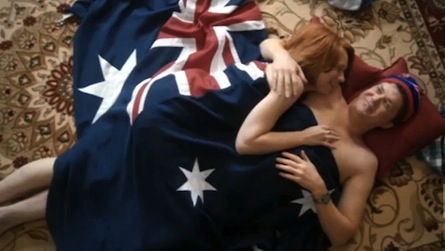
Despite my problem with the fact that there is a comedy show about a sitting prime minister, it is an accurate and (mostly) funny satire of Gillard’s time in office. I voted for her, and regret doing so because of the way she’s blundered the carbon tax and the asylum seeker issue. I hope At Home with Julia seeks to delve more into these issues, instead of portraying sex—an act the show asserted it would never do—under the Australian flag in the Prime Minister’s office. As Anthony Sharwood wrote on The Punch:

“Yet somehow, it was deemed OK to make sexual jokes about an incumbent prime minister in her late 40s, whose love life has never had the tabloid quality of, say, Bob Hawke’s. Even if you dislike Labor and Gillard, the nookie scenes were cringeworthy and savagely inappropriate.”

What do you think? Much ado about nothing, or wildly inappropriate and disrespectful?

Related: Not Quite Out of the Woods: The State of Australian Politics.

Elsewhere: [The Punch] Why is the ABC Screening This Crap?

[MamaMia] At Home with Julia: Love or Loathe?

Image via News.com.au.

Guest Post: Feminism Respects Women More Than Anything, Including the Catholic Church!

Just over a week ago I was reading this here blog when I came across an article that shocked me. It was a response to a feminist blog that stated that the Catholic Church disrespects women. The response was supposed to demonstrate that “[the Catholic Church is] one of the few places in the modern world where women can find true acceptance and respect.” I almost choked when I read those words. Surely a Solidarity Salon or feminist society would be a more accepting place.

The Catholic Church has systematically stripped away women’s rights from the outset. Before people go asking for evidence, permit me to quote the Bible:

“That they may teach the young women to be sober, to love their husbands, to love their children, to be discrete, chaste, keepers at home, good, obedient to their husbands, that the word of God be not blasphemed.” Titus 2:4, 5 (emphasis mine).

According to this, women are subservient to men, must marry, have children and behave in a particular way—chaste, pure, with loving eyes only for him. The most important point here, however, is that wives must be obedient to their husbands. This indicates that women are viewed as being unequal to men. I cannot see how we can possibly feel respected if we do not feel equal.

Women in the Bible, and therefore in the eyes of the Catholic Church, are always presented in one of two ways: the Madonna or the whore. The Virgin Mary (mother of Christ and most famous of all biblical “vessels”), Priscilla (devoted wife of Aquila who extended her hospitality to St. Paul when he was in need), Ruth (loyally took care of her sick mother-in-law) and Elizabeth (who bore a son, John the Baptist, despite being well past child-bearing age) are all examples of the Madonna; the virtuous woman in the Bible.

So some of the examples are a little stretched for goodness—I’ll gladly look after my mother-in-law but I doubt that alone makes me a good person. That is because women are painted as sinners and whores far more frequently in the good old pages of the Bible. A small list of examples include: Eve (duh, she started it all by defying God and eating some fruit), Jezebel (worshipped false gods and murdered her husband and sons), Delilah (betrayed Samson, lured him with her sexuality and maimed him by cutting off his hair in which his strength lay, effectively leading to his death), Salome (flirted and danced seductively for her step-father to persuade him to execute John the Baptist—at the age of thirteen! [Scarlett Woman note: so the sexualisation of children isn’t just a raunch culture, Internet-age thing!]), Mary Magdalene (one of Jesus’ most reliable disciples, however she was painted as a prostitute until 1969 when the Pope recognised her as a true disciple). I could go on. Is it just me, or are the stories about the “evil” women just so much more fun? Now that we’ve had a who’s who of female biblical figures, I’d like to address some of the points that were made in the article.

The first point, predictably, is abortion. Apparently, because a high percentage of women having abortions reported using contraception and it failing “there is a huge problem with contraception—something the Church has said all along.” The Catholic Church is against contraception because they believe that every union between sperm and egg is a life and that only God has the right to give or take away life. Jennifer Fulwiler’s argument seems to be more centred on the science of contraception, an aspect of the argument that the Catholic Church has never really looked into being clouded with the morality angle. There were a few comments written in response asserting that if feminists want to be environmentalists as well, they shouldn’t pump their bodies and waterways with chemicals that inhibit pregnancy. Aaah, psedo-science!  As both a feminist and an environmentalist, I endorse the use of the Pill. All medication carries a risk, even aspirin. I received a very competent education on the menstrual cycle and how the pill works to inhibit the release of an egg by adding more oestrogen and progesterone, hormones that are naturally produced in the body, at a particular time in the cycle. If you are educated on how it works, you won’t be afraid of it. I would like to ask a question about sperm, though. If the church posits that the union between egg and sperm is a human being, do they believe that individual sperm and unfertilised eggs are also people? If this is the case, how can they condone the reproduction process, considering how many poor innocent sperm die in the hostile environment of the womb? [Scarlett Woman note: Or in “masturbatory emissions”, as Elle Woods would say?! Oh, that’s right: masturbation is evil.]

The article goes on to say that—shock, horror!—women are having sex for pleasure, not procreation. Really? In 2011? I had no idea! This is blamed on being “bombarded with about a zillion messages a day that portray sex as… pleasure and fun” and that you only have to “turn on the E! Network or flip through an issue of Cosmo” to see this message being touted and lauded as positive. I must admit, I always go to Cosmo for the best sex tips! The hyper-sexualisation of society is something that religion in general often uses as a way of renouncing feminism.  In a Google search of feminism, the third option is a website called Feminism is Evil. Not only is the sheer ridiculousness of the “argument” against feminism laughable, the only evidence appears to be quotes from the Bible. Feminism is Evil also blames the media for the unfeminine behaviour of women:

“The television is about as false and misleading as can be nowadays… People are being indoctrinated, especially our youth, to have a false view of reality. Television nowadays is being used as a weapon to promote agendas that go 100% contrary to the Word of God; such agendas as homosexuality, feminism and abortion.” (Original emphasis removed.)

At one point, the site makes the argument that men are more pure than women because “not one man has ever had an abortion”! I still believe that the mainstream media presents a patriarchal, homophobic lifestyle as the norm. Whilst there may be more divorced characters on television, they still promote impeccable family values. In CSI: Crime Scene Investigation, I would argue that Catherine works extra hard on her relationship with her daughter, Lyndsay, insisting on things like eating dinner together at the table and having movie nights. If anything, she is the most family-oriented character on the show. Similarly, Glee deals with a gay character, Kurt, by placing him in a highly supportive family. He has a great relationship with his father and becomes integrated into a full family unit with the marriage of his dad to fellow Glee clubber Finn’s mum.

Whilst I am the first to discuss the objectification of women in advertising that portrays them as sexual objects, it’s strange how we actually agree on something but think that it’s wrong for completely different reasons. I still maintain that most adverts place women in domestic spheres. This is completely compliant with the church, according to Feminism is Evil, as “biblically a woman’s place is in the home.” If I have to see one more advertisement for cleaning or cooking products in which only women appear, or in which they are exasperated at the incompetence of their husbands (and they are always husbands), I feel I might scream! The media systematically proliferates society with these wholesome messages of propaganda for “traditional” gender roles as a response to the increasing feminist and homosexual rights movements. People just don’t see it, as the message is more subtle than the ads of the ’50s and ’60s.

Back to the article at hand, and Fulwiler falsely states that “secular feminists are not willing to stand up for all women.” This is a sweeping generalisation. She cannot speak for everyone, and neither can I, however I was offended by this statement. I, personally, am willing to stand up for all women, even ones who, like her, are victims of the patriarchy. I actually feel that women who have been indoctrinated into a repressive and unequal culture need to be represented more, as they have lost their own voices.

As the article goes on, however, I realise that I don’t represent all women, if Fulwiler is to be believed:

“Pro-choice feminism only respects women once they’ve reached a certain age, usually about 36 weeks; the ones who are younger than that are not considered worthy of consideration as human beings, let alone worthy of respect. The Catholic Church respects all women, no matter how small and voiceless.”

Oh, right, I see what she means. I could not disagree more. This issue is, undoubtedly, highly subjective based on when one considers a foetus becomes a person.

I am not speaking for any other secular feminist at this point but I don’t consider an aborted foetus a woman that I have failed to represent. This is not about neglecting women here; this is about terminating a pregnancy, not a life.  I believe that the person to focus on is the woman who should be given the choice as to whether she wants to continue the pregnancy and eventually give birth to a fully-fledged human, or terminate that pregnancy and not bring an extra child into the world. Each case is individual and should be treated that way, however, at the end of the day, the choice should only ever be that of the woman’s.

Once again, there is a misconstrued notion that the Catholic Church educates women on abortion better than pro-choice organisations or abortion clinics. I disagree, and I went on quite a few websites to discover what they say the procedure consists of. According to Better Health Victoria, two types of abortion are currently available:

  • Surgical abortion: a low-risk procedure most commonly used for first trimester (7–12 weeks) abortion in Australia. Known as suction aspiration or suction curette, it involves removing the lining and contents of the uterus (womb). A range of other surgical techniques are used for abortion later in pregnancy.
  • Medical abortion: a low-risk alternative to surgery used for terminating pregnancies earlier than 7–9 weeks (depending on the clinic). RU486 (mifepristone), also known as “the abortion pill/drug”, is the most widely known medication used for this procedure. It’s available in some clinics in Australia and is up to 98 per cent effective when used in the first nine weeks of pregnancy.

This seems to be the general consensus on most abortion websites I visited. I did come across several problems, though, as most of the sites had been hijacked by religious pro-life propaganda. One website, called Pro-Choice.com, was full of pictures of foetuses and religious messages. If you can’t go to a site labelled “pro-choice” without it being corrupted by religion, where can you go?  I find it quite insulting to read that apparently the Catholic Church provides more accurate information on abortion. Women undergoing the procedure are given accurate and thorough information regarding the process just like any other medical procedure. The Church’s scare mongering and twisting of the facts are not scientifically- or medically-based enough to be considered “information.”

Now, Ms Fulwiler is not saying that “secular feminists intend to disrespect women”; she thinks we “mean well but are simply misguided.” How nice of her to be concerned!  She says she knows how we feel because she used to be the same until she found God was brainwashed. She then says that she started “questioning assumptions.” For someone who questions assumptions, she sure makes a few herself. the first being that the Catholic Church has moved into a modern world in which Eve and Jezebel are not real but allegorical so that women are really seen as respectable in the eyes of the Church. According to Feminism is Evil, even female ministers are going against the word of God and should get back to the kitchen!

The second assumption she makes is that women are being blindly led to the abortion clinic the second they get pregnant. As I stated earlier, every case is different and I feel that there is a tendency to sweep over that and assume that pro-choice women relish in the devilry of their abortive practices.

The third and final assumption is that God exists. I understand that this is a faith-based claim, as there hasn’t been an awful lot of concrete evidence that He has spoken to anyone of late, yet the whole church system relies on the fact that he’s real. If the assumption is wrong, as I believe, then the reasoning behind the oppression of women and the pro-life argument go completely out the window.

Oh, and one final assumption: that secular feminists care what you think.

—Laura Money.

Related: On Stalking.

On Stripping.

Elsewhere: [National Catholic Register] Feminists Don’t Respect Women; the Catholic Church Does.

[YouTube] Legally Blonde Part 5.

[Feminism is Evil] Homepage.

[Better Health Victoria] Abortion.

[ProChoice] Homepage.
Manic Pixie Dream Bitch.


From “The Pinup of Williamsburg” by Jada Yuan in New York Magazine, via Jezebel:

(500) Days Of Summer… told almost entirely through Tom’s perspective, was ‘actually very misunderstood,’ [Deschanel] says. ‘I can’t tell you how many guys, and girls, are like, “You did him wrong!” What, she’s a bitch because she didn’t want to date that guy? So? Are we bitches because we have our own opinions? If that makes me a bitch, or that makes women bitches, then maybe we’re all bitches.’”

Elsewhere: [New York Magazine] The Pinup of Williamsburg.

[Jezebel] Zooey Deschanel: “Maybe We’re All Biches”.

[Musings of an Inappropriate Woman] Elizabethtown, Garden State & the Alternative Flat Fantasy Female.

Image via Robray Burn.

Movies: The Change-Up Does Nothing to Change Stereotypes.


Remember when Katherine Heigl bit the hand that fed her and criticised Knocked-Up for being sexist and perpetuating women/wives-as-shrews stereotypes? Where was Leslie Mann, who played Heigl’s sister in the movie, and is director Judd Apatow’s wife, during all this?

Certainly she didn’t take Heigl’s valid-but-ill-received criticisms of the 2007 runaway hit to heart, as she is basically playing the exact same character in The Change-Up: shrewish, run-off-her-feet with three children and a seemingly successful job (she discusses something in the vein of building planning, so perhaps she’s an architect? What does it matter, right?), and stuck in an unhappy marriage in which her husband doesn’t find her attractive.

And what about Jason Bateman and Ryan Reynolds’ characters? Reynolds, playing man-child Mitch Planko, is a loser stoner who only peels himself off the couch to score 9-months-pregnant women, a job in a soft-core porno, and weed.

Bateman’s Dave Lockwood, on the other hand, is a successful lawyer who’s been with the same woman for 18 years and no matter how much he accumulates, he’s never happy.

The only other woman in the film with more than a few lines and a tit-shot is Sabrina, played by Olivia Wilde. If Mann’s Jamie is the overworked and undersexed Madonna, Sabrina is the work-hard, play-hard whore. She espouses clichés like “I prefer to be sexually harassed in my private life,” or something to that effect. Way to stand up for women’s rights there!

There was one redeeming quality to the film, if you look really hard. Jamie makes an astute observation about women and marriage, and is somewhat representative of a lot of women in long-term relationships or marriages who no longer feel loved or desired by their husbands, who are taken for granted and who are run off their feet with 2.5 kids and a job (although Dave helps to break the stereotype of absentee father who doesn’t engage with his kids). But this also does a disservice to other kinds of wives and mothers and families, who don’t have rich husbands and live in a mansion, by all accounts.

Oh, and the unrealistically pert breasts of a breastfeeding mother of three and the ass of a 17-year-old on a lady pushing 40 don’t do much to help real women, either.

Related: The Taboos of Sexual Harassment.

Elsewhere: [MamaMia] These Are the Un-Retouched, Un-Fake Breasts of a 33-Year Woman Who Has Breastfed Two Babies.

Image via YouTube.

Why is Feminism Still a Dirty Word?

Recently, when asked in an interview with UK Harper’s Bazaar if she’s a feminist, Beyonce said she wanted to invent a new word for feminism, because she doesn’t feel it “necessary” to define whether she is one or not.

Why, in this day and age, do we still distance ourselves from the word “feminism”?

And it’s not just Beyonce. Keri Hilson, Lady Gaga, and even (kind of) Tina Fey, have been called a feminist in one instance, and tried to backtrack on it in the next.

In response to all this, Jezebel ran a contest to come up with “a catchy new word for feminism”, like Beyonce suggested. Some suggestions were “FUCK PATRIARCHY”, “Flesh-Hungry Young Slutism” (seemingly appropriate given it has been the year of the SlutWalk, if you will), “Vaginist”, “Diva-is-a-female-version-of-a-hustla-ism” (how you like that, Beyonce?), but the one that came out on top was “Equalism” which, in my experience, is what young feminists today strive for.

Speaking of young feminists, I would probably only define a handful of my friends as this, and even they are hesitant to describe themselves this way.

One says she’s not a feminist because she wants to “cook for her boyfriend”. Since when did not cooking and feminism become mutually exclusive?

Another says he’s (yes, he’s) could never truly be a feminist because he doesn’t have a vagina, so therefore will never know what those who do have to go through on a daily basis in a patriarchal society, and have gone through for centuries in patriarchal societies.

I have another who, just by looking at her, screams feminism before she even opens her mouth. Yet sometimes, when she says things I morally disagree with, I think, “she’s not feminist enough”. (Abhorrent, I know, and something I strive not to think and say as a feminist. And, by my own admission, some might say I’m “not feminist enough” because of the way I talk and how I dress.)

It’s a far cry from Beyonce, Gaga et al., who try to distance themselves from feminism, while young feminists (and old!) bicker amongst themselves about who’s more feminist! And it perfectly illustrates the discrepancies between what self-described feminists project onto the movement, and what lay, non-feminist Generation Yers believes it to be about.

Camilla Peffer over at Girls Are Made From Pepsi writes:

“I think most women associate feminism with radicalism and the whole bra burning hulla-balloo. Which is RI-DUNK-U-LOUS. And a lot of people see the term feminist [as] biased towards females in the sense that the whole movement promotes this idea of women being better than men.”

Indeed, there is a far cry between the first wave suffragist movement, second wave “bra-burning” and the sexual revolution, and current third-wave feminism. Some would even say that we have passed third-wave feminism and are now living in a post-feminist society.

When I first started getting into feminism about two years ago, I subscribed to this notion. Now, having been exposed to all manner of blogs, academic articles, events etc. to put the sexism, discrimination and harassment I’ve experienced as a woman into perspective, I can see that we sure as hell aren’t living in a post-feminist world and that we still need feminism, perhaps more than ever with the rise of the Tea Party and Michele Bachmann and the closure of Planned Parenthoods in the U.S., the blatant harassment most women experience on the street and in their workplaces every day, the attacks on SlutWalk, and the atrocities facing Third World women, to name but a few.

Taking on these battles shouldn’t be seen as something “dirty”; it should be seen as something we can all get behind, if it leads to our daughters experiencing a world free from harassment and discrimination based on what genitals she possesses and what she looks like, no matter what part of the world she hails from.

Sadly, as Rachel Hills muses, “it can be a bit uncool to care. Feminism means caring and wanting to change things, ergo it makes people uncomfortable—especially people who are comfortable with the status quo.”

Are you comfortable with the status quo? Do you think feminism is still a dirty word?

Related: Why Young Feminists Still Have “A Long, Long Way to Go” in the Eyes of Second-Wave Feminists.

So Misunderstood.

Melbourne Writers’ Festival: A Long, Long Way to Go: Why We Still Need Feminism.

Has Feminism Failed?

I Ain’t No Hollaback Girl: Street Harassment in CLEO.

The Taboos of Sexual Harassment.

Ain’t Nothin’ Gonna Break My Slutty Stride.

Elsewhere: [Jezebel] Let’s Invent a Catchy New Word for Feminism.

[Jezebel] The Catchy New Word for Feminism.

[Jezebel] Keri Hilson is a Feminist, Not That She Wants to Say So, Exactly.

[Jezebel] Tina Fey on the Message of 30 Rock’s “Joan of Snark” Episode.

[Feministe] Time to Check In With Tina Fey’s Feminism.

[The Frisky] Tina Fey: Not Feminist Enough?

[Girls Are Made From Pepsi] The Post in Which I Talk About Beyonce, Feminism & Equality For All.

Guest Post: On Stalking.

I am standing at a tram stop in Brunswick waiting when a poster catches my eye. Someone has stuck it over the City of Moreland sign—a prominent place. Its headline screams: “Women Should Be Careful.” I’m hooked.

Upon reading the article I become increasingly angered as it goes on to explain how women should cover up and not expose their bodies to men as men can’t help but be attracted to that “provocative attire.” Not only should women expect to be sexually assaulted if showing skin, they are actually “asking for it.” I am outraged and start tearing the poster down but the man (I would assume and hope) has stuck it on with liquid nails. I manage anyway, throwing the wad of paper in the bin with a satisfying clunk. A woman is sitting on the bench near me also waiting for the tram. She turns to me and asks, “Didn’t like what it said?” No, I didn’t like it at all.

*

The idea that a woman is asking for it if she wears revealing clothing is repugnant. Not only is it outdated in 2011, it also allows men to get off scot-free. Whatever the length of my skirt, I refuse to be an excuse for a man’s behaviour. It is a common misconception that most women are harassed, attacked and stalked because of their provocative clothing or behaviour.

When I asked a group of friends to define the look of a stalking victim the consensus was a young (18–25) woman, thin, attractive, large breasts and, most importantly, wearing “slutty” clothing. It was also decided that most of these women will be stalked by men who had seen them out at a club/pub and followed home at very late hours. This profile is not true. According to California State University, 77% of female victims and 64% of male victims know their stalker and 59% of female victims and 30% of male victims are stalked by an intimate partner. This changes the image of a creepy guy hanging out in your garden after watching you dance at a party.

In a study by the Australian Centre for the Study of Sexual Assault it was revealed that only 1% of women surveyed were raped by a stranger. Clearly there is a different representation of this in the media. Still, even if most cases of stalking and rape will be carried out by someone who knows the victim, there are still instances when a stranger will take a shine to them.

*

I am on the train, coming home from work. I’m wearing a black dress, black stockings and a black coat and holding a bag of groceries. I sit down and accidentally knock the man in front of me with my bag.

“Sorry,” I say giving him a small apologetic smile.

“That’s okay,” he says, looking me up and down. “Are you coming home from work?”

“Yes.” I reply, not impolitely.

He then asks me where I work, what I do etc. I proceed to tell him, being polite but not particularly inviting. He then brags about working in an industry with a lot of money and invites me to join him at his work one day soon. I decline and then get off at my stop. He also gets off at my stop and I feel a tug at my bag of groceries. He offers to carry them for me and asks if I am married. I say no but that I have a boyfriend and he tells me that “we could always break up.”

He then asks where I live and follows me home. At this point I am pretty scared. It isn’t dark, it’s not isolated, I’m not wearing anything revealing… this isn’t how I expect the stalking story to play out. I panic and actually walk down my street before common sense kicks in and I stop two houses down from mine, pretending that it is my house, even going so far as to fumble with the letterbox pretending to check for mail. I get out my keys and ask him to leave. He then tries to invite himself in for coffee, then dinner, then a chat. I say no and am rude to him for the first time.

“Aren’t you going to go inside?” he asks, as if calling my bluff.

“Not until you are down the end of this street,” I say.

Then he says the words that stop me cold: “That’s ok, I know where you live. I can come anytime.”

The problem I had after this occurred was that I felt that it had been my fault. I shouldn’t have spoken to him, I shouldn’t have smiled at him, I should have been wearing a sack… all sorts of irrational thoughts went through my mind. Actually, the only thing I should regret is practically leading him to my door. That was stupid. When I told people, I was actually asked by one friend what I was wearing. Another told me I shouldn’t have used my “devastating” smile. The most common feedback I got, however, was that I’m just too nice. I shouldn’t be so polite and friendly to men because they take it as a sign that I’m flirting. This isn’t right! It just confirms what the poster said, that it’s the woman’s responsibility not to be stalked or get raped. I’m getting quite sick of men being blameless in these situations. It is the narrative that is constantly being touted by the media, in ads like the Razzamatazz stockings where you only see a woman’s legs in Razzamatazz and in the background are the men’s reactions to her sexy legs, implying they can’t help it. One of them spills a coffee, another trips over and a third is slapped by his girlfriend for looking. Unless ads like this stop then we will forever live in a sexist society that backs up the theory that the sexualisation of women is innate and part of our evolutionary journey.

At this point, I would like to say that I was living in fear every time I got on a train. I switched to the tram, I started calling my boyfriend to meet me at the station so we could walk home together and told all of my friends what had happened.

*

I am at work, re-entering the building after a break. He’s there in the foyer greeting me like an old friend. My colleague thinks we know each other, so walks ahead and leaves us alone. I am scared. I tell him I am busy and that I finish at 5pm. Why do I say that? The fear makes me irrational.

I try to tell him I’m busy after work and not to meet me, but he just smiles and says he’ll see me at five. I walk into the administration area, call my boss and start hyperventilating. Security sees me out at 5pm. I am flanked by two friends but I don’t see him. I can only hope that he is bothering another girl instead, then feel terrible for inflicting him on someone else.

*

I haven’t seen him since. I do live with the idea of him in that back of my mind, though. I just wish that other victims of stalking don’t blame themselves. Whatever I wear, wherever I go, yes means yes and no means no.

—Laura Money.

Related: Ain’t Nothin’ Gonna Break My Slutty Stride.

The Taboos of Sexual Harassment.

On Stripping.

Elsewhere: [California State University Department of Police Services] Stalking, Threats & Annoying/Harassing Calls.

[Australian Centre for the Study of Sexual Assault] Statistical Information.


Why Young Feminists Still Have “A Long, Long Way To Go” in the Eyes of Second-Wave Feminists.

Last week I wrote about the Melbourne Writers’ Festival event, entitled A Long, Long Way to Go: Why We Still Need Feminism, presented by Sophie Cunningham and Monica Dux.

On the whole, Cunningham’s presentation was thought-provoking, if a little small-minded, but my main point of contention is as follows.

Cunningham brought up third/fourth wave feminism (the feminism we’re experiencing now, by most accounts), saying that while she applauds the grassroots feminist movements such as SlutWalk, she wasn’t sure 25-year-old women could fully understand the concept of feminism because they still have men fawning all over them at that age.

Now that’s just a whole lot of wrong.

First of all, I am soon-to-be-24 and I don’t have men falling at my feet (well, except when it’s unwanted), and nor do my similarly-aged friends.

Secondly, who’s to say that even if we did, we wouldn’t recognise that, unless they had had some kind of interaction with us other than staring at our boobs, they were interested in us purely for our looks, and that’s anti-feminist. (Then again, I know girls who do have men fawning all over them purely for their looks and couldn’t care less.)

And thirdly, this kind of feminism in fighting is exactly what has been undoing the feminist movement in recent years. As I wrote:

“… Cunningham saw a sort of ‘bottleneck’ in modern feminism, where white, privileged feminists like myself don’t understand the problems facing feminists of colour, feminists with sexual orientation other than straight, feminists with gender other than cis, and feminists with disabilities…”

This is not to mention conflict between the ages, or waves, of feminism.

In Susan Faludi’s attempted takedown of young feminists in her article, “American Electra: Feminism’s Ritual Matricide”, last year, she writes:

“… Despite its [feminism’s] many victories, it seems to falter along a ‘mother–daughter’ divide. A generational breakdown underlies so many of the pathologies that have long disturbed American [or, rather, Western] feminism—… its bitter divisions over sex… [and] alongside the battle of the sexes rages the battle of the ages.”

I can’t think of a better example than, oddly enough, an episode of Gossip Girl from its most recent season, in which it addresses the clash between young and old feminists after Serena van der Woodsen is accused of having an STD. Her dean at Columbia University tells her:

“Women of my generation had to fight for every opportunity. And to be taken seriously, and your attitude, Miss van der Woodsen, makes a mockery of that.”

I wrote in response at the time, in reference to Faludi’s article:

“Now if that isn’t the second wave looking down upon the third wave for our apparent flippancy about ‘activism’, our ‘obsession with technology’ (Gossip Girl’s blasts are a prime example of this), our ‘unwilling[ness] to challenge sexual exploitation for fear of pissing off men’ (hello, Serena), and our infatuation with Lady Gaga (well, Gossip Girl did feature the Lady herself in an episode…), I don’t know what is.

“… It would be interesting to see Serena fight back and declare herself ‘sick to death of hearing about the glory days of Seventies feminism’, whilst older women, like Dean Reuther, ‘declaring themselves sick to death of being swept into the dustbin of history.’

“Faludi spends a lot of time criticising (via her second wave subjects) the technology third wavers use, specifically blogging: ‘All they want to do is sit at their computers and blog.’ Ouch.

“I’m sure Gossip Girl would have something to say about that.”

Exhibit A: SlutWalk as an anti-testament to Faludi’s assertion.

Could it be jealousy these second-wavers are suffering from? I’d like to think feminism is above that, but it is one of the seven deadly sins and can get the better of us. Contrary to what Cunningham said, I don’t think it’s because of the way we look. Everyone knows age is not a precursor to looking hot. I think second-wavers might long for their glory days of making things happen, being invigorated and excited by feminism, instead of seeing their options shrivel up and die the older they get. Again, please see exhibit A. While I don’t know the ages of those who were critical of the SlutWalk, but if they were older it might be easy to see why they were a bit miffed by the anti-slut-shaming and -victim-blaming movement that they felt left them behind.

There needs to be something done to rectify this. Not only the gap between the ages, but the gap between the races, the abilities, the genders and the sexual orientations.

I don’t pretend to know how we’re going to do this, but it will have to start with listening and understanding, empathy, perhaps some mentoring and—what feminism is all about, not just between the sexes, but between all those I mention above—equality.

Related: Melbourne Writers’ Festival: A Long, Long Way to Go—Why We Still Need Feminism.

Ain’t Nothin’ Gonna Break My Slutty Stride.

The Taboos of Sexual Harassment.

Will Boys Be Boys When it Comes to Objectifying Women?

Surfing the Third Wave: Second-Wave VS. Third-Wave Feminism on Gossip Girl.

Elsewhere: [Harper’s Magazine] American Electra: Feminism’s Ritual Matricide.

The Taboos of Sexual Harassment.

The other day at work I was sexually harassed by a customer.

I was just standing there, and a short (probably around my height), bald, fat man in a dirty navy blue polo shirt, who was about 50–55, came up to me and asked me where the toilets were. I told him, then he asked “how’ve you been”, with a tone that implied he knew me. I said fine, and he looked me up and down and said in a sleazy voice, “Ooo, I’d like to take you home.” I immediately walked away and told three of my colleagues who were stationed nearby. As I left, he said something to the effect of, “I probably shouldn’t have said that.”

No, he shouldn’t have.

Now, sexual harassment probably isn’t anything new to a lot of women. It’s just something we have to face because we have a vagina.

I’ve been harassed at work before, not as blatantly as Sunday’s episode, but I’ve never felt comfortable enough to eject myself from the situation. As someone who works in customer service, I think I placed not being rude above keeping myself safe. But, post-SlutWalk, I now have the confidence not to put up with that shit.

But I didn’t report it.

I told a few colleagues, until I eventually mentioned it several hours later to a security guard, who also happens to be a close friend of mine. He sternly asked me if I’d reported it to my manager. I told him no, and he asked me what I would do if he came back? If he stalked me? If he attacked me? If he attacked someone else? His older-brother protectiveness made me decide to report it.

It’s funny that I didn’t think to report it the moment it happened. I guess that’s the stigma of sexual harassment (and don’t even get me started on the stigma of sexual assault!). I think I thought that because I can handle myself and I won’t put up with that shit, that it wasn’t a big deal.

It was.

I filed a report with my manager, security know about it and have footage of the man, and it’s been forwarded to the appropriate department.

The responses I got from fellow colleagues were at each end of the spectrum. Some expressed outrage and encouraged me to report it, others asked me if he touched me, as if that would be the only thing to warrant filing a report. No, he didn’t, because that would be sexual assault. (Why do we not bat an eyelid when verbal harassment occurs, but are quick to leap into action when the physical barrier is breached? Both are violations of a person based on the fact that their harasser thinks they’re public property, or available for them to make comments on/touch.)

But these responses really illustrate the abovementioned taboo of sexual harassment. That boys will be boys. That as a young, pretty woman, you just have to suck these things up. That it doesn’t really count because you were only verbally violated.

I am somewhat ashamed that I was so quick to brush it off. (Let’s be clear: I’m not ashamed that I was harassed. I’m ashamed that I didn’t take it seriously to begin with. Rape is my biggest fear, but if I was ever raped, you can be damn sure I wouldn’t keep quiet about it because I was ashamed.) This is 2011. This kind of thing shouldn’t be happening. But it does. So as modern women, we should be able to say that making comments about our physical appearance without our consent is a no-go. Just like making physical contact with our bodies without our consent is.

Related: I Ain’t No Hollaback Girl: Street Harassment in CLEO.

Ain’t Nothin’ Gonna Break My Slutty Stride.

So a Tattoo Makes Me Public Property, Huh?

Will Boys Be Boys When it Comes to Objectifying Women?

Event: Melbourne Writers’ Festival—A Long Long Way to Go: Why We Still Need Feminism.

We’re in a post-feminist era. Feminism is dead. Has feminism failed?

From the arguments presented by Sophie Cunningham in her Melbourne Writers’ Festival address, titled after the line in Helen Reddy’s “I Am Woman” (and the title of a book I thought Cunningham mentioned she’d had/is having published, but upon further inspection, this doesn’t seem to be the case), these post-feminism assertions are null and void.

While Cunningham stated at the beginning, after her introduction by Monica Dux, that she’d be focusing purely on feminism as it relates to Western women, but to keep the big picture in mind, I was disappointed that she kept her key points to the lack of women (or recognition of women) in writing, music, film and the arts in general.

Having said that, though, she made some pertinent points: that in 2009 and 2011, the Miles Franklin Award shortlists were all male; that for a woman in Australia to be paid the same as a man in the same job, she would have to have a PhD to his Bachelor degree; that a 25-year-old woman will earn $1.5 million over the next 40 years, whereas a male will earn $2.4 million (to which Dr. Anne Summers responded, “There’s a $1 million penalty for being a woman in Australia today.”); it’s safer to be a soldier in one of the most dangerous countries in the world, the Democratic Republic of Congo, than to be a woman; women do two thirds of the world’s work for 10% of the pay; that when literary submissions are read blind, the inclusion/choosing of women increases sevenfold. (This is epitomised in The Big Issue’s latest fiction edition, in which six competition pieces were read without names attached, and five [possibly six; it isn’t clear if Nic Low, whose piece Slick appears in the anthology, is male or female] are from women writers.)

To really illustrate the “invisible woman” syndrome in the “writing culture crisis”, and amongst many other industries, Cunningham used an anecdote about a female reporter who attended a Liberal rally organised by Tony Abbott and was taunted by the crowd for daring to question Malcolm Turnbull (I think; don’t quote me on this)*. To escape the abuse that threatened to get physical, she disappeared into the crowd, becoming “invisible”. If only Lara Logan, whom Cunningham spoke about, was able to do this in Tahrir Square.

Cunningham brought up the notion that in terms of women’s equality and feminism, our society is regressing somewhat. This is a contention I agree with. Therefore the “invisibility” of women has become “normalised”.

Aimless Panther writes on Feminaust:

“Yay, Aussie women now make up 12% of board members! Wait… seriously, is 12% something to CELEBRATE?!?!”

My sentiments exactly.

In film, Cunningham talked about the Bechdel test and how the feminist movie of the year, Bridesmaids, makes the cut, whereas Cowboys & Aliens doesn’t. Not to toot my own horn (okay, I’ll toot away!), but has Cunningham been reading The Scarlett Woman?!

She also mentions Pixar’s first film featuring a female protagonist, 2012’s Brave, about a strong, assertive and “brave” (duh!)—hence “ugly”—redhead. My, how far we’ve come!

Where Cunningham saw a sort of “bottleneck” in modern feminism, where white, privileged feminists like myself don’t understand the problems facing feminists of colour, feminists with sexual orientation other than straight, feminists with gender other than cis, and feminists with disabilities, she praised the “grassroots” feminism sprouting in the young feminist community, epitomised by SlutWalk. (SlutWalk has been criticised by non-white, non-middle-class feminists for excluding them. Cunningham defended the protest, but by only speaking about issues that affect the feminists SlutWalk caters to, perhaps she could be seen as contributing to this bottleneck?)

She longs for a fourth wave feminism, and finished the talk with this. Some would say we are in/entering a fourth wave, where sexual liberation and reproductive rights still reign supreme, but there is more of a focus on the needs of different types of feminists, as mentioned above, and “serious”, Third-World feminism, where some view the movement is most needed.

Those who are instigating these grassroots movements; this fourth wave; these feminist blogs; are arguably the 25-year-olds who “don’t get feminism”, as Cunningham asserted. While I don’t wish to demonise her for questioning my, and my peers’, motivations and understanding of the movement we so lovingly work towards, I was thoroughly offended by this comment. If Cunningham, and an elderly audience member who spoke up during question time by reiterating that young people don’t “get” what “real” feminism is all about, took a look around the function room at BMW Edge at Federation Square, they would have realised that the majority of people in attendance were under or around 25. Some of them were men, which signifies that yes, while we do still have “a long long way to go”, there are people on our side.

Furthermore, I remember last year there was a bit of tension in the ranks between second- and third-wave feminists, which has also contributed to the bottleneck Cunningham speaks of.

I think we, as feminists, need to be careful about who we call a “real feminist”. Is she the man-hating “HLL (Hairy Legged Lesbian)” stereotype? The woman who shuns all pain-killers to have a natural, home birth, and shames all those who don’t? The “expert”? The grassroots SlutWalk organisers? According to Cunningham, perhaps it’s not the young, beautiful women who “don’t understand” the real issues of concern for feminism because, well, they’re 25 and still have men drooling at their feet. (I’m paraphrasing here, but this is basically the gist of what I interpreted Cunningham to mean). There’ll be more on this to come throughout the week. In the meantime, what do you think?

*Updated 05/09/11: It was actually Alan Jones, at the Rally of No Confidence in Canberra, who lead the crowd in a verbal barraging of journalist Jacqueline Maley after she asked him if he had been paid to speak. I have added the link to this information below.

Related: Has Feminism Failed?

“Who the Bloody Hell Are We?”: The Sentimental Bloke at the Wheeler Centre.

Witch Trial: Burning at the Stake on Charmed.

Bridesmaids Review.

Cowboys VS. Aliens & Indians… Does it Really Matter? They’re All the Same Anyway, According to the New Movie.

Rachel Berry as Feminist.

Ain’t Nothin’ Gonna Break My Slutty Stride.

Melbourne Writers’ Festival: Never, Ever, Again—Why Australian Abortion Law Needs Reform by Caroline de Costa Book Launch.

Surfing the Third Wave: Second-Wave VS. Third-Wave Feminism on Gossip Girl.

Elsewhere: [ABC’s The Drum] A Prize of One’s Own: The Case for an Aussie Orange.

[Feminaust] Welcome to Monday August 29 2011.

[Sydney Morning Herald] The Fee, Me & Alan Jones: How Question of Money Turned Crowd Nasty.

Image via Melbourne Writers’ Festival.