TV: Revenge is a Dish Best Served by a Woman.

revenge emily victoria

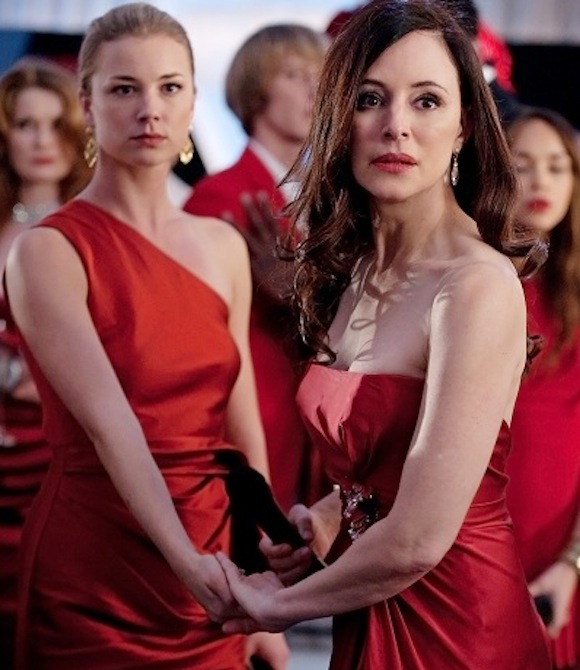
In an episode that aired a few of weeks ago—“Power”—judge’s wife and friend of the Graysons Patricia Barnes revealed she’s a sufferer of domestic violence. With protagonist Emily Thorn’s encouragement, Patricia helps piece together part of the Revenge puzzle and purge herself of her powerless victim status. Because the women of Revenge are anything but powerless.

For a show that focuses so much around power, money, killing and vengeance, women really are at the centre of these traditionally male attributes and they’re calling all the shots.

Obviously, there’s Emily/Amanda, and the avenging of her father’s wrongful incarceration for crimes he didn’t commit and his subsequent death, which the show revolves around, and her juvie parallel Amanda/Emily, whose surfacing (and resurfacing) in the Hamptons last season threw everything into disarray.

But we all know Revenge’s most intriguing female character is Victoria Grayson. Madeleine Stowe plays the aloof ice maiden with a past that was revealed in season two’s “Lineage” to perfection, which kind of makes you understand why she is the way she is.

And then there’s the secondary—albeit still important to the story—female characters Charlotte, Padma, Emily’s mum, Helen Crowley and Ashley, who are all strongly rendered, which is more than can be said for some of the male characters.

Daniel Grayson has proved himself to have some gumption after all when he overthrew his father from the head of Grayson Global this season. Viewers could be excused for thinking this wasn’t the case last year, when it seemed like all Daniel did was follow Emily around like a puppy.

This is quite the juxtaposition to Jack, who is a lovely guy but tends to get walked over because of it. He’s also a somewhat feminised character, showing emotion often and saying things like “I’m going to prove that you can have it all”.

The thing Daniel and Jack both have in common, though, and with the rest of the male cast, for that matter, is that they are easily manipulated by the women in their lives. Daniel “floats through life on the crests of women, unable to make his own decisions”. Conrad, although he thinks he’s the head of the Grayson household, is also subtly controlled by Victoria, and allows himself to be influenced by Ashley’s business acumen when she returns to work for him in “Sabotage” a few weeks ago. Nolan has proved himself to be a loyal friend and revenge-partner to Emily, but is treated like absolute shit by her, not to mention being screwed over several times by Padma. Aiden is probably the strongest male character on the surface, but when he rebels against Emily, he’s dressed down by his storyline and comes crawling back to her way of exacting retribution in last night’s “Union”. Let’s not forget Mason Treadwell, perhaps the biggest victim of Emily’s vendetta (you know, apart from all the men who end up dead), who’s now serving time for crimes he didn’t commit in the vain hope Emily comes through on her promise to give him her scoop when it’s all over.

Speaking of Emily, she is a strange character, isn’t she, in that she doesn’t really have any personality traits (though it could be argued that it’s all part of her plan to mask her true identity and come across as a blank canvas onto which people can project their perceptions of her). Revenge is a plot-driven show, so you get behind Emily’s plight because of the hardships she’s faced in her past. But very rarely do we get a glimpse into her inner psyche. It’s perhaps only when Sammy, her dog, dies and when her mum, Kara, comes back from the dead that we see a glimmer of emotion. This is on the contrary to someone like Victoria whose emotions are kept close to her chest but which you can see in her eyes, or even Amanda, who fluctuates between anger, protection and passion. When Amanda accuses Emily of destroying lives with her obsession, Emily justifies it by attesting that she’s “righting wrongs”. And the only way to do that is to “close your heart if you want to succeed.” Ahh, the wise words of Mr. Takeda, one of the only male characters whose integrity manages to remain unscathed.

I wouldn’t go as far as to say Revenge is a feminist show, but it is refreshing to not hear a mention of a woman’s incapability to pull off what Emily, Victoria, Ashley et al. have managed to, that I recall. Vengeance is perhaps not the most attractive motive to have, but Emily is steadfast and solitary in her mission to avenge her father. She employs mostly men to do some of her dirty work, but she’s the mastermind of the operation. And while Victoria’s scheming from the confines of her Hamptons mansion isn’t necessarily the most positive portrayal of a woman, she is a smart lady, much like Ashley, who refused to accept her firing by Victoria after she was prostituted out to one of Daniel’s rivals and caught sleeping with Conrad and hustled to find a consulting position with him like the “cat [who] dragged itself back in”. Revenge is a show in which the women are just as reprehensible—and powerful—as the men.

Related: Dominic Dunne Makes a (Re)Venge-ful Return to the Small Screen.

Image via Pop Culture Nerd.
TV: Glee—Chris Brown is a Guilty Pleasure.

glee guilty pleasures jake bobby brown chris brown

Last week it was SVU, this week Glee is undertaking the Chris Brown treatment.

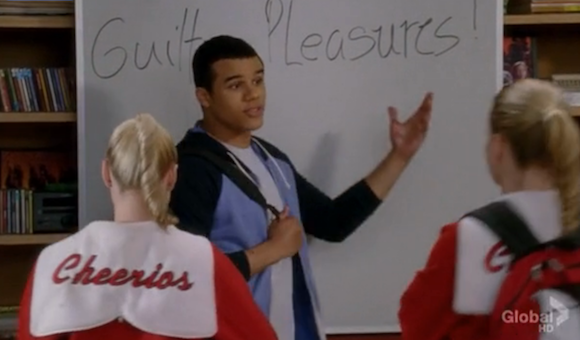
While Chris Brown is hardly in the guilty pleasures league of Wham!, Barry Manilow and the Spice Girls—the other shameful secrets of the New Directions—it was nice to see Glee address the notion of “liking the art but not the artist”.

This is an issue I’ve been grappling with lately as I write some wrestling-related pieces; for all its racism, misogyny, homophobia, ableism and promotion of a rigid type of masculinity, is it still okay for a level-headed person to like professional wrestling? Much the same, is it okay for someone who acknowledges Brown for the “douchebag” he is (“I don’t think that douche is a strong enough word to describe him,” interjects Unique) to still like his music?

I personally have a couple of Brown songs on my iTunes (purchased pre-Rihanna beating, might I add?!), and against my best efforts, I do quite like “Turn Up the Music”, but I refuse to pay for anything he’s selling and make it my personal mission instead to compensate him with as much bad press as possible. I have even been known to exit a pumping dancefloor when a Brown song comes on, if only for the principle of it.

In researching one of the abovementioned wrestling articles, I came across a couple of articles that really resonate with this idea. In an article about female stereotypes in video games, Anita Sarkeesian asserts it is “both possible and even necessary to simultaneously enjoy media while being critical of its more problematic or pernicious aspects.” Similarly, in her fantastic post about the intersection of rap, feminism and cunnilingus, which I linked to here a couple of weeks ago, Maddie Collier urges us to acknowledge the instances our pop culture of choice “sickens and disappoints us” in order to “fully appreciate the moments when it’s good and kind and real”. And the Social Justice League has a whole article on the topic.

After incurring the ire of the feminists, Jake decides to change his guilty pleasure song choice from Chris Brown to another Brown: Bobby. While this is problematic in itself—which Kitty and Artie point out to Jake, who’s apparently oblivious to the whole Bobby and Whitney thing—it highlighted the fact that it is “My Prerogative” to like problematic pop culture. Just as long as we’re acknowledging where it goes wrong, right?

But “does it really matter what a couple of high school kids think?” Yes. Because as avid pop culture consumers they’re shaping the attitudes of tomorrow. And unless we’re educating them in the ways of navigating pop culture safely, the seemingly widely held belief that hitting your partner is justified will continue on into the next generation.

Related: Special Victims Unit Takes on Chris Brown & Rihanna.

My Thoughts on Chris Brown.

My Weekend with Wrestlers.

Elsewhere: [Think Progress] Anita Sarkeesian’s Tropes VS. Women Series is Up—And It’s Great.

[The Pantograph Punch] Eat It Up & Lay Wit It: Hip Hop, Cunnilingus & Morality in Entertainment.

[Social Justice League] How to Be a Fan of Problematic Things.

Image via Ch131.

TV: Special Victims Unit Takes on Chris Brown & Rihanna.

law & order special victims unit rihanna chris brown funny valentine

Perhaps to make up for casting convicted rapist Mike Tyson on a show that largely promotes victims rights, Law & Order: Special Victims Unit holds a very unflattering microscope to the thankfully recently-ended tumultuous relationship of Chris Brown and Rihanna.

While the episode did cast a negative light on the predominantly black rap industry, “perpetuating the stereotype that hip hop artists are thugs”, we have to remember that the storyline was a direct commentary on Chris Brown’s beating of Rihanna four years ago and her subsequently taking him back.

Take, for example, the character of Micha Green, a young ingénue of an aging hip hop prodigy. Sounds a lot like Jay Z’s working relationship with Rihanna. And Micha’s lover and assailant’s, Caleb Bryant, initials are the same as one Chris Brown’s. Since giving Caleb the last name of Brown or Black would be too on the nose (and a little bit racist?), Micha is the one with a colour for a surname.

Further to that, the evidence photos of Micha’s mangled face are leaked to the press, and a restraining order is slapped on Caleb, who gets a tattoo on his torso that eerily resembles Brown’s neck tattoo of an alleged Mexican sugar skull that eerily resembles Rihanna’s post-beating face. Caleb might have “the Bryant team” (an obvious nod to Brown’s #TeamBreezy) on his side, but he’s playing “Russian Roulette” (Rihanna’s 2009 song) with Micha’s life.

Both Caleb and Micha, and, by extension, Brown and Rihanna, grew up with abusive fathers but SVU is sure to make a point of difference between the two couples, with Sgt. Munch suggesting they double date.

There’s a fair share of victim-blaming from witnesses and fans of the couple, which mirrors similar attitudes to Rihanna that continue to this day. “She shouldn’t have dissed him” lest she get beat in SVU becomes “she shouldn’t have taken him back” in the discourse of today.

Again, the show’s treatment of the “incident”, as Brown is so fond of calling it, was particularly harsh, with Micha’s “inevitable” death at the hands of Caleb, but if it helps to show that domestic violence doesn’t just “happen once”, then SVU can continue to paint as ruthless a picture of intimate partner violence as they like.

I’m just glad Rihanna got out before what happened to Micha happened to her…

Related: Rihanna & Domestic Violence.

My Thoughts on Chris Brown.

Elsewhere: [Jezebel] Piling on Rihanna Accomplishes Nothing.

Image via Crushable.

TV: Girls—A Season Two Retrospective.

girls

How did Girls go from this…

How did Girls go from one of the best shows on television, so perfectly rendering the lives of twenty-something women in its first season (if a little narrow minded on the racial diversity front) to the disjointed, experimental mess of season two, the finale of which aired last night?

Lena Dunham was obviously under a lot of pressure to perform to the standards she set last year and she buckled under it, mirroring Hannah’s signing on to write an ebook in a month and getting shafted with a mental illness for her efforts. While pretty well every episode of season one lent themselves both to plot and character development, it seemed like the ten episodes of this season each existed in a vacuum; separate from each other and only slightly showing us both new and familiar aspects of the characters.

For example, I know Jemima Kirke just had a baby, but where the hell was Jessa? Sure, we met her dysfunctional dad, which gave us a glimpse into her carefree and flakey motivations, but she was barely around for us to see just how the unraveling of her marriage to Thomas-John affected her.

And Shoshanna was one of the best things to come out of Girls, and still is, arguably, but I hate that her character has succumbed to the virgin-turned-whore trope in that she’s gotten a taste for sex and now she can’t help herself. I expected more from Dunham.

Marnie’s remained just as unlikeable, though less relatable, as she was in the first season while Hannah’s—and, by extension, Dunham?—personality fluctuates from episode to episode, perhaps to foreshadow her eventual OCD relapse.

girls hannah cuts her hair

… to this?

It seems as though Dunham used the early episodes of season two to respond to her detractors (no racial diversity? Hannah dates a black guy. Dunham’s obsessed with being naked? Get naked some more.), and force feed characters of colour (okay, one character of colour) and gratuitous nudity down our throats. I found the balance of “awkward sex”, the embracing of different types of naked bodies and everyday activities that didn’t involve these things in season one refreshing, but by season two it was just too much. Did Hannah really need to wear a mesh singlet with nothing underneath while on a cocaine bender for a whole episode? Did we really need to see Hannah drop trou to pee next to a train station in the middle of nowhere? While I think body diversity is great, and Dunham is largely responsible for the current discourse about it, I think she’s going the wrong way about advocating for it.

Having said that, though, the episode with perhaps the most sex and nudity—the mid-season “One Man’s Trash”, which drew the ire of Dunham’s, and the show’s, critics who thought Hannah wasn’t “pretty enough” to bag a rich, hot doctor—was actually my favourite. It was also the most removed from the essence of Girls, so much so that it was speculated that it could have been a dream sequence (yeah, ’cause someone like Hannah could never get someone like Joshua in real life).

The lackluster sophomore season of Girls has left me wondering what happened to a show that could have been “the voice of my generation… Or at least a voice… of a generation.”

Related: Girls—Pretty Girl Problems.

Girls Are Complex Creatures.

Girls Acknowledges Its Privilege.

Elsewhere: [Jezebel] Why We Need to Keep Talking About the White Girls on Girls.

[Jezebel] What Kind of Guy Does a Girl Who Looks Like Lena Dunham Deserve?

[Daily Life] Why Ugly Sex is Important.

TV: The Underlying Message in Glee’s “Naked” Episode.

glee men of mckinley calendar ryder

glee men of mckinley calendar jake

glee men of mckinley calendar artie

Male body image was the word(s) in Tuesday night’s (excuse the one-day-lateness of this post, as I was all ready to settle down in front of the TV last night to watch “Naked” on Channel Ten, only to discover that Glee has now been demoted to Eleven on Tuesday nights) episode, in which Tina (she’s just a wealth of ideas when it comes to Blaine) suggests New Directions raise money for regionals by producing a “Men of McKinley” calendar.

Being the only non-able bodied man in the group, Artie is understandably perturbed, and defensively asks why the women of McKinley High aren’t being objectified in the calendar, also. Kitty rejoins:

“Girls are the ones that buy stuff. It’s a consumer-driven economy. Those Twilight books are poop on paper and we’ve turned them into a billion dollar industry.”

Yes, ’cause women aren’t capable of deciphering what’s drivel and what’s not. They’re also only capable of being objectified or the objectifiers, never the subjects.

Kitty makes a fair point, though, that hot, shirtless men are more likely to make more money for the club’s regionals fund that sexy schoolgirls. And, let’s face it, we get enough of that already.

None of the Glee men stray from the socially acceptable norm of what’s attractive, so that just leaves wheelchair-bound Artie to take on the body image issues that aren’t exclusively the realm of women, he tells Finn.

Wait a minute: wasn’t there an episode this time two years ago in which Finn was the one with the body hang-ups and Artie espoused words of wisdom for navigating the female gaze as a high school boy? While Finn might have grown up since then and Artie’s still in a wheelchair, it’s just another example of the lack of continuity and explanation in Glee.

At the other end of the spectrum, we have teenage Adonis, Sam, turning into an egomaniac when he receives an überlow SAT score and thinks he has to rely on his looks alone to get by in life.

Meanwhile in New York City, Rachel accepts a role in a student film in which she’ll have to be topless. She decides to do the nude scene, much to the chagrin of Kurt, who says Rachel’ll never be taken seriously as an actress. Supportive boyfriend, Brody, retorts that all the serious actresses have done nude scenes. Nudity=Oscar, as I’m sure Seth MacFarlane would concur

Related: The Underlying Message in Glee’s “Sadie Hawkins” Episode.

The Underlying Message in Glee’s “Rocky Horror Glee Show” Episode.

Elsewhere: Two of the Boob Showings Referenced in Seth MacFarlane’s “We Saw Your Boobs” Song Occurred During Rape Scenes.

Images via Ch131.

The Changing Face of the Reality Singing Competition.

american idol judging panel jlo steven tyler randy jackson

There was a time, ten or so years ago, when American, and then Australian Idol, hit our screens and was judged by washed-up middle-aged music industry big wigs, like Simon Cowell, Mark Holden, Ian “Dicko” Dickson and the token women on the panel, Marcia Hines and Paula Abdul. These judges were mostly respected, if unfamiliar to Idol’s target demographic. Apart from Abdul’s “Opposites Attract”, I wouldn’t have known any of them from a bar of soap.

Not only was this before Britney, J.Lo, Mariah et al. demanded millions to sit in the judging chair, but it was also prior to the influx of talent shows; reality shows in general, really. Now we have myriad Got Talent’s, Voices’s, X-Factor‘s and the truckload of former and current stars it brings with it.

x factor australia judges

For every Britney and Christina, whose careers have been languishing in the pop wasteland for the last few years and could be helped by a judging role, there’s a Nicki Minaj, whose choice to judge the latest season of American Idol in the prime of her career baffles me. And we can’t forget Jennifer Lopez, who was the epitome of irrelevance prior to taking on the gig, and is now once again one of the highest earning performers in the industry (thanks, in no small part, to her franchise of perfumes) and deservedly so, as I saw her in concert last year and she is the consummate performer. Closer to home, Guy Sebastian, a reality singing competition winner himself, had a sprinkling of top ten and number one hits in the last few years, but really hit the big time with the Eve and Lupe Fiasco collaborations, “Who’s That Girl?” and “Battle Scars”, respectively, released after his turn as a judge on The X Factor.

x factor judging panel britney spears demi lovato simon cowell

So the “expert” record industry execs have pretty much gone the way of Dicko, albeit with the mainstays Cowell (The X Factor in the U.S.), L.A. Reid (ditto) and Randy Jackson from the original series of Idol, to make way for younger, sexier and more relevant judges, sometimes with an overhaul in between each season. And then there are the performers so out of place that were obviously hired ’cause everyone else turned them down: Demi Lovato, Khloe Kardashian (as a host) and, arguably, Nicki Minaj.

I think the new season of Idol’s focus on the feud between Mariah Carey and Minaj hinders not only the show (it’s about the TALENT), but also Nicki’s career in the long run. 2012 was perhaps Minaj’s strongest year to date, with “Superbass” being certified platinum, and “Starships” dominating the airways. While she’s never had a number one hit on the U.S. Billboard charts, Minaj was infiltrating pop culture at warp speed, so to her it might have seemed logical to dominate reality television as well. But, to me, singing competition judging panels are the domain of has-beens; people who’ve been down a similar road and can offer advice on the highs and lows of stardom. Who knows? Maybe Minaj will be the one to change that.

What do you think? Do you long for the no-frills early days of Idol, or are you all for big names on the judging panel overshadowing the talent?

Images via People, Wikipedia, Digital Spy.

TV: The Underlying Message in Glee’s “Sadie Hawkins” Episode.

glee sadie hawkins dance

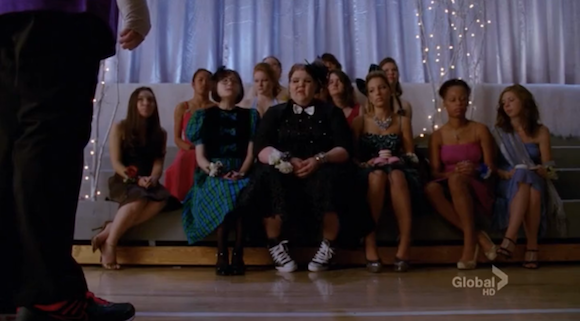
And that is: empowerment! Yay! ’Cause nothing is more empowering than a heteronormative school dance where the women ask the men to be their dates, right?

glee sadie hawkins too young to be bitter club

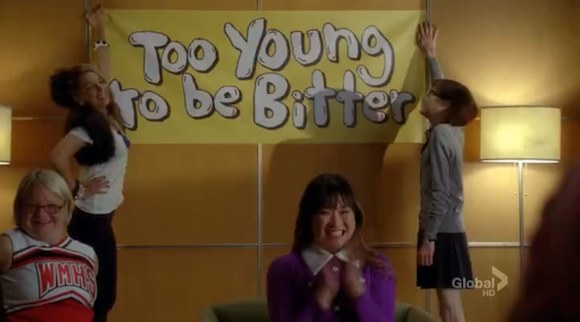
That’s according to Tina Cohen-Chang, at least, who comes up with the idea for a myriad of reasons: a prelude to the upcoming prom, an excuse to get close to gay crush Blaine, and something for her fellow “Too Young to Be Bitter” club members to get behind in their quest to become, um…, less bitter.

Coach Beiste is all for the dance, because Sadie Hawkins is a metaphor for empowerment, duh, as we’ve already established in the opening paragraph. But it’s not just about socio-sexual empowerment, Beiste says it’s also about gaining the strength to follow your dreams, as she did after her first Sadie Hawkins dance when she decided to follow her passion for football.

glee sadie hawkins lauren zizes

Beiste’s overweight and unconventionally unfeminine student counterpart, Lauren Zizes (who, by the way, hasn’t been seen since the end of season two. Way to go with the continuity, Glee writers), is part of the “Too Young to Be Bitter” club, too, and by the end of the episode has the courage to both ask Joe to dance at Sadie Hawkins and apply for a wrestling scholarship at Harvard. This, along with the other members’ success at the dance, apparently calls for the disbanding of the club because everyone’s empowered now.

But the undercurrent flowing through this episode was Blaine and Sam’s sleuthing regarding the Warblers: Sam seems to think the team is using human growth hormones because of their energetic stage presence, a video of Hunter Carrington allegedly ‘roid raging in a coffee shop, the Warblers’ suddenly larger physical appearance, and the testimony of former Warbler, sunshiney Trent.

Apart from being a suspiciously similar plotline to Pitch Perfect, it just goes to show that “Sadie Hawkins” was about completely superficial lipstick feminism and it was the boys who really saved the day.

Images via Ch131.

TV: Modern Family is Anything But.

modern family mud portrait

After a recent spat with my housemate about the apparent modernity of Modern Family, in which he defended the show for its gay couple with an adopted Vietnamese baby and a strong Latino presence while I cried stereotyping, I decided I should actually watch an episode or two of it before I denounce Modern Family as an archetype perpetuating farce.

Now, with three and a half seasons and some informed opinions under my belt, I can wholeheartedly say I abhor the sexist tropes of the fiery Latina, Gloria, and the shrill, controlling housewife, Claire, and Modern Family’s blatant racism, homophobia and slut-shaming. Let me count the ways…

Right off the bat in the sixth episode of season one, “Run for Your Wife”, there were some troubling stereotypes about stay-at-home mums. When the Dunphy kids head off to their first day of school for the year, mum Claire looks forward to some downtime to get started on a new book. Phil, who’s supposed to be the breadwinner of the family, is also home and wants to hang out with his wife. After blowing off some open-houses he’s supposed to be putting on as part of, you know, his job as a real estate agent, Phil gets embroiled in a mid-afternoon jogging race with Claire.

As a child who grew up with a stay-at-home mum, I can tell you that I never once saw her sitting down to read a book in the middle of the day or challenge my dad to a childish competition. There was too much cooking, cleaning, washing, shopping and picking up to do. In fact, my dad was barely home and often working more than one job in order to put food on the table and keep us in a home one fifth of the size of the Dunphy’s, which is more than we can say for Phil who is rarely shown at work.

While the acting of Ty Burrell (Phil) and Julie Bowen (Claire) is something to write home (or at least the awards shows) about, their characters leave a lot to be desired. Phil is always dropping the ball (or getting it thrown into his face, as in “Door to Door” in season three) on being a functioning human being, let alone a good husband and father, and Claire often refers to him as her fourth child (she technically only has three: Haley, Alex and Luke). The trope of wife-as-replacement-mother is a tired one, but that doesn’t stop Modern Family for milking it for all it’s worth.

This brings us to Gloria, who is anything but. She’s young, sexy and, most notably, a loud, sassy Latin woman who’s always getting arked up about something. In season one’s “Up All Night”, Gloria’s son Manny’s dad comes to visit. While Gloria is now remarried to the older and dependable Jay, ex-husband Javier is a fellow fiery Latino who tries to make up for his absence by showering Manny with extravagant gifts. In the episode, Javier takes Jay and Manny to a baseball field in the middle of the night, and the next day comes bearing motorbikes. Gloria becomes audibly incensed that Jay’s falling for Javier’s tricks, like she used to, and storms off, yelling in Spanish. Every portrayal of a Hispanic woman in pop culture doesn’t have to be that of the “hot blooded” Latin mama; just look at the gay, Latina orthopedic surgeon Dr. Callie Torres in Grey’s Anatomy, a show that is far more modern than one with that word in its title, for example.

Speaking of the gays, what portrayal of contemporary American life would be complete without the requisite homosexual couple with an adopted Asian baby? Certainly not Modern Family, which turns the gay dial up to eleven with stay-at-home dad, former farm-dweller and part-time clown Cam, the uptight, dogmatic (unsurprisingly the brother of Claire) lawyer Mitchell and their über inappropriate ways. For example, in “Run for Your Wife”, Mitchell accidentally bumps baby Lily’s head against a door frame, and they take her to the doctor. The doctor happens to be Asian-American, so Cam embarks on a sermon about how he and Mitchell intend to raise Lily with influences from her Asian roots, completely disregarding the fact that the doctor was born and raised somewhere in middle America and identifies first and foremost as an American.

Later on, in season two’s “Unplugged”, Cam and Mitchell try to get Lily into a preschool. When they realise Lily’s going up against an adopted African-American boy with disabled-lesbian parents for the last spot at a prestigious private school, Cam flubs the interview by emphasising his 1/16th Cherokee heritage and speaking in pidgin English. As someone who is also 1/16th Cherokee, I’m sure you can imagine my offence at this.

Cam, as I’m sure you can imagine if you don’t already watch Modern Family, is the flamboyant half of the couple, and enjoys dressing Lily up as famous gay icons and encouraging her creative side. In the episode “Chirp”, in season two, Cam goes against Mitchell’s wishes and has Lily film a commercial for a furniture store. The ad is completely racist, using emphasised Asian accent voiceovers and Godzilla, and when Mitchell points this out, Cam uses the defence of hipsters the world over: “It’s ironic.” I suppose because they have an Asian kid, they’re allowed to be racist…?

While there are some redeeming qualities throughout the show’s run, such as the “Mother’s Day” (season two), “After the Fire” (season three), and “Schooled” (recently aired as part of season four) episodes which seek to unpack gay parenting and stereotypes of femininity, masculinity and homosexuality, it’s also rife with slut-shaming (Jägermeister is a magic potion that puts girls to sleep but instead of waking up “in a castle, you wake up in a frat house with a bad reputation” in “Moon Landing”, whilst Phil marvels in “Travels with Scout” that with his “emotionally distant father” it’s a miracle he didn’t end up as a stripper), homo- and transphobia (dad Jay insinuates that Mitchell is a cross-dresser because he’s also gay in “Starry Night”), and jokes about domestic violence (when Mitchell asks his dad to teach him how to fight in “Game Changer”, Jay asks if he’s having problems with Cam).

As I’m sure Glee can attest, an after school special-esque episode here and there doesn’t make up for Modern Family’s utter lack of modernity the majority of the time.

Related: The Underlying Message in Glee‘s “On My Way” Episode.

Elsewhere: [Chica & the City] Casting Call for “Hot Blooded” Latina Moms Makes My Blood Boil.

Image via BuddyTV.

TV: The Carrie Diaries—“Mumbling Incoherently Does Not Mean She’s ‘Into It’.”

the carrie diaries fright night larrissa passed out

Last week the female anatomy and empowerment were addressed, and this week The Carrie Diaries was all about the disenfranchisement possession of the female anatomy can sometimes beget.

It was Halloween, and Carrie took Walt to another one of Larissa’s fabulous parties in the city. (How these 16-year-olds manage to club- and party-hop without any mention of fake IDs is beyond me.) Carrie met a hot young writer for her bible, Interview magazine, and ditched Larissa and Walt for him, who both happened to be high on ecstasy and LSD. Later, while Carrie was tending to a strung out Larissa, her crush, Bennett,  was cruising Walt, who flipped out and left the party for the streets of New York. When Carrie left Larissa passed out on a bed that doubled as a coat rack (isn’t that the beginning of an episode of Law & Order: SVU…?) to get back to flirting, she finds out that Walt’s gone missing. Carrie admonishes Bennett for letting her friend go missing, when she was the one who left him at a party in the city whilst he was high for the first time. Whilst Carrie’s stressing out about one friend going missing, the other is getting molested while she’s unconscious by a guy in a lion costume. Carrie employs her newfound feminism to tell the extra from the cast of Cats that “mumbling incoherently does not mean she’s into it” and that being unconscious is not an invitation for sexual advances.

The Cowardly Lion calls her what all feminists have been labelled at one point or another, a killjoy, and Bennett tells Carrie that “Larissa got herself into this mess” by taking drugs. After smoothing things over, Carrie entrusts victim-blaming Bennett to watch over Larissa while she takes to the streets to look for Walt. You’d think someone as small-minded as Bennett would insist she stay indoors while he heroically braves the parasites of the city to find her friend, lest she bring on a sexual assault herself. But Carrie just tells him not to “take advantage of her while she’s passed out” to which Bennett replies, “She’s not my type.” You mean unconscious women aren’t sexually attractive to him? There may be hope for Bennett yet—oh wait, he was insinuating that women in general aren’t his type, not just passed out ones. Nevermind…

Related: The Carrie Diaries—The Vagina Monologues.

Image via Ch131.

TV: The Carrie Diaries—The Vagina Monologues.

carrie diaries read before use vagina

The Carrie Diaries, Fox8’s new series based on Candace Bushnell’s Sex & the City prequel publication of the same name, was not a show I had high hopes for. Maybe that’s why I like it so much!

It’s successfully carved out a niche for itself that’s very separate from the HBO series that made Carrie Bradshaw famous, and even though it’s set in the ’80s, it’s so relatable it could be unfolding in the present day. Unlike Rock of Ages, for example, which was so distracting in its bid to recreate the ’80s, The Carrie Diaries just gets the fashion, hair and music so right.

Not only that, but last night’s episode, “Read Before Use”, really tapped into the essence of Carrie and Sex.

Carrie and Mouse attend an art exhibition in the city with Larissa in which former porn star Monica Penny displays her vagina for a penny in what Larissa calls a reclamation of her power. When it’s Carrie’s turn to place a penny in the jar and view her vagina, Monica takes a liking to the young ingénue and tells her never to let a man make decisions for her and to own her power. This, of course, means Carrie should take to Monica’s throne and show her own vagina.

Being underage but still faking it masterfully, Carrie declines, which leads Larissa to tell her that she’s not the girl she thought she was. Larissa thought Carrie would one day be on a billboard or “on the side of a bus”, in a throwback (forward?) to SATC and Carrie’s column promo. Carrie, exhibiting shades of feminism, tells Larissa it’s her choice not to show her vagina, and asks if that isn’t a form of power, too?

For a show that’s aimed primarily at the high school set, you have to applaud it for using the word vagina more than many other cable television shows. In using “vagina” so unashamedly and weaving the politics of choice and power into the fabric of the episode so seamlessly, “Read Before Use” was like feminism in training for the show’s young viewers. Let’s hope they keep it up.

Image via YouTube.