TV: Glee—Female-on-Male Molestation is, “Like, Every Teenage Boy’s Fantasy.”

glee ryder lynn molested

Apparently the episode in which Ryder and Kitty reveal that they were molested as children was made in partnership with RAINN, the Rape, Abuse & Incest Nation Network, although you wouldn’t think it from Sam and Artie’s reaction to Ryder’s confession.

“Some hot 18-year-old played with your junk? I’d kill for that!”

“Why are you ashamed of this?”

While their responses are typical of many of the attitudes surrounding female-on-male sexual assault, the fact that these were really the only strong reactions—apart from Marley, Tina and Mr. Schue’s meek protestations about it being “not cool”—before the show moved on doesn’t really scream sexual assault awareness.

Artie, Sam et al.’s feedback simply buys into the notion that girls who are sexually assaulted are sluts who wanted it (Kitty’s depiction on the show as a bitchy, sexually promiscuous cheerleader proves this, though in their defence I doubt the writers had this storyline in mind when they created her character) and boys are sexually awakened studs. Had the episode aired a follow-up scene in which Mr. Schue led the class in an after school special-esque speech about the detrimental effects of sexual assault and the accompanying attitudes surrounding it, it would have been schmaltzy and patronising as only Glee can be, but at least it would have taken a crack at dismantling such bias.

Elsewhere: [RAINN] Glee & RAINN Team Up for Episode.

Image via Wikia.

On the (Rest of the) Net.

rh reality check not like other girls feminism

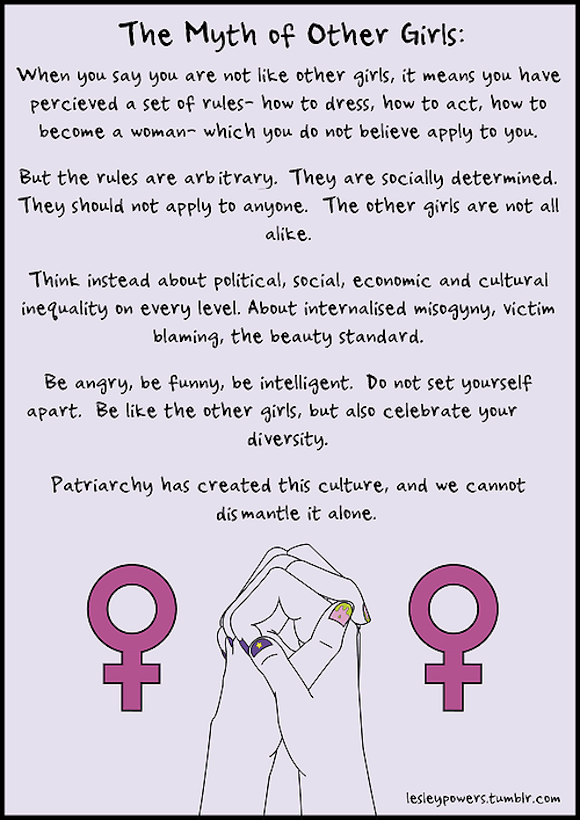
Saying “I’m not like other girls” just buys into the myth that all women have a defined set of attributes and that those who aren’t “feminine”, “girly”, “bitchy” and don’t have many female friends (just to list some of the tropes associated with “other girls”) are somehow better than other women. I’ve been guilty of uttering those words before, but that was before I came to the above understanding. I believe I’m different from other girls, just as I’m different from other humans. We all have different character traits, values and interests; it’s just that some we can relate to more and are closer to the surface than others. [RH Reality Check]

In defence of sex work. [Daily Life]

Further to that, Mia Freedman clarifies her position on sex workers voiced on Q&A last month. [MamaMia]

“Why Would Anyone Have a Late-Term Abortion?” [New Matilda] 

Ahead of its publication in new (and, might I add, awesome!) zine, Filmme Fatales, editor Brodie Lancaster writes in opposition to the Gwyneth Paltrow haters. [TheVine] 

More Gwyneth: she was my thinspo. Beauty and putting women on pedestals. [Mirror, Mirror OFF the Wall]

On the merits and drawbacks of “Hashtag Feminism”, “destroying the joint”, the news sources “to whom [we] choose to listen” and the “personalised newspaper” that is social media, through which we “see only views [we] agree with”. [The Monthly]

Jennifer Aniston, ourselves. [Thought Catalog]

Is Amanda Bynes that different from us? [Clam Bistro]

Are we too old to “get” Girls?  [One Good Thing] 

Why talking about sexism in pop culture is important. [The Age]

How can disabled women “Destroy the Joint” when they can’t even access it? Stella Young on feminism and disability. [ABC Ramp Up] 

Image via RH Reality Check.

TV: Modern Family—B(r)e(a)st Men.

breastfeeding modern family

Older men telling breastfeeding mothers to “be a bit classy about it” seems to be the order of the day, and art is imitating life on Modern Family.

First David Koch made that massive gaffe about breastfeeding mothers on Sunrise, insinuating that there’s a time and place for it and it isn’t in public, and now Modern Family’s resident baby boomer, Jay Pritchett, is shaming Gloria for giving their newborn, Fulgencio Joseph, sustenance via her breast milk. Similarly to Kochie’s sentiments, Jay tells Gloria not to “do that in front of strangers” when he catches the mailman staring at her bare breast—albeit with a baby suckling it—and that perhaps a “dark closet” might be more appropriate. Yeah, because breastfeeding mothers just love expressing milk in public toilets or fitting in a breastfeed whilst changing their baby’s nappy in a baby change room.

We’ve all heard the outcry surrounding the sexualisation and shaming of breastfeeding: it’s the most natural act; it’s what breasts were intended for; breastfeeding shouldn’t be seen as sexy, etc. But when you’ve got popular personalities like Kochie and TV shows like Modern Family pushing the opposite agenda, can we really expect the public perception of breastfeeding as sexual and/or shameful to change?

Further to this, when Manny expresses (pardon the pun) a fixation with the female form in art class, everyone jumps to the conclusion that Gloria’s voluptuousness and her clingy maternalistic treatment of her son is at the crux of Manny’s newfound sexual awakening. Breastfeeding and motherhood are, again, completely natural and all but essential for the evolution of the human species, not exhibitionist performances at the detriment of male children.

Once again, Modern Family fails to emphasise the “modern” part of its title

Related: Modern Family is Anything But.

Image via Double Think.

On the (Rest of the) Net.

tom cruise age difference leading women

The age disparities between leading men and their love interests. [Vulture]

I’m on Twitter! Follow me @ScarlettEHarris.

Nice Guys of OKCupid has paved the way for homosexual creeps with Douchebags of Grindr.

Why was Boston “terrorism” but not Sandy Hook, Aurora or Columbine, for example? [The Guardian]

Feminist awakenings. [Daily Life]

Sexism on MasterChef. [Daily Life]

A collection of essays on Spring Breakers. [The New Enquiry]

Shooting victim Gabrielle Giffords on the recent vetoing of background checks for gun buyers by the U.S. Congress. [NYTimes]

The Tribeca Film Festival is honouring one of its female filmmakers with the inaugural Nora Ephron Prize! [Tribeca Film Festival]

If we needed a reminder of the patriarchal corners of the world women have yet to be granted entry into, there’s now a Tumblr dedicated to just that! [Boys Clubs]

How to discuss Tyler Perry without sounding racist. [AV Club]

The symptoms of and treatment for feminist burnout. [Bitch Flicks]

James Deen on gender equality and slut-shaming (NSFW). [James Deen Blog]

Gun control does not mean penis control: guns and masculinity. [Women’s Media Centre]

How much murder and rape is there on TV? [Vulture] 

Image via Vulture.

TV: Guns on Glee.

glee shooting star

Apparent gun-toter Sue Sylvester sums up the phenomenon about guns in school best with her monologue about why she allegedly teaches at William McKinley High School armed:

“In light of recent events, I feel more safe with it in my office… The safety net of the public mental health system is gone. Parents are too busy working three jobs to look after them. And the gun yahoos are so worked up about Obama taking away their guns that every house has a readily available arsenal.”

In light of such recent events—namely the Sandy Hook elementary school massacre, but after the past week in America, pick your act of mass violence, any act of mass violence—perhaps it was too soon for Glee to touch on this topic, so artlessly, might I add. But, with the U.S. Senate vetoing the implementation of background checks for prospective gun purchasers and the call for teachers to carry firearms in the wake of Sandy Hook, we need to be discussing gun safety more than ever. It’s just that Glee, what with its disjointed storytelling consisting of one part Brittany-thinks-it’s-the-end-of-the-world-so-let’s-turn-this-into-an-after-school-special-about-the-importance-of-telling-our-loved-ones-how-much-they-mean-to-us, one part truly affecting ten minutes of the New Directions kids cowering in the choir room as a gun goes off, didn’t do the issue justice. As always, the show has so much potential but fails to live up to it.

Later in the episode, it is revealed that Becky Jackson was the one who brought the gun to school, which sheds light on Sue’s remarks about mental health. Becky was one of the suspects I had in mind as the events unfolded, along with dejected Ryder and conspicuously absent Brittany, who arguably would have been better choices but, being Glee, of course they took the easy way out: give the mentally disabled kid the gun. (Apparently this is going to open up a discourse about Becky’s condition and background but in all likelihood we’ll probably never hear about it again.)

The anticlimax of the shooting all being a big misunderstanding reminded me of Dave Karofsky’s suicide attempt and Quinn’s car accident last season: all had the potential to shock audiences and talk about mental health, but Glee chose the easy, happy ending instead.

In Sue’s closing statement as Principal Figgins fires her, she says:

“An entire career of doing the right thing—winning… I sent Cheerios off to the Ivy Leagues. I’ve educated girls who are CEOs of Fortune 500 companies. They’re mothers… Gold medalists… I’ve coached two Grammy winners. An internet billionaire and a lesbian secretary of state [Hillary Clinton?!]. But all I’ll be remembered for is this one thing? It’ll be the first line of my obituary.”

And in so doing, she makes a pertinent commentary on American culture: “winning” is the “right thing”, and in so many instances, this involves the use of weapons: war, the upholding of the second amendment, phallic sports equipment as artillery, masculinity in general… I’m sure Glee was not intending to make such a statement, and thus it seems a little disjointed.

Another point I also don’t think they were trying to make, but was quite timely and humorous, was that of the shooting making Sue’s obituary. Let’s be real: the only thing that’s making her obit is her homemaking skills.

Related: The Underlying Message in Glee‘s “On My Way” Episode.

Elsewhere: [Wet Paint] Glee‘s School Shooting: Lauren Potter’s (Becky) Mother Opens Up.

[Daily Life] Defending Masculinity with Guns.

[Daily Life] Where Are All the Female Obituaries?

Image via YouTube.

TV: Revenge is a Dish Best Served by a Woman.

revenge emily victoria

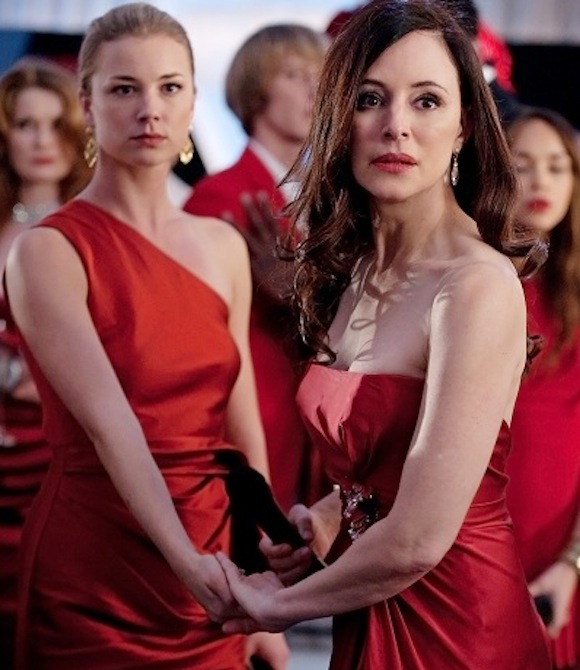
In an episode that aired a few of weeks ago—“Power”—judge’s wife and friend of the Graysons Patricia Barnes revealed she’s a sufferer of domestic violence. With protagonist Emily Thorn’s encouragement, Patricia helps piece together part of the Revenge puzzle and purge herself of her powerless victim status. Because the women of Revenge are anything but powerless.

For a show that focuses so much around power, money, killing and vengeance, women really are at the centre of these traditionally male attributes and they’re calling all the shots.

Obviously, there’s Emily/Amanda, and the avenging of her father’s wrongful incarceration for crimes he didn’t commit and his subsequent death, which the show revolves around, and her juvie parallel Amanda/Emily, whose surfacing (and resurfacing) in the Hamptons last season threw everything into disarray.

But we all know Revenge’s most intriguing female character is Victoria Grayson. Madeleine Stowe plays the aloof ice maiden with a past that was revealed in season two’s “Lineage” to perfection, which kind of makes you understand why she is the way she is.

And then there’s the secondary—albeit still important to the story—female characters Charlotte, Padma, Emily’s mum, Helen Crowley and Ashley, who are all strongly rendered, which is more than can be said for some of the male characters.

Daniel Grayson has proved himself to have some gumption after all when he overthrew his father from the head of Grayson Global this season. Viewers could be excused for thinking this wasn’t the case last year, when it seemed like all Daniel did was follow Emily around like a puppy.

This is quite the juxtaposition to Jack, who is a lovely guy but tends to get walked over because of it. He’s also a somewhat feminised character, showing emotion often and saying things like “I’m going to prove that you can have it all”.

The thing Daniel and Jack both have in common, though, and with the rest of the male cast, for that matter, is that they are easily manipulated by the women in their lives. Daniel “floats through life on the crests of women, unable to make his own decisions”. Conrad, although he thinks he’s the head of the Grayson household, is also subtly controlled by Victoria, and allows himself to be influenced by Ashley’s business acumen when she returns to work for him in “Sabotage” a few weeks ago. Nolan has proved himself to be a loyal friend and revenge-partner to Emily, but is treated like absolute shit by her, not to mention being screwed over several times by Padma. Aiden is probably the strongest male character on the surface, but when he rebels against Emily, he’s dressed down by his storyline and comes crawling back to her way of exacting retribution in last night’s “Union”. Let’s not forget Mason Treadwell, perhaps the biggest victim of Emily’s vendetta (you know, apart from all the men who end up dead), who’s now serving time for crimes he didn’t commit in the vain hope Emily comes through on her promise to give him her scoop when it’s all over.

Speaking of Emily, she is a strange character, isn’t she, in that she doesn’t really have any personality traits (though it could be argued that it’s all part of her plan to mask her true identity and come across as a blank canvas onto which people can project their perceptions of her). Revenge is a plot-driven show, so you get behind Emily’s plight because of the hardships she’s faced in her past. But very rarely do we get a glimpse into her inner psyche. It’s perhaps only when Sammy, her dog, dies and when her mum, Kara, comes back from the dead that we see a glimmer of emotion. This is on the contrary to someone like Victoria whose emotions are kept close to her chest but which you can see in her eyes, or even Amanda, who fluctuates between anger, protection and passion. When Amanda accuses Emily of destroying lives with her obsession, Emily justifies it by attesting that she’s “righting wrongs”. And the only way to do that is to “close your heart if you want to succeed.” Ahh, the wise words of Mr. Takeda, one of the only male characters whose integrity manages to remain unscathed.

I wouldn’t go as far as to say Revenge is a feminist show, but it is refreshing to not hear a mention of a woman’s incapability to pull off what Emily, Victoria, Ashley et al. have managed to, that I recall. Vengeance is perhaps not the most attractive motive to have, but Emily is steadfast and solitary in her mission to avenge her father. She employs mostly men to do some of her dirty work, but she’s the mastermind of the operation. And while Victoria’s scheming from the confines of her Hamptons mansion isn’t necessarily the most positive portrayal of a woman, she is a smart lady, much like Ashley, who refused to accept her firing by Victoria after she was prostituted out to one of Daniel’s rivals and caught sleeping with Conrad and hustled to find a consulting position with him like the “cat [who] dragged itself back in”. Revenge is a show in which the women are just as reprehensible—and powerful—as the men.

Related: Dominic Dunne Makes a (Re)Venge-ful Return to the Small Screen.

Image via Pop Culture Nerd.
Event: Stella—A Prize of One’s Own at The Wheeler Centre.

the wheeler centre stella prize

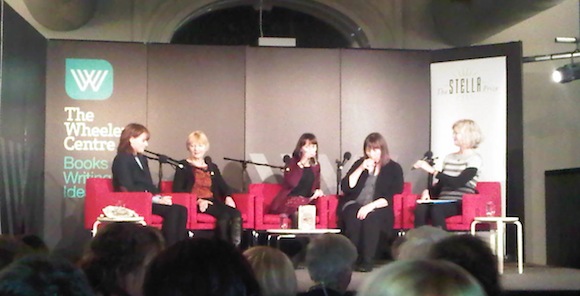
Last Tuesday the first women’s-only literary prize in Australia—the Stella, after the lesser-known first name of Miles Franklin—was awarded to Carrie Tiffany for her novel Mateship with Birds. On Thursday night, the winner; founding donor, Ellen Koshland, and chairs, Aviva Tuffield and Kerryn Goldsworthy, of the Stella Prize; and panel facilitator Sian Prior met at the Wheeler Centre to discuss the landmark event.

I’m sure most have heard of the dismal representation of female writers being reviewed and writing reviews in major publications, and winning prizes, despite the breakdown of actual books being published by women being pretty even with men. The Stella Prize was born of this with the goal to “put gender on the agenda”, and if the 80% of books by women being shortlisted for the Miles Franklin this year and the accompanying press is any indication, the Stella committee has certainly succeeded in opening up the discourse.

Most of the news media I consume is feminist-, or at least left-, skewed, so everything I’ve read about the Stella has been positive. However, on the panel Tiffany quoted this choice headline from a certain newspaper with this country’s name as its title amidst the news of her win: “Bush Romance Novel Wins Writer’s Prize” [online title differs slightly].

Because all women are capable of writing about is romance, right? Specifically, vampire- and sadomasochistic-romance. But as Prior asserted, if that’s the case, “what’s so wrong with vampire- and sadomasochistic-romance, anyway?”  And romance is a “small subject”, just like all the other “small subjects” apparently only women write about: domestic life, relationships, etc. And on the occasion that a man does write about these topics, they’re looked at through a different “scope” than when a woman tells the story.

stella prize shortlist

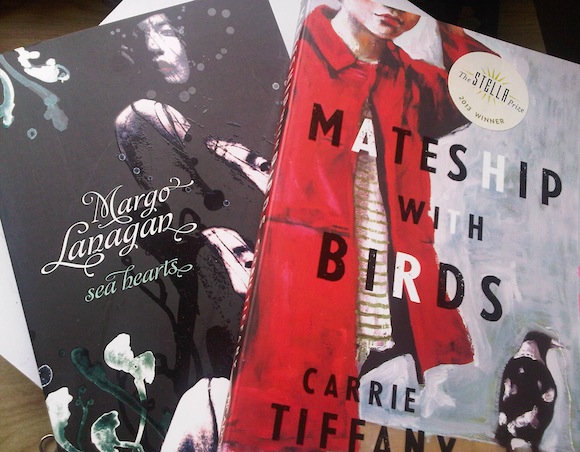
While I shamefully haven’t read any of the books on the Stella shortlist (although I did pick up Mateship with Birds and Margo Lanagan’s Sea Hearts, which I’ve wanted to read since I heard her speak at the Bendigo Writers Festival last year), not all of them subscribe to this “gender of genre” talked about above. Sea Hearts is a fantasy novel, while The Sunlit Zone by Lisa Jacobson is speculative fiction. Goldsworthy mentioned that the judges were wary of choosing books that ticked certain boxes; being a genre novel, fact-laden non-ficition, or from an Indigenous woman, for example.

When an audience member asked about Indigenous writers included on the longlist and quotas for them within the Stella prize during question time, Goldsworthy mentioned they didn’t want to “ghettoise” the prize by awarding it to a token Indigenous woman. By using this reasoning for not awarding the Stella to an Indigenous longlistee, doesn’t that just “ghettoise” and “tokenise” the longlist? What’s the point of including them on the longlist at all if they don’t have a chance at the main prize? I noticed a lot of head shaking during Goldsworthy’s answer, including my own, from people presumably on a similar train of thought. Indigenous people are a marginalised group, as are women (despite being more than half of the population and, indeed, about the same number of written word consumers). Born of the need to hear marginalised voices, would the Stella Prize even exist? I hope next year more Indigenous women are selected as contenders, not just for their tokenism.

Related: Bendigo Writers Festival.

Elsewhere: [The Australian] Bush Romance Tale a Stella Achievement.

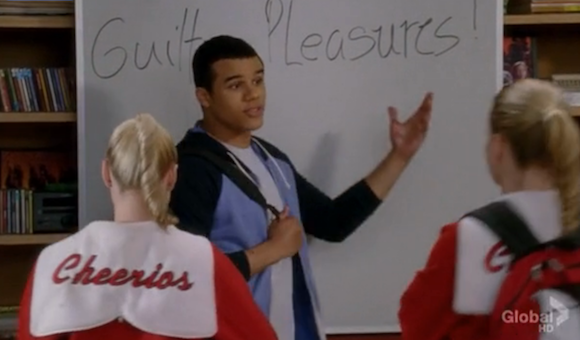
TV: Glee—Chris Brown is a Guilty Pleasure.

glee guilty pleasures jake bobby brown chris brown

Last week it was SVU, this week Glee is undertaking the Chris Brown treatment.

While Chris Brown is hardly in the guilty pleasures league of Wham!, Barry Manilow and the Spice Girls—the other shameful secrets of the New Directions—it was nice to see Glee address the notion of “liking the art but not the artist”.

This is an issue I’ve been grappling with lately as I write some wrestling-related pieces; for all its racism, misogyny, homophobia, ableism and promotion of a rigid type of masculinity, is it still okay for a level-headed person to like professional wrestling? Much the same, is it okay for someone who acknowledges Brown for the “douchebag” he is (“I don’t think that douche is a strong enough word to describe him,” interjects Unique) to still like his music?

I personally have a couple of Brown songs on my iTunes (purchased pre-Rihanna beating, might I add?!), and against my best efforts, I do quite like “Turn Up the Music”, but I refuse to pay for anything he’s selling and make it my personal mission instead to compensate him with as much bad press as possible. I have even been known to exit a pumping dancefloor when a Brown song comes on, if only for the principle of it.

In researching one of the abovementioned wrestling articles, I came across a couple of articles that really resonate with this idea. In an article about female stereotypes in video games, Anita Sarkeesian asserts it is “both possible and even necessary to simultaneously enjoy media while being critical of its more problematic or pernicious aspects.” Similarly, in her fantastic post about the intersection of rap, feminism and cunnilingus, which I linked to here a couple of weeks ago, Maddie Collier urges us to acknowledge the instances our pop culture of choice “sickens and disappoints us” in order to “fully appreciate the moments when it’s good and kind and real”. And the Social Justice League has a whole article on the topic.

After incurring the ire of the feminists, Jake decides to change his guilty pleasure song choice from Chris Brown to another Brown: Bobby. While this is problematic in itself—which Kitty and Artie point out to Jake, who’s apparently oblivious to the whole Bobby and Whitney thing—it highlighted the fact that it is “My Prerogative” to like problematic pop culture. Just as long as we’re acknowledging where it goes wrong, right?

But “does it really matter what a couple of high school kids think?” Yes. Because as avid pop culture consumers they’re shaping the attitudes of tomorrow. And unless we’re educating them in the ways of navigating pop culture safely, the seemingly widely held belief that hitting your partner is justified will continue on into the next generation.

Related: Special Victims Unit Takes on Chris Brown & Rihanna.

My Thoughts on Chris Brown.

My Weekend with Wrestlers.

Elsewhere: [Think Progress] Anita Sarkeesian’s Tropes VS. Women Series is Up—And It’s Great.

[The Pantograph Punch] Eat It Up & Lay Wit It: Hip Hop, Cunnilingus & Morality in Entertainment.

[Social Justice League] How to Be a Fan of Problematic Things.

Image via Ch131.

On the (Rest of the) Net.

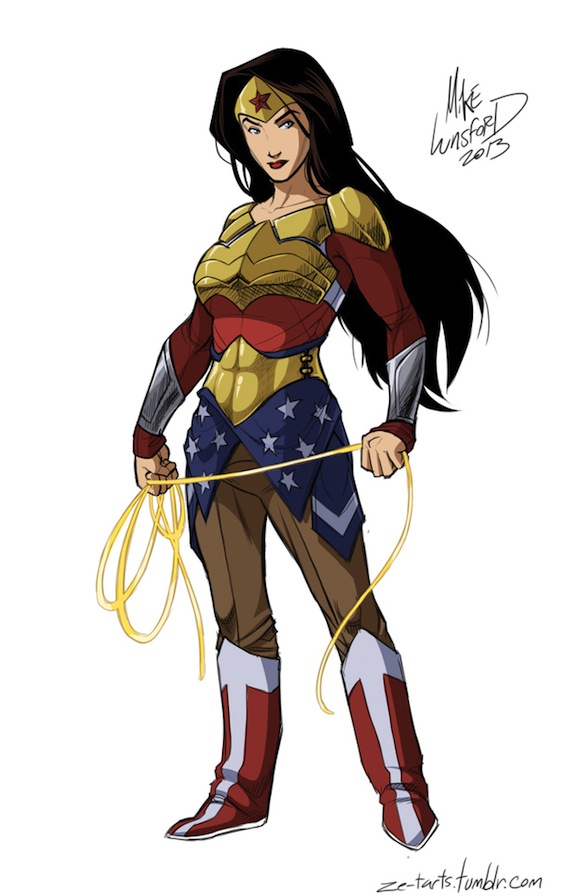
fully clothed superheroine costumes michael lunsford

Fully-clothed superheroines. [BuzzFeed]

“The Ugly Side of Tanning”. In short, don’t do it! Embrace the pale. [Beauty Redefined]

In defence of Betty Draper. [Jezebel]

“Diary of a Q&A Appearance.” [MamaMia]

An app that filters OkCupid creeps for whom alarm bells wouldn’t necessarily initially sound. [Daily Life]

Image via BuzzFeed.

TV: Special Victims Unit Takes on Chris Brown & Rihanna.

law & order special victims unit rihanna chris brown funny valentine

Perhaps to make up for casting convicted rapist Mike Tyson on a show that largely promotes victims rights, Law & Order: Special Victims Unit holds a very unflattering microscope to the thankfully recently-ended tumultuous relationship of Chris Brown and Rihanna.

While the episode did cast a negative light on the predominantly black rap industry, “perpetuating the stereotype that hip hop artists are thugs”, we have to remember that the storyline was a direct commentary on Chris Brown’s beating of Rihanna four years ago and her subsequently taking him back.

Take, for example, the character of Micha Green, a young ingénue of an aging hip hop prodigy. Sounds a lot like Jay Z’s working relationship with Rihanna. And Micha’s lover and assailant’s, Caleb Bryant, initials are the same as one Chris Brown’s. Since giving Caleb the last name of Brown or Black would be too on the nose (and a little bit racist?), Micha is the one with a colour for a surname.

Further to that, the evidence photos of Micha’s mangled face are leaked to the press, and a restraining order is slapped on Caleb, who gets a tattoo on his torso that eerily resembles Brown’s neck tattoo of an alleged Mexican sugar skull that eerily resembles Rihanna’s post-beating face. Caleb might have “the Bryant team” (an obvious nod to Brown’s #TeamBreezy) on his side, but he’s playing “Russian Roulette” (Rihanna’s 2009 song) with Micha’s life.

Both Caleb and Micha, and, by extension, Brown and Rihanna, grew up with abusive fathers but SVU is sure to make a point of difference between the two couples, with Sgt. Munch suggesting they double date.

There’s a fair share of victim-blaming from witnesses and fans of the couple, which mirrors similar attitudes to Rihanna that continue to this day. “She shouldn’t have dissed him” lest she get beat in SVU becomes “she shouldn’t have taken him back” in the discourse of today.

Again, the show’s treatment of the “incident”, as Brown is so fond of calling it, was particularly harsh, with Micha’s “inevitable” death at the hands of Caleb, but if it helps to show that domestic violence doesn’t just “happen once”, then SVU can continue to paint as ruthless a picture of intimate partner violence as they like.

I’m just glad Rihanna got out before what happened to Micha happened to her…

Related: Rihanna & Domestic Violence.

My Thoughts on Chris Brown.

Elsewhere: [Jezebel] Piling on Rihanna Accomplishes Nothing.

Image via Crushable.