Happy Slut-O-Ween: The Hyper-Sexualisation & -Feminisation of Costumes for Women.

It’s that time of year again when U.S. residents in particular, but an increasing amount of Aussies, too, start gearing up for the last day of October when the jack-o’-lanterns are lit, trick or treating is had, and costumes are curated: Halloween.

The holiday that is believed to have pagan roots in preparing for the onset of winter in the northern hemisphere and warding off evil spirits when the barrier between the dead and the living is at its thinnest, but is more traditionally an excuse for kids to dress up and gorge themselves on lollies, has been appropriated by the mostly-Gen Y masses as an excuse to get your kit off.

Obviously not everyone celebrates Halloween by finding the shortest, tightest, most low-cut outfit available, but the perception of female sluttiness is, if not encouraged, then more acceptable on All Hallow’s Eve than on a regular night out. (Not to worry; garden-variety slut-shaming is sure to be had on October 31st as well.) As Nicole Elphick points out, slutty Halloween costumes are acceptable because we’re often portraying if not a different version of ourselves, then someone else completely: “Oh, it’s just a costume – it’s not me!”

Certainly there are less mainstream Halloween-centric events out there, where party-goers take pride in creating the most original, obscure and ugly costumes they can. But for the not-so-dedicated novice Halloween goers who don’t have the time or money to come up with a truly fancy or left-of-centre costume, there’s always the “one slut fits all” section of the costume store brimming with options.

You know the area of Lombards or any costume hire store that’s segregated from the “serious” party paraphernalia and stocks such run-of-the-mill outfits as the sexy maid, the sexy nurse and the mediocre “tuxedo bunny” that resembles the traditional Playboy bunny costumes not one iota. (This Halloween I’m dressing up as Gloria Steinem when she went undercover at The Playboy Club in the ’60s, so I can attest to the poor quality and unrealistic [oh, the irony!] Playboy costumes available for purchase, so much so that I had mine made.) Sure, these costumes are quick, cheap and come with most of the accessories needed to complete the look—in fact, some of them consist solely of the accessories and little else, fabric-wise—but they’re boring  and flash as much flesh as possible. Where are the options for those who don’t want to default to eye-candy or the “sexy nurse” or “sexy nun” instead of a legitimate doctor or person of the clergy?

Furthermore, the problem with the sexy person woman-in-uniform, sexy animal and sexy Scrabble costumes is not only the unoriginality of the former and the absurdity of the latter, but the blatant feminising of these costumes: apparently only women can be sexy fire-fighters, sexy Nemos and sexy showers, while men are just fire-fighters, Nemo and a shower. (The argument could be made that all men in uniform are inherently sexy, but their occupations definitely aren’t sexualised the way in which women in these professions—or even just in these costumes—are.) Elphick adds that, “You can think of almost any regular costume and odds are some costume manufacturer has already made a risqué version for full-grown women.”

Lisa Wade elaborates on the dearth of “sexy” male costumes in an article on Sociological Images. Not only that, but the “sexy” costumes that areavailable to men focus on sex as something to be laughed at or on a man’s status as a recipient of sex from women, not as sex objects themselves:

“When men go sexy, it means joking about how men should be sexually serviced, have access to one night stands, or being in charge of and profiting from women’s bodies. A different type of ‘sexy’ entirely.”

Maybe with the success of Magic Mike this year we’ll be seeing an influx of male stripper-inspired costumes… Something tells me this is doubtful.

*

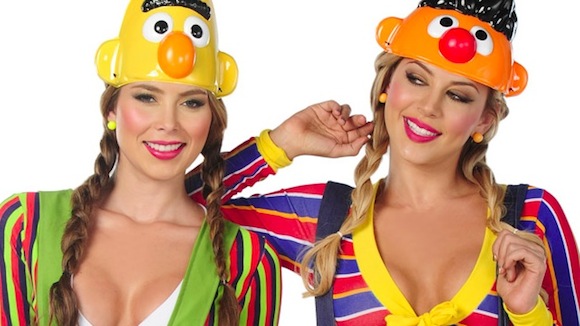
I think this obsession with Halloween hyper-feminisation is just a magnified reflection of society’s need for women to be heteronormatively feminine: long hair augmented with extensions for the event, facial symmetry exaggerated with over-the-top makeup and false eyelashes, slender (I, personally, have upped my fitness regime over the past couple of months in preparation), wears dresses (have you noticed how even if the effigy’s garb resembles a dress in no way, the Halloween costume will inevitably appropriate it into a skirt or, less-often, short-shorts if it’s marketed towards women? The “sexy” Sesame Street costumes that have been in the news of recent come to mind).

Rachel Hills hit the nail on the head when, in a response to a similar post earlier this year, she pondered whether the gravitation towards hyper-feminine and-sexy get-ups either in daily life or for special events reflect a fear of not being seen as attractive enough.

Reflecting on my past costume party ensembles, which include Catwoman, sexy Rosie the Riveter and Eve bare as much flesh as possible, it would seem a fear of being perceived as unattractive, unfeminine and/or unsexy is inherent in them, too. As someone who is relatively content with her appearance and in touch with her feminist side (no matter how “slutty” my costumes appear to the naked eye, I always try to incorporate my feminism in there somewhere), this is not something that is front of mind when putting my outfits together, but I guess the evidence speaks for itself: the most conservative Halloween costume I’ve worn was a long, pink vintage dress that I accessorised with fishnets, a feather boa and a headband to portray a 1920s flapper. The only time I’ve ever incorporated pants into the mix was when they were skin-tight pleather leggings (Catwoman, a female wrestler, and one of Barbie’s Rockers), going back as far as my first outing as Catwoman at my tenth birthday party. Inappropriate? Perhaps. But I guess that also conveys a telling tale of our expectations of femininity and, increasingly, sexiness, when it comes to young girls, a topic which is probably best left unpacked til another time.

But maybe we’re reading too much into this? Just because a woman chooses to amp up her sexuality and flash some flesh on Halloween doesn’t necessarily mean that this desire is insidiously ingrained in her by the patriarchy. Feminist du jour Caitlin Moran insists that women are “not dressing up sexy: It’s a parody of sexuality. They’re being silly,” while sex and gender writer Hugo Schwyzer thinks that “the lack of options for any other kind of costume make sexiness the default position rather than the chosen one.” But I have plenty of friends—both female and male—who enjoy getting their sexy on as often as they cover up in the costume department.

When I asked a friend who is so dedicated to her more masculine costumes that I often don’t recognise her for all the faux facial hair, but who also tarts it up with the best of them, most recently in a “sexy” Little Bo Peep costume for her birthday, she said she honestly doesn’t give it much thought. “[Costumes] allow me to hide any insecurities I would usually have… I can hide who I really am for the time I’m in costume,” she said, which is not unlike Elphick’s above assertion that “Halloween is all about taking on an identity that is explicitly not yours.” None of said friends are particularly feminist in their thinking so, as “civilians”, it’s refreshing that they dress up this way without pushing an anti-gender stereotyping message; they haven’t given it a second thought and do it because they want to. Perhaps there is hope for us yet…

Schwyzer sums it up thusly:

“[The] mandatory sexualization of girls and women reflects a culture ill at ease with women’s power. Halloween is at least partly about how we manage fear—and one fear we seem to still have is of powerful women. Sexualising everyone from tween girls to grown mothers is actually a way of reinforcing traditional values. Underneath it all, the message is, all women are the same—they just want attention from men.”

Going back to the earlier point that the reason we see so much skin on Halloween is because of the utter lack of pre-packaged sartorial alternatives, you have to wonder about the costumes that mimic their real-life and/or fantasy life counterparts to a tee: is the reason Halloween has strayed so far from its pagan roots because of our increasingly sex-obsessed society and need for the genders to perform as they always have? For all the absurdly sexualised children’s characters, pets and household appliances, there are as many traditionally scantily attired female superheroes, pop stars and influential women in history to choose from.

As for the guys, Schwyzer thinks the popularity of Magic Mike might see the odd male dressed in short shorts, a bow tie and not much else, but for the most part, they’ll stick to the established costumed-gender norms of “endless capes and Harlequin masks”, just as most women will go for the shorter, tighter, sexier option.

Related: Slut-Shaming in Romantic Relationships—It’s Not On Unless It’s Not On.

‘Tis the Season…

Costumes & Gender.

Elsewhere: [Daily Life] Why Sexy Halloween Costumes Are Okay.

[Jezebel] A Musical Reminder That You Can Wear Clothes on Halloween & That’s Okay.

[Sociological Images] What Do Sexy Halloween Costumes for Men Look Like?

[io9] Slutty Sesame Street Halloween Costumes Prove (Again) That Nothing is Sacred, Culture is a Sham.

[Salon] Caitlin Moran: Women Have Won Nothing.

Image via Buzzfeed.
On the (Rest of the) Net.

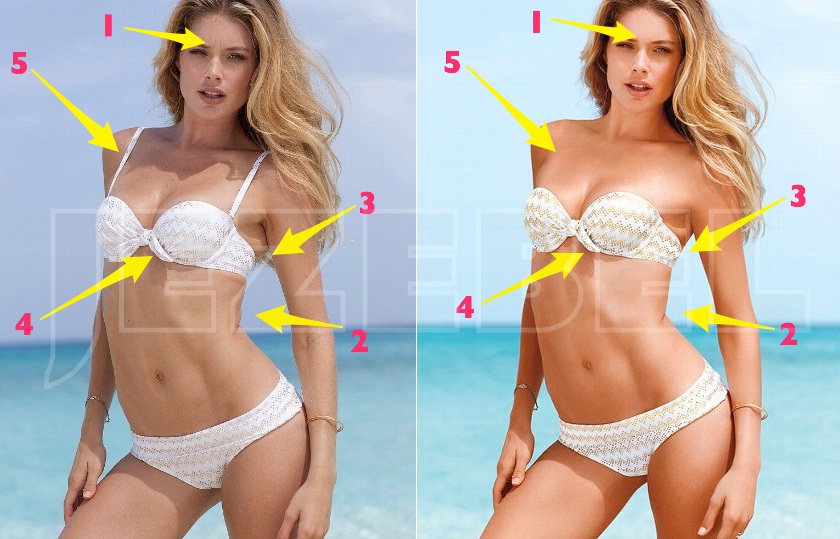
Victoria’s Secret and Photoshop: first you see it, then you don’t. [Jezebel]

If you’re an anti-feminist woman maybe you should be evicted from the house that feminism built. [Dammit Janet]

The case against freedom of opinion. [The Conversation]

Why Beyonce is a phony. [TheVine]

“Top 10 Most Obvious Halloween Costumes”, with a special mention to option number two, which inevitably has an outing every year. But here’s an idea: how about combining Presidential politics and dogs in costumes to create Mitt Romney strapped into a cage on top of your canine? Already been done by the marvelous minds that enter the annual Tomkins Square Park Halloween dog parade, but nevermind: I’m still dressing my dog up as this! [TheVine,  HuffPo]

Why is the “colour” of Rihanna’s fragrance—called Nude—so white? [Sociological Images]

Surprise, surprise, Taylor Swift is not a feminist:

“I don’t really think about things as guys versus girls. I never have. I was raised by parents who brought me up to think if you work as hard as guys, you can go far in life.”

As the article points out, not only does she not know what feminism is, but her music is purely about guys versus girls and how poor little innocent Taylor had her heart broken by a big bad boy. You know, when she’s not slut-shaming and perpetuating a heteronormative Romeo-chases-Juliet-in-a-castle ideal of relationships. [Jezebel]

Clem Bastow unpacks Caitlin Moran’s Twitter gaff about the racial diversity of Girls. [Daily Life]

Who knew Eva Longoria is more than just a “boring pretty person with bouncy hair”? In fact, she’s chair of the committee to re-elect Barack Obama and retweeted a controversial statement related to voting for Mitt Romney. You go, girl! [Jezebel]

Image via Jezebel.

TV: Alexa Chung, It Girls & Gossip Girl.

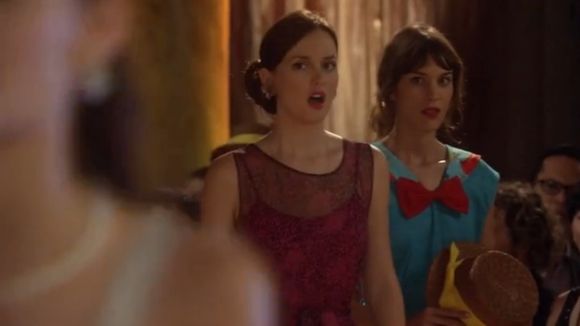
It was just last week that I admonished Gossip Girl for losing its relevance, but last night’s episode sure proved me wrong when it featured newsworthy It girl-of-the-moment, Alexa Chung.

Chung’s been in the news recently with her comments on her fashion icon and thinspiration status:

“… You can appreciate my style without having to appreciate my weight. It’s not actually mutually exclusive. I just get frustrated because just because I exist in this shape doesn’t mean that I’m like advocating it…

“I’ve been dragging my ass around castings for years without anyone saying, oh you’ve got unique style. I think it was very much a case of being in the right place in the right time. I’ve really just been ripping off Jane Birkin. Sorry, has no one else seen a picture of Françoise Hardy? Look it up. I’m just the middle man.”

It’s an interesting discourse which I’m not going to go into here but is discussed at length by Rachel Hills, both at Musings of an Inappropriate Woman and Daily Life.

Interestingly, at Blair’s debut fashion show in which Chung models as herself, a lot of her collection is clothes Chung would wear in real life. Okay, maybe just the straw hats that all of Blair’s models accessorise with… And come to think of it, newbie Sage has a certain Alexa-air about her…

Related: Gossip Girl Becomes Even More Irrelevant in its Final Season.

Elsewhere: [Jezebel] Alexa Chung Doesn’t Want To Be Your Thinspo: “Just Because I Exist in This Shape Doesn’t Mean I’m Advocating It.”

[Musings of an Inappropriate Woman] When “Style Icons” Speak: My Response to Alexa Chung on Body Image.

[Daily Life] Skinny Privilege.

Image via Ch131.

TV: Gossip Girl Becomes Even More Irrelevant in Its Final Season.

Gossip Girl premiered its sixth and final season in the States two weeks ago and it’s being fast-tracked to Fox8 in Australia like so many U.S. shows are these days (I can’t keep up!). While its finale is a long time coming and I’ll always be nostalgic for the good old days of GG (seasons one and four were probably my favourites), I think Gossip Girl has finally lost the plot.

Last season’s finale seemed to juxtapose where all the characters started out with where they might end up, and fans held out hope that the show would return to its soapie-scandalous roots with Dan wreacking revenge on the Upper East Side, Serena being the lost cause that inevitably rears its head at least once per year, and Blair and Chuck teaming up to drag everyone down with them, namely the traitorous Bart and Lily.

Two episodes in and the season’s not starting off as strong as it could have, and Dan’s struggling to avenge the wrongs he feels he’s been handed by his socialite set of former friends and lovers. Partner-in-crime Georgina spent last week’s episode arranging meetings with all the major New York publications—New York, The Nation, Vanity Fair et al—but Dan instead opts to publish his exposé in serial form in Nate’s Spectator, a fledgling newspaper that’s struggling after Nate let the “who is Gossip Girl” scoop go in exchange for finding Serena.

Seriously?! I mean, despite the fact that The Spectator is a new newspaper in a sea of old-media extinctions run by a presumably not-even-21-year-old that relies on unmasking a high school blogger to sell copies, channelling Dominic Dunne, who rose to fame with his Vanity Fair pieces on crime and justice for the rich and famous in the ’80s, Dan is barking up the wrong tree in trying to get “the memoir he should have written” serialised in a magazine, only highlights the show’s irrelevance.

Georgina opines that once they can get a magazine to bite, in will roll the money, fame and movie rights. Um, hello, blogs are where it’s at these days. Look at all the Tumblrs and Twitter accounts that now have books, TV shows and movies based on them: Suri’s Burn Book, Fuck! I’m in my 20s, Shit My Dad Says, The Social Network, Stuff White People Like, The Sartorialist… I could go on forever. We know Dan did the whole book-to-movie deal, Rufus crapped on about “creating a groundswell” by word-of-mouth, and Serena tried her hand at blogging last season, but if Gossip Girl wants to “move on” from high school and debut in the adult world, as Serena so desperately desires, she’d better stop living in the first half of last decade.

Sage, Serena’s boyfriend Steven’s 17-year-old daughter and Nate’s new girlfriend (phew!), perhaps puts it best when she said, “Nobody in high school reads Gossip Girl. It’s for old people.” Or people who just can’t move on from the way things used to be.

Related: Gossip Girl Season 5 Final—What Goes Around Comes Around…

Is Serena Our Generation’s Dominic Dunne?

Gossip Girl Thinks Bloggers Aren’t Good Enough.

Image via YouTube.

On the (Rest of the) Net.

Yikes! Sesame Street gets the slutty Halloween costume treatment. [io9]

“Porn in China.” [Daily Life]

Mitt Romney’s history of flip-flopping on abortion. [Jezebel]

Plus-sized women may be getting more roles on TV and in movies and are topping the charts, but the emphasis is still on their weight rather than their talents. [Wall Street Journal]

Erin Handley interviews Clementine Ford on her feminism:

“A lot of people will only tolerate feminism if it doesn’t affect their lives in any way, at all. They will tolerate women’s quest for equality as long as it has no impact on them or their lives. And that is obviously not equality.” [Right Now]

Two Aussie feminists on why Tony Abbott can be one if he labels himself so, and why his anti-choice sentiments prove he most definitely isn’t. I tend to lean towards Monica Dux’s latter assertion: just because you say you are, doesn’t necessarily mean you are. You have to have the values to back it up, and Abbott’s coming out via his wife as a feminist is all about politics. Sarah Palin, anyone? [Crikey, ABC Unleashed]

Kate Waterhouse defends her “full-figured” question to Christina Hendricks. [The Age]

It’s unrealistic for ugly guys to get hot chicks and for hot chicks to have low self-esteem. Please. I know plenty of conventionally attractive women who have self-worth issues because self-esteem doesn’t just hinge on the way you look. Revolutionary, I know! I also know plenty of ordinary-looking guys who are a hit with the ladies. This is because personality trumps ease on the eye. And liking yourself trumps the way you look. [Daily Life]

Further to that (in fact, this article was quoted in the one above), why do conventionally attractive comediennes, like Tina Fey, play the ugly card? [New Inquiry]

Everyone should just get over nudity. After all, everyone has a naked body. [Jezebel]

It’s time to remove the stigma from STIs. [MamaMia]

Image via io9.

On the (Rest of the) Net.

The iconic photograph of “The Kissing Sailor” may actually be an image of sexual assault. [Crates & Ribbons]

Let’s put more nudity on Page 3, not ban it:

“… I say the answer is more nudity in newspapers, not less. Put more boobs on Page 3, and add some cocks too. Show people of every size, shape, colour, gender and sexuality; let them speak in their own voice, and celebrate them all. That, rather than self-censorship of adult-oriented content, would be a progressive tabloid revolution worth fighting for.” [New Statesman]

While I don’t agree with most of her sentiments, Clem Bastow makes some interesting points about the inclusion of men in feminism. This was also a topic that came up during the abovementioned “who’s-a-feminist” debate with my friends. [Daily Life]

Let’s stop debating the “culture wars”: people deserve rights. The end. [Jezebel]

Julia Gillard’s Question Time smackdown against Tony Abbott and the liberal party’s sexism and misogyny primarily against her gets the New Yorker treatment. In a nutshell, maybe Obama could take a page out of her book?

Michelle Smith’s Wheeler Centre Lunchbox/Soapbox address on girls in culture, both now and in the Victorian era. Wait, they’re not the same thing?!

I’ve been embroiled in a “I-don’t-believe-in-feminism-I-believe-in-equality” debate this week but, as Ben Pobjie rightly points out, when it comes to Kate Ellis being talked over and shouted down on Q&A, it’s about human decency, not feminism. [MamaMia]

Jill Meagher and safety on the streets from a disability point of view. [ABC Ramp Up]

The case against condom use in porn. [Jezebel]

In defence of Mean Girls‘ Janis Ian. [Rookie]

Brave isn’t “Just Another Princess Movie”. [The New Inquiry]

Image via Tumblr.

Magazines: Christina Aguilera’s Body is Not “Your Body”.

In a career resurrection the likes of Jennifer Lopez’s post-Idol comeback, Christina Aguilera parlays her success as a judge on The Voice into a new album, after 2010’s failed Bionic (though it did spawn the single “Not Myself Tonight”, which I unashamedly loved). This time, though, she’s told her record executives that they’re “working with a fat girl. Know it and get over it.”

When I think of Christina Aguilera I don’t think “fat”, but she tells the mag that “I got tired of being a skinny, white girl. I am Ecuadorian but people felt so safe passing me off as a skinny, blue-eyed white girl.” Think: any of her pre-Stripped videos.

In the theme of her newest single off the album Lotus, “Your Body”, she says:

“My body can’t put anyone in jeopardy of not making money anymore. My body is just not on the table that way anymore.”

Rock “Your Body”, Christina!

Image via Just Jared.

Movies: Ruby Sparks & The Catcher in the Rye*.

As I have written over the past week or so, there are many ways to interpret Ruby Sparks, whether as a commentary on the indie movie phenomenon of the Manic Pixie Dream Girl or the abusive nature of protagonist Calvin and title character Ruby’s relationship.

But I also picked up on the use of Catcher in the Rye as a sort of metaphor for Calvin’s tortured soul and his equally tortured relationship with Ruby. The intertwining of Calvin’s obsession with the way people perceive his dog, Scotty, and thereby perceive him, is made all the more symbolic in the scene where Calvin comes home late to discover Scotty’s trashed his room, peed in his bed and eaten a copy of J.D. Salinger’s seminal work.

It’s not really until the end of the movie that all the subtle references to the book come together as pieces of the puzzle. For those of you who have read Catcher in the Rye (I would assume everyone has, but those who I’ve spoken to about the movie in the hopes of getting their thoughts on the inclusion of the book as a theme have been unenlightened as to Holden Caulfield’s story), it could be interpreted that none of what Holden describes throughout the novel actually happened, as his mental capacity is questionable. Calvin is akin to a modern day Holden Caulfield, if only in terms of mental health, in that he sees a shrink (though in the creative world, who doesn’t?), has skewed views of what women should be and literally imagines his dream girl into existence.

This calls into question the turn of events depicted in the movie. Did Calvin imagine Ruby and their whole relationship? Did he black out around the time he met her, wrote about her and, reading back over his work, doesn’t remember how he met her, thereby making himself believe that she came to life from his writing? We know his family met and loved Ruby, but could that be a construction of his imagination? Holden concludes Catcher in the Rye in a mental facility; is that were Calvin tells his story from, too?

To further support the notion that something’s not right with Calvin’s account of his relationship with Ruby, his shrink, Dr. Rosenthal, asks him if he’s sure Ruby’s not real…

To employ the Manic Pixie Dream Girl trope here, too, Ruby initially functions as a female version of Calvin to somehow narcissistically improve his existence. That he writes her to be depressed, then euphoric, then back again, and looks at her with pity when she expresses these extreme emotions could be seen as Calvin dealing with his own emotional ups and downs.

I don’t have the answers and there’s a good chance that I’m overthinking Ruby Sparks too much, but from my point of view there are endless realms of possibility the film could be taken in to.

What do you think?

Related: Ruby Sparks & the Manic Pixie Dream Girl.

Ruby Sparks & the Abusive Relationship.

*Blanket spoiler alert for both Ruby Sparks AND The Catcher in the Rye.

Image via The Thousands.

TV: The Problem with Smash.

This post was originally published earlier in the year when Smash first aired on Foxtel’s W, now SoHo.

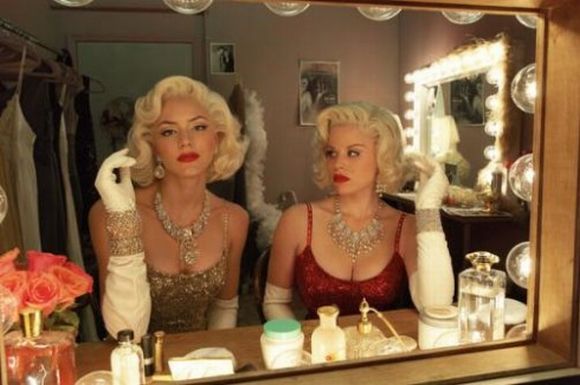
Smash, the Steven Spielberg-produced musical-serial about a Marilyn Monroe Broadway show, debuted with promise. I quite enjoyed the first few episodes, with Debra Messing as one of the musical’s writers, Angelica Huston as its producer, and Broadway star Megan Hilty as the number one contender for the role of Marilyn. But then Smash kind of plateaued.

Clem Bastow, writing for TheVine, seems to think it’s because of Katharine McPhee’s inclusion as the other competitor vying for the lead, and I have to agree. Bastow writes:

“The trouble with McPhee’s performance in Smash is that it jolts me out of my suspension of disbelief… [B]ut whenever Karen/Katharine opens her mouth, the fourth wall comes crashing down around me. Her voice is thin, her performance mannered, she acts with her chin like a young Gwyneth Paltrow, and self-consciously holds her mouth in such a way to suggest a very pretty female version of Jack Nicholson’s Joker.”

I’m all for Hilty’s Ivy Lynn, who’s spent ten years in the chorus and lives and breathes Marilyn through and through. But I just can’t get behind McPhee’s Karen Cartwright who, as Ivy rightfully observes, got to New York five minutes ago, hasn’t paid her dues and is already getting callbacks for lead roles. She can’t act (McPhee as Karen nor Karen as Marilyn), complains about everything and is an ineffable dolt.

But in the last few weeks, Smash has been looking up. I immensely enjoyed the episode when Ivy lost the plot after being replaced as Marilyn by Uma Thurman’s major movie star, Rebecca Duvall, and had to go back to being an angel in the chorus line of Bombshell’s (the name they’ve settled on for the fictional—but very well could be a real Broadway show if Smash’s commercial success continues—musical) writers’ other Broadway show, Heaven on Earth. Ivy loses it, mixes her throat medication with alcohol, goes on stage high, and ends up singing Rihanna’s “Cheers (Drink to That)” with Karen in Times Square (video above. Please excuse the horrid quality, but I wanted a clip that actually showed the scene rather than just the audio).

I still can’t stand Karen and Ellis, the sneaky assistant to Huston’s Eileen and, formerly, Bombshell writer Tom Levitt but, if it’s about Marilyn Monroe, I’m willing to let Smash go out with a bang.

Are you watching Smash? What do you think of it?

Related: The Problem with Smash. 

Elsewhere: [The Vine] You Ain’t Gettin’ 88 Cents From Me, Smash.

Image via Crushable.

Movies: Ruby Sparks & the Abusive Relationship*.

I first went into Ruby Sparks thinking it was going to be just another quirky, indie (500) Days of Summer-esque vehicle to cement writer and star Zoe Kazan as the newest Manic Pixie Dream Girl of the same first name to watch.

For the first third of the movie, I wasn’t wrong. It deals with main character Calvin’s decade-long writers block and feelings of “inadequacy” at not being able to live up to his “genius” and “boy wonder” monikers upon the release of his first (and only) novel when he was in his late teens. Naturally, the role of titular character and token MPDG, Ruby, is to come into Calvin’s life in a whirlwind of “messy”-ness, complication and coloured tights and help him out of his creative rut. Ruby Sparks is the exception to the MPDG rule, though, as where (500) Days’ Summer and Sam of Garden State are real women (though “girls” would be a more accurate description) whom the male protagonists envision as their ideal mates, Ruby is literally Calvin’s dream lover: he wrote her on his pretentious typewriter.

In an interview with the Huffington Post, Kazan responds to the idea of Ruby Sparks as a critique of the MPDG and how she didn’t initially have that goal when she wrote the screenplay. She also talks about the twist in the third act in which Calvin’s need to have Ruby conform to his dream girl stereotype turns into an abusive obsession with controlling her:

“I think if you’re going to make a movie in which a man can control a woman, if you don’t push it to the extreme, it’s going to be sexist.”

It’s funny she said that, as I had trouble reconciling the fact that a seemingly switched-on woman wrote Ruby Sparks with the first half of it which, as I mentioned above, had one of the only female characters succumb to the idea of what a certain kind of woman should be. (Then again, men don’t have a monopoly on sexism.) “You haven’t written a person; you’ve written a girl,” Calvin’s brother, Harry, tells him upon reading his first draft.

Ruby is a girl who at first seems like a fun-loving, spirited artist with no threatening aspirations of capitalising on her illustrative talents (she admits she’s “super good”) by parlaying them into a career. When Ruby does express a desire to get out of the house more, meet some people and maybe get a job, Calvin begs her to stay with him because “I don’t need anyone else”, and neither should she.

It emerges that Calvin’s last serious lover was a novelist, too, whom he bumps into at a book party at which Ruby frolics in her underwear in the pool with Calvin’s agent and subsequently gets slut-shamed by her boyfriend for it. Calvin’s ex tells him that “it’s like you had this image of me and anything I did to contradict it you just ignored… The only person you wanted to be in a relationship with was you.”

Ruby in her original form, before Calvin starts making “tweaks” the moment she develops some autonomy, is essentially a female version of her creator. Not only has Kazan taken the notion of the MPDG and the trope’s traditional role in shaping and changing her male counterparts’ life and turned it on its head, but she has indeed taken Ruby and Calvin’s relationship to the extreme in the ultimate spin on intimate partner abuse.

When Ruby’s had enough and suggests she stay at her apartment after the book party, Calvin reveals he has utter control over her because she’s not real. While on the surface the suspension of disbelief required by the audience makes this a true statement in the context of the film, the more insidious subtext is that Calvin has such a skewed view of what women should be that it seems he’s saying that not only does Ruby not exist in real life, but nor do real women in his. In fact, they’re more like domestic animals to be controlled, as with Calvin’s written manipulation of Ruby in this scene where he types her on all fours barking like a dog: the ultimate act of degradation.

Speaking of dogs, Calvin’s inferiority complex which so many abusive partners have is evident in his treatment of his dog, Scotty, named for fellow tortured soul and wife-beater, F. Scott Fitzgerald. He prefers the idea of a dog as opposed to actually being a pet owner, because he’d like fellow park-goers to “stop to pet him and I would meet them but Scotty gets scared when people try to pet him”. He gets defensive when Scotty goes to the toilet like a female canine as, by extension, it threatens Calvin’s masculinity. Of course Calvin appropriates Ruby’s shine to Scotty despite or perhaps because of his oddities into a metaphor for her feelings towards her future abuser.

If it wasn’t for the happily-ever-after cop-out of an ending, what initially seemed like the indie movie du jour has turned into a commentary on Manic Pixie Dream Girls and the danger of emotionally abusive relationships.

Related: Ruby Sparks & the Manic Pixie Dream Girl.

Elsewhere: [HuffPo] Zoe Kazan, Ruby Sparks Writer & Star: “Quirky” Means Nothing.

*Blanket spoiler alert.

Image via Groucho Reviews.