On the (Rest of the) Net.

Race and online dating. [Jezebel]

Hermione the heroine. [HuffPo]

Jezebel also writes in praise of “The Women of the Harry Potter Universe.”

Tavi Gevinson on growing into her beauty:

“I could pretend to be an archetype of a feminist superhero and say I never want to be a conventionally attractive person. But, while I have so much respect for the people who can say that truthfully, I’m not there yet… I admit to the basic human desire to be attractive…

“Maybe I liked my face. Is that not okay?” [The Style Rookie]

If the DSK case has taught us anything, it’s that “any deviation of the victim’s life from the concept of the ‘perfect victim’ is exploited and becomes the focus of attention, as has happened to the DSK victim. Ever had a drink? Been to a party? Been a little bit late to a meeting? Lost your temper? Tried to fight back? Lied to your friends about what’s going on in a relationship? Forgiven someone? Posted a Facebook photo of you hugging someone? Well then clearly YOU ARE A DRUG-ADDLED VIOLENT SLUT BITCH and that necessitates a billion more hearings to talk about how VIOLENT and SLUTTY and DRUG-ADDLED and BITCHY you are.” [Think on This]

Still with Strauss-Kahn, Bob Ellis airs his always controversial, archaic and small-minded misogynist thoughts on the “honeytrapping” of “good men”. [ABC The Drum]

“When Rape Victims Lie.” [Sasha Said]

And this wraps up the DSK portion of the program:

“… I have no sympathy, empathy or even good thoughts for Dominique Strauss-Kahn. Not just because of the rape accusations but also because of his betrayal of the socialist ideals he was supposed to uphold as a prominent member of the French Socialist Party. His ideals that went through the drain when he accepted to become head of the IMF, one of the most subjugating, neo-imperialist institutions imposed on the Global South.

“And now, of course, there is no longer a case against him. However, and this is where I’d like us to focus, there is no longer a case because, it is claimed, the victim lied on issues unrelated to the rape allegations. Let that sink in for a second: a woman who is an asylum seeker/refugee, who hails from one of the poorest countries on earth (where the IMF played a big role in promoting the prevailing poverty and economic hardships that afflict her homeland) was found to have lied in order to get on with her life.” [Tiger Beatdown]

Jokes about Casey Anthony: too soon? [Splitsider]

“So you want to move to New York?” Here are the realities. Not as grim as you might think, yay! [Yikes Machine]

“The World Map of Useless Stereotypes.” If they’d reduced the space allocated for New York, they might have been able to include Australia. Oh yeah, maybe they were playing up the stereotype of us being the forgotten continent of sorts. [Jezebel]

The Lion King promotes homosexuality? And nine other “crazy things” that have come out of potential 2012 Republican presidential candidate Michele Bachmann’s mouth. [Think Progress]

Elitism in the public school system. [Persephone Magazine]

If global gender equality was represented by the FIFA Women’s Soccer World Cup, this is what it would look like. [Jezebel]

Ten life lessons, according to Ja Rule. Hilarious! [Thought Catalog]

“If I Were a Girl,” also on Thought Catalog, is equal parts poignant and insulting. Interesting to get a guy’s point of view on what it would be like to be a girl.

Read what happens when “a teen… calls the Westboro Baptist Church” to talk about feminism! [Jezebel]

Waking up to the Leiby Kletzky murder crime scene. [Jezebel]

Sleazy News of the World-esque journalism has a place somewhere, right? [Gawker]

“Penis shaming.” [Rachel Rabbit White]

On “Writing Race.” [Zero at the Bone]

More on the should-we-tell-little-girls-they’re-pretty debate. [The Beheld]

Part two of Camilla Peffer’s “In Defence of Women Behaving Badly.” [Girls Are Made from Pepsi]

Men in crisis: “Digging deeper into modern Masculinity.” [Rachel Rabbit White]

Images via The Style Rookie, Buzzfeed.

The Humble Brag.

From “Branding Girls: Is This a Good Thing?” by Erica Bartle on Girl with a Satchel:

“Soroya Darabi, social media strategist for ABC News in the US and former New York Times staffer… [says] ‘I wrote a tweet I now regret,’ recalls Darabi. ‘[It] said, “I’m in a new book about New York social media. God, I hope the character is cool and not a total dweeb.” The tweet was meant to show how this new-found attention weirds me out, but instead I think it came off as shameless self-promotion. Now I’m less likely to write about a personal win because I prefer to be authentic and well-regarded than notorious and famous.'”

Musings of an Inappropriate Woman blogger, Rachel Hills, calls this “the humble brag” in the comments.

I don’t think Darabi sounded like she was “shamless[ly] self-promoti[ng]”; she sounded sarcastic, tongue-in-cheek, self-deprecating and genuine. Sometimes it’s fine to say, “hey, check out my latest freelance article in this month’s Madison” (if only I was able to say that!) without coming across like a big-noter. If you don’t talk yourself up, no one will.

But I also understand where Darabi and Hills are coming from in not wanting to sound obnoxious, and that the blogging/Tweeting medium can sometimes misconstrue our tones.

I remember Sarah Ayoub-Christie of Wordsmith Lane (R.I.P.) used to struggle with this. Personally, I never found her to be holier-than-thou, or up on her high horse, which I believe some commenters on the blog did. On my own blog, there are some posts I look back on and think I sound like a pretentious bitch (well, I am, but I don’t want to sound like one!), and others in which I wish I could just change a certain phrase.

But, at the end of the day, you can’t always be “on” when it comes to “personal branding”, and the mistakes and misconstrued comments are what make us stronger. And I also think it’s about finding a balance between the real you, you show your close family and friends, and the “personal branding” version of you, you show to potential clients or suitors at dinner parties.

What do you think?

Elsewhere: [Girl with a Satchel] Branding Girls: Is This a Good Thing?

[Musings of an Inappropriate Woman] Homepage.

[Sarah Ayoub’s Wordsmithlane] Homepage.

Conservativism Reigns Supreme in The Sunday Age’s Opinion Section.


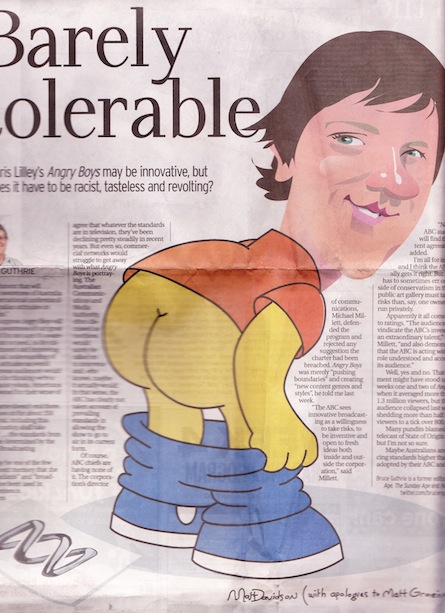
I was pleasantly surprised to see an article on Chris Lilley’s Angry Boys juxtaposed against one on the SlutWalk in The Sunday Age’s Opinion columns this past weekend.

What I wasn’t so pleasantly surprised to find was that they were both championing the censorship of a show “many critics and some intellectuals have applauded… for [its] brave comedy” and of women’s rights to wear what we want when we want where we want without the risk of sexual assault.

On that, Nicole Brady, author of “It Makes Sense to Be Aware of What You Wear” actually sides with the Toronto policeman, Michael Sanguinetti, writing, “The word ‘slut’ was probably overkill, but that policeman was onto something… Boiled down, and stripped of the inflammatory ‘slut’, his argument was ‘be careful about what you wear’. Advice as dull as your mother telling you to wear a coat on a cold morning.”

I don’t want to go into why what the cop said was wrong and why Brady’s likening of “not dressing like a slut” to wearing “a coat on a dull morning” is an archaic way of thinking (for that, you can go here).

In the article to the left of Brady’s, Bruce Guthrie continues in his argument against the ABC/HBO partnership, saying that the ABC’s charter may be in conflict with the success of and American market for the show. “I’m not sure if the cable network has a charter, but if it did it would probably say this: ‘Our goal is to make as much money from our programming as possible’,” he writes. Guthrie specifically takes issue with Lilley’s portrayal of rapper S.Mouse, a role for which the actor and creator appears in blackface. “Why is it okay for Lilley to wear blackface, but the guys from Hey, Hey, It’s Saturday are vilified for it?” I’ve heard it asked.

Unlike Brady’s, I can see Guthrie’s point. I think Angry Boys has a lot of potential, and it is damn funny, but I feel that it has gone a bit downhill from the first episode, which focused heavily on the Sims twins, Daniel and Nathan, and their Gran’s workplace, a juvenile detention centre, to last week’s third, which “explained—and showed, needlessly and graphically—how surfer Blake Oldfield became a eunuch.”

But it does portray Australian “bogan” life to a tee, and I think if the show focused a bit more on the juvenile detention centre, and the classism and racism that surrounds it, Angry Boys would not only be a funny show, it would also be an apt dialogue on Australian society.

Related: Ain’t Nothin’ Gonna Break My Slutty Stride.

On the (Rest of the) Net.


Porn star Stoya Tweets, “If you think pubic hair on a woman is unnatural or weird, you aren’t mature enough to be touching vaginas.” You go, girl!

Beware hot baths in winter: they can cause heart attacks!

Celebrities and mental illness.

I was absolutely disgusted by Bob Ellis’ take on the ADFA sex scandal on ABC’s The Drum Unleashed, comparing the unconsented filming of a young female cadet during sex to the girls discussing last night’s date on Sex & the City. Here are some choice excerpts:

“Let us imagine the girl agreed to be filmed, and then, afterwards, being mocked for it, and flabbergasted by the number of leering hoons who saw the film, made the complaint. Would that then occasion the sacking of her commanding officer, the court-martial of fifteen or twenty of her fellow recruits, and the bastardising of her lover?

“… She would have been mortified. She would have cursed for months the prurient observers of her bed games. She would have railed at them in the canteen. She would have sobbed on the phone to her mother. She would have attracted some sympathy. She would almost certainly have got over it… And she might… have married the boy.”

“… They, and we, should be careful when we attend too closely to what occurs in a bedroom consensually, and how we punish either participant.

“… Is the young woman, moreover, to be named, and acclaimed, and promoted, and hereafter entrusted with frontline command on some field of battle? Who would trust her in any high army position? Who would be sure she was truthful? Or sound of judgment? Or loyal? Or reliable under fire?”

To end, he makes sure we know that group sex didn’t occur, “as it sometimes does in traveling footballers’ motel rooms”, as if that somehow makes it okay.

Kim Powell writes in response at News with Nipples about Ellis’ assertion that (male) society owns female bodies, as he began the above piece by reminiscing about an old M.A.S.H. episode in which the shower Hot Lips Houlihan is using is lifted by a crane and the menfolk gaze at her naked body.

Girl with a Satchel posts a smashing review of Tina Fey’s Bossypants.

Vintage Gala Darling, circa 2005. Glad to see she hasn’t changed :).

“7 Reasons to Get Excited About the Royal Wedding”… one week later!

In relation, is Princess Catherine doomed to repeat the same fate as Diana? A royal comparison.

Also, “Jessica Rudd shines some perspective on the wedding and the Republic.”

Much to my chagrin, tanning beds are safe… for some things!

Sarah Wilson on private schooling:

“I know parents want to provide the best for their own kids… I don’t know that fancy pools and excursions to Tuscany make for a better education.”

“Things Fat People Are Told”:

“If a fat person defied any of these pronouncements in any way, they spoke of having their lives and experiences denied. They couldn’t really have low blood pressure. They couldn’t really be getting married.

“The hostility fat people experience is extreme. One woman spoke about being on an operating table for a C-section and having a surgeon mock her fat, suggesting they get rid of it while they’ve got her open. Another spoke of sitting in an ambulance while a police officer refused to believe she was raped. Others were told they should be happy to have been sexually assaulted. We heard about how transgender persons were belittled for being too fat to pass. We heard about fat people who were sick and were denied treatment until they lost weight. Fat mothers were told they were selfish for being fat because they would orphan their children. Or that their children would never love them. Or that they’d just ruin their children’s lives so maybe the baby should just die in the womb.”

Lisa Simpson would “totally be a Jezebel reader if she were human.”

Images via Jezebel.

VCE Top Designs—frankie Editor Jo Walker Talks to Media Students.


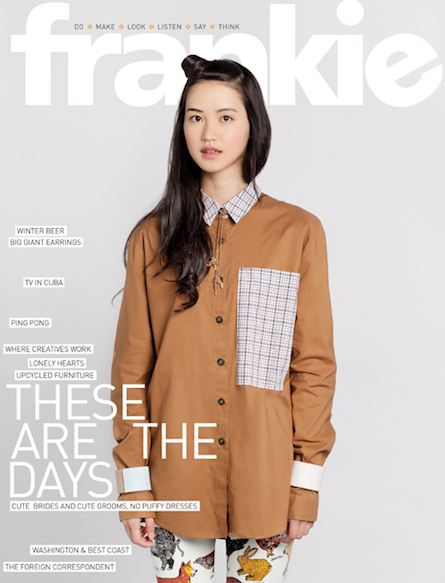
Last Thursday frankie editor Jo Walker spoke to VCE students studying media and design at Melbourne Museum, as part of their annual VCE Top Designs exhibition.

The forum was also headed by two VCAA State Reviewers, who got the event off to a promising start when they asked the students if any of them read magazines as inspiration for their projects, and a tumbleweed blew by.

But you know what high school kids can be like: in the words of Matilda’s Miss Trunchbull, “I’m glad I never was one!”

Walker can count me as one of her loyal subjects, and I hung on her every word.

Granted, a lot of it is stuff I’ve heard before, as it’s been five and a half years since I graduated from high school, but interesting nonetheless.

She spoke about frankie’s humble beginnings, the founding editors Louise Bannister, who left not long after the mag’s inception to backpack around Canada, and Lara Burke, who’s still there as creative director today.

Walker described frankie as a “general interest magazine for hipsters”, which I have to say was a turn off, as I can’t stand hipsters! But, like my friend Zoe, who looks like a hipster on the outside, but is really just a normal, cool, great person on the inside, frankie is similar.

Walker said it’s easier to describe what frankie isn’t than what it is: it’s not a colourful, mainstream mag about how to please your boyfriend in bed. frankie readers already know how to do that, according to Walker!

The mag is inspired by “random conversations in pubs”, bookstores, news shows like ABC’s Australian Story, the internet, social media and frankie staff’s favourite blogs (no word on if The Scarlett Woman is one of them!). But essentially, if editors Walker and Burke  like it, it goes to print.

frankie has stopped using models for its fashion shoots (though not for the cover evidently), instead using musicians in what could be seen as a token gesture to silence its critics.

Stepping away from the typical frankie-esque story, this month has a “frankie weddings” special, which Walker described as “not just another [Cosmo Bride] wedding story”.

Ultimately, Walker says she looks to give each issue the balance, flow and rhythm of a “mixtape” (though I don’t think many of the kids knew what one is; “an iPod playlist”, if you will.)

I was so inspired by the talk and the amount of references to the current issue, I went out and bought a copy, even though I don’t get paid til next week and had already exhausted my magazine allowance!

Related: George Michael Paper Dolls in Independent Zine ZINm.

 frankie Review: January/February 2011.

Elsewhere: [Musings of an Inappropriate Woman] Why It’s Worth Talking About frankie Magazine.

Image via Girl with a Satchel.

TV: Paper Giants–The Birth of Cleo Review.


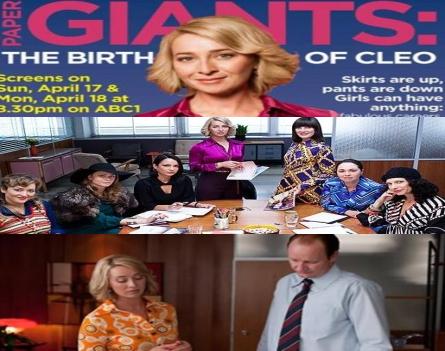
Asher Keddie has never been my favourite actress. So I wasn’t particularly looking forward to her portrayal of magazine mogul Ita Buttrose in ABC’s Paper Giants.

However, after watching both episodes online on Good Friday, I’m now a Keddie convert.

If you’ve read any of the myriad of positive reviews of the miniseries, you’ll know that Keddie gets the Ita lisp down perfectly.

But Keddie gives off a different air to Ita (granted, I’m only really familiar with The Morning Show and etiquette Ita, not the golden age of magazines Ita), though, and really makes the role her own.

Film-wise, the imagery embodies the ’70s perfectly (’cause I was alive then and all!) and harkens back to simpler times, when the printers baulked at having to change their formatting to accommodate the patented Cleo sealed section, saying it couldn’t be done!

Though the role of women was going through an upheaval at the time, and Cleo paved the way for women of that generation.

I found it funny and quite poignant that women like Ita and her assistant Leslie, played by Jessica Tovey, were working to change the status of women through their magazine, while privately their lives were in shambles: Leslie tries to take on the role of sexually empowered woman, experimenting with role play, fantasy and sex toys, but still stays with her unenlightened fiancé Muz, while maintaining an affair with a senior co-worker, who refuses to leave his wife for her. And before Ita’s husband, Mac, leaves her raising one child and pregnant with another, the film juxtaposes Ita arriving home from a long day at the office that included being rebuffed for a loan without the permission of her husband with asking Mac if he’d like onions with his steak, which she immediately begins making.

At this juncture, the Cleo girls raise the notion of Superwoman, and if she actually exists; a debate modern feminists are still grappling with.

My favourite parts of the miniseries, apart from Keddie as Ita, and Rob Carlton as Kerry Packer, was its ability to poke fun at the present day, such as a dig at Time Out magazine, and how it will “never take off” and a Cleo girl asking, “Who’s Paul Keating?”

Related: “Cultural Talking Points”: How Does Jackie O’s “Bad Parenting” Relate to Hunting?

Has Feminism Failed?

Images via Facebook, ABC.

Event: “Who the Bloody Hell Are We?”—The Sentimental Bloke at the Wheeler Centre.

I was so looking forward to “So Who the Bloody Hell Are We?: The Sentimental Bloke”, held on Monday night at the Wheeler Centre, which I attended with my staunchly feminist friend Laura (who has written for The Scarlett Woman here, and whom I’ve written abouthere) and staunchly MRA friend Andrew (who has also guest posted here and here).

I was rudely disappointed.

I expected the panel to delve into the masculinity crisis facing Australian men today by addressing such issues as rape culture in sport, domestic violence, metrosexuality and parenting. Well, three out of four ain’t bad.

I’m not the only one who felt that way, as Andrew Frank writes:

“I’ve got two words for you: Sarah Palin”—Dr. Anne Summers, AO.

I didn’t get it. Based on the participation rates of the laughter that followed, I don’t think half the audience did either.

Using a right wing American female politician to attempt to illustrate that there are no gender issues related to  men that hunt in contemporary Australia, only cultural ones, is using a form of logic that I can’t understand. But then again, she claims to be a feminist.

The setting was The Wheeler Centre, and the discussion loosely titled, “So Who the Bloody Hell Are We?: The Sentimental Bloke”. The presenter: Michael Cathcart. The panel was comprised of Craig Reucassel, founding editor of The Chaser newspaper and ABC television personality, Craig Sherborne, memoirist, poet and playwright, and Dr. Anne Summers AO, “best-selling author, journalist, and thought leader”. About that last one: I am worried.

Initially, the discussion promised to focus upon being a man, as individuals and as an ideal, in contemporary Australian society. This would include several aspects of particular relevance, such as parenting, the workplace, and various social settings. It would also examine the evolution of the ideals of masculinity, over the 20th century to the present. I was sadly disappointed.

After being egged on by Scarlett and Laura to “man up” [Scarlett Woman note: I say that sarcastically; I strongly disagree with “man-up” as motivation to be courageous.], I decided to ask the question that plagued me from the start, and gets under my skin from time to time. My question went something like this:

“I am a very passionate hunter. I do it because I love it, not because I need to feel manlier. This is something for which I am socially criticized, in a manner that suggests I use it as a method of compensation for feelings of being emasculated. Do any of you perceive any distinction between the social pressures placed on men of decades past to be the stiff-upper-lipped, emotionally suppressed and distant figure, and the social pressures contemporary Australian men are subject to in terms of being ‘metrosexual’ or the ‘Sensitive New Age Guy’?”

I missed Sherborne’s reaction, but Reucassel mocked hunting as an activity for the royal family {unbeknownst to him, I also fence!). Dr Anne Summers, screwed up her face and said, “Between being a SNAG and hunting?” in as condescending a tone as you can imagine.

It was asked that the microphone be returned to me. Reucassel asked me how I started hunting. I replied that it came to me through my Dad, and my Dad’s Dad. I then turned my attention to Summers again and stated that the hunting’s relevance here rested in the fact that according to my friends, hunting and masculinity were, for the distant father figure, and are, now, according to my friends, inextricably intertwined. It is the quintessential example of men today not conforming to the metrosexual, SNAG criteria.

Reucassel then said that the idea of hunting abhors him; that It is definitely an antiquated recreation, but it takes bravery to pursue in light of contemporary attitudes and if I want to, then more power to me. I respect his viewpoint. I would never force someone to hunt who didn’t want to, and he reflects my right to be autonomous in deciding where I get my food. But he missed the vital issue: is there a difference between my social pressure not to hunt and the social pressure on men from decades past to be emotionally restrained?

Insert Summers’ initial right-winged impression here, to which I didn’t get another chance to respond.

Sarah Palin hunts. I think Summers was trying to say that dealing with the bad rap that being a hunter carries is not specifically a male problem. And in that single fact, she is correct. So therefore, the issue faced here by hunters is not gendered, but cultural. However, to go so far as to imply that because Palin hunts, the social criticism of male Australian hunters—or indeed other men who engage in traditionally masculine recreational activities—does not warrant discussion is a fallacy. I believe that is what she intended to say. And soon after it became apparent from the comments of Cathcart and Sherborne that they believed she had jumped on the “cultural, not gendered” tack as well. However, because I did not warrant a detailed response, evidenced in hindsight by her curt reply and insulting tone, we cannot be sure. Perhaps she meant to say that Palin is an idiot, and therefore, all hunters are. But I shall continue through with the interpretation that Laura helped me conclude.

If we accept the premise of Summers, any criticism of my masculinity with hunting as evidence is blatantly flawed. Speaking regarding men in contemporary society, Summers has decided that the social reality is… wrong? Because a number of women engage in hunting, including the prominent Palin, they must be subject to exactly the same social criticisms that the men who engage in this statistically dominated male activity, right? If we accept this, Summers did not respond to me, as she intended. She responded to those that undermine the masculinity of Australian male hunters. Undermining my “masculinity in the metrosexual sense” because I hunt is wrong because women hunt, too. Unfortunately for her, your average person that rips on a hunter seems unaware of the tradition that hunting is a male thing. By the way: I hate that tradition. I really, really do.

On that count, any person seeking a discourse regarding being a man in contemporary Australia rather than trying to fulfill a feminist agenda would disagree. It’s like saying because both men and women are in the police force they obviously have precisely the same experience—I would have loved to get her started on that one pertaining to rape cases. If the topic for the evening had been, “The Sentimental Bloke and the Empowered Woman: Being a Man, Or a Woman, in Contemporary Society”, then perhaps it would have been a valid vein of thought. But could anyone really think that her premise was not flimsy and tenuous? She, too, missed the point: attempting to discern the differences and similarities of social pressure on males not to hunt and the social pressure on men from decades past to be emotionally restrained.

Discussion that followed pigeonholed me into the “shooter” stereotype as if I wasn’t even there. I won’t forget for a long time the sneer in her voice: “He’s a shooter”. I despise hoons that are hunters according to external perception, blazing through the bush with a beer in one hand and a gun in the other. Summers was perfectly willing to condemn me using a stereotype to which I do not conform. This after using a prominent female American politician, a single example, to attempt to nullify two gendered stereotypes and the resulting social pressures of two different eras that I wished to contrast. Yeah, that woman totally understood the topic for the evening. She is sooo smart! And yes, I’m bitter I didn’t get to verbally tear her to shreds.

The presenter, in my opinion, then made an awful mistake. Cathcart asked the panel, “Have any of you killed a mammal, and eaten it?” I think this was asked with the goal of illustrating the cultural differences between the contemporary and past societies in which hunters and men have existed. This wandered further still from the vital issue, as whether or not someone has killed an animal they have eaten and whether or not hunting is ethical does not address the relevant gendered issues. Reucassel said no, and then admitted to being a meat eater which, he realised, weakened his argument. Sherborne said yes, and told stories of how he grew up on a farm. Summers said no, and her admission to being a meat eater was accompanied with a bowed head.

In order to further display her tight grasp on the issues that were, but should not have been at hand, I remember Sherborne raising the following issue, when asked if he himself has ever hunted:

Sherborne: “Is fishing hunting?”

Summers: “No.”

Cathcart: “Why not?”

Summers: “I don’t know”

Cathcart ended that portion of the discussion with, “Well, I don’t know if we answered your question, but they certainly had fun ridiculing you”.

Subsequent audience questions referred to mine. They tried again to get at my “underlying question.” As far as I could tell, no such luck. My spirits were buoyed somewhat as I exited the room, as I heard the word hunting on the lips of four or five people, was complimented by a few others, and heard several chide the panel’s incorrect interpretation and inadequate response to my questioning. Walking down the street five minutes later I fortuitously heard an elderly couple discussing the exact same issue, and they could not have approved of my thoughts more.

Perhaps my motivation to have written all this down rests in the fact that I wanted answers—validation—and I didn’t get any. I am a hunter. I am also a kind, caring and sensitive man, who fully acknowledges the depths of his emotion wherever possible. I even have passing interests in skin care from time to time. The people on the stage were supposed to confirm my belief that pressures on me to be the latter (SNAG) are directly related to pressures not to be the former (strong, silent and conventionally “masculine”), and that the same situation with different polarities existed for men decades ago. Or, they were supposed to admonish this point of view, and provide me with enlightenment such that I could embrace my modern masculinity as the sensitive young man and the hunter with no sense of conflict.

But they didn’t. Aspects of life difficult for the contemporary sentimental bloke didn’t exist for every sentimental bloke. Consequently they were considered circumstantial and did not warrant discussion. Or difficulties that didn’t apply only for men, as women suffered similarly, meant that they did not warrant discussion. Or difficulties founded in culture were dealt with in a manner that suggested their gendered implications were irrelevant. Honestly, the only issue duly treated, was the evolution of male parents who now change nappies and push prams, juxtaposed against past male parents who would only pace outside the birthing room then work to support the child, occasionally throwing in a life lesson. Everything else was glossed over in a cursory fashion, played way, way down, or even straight out denied, suggesting that none of the panel members were prepared to really get their hands dirty and discuss issues that contemporary Australian men deal with in defining who and what we are. After all, even though the title of the event was “So Who the Bloody Hell Are We?: The Sentimental Bloke” it just wouldn’t be fair to deal with the impact issues have on men when they also effect women, would it?

Related: How to Make a Woman Fall in Love with You, Glee Style.

Double Standards.

On Stripping.

Unfinished Business at the Melbourne International Comedy Festival.

Images via The Wheeler Centre, Indie Posted.
Profile: Rachel Hills of Musings of an Inappropriate Woman.

I’ve only become familiar with Rachel Hills, sex and gender blogger at Musings of an Inappropriate Woman, in the past few months, but she’s made her way to the top of my must-read blogs. Here, she answers questions about her inspiration, future writing goals and what she does in her spare time in a new city (she recently moved from Australia to begin a new chapter of her life in London).

Can you give us a quick run-down of your professional writing portfolio thus far?

I’ve been freelancing for six years now, and have written for (in alphabetical order) the ABC, The Age, The Australian, The Big Issue, The Bulletin, The Canberra Times, Cleo, Cosmopolitan, The Courier-Mail, Girlfriend, Girls’ Life (US), Glamour (UK), The Huffington Post, Jezebel, The Monthly, New Matilda, Russh, Sunday Life, Sunday Magazine, Sydney Morning Herald, Vogue, The Walkley Magazine and YEN, as well as a bunch of smaller, indie magazines and blogs.

I got my start writing opinion pieces for the Sydney Morning Herald. These days, I usually write “think piece” features on personal-is-political type issues, or women’s mag fare with smarts.

How long have you been blogging at Musings of an Inappropriate Woman and what made you decide to start a blog?

I just did a quick scan of my archives and discovered I just reached my three year anniversary on October 30.

I’ve written for the internet pretty much ever since it was possible to (I started my first website in 1998), but I was always kind of hesitant of writing publicly under my own name. As a teenager because of my secret pop music loving shame, as a university student because I was involved in student politics and that makes you extremely paranoid (not of people digging up info on you when you become a politician, but of people digging up info on you and putting it in the student newspaper), and then as an adult because I didn’t want to cannibalise my own story ideas.

I cracked through basically because I loved reading other people’s blogs, and because I was inspired by the way that other journalistsparticularly in the USwere using blogs to connect with their audiences. My blog was quite different when I first started writing it, thoughit was more a mix of political commentary, scrapbook and lifecast, as opposed to the more reflective, personal-is-political blog it is today.

What are some of your favourite blogs?

I have a soft spot for blogs which make you feel like you’re getting to know the person writing itblogs like Gala Darling, Girl With A Satchel, Wordsmith Lane, The Ch!cktionary, Emily Magazine, Garance Dore, Style Rookie and The Scarlett Woman [that’s me!] are often at the top of my Google Reader.

I also love blogs that make me think about thingsFeministe, Pandagon, The Awl, Tiara The Merch Girl, Rabbit White, Kapooka Baby, Jezebel, Hugo Schwyzer, Racialicious. And people like Chris Brogan, Seth Godin and Chris Guillebeau are like mentors I’ve never met when it comes to things like blogging and community building.

I’ve lost count of the number of blogs I subscribe to on Google Reader, though, so that’s really just scraping the surface of what I read.

What has been your proudest writing-related achievement to date?

I don’t think I actually have one! There are lots of stories I’m fond of, and I still get excited whenever I get a story up, but there isn’t one that stands out as being more significant than the others. I suppose the one I was most proud of at the time was that first opinion piece in the SMH. And I hope my book will be my proudest writing accomplishment in a couple of years.

And your proudest non-writing achievement?

In 2006, I travelled around the US meeting some of my favourite journalists and editors: people from The Economist, The New York Times, The Huffington Post, US Cosmopolitan and so on. Very nerdy, but also very gutsy lots of people at home thought I was a bit of a weirdo for attempting it (with a couple of notable exceptions). I’m quite proud of that.

Back to your book, to be titled The Sex Myth; how is it coming along?

Haha, it’s coming along okay. I’m dedicating a lot of time to it at the moment, and there are bits of it that I really like, which is nice. I’ve shown the overview to a few high profile people, and the response has been universally very positive. I’m just trying to get everything in place at the moment to translate that positivity into a kickass book deal.

You’ve written about workaholism and the work/life balance in the past. How do you balance all your commitments?

It was much, much harder when I was living in Australia and holding down a near full-time job. Now that I’m working for myself again, it’s much easier to fit in all the things I want to work on, and living with my partner means I still make plenty of time for myself. (When he’s away, I start working later, procrastinating more and sleeping less.)

That said, even working for myself, I’m still managing four main areas of workfreelancing, book, PhD and blogonly one of which pays. So finding time for all of them can be a bit tricky.

What is your favourite way to unwind?

Having spent the past two and a half years of my life reading books on the philosophy of sex, I’ve developed a bit of a fiction obsession recently. It’s so much easier and more relaxing to read than the academic stuff I’m usually buried in.

I’m also really enjoying getting to know London, and digging out all the interesting things there are to do here. My boyfriend often asks me how I manage to find all the things we check outphotographic treasure hunts, interactive theatre, art galleries, bars with secret passage ways.

And yoga. It’s clichéd, but it relaxes me, keeps me fit and keeps my bad neck (from too much time sitting in front of a computer) in proper alignment.

Because most bloggers write about things they’re passionate about, as I know both you and I do, do you find sometimes it’s a chore to churn out posts on, for example, mag-world musings or the happenings on your favourite TV show (you and I both share a penchant for Gossip Girl) and the like, as previously you would have done those things for pleasure? Because that’s definitely something I struggle with from time to time.

Because I write for a living, one thing I’m very careful to do is keep blogging a pleasure. The main way I do this is by writing when I’m feeling inspired: if the writing doesn’t flow easily, blogging starts to feel like an obligation… and while I have no concrete evidence of this, I suspect it makes the posts less interesting to read, too. If I’m not feeling inspired and haven’t updated much that week, I’ll try to find something else around the net that I think will be of interest to my audience and share that with them instead.

What advice do you have for other bloggers?

Don’t feel like you have to get it right immediately. Sure, the internet sticks around forever, so you want to think before you post, but blogging is something you learn by doing just like anything else, and chances are it will take you a while to find your best blogging voice. (It took me a while, and I’d been writing on the net for nearly 10 years and writing professionally for three when I started. And I’m still learning.) Experiment until you find that perfect intersection of what you love, what feels authentic for you, and what people respond to.

And finally, where do you see yourself, writing-wise, in the future?

I’d like to just keep on doing what I do now, only on a bigger and better level, with all the aspects of my work (journalism, blogging, books) feeding into one another.

[Musings of an Inappropriate Woman].