Event: SlutWalk.

Never before (okay, this year) have I been so excited for something. That includes the multitude of costume parties I’ve been to this year.

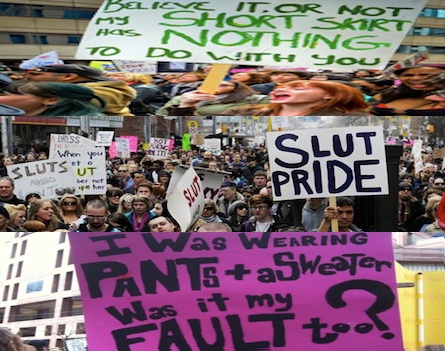
About a month ago, I cottoned on to the buzz surrounding SlutWalk, an event spawned by Sonya Barnett and Heather Jarvis, after they heard a Toronto police officer telling a rape victim that she wouldn’t have been attacked had she been dressed less provocatively.

The first march was in early April, and was met with great success. Other events have been staged in Dallas, Texas and Boston, Massachusetts.

Next Saturday 28th May, SlutWalk comes to Melbourne, and I am beside myself with excitement. The only rally I’ve ever marched in was when I was 15, for (or rather, against) nuclear power with my mum, sister and bestie. I wasn’t really informed enough to have views on nuclear power back then, and I’m still undecided about it. Obviously the disaster in Japan highlights the question mark surrounding the idea of nuclear power in Australia.

However, I do have strong views about slut-shaming, rape, sex and reproductive rights, and I will be immensely proud to walk alongside my fellow sluts, as we reappropriate the word, much like the gays have reclaimed “fag”.

Obviously, rape is not about how a woman is dressed or how much lust she inspires in men, regardless of what she’s wearing. Women are raped when they’re on their morning jog, walking to and from work, out at night in their nicest outfit, or in their home by a friend or family member. I resent the comments that police officer made, and I will be wearing my “sluttiest” outfit in protest. But I’ll be wearing it with a prim and proper bun.

To join the SlutWalk, visit their Facebook page.

Related: Apocalypse Now: 2012 Come Early?

So a Tattoo Makes Me Public Property, Huh?

Elsewhere: [Facebook] SlutWalk.

Images via MamaMia.

Guest Post: Living Below the Line.

For a week this May, I will be living on $2 a day to raise money and awareness for the Oaktree Foundation, in their increasingly successful Live Below the Line campaign. I’ve pledged to live on just $2 a day for five days, from May 16th to 20th.

At first it seems an impossibly small amount, but then you realise that actually a truly ridiculous number of people live on that amount every day.

$2 is the Australian equivalent of the international extreme poverty line—and through this challenge I’m hoping to raise awareness about the issue, but also money to make a difference. You might think that the $2 would go further and buy more in developing countries (that’s what I thought too)—but actually the $2 is worked out to be the Australian equivalent of what life is like for over a billion people. Extreme poverty means $2 per day buying Australian stuff, with Australian dollars. It’s pretty incredible to think about.

It’s definitely going to be hard (those of you who know me, know how much I like good food and wine). There’ll be no coffee, no sugar, no flavour, no alcohol, no snacks and not much nutrition. But if through this I can get a better insight into what life is like for those trapped in poverty—and raise money to make a difference for them—then it’s a sacrifice I’m willing to make. Particularly if you consider that the average Australian spends more per year on confectionary than people living in extreme poverty have to spend in their entire budget. I will spend my $2 a day on food, but if I were one of the people this campaign is raising funds and awareness for, my $2 a day would also have to cover shelter, education, and healthcare as well as food and other basic needs.

Those of you who are able, please donate generously:

  • $50 will provide a classroom in remote PNG with all the stationery they need for a year.
  • $100 will provide a scholarship for a poor student in Cambodia so they can attend school for the first time.
  • Any amount will make a big difference, so please sponsor me with whatever you can spare.  Even $2 each can add up quickly, so dig deep, or take the challenge yourself to raise funds!

Anyone who has any tips on how to survive of this amount, they will be most welcome, so please leave your comments bellow. I will be sure to keep you posted via The Scarlett Woman, with how the challenge is developing and would appreciate any insight that can be offered, because I am not a good cook—I can’t even cook rice!

—Tess Keane.

Event: Evolution of the Bookshop at the Wheeler Centre.

I never thought a seemingly boring panel conversation about e-books versus hard copy print media would trump a discussion about masculinity in Australia, but it seems “The Evolution of the Bookshop” has come out on top when it comes to talks I’ve seen at the Wheeler Centre lately.

I’m a bit late reporting on this one, but a couple of weeks ago I attended “The Evolution of the Bookshop”, which entailed the panel of Michael Webster, Corrie Perkin, Jo Case and Chris Flynn, with Sally Heath as the facilitator.

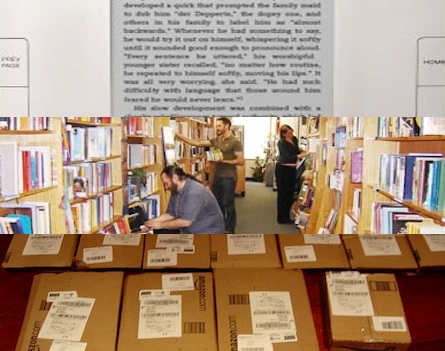
The main item of contention on the agenda was the receivership of the REDgroup, which includes Borders and Angus & Robertson (for those of you living under a rock in recent months) and how online shopping from overseas stores, like Amazon and the Book Depository, may have contributed.

2010 was a good year for books in Australia, actually, as Webster, of RMIT and Nielson BookScan, pointed out in a riveting (no, I’m not kidding!) spreadsheet. There was no denying the large amount of Australian dollars that were spent online on books, what with parity and all that jazz, and the panel urged the audience to buy local throughout the night.

But when Flynn, fiction editor of The Australian Review of Books, compared the prices of all the books he bought over the course of a year at Borders (the devil’s bookstore, according to the panel!), Readings (of which Case is a staff member) and the Book Depository (there was over $1000 difference between online and at a bricks and mortar bookstore), it doesn’t bode well for physical bookstores.

Personally, I’m not in the financial bracket to be supporting local bookstores when I can get the books I want online for half the price at a click of a button.

Earlier this year, I went into Borders at Melbourne Central wanting to purchase Marilyn Monroe’s Fragments, The Great Gatsby and Sloane Crosley’s two books of essays (which you may remember me writing about here). They had none of them in store. An hour later I was at home on Amazon, $70 poorer but immeasurably happier that four brand new books were on their way to me.

Case made the case (haha!) for the experience of shopping at a bookstore, but Flynn countered with the presumption that people who shop online probably already belong to an online community, and thus their experience at an online bookstore is just as valid and important as at a physical one.

As the owner of her own bookshop, Perkin asserted that she just can’t compete with free shipping and the iPhone app Shazam, which allows users to record a piece of music, to which the app generates the full details of and where you can buy it online.

But independent bookstores compete on service, not price. Perkin relayed the example of running out of Jamie’s 30 Minute Meals recipe book and being told that the next shipment wouldn’t be for awhile as it was, and is, a very popular title. She was forced to buy copies of the book on the Book Depository at her own expense, and provide them to her customers who had already committed to the title via pre-sale. Now that is service!

Flynn countered that whether we like it or not, e-readers have hijacked traditional forms of reading, but based on a show of hands, not one person at the Wheeler Centre that night owned or read books on an e-reader.

On a side note, I will be visiting the best second-hand bookstore I’ve ever been to over the weekend, and there’ll be more to come on that next week.

Related: “Who the Bloody Hell Are We?”: The Sentimental Bloke at the Wheeler Centre.

The Ten Books I Wanted to Read This Year But Didn’t.

All Eyes on Marilyn.

Images via Crunch Gear, TS Bookshop, Lance Wiggs.

Event: “Who the Bloody Hell Are We?”—The Sentimental Bloke at the Wheeler Centre.

I was so looking forward to “So Who the Bloody Hell Are We?: The Sentimental Bloke”, held on Monday night at the Wheeler Centre, which I attended with my staunchly feminist friend Laura (who has written for The Scarlett Woman here, and whom I’ve written abouthere) and staunchly MRA friend Andrew (who has also guest posted here and here).

I was rudely disappointed.

I expected the panel to delve into the masculinity crisis facing Australian men today by addressing such issues as rape culture in sport, domestic violence, metrosexuality and parenting. Well, three out of four ain’t bad.

I’m not the only one who felt that way, as Andrew Frank writes:

“I’ve got two words for you: Sarah Palin”—Dr. Anne Summers, AO.

I didn’t get it. Based on the participation rates of the laughter that followed, I don’t think half the audience did either.

Using a right wing American female politician to attempt to illustrate that there are no gender issues related to  men that hunt in contemporary Australia, only cultural ones, is using a form of logic that I can’t understand. But then again, she claims to be a feminist.

The setting was The Wheeler Centre, and the discussion loosely titled, “So Who the Bloody Hell Are We?: The Sentimental Bloke”. The presenter: Michael Cathcart. The panel was comprised of Craig Reucassel, founding editor of The Chaser newspaper and ABC television personality, Craig Sherborne, memoirist, poet and playwright, and Dr. Anne Summers AO, “best-selling author, journalist, and thought leader”. About that last one: I am worried.

Initially, the discussion promised to focus upon being a man, as individuals and as an ideal, in contemporary Australian society. This would include several aspects of particular relevance, such as parenting, the workplace, and various social settings. It would also examine the evolution of the ideals of masculinity, over the 20th century to the present. I was sadly disappointed.

After being egged on by Scarlett and Laura to “man up” [Scarlett Woman note: I say that sarcastically; I strongly disagree with “man-up” as motivation to be courageous.], I decided to ask the question that plagued me from the start, and gets under my skin from time to time. My question went something like this:

“I am a very passionate hunter. I do it because I love it, not because I need to feel manlier. This is something for which I am socially criticized, in a manner that suggests I use it as a method of compensation for feelings of being emasculated. Do any of you perceive any distinction between the social pressures placed on men of decades past to be the stiff-upper-lipped, emotionally suppressed and distant figure, and the social pressures contemporary Australian men are subject to in terms of being ‘metrosexual’ or the ‘Sensitive New Age Guy’?”

I missed Sherborne’s reaction, but Reucassel mocked hunting as an activity for the royal family {unbeknownst to him, I also fence!). Dr Anne Summers, screwed up her face and said, “Between being a SNAG and hunting?” in as condescending a tone as you can imagine.

It was asked that the microphone be returned to me. Reucassel asked me how I started hunting. I replied that it came to me through my Dad, and my Dad’s Dad. I then turned my attention to Summers again and stated that the hunting’s relevance here rested in the fact that according to my friends, hunting and masculinity were, for the distant father figure, and are, now, according to my friends, inextricably intertwined. It is the quintessential example of men today not conforming to the metrosexual, SNAG criteria.

Reucassel then said that the idea of hunting abhors him; that It is definitely an antiquated recreation, but it takes bravery to pursue in light of contemporary attitudes and if I want to, then more power to me. I respect his viewpoint. I would never force someone to hunt who didn’t want to, and he reflects my right to be autonomous in deciding where I get my food. But he missed the vital issue: is there a difference between my social pressure not to hunt and the social pressure on men from decades past to be emotionally restrained?

Insert Summers’ initial right-winged impression here, to which I didn’t get another chance to respond.

Sarah Palin hunts. I think Summers was trying to say that dealing with the bad rap that being a hunter carries is not specifically a male problem. And in that single fact, she is correct. So therefore, the issue faced here by hunters is not gendered, but cultural. However, to go so far as to imply that because Palin hunts, the social criticism of male Australian hunters—or indeed other men who engage in traditionally masculine recreational activities—does not warrant discussion is a fallacy. I believe that is what she intended to say. And soon after it became apparent from the comments of Cathcart and Sherborne that they believed she had jumped on the “cultural, not gendered” tack as well. However, because I did not warrant a detailed response, evidenced in hindsight by her curt reply and insulting tone, we cannot be sure. Perhaps she meant to say that Palin is an idiot, and therefore, all hunters are. But I shall continue through with the interpretation that Laura helped me conclude.

If we accept the premise of Summers, any criticism of my masculinity with hunting as evidence is blatantly flawed. Speaking regarding men in contemporary society, Summers has decided that the social reality is… wrong? Because a number of women engage in hunting, including the prominent Palin, they must be subject to exactly the same social criticisms that the men who engage in this statistically dominated male activity, right? If we accept this, Summers did not respond to me, as she intended. She responded to those that undermine the masculinity of Australian male hunters. Undermining my “masculinity in the metrosexual sense” because I hunt is wrong because women hunt, too. Unfortunately for her, your average person that rips on a hunter seems unaware of the tradition that hunting is a male thing. By the way: I hate that tradition. I really, really do.

On that count, any person seeking a discourse regarding being a man in contemporary Australia rather than trying to fulfill a feminist agenda would disagree. It’s like saying because both men and women are in the police force they obviously have precisely the same experience—I would have loved to get her started on that one pertaining to rape cases. If the topic for the evening had been, “The Sentimental Bloke and the Empowered Woman: Being a Man, Or a Woman, in Contemporary Society”, then perhaps it would have been a valid vein of thought. But could anyone really think that her premise was not flimsy and tenuous? She, too, missed the point: attempting to discern the differences and similarities of social pressure on males not to hunt and the social pressure on men from decades past to be emotionally restrained.

Discussion that followed pigeonholed me into the “shooter” stereotype as if I wasn’t even there. I won’t forget for a long time the sneer in her voice: “He’s a shooter”. I despise hoons that are hunters according to external perception, blazing through the bush with a beer in one hand and a gun in the other. Summers was perfectly willing to condemn me using a stereotype to which I do not conform. This after using a prominent female American politician, a single example, to attempt to nullify two gendered stereotypes and the resulting social pressures of two different eras that I wished to contrast. Yeah, that woman totally understood the topic for the evening. She is sooo smart! And yes, I’m bitter I didn’t get to verbally tear her to shreds.

The presenter, in my opinion, then made an awful mistake. Cathcart asked the panel, “Have any of you killed a mammal, and eaten it?” I think this was asked with the goal of illustrating the cultural differences between the contemporary and past societies in which hunters and men have existed. This wandered further still from the vital issue, as whether or not someone has killed an animal they have eaten and whether or not hunting is ethical does not address the relevant gendered issues. Reucassel said no, and then admitted to being a meat eater which, he realised, weakened his argument. Sherborne said yes, and told stories of how he grew up on a farm. Summers said no, and her admission to being a meat eater was accompanied with a bowed head.

In order to further display her tight grasp on the issues that were, but should not have been at hand, I remember Sherborne raising the following issue, when asked if he himself has ever hunted:

Sherborne: “Is fishing hunting?”

Summers: “No.”

Cathcart: “Why not?”

Summers: “I don’t know”

Cathcart ended that portion of the discussion with, “Well, I don’t know if we answered your question, but they certainly had fun ridiculing you”.

Subsequent audience questions referred to mine. They tried again to get at my “underlying question.” As far as I could tell, no such luck. My spirits were buoyed somewhat as I exited the room, as I heard the word hunting on the lips of four or five people, was complimented by a few others, and heard several chide the panel’s incorrect interpretation and inadequate response to my questioning. Walking down the street five minutes later I fortuitously heard an elderly couple discussing the exact same issue, and they could not have approved of my thoughts more.

Perhaps my motivation to have written all this down rests in the fact that I wanted answers—validation—and I didn’t get any. I am a hunter. I am also a kind, caring and sensitive man, who fully acknowledges the depths of his emotion wherever possible. I even have passing interests in skin care from time to time. The people on the stage were supposed to confirm my belief that pressures on me to be the latter (SNAG) are directly related to pressures not to be the former (strong, silent and conventionally “masculine”), and that the same situation with different polarities existed for men decades ago. Or, they were supposed to admonish this point of view, and provide me with enlightenment such that I could embrace my modern masculinity as the sensitive young man and the hunter with no sense of conflict.

But they didn’t. Aspects of life difficult for the contemporary sentimental bloke didn’t exist for every sentimental bloke. Consequently they were considered circumstantial and did not warrant discussion. Or difficulties that didn’t apply only for men, as women suffered similarly, meant that they did not warrant discussion. Or difficulties founded in culture were dealt with in a manner that suggested their gendered implications were irrelevant. Honestly, the only issue duly treated, was the evolution of male parents who now change nappies and push prams, juxtaposed against past male parents who would only pace outside the birthing room then work to support the child, occasionally throwing in a life lesson. Everything else was glossed over in a cursory fashion, played way, way down, or even straight out denied, suggesting that none of the panel members were prepared to really get their hands dirty and discuss issues that contemporary Australian men deal with in defining who and what we are. After all, even though the title of the event was “So Who the Bloody Hell Are We?: The Sentimental Bloke” it just wouldn’t be fair to deal with the impact issues have on men when they also effect women, would it?

Related: How to Make a Woman Fall in Love with You, Glee Style.

Double Standards.

On Stripping.

Unfinished Business at the Melbourne International Comedy Festival.

Images via The Wheeler Centre, Indie Posted.
Magazines: Nit Wit.


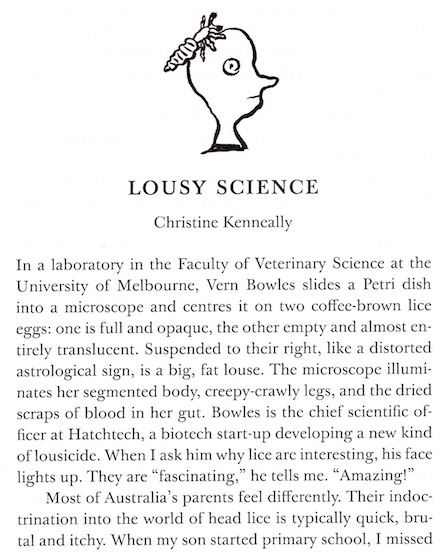
So I found out some interesting facts about head lice from The Monthly’s February 2011 edition.

For example, lice have been around since the dawn of time. In fact,

“lice combs feature in Renaissance paintings of the baby Jesus. They were buried in the tombs of 3000-year-old Egyptian mummies (for the lice in the afterlife). Scientists even found a 10,000-year-old nit clinging tenaciously to a human hair in north-east Brazil.”

Head lice, the other white meat cockroach.

And, considering “they now infest up to 35% of 4–11 year old Australian school children once per year,” nits shouldn’t have such a stigma attached to them.

But they do. I remember when my little sister was invited for a “play date” at—you could say—the school lice-spreader’s house. I warned her not to go and my mother not to let her, but to no avail. And lo and behold, within a week, the whole family was dousing ourselves in Nads.

The author of The Monthly piece, Christine Kenneally, laments her son’s recurring bouts with lice, and let me tell you: I don’t think our household was nit-free for close to a year! I managed to steer clear of them (thank God; I was in year 10 at the time, and I can only imagine the ostracism that I would have faced at my high school.), but with hair down to your bottom and a hippie mother who only believes in natural treatments, my sister had a very hard time of it.

However, there is good news:

“Most treatments are neurotoxins. They damage the nervous system of the louse but they generally don’t hurt the egg… Even if a neurotoxin can get inside the egg, it won’t do much until the third or fourth day when the nervous system has developed. Hatchtech… has created a louciside and ovicide. When it’s time for treated eggs to hatch, enzymes involved in hatching are blocked, and the louse dies inside the egg.”

High fives all round!

On the (Rest of the) Net.


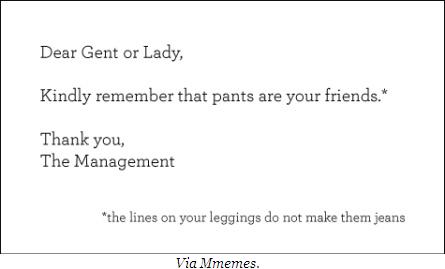
The perils of pants-less ladies.

Does Gossip Girl care about women in politics?

Bryce Corbett in defence of Nicole Kidman:

“… it seems to me that Nicole Kidman is engaged in what must be a most dissatisfying unrequited love affair with her homeland. She flies to Australia to pimp her country on Oprah. She makes a film with Baz Luhrmann which (whatever you may have thought of the final product) was a massive shot in the arm for the local film industry and a two-hour love-song to her country of birth. She fronts up to G’Day USA every year to flog the myriad wonders of Down Under. And following the Victorian bushfires, she donated half-a-million dollars of her own money to the Red Cross relief fund. What a cow.”

“Sexual Assault & the Super Bowl.”

Anna Chong, a designer from the London College of Fashion, has re-imagined Lady Gaga’s most popular get-ups into Barbie-sized outfits. But she’s not the first to do it

“Why is Captain America Ruling Our Screens & Not Wonder Woman?”

Seinfeld’s Elaine Benes as modern-day hipster fashion icon.

The New York Times profiles “nice-guy blogger” Jared Eng on his “cheery, quotidian, Britney-goes-to-Starbucks” blog, JustJared.com.

Also at The New York Times, The Catcher in the Rye’s Holden Caulfield is un-relatable.

Jacob Lambert on “The Paper-Reader’s Dilemma”:

“No longer are books being pitted against pixels; pointing out that paper isn’t reflective either seems very 2007.  The war is now between tablets, as if the book never existed at all.”

Yet more dispelling of the Nicole Kidman vitriol, this time in a vintage (2008) article on Girl with a Satchel.

In the same vein of “17 Arguments Against Gay Marriage & Why They’re Bollocks” and “10 Things You Need to Understand About Asylum Seekers”, comes John Birmingham’s defence of Sandra Reynolds, via MamaMia.

I’d been searching for this article for awhile to reference in a few Lady Gaga musings, and finally came across it again last week and re-read it in the bath. Bliss. A fine example of quality journalism.

Reblogged from Fuck Yeah, Gender Studies, Rachel Hills runs a post on the question of “Who Sexualises Children?”:

“God, it doesn’t even make sense—HOW can a child be sex vixen? When I look at a child, I see a child. Regardless of costume. Dressed like Mary Poppins or dressed like Britney Spears, a kid is a kid! If you see something sexual, the problem is with you.”

I haven’t been shy about my hatred of Charlie Sheen (I know hate is a strong word, but honestly, he is a despicable human being), especially when he gets a free pass because he happens to be the star of TV’s most successful show, while Lindsay Lohan’s career is in ruins. Jezebel reiterates this:

“In recent years no stars (with the possible exception of the oddly lovable Celebrity Rehab cast members) have had their problems with addiction more publicized than Charlie and Lindsay. However, the way these stars are treated by the media and the public is vastly different, mainly due to the double standard for female celebrities.

“The scorn for Lindsay is particularly strange because compared to Charlie, she’s only hurting herself. Let’s review some of Lindsay’s biggest tabloid scandals: Two DUI arrests, four stays in rehab, missing numerous court hearings, going to jail for failing a drug test, battling bulimia, battling her father, and breaking up with her girlfriend. As for Charlie, he’s been in and out of rehab for years, he “accidentally” shot fiancee Kelly Preston in the arm, he was named as a frequent visitor to brothels owned by Heidi Fleiss, he’s dated numerous porn stars, he ODed on cocaine, allegedly shoved Denise Richards and verbally abused her during their marriage, and was arrested for domestic violence against Brooke Mueller, but avoided jail time due to a plea deal. Lindsay has never been married and has no children. Charlie has been married three times and has five kids, four of whom are under the age of 10.”

On the (Rest of the) Net.

The latest Teen Vogue with Pretty Little Liars star Lucy Hale on the cover worryingly espouses using dieting to achieve “Your Best Body”.

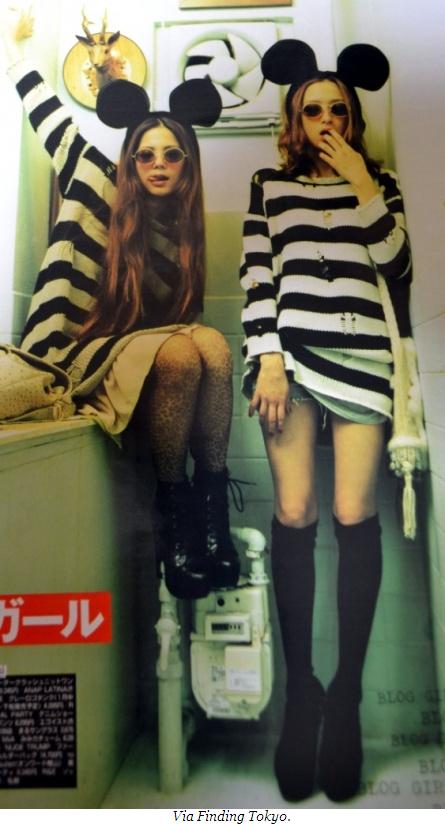
Minnie Mouse meets beatnik meets Gala Darling is the latest “blog girl” trend.

A superb 2004 Andrew Denton interview with media darling/mogul Ita Buttrose.

Charlie Glickman on the perils of alternative male and female sexuality.

Pop music=guilty pleasure no more. (However, stay tuned next week for an alternative view on this subject.)

Girl with a Satchel laments the unattractive “View from the Glossip Stand” in Zoo’s UnAustralians of the Year feature.

“Stereotyping is a fun and useful tool… to categorise interests and make harmful blanket statements” about your favourite magazines. For example, Lula is for those who “never spend money on U.S. fashion magazines because they just don’t ‘get it’; they’re so dull”, while Details has “a strong Patrick Bateman vibe”.

More on Gwyneth Paltrow’s unlikability, this time from New York Magazine:

“Gwyneth is also kind of a jerk. Her perfection is judgment on the rest of us, and she makes this known in interviews and on her lifestyle website, Goop, the tone of which suggests a domestic personality just one degree shy of Joan Crawford in Mommie Dearest.”

The Freudian nature of the vampire.

How women are reclaiming “bitch” as their own.

New research indicates that women’s bodies may protect themselves from rape. And so opens a whole other can of consent worms…

“Are Music Video Girls Exploited?”

This article puts to the rest the “you can’t be both beautiful and smart” way of thinking.

Magazines: Independent Zine Zinm Preview.


Last week I was lucky enough to be featured in a friend of a friend’s Melbourne-based zine, Zinm by Marc Bonnici.

Our mutual friend Anthony had been urging me to check out his self-titled blog for the better part of a year, until I happened upon last month’s copy of Zinm that he’d brought to a get-together.

I was instantly drawn in as I briefly flicked through the pages, a picture from Mean Girls staying most clearly in my mind. (“Burn Book” is a regular feature of Zinm.)

Try as I might, I was never able to get my mitts on a copy of last month’s edition, but better still, I was able to be featured in this month.

As Australia Day rolls around again, guest contributors Anita Calavetta, Marc Bergmann, Dodie Smith, and Muriel Barbery, as well as Marc himself, muse about what Australia means to us. Yours truly continues on her plight to get the safety net for footballers behaving badly removed, as I feel that is a strong part of Aussie culture.

Unfortunately there are not any copies of the latest edition available, as there is a limited print run. But the title has doubled in demand since its inception three issues ago. If you are interested in bagging a copy, I suggest you check out Marc’s blog and drop him a line.

Us independent writers have got to stick together.

Related: Beauty & the Bestiality.

Why Are Famous Men Forgiven for Their Wrongdoings, While Women Are Vilified for Much Less?

Bad Boys, Whatcha Gonna Do? Host a Seven Family Show.

Elsewhere: [Marc Bonnici] Homepage.

UPDATED: Julian Assange—Modern Day Outlaw.


From The Curvature via Musings of an Inappropriate Woman:

“I am SO SICK today of people who can’t see that:

1) WikiLeaks is important and does good work;

2) Julian Assange may be a rapist;

and

3) The pursuit by the authorities for the rape charges may be motivated as much by WikiLeaks as by a desire to see justice done are not in any way contradictory positions and could all be simultaneously true.”

Also check out Rachel Hills’ further musings on WikiLeaks and Assange here.

And for some more opinions on WikiLeaks, visit MamaMia for Mia Freedman’s compilation of the most poignant, as well as her own admission of jumping to conclusions and maybe not articulating her views as well as she could have.

And here is my original post, published last week:

The Australian founder of whistleblower website Wikileaks, Julian Assange, has handed himself over to police today on “undisclosed sexual assault charges” (allegedly rape, which was then changed to having consensual sex with two women whilst claiming to have worm a condom, but didn’t).

He does have a certain creepy quality to him which makes me think it’s not unlikely he’s committed these crimes, but is that really the issue?

More than likely, these charges have been fabricated to get him behind bars, thus stopping him from publishing more confidential government documents and damaging international relations.

Do we really need to know that the U.S. thinks Kevin Rudd is an “abrasive control freak” or the common perception of world leaders such as Hillary Clinton or French president Nicolas Sarkozy? Most of the stories published in the mainstream media about Wikileaks doesn’t indicate many imperative top secret documents (related to terrorism, nuclear weapons etc.) that the general public arguably has a right to know have been leaked. Obviously there are larger issues at hand: Assange is a threat to global governments.

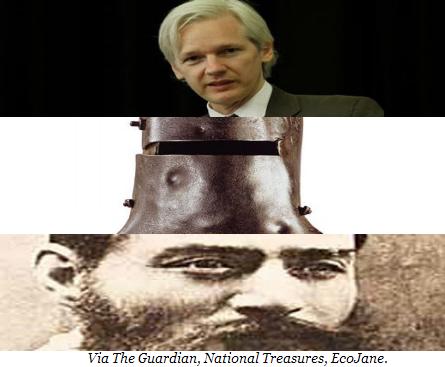
But here in Australia, Assange’s home country, he is viewed as a hero. Somewhat of a modern day Ned Kelly, if you will. Aussie’s appreciate an underdog sticking it to the man, so despite what his website has published, I think most Australian’s are probably rooting for him.

Elsewhere: [The Curvature] I Am So Sick of People Who Can’t See That…

[Musings of an Inappropriate Woman] I Am So Sick of People Who Can’t See That…

[Musings of an Inappropriate Woman] Quick Thoughts on Julian Assange, WikiLeaks & Those Rape Allegations.

[MamaMia] WikiLeaks: Some Food for Thought.

[MamaMia] Updated: Are WikiLeaks & Julian Assange Forces of Good or a Dangerous Menace?

Julian Assange—Modern Day Outlaw.


The Australian founder of whistleblower website Wikileaks, Julian Assange, has handed himself over to police today on “undisclosed sexual assault charges” (allegedly rape, which was then changed to having consensual sex with two women whilst claiming to have worm a condom, but didn’t).

He does have a certain creepy quality to him which makes me think it’s not unlikely he’s committed these crimes, but is that really the issue?

More than likely, these charges have been fabricated to get him behind bars, thus stopping him from publishing more confidential government documents and damaging international relations.

Do we really need to know that the U.S. thinks Kevin Rudd is an “abrasive control freak” or the common perception of world leaders such as Hillary Clinton or French president Nicolas Sarkozy? Most of the stories published in the mainstream media about Wikileaks doesn’t indicate many imperative top secret documents (related to terrorism, nuclear weapons etc.) that the general public arguably has a right to know have been leaked. Obviously there are larger issues at hand: Assange is a threat to global governments.

But here in Australia, Assange’s home country, he is viewed as a hero. Somewhat of a modern day Ned Kelly, if you will. Aussie’s appreciate an underdog sticking it to the man, so despite what his website has published, I think most Australian’s are probably rooting for him.