On the (Rest of the) Net.


Spice World as metatext madness! [Thought Catalog]

Are we living in the post-ideas age? [New York Times]

“The Opposite of ‘Man’ is ‘Boy’, Not ‘Woman’” by Hugo Schwyzer:

“… Men who long for a vanished world of all-male preserves are making a fundamental mistake about masculinity. They think that the opposite of ‘man’ is ‘woman’ and that in order to prove oneself the former they must do (perform) things that no woman can. But it makes good sense to suggest that the better antonym of ‘man’ is ‘boy.’ To ‘perform masculinity’ isn’t about doing what women don’t. It’s about doing what boys lack the will or the maturity to do.

“If we really are in a ‘man crisis’ in America, I suspect it’s rooted as much as anything else in this fundamentally mistaken belief that manhood needs to be about rejecting anything that smacks of the feminine.” [The Good Men Project, via Jezebel]

How they got Osama bin Laden. [The New Yorker]

“Talking to an Abortion Clinic Protester.” [Jezebel]

The “proper etiquette” for drunk Jersey Shore sluts. [Jezebel]

Cutting off your animal cruelty to spite your feminism. Feminaust’s Ms Elouise on PETA’s latest anti-animal cruelty porn site:

“Is using Pamela Anderson’s body as a sex object and comparing it with a piece of meat an acceptable way of drawing attention to the plight of animals in the meat industry?

“PETA’s use of women’s bodies as a means to furthering their animal rights activism undermines their claims to ‘we all have the same parts’ because they’re saying the exact opposite, they’re saying:

“‘LOOK BOOBIES! Now that we have your attention, meat is bad.’”

While this is a great article, I don’t agree with its sentiments 100%. Yes, some of PETA’s campaigns have been unnecessarily focused on the female form, illustrating no real point, but I do think the “I’d rather go naked than wear fur” and the Pamela Anderson campaigns use it in a positive way. Both for women and animals. What do you think?

“Do You Prefer ‘Fashion Victim’ or ‘Ensembly Challenged’?” Squee! All of Cher Horowitz’s outfits in less than 60 seconds! [Worn Fashion Journal]

Questions for “perfect-looking women”, if there is such a thing. [Thought Catalog]

A letter to Gloria Steinem. [Ms. Magazine]

Rachel Rabbit White on “femme-guilt, beauty-privilege and the phenomenon of girls slut-shaming other girls.”

Everything Sarah Hepola learned about New York City. [The Morning News]

The victim-blaming of Lara Logan for deigning to be hot, bare cleavage and get raped. [Broad Street Review]

“Feminism, Colonialism and Islamophobia” at Qantara.

Image via Fan Pop.

On the (Rest of the) Net.


“The Case for Dry Humping: Why Being Prude is a Feminist Statement.” [HuffPo]

Alone time is my siren call. Here, Jezebel’s Social Minefield tells you how to get more “me time” without offended those who want to have “we time” with you.

One woman goes mirror-free for a year. [Jezebel]

Lady Gaga’s run out of people to plagiarise, so she’s turned to herself for inspiration in her latest video for “Yoü & I”. [Fashionista]

Nipple slips from Khloe Kardashian, Nicki Minaj and Kelly Rowland in quick succession: shock, horror! [The Washington Post] (SFW)

Camilla Peffer on Beyonce as the anti-feminist. [Girls Are Made From Pepsi]

The gender politics of Justin Bieber. [FBomb]

Is there a need for women to have their periods?:

“… I do want to raise the question that while we do the work of destigmatising menstruation and teach young girls to be proud and excited about their menarche don’t we also have a responsibility to question its necessity? We tell women they don’t have to have sex to have children, that breast cancer can be beaten, that they can have their tubes tied and then re-connected and their faces lifted and de-wrinkled. We live in a modern world with modern solutions, isn’t it time we started seriously thinking and talking about the need to bleed?” [Feminaust]

Porn star and new mum displays picture of her breastfeeding her newborn daughter in an exhibition challenging the Madonna/whore dichotomy of motherhood, controversy ensues:

“The idea that there is something inherently prurient about a porn star breast-feeding plays right into that classic either-or thinking: Her breasts are erotic in one venue, so they can’t be wholesome in another. It’s a wonder anyone lets her breast-feed at all! On the one hand, it’s surprising to see this attitude coming from a pornographer; on… [yet an]other hand, it’s perfectly appropriate given the way motherhood is fetishised in porn.

“…We don’t like to think of moms as sexual beings—except for in the taboo-busting world of porn (paging Dr. Freud). It’s fitting for a porn star mama, the rare industry ‘MILF’ who is actually a mom, to remind folks that, generally speaking, one has to have sex in order to become a mom.” [Salon]

Anne Hathaway’s new effort, One Day, has a “bleak worldview of co-dependence where men need women to improve them, and women need to improve themselves to deserve men’s notice and achieve their purpose,” with The Film Stage dubbing it “the most toxic romance of the year”.

Also at The Film Stage, a breakdown of Katherine Heigl’s stereotype-reinforcing rom-coms, from the career-making Knocked Up, which she subsequently dissed for being sexist, to the just-as-sexist Killers and Life as We Know It.

Here’s an extended version of Erica Bartle’s debut piece for Sunday Life. While I don’t necessarily agree with her sentiments on faith most of the time, this is a great read. Better than the published piece, dare I say? [Girl with a Satchel]

Taylor Swift VS. feminism. [Autostraddle]

Is it “time for an abortion pride movement”?:

“… Women should not merely have the right to end unwanted pregnancies, they should have the right to be proud of having done so. Surely, there is enough suffering in this world already without adding infants with Tay-Sachs disease and Lesch-Nyhan syndrome to the mix. Women who step up to the ethical plate and have the strength to say, ‘This is the wrong time,’ or ‘This is the wrong fetus,’ should hold their heads high in the streets.” [Opposing Views]

Oh, the hilarity of Photoshop on this Glee/Vogue/Fashion’s Night Out advertisement. [Styleite]

It’s not just women who get the short end of the stick when it comes to Disney films: “Sexism, Strength & Dominance—Masculinity in Disney Films.” [FBomb]

The awesomeness that is Adam Lambert. [Autostraddle]

One from the vault: Buffy’s Willow Rosenberg destroys the world when her lesbian love is killed, calling into question the show’s support of the LGBT community. [Salon]

A mother’s perspective on the dysfunctional Twilight-saga relationship between Edward and Bella. [Persephone Magazine]

The politics of the SlutWalk. [New York Times]

Five of The Simpsons’ best recipes, including 64 slices of American cheese and Vaseline toast! [Warming Glow]

Image via Chubby Wubby Girl, Styleite, Salon.

On the (Rest of the) Net.

Race and online dating. [Jezebel]

Hermione the heroine. [HuffPo]

Jezebel also writes in praise of “The Women of the Harry Potter Universe.”

Tavi Gevinson on growing into her beauty:

“I could pretend to be an archetype of a feminist superhero and say I never want to be a conventionally attractive person. But, while I have so much respect for the people who can say that truthfully, I’m not there yet… I admit to the basic human desire to be attractive…

“Maybe I liked my face. Is that not okay?” [The Style Rookie]

If the DSK case has taught us anything, it’s that “any deviation of the victim’s life from the concept of the ‘perfect victim’ is exploited and becomes the focus of attention, as has happened to the DSK victim. Ever had a drink? Been to a party? Been a little bit late to a meeting? Lost your temper? Tried to fight back? Lied to your friends about what’s going on in a relationship? Forgiven someone? Posted a Facebook photo of you hugging someone? Well then clearly YOU ARE A DRUG-ADDLED VIOLENT SLUT BITCH and that necessitates a billion more hearings to talk about how VIOLENT and SLUTTY and DRUG-ADDLED and BITCHY you are.” [Think on This]

Still with Strauss-Kahn, Bob Ellis airs his always controversial, archaic and small-minded misogynist thoughts on the “honeytrapping” of “good men”. [ABC The Drum]

“When Rape Victims Lie.” [Sasha Said]

And this wraps up the DSK portion of the program:

“… I have no sympathy, empathy or even good thoughts for Dominique Strauss-Kahn. Not just because of the rape accusations but also because of his betrayal of the socialist ideals he was supposed to uphold as a prominent member of the French Socialist Party. His ideals that went through the drain when he accepted to become head of the IMF, one of the most subjugating, neo-imperialist institutions imposed on the Global South.

“And now, of course, there is no longer a case against him. However, and this is where I’d like us to focus, there is no longer a case because, it is claimed, the victim lied on issues unrelated to the rape allegations. Let that sink in for a second: a woman who is an asylum seeker/refugee, who hails from one of the poorest countries on earth (where the IMF played a big role in promoting the prevailing poverty and economic hardships that afflict her homeland) was found to have lied in order to get on with her life.” [Tiger Beatdown]

Jokes about Casey Anthony: too soon? [Splitsider]

“So you want to move to New York?” Here are the realities. Not as grim as you might think, yay! [Yikes Machine]

“The World Map of Useless Stereotypes.” If they’d reduced the space allocated for New York, they might have been able to include Australia. Oh yeah, maybe they were playing up the stereotype of us being the forgotten continent of sorts. [Jezebel]

The Lion King promotes homosexuality? And nine other “crazy things” that have come out of potential 2012 Republican presidential candidate Michele Bachmann’s mouth. [Think Progress]

Elitism in the public school system. [Persephone Magazine]

If global gender equality was represented by the FIFA Women’s Soccer World Cup, this is what it would look like. [Jezebel]

Ten life lessons, according to Ja Rule. Hilarious! [Thought Catalog]

“If I Were a Girl,” also on Thought Catalog, is equal parts poignant and insulting. Interesting to get a guy’s point of view on what it would be like to be a girl.

Read what happens when “a teen… calls the Westboro Baptist Church” to talk about feminism! [Jezebel]

Waking up to the Leiby Kletzky murder crime scene. [Jezebel]

Sleazy News of the World-esque journalism has a place somewhere, right? [Gawker]

“Penis shaming.” [Rachel Rabbit White]

On “Writing Race.” [Zero at the Bone]

More on the should-we-tell-little-girls-they’re-pretty debate. [The Beheld]

Part two of Camilla Peffer’s “In Defence of Women Behaving Badly.” [Girls Are Made from Pepsi]

Men in crisis: “Digging deeper into modern Masculinity.” [Rachel Rabbit White]

Images via The Style Rookie, Buzzfeed.

Magazines: Man Up.

“Manning up” seems to be a common theme on The Scarlett Woman this past week.

I don’t agree with the term, as it implies that simply being a man is equivalent to being courageous. Not to toot my own horn (okay, I am!), but I feel like I “man up” a whole hell of a lot more than most of my male friends. But it is a good descriptive phrase, along with “grow some balls” and “don’t be a pussy”, to which the same above critique applies.

Last weekend’s Sunday Life ran a story entitled “You’ve Got Males”, about the conundrum of raising males, which could be a good article if it wasn’t so sexist and traditional-man bashing.

Some such examples are:

“… Mum went through a feminist phase where the various pitfalls of male behaviour were outlined to me early and often, boot-camp style: think The Biggest Loser if they were trying to create metrosexuals instead of skinny people”—most feminists will tell you that it isn’t a phase; children should be allowed to grow in their own ways, whilst being gently guided by their caregivers.

“Such a boy thing to do” —what, exactly? Playing with trucks and being destructive? I have observed plenty of male children being more mellow, whilst girls go ahead and trash their cubbies after they’ve been lovingly tidied by moi (true story). It comes down to being an individual, not a stereotype. And at aged three, should we really be pushing stereotypes on our children?!

“Our first-born liked babychinos and was more artsy than fartsy. But our second boy was a full-blown bloke (‘Finally, a male in the family,’ said my wife)” —liking babychinos means your parents are pretentious, not that you’re going to grow up to be a SNAG. And what’s so wrong with that anyway?

The article also discusses the pack mentality of “groups of men behav[ing] in a more blokey fashion”, which was briefly touched on at the Wheeler Centre’s “The Sentimental Bloke” discussion, in the form of a solitary wine vs. group beers, and how to “deprogram” this.

Personally, I’m not a fan of “blokey behaviour” in the stereotypical sense, but nor to I agree with the parenting style—or typical Australian attitudes—this article attempts to push: that it’s one (bloke) or the other (SNAG), with no regard for the myriad of options in between, or what’s best for the individual child.

Related: Unfinished Business at the Melbourne International Comedy Festival.

“Who the Bloody Hell Are We?”: The Sentimental Bloke at the Wheeler Centre.

Event: Evolution of the Bookshop at the Wheeler Centre.

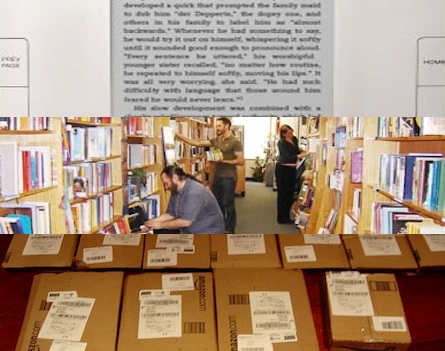
I never thought a seemingly boring panel conversation about e-books versus hard copy print media would trump a discussion about masculinity in Australia, but it seems “The Evolution of the Bookshop” has come out on top when it comes to talks I’ve seen at the Wheeler Centre lately.

I’m a bit late reporting on this one, but a couple of weeks ago I attended “The Evolution of the Bookshop”, which entailed the panel of Michael Webster, Corrie Perkin, Jo Case and Chris Flynn, with Sally Heath as the facilitator.

The main item of contention on the agenda was the receivership of the REDgroup, which includes Borders and Angus & Robertson (for those of you living under a rock in recent months) and how online shopping from overseas stores, like Amazon and the Book Depository, may have contributed.

2010 was a good year for books in Australia, actually, as Webster, of RMIT and Nielson BookScan, pointed out in a riveting (no, I’m not kidding!) spreadsheet. There was no denying the large amount of Australian dollars that were spent online on books, what with parity and all that jazz, and the panel urged the audience to buy local throughout the night.

But when Flynn, fiction editor of The Australian Review of Books, compared the prices of all the books he bought over the course of a year at Borders (the devil’s bookstore, according to the panel!), Readings (of which Case is a staff member) and the Book Depository (there was over $1000 difference between online and at a bricks and mortar bookstore), it doesn’t bode well for physical bookstores.

Personally, I’m not in the financial bracket to be supporting local bookstores when I can get the books I want online for half the price at a click of a button.

Earlier this year, I went into Borders at Melbourne Central wanting to purchase Marilyn Monroe’s Fragments, The Great Gatsby and Sloane Crosley’s two books of essays (which you may remember me writing about here). They had none of them in store. An hour later I was at home on Amazon, $70 poorer but immeasurably happier that four brand new books were on their way to me.

Case made the case (haha!) for the experience of shopping at a bookstore, but Flynn countered with the presumption that people who shop online probably already belong to an online community, and thus their experience at an online bookstore is just as valid and important as at a physical one.

As the owner of her own bookshop, Perkin asserted that she just can’t compete with free shipping and the iPhone app Shazam, which allows users to record a piece of music, to which the app generates the full details of and where you can buy it online.

But independent bookstores compete on service, not price. Perkin relayed the example of running out of Jamie’s 30 Minute Meals recipe book and being told that the next shipment wouldn’t be for awhile as it was, and is, a very popular title. She was forced to buy copies of the book on the Book Depository at her own expense, and provide them to her customers who had already committed to the title via pre-sale. Now that is service!

Flynn countered that whether we like it or not, e-readers have hijacked traditional forms of reading, but based on a show of hands, not one person at the Wheeler Centre that night owned or read books on an e-reader.

On a side note, I will be visiting the best second-hand bookstore I’ve ever been to over the weekend, and there’ll be more to come on that next week.

Related: “Who the Bloody Hell Are We?”: The Sentimental Bloke at the Wheeler Centre.

The Ten Books I Wanted to Read This Year But Didn’t.

All Eyes on Marilyn.

Images via Crunch Gear, TS Bookshop, Lance Wiggs.

Event: “Who the Bloody Hell Are We?”—The Sentimental Bloke at the Wheeler Centre.

I was so looking forward to “So Who the Bloody Hell Are We?: The Sentimental Bloke”, held on Monday night at the Wheeler Centre, which I attended with my staunchly feminist friend Laura (who has written for The Scarlett Woman here, and whom I’ve written abouthere) and staunchly MRA friend Andrew (who has also guest posted here and here).

I was rudely disappointed.

I expected the panel to delve into the masculinity crisis facing Australian men today by addressing such issues as rape culture in sport, domestic violence, metrosexuality and parenting. Well, three out of four ain’t bad.

I’m not the only one who felt that way, as Andrew Frank writes:

“I’ve got two words for you: Sarah Palin”—Dr. Anne Summers, AO.

I didn’t get it. Based on the participation rates of the laughter that followed, I don’t think half the audience did either.

Using a right wing American female politician to attempt to illustrate that there are no gender issues related to  men that hunt in contemporary Australia, only cultural ones, is using a form of logic that I can’t understand. But then again, she claims to be a feminist.

The setting was The Wheeler Centre, and the discussion loosely titled, “So Who the Bloody Hell Are We?: The Sentimental Bloke”. The presenter: Michael Cathcart. The panel was comprised of Craig Reucassel, founding editor of The Chaser newspaper and ABC television personality, Craig Sherborne, memoirist, poet and playwright, and Dr. Anne Summers AO, “best-selling author, journalist, and thought leader”. About that last one: I am worried.

Initially, the discussion promised to focus upon being a man, as individuals and as an ideal, in contemporary Australian society. This would include several aspects of particular relevance, such as parenting, the workplace, and various social settings. It would also examine the evolution of the ideals of masculinity, over the 20th century to the present. I was sadly disappointed.

After being egged on by Scarlett and Laura to “man up” [Scarlett Woman note: I say that sarcastically; I strongly disagree with “man-up” as motivation to be courageous.], I decided to ask the question that plagued me from the start, and gets under my skin from time to time. My question went something like this:

“I am a very passionate hunter. I do it because I love it, not because I need to feel manlier. This is something for which I am socially criticized, in a manner that suggests I use it as a method of compensation for feelings of being emasculated. Do any of you perceive any distinction between the social pressures placed on men of decades past to be the stiff-upper-lipped, emotionally suppressed and distant figure, and the social pressures contemporary Australian men are subject to in terms of being ‘metrosexual’ or the ‘Sensitive New Age Guy’?”

I missed Sherborne’s reaction, but Reucassel mocked hunting as an activity for the royal family {unbeknownst to him, I also fence!). Dr Anne Summers, screwed up her face and said, “Between being a SNAG and hunting?” in as condescending a tone as you can imagine.

It was asked that the microphone be returned to me. Reucassel asked me how I started hunting. I replied that it came to me through my Dad, and my Dad’s Dad. I then turned my attention to Summers again and stated that the hunting’s relevance here rested in the fact that according to my friends, hunting and masculinity were, for the distant father figure, and are, now, according to my friends, inextricably intertwined. It is the quintessential example of men today not conforming to the metrosexual, SNAG criteria.

Reucassel then said that the idea of hunting abhors him; that It is definitely an antiquated recreation, but it takes bravery to pursue in light of contemporary attitudes and if I want to, then more power to me. I respect his viewpoint. I would never force someone to hunt who didn’t want to, and he reflects my right to be autonomous in deciding where I get my food. But he missed the vital issue: is there a difference between my social pressure not to hunt and the social pressure on men from decades past to be emotionally restrained?

Insert Summers’ initial right-winged impression here, to which I didn’t get another chance to respond.

Sarah Palin hunts. I think Summers was trying to say that dealing with the bad rap that being a hunter carries is not specifically a male problem. And in that single fact, she is correct. So therefore, the issue faced here by hunters is not gendered, but cultural. However, to go so far as to imply that because Palin hunts, the social criticism of male Australian hunters—or indeed other men who engage in traditionally masculine recreational activities—does not warrant discussion is a fallacy. I believe that is what she intended to say. And soon after it became apparent from the comments of Cathcart and Sherborne that they believed she had jumped on the “cultural, not gendered” tack as well. However, because I did not warrant a detailed response, evidenced in hindsight by her curt reply and insulting tone, we cannot be sure. Perhaps she meant to say that Palin is an idiot, and therefore, all hunters are. But I shall continue through with the interpretation that Laura helped me conclude.

If we accept the premise of Summers, any criticism of my masculinity with hunting as evidence is blatantly flawed. Speaking regarding men in contemporary society, Summers has decided that the social reality is… wrong? Because a number of women engage in hunting, including the prominent Palin, they must be subject to exactly the same social criticisms that the men who engage in this statistically dominated male activity, right? If we accept this, Summers did not respond to me, as she intended. She responded to those that undermine the masculinity of Australian male hunters. Undermining my “masculinity in the metrosexual sense” because I hunt is wrong because women hunt, too. Unfortunately for her, your average person that rips on a hunter seems unaware of the tradition that hunting is a male thing. By the way: I hate that tradition. I really, really do.

On that count, any person seeking a discourse regarding being a man in contemporary Australia rather than trying to fulfill a feminist agenda would disagree. It’s like saying because both men and women are in the police force they obviously have precisely the same experience—I would have loved to get her started on that one pertaining to rape cases. If the topic for the evening had been, “The Sentimental Bloke and the Empowered Woman: Being a Man, Or a Woman, in Contemporary Society”, then perhaps it would have been a valid vein of thought. But could anyone really think that her premise was not flimsy and tenuous? She, too, missed the point: attempting to discern the differences and similarities of social pressure on males not to hunt and the social pressure on men from decades past to be emotionally restrained.

Discussion that followed pigeonholed me into the “shooter” stereotype as if I wasn’t even there. I won’t forget for a long time the sneer in her voice: “He’s a shooter”. I despise hoons that are hunters according to external perception, blazing through the bush with a beer in one hand and a gun in the other. Summers was perfectly willing to condemn me using a stereotype to which I do not conform. This after using a prominent female American politician, a single example, to attempt to nullify two gendered stereotypes and the resulting social pressures of two different eras that I wished to contrast. Yeah, that woman totally understood the topic for the evening. She is sooo smart! And yes, I’m bitter I didn’t get to verbally tear her to shreds.

The presenter, in my opinion, then made an awful mistake. Cathcart asked the panel, “Have any of you killed a mammal, and eaten it?” I think this was asked with the goal of illustrating the cultural differences between the contemporary and past societies in which hunters and men have existed. This wandered further still from the vital issue, as whether or not someone has killed an animal they have eaten and whether or not hunting is ethical does not address the relevant gendered issues. Reucassel said no, and then admitted to being a meat eater which, he realised, weakened his argument. Sherborne said yes, and told stories of how he grew up on a farm. Summers said no, and her admission to being a meat eater was accompanied with a bowed head.

In order to further display her tight grasp on the issues that were, but should not have been at hand, I remember Sherborne raising the following issue, when asked if he himself has ever hunted:

Sherborne: “Is fishing hunting?”

Summers: “No.”

Cathcart: “Why not?”

Summers: “I don’t know”

Cathcart ended that portion of the discussion with, “Well, I don’t know if we answered your question, but they certainly had fun ridiculing you”.

Subsequent audience questions referred to mine. They tried again to get at my “underlying question.” As far as I could tell, no such luck. My spirits were buoyed somewhat as I exited the room, as I heard the word hunting on the lips of four or five people, was complimented by a few others, and heard several chide the panel’s incorrect interpretation and inadequate response to my questioning. Walking down the street five minutes later I fortuitously heard an elderly couple discussing the exact same issue, and they could not have approved of my thoughts more.

Perhaps my motivation to have written all this down rests in the fact that I wanted answers—validation—and I didn’t get any. I am a hunter. I am also a kind, caring and sensitive man, who fully acknowledges the depths of his emotion wherever possible. I even have passing interests in skin care from time to time. The people on the stage were supposed to confirm my belief that pressures on me to be the latter (SNAG) are directly related to pressures not to be the former (strong, silent and conventionally “masculine”), and that the same situation with different polarities existed for men decades ago. Or, they were supposed to admonish this point of view, and provide me with enlightenment such that I could embrace my modern masculinity as the sensitive young man and the hunter with no sense of conflict.

But they didn’t. Aspects of life difficult for the contemporary sentimental bloke didn’t exist for every sentimental bloke. Consequently they were considered circumstantial and did not warrant discussion. Or difficulties that didn’t apply only for men, as women suffered similarly, meant that they did not warrant discussion. Or difficulties founded in culture were dealt with in a manner that suggested their gendered implications were irrelevant. Honestly, the only issue duly treated, was the evolution of male parents who now change nappies and push prams, juxtaposed against past male parents who would only pace outside the birthing room then work to support the child, occasionally throwing in a life lesson. Everything else was glossed over in a cursory fashion, played way, way down, or even straight out denied, suggesting that none of the panel members were prepared to really get their hands dirty and discuss issues that contemporary Australian men deal with in defining who and what we are. After all, even though the title of the event was “So Who the Bloody Hell Are We?: The Sentimental Bloke” it just wouldn’t be fair to deal with the impact issues have on men when they also effect women, would it?

Related: How to Make a Woman Fall in Love with You, Glee Style.

Double Standards.

On Stripping.

Unfinished Business at the Melbourne International Comedy Festival.

Images via The Wheeler Centre, Indie Posted.
On the (Rest of the) Net.

“Christina Aguilera: Always the Second Fiddle.”

I don’t believe in New Years resolutions anymore, namely because I could never realise mine. But I like Rachel Hills’ idea of writing an obituary for the year passed. In this case, her 2008 in review.

HuffPo on the absence of modern technology in modern literature:

“The average fictional character is either so thoroughly disinterested in email, social media, and text messages he never thinks of it, or else hastily mentions electronic communications in the past tense. Sure, characters in fiction may own smart phones, but few have the urge to compulsively play with the device while waiting to meet a friend or catch a flight. This ever-present anachronism has made it so that almost all literary fiction is science fiction, a thought experiment as to what life might be like if we weren’t so absorbed in our iPhones but instead watched and listened to the world around us at a moment’s rest.”

Girl with a Satchel ponders the price of a pretty picture.

“Caring for Your Introvert” is one of the best articles I’ve read all year (and considering it was written in 2003, that’s saying something). Here, an excerpt:

“With their endless appetite for talk and attention, extroverts also dominate social life, so they tend to set expectations. In our extrovertist society, being outgoing is considered normal and therefore desirable, a mark of happiness, confidence, leadership. Extroverts are seen as bighearted, vibrant, warm, empathic. ‘People person’ is a compliment. Introverts are described with words like ‘guarded’, ‘loner’, ‘reserved’, ‘taciturn’, ‘self-contained’, ‘private’—narrow, ungenerous words, words that suggest emotional parsimony and smallness of personality. Female introverts, I suspect, must suffer especially. In certain circles, particularly in the Midwest, a man can still sometimes get away with being what they used to call a strong and silent type; introverted women, lacking that alternative, are even more likely than men to be perceived as timid, withdrawn, haughty.

“The worst of it is that extroverts have no idea of the torment they put us through. Sometimes, as we gasp for air amid the fog of their 98-percent-content-free talk, we wonder if extroverts even bother to listen to themselves. Still, we endure stoically, because the etiquette books—written, no doubt, by extroverts—regard declining to banter as rude and gaps in conversation as awkward. We can only dream that someday, when our condition is more widely understood, when perhaps an Introverts’ Rights movement has blossomed and borne fruit, it will not be impolite to say ‘I’m an introvert. You are a wonderful person and I like you. But now please shush.’”

Furthermore, The Los Angeles Times notes that despite the introverted minority, television doesn’t reflect their existence very well. (Does television reflect anything very well?):

“Watch Seinfeld or Friends or Sex & the City or Community or Men of a Certain Age—the list is endless—and you’ll see people who not only are never ever alone but people whose relationships are basically smooth, painless, uninhibited and deeply, deeply intimate—the kind of friendships we may have had in college but that most of us can only dream about now. How many adults do you know who manage to hang out with their friends every single day for hour after hour?”

On that, Gossip Girl is notorious for misrepresenting reality. While she knows I love her, GG often makes me feel guilty about the clothes I’m not wearing, the sex I’m not having, and the events I’m not going to. Apparently, it’s not true to the books, either.

Check out The Washington City Paper for their musings on masculinity over the past decade, with a special focus on boy bands, metrosexuals, hipsters and guidos, à la Jersey Shore.

Gwyneth Paltrow: You either love her or hate her. I hated her with a passion until I saw her on Glee, in which she came across as carefree, cool and sexy and made her a tiny bit more relatable to the general populus who don’t subscribe to her Goop musings. Mia Freedman writes hilariously on this conundrum, with a focus on a related article from Salon.

Also at MamaMia, “17 Arguments Against Gay MarriageAnd Why They’re Bullocks” is brilliant.

Tangled will be the last fairytale Disney releases in a while.

Can you still be a feminist and dress in a bra top? (Of course you can; stay tuned for more on this next week.) Or espouse archaic notions of heterosexual relations, for that matter?

“The Ongoing, Albeit Amusing, Battle to Save Bristol” on Dancing with the Stars:

“‘This seems like a case of the rich, popular cheerleaders looking like they’ve sucked on a lemon when they learn that the poor girl in school, the one in the home-made clothes and religious family, gets elected Prom Queen.’

“I’ve rarely seen such a clean-cut example of the conservative tendency to say up is down and black is white. Or, more precisely, to bemoan how oppressed white, rich, and highly privileged people are.

“… But Bristol Palin hasn’t really done squat. She is literally famous for having a baby at an inopportune time. And now she continues to get promoted over more talented people than her because she was born into the right family… Bristol Palin is a hero to wingnut America because she’s a great example of rewarding someone for being born into privilege instead of on their merits.

“… I just find it extremely funny that the wingnutteria is backing someone with no talent on a show with no real importance to stick it to liberals who by and large don’t really care, and they’re doing so because they’re intoxicated by privilege and kind of wish they had a monarchy, but they’re pretending that they’re doing it because they want to see the oppressed rise above. I suppose after Dancing with the Stars is done, they should start sticking it to the liberals by defending poor, oppressed Paris Hilton, who is definitely the weird girl with handmade clothes that is picked on by cheerleaders.”

Mel Gibson and the curse of the “Sexiest Man Alive” tag.

On Stieg Larsson and the “disturbing”, “torturous” patriarchy of his Millennium trilogy.

Women are funny, too.