On the (Rest of the) Net.


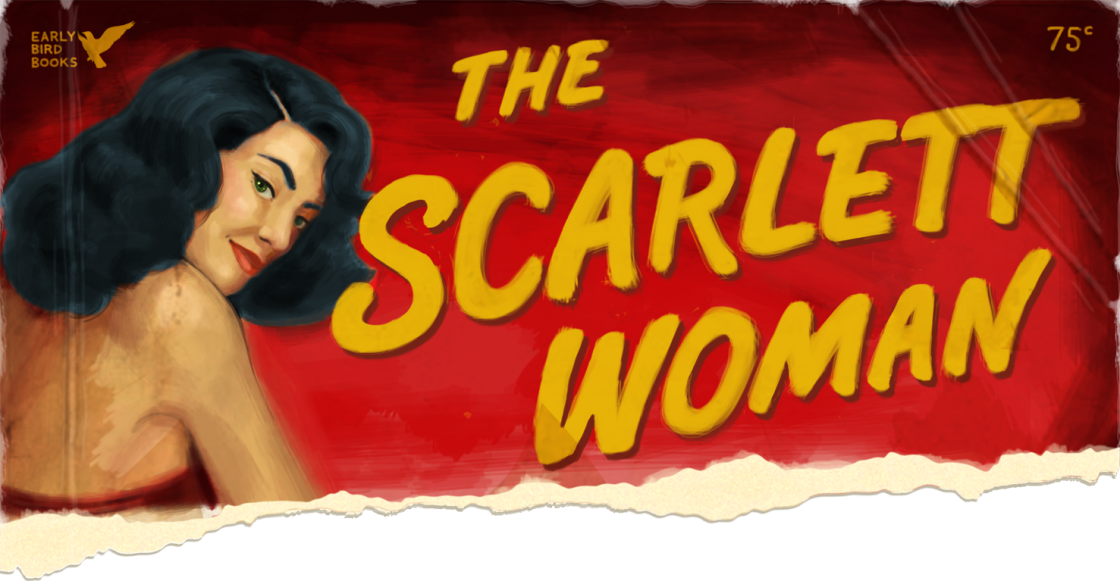
Eight-year-old yellow wunderkind Lisa Simpson has her own book club.

Sarah Ayoub addresses Eddie Maguire’s racist comments in The Sydney Morning Herald.

Paula Joye at Girl with a Satchel on declining mag circulation.

How Hugh Hefner got his groove back at The New York Times.

I never thought there was a “link between autism and vaccinations” until my sister told me the story of how her boyfriend’s brother went from normal, happy and healthy baby to severely disabled after a vaccination. That made me think differently. This article will challenge your beliefs either way.

If “at least 40% of your diet consists of pre-packaged food”, “you don’t sleep enough for proper brain function” and “your boss knows you’re gullible”, you most likely work a 16-hour workday.

On stripping (take two):

“… the brotherly succor would partially exist in the form of shared ambivalence. I would venture to say that this how a majority of men feel about strippers… Do I enjoy strippers? Not really. Do I frequent tithouses often? No. Nor have I any close friends who do… I think men would be willing to renounce strippers if women renounced the Sex and the City franchise. I mean cut all cords. Shit’s gotten out of hand. No reruns. None of the third-wave dime store psychology. A complete effacement out of pop culture. You’re not even allowed hearken back to the simpler days when it meant something to you. Do we have a deal?”

Speaking of Sex & the City, is there a double standard between the second movie and lad flick Get Him to the Greek?

Is it possible to be a feminist and like fashion, too?

“I still get thrilled and impressed by bold, lovely, and often expensive fashion. And I still feel like I’m a person of worth, whether I’m wearing vintage Chanel or ‘vintage’ sweatpants. But I can’t seem to reconcile these two (competing?) impulses; on the one hand, a value in ‘art for art’s sake[’], beauty, style, and other intangibles; on the other, an investment in valuing substance over style, actions over appearances, and real justice over flamboyant showmanship.”

“What Your Favourite Magazine Says About You (Part II).”

Zoë Foster espouses the benefits of the “Better Man, Better Dan” theory.


Images via The Lisa Simpson Book Club, The Frisky.

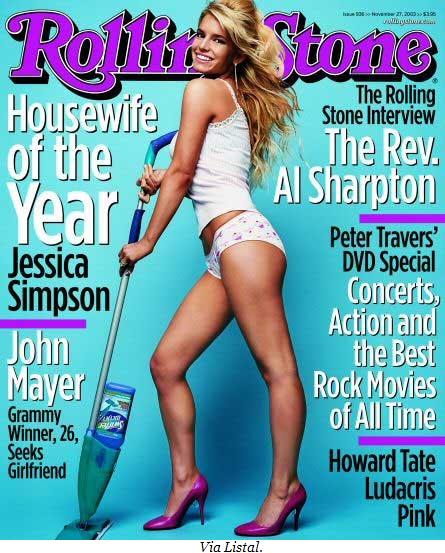
Lea Michele Just Can’t Win.


From “Righteous Moms Just Can’t Let Lea Michele Be Sexy” by Margaret Hartmann on Jezebel:

“Yes, some children will probably see the cover while walking past a newsstand, but it’s doubtful that this issue alone will lead to the crushing realization that sex sells. The GQ cover was tasteless and the Cosmo cover may appear a bit desperate, but it isn’t as if Lea’s doing Playboy. Ten years ago, parents were losing it because Britney Spears delivered sexed-up performances, seemingly with no regard for the little girls who idolized her. Britney summed it up well (and ridiculously) with her song ‘Not A Girl, Not Yet A Woman.’ In American pop culture, this dichotomy is nothing new, Lea Michele is just our current scapegoat.”

Related: Disturbing Behaviour: Terry Richardson Does Glee.

Elsewhere: [Jezebel] Righteous Moms Just Can’t Let Lea Michele Be Sexy.

Images via Reality by Rach, Twenty2.OnSugar.

On the (Rest of the) Net.


The Queensland schoolgirl/Nick Riewoldt scandal is still going strong, with articles at both MamaMia and Deadspin worth a look.

Also at MamaMia, “Are You Spending More or Less Time on Facebook Than Last Year?” I’d say it’s about the same for me.

The psychology of suicide bombers.

Inner confidence = shaving your pubes at Musings of an Inappropriate Woman.

Many people accused Holly Madison, Hugh Hefner’s former number one girlfriend, of being a gold digger, but after years of being “fucked in the assfiguratively and literally… she earned it”. Similar accusations follow Hef’s latest fiancé, Crystal Harris.

GWAS and Marta Wohrle on “The High Standards of Blogging”.

“How to Deal With a Neat Freak” at Lifehacker. How about when you’re the neat freak…?

Valley of the Dolls.


From “The Tyranny of Self-Perfection” by Anne Summers on The Australian website:

“… voicing her concerns that, overall, women were slipping backwards from the promise of equality that she, the daughter of a feminist, had grown up with. Another guest demurred: ‘Young women now have good role models, they are forging ahead,’ Anne McElvoy, deputy editor of the London Evening Standard told her ‘Why do you think things are bad for them?’

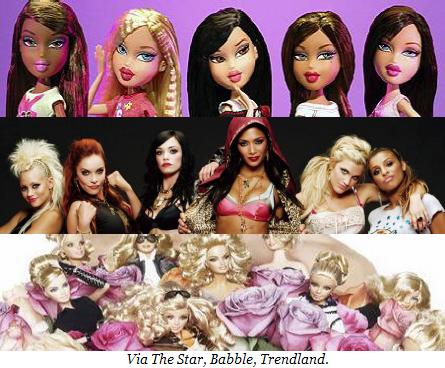
“It is entirely possible that McElvoy had never seen a Bratz doll or watched a Lady Gaga video. Unless she has young daughters or other close relatives she might not be aware of the ubiquity of pink or the Playboy logos that are now de rigueur adornments on the pencil cases of the pre-teen set.

“This reviewer has to confess a comparable ignorance. Sure, I’ve seen little girls dressed inappropriately for travel in pink tutus at airports. I’ve checked myself from disapproving of the skimpy outfits sported by 10-year-old daughters of friends. Gee, I still thought Barbie was bad.

“It’s partly that she now has daughters and has discovered that the ‘slutty and sultry’ Bratz with its wardrobe for clubbing and shopping has displaced innocent blonde Barbie as the top-selling doll for girls. It’s partly the growing use of the language of liberationmost often the word ‘empowering’to describe the new sexual thraldom. And it’s also the realisation that ‘the rhetoric of choice may have burgeoned in this generation, but in many ways the range of female characters and role models available for young girls has narrowed’.

“Girls want to be WAGS, ‘glamour models’ (pose naked without displaying genitals) or even prostitutes because they have been led to believe that these vocations will deliver them the celebrity lifestyle so relentlessly documented in magazines and on television…”

… and in the aisles of toy stores, too, if the Bratz pack has anything to do with it.

Elsewhere: [The Australian] The Tyranny of Self-Perfection.

On the (Rest of the) Net.

A new discovery of mine, Millennials Mag, publishes quirky, up-to-the-minute features on everything from Mad Men to youth crises to Lindsay Lohan. In fact, here’s one on Lindsay, as well as the hilarious “Bylines & Boyfriends” and “The Myth of the Plugged In Millennial”:

“Do you find that you have friends your age who still don’t understand blogs/blogging? And that it’s actual work/writing?… In a way it’s like, really dispiriting, because I have friends who still can’t understand why I’m a journalism major if I don’t want to work for The New York Times… Like I have a friend who wants to be a fashion blogger, but told me she would never get a Twitter account… Well they will clearly never be a blogger…”

Gah! I guess I’ll never be a blogger then, either. Oh wait, I am! Twitter Schmitter (Shitter?).

Rachel Hills discusses the (pop) cultural virtues of Sweet Valley High, and how Gossip Girl relates to real-life. I particularly like the latter, as it deals with the breakdown of friendships, which is something I’m dealing with at the moment. Hills says:

“… When I think about my own anger, about grudges I’ve been unable to let go of, often it has little to do with the original offence. Instead, it’s about a residual feeling I can’t get rid of, a new framework I’ve built up in my head…”

Halloween is just around the corner (more on that to come later today/next week), and Gala Darling ventured to the 20th Annual Tompkins Square Halloween Dog Parade. Check out the dressed-up dogs that were out in full force. And while you’re there, see her case for adopting rescue animals.

Britney Spears, now Miley Cyrus: Eat the Damn Cake writes about how growing up = “Girls, Take Off Most of Your Clothes”.

Betty Talk’s musings on “Western Feminism & Global Gender Justice” harkens back to the Feminism Has Failed debate I attended about a month ago, in that “Western feminists are characterised by being somewhat ethnocentric,” and trying to prevent genital mutilation in some lesser-developed parts of the world, for example, is a little bit ignorant when such societies have “practised these customs for centuries”.

Becky Sharper, on The Pursuit of Harpyness, discusses The Guardian journalist Sarah Churchwell’s rant on Bridget Jones and how the myth of the single girl stereotype affects actual single girls.

Published two years ago, Racialicious’s Latoya Peterson ponders “The Not Rape Epidemic” in the form of her own sexual assault when she was fourteen. Powerful stuff.

MamaMia defends Helen Mirren’s right to bare breasts. When you look that good at 64, all I have to say is: you go, girl!

Mad Men’s Betty Francis (nee Draper) exemplifies the cycle of abuse on Tiger Beatdown.

Is curvy Christina Hendricks getting the Kate Winslet treatment?

The male motivational power of the pinup.

In a similar vein, the consensus circulating around the blogosphere is that Hugh Hefner is to blame for all that is wrong in the world today, which is an issue I beg to differ on, however it’s not all Playmates and flamingos at the Playboy Mansion, either, according to The Washington Times.

Following on from Rachel Hills’ post on intersectionality, Hoyden About Town profiles the “squishy bits” of “Intersectionality and Privilege”.

It has never been a better time to be an out-and-proud gay man, in my opinion. This is evidenced by all my straight and single friends who are also desperate and dateless (myself included!), while my gay friends flourish in the dating world, with the added bonus of the iPhone app Grindr. If only the straight folk had an online dating service to present potential suitors to usoh wait, we do. It’s called online dating, which still has a stigma attached to it (if the disappearance and suspected murder of Zara Baker, whose stepmotherwhom her father met onlineis a suspect, is anything to go by), the likes of which Grindr has never seen.

The Changing Face of Beauty.

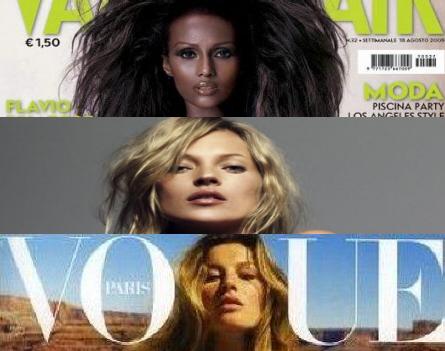
I’ve been meaning to visit Modelinia for a while now, and their History of Models timeline got me thinking about beauty norms across the ages since models became mainstream. Modelinia’s timeline begins in 1928 and follows the top faces (and bodieshello, Elle “The Body” McPherson), such as Twiggy, Iman and Lauren Hutton, through to today’s most famous faces.

Modelinia’s timeline begins with society girls like Dorian Leigh, who was perhaps the “world’s first supermodel” and appeared on the cover of Vogue seven times in 1944 and earned $300,000, “an amount that was unheard of during that time”. Leigh’s partnership with famed photographer Richard Avedon paved the way for future “model as muse” photographer-model dynamics. Leigh was also one of the models who inspired the classic, Breakfast at Tiffany’s.

The late 1940s and ’50s ushered in the age of “Hollywood glamour”, when Leigh appeared on Broadway in The Fifth Season, and “Million Dollar Baby” Lisa Fonssagrives married photographer Irving Penn. These women also proved there was life after modelling, with Fonssagrives “designing a line of leisurewear for Lord & Taylor”, and Leigh opening her own modelling school in Paris, much like Tyra Banks and Heidi Klum today.

The period beginning in 1960 was known as the “awakening” and spawned the births of McPherson, Linda Evangelista, Paulina Porizkova, Cindy Crawford, Stephanie Seymour, Christie Turlington, and Naomi Campbell, the women who would later become known as the über-models of the ’90s.

The ’60s were the years of Twiggy, whose picture was discovered hanging in a hairdresser’s window, and in 1965 she appeared on the cover of Vogue in three separate countries, landing the American edition thrice. She was also the subject of three separate documentaries that year, following on from her radio debut, with the single “Beautiful Dream” in 1964.

Around this time, Hutton refused to close the gap in her teeth, paving the way for the gap-toothed everywhere, like Madonna and Aussie model Jessica Hart.

It was a period of firsts for Hutton, which carried over into the ’70s, who was the first model to front a fragrance campaign, the first to sign an “exclusive cosmetics contract” and the first to reach $1 million in earnings.

The days of disco saw the birth days of the second wave of ü ber-models, like Klum, Shalom Harlow, Banks, Kate Moss, and Laetitia Casta, and the juxtapositioning of the all-American girl next door, Christie Brinkley, with the exotic beauty of Iman. In 1974, Brinkley signed a cosmetics contract with Covergirl, which resulted in a 20-year partnership. Iman served as muse for Yves Saint Laurent, who released his African Queen collection in 1978. While Brinkley appeared on the cover of Sports Illustrated Swimsuit Edition three years in a row (19771979), Iman proved she has commercial appeal, fronting “the June cover of Italian Cosmopolitan” in 1978.

The era of the “poster girl” (commencing with Brinkley’s aforementioned Sports Illustrated cover in 1987 and culminating in the permeation of models in the mainstream) sees models on the covers of all major magazines, from Life to Cosmo to Vogue to Playboy.

And if the saturation of popular culture in the ’80s seemed extreme, the ’90s sought to solidify this with “the rise of the supermodel”, coinciding with “the waif” ideal popularised by Moss’s “heroin chic” look (or as we would find out in 2005, cocaine chic), which was perhaps named for Calvin Klein’s Heroin Kids campaign, which Moss fronted in 1994 .

George Michael’s classic Freedom ’90 featured a bevy of supermodels, including Crawford, Turlington, Campbell, Evangelista, and Tatjana Patitz, in 1988. To accompany this, said models appeared on the cover of British Vogue, followed by the iconic group runway walk for Versace in 1989.
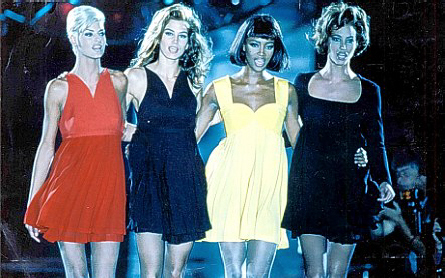
The rapid rise of Seymour began in 1989, when she appeared nude in Playboy, began dating Axl Rose of Guns N’ Roses and appeared in their “Don’t Cry” video clip, followed by “November Rain”. She became the first major model to sign with lingerie empire Victoria’s Secret in 1990, followed by her runway debut for Valentino.

It is interesting to note that the über-models of this time worked primarily in beauty campaigns and magazines before debuting on the runway, whereas now it’s the other way around. There are a lot of nameless and faceless models who walk on the runways and act solely as “clothes hangers” for the garments. It is rare that a model will move beyond that tag and permeate the zeitgeist, but those who have include Gisele Bündchen, Agyness Deyn, Daria Werbowy and Miranda Kerr.

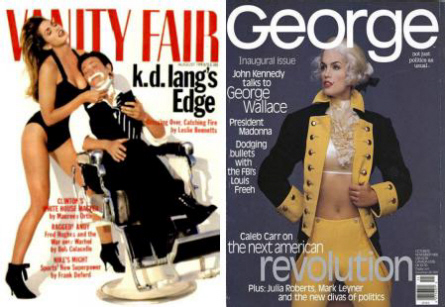
Crawford’s star also rose even higher during this period, with her marriage to Richard Gere and her constant presence on magazines cover of all kinds, including a sexy 1991 cover of Vanity Fair, in which a bathing suit-clad Crawford shaves k.d. lang in a barbers chair.

But Crawford had some competition rapidly rising alongside her: Moss. In 1991, Moss fronted the Calvin Klein Obsession for Men campaign, as well as the Calvin Klein jeans ad together with Mark Wahlberg.

1992 was also a year for sexy magazine covers, with Seymour gracing Playboy for a second time, and McPherson making her debut for the magazine.

In other mag news, Crawford was asked to posed for the cover of the groundbreaking first edition of John F. Kennedy Jr.’s publication, George, aswho else?George Washington.

19941995 was surely Harlow’s time, as she added to her resume of film roles in In & Out, as well as gracing the cover of February W, March’s Paris Vogue, and June Harper’s Bazaar US in 1994, and March W, and December Vogue with fellow model-turned-actress, Amber Valetta.

That year Banks appeared on the cover of Sports Illustrated Swimsuit Edition, the first black model to do so solo.
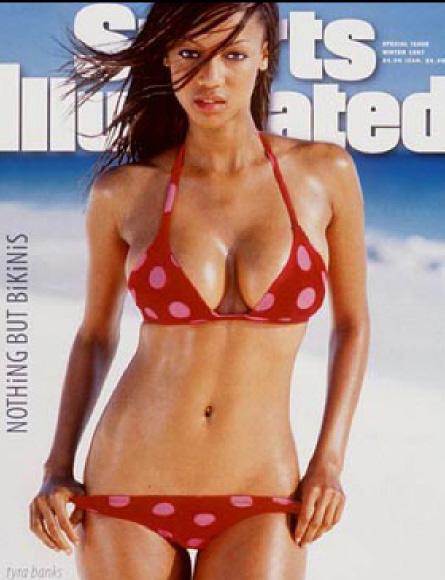
With Bündchen’s appointment to Vogue cover girl in July 1997 the “heroin chic” era allegedly ended, and the championing of healthy bodies like Bündchen’s began. Maybe in the modelling world, but the “heroin chic” movement has wrecked havoc on the notions of beauty, body image and popular culture.

On a side note, recently Playboy.com profiled the changing of women’s breasts over the years, and Jezebel was quick to counter that its not our breasts that have changed, but the media’sie. Playboybelief of what they should look like (NSFW). It is not dissimilar in the case of beauty magazines aimed at women.

By the turn of the millennium, the age of the supermodel subsided, which was noticeable on magazine covers across the world, which began to, and still do, feature actresses and singers on their covers.

With the retirement of the most beautiful faces and bodies in the business, models almost ceased to be relevant, and women who made achievements for something other than their looks were championed. Obviously, there is still a large gap between women on magazines and television and in advertising campaigns and movies in correspondence to how they look rather than what they do, but looking back on the dominance of beauty in the ’80s and ’90s, we are slowly starting to celebrate diversity.

In addition, there’s the whirlwind surrounding plus-sized model Crystal Renn (is she plus-sized, isn’t she plus-sized?), and the model as somewhat of a prop for photographers, magazine editors and designers making a statement, as seen on Evangelista’s November 2009 cover for W magazine’s “The Art Issue”, or Claudia Schiffer (who, interestingly, was not featured in Modelinia’s timeline) and Karl Lagerfeld’s collaboration.
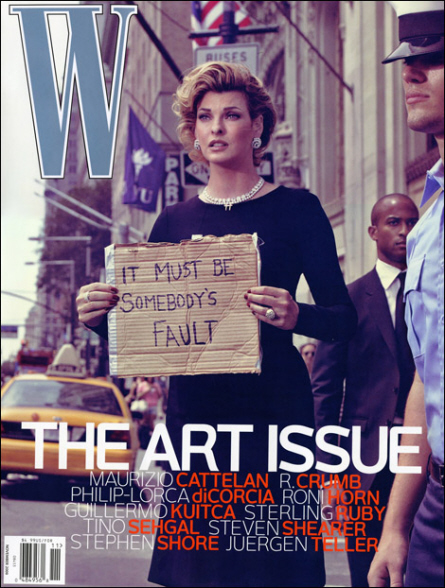
While it’s always nice to look a somethingone beautiful, it’s also nice to realise that there should be more to a model than what she looks like, and in a lot of cases, there is.

You only need to look at the aforementioned Banks and Klum’s careers in television (America’s Next Top Model and The Tyra Banks Show, and Project Runway and Germany’s Next Top Model, respectively), Erin Wasson’s foray into designing, and Kerr’s championing of a healthier life to see this in practice.

But I guess the question is, is this timeline representative of the success of certain types of models in response to our changing attitudes, or are our changing attitudes representative of the success of certain types of models?