On the (Rest of the) Net.

Rachel Hills answers the age-old aspiring-freelance question: “When should I stop writing for free?” [Musings of an Inappropriate Woman]

Last week, I emailed Hills to get her thoughts on feminist author Erica Jong’s assertion that the “younger generation” (she references her daughter, who is in her thirties) isn’t interested in sex. [Musings of an Inappropriate Woman]

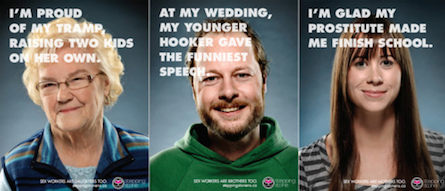
Also at Musings of an Inappropriate Woman, check out these reblogged images above.

Why is there such a big problem with porn? There’ll be more to come on this next week. [Jezebel, via The Scientific American]

Feminism, not enough sex, too much sex, and Muslims were the cause of the Norway terrorist, according to the Norway terrorist. [Jezebel]

Check me out: I’m Girls Are Made from Pepsi’s “Lady of the Week”!

Amy Winehouse VS. Norway: “On Caring About More Than One Thing at Once”:

“If the only world event worth commenting on is the most severe tragedy, then where does the pissing contest end? Yes, what happened in Norway was terrible, but what about what happened in Japan? What about what happened with the Asian tsunami? What about 9/11 here in the good ol’ US of A? (You said you’d never forget!) What about everything bad that has ever happened?” [Jezebel]

Girl with a Satchel’s Erica Bartle gets her faith on on MamaMia. You go, girl!

Also at MamaMia, Mia Freedman’s stirring the pot this week! She writes on Cadel Evans’ Tour de France win and if sportsmen should be considered heroes, the News of the World phone hacking scandal, and runs a guest post by Tony Abbott on why the carbon tax is a bad idea.

“What Your First Screen Crush Says About You.” [Jezebel]

Despite its misogyny, does hip hop actually promote lady love? [Jezebel, Autostraddle]

10 easy steps to radical self love. [Gala Darling]

Why rape cases don’t get prosecuted, parts one and two. [Jezebel]

“The 10 Coolest Witches in Pop Culture.” Where’s Teen Witch? And the Halliwell sisters? Disappointed. [Flavorwire]

“How Not to Propagate Bad News.” [Girl with a Satchel]

She’s out of your league. Kind of relates back to this article from a couple of weeks ago. [Jezebel]

I’ve just signed up to RSVP.com, so this article is kind of appropriate: “Questions We Wish Were Appropriate to Ask on a First Date.” [Jezebel]

Body image, burgers and the First Lady. [WSJ Speakeasy]

Four commentators, including a mum and a teen, weigh in on the Lady-Gaga-as-role-model debate. For more on this topic, check out this article. [Sydney Morning Herald, Girl with a Satchel]

Hugo Schwyzer in defence of talking to girls about beauty. [Healthy is the New Skinny]

“Does Free Birth Control Stand a Chance” in the USA? [Jezebel]

The problem with Black Swan. [Persephone Magazine]

What exactly is a “Mama Grizzly”? And no, I’m not talking about bears. [Newsweek]

“Born This Way” or choose to be gay? Does it really matter? [The Bilerico Project]

Do most men pay for sex in some way, whether it be porn or prostitutes? [Jezebel]

Images via Haley Tobey, Musings of an Inappropriate Woman.

Event: Ain’t Nothin’ Gonna Break My Slutty Stride.

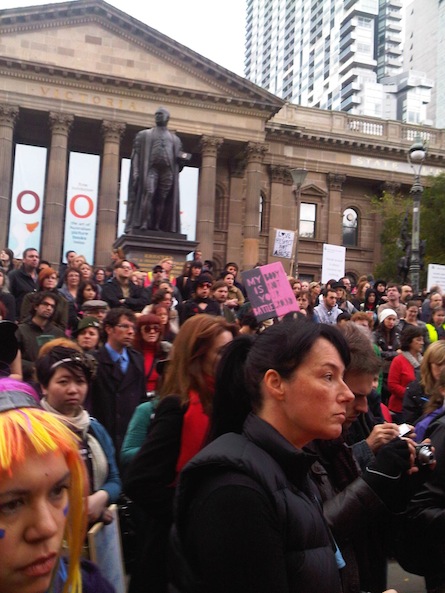
Ralliers outside the State Library on Swanston Street.

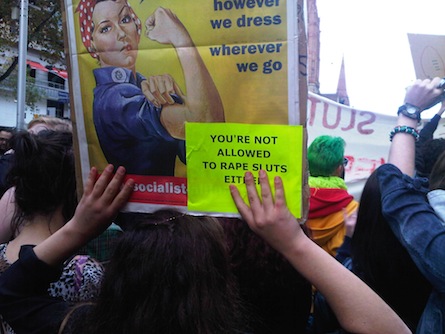
Best. Sign. Ever.

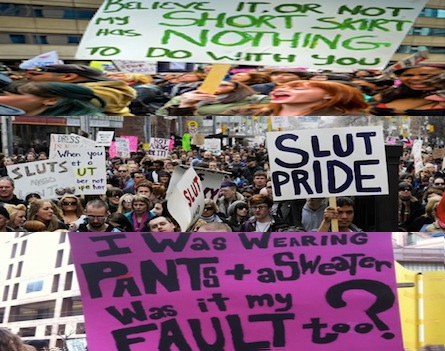
Last Saturday the highly anticipated SlutWalk occurred in several Australian cities, and I attended the Melbourne event with my fellow anti-slut-shamer friend Laura (both of us below).

We rocked up in our sluttiest outfits, which you can see above, complete with permanent marker declarations of our proud sluthood to boot. Some of the other outfits we noticed were short skirts with knee-high skull print socks and customised Doc Martins, worn by event organiser Clem Bastow (below), lace dresses and gym gear, the latter of which adorned a short-haired tattoo fan with a body Tracy Anderson would envy.

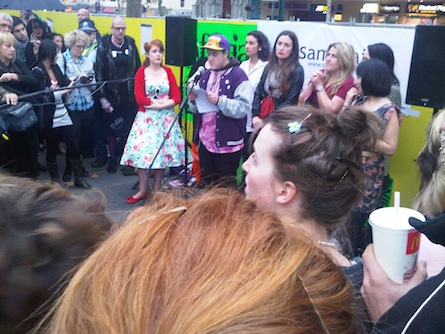
Clem Bastow.

Monica Dux.

As Bastow commented when she gave one of the opening addresses, along with fellow event organisers Karen Pickering and Lauren Clair, and noted feminists Monica Dux (above) and Leslie Cannold, amongst others: “thank you, God, it looks like you’re going to rain on me”. But no one was gonna rain on our parade and, despite the chilly temperatures, we still walked tall and proud in whatever get-ups we chose to wear.

Dux said this is the beginning of a movement, which I have to disagree with. SlutWalk is not the beginning of a movement; it is part of the reignited battle to stop victim-blaming and slut-shaming based on one cop’s archaic musings on rape and how much a woman was “asking for it”. Here’s a fun fact: WE’RE NEVER ASKING FOR IT! (See Bastow’s sign, above). No matter how we are dressed, where we are, how much we’ve had to drink, or what we do for work.

Speaking of, I was really proud to see the representation of sex workers at the event, and president of the Australian Sex Workers’ Association, the Scarlet Alliance (represent!), Elena Jeffreys (above) spoke about her sexual assault and that even though she was paid for sex, she was not consenting to assault. Her opinions on the SlutWalk were really interesting and I hope they receive as much publicity as the negative perceptions of the rally have in the media.

In the days leading up to SlutWalk, I was embroiled in a heated debate on Facebook with a friend who disagrees with the SlutWalk. I think he confused—like a lot of people—the meaning of the SlutWalk with an excuse to get gussied up in a very risqué manner when, in fact, that was not at all what it was about. That didn’t stop protestors on the steps of Parliament House at the top of Bourke Street brandishing their “rape is horrifying, but so is immodesty” placards (above). Like one of the speakers (whose identity escapes me: should have used my BlackBerry voice recorder!) said: it’s not up to us to curb our behaviour (and that includes how we choose to dress) at the risk of potentially being sexually assaulted; it’s up to those who sexually assault to curb their behaviour!

I think most people against the SlutWalk had a problem with the use of the word slut. As Cannold said, “words matter…: … we won’t stand for one, the same one, being slung at us over and over again to demean and degrade us.” Lori Adelman, in a post on Feministing, said she didn’t agree with the term “slut” and that she “would much rather have attended a ‘Do Not Rape’ Walk”:

“I find that the term disproportionately impacts women of colour and poor women in order to reinforce their status as inherently dirty and second-class, and hence more rape-able.”

To me, “slut” is just a word. It meant as much to me to be called a slut when I was 12 as it does today; as they (and Rihanna) say, sticks and stones will break my bones but names can never hurt me. It’s not about the term “slut”, it’s about the backwards and extremely offensive views that go along with that word. As coordinator of the first SlutWalk in Toronto, Sonya Barnett, told Rachel Hills: “if he [the policeman] had said something else, we would have called it something else.”

The speaker who garnered the most attention, though, was transgendered man, Cody Smith (above), who had been raped both as a biological female, and as a trans man. There were tears a plenty during his speech!

It was nice to see such a welcoming, non-judgmental turnout of everyday men, women and children of all walks of life, wearing all sorts of garb, not just the fishnetted and cut-out body con dresses that certain attendees chose to wear (guilty as charged!). After all, rape is not about what you’re wearing, what you look like, what size you are, how old you are, what your sexual orientation or gender is, or any other denomination that you happen to belong to as a person. It is about the perpetrator, and nothing you can or cannot do will stop them from attempting to rape you.

As Smith said, it shouldn’t be the victims of sexual assaults’ responsibility to educate the general public on sexual assault and victim-blaming. And I thought the sexual revolution happened several decades ago: it shouldn’t be up to members of a fringe movement to educate the general public on the sexual rights of women to express themselves however they please without the threat of retaliation. In fact, feminism—which is what the SlutWalk was all about—shouldn’t be considered as on the fringe in 2011.

Related: SlutWalk.

So a Tattoo Makes Me Public Property, Huh?

Has Feminism Failed?

Rihanna’s “S&M”: Is it Really So Much Worse Than Her Other Stuff?

Elsewhere: [Feministing] SlutWalk: To March or Not to March.

[Musings of an Inappropriate Woman] Ask Rachel: What Are Your Thoughts on SlutWalk?

Black and white images via Ali Ryan Photography.

On the (Rest of the) Net.


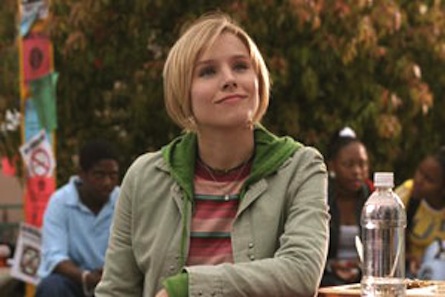
“The Class Boundaries of Veronica Mars.”

Why the Body Image Advisory Group’s voluntary code of conduct didn’t work.

Rachel Hills on the internet, artifice and being fake.

“The New Middleton Class”.

Speaking of the Middleton’s, Melinda Tankard Reist takes issue with the admiration of Pippa’s ass online:

“The FB site provides an opportunity for men everywhere to share their sexual fantasies for the young maid of honour. Knock her up, bash her in, cause her injury such that she would not be able to walk. Wrecking and shredding a woman’s anus is a popular porn script.

“And all this is supposed to be accepted as a compliment. Of course there are no ‘Pippa the Wonderfully Supportive Sister Appreciation Societies’ or other pages lauding her gifts and character and other non-body related attributes.”

Bret Easton Ellis on the spectacle that is Charlie Sheen.

“Filling the Gaps” in the online feminist community’s “call-out culture”.

In what was Elizabeth Taylor’s last interview, with Kim Kardashian for US Harper’s Bazaar, she divulges her thoughts on living like a queen, the Krupp diamond and Twitter. I was never a fan of Taylor, but this interview made me one.

What does it mean to be a feminist today?

Is the male body “Repulsive or Beautiful?”

Ever been hollered at in the street as you walk past a construction site? “Why Men Cat Call” sounds interesting, but is disappointingly dismal.

Amélie sex (noun): intercourse undertaken in the classic missionary position which, by itself, is not objectionable—during which the male is impervious to the female’s lack of enjoyment.”

The bromance VS. Bridesmaids“Homance”.

Don’t give up your day job: “Freelancing on the Side.”

Images via I Just Have So Many Feelings, Sydney Morning Herald.

UPDATED: SlutWalk.

For those of you yet to be persuaded to join in the SlutWalk festivities this Saturday 28th May at the State Library, here are some excerpts from SlutWalker Jaclyn Friedman’s talk at the Boston, Massachusetts event, from Feministing:

“Is a slut a girl who has sex too young? With too many partners? With too little commitment? Who enjoys herself too much? Who ought to be more quiet about it, or more ashamed? Is a slut just a woman who dresses too blatantly to attract sexual attention? And what do any of these words even mean? What’s too young, too many partners, too little commitment, too much enjoyment, too blatant an outfit? For that matter, what’s a woman, and does a slut have to be one?

“… You can call us that name, but we will not shut up. You can call us that name but we will not cede our bodies or our lives. You can call us that name, but you can never again use it to excuse the violence that is done to us under that name every single fucking day.

“… We can be called sluts for nearly any reason at all. If we’re dancing. If we’re drinking. If we have ever in our lives enjoyed sex. If our clothes aren’t made of burlap. If we’re women of colour, we’re assumed to be sluts before we do a single thing because we’re ‘exotic.’ If we’re fat or disabled or otherwise considered undesirable, we’re assumed to be sluts who’ll fuck anyone who’ll deign to want us. If we’re queer boys or trans women, we’re called sluts in order to punish us for not fearing the feminine. If we’re queer women, especially femme ones, we’re called sluts because we’re obviously ‘up for anything,’ as opposed to actually attracted to actual women. If we’re poor, we’re gold diggers who’ll use sex to get ahead. And god forbid we accuse someone of raping us—that’s the fast track to sluthood for sure, because it’s much easier to tell us what we did wrong to make someone to commit a felony violent crime against us than it is to deal with the actual felon.

“You know what I expect will happen when I’m dressed like a slut? People will want to get with me. You know what I don’t mean when I dress like a slut? That anyone I encounter can literally do anything at all they want to me. I know. It’s shocking. Because clearly you thought me wearing my tits out like this gives every single one of you carte blanche to do anything whatsoever you might want to do with my body. I’m very sorry to disappoint.

“… I just want to point out how ridiculous it all sounds when you spell out the meaning of ‘she was asking for it.’ Because the rapists are not confused. Those tiny percentage of guys doing most of the raping? They’ve told researchers that they know full well they don’t have consent. It’s the rest of us that seem confused. We’re the ones that let them off with a little ‘boys will be boys’ shrug and focus our venom on ‘sluts’ instead, leaving those boys free to rape again and again.

“… There’s nothing wrong with being a slut. Not a thing. It’s OK to like sex. Sex can be awesome. It can be life-alteringly awesome, but even when it’s not, it can be a damn good time. Our sexual desire is part of our life force. And as long as you’re ensuring your partner’s enthusiastic consent, and acting on your own sexual desires, not just acting out what you think someone else expects of you? There’s not a damn thing wrong with it. Not if it’s a hookup, not if you’re queer, not if you like it kinky, not if your number’s too high. If you’re playing on your own terms and you’ve got an enthusiastic partner? Please, I beg of you, just have a fucking awesome time. Our lives are way too often full of struggle and pain. If you can do something with someone else that brings both of you pleasure and joy? You’re increasing the pleasure and joy in the world.

“There has been a lot of misunderstanding about the meaning of the SlutWalk, and none more egregious than those who claim our agenda is to encourage all women to be sluts. Whatever that means, our mission could not be further from that. Our mission here today is to create a world in which all of us are free to make whatever sexual and sartorial choices we want to without shame, blame or fear. If you dress and experience your sexuality in decidedly unslutty ways, and you know that there’s nothing we can do to make someone rape us, the SlutWalk is your walk, too…”

*

Never before (okay, this year) have I been so excited for something. That includes the multitude of costume parties I’ve been to this year.

About a month ago, I cottoned on to the buzz surrounding SlutWalk, an event spawned by Sonya Barnett and Heather Jarvis, after they heard a Toronto police officer telling a rape victim that she wouldn’t have been attacked had she been dressed less provocatively.

The first march was in early April, and was met with great success. Other events have been staged in Dallas, Texas and Boston, Massachusetts.

Next Saturday 28th May, SlutWalk comes to Melbourne, and I am beside myself with excitement. The only rally I’ve ever marched in was when I was 15, for (or rather, against) nuclear power with my mum, sister and bestie. I wasn’t really informed enough to have views on nuclear power back then, and I’m still undecided about it. Obviously the disaster in Japan highlights the question mark surrounding the idea of nuclear power in Australia.

However, I do have strong views about slut-shaming, rape, sex and reproductive rights, and I will be immensely proud to walk alongside my fellow sluts, as we reappropriate the word, much like the gays have reclaimed “fag”.

Obviously, rape is not about how a woman is dressed or how much lust she inspires in men, regardless of what she’s wearing. Women are raped when they’re on their morning jog, walking to and from work, out at night in their nicest outfit, or in their home by a friend or family member. I resent the comments that police officer made, and I will be wearing my “sluttiest” outfit in protest. But I’ll be wearing it with a prim and proper bun.

To join the SlutWalk, visit their Facebook page.

Related: Apocalypse Now: 2012 Come Early?

So a Tattoo Makes Me Public Property, Huh?

Elsewhere: [Feministing] “You Can Call Us That Name, But We Will Not Shut Up.”

[Facebook] SlutWalk.

Images via MamaMia.

On the (Rest of the) Net.

Embrace your inner slut:

“If someone calls you a slut, there’s nothing you can say to refute the claim because it never had any cognitive content anyway.

“If you try to argue that you’re not a slut, you’re implicitly buying into the idea that there are sluts out there. If there’s some criterion that will set you free, that standard will indict someone else—someone with a higher ‘number,’ or shorter skirt, or a later curfew. So we get bogged down in slut/non-slut border skirmishes over a line nobody should have tried to draw in the first place, and we all lose.

“Even virginity is not a defense against alleged sluttiness. Virgins can be sluts if they dress the wrong way, walk the wrong way, or even instill the wrong thoughts in other people. Some people will convict you of sluttitude because your body is the wrong shape, or the right shape.”

Sluts just can’t win. That’s why you should (as above) embrace your inner slut and join the SlutWalk next weekend in Melbourne, at the State Library from 1pm. I’ll be blogging more about this throughout next week.

Glee’s Mercedes just can’t get a date!

Video vixen VS. female bodybuilders:

“It is not ‘respectable’ to be black, female, voluptuous, and sexy on a stage for profit, but it is perfectly acceptable to be black, female, muscular, and ‘unsexy’. Is this double standard acceptable? Is one profession truly more sexualized than the other?”

I don’t entirely agree with this hypothesis. I think it’s far more acceptable to be conventionally and femininely sexy, as opposed to muscular and unconventionally masculine. Sure, the video vixen job title isn’t exactly perceived as a classy, “respectable” occupation, but neither is female bodybuilding. Society as a whole would much rather see women shaking what they were born with (or, you know, what the plastic surgeon gave them) than manipulating their bodies via hormones and free weights.

The surrogacy debate rages on at MamaMia

“$150,000 Doesn’t Make You Rich. Discuss.” Okay, I will: I come from a family where my mother stayed home with my sister and I, and my dad worked three jobs at some stages. I was very young then, so I have no idea how much money he brought in. But I can tell you, it sure as hell wasn’t $150,000, and we struggled to keep our heads above water week-to-week. We never had savings, we could never go on family holidays that required much travel because we couldn’t afford flights or accommodation. I missed out on all but one of my seven cousins’ weddings because we couldn’t make it interstate. My parents have only bought two houses in their lifetime: the other nine we resided in throughout my lifetime were rentals. I also don’t know how much my dad makes now, but it is a lot less than $100,000, and my mum’s on a pension. In my opinion, $150,000 a year is rich.

“Opposition leader Tony Abbott says the Government is punishing ‘aspiration and hard work’,” with the new middle class welfare breaks. Is working three jobs and hardly being able to see your family not hard work, Mr. Abbott?

How to deal with your boyfriend’s porn-watching habit.

The argument for Pixar movie heroines who aren’t princesses, “from all the girls with band-aids on their knees”.

The perils of being smiled at by a cute guy in a café when you’re not wearing makeup.

Texas’ “10 Hottest Female Sex Offenders”. “No doubt that 4-year-old boy, that 2-year-old boy and that 13-year-old girl are taking solace even as we speak that at least they were abused, molested and assaulted by a hot person.”

Hillary Clinton, brownies and Vanity Fair’s cover line.

The aftermath of the royal wedding and the state of Britain’s monarchy for the next 30 years.

Gay/straight chicken: when straight men insult homosexuality and “gay men insult women”.

“Is Kate Hudson Coasting on Cuteness?” My money is on “yes”. When was the last time she starred in a box-office smash, or was nominated for an award other than a Razzie?

Images via Jezebel, Fashion Fame.

Book Review: Mia Culpa—Confessions from the Watercooler of Life by Mia Freedman.


Mia Freedman really is a brand unto herself. We all know she revolutionised the magazine world at age 25 as editor of Cosmopolitan. Her blog, MamaMia, really came into its own during last year’s federal election, offering a different take on politics for modern women. And she’s now a three-time published author with her own television show on SkyNews!

Of course she credits her husband, Jason, her kids, friends, family and MamaMia team with supporting her and helping run her media juggernaut, all of whom she writes about—sometimes anonymously, but oftentimes not—in her latest memoir-cum-“long, wonderful dinner-party conversation”, Mia Culpa: Confessions from the Watercooler of Life.

A lot of the material that makes up Mia Culpa I’ve read before, I will admit, in Freedman’s Sunday Life column, her blog, and various other publications she makes appearances in. But I’ve been known to revisit favourite blog posts and articles before, so it was very enjoyable to read Freedman’s musings on everything from sex to SNAGS (p. 64–67) to showering (p. 290) to breastfeeding (p. 175–179) to interior design (p. 129) to social stamina (read: non-existent when you have a young family, p. 131–136) to Christmas (p. 148–152) to how many children you want/have (p. 71–75) to the hypocrisy of being a certain-meat eater (“I’ve never eaten things like duck or rabbit or deer because I relate to those animals in a way I don’t relate to chickens—perhaps because many of them were storybook characters. Bambi, anyone?” [p. 145]. Guilty as charged) to Disney princesses (p. 180) to The Secret (p. 301).

Some of my favourite parts existed in the first chapter and were a nice way to begin the book. In it, Freedman writes about grooming standards in long-term relationships (p. 4–12), choosing between your ass or your face as you grow older (p. 13–16), skinny-shaming VS. fat-shaming (p. 16–23) and the pre-requisite rant on unrealistic portrayal of women VS. men in the media (p. 23–32). But when she puts it like this, it’s hard not to see Freedman’s point:

“Pretend the world was full of pictures of naked men. On billboards and the sides of buses, in magazines and ads for beer, cars and deodorant. Imagine there were penises everywhere you turned and you couldn’t escape seeing them every day.

“And all the images of nude men were fake. Every male model and celebrity had had penile enlargement surgery, and afterwards, his penis had been extensively photoshopped to make it look even bigger. So now, all the penises you saw in the media every day were knee-length and as thick as an arm.

“One day, next to a magazine article about a celebrity with a foot-long penis, you read the headline: ‘This is what a 43-year-old penis looks like’. The caption underneath read: ‘Asked for the secret to his long schlong, former male model Markus Schenkenberg insists he was just born that way. “I wear cotton boxer shorts and I exfoliate in the shower,” he shrugs. “That’s all I do.”’

“After reading a hundred stories like that and being bombarded by 10,000 images of men with surgically altered and digitally enhanced penises, do you think you might look down at your natural, un-photoshopped trouser snake and feel a little… deflated? Inadequate? Insecure? Angry?”

There’s also some of Freedman’s fascinating thoughts on being a “try-sexual” as per Katy Perry’s “I Kissed a Girl” (p. 241–244), which has been written about extensively on sites like MamaMia and Rachel Hills, and tattoos (more on that to come later today).

You don’t have to be a Freedman fan-girl to enjoy this book; I would recommend it to anyone who happens to be of the female gender, and even those who don’t happen to be but are just looking for some enlightenment on the species.

Related: MamaMia: A Memoir of Mistakes, Magazines & Motherhood by Mia Freedman Review.

UPDATED: Skinny-Shaming VS. Fat-Shaming.

“Who the Bloody Hell Are We?”: The Sentimental Bloke at the Wheeler Centre.

Elsewhere: [MamaMia] MamaMia Gets a TV Show.

[MamaMia] Cindy Crawford is Naked in Allure Magazine. And 43.

[MamaMia] I Kissed a Girl. Because I Had Something to Sell.

[MamaMia] Kissing a Woman Does Not a Lesbian Make.

[Rachel Hills] The Rise of the Guy-On-Guy Kiss.

Image via Australian Women Online.

Magazines: Paper Dwarves, Digital Giants?


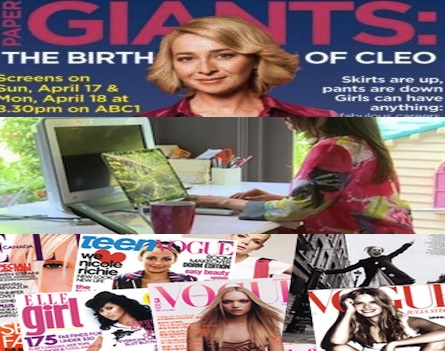
A few weeks ago, in response to ABC’s Paper Giants: The Birth of Cleo, Mia Freedman wrote on MamaMia about her thoughts on the state of the (mag) nation and if magazines are still relevant and the amount of influence they wield in 2011:

“… Not that much excitement goes on in magazines anymore… [It’s a struggle to] get them [those who work on a magazine] to try and think about something that hasn’t been done before, something that will start a conversation and boost sales.”

Freedman compares pay TV’s Park Street, a The Devil Wears Prada-esque reality show about ACP’s head offices, featuring the editors of Dolly, Cleo, Cosmo, Madison and Shop Til You Drop, which received dismal ratings and poor audience response, to the critical success and brilliant take on Cleo in her influential heyday of Paper Giants. She says, “Gemma Crisp [editor of Cleo] explained the editorial process that a story undergoes from conception to publication. It takes a minimum of three months… When was the last time you waited three months for something? Life doesn’t happen in increments of months anymore. It happens in moments, in text messages, in Tweets. It’s fast and it’s relentless and if it takes you three months (or even three weeks) to get from thought to print then that’s just too long to retain the attention of your audience.”

When she puts it like that, Freedman makes me long for a simpler time, when I hung on the every word magazines published, as opposed to reading hundreds of articles a week, mostly on blogs, but also in magazines, in an attempt to stay on top of my blogging game.

Erica Bartle, creator of Girl with a Satchel and a former mag girl herself, says Freedman’s “blog-cum-website” “deals in what everyone’s talking about TODAY. It feeds off the 24-hour news cycle. And Mia’s own profile. And her opinion… It’s like a current affairs program for women online.” And now with MamaMia launching on SkyNews, Freedman’s brand is literally a current affairs program.

Not all blogs can operate this way. MamaMia has a team of bloggers, editors and techs who keep the site running smoothly which thus, as Bartle said, allows it to operate on a 24-hour news cycle.

Personally, I have a part-time paid job I go to four times a week, this means I only get to blog two or three days a week, and with so much info to process and a maximum of 15 posts per week to churn out in a small amount of time, this means I can’t always post as early and as often as I’d like.

But even for those who blog fulltime, like Bartle, it’s not always about what’s happening right NOW as it is about maintaining the blog’s integrity.“I personally operate on a different plane, because my beliefs very much inform my work. For that, I’m willing to sacrifice certain economic constraints,” she says.

Still in the blogging world, you have someone like Gala Darling, who is very much a self-made businesswoman as a result of her über-successful blog of the same name. She’s gone from strength to strength over the past few years; something she could never have done had she been a magazine editor (bar the select few, like Anna Wintour, Anna Dello Russo and yes, Freedman).

But, essentially, MamaMia has the advantage of possessing “a figurehead with credibility whose background is in traditional media. She has the gut instinct of an editor. Online you need news nous as well as technological nous and business nous.”

Another editor who has these qualities in spades is former Cleo and Girlfriend editor, Sarah Oakes, whom Bartle worked under at Girlfriend. Bartle says she invoked an atmosphere of ghosts of magazines past, creating “camaraderie, creativity and positivity, which I think she achieved. She gave you more work if she thought you could be stretched; gave you a talking to if you had crossed a line; gave you a pat on the back for a job well done.” Very Ita-like, wouldn’t you say?

Oakes is now editor of The Age & Sydney Morning Herald’s Sunday Life supplement, a title which has improved markedly since she took over. (I have also blogged here about how I think both Girlfriend and Cleo became better titles under her leadership.)

In fact, newspaper inserts are giving the glossies on the newsstand a run for their money, as they “are getting exclusives and have strong writing and design teams, as well as columnists and styling/shoots. These free weekly titles, because of the mastheads they reside within, have enviable readerships and access to celebrities. They are also respectable, well executed and FREE,” Bartle notes.

But at the end of the day, are magazines relevant?

Freedman writes:

“The internet has not only sucked up their readers, it has also gobbled up their purpose: to be a way women form tribes and communicate. Now there’s YouPorn and any other number of sites for titillation, Google for questions about sex, and any number of websites or free newspaper magazines if you’re looking for other types of content or a magazine-style experience. Women don’t want to be spoken TO anymore. They want to be part of the conversation, something which the internet allows, in fact depends on… the internet has taken the sting out of the raunch-factor for mags like Cosmo and Cleo.”

Yes, as Freedman says, there are much raunchier locales to get what would have been included in a sealed section only a few years ago. There’s also Perez Hilton, TMZ and even shows like Entertainment Tonight and E! News that monopolise celebrity content, while the fashion blogs are more of a go-to for what kids are wearing these days.

Sure, Vogue’s always going to be a premiere source for high fashion shoots from photographers the likes of Annie Leibovitz, Patrick Demarchelier and David LaChapelle, but magazines “seem to exist on a strangely distant planet where all the people look like plastic and the sole pursuit is ‘perfection’. Except that perfection doesn’t really exist,” says Freedman.

When sites like Jezebel, Cover Girl Culture and, yes, MamaMia and Girl with a Satchel are debunking photoshop myths and striving for more realistic representations of women in the media, magazines are doing this movement any favours. (Except maybe Brigitte.)

And when you can get most of a magazine’s content online anyway (I passed on a near-$20 copy of US Harper’s Bazaar in favour of accessing interviews with Kim Kardashian and Hillary Clinton on their website), are they really worth it?

Bartle doesn’t think so. “No, but they need to be distinctive from what we can get online or elsewhere if we are going to part with $5-$10 to purchase one. Premium magazines, which I have no qualms spending extra on, include The Gentlewoman and O The Oprah Magazine, because they cater to my tastes, sensibility and need for a good read on a Saturday afternoon with a cup of tea.”

I agree with Bartle’s sentiments.

While online is great for content from individuals not curated and/or watered down by magazines editors to fit the mold of their magazine, holding a truly great glossy in your hands, like the appeal of a physical book, while at the hairdressers, a café or tucked up in bed, means magazines will always hold a place in our hearts.

Right next to the Kindle and Google Reader.

Related: Paper Giants: The Birth of Cleo Review.

Everything They Touch Turns To Gold.

The Evolution of the Bookshop at The Wheeler Centre.

Elsewhere: [MamaMia] Paper Giants VS. Park Street: Why Magazines Are Not What They Used to Be.

[MamaMia] MamaMia Gets a TV Show.

[Girl with a Satchel] Homepage.

[Girl with a Satchel] Mid-Week Media Musings.

[Gala Darling] Homepage.

Images via ABC, MamaMia, Teacup.
A Slut By Any Other Name?


From “Slut Shaming: It’s Not About How Much Sex You Have” by Rachel Hills on Musings of an Inappropriate Woman:

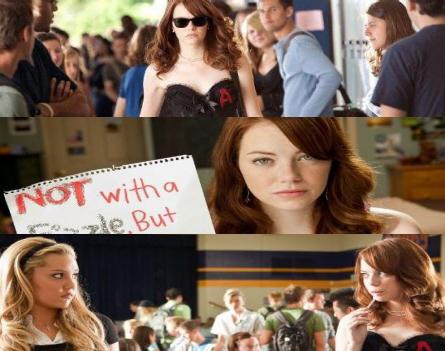
“When I hear the word ‘slut’ bandied about, it usually has less to do with the number of partners a girl has or what she wears, than with her perceived threat to the Girl Code.

“It’s about stuff like flirting with another girl’s boyfriend (or hell, flirting with another girl’s love interest), or seeming too interested in the attentions of men (particularly men whom other women are interested in the attentions of). It’s about the possibility that professional success might be predicated in some way on sex appeal. It’s about the fear that the ‘slut’ in question might betray you for a man … or even just for a fun night out.”

Elsewhere: [Musings of an Inappropriate Woman] Slut Shaming: It’s Not About How Much Sex You Have.

Images via IMDb.

Born This Way.


From “If We’re Born Gay, How Would We Know?” by Lisa Wade on Jezebel:

“It is a specifically American belief that gay men act feminine and lesbians act masculine.  But, in fact, gay men and lesbians have a wide range of gender performances, as do straight and bisexual people.  In fact, most of us could probably find a picture or two in our histories showing gender non-conformity.  Meanwhile, most gay men and lesbians could probably find pictures of themselves conforming.  That gender performance is associated with sexual orientation in our society is a belief in U.S. culture, but it’s not somehow inevitable or biological.”

Elsewhere: [Jezebel] If We’re Born Gay, How Would We Know?

Images via YouTube.

He’s Just Not That Into You… He’s Into Porn.

From “He’s Just Not That Into Anyone” by Davy Rothbart in New York Magazine’s porn issue:

“There is no glory in trying to make love to men who only know how to fuck—man after man after man after man raised on porn.”

Related: The Internet is For Porn.

Elsewhere: [New York Magazine] He’s Just Not That Into Anyone.