Lindsay Lohan & Double Standards.


From Vanity Fair, October 2010:

“We started talking about the double standards for famous men and women who misbehave. ‘It’s the same with men being dominant in the world and getting the easy way out and getting a free pass consistently,’ Lindsay said. ‘Like, if a man cheats on his wife… It’s not okay… But they still keep their deals, they still keep their contracts, they still keep their roles, they still get their gigs…’

“‘With girls,’ Lindsay said, ‘you lose. You lose everything. You lose contracts, you lose…’ She shook her head.”

A certain Charlie Sheen comes to mind…

Related: Guilty Until Proven Innocent: Charlie Sheen’s Witness.

Good-Time Girls.

Poor Little Rich Girl: Lindsay Lohan in Who.

Why Are Famous Men Forgiven for Their Wrongdoings, While Women Are Vilified for Much Less?

Bad Boys, Whatcha Gonna Do? Host a Seven Family Show.

On the (Rest of the) Net.

“Christina Aguilera: Always the Second Fiddle.”

I don’t believe in New Years resolutions anymore, namely because I could never realise mine. But I like Rachel Hills’ idea of writing an obituary for the year passed. In this case, her 2008 in review.

HuffPo on the absence of modern technology in modern literature:

“The average fictional character is either so thoroughly disinterested in email, social media, and text messages he never thinks of it, or else hastily mentions electronic communications in the past tense. Sure, characters in fiction may own smart phones, but few have the urge to compulsively play with the device while waiting to meet a friend or catch a flight. This ever-present anachronism has made it so that almost all literary fiction is science fiction, a thought experiment as to what life might be like if we weren’t so absorbed in our iPhones but instead watched and listened to the world around us at a moment’s rest.”

Girl with a Satchel ponders the price of a pretty picture.

“Caring for Your Introvert” is one of the best articles I’ve read all year (and considering it was written in 2003, that’s saying something). Here, an excerpt:

“With their endless appetite for talk and attention, extroverts also dominate social life, so they tend to set expectations. In our extrovertist society, being outgoing is considered normal and therefore desirable, a mark of happiness, confidence, leadership. Extroverts are seen as bighearted, vibrant, warm, empathic. ‘People person’ is a compliment. Introverts are described with words like ‘guarded’, ‘loner’, ‘reserved’, ‘taciturn’, ‘self-contained’, ‘private’—narrow, ungenerous words, words that suggest emotional parsimony and smallness of personality. Female introverts, I suspect, must suffer especially. In certain circles, particularly in the Midwest, a man can still sometimes get away with being what they used to call a strong and silent type; introverted women, lacking that alternative, are even more likely than men to be perceived as timid, withdrawn, haughty.

“The worst of it is that extroverts have no idea of the torment they put us through. Sometimes, as we gasp for air amid the fog of their 98-percent-content-free talk, we wonder if extroverts even bother to listen to themselves. Still, we endure stoically, because the etiquette books—written, no doubt, by extroverts—regard declining to banter as rude and gaps in conversation as awkward. We can only dream that someday, when our condition is more widely understood, when perhaps an Introverts’ Rights movement has blossomed and borne fruit, it will not be impolite to say ‘I’m an introvert. You are a wonderful person and I like you. But now please shush.’”

Furthermore, The Los Angeles Times notes that despite the introverted minority, television doesn’t reflect their existence very well. (Does television reflect anything very well?):

“Watch Seinfeld or Friends or Sex & the City or Community or Men of a Certain Age—the list is endless—and you’ll see people who not only are never ever alone but people whose relationships are basically smooth, painless, uninhibited and deeply, deeply intimate—the kind of friendships we may have had in college but that most of us can only dream about now. How many adults do you know who manage to hang out with their friends every single day for hour after hour?”

On that, Gossip Girl is notorious for misrepresenting reality. While she knows I love her, GG often makes me feel guilty about the clothes I’m not wearing, the sex I’m not having, and the events I’m not going to. Apparently, it’s not true to the books, either.

Check out The Washington City Paper for their musings on masculinity over the past decade, with a special focus on boy bands, metrosexuals, hipsters and guidos, à la Jersey Shore.

Gwyneth Paltrow: You either love her or hate her. I hated her with a passion until I saw her on Glee, in which she came across as carefree, cool and sexy and made her a tiny bit more relatable to the general populus who don’t subscribe to her Goop musings. Mia Freedman writes hilariously on this conundrum, with a focus on a related article from Salon.

Also at MamaMia, “17 Arguments Against Gay MarriageAnd Why They’re Bullocks” is brilliant.

Tangled will be the last fairytale Disney releases in a while.

Can you still be a feminist and dress in a bra top? (Of course you can; stay tuned for more on this next week.) Or espouse archaic notions of heterosexual relations, for that matter?

“The Ongoing, Albeit Amusing, Battle to Save Bristol” on Dancing with the Stars:

“‘This seems like a case of the rich, popular cheerleaders looking like they’ve sucked on a lemon when they learn that the poor girl in school, the one in the home-made clothes and religious family, gets elected Prom Queen.’

“I’ve rarely seen such a clean-cut example of the conservative tendency to say up is down and black is white. Or, more precisely, to bemoan how oppressed white, rich, and highly privileged people are.

“… But Bristol Palin hasn’t really done squat. She is literally famous for having a baby at an inopportune time. And now she continues to get promoted over more talented people than her because she was born into the right family… Bristol Palin is a hero to wingnut America because she’s a great example of rewarding someone for being born into privilege instead of on their merits.

“… I just find it extremely funny that the wingnutteria is backing someone with no talent on a show with no real importance to stick it to liberals who by and large don’t really care, and they’re doing so because they’re intoxicated by privilege and kind of wish they had a monarchy, but they’re pretending that they’re doing it because they want to see the oppressed rise above. I suppose after Dancing with the Stars is done, they should start sticking it to the liberals by defending poor, oppressed Paris Hilton, who is definitely the weird girl with handmade clothes that is picked on by cheerleaders.”

Mel Gibson and the curse of the “Sexiest Man Alive” tag.

On Stieg Larsson and the “disturbing”, “torturous” patriarchy of his Millennium trilogy.

Women are funny, too.
Attack of the Three-Dimensional Disney Character.

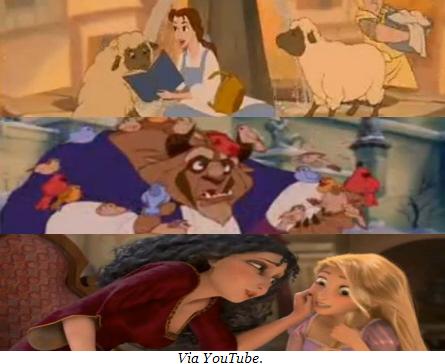
So there’s the vanilla damsels in distress of early Disney films, like Snow White, Sleeping Beauty and Cinderella. And there’s the first independent princess, Belle, “who enjoyed reading and learning, and who lived her life according to her standards”.

But there’s a new kind of three dimensional Disney character, in the form of the villain.

Now, The Beast from Beauty & the Beast isn’t exactly new (he’s pushing 20 years old), but seeing the process the Disney animators went through to create him in Dreams Come True: The Art of Disney’s Classic Fairytales (there’s also some featurettes on the DVD, which has been re-released from the vault) reveals just how complex a character he is.

Incorporating features from a buffalo, bear, gorilla, lion, boar and wolf, but with gentle cows ears, ensures The Beast doesn’t come across as completely horrible.

Both in the exhibition and in the curator’s talk I attended, it was mentioned that despite his ugly exterior, the Beast had to have attributes (both physicalthe aforementioned cows ears, and blue eyesand personality-wise) that a beautiful woman of Belle’s integrity, intelligence and courage could fall in love with. (It could be argued that there are some classic abusive relationship markers in Belle and the Beast’s union, but more to come on that next week.)

Elsewhere, in the upcoming Tangled, which is also featured in Dreams Come True, Mother Gothel, Rapunzel’s keeper, is the movie’s villain. However, she and Rapunzel share a more complicated relationship than that of Snow White and the Evil Queen, Cinderella and her evil stepmother, or Aurora and Maleficent (whose appearance was based on Katharine Hepburn, FYI), in that the animators wanted Mother Gothel to be “believable for Rapunzel to love”. God knows I’ve had my fair share of love-hate with my mother, so I think this movie will be quite relatable in that respect.

Can’t wait to see it in January!

Related: You Can Ring My Belle.

Women in Fiction: Are Our Favourite Female Characters Actually Strong, or Stereotypes?

Women in Fiction: My Favourite Fictional Females.

Elsewhere: [Overthinking It] Why Strong Female Characters Are Bad for Women.

[Overthinking It] Why Weak Male Characters Are Bad for Women.

Julian Assange—Modern Day Outlaw.


The Australian founder of whistleblower website Wikileaks, Julian Assange, has handed himself over to police today on “undisclosed sexual assault charges” (allegedly rape, which was then changed to having consensual sex with two women whilst claiming to have worm a condom, but didn’t).

He does have a certain creepy quality to him which makes me think it’s not unlikely he’s committed these crimes, but is that really the issue?

More than likely, these charges have been fabricated to get him behind bars, thus stopping him from publishing more confidential government documents and damaging international relations.

Do we really need to know that the U.S. thinks Kevin Rudd is an “abrasive control freak” or the common perception of world leaders such as Hillary Clinton or French president Nicolas Sarkozy? Most of the stories published in the mainstream media about Wikileaks doesn’t indicate many imperative top secret documents (related to terrorism, nuclear weapons etc.) that the general public arguably has a right to know have been leaked. Obviously there are larger issues at hand: Assange is a threat to global governments.

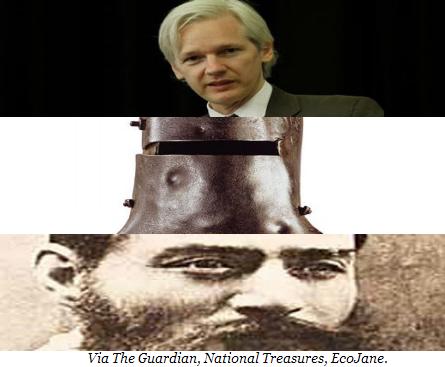
But here in Australia, Assange’s home country, he is viewed as a hero. Somewhat of a modern day Ned Kelly, if you will. Aussie’s appreciate an underdog sticking it to the man, so despite what his website has published, I think most Australian’s are probably rooting for him.

Wanted: Taylor Swift.

For crimes including slut-shaming, kissing and telling, homophobia, “anti”-bullying and self-righteousness.

At least according to this dialogue between Sady Stein and Amanda Hess on Tiger Beatdown:

“I have problems with Taylor Swift, which are, Example A: Slut-shaming, and Example B: The fact that she is posited as an anti-bullying Girl Power achetype when she writes songs that are like ‘go and tell my friends that I’m obsessive and crazy/that’s fine I’ll tell mine that you’re gay.’”

And yes, I did use other parts of this Tiger Beatdown article as inspiration for yesterday’s “Smiling Assassin” post.

Related: Smiling Assassin.

Elsewhere: [Tiger Beatdown] Sexist Beatdown: Revenge of the Smiler Edition.

[The New Gay] If Katy Perry Crapped in a Pizza Box, Would You Eat It?

Body Image: Skinny-Shaming VS. Fat-Shaming.

My mum is very thin.

She wasn’t always, though. In her late teenage years and early twenties, she was quite overweight. Dare I say, borderline obese?

Now, though, she’s tiny. At 52 years of age (and about 47kgs on the scale), she struggles to put and keep weight on.

She is constantly told how skinny she is by friends, family and even people she’s just met. If she were heavier, do you think people would be drawing as much attention to her weight; at least to her face? I doubt it (with the exception of the media if she were a public figure).

Why do people feel the need to objectify and vilify thin womenusing their weight as a weapon against them? Is it because it’s un-PC to do so with a fat person? Because they’re jealous? I would tend to lean more towards the former.

I have received this treatment myself, and while my body is nowhere near the slight size of my mother’s, I do try to take care of it by exercising. And to offset the fattening effects of my sweet-tooth indulgences. (The other day I ate a whole block of Cadbury Top Deck. And another whole block the following day!)

I wasn’t always the size I am now, either. (Truth be told, however, I have always hovered around a size 12; now I’m just more toned and lean towards a size 10.) In high school, my weekends usually consisted of sitting on the couch watching Friends and Will & Grace and eating. I led a very sedentary lifestyle back then; the difference between me then and me now is the fact that I exercise to counteract hours spent at the desk (okay, I won’t lie; it’s usually the couch!) blogging, or evenings spent chilling out with some books, magazines, blogs and TV.

So what gives people the right to blatantly draw attention to a small frame to the inhabitant of that frame? Don’t get me wrong; inhabitants of a larger frame have attention drawn to them all the time. But we usually have the decency to not do it to their faces. I don’t know which is worse; personally, that kind of thing is water off a duck’s back to me. Because I come across as cold, aloof and feeling-less, people think I have emotions of steel and they can say and do anything they want to me. I can take a lot of shit, but people like my mother can’t. People pointing out her pin-thinness is a sore subject for her.

I think it comes down to a similar school of thought that slut-shaming belongs to. And that seems to be that women who sell their bodies out to succumbing to the ideal shape or to receiving sexual pleasure are at the mercy of ridicule from others.

In this day and age, we’re learning to accept the curves of a larger woman (but only as large as the advertising and magazine industry displays as acceptable). But when can we learn to accept that women do take care of their bodies, and shouldn’t be singled out for doing so. More importantly, though, when will we learn to accept that some people really just can’t put weight on, and they shouldn’t be targeted as succumbing to the narrow beauty ideal presented by society. Much the same way as overweight people shouldn’t be targeted for not succumbing to it.

Thoughts?

’Tis the Season…

… for office Christmas parties.

As opposed to the boring lunches a few of my friends have mentioned their workplaces hold, my employer happens to go all out on the Christmas party front.

Last year’s theme was horror (odd for that time of the year, I know), and I came up with a Bride of Chucky costume, complete with doll. However, I was struck down with the flu a few days beforehand and was unable to attend. The fact they had a dance instructor teaching partygoers “Thriller” just added insult to injury.

This year, however, the theme is pirates.

As a member of the planning committee, I fought tirelessly (and by I, I mean my friend Laura, as I was in the midst of a wisdom-tooth haze when the theme was being chosen) to push through our original idea of cartoons, and failing that, 1920s/’30s swing.

Unfortunately, misogyny won out, and a pirate theme it was.

Talk about unoriginality, though. There are about three options of pirates in popular culture to use as a reference point: Pirates of the Caribbean (how many Jack Sparrow-wannabe’s but could-never-be’s will there be walking around?), Pirates of Penzance, and Peter Pan. If someone were to really think outside the box, they could get a party of five (pardon the pun) or six together and go as The Wiggles and Dorothy the Dinosaur, with Captain Feathersword as the MVP of the group.

Notice that these three ensembles have very limited roles for women. And as a workplace that employs just as many women as men, pirates is very limiting to the fairer sex.

Serendipitously, I happened to happen upon a three-year-old post by Rachel Hills discussing exactly this.

“‘I didn’t realise the boys were meant to come as pirates and the girls were meant to come as skanks,’” Hills’ friend laments at a pirate-themed party.

My point exactly; pirates is all well and good for men who are young-at-heart, and men who perhaps want to get their gear off and go shirtless, and men in general, but women are faced with exactly two options: slutty pirate or slutty wench.

Now I’ve got some co-workers who are happy to go as more masculine pirates. (One friend, Lana, sent me a picture the other day of her costume, and you can hardly tell it’s her and she looks great.) I haven’t come across many friends who are going as wenches, which may be a testament to my own views (and thus the changing views of society?) on the topic, but that doesn’t mean there won’t be plenty of buxom babes letting the stress of the year off their chests. In what was a poignant throwback-forward, perhaps, from my friend and former co-worker Tess, she came dressed as a pirate for my Halloween-themed birthday party this year, and managed to retain her dignity.

Sure, wenches are traditionally slutty by name and by nature, as noted in the comments of Hills’ abovementioned article, but that’s not the problem I have with them.

I’m the first to put my hand up (whilst simultaneously holding my skirt down) to embrace my inner sartorial slut when it comes to hitting the town (Hello?! Have you seen my Halloween costume?), and while I will not be attending my Christmas party as a wench, there will still be a hefty dose of slut in my outfit (pictures to come next week).

The problem I have with the limiting theme is that there is no room for originality or diversity, particularly for the female members of the payroll. It’s one slut fits all.

Related: The Witching Hour: Halloween/My Birthday at Witches in Britches Cabaret.

Elsewhere: [Musings of an Inappropriate Woman] Attractive = Hot = Not Much Clothing On?

[Rabbit White] In Defence of Slut-O-Ween.

[Rabbit White] Defence of Slut-O-Ween II: Straight People’s Pride?

[The Stranger] Happy Heteroween.

Smiling Assassin.


From “Sexist Beatdown: Revenge of The Smiler Edition” by Sady Stein on Tiger Beatdown:

“In adolescence, no-one is normal. That’s why it’s adolescence, for fuck’s sake. The girl who can pull off ‘normal’ the most convincingly is usually the girl who’s best at lying. And all too often, she is The Smiler. The Smiler is nice. The Smiler is pretty. The Smiler is popular, but not too popular; she’s just normal folks, you know? The Smiler is good in school and her teachers love her, but she’s not the valedictorian. The Smiler is in show choir and is cast in all the theatre productions, and she makes sure of her position by purposefully fucking with people’s heads and making them cry during auditions with ‘helpful advice’ about how nobody likes them and they should leave to make people happy, but she’s smiling. (Actual true story.) The Smiler is a respected youth group leader, a pillar of her community, and she tells the girl who’s been abused by her boyfriend that it wouldn’t have happened if she hadn’t presented herself so provocatively, but she promises that Jesus can make it better, and she’s smiling. (Also actual true story.) Sometimes, the Smiler is so good at what she does that the Smiler is your friend: Talk to the Smiler! Hang out with the Smiler! The Smiler only wants to help! Tell the Smiler your troubles—your many secret troubles that no-one knows about because you’d prefer to keep them private! But surely you can trust the Smiler? Except that two weeks later, everybody somehow knows a distorted Grand Guignol disastrous version of exactly what you told the Smiler, and your life is effectively over until college. (I was home-schooled.)

“… What I feel is that I am hanging out with the youth group leader/glee club star/all-around nice girl who also spreads a rumour about how you went to third base with Derek and are a total skank.”

Sounds a lot like Amanda Bynes’ character in Easy A, don’t you think?

Related: Easy A Review.

Elsewhere: [Tiger Beatdown] Sexist Beatdown: Revenge of The Smiler Edition.

On the (Rest of the) Net.

Just a short one this week, as I haven’t had a lot of time for reading. L

Rabbit White ponders the things she learnt about her own sexuality from the men at Mr. International Rubber:

“It is being put in a sexual situation when you are non-sexual. It’s being introduced to a new world all at once. But it’s not long before I feel comfortable here, basking in male sexuality that is totally not directed at me. I think I finally getting the draw to being a ‘fag hag’or ‘fairy princess’. I get to gawk and join in the lust without fear of being pulled in or anxiety of protecting myself. In the view from here, human sexuality is a celebration and male sexuality is valid and uniquely cool.

“I don’t know how many times I’ve read advice columns where girls write in, worried about their smell or unable to enjoy sex because they are self conscious. Perhaps it’s because girls are taught to please everyone else, putting themselves last, but there just seems to be something in female sexuality that is uncomfortable with receiving pleasure. Look at all the women’s mags, obsessed with ‘how to please a man’.

“But maybe the ‘pig’ concept could lessen fears around receiving pleasure. What if your partner liked you sweaty, smelly, just the way you are right now? And just wanted more and more and more of that.”

Sady Doyle, of Tiger Beatdown (lots of feminist goodness from them this week) discusses “The Fantasy of Girl World”:

“The fantasy of girl world often feels like the feminist imagination taken to its most self-indulgent, hypocritical extremes. We stand for tolerance and egalitarianism, whereas the people who disagree with us are IGNORANT WIFE-BEATING MONSTERS. Women, if left on their own, would eliminate war, poverty, heartbreak and pets that are not cats. But, here’s a question for you: Why shouldn’t it look like this? What’s wrong with a wish-fulfilment fantasy that tells women they could do well with power and without oppression? What’s wrong with girls geeking out over the idea that they’re special?”

Glee’s Rocky Horror episode failed to touch-a, touch-a, touch-a, touch Garland Grey at Tiger Beatdown:

“Early on in the episode Mike volunteers to play Dr. Frank-N-Furter, but a few scenes later he says his parents won’t allow him to play a ‘tranny’. Mercedes takes the role, delivering a show stopping version of ‘Sweet Transvestite’, but the word ‘transsexual’ is replaced by ‘sensational’. For Glee, transpeople are punch lines, not anyone the show needs to fucking think about. While doing Rocky Horror Picture Show, a musical whose entire message is about accepting people’s sexuality and gender.

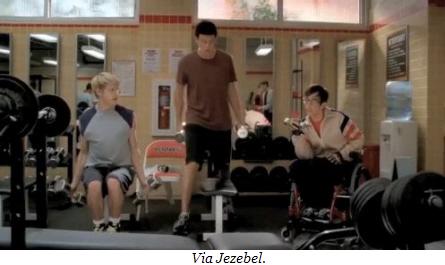
“Can we just cut out losses and rename this show Chord Overstreet in Tiny Gold Shorts? Clearly, he is fanservice and I don’t even care… However, as much as I appreciated seeing his abs, I didn’t care for the oddly-specific diet regimen he blurts out before showing them or the comically small weights Artie was holding. Artie’s a paraplegic, pushing himself everywhere in his wheelchair, lifting himself in and out of it dozens of times a day, and THAT is the biggest weight he’s lifting? That weight is a clear signal to the audience that Artie doesn’t belong in the locker room and is only there to provide comic relief…”

The four types of Facebook friends, according to Susan Orlean.

The Pervocracy on the “Slut, Deconstructed”:

“I’m 25. I lost my virginity at 15. So 26 partners is only two or three a year. It’s hardly going home with a new guy every night. To break it down further, 6 of those partners were serious romantic relationships, and you can’t call a girl slutty for sleeping with her own boyfriend, right? So now it’s 20 casual partners over 10 years—a raging, wild, man-eating two per year. I’m so cock-crazy I need it every six months, baby…

“Oh, and a woman in ‘my god, you can see her everything’ clothing dancing on tables and flirting with every guy in the bar might be a virgin for all you know about her.”

It’s the wrong time of year here, but there’s not many things I love more than trawling through the gossip magazines in summer, style-stalking the celebrities in Aspen and New York, longing for cool weather again to break out the beanies, woollen cardigans and shearling coats (okay, wrong continent for shearling!).

You Can Ring My Belle.

From Disney’s Dreams Come True: The Art of Disney’s Classic Fairytales:

“Arthur Rackham, the famed British illustrator of children’s fairytale books, said that there is no doubt that ‘we should be behaving ourselves very differently if Beauty had never been united to her Beast.’

“In Belle, Disney had its first independent female character, one who enjoyed reading and learning, and who lived her life according to her standards. Longing for substance in her life, she shunned the vacuous Gaston, over whom all the other ladies in town swooned. Belle’s genuine selflessness also distinguished her from the other women in town, including, most particularly, the ladies who pursued Gaston.

“While anyone else would have been overcome with fear, Belle’s devotion to her father gave her the courage to stay alone with the fearsome Beast in his remote castle.

“Her strong will earned the respect and devotion of the Beast.”

While some would say the Beast is the Disney equivalent to an emotionally abusive boyfriend (watch this space), this description of Belle shows that you have to love yourself before someone else will.

Plus, it proves that Belle is the most bitchin’ of the Disney princesses.

Related: Drug of Choice: The Disney Heroine.

Women in Fiction: My Favourite Fictional Females.

Women in Fiction: Are Our Favourite Fictional Females Actually Strong, or Stereotypes?

The Representation of Trees in the World of Walt Disney.