TV: The Underlying Message in Glee’s “Born This Way” Episode.


The underlying message this week is that there is none: acceptance—of Rachel’s Jewish nose, Quinn’s chubby-checker past and Tina’s “Orient descent”—was right there on the surface for all to see.

This is Glee’s second Lady Gaga-themed episode, the first of which was very Gaga-centric, however this week’s effort kicked last seasons’ butt!

The storyline began with Rachel getting hit in the face by Finn during a dance number, and her doctor recommending she get a nose job to fix her deviated septum, like big-nosed babes, Jennifer Aniston and Ashlee Simpson, before her.

She decides to take angel-faced Quinn along to the appointment, using her nose as an example of what she wants the new and improved Rachel to look like.

This is followed up by a tear-jerking rendition of “Unpretty” by TLC by unlikely soul-sisters Rachel and Quinn.

You might remember a few episodes back (although it’s been so long since a new episode has aired, both on Ten and in the U.S., that you could be forgiven for not remembering) when Quinn morphed from struggling with her social standing after giving birth last season to prom-queen obsessed, “I’m relatively sane for a girl”-espousing zombie.

I didn’t buy it then, and I’m glad we get a more in-depth look at her life now.
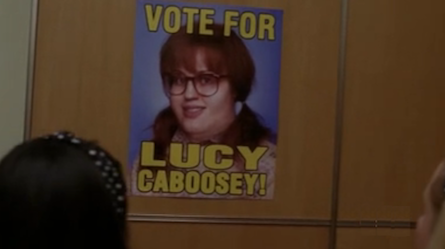
Lauren Zizes decides to run for prom queen, with Puck by her side as her king. Most of the non-size-two students at McKinley are ecstatic to see someone who looks like them running for prom queen, which should have given Lauren the heads up that her plan to take down Quinn wouldn’t work: she unearths Quinn’s past as Lucy Fabray, before she transferred to McKinley in eighth grade.

Lucy was overweight, uncool, and bullied constantly at her old school, until she joined ballet, gymnastics and cheerleading, lost weight and asked her parents for a nose job, at which point they began to call her by her middle name, Quinn.

Lauren plasters posters of Quinn as Lucy all over the school, which inadvertently sees Quinn’s approval rating go up 40% because her student body realises she’s not just a vapid beautiful person, but someone with problems and a past, just like them.

But not all of the glee club’s members are accepting that they were “born this way” out in the open.

Santana manages to convince Dave Karofsky to help her get Kurt back to McKinley, or else she’ll tell everyone he’s gay. In turn, her “Macbethian” and “Latina Eve Harrington” ways, she believes, will help her become prom queen.

Eventually, word gets back to Kurt about what’s really going on, and he agrees to return to McKinley on the condition that Karofsky be schooled in acceptance of gays and lesbians, even if he doesn’t come out.
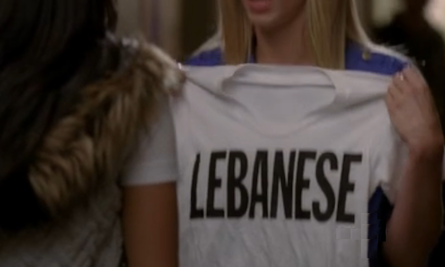
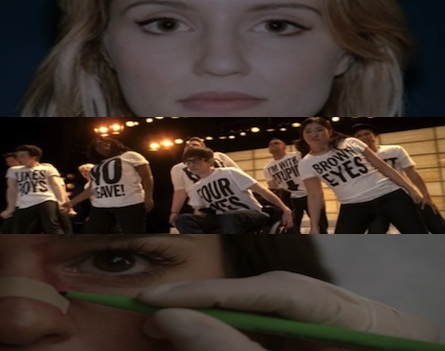
Santana could do well to adopt this school of thought, as she is still in the closet and still in pain that Brittany can’t be with her. Brittany makes Santana a “Lebanese” t-shirt for her to wear in this week’s performance (it was meant to say “lesbian”, but it’s a nice tie in to the “Born This Way” lyrics!)

Of course all the storylines are neatly wrapped up into a special 90 minute package, as is Glee’s style. Emma even manages to address her crippling OCD and goes to therapy.

But I think the most interesting “underlying message” of the episode was Santana’s view at the three-minute mark on changing things you’re not happy with.

As much as, on the one hand, our society preaches self-love and acceptance, what of all the beauty products, foods and exercise regimes that are spruiked to us on a daily basis via all mediums?

I don’t want to turn this into a rant on body image and the affect advertisements, magazines, TV, movies etc. have on it, but Santana does raise a good point: if changing things about you, like Rachel’s nose, Tina’s eye colour, or Sam’s “guppy lips”, makes you feel better about yourself, then so be it.

I got a tattoo a couple of weeks ago because I didn’t like the way the back of my neck looked without one; does that make me “hate myself”? Hell no! Anyone who knows me will tell you that I am confident in who I am, both on the inside and the outside. (Those who don’t just think I’m an arrogant bitch!)

But I think that if you are happy with yourself in general in most aspects of your life and can engage in “active critical thought” about the things you aren’t, what’s a little hairdo change here or gym membership there?

Or—dare I say it?—a nose job?

Related: The Underlying Message in Glee’s “Original Song” Episode.

Gwyneth Paltrow Addresses Tabloid Culture & Her Haters.

Glee “Sexy” Review.

The Underlying Message in Glee’s “Blame it on the Alcohol” Episode.

How to Make a Woman Fall in Love With You, Glee Style.

Glee “Silly Love Songs” Review.

The Underlying Message in Glee’s “Furt” Episode.

The (Belated) Underlying Message in Glee’s “Never Been Kissed” Episode.

The Underlying Message in Glee’s “The Rocky Horror Glee Show” Episode.

The Underlying Message in Glee’s “Duets” Episode.

The Underlying Message in Glee’s “Grilled Cheesus” Episode.

The Underlying Message in Glee’s “Britney/Brittany” Episode.

Is There Really a Beauty Myth?

Images via Megavideo.

Tina Fey on Women in Comedy, Olivia Munn & “Joan of Snark”.


From “Tina Fey on the Message of 30 Rock’s ‘Joan of Snark’ Episode” by Margaret Hartmann on Jezebel:

“That story [the controversy surrounding hottie Olivia Munn’s hiring by The Daily Show] is so loaded and complex that I was really glad that we did it and I think it has confused and sort of delighted the internet in a way because it sort of opens up more questions than it answers. For me it was about Liz is in the wrong. She thinks she’s doing the right thing by trying to correct this woman, by trying to say ‘you don’t have to be this way’ and at the same time, this girl has every right to be whoever she wants …

“It’s just such a tangled-up issue, the way that women present themselves—whether or not they choose to, as I say, put their thumbs in their panties on the cover of Maxim, and the way women judge each other back and forth for it. It’s a complicated issue, and we didn’t go much further saying anything about it other than to say, ‘Yeah, it’s a complicated issue and we’re all kind of figuring it out as we go.’

“In the episode we have a fake website, that we’re referring to a feminist website called JoanOfSnark.com that the women at Jezebel.com immediately recognized that it was their website basically. And it was a reaction to the way I saw Olivia Munn … treated on The Daily Show.

“… I don’t have the answer, but I find it interesting. That’s all I can say. I find it interesting that Olivia gets people who go after her sometimes on these sites—because she’s beautiful, I think is part of it. I think if she were kind of an aggressive, heavier girl with a Le Tigre mustache posing in her underpants, people would be like, ‘That’s amazing. Good for you.’ But because she is very beautiful, people are like, ‘You’re using that.’ It’s just a mess! We can’t figure it out.”

“Since Fey is probably the most prominent woman in comedy today, it can be frustrating when she raises thoughtful issues, then throws her hands up and says she just doesn’t know where she stands. It also seems she missed an important part of the discussion. People didn’t question Munn’s place on The Daily Show because attractive women can’t do comedy, but because she’s not particularly funny.”

Elsewhere: [Jezebel] Tina Fey on the Message of 30 Rock’s ‘Joan of Snark’ Episode.

Images via Jezebel, Complex, Daily Contributor.

Pretty Girl Bullshit.


White Girl Problems is the latest Twitter phenomenon to sweep the pop culture world, with such gems as “Fine, if that’s the way you’re going to act, then you’re uninvited to my Elizabeth Taylor memorial cocktails” and “I’m sorry you think I’m being a bitch”; the passive-aggressive “apology” heard in relationships the world over.

While the Twitter profile is poignantly taking the piss out of the problems of the privileged, there is the issue of race there, also.

Like, why is it called White Girl Problems? Why not Privileged Girl Problems? Or Rich Girl Problems? But even with that, it would be feeding into the classism debate. Whichever way you look at it, White Girl Problems is a double entrendre of racism and classism.

It also highlights the body image battle a lot of young girls face, be they white, black, rich, poor, or whatever. Here are a couple of examples:

While I’m not personally offended by the Twitter feed (I am a white girl with [first world] problems, after all), I can understand why some might be.

Racialicious, actually writing about the Alexandra Wallace/“Asians in the Library” scandal, says that it all comes down to “white female privilege”, meaning “you can say more outrageous shit because you’re a pretty white lady”.

That may be so (I have been known to voice my opinion on all manner of topics that may be deemed controversial: the baptism of babies being bullshit, pretentious parenting, and abortion [more to come on that last one in coming weeks]), but how long have men—of all races but, yes, particularly Caucasian ones—been getting away with it? And still are. Charlie Sheen and Chris Brown are two names that spring to mind…

Related: First World Problems.

Rihanna’s “S&M”: Is It Really So Much Worse Than Her Other Stuff?

Guilty Until Proven Innocent: Charlie Sheen’s Witness.

Why Are Famous Men Forgiven for Their Wrongdoings, While Women Are Vilified for Much Less?

Elsewhere: [Twitter] White Girl Problems.

[Racialicious] Go After the Privilege, Not the Tits: Afterthoughts on Alexandra Wallace & White Female Privilege.

Images via TV.IGN, Anu News, Film Junk.

The Beauty Myth.

From “How Yoga Makes You Pretty—Part 1” by Melanie Klein at Elephant Journal:

“We’ve been told that ‘pretty’ is the magical elixir for everything that ails us. If we’re pretty we’re bound to be happier than people who aren’t pretty. If we’re pretty, we’ll never be lonely; we’ll have more Facebook friend requests; we’ll go on more dates; we’ll find true love (or just get laid more often); we’ll be popular. If we’re pretty, we’ll be successful; we’ll get a better job; we’ll get rewarded with countless promotions; our paychecks will be bigger.  In short, ‘pretty,’ something Naomi Wolf refers to as a form of cultural currency in the feminist classic The Beauty Myth, will buy us love, power and influence. And, in the end, ‘pretty’ will make us feel good.”

Related: Is There Really a Beauty Myth?

Elsewhere: [Elephant Journal] How Yoga Makes You Pretty—Part 1.

Picture Perfect.


From “No Refuge: How Webcams & Cell Phones Ratchet Up the Pressure to be Perfect” by Hugo Schwyzer:

“… A young woman who had been scrupulous about her appearance all day could return to her bedroom at night, change into what was comfortable, and have at least a little waking time where her looks didn’t matter…

“The real problem is that the webcam has stripped the bedroom and the bathroom from their role as safe refuge from the beauty-obsessed culture…”

I find Schwyzer’s points to be particularly poignant to my own life.

Until a few months ago, I had lived either at home, with family who knew me from the day I was born and had seen me in all my glory (and not-so-glorious moments) for twenty-two years, or on my own. During that time, as soon as I would get home I’d change into my pyjamas, wipe the makeup off, and pop the curlers in, not caring what I looked like.

Then I moved in with my cousin, and I kept up appearances for a few days until I realised she likes to bum around the house in holey pants and nose strips, too.

Honestly, I don’t give a crap what I look like at home, and if I don’t want to draw attention to myself, I will adopt my at-home strategy in the big wide world, too.

For example, most mornings I go for a jog as soon as I wake, and usually stop by the supermarket on the way home. I chuck a bit of lipgloss on an whip my hair (though not in true Willow Smith style) into a ponytail, but other than that, I look pretty crappy. If I wanted to be stared at while I exercised, I would go to a juice-head gym in full make-up and a crop top or jog with my friend Tess at her neighbourhood track, where the beautiful people go to workout. But I don’t.

A similar situation occurred at my work Christmas party. I was getting my slut on when I was approached by Jack Sparrow. He initiated contact (both verbal and physical), asking which department I worked in and why he’d never seen me before. Unbeknownst to him, he had seen me before…

… Earlier that day, I rocked up for a few hours to help set up in jeans, a t-shirt, work boots (okay, they were Tony Bianco) and my glasses, where he was also lending a hand. He took one glance at me and continued with his work.

What’s even funnier? The following day I reverted back to my bespectacled self, and he went about his day, not realising that I was the girl from the night before.

I don’t begrudge him that, though. I deliberately do these things to fly under (or above) the radar.

Relating more closely to Schwyzer’s point, however, I’m lucky; my generation managed to bypass the whole webcam/sexting/profile pictured frenzy that consumes the lives of teens now. Who knows what pressures I would have facedand how differently my psyche would have developedif my privacy was constantly invaded by mobile phones, Facebook and the like?

Celebrities who are a little younger than I am, though, like Rihanna, Vanessa Hudgens and (the markedly younger) Miley Cyrus have succumbed to the allure of naked photography, with the latter also dabbling in the filming of lap dances to 40-year-old directors and experimentation with bongs.

Personally, I don’t understand the pull of compromising photos. My advice to teen starlets and football players alike? If you’re going to take compromising photos, make sure you’re the only one with a copy or JUST. DELETE. THEM.

Related: ’Tis the Season…

Elsewhere: [Hugo Schwyzer] No Refuge: How Webcams & Cell Phones Ratchet Up the Pressure to be Perfect.

Hot Girls Reading Books.

We’ve done the guys, now it’s time for the girls.

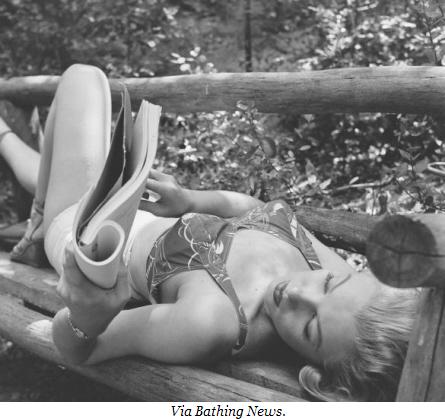
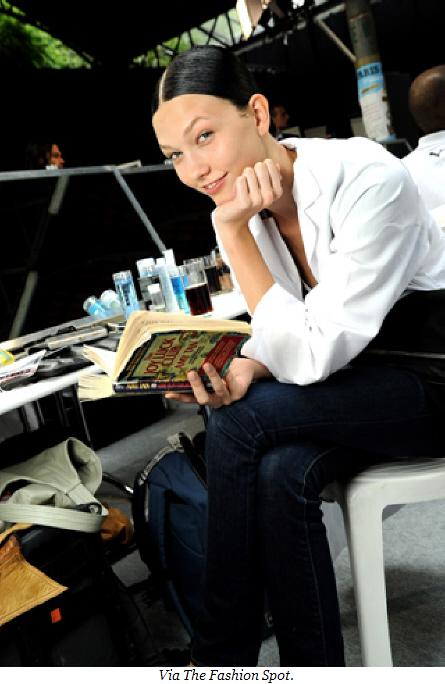
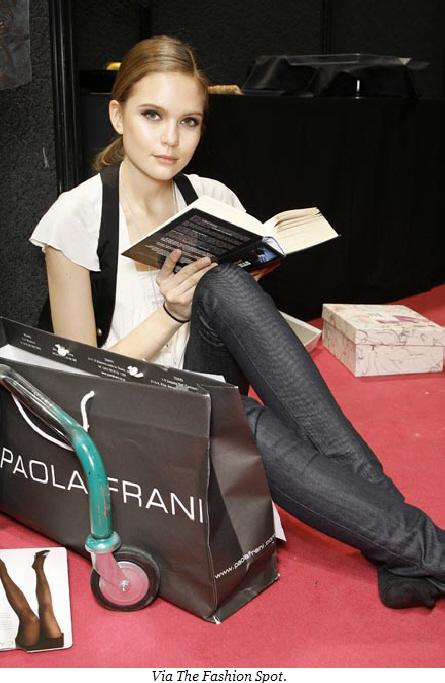
You wouldn’t believe what a struggle it was to find pictures of hot chicks reading. You would think there was a stereotype of beautiful women being dumb, wouldn’t you?

There’s non-threatening beauties like Audrey Hepburn, whom most would buy as a smart lady, and drop-dead stunners like Angelina Jolie, who’s proved herself via years of pushing the boundaries in terms of her art and her humanitarian work.

Everyone knows I love Marilyn Monroe, especially images of her laughing in the face of the stereotype surrounding her andGod forbid!reading.

You can’t get much hotter than a supermodel, right? Especially one who has a book on hand for all those idle hours backstage.

Related: Beauty & the Book.

Beauty & the Book, Take 2.

“With a Gun Between Her Legs”: Why Strong (AKA “Sexy” Whilst Being “Strong”) Female Characters Are Bad For Women.

All Eyes on Marilyn.

Fragments of Marilyn Monroe’s Literary Life.

Has Feminism Failed?

Last Wednesday evening, I went to a debate about the state of feminism and whether it’s failed at the Melbourne Town Hall on Swanston Street.

Entitled “Feminism Has Failed”, I went into the debate with my own preconceived notions about feminism’s success and came out of it with similar feelings, as I think most of the attendees did, if the vote before and after the debate was anything to go by.

I felt that for someone like me, a young, white, middle-ish class Australian female, feminism hasn’t failed, but for most other women around the world who don’t have access to such things I’m afforded (education, employment, food, water, shelter, the ability to do/be almost anything I want), feminism has certainly failed.

And that was the basis of the first speaker for the affirmative team, Virginia Haussegger’s speech.

Instead of feminism working for women all over the globe, the rest of the world has waged a “global war against women”, or a “gendercide”, if you will. An example of this is the recent Time magazine cover in which an Afghani woman, or girl rather, was depicted with her nose and ears cut off by her husband, after trying to flee his abusive household.

To rebut this argument was Jennifer Byrne, who said she was taking a “working girl’s view” of feminism, and mentioning a phrase we’ve heard a lot of in third-wave feminism“wonder woman”. (Funnily enough, Haussegger has published a book of the same name.) She noted that we have so much choice now that we “scarcely notice feminism” now.

Stephen Mayne, the only male on either debate team, took a business point of view, and harped on about the dismal number of women on ASX publicly traded company boards. He mentioned that his fellow team member, Gaye Alcorn, who spoke last, editor of The Sunday Age, is only given one day a week, as opposed to the six other days of the week in which a man edits the newspaper. Mayne said that feminism surely HAS failed if a phenomenon such as Britain’s Page 3 girls exist, and if “this country came this close to electing Tony Abbott.” All in all, Mayne was the best speaker of the night and really brought it home for his team, in my opinion.

Next up was Monica Dux, whom Haussegger verbally attacked during her speech as “the snooty head girl [of feminism] with the key”, who wouldn’t let her become part of the club because she has views that aren’t necessarily Dux’s own.

Dux addressed the negative connotations feminism sometimes has, asserting that feminism doesn’t have a Bible, as it’s “constantly evolving and changing”, and is “not a cult” with Germaine Greer at the helm.

Gaye Alcorn confuted Byrne’s former assertion that “we hardly notice feminism anymore” with “sexism has become so embedded in our culture that we no longer notice it”, making reference to the David Jones sexual harassment suit that Mayne also spoke about.

Alcorn also mentioned Naomi Wolf’s The Beauty Myth and the great porn debate (more on that to come this week), and that in some ways it’s harder for womenbody image-wisebecause the culture that young people grow up in has changed.

Controversially, Alcorn referenced the Body Image Advisory Board and it’s chairwomen, the “gorgeous” Mia Freedman, Sarah Murdoch and Kate Ellis, saying that of course they had beautiful women to front the campaign, because it wouldn’t have gotten any publicity with Plain Janes. Out of everything the affirmative team said, this was the only thing I took issue with. “Like, sorry those women happen to be genetically blessed, but they have as much right to talk about body image and beauty as a less fortunate-looking woman does. You can’t help the way you’re born,” I said to my friend, who satirically replied, “Well, it’s about beauty, hello?!” Gold.

Finally, Wendy McCarthy spoke, saying that “feminism is the most significant social movement” of the last fifty years. She mentioned that feminism has “created space for men to be better fathers” which, to me, signals that perhaps feminism has failed if that’s the main point she can come up with; that it benefits men.

The debate ended with the final vote, in which the results stayed pretty much the same. While the affirmative team definitely won the debate, in the minds of the audience members, at least, feminism has not failed, and is still alive and well in our culture.

But as the affirmative team mentioned, Western feminists need to stand up for women in less fortunate countries, and by the same token, “feminists can’t be accountable for all feminist issues at all times.”

In Defence of Barbie.

Last week I posted a story about my favourite fictional females, and Barbie was one of them.

Granted, she’s not exactly fictional, but she’s by no means “real”, and doesn’t represent real women in any way. So much so that if Barbie were alive, she would be so underweight she wouldn’t be able to menstruate, and so out of proportion that she would fall over.

These factors aside, I loved Barbie as a kid. Still do. Being as innocent and ignorant as children are, I was oblivious to the fact that Barbie is allegedly a bad role model for kids. Sure, I often wished I was blonde haired and blue eyed like Barbie (which probably stemmed from both my mother and younger sister possessing these traits, and me feeling like the odd one out), but mostly Barbie instilled in me the ideal that I could be anyone I wanted to be.

Hello?! Barbie has had such occupations as a teacher (in nine different subjects, no less!), doctor, police and army officer, astronaut, ballerina, gymnast and even a McDonald’s employee, amongst many, many others (see the full list here).

Of course, some of these occupations required Barbie to rely on her looks (Baywatch lifeguard, model), but most of her occupations require legitimate skills in real life. And also in real life, some jobs do depend on workers’ appearances.

Barbie also acts as a blank canvas for young girls (and boys) to project their ideals onto her. Most times I played Barbies with my sister, we often put our dolls in high school situations. When the aforementioned Baywatch Barbie came out, with an accompanying dolphin toy, we transformed the bathroom into the beach. Even as I got older, my teenage friends and I used our Barbies as art projects and pop culture experiments. I remember a certain Michael Jackson version of Ken that totally kicked butt!

I changed my mind several times as I grew up about what I wanted to be when I actually did grow up, and Barbie came on that journey with me. From violinist, to vet, to actress to journalist (I wonder if there will be a blogger Barbie in the future…?), Barbie was there, helping me craft out my ambitions and, like, what I would wear.

Yes, Barbie is unrealistically beautiful and thin and leads a charmed life, but this doesn’t govern how she is perceived by little girls (and, again, boys) and how they play with her. She may serve as a guinea pig for Toy Story’s Sid-like torture, a model for the latest buzz-cut á la an aspiring hair-dresser, “a happy hetero, a lipstick lez, or a bitchin’ CEO” (my preference was for the power-suited latter), a way to express juvenile sexual interest while her owner remains a “good girl” (which perhaps contributes to the negative perception surrounding the doll), or remain exactly as Mattel intended her to be: an immaculate representation of femininity. And that’s okay.

Primarily, I think, again, that Barbie allows girls to be whoever they want to be. I don’t necessarily think young girls have a clear-cut perception of the perfection Barbie represents in the grown-up world; for them, she’s just a cool doll with a fab convertible, ever-changing wardrobe and a resume that will get her where she wants to go. Importantly, too, Ken is not a deciding factor in her life, and Barbie will do whatever she wants with or without the approval of the man in her life. And now that she’s divorced, perhaps she doesn’t need or want a man in her life at all.Maybe I’m just lucky; the presence of Barbie and exposure to pop-cultural representations of “traditional” femininity in my life at a young and susceptible age, I feel, has enriched my life rather than hindered the development of a healthy body image. Who can say what factors contribute to food, weight and body image issues in young (and old) women alike? I know I definitely can’t put my finger on the defining aspects in my life that have allowed me to think critically and actively about such things. But I do think a little too much emphasis is conveniently placed on Barbie as the culprit.

Related: Women in Fiction—My Favourite Fictional Females.

Is There Really a Beauty Myth?

Elsewhere: [Yahoo! Answers] What Would Barbie’s Measurements Be If She Were a Real Person?

[Wikipedia] Barbie’s Careers.

[Greteman] In Defence of Barbie.

The Changing Face of Beauty.

I’ve been meaning to visit Modelinia for a while now, and their History of Models timeline got me thinking about beauty norms across the ages since models became mainstream. Modelinia’s timeline begins in 1928 and follows the top faces (and bodieshello, Elle “The Body” McPherson), such as Twiggy, Iman and Lauren Hutton, through to today’s most famous faces.

Modelinia’s timeline begins with society girls like Dorian Leigh, who was perhaps the “world’s first supermodel” and appeared on the cover of Vogue seven times in 1944 and earned $300,000, “an amount that was unheard of during that time”. Leigh’s partnership with famed photographer Richard Avedon paved the way for future “model as muse” photographer-model dynamics. Leigh was also one of the models who inspired the classic, Breakfast at Tiffany’s.

The late 1940s and ’50s ushered in the age of “Hollywood glamour”, when Leigh appeared on Broadway in The Fifth Season, and “Million Dollar Baby” Lisa Fonssagrives married photographer Irving Penn. These women also proved there was life after modelling, with Fonssagrives “designing a line of leisurewear for Lord & Taylor”, and Leigh opening her own modelling school in Paris, much like Tyra Banks and Heidi Klum today.

The period beginning in 1960 was known as the “awakening” and spawned the births of McPherson, Linda Evangelista, Paulina Porizkova, Cindy Crawford, Stephanie Seymour, Christie Turlington, and Naomi Campbell, the women who would later become known as the über-models of the ’90s.

The ’60s were the years of Twiggy, whose picture was discovered hanging in a hairdresser’s window, and in 1965 she appeared on the cover of Vogue in three separate countries, landing the American edition thrice. She was also the subject of three separate documentaries that year, following on from her radio debut, with the single “Beautiful Dream” in 1964.

Around this time, Hutton refused to close the gap in her teeth, paving the way for the gap-toothed everywhere, like Madonna and Aussie model Jessica Hart.

It was a period of firsts for Hutton, which carried over into the ’70s, who was the first model to front a fragrance campaign, the first to sign an “exclusive cosmetics contract” and the first to reach $1 million in earnings.

The days of disco saw the birth days of the second wave of ü ber-models, like Klum, Shalom Harlow, Banks, Kate Moss, and Laetitia Casta, and the juxtapositioning of the all-American girl next door, Christie Brinkley, with the exotic beauty of Iman. In 1974, Brinkley signed a cosmetics contract with Covergirl, which resulted in a 20-year partnership. Iman served as muse for Yves Saint Laurent, who released his African Queen collection in 1978. While Brinkley appeared on the cover of Sports Illustrated Swimsuit Edition three years in a row (19771979), Iman proved she has commercial appeal, fronting “the June cover of Italian Cosmopolitan” in 1978.

The era of the “poster girl” (commencing with Brinkley’s aforementioned Sports Illustrated cover in 1987 and culminating in the permeation of models in the mainstream) sees models on the covers of all major magazines, from Life to Cosmo to Vogue to Playboy.

And if the saturation of popular culture in the ’80s seemed extreme, the ’90s sought to solidify this with “the rise of the supermodel”, coinciding with “the waif” ideal popularised by Moss’s “heroin chic” look (or as we would find out in 2005, cocaine chic), which was perhaps named for Calvin Klein’s Heroin Kids campaign, which Moss fronted in 1994 .

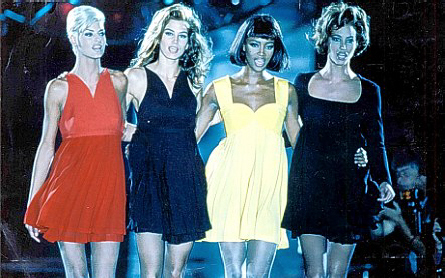
George Michael’s classic Freedom ’90 featured a bevy of supermodels, including Crawford, Turlington, Campbell, Evangelista, and Tatjana Patitz, in 1988. To accompany this, said models appeared on the cover of British Vogue, followed by the iconic group runway walk for Versace in 1989.

The rapid rise of Seymour began in 1989, when she appeared nude in Playboy, began dating Axl Rose of Guns N’ Roses and appeared in their “Don’t Cry” video clip, followed by “November Rain”. She became the first major model to sign with lingerie empire Victoria’s Secret in 1990, followed by her runway debut for Valentino.

It is interesting to note that the über-models of this time worked primarily in beauty campaigns and magazines before debuting on the runway, whereas now it’s the other way around. There are a lot of nameless and faceless models who walk on the runways and act solely as “clothes hangers” for the garments. It is rare that a model will move beyond that tag and permeate the zeitgeist, but those who have include Gisele Bündchen, Agyness Deyn, Daria Werbowy and Miranda Kerr.

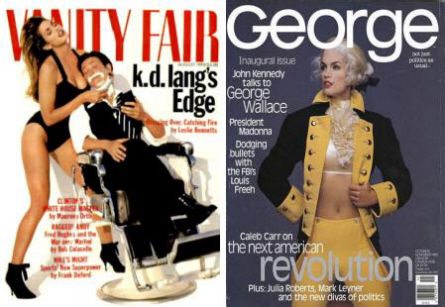
Crawford’s star also rose even higher during this period, with her marriage to Richard Gere and her constant presence on magazines cover of all kinds, including a sexy 1991 cover of Vanity Fair, in which a bathing suit-clad Crawford shaves k.d. lang in a barbers chair.

But Crawford had some competition rapidly rising alongside her: Moss. In 1991, Moss fronted the Calvin Klein Obsession for Men campaign, as well as the Calvin Klein jeans ad together with Mark Wahlberg.

1992 was also a year for sexy magazine covers, with Seymour gracing Playboy for a second time, and McPherson making her debut for the magazine.

In other mag news, Crawford was asked to posed for the cover of the groundbreaking first edition of John F. Kennedy Jr.’s publication, George, aswho else?George Washington.

19941995 was surely Harlow’s time, as she added to her resume of film roles in In & Out, as well as gracing the cover of February W, March’s Paris Vogue, and June Harper’s Bazaar US in 1994, and March W, and December Vogue with fellow model-turned-actress, Amber Valetta.

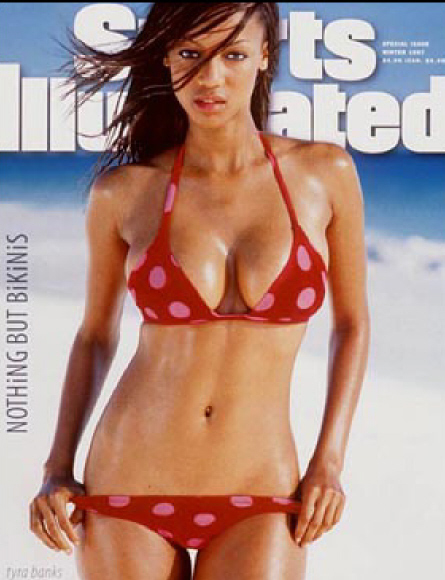
That year Banks appeared on the cover of Sports Illustrated Swimsuit Edition, the first black model to do so solo.

With Bündchen’s appointment to Vogue cover girl in July 1997 the “heroin chic” era allegedly ended, and the championing of healthy bodies like Bündchen’s began. Maybe in the modelling world, but the “heroin chic” movement has wrecked havoc on the notions of beauty, body image and popular culture.

On a side note, recently Playboy.com profiled the changing of women’s breasts over the years, and Jezebel was quick to counter that its not our breasts that have changed, but the media’sie. Playboybelief of what they should look like (NSFW). It is not dissimilar in the case of beauty magazines aimed at women.

By the turn of the millennium, the age of the supermodel subsided, which was noticeable on magazine covers across the world, which began to, and still do, feature actresses and singers on their covers.

With the retirement of the most beautiful faces and bodies in the business, models almost ceased to be relevant, and women who made achievements for something other than their looks were championed. Obviously, there is still a large gap between women on magazines and television and in advertising campaigns and movies in correspondence to how they look rather than what they do, but looking back on the dominance of beauty in the ’80s and ’90s, we are slowly starting to celebrate diversity.

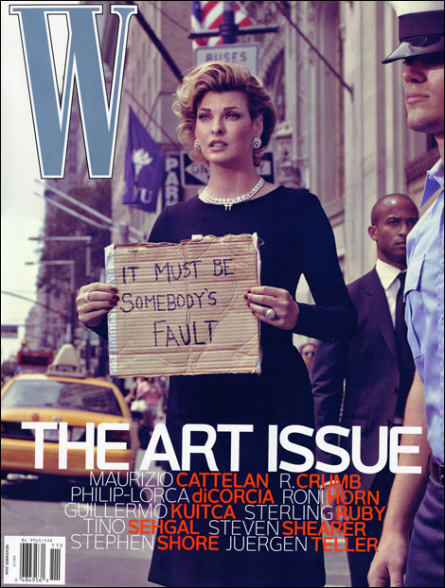
In addition, there’s the whirlwind surrounding plus-sized model Crystal Renn (is she plus-sized, isn’t she plus-sized?), and the model as somewhat of a prop for photographers, magazine editors and designers making a statement, as seen on Evangelista’s November 2009 cover for W magazine’s “The Art Issue”, or Claudia Schiffer (who, interestingly, was not featured in Modelinia’s timeline) and Karl Lagerfeld’s collaboration.

While it’s always nice to look a somethingone beautiful, it’s also nice to realise that there should be more to a model than what she looks like, and in a lot of cases, there is.

You only need to look at the aforementioned Banks and Klum’s careers in television (America’s Next Top Model and The Tyra Banks Show, and Project Runway and Germany’s Next Top Model, respectively), Erin Wasson’s foray into designing, and Kerr’s championing of a healthier life to see this in practice.

But I guess the question is, is this timeline representative of the success of certain types of models in response to our changing attitudes, or are our changing attitudes representative of the success of certain types of models?

The Hills Have (Dead) Eyes.


While The Hills has come to an end (more on that to come), its final season has been one marred with controversy.

First, Heidi Montag debuted her plastic (not-so-) fantastic look in the lead up to the premiere.

And in other Speidi news, the couple accused a producer of sexual harassment and left the show soon after.

Kristin Cavallari was suspected of having an eating disorder and a drug addiction, while Stephanie Pratt came clean in the tabloids about her past food and alcohol problems.

And finally, Heidi filed for divorce from Spencer, who demonstrated signs of drug dependence and anger management issues in his final episodes.

Phew!

A recent episode, aptly named “This is Goodbye” for Speidi’s last hurrah, was troubling, in that it showed just how distorted Spencer and Heidi’s perception of reality has become.

Kimberly, in a topical blog post on I Love Wildfox (a component of the brand Wildfox Couture), came to the defence of Kristin, Audrina et al, saying that with the seemingly low expectations the producers have of its cast, it’s no wonder Heidi, in particular, “has a warped perception of who she should be”:

“Maybe I need to watch the prior seasons to understand what MTV was really going for, but basing my opinion on this [one] episode I gathered this message from the astoundingly popular series: look pretty, gossip, sunbake, flirt, look pretty…

“The girls on the show are all incredibly physically beautiful. Looking good in every light at every camera angle is not normal. Most girls don’t look half as pretty on camera as they do in real life.

“It saddens me that MTV chose the easy suck-you-in route once again, telling all girls everywhere, ‘this is what you should talk about, this is what you should want to be,’ without showing (even once in an entire episode) what these girls actually struggle with, what they are good at, or what they dream of; even The Girls of the Playboy Mansion managed to do that!”

The buzz surrounding the final episode, which aired last week and featured Kristin leaving for Europe, with a saddened Brody Jenner (Kristin’s ex) watching as she drives awayonly to have the Hollywood sign Brody’s standing in front of revealed as a green screen, and that the whole final scene was shot on a film lot, seems to be taking a stab at the “scripted” label, leaving audiences wondering whether the whole thing was a set-up or if it somehow morphed into one along the way.

Kristin has been quoted as saying that The Hills was just her job, and she would never put her real friends and the people she cares about on TV.

So why did “Heidi’s family appear on the show to discuss her surgery, further condoning the need for limelight on their daughter’s sad and massive insecurities”?

You will notice that it’s really only the Pratt and Montag families who were caught up in the “drama” of the whole show, which bodes the questions: were Speidi’s marital woes all a set up? What is the extent of Heidi’s body dysmorphia and the necessity of her multiple surgeries? Did her family really express shame at her new look, or were they all in on the act, if it was an act, too?

Going back to “This is Goodbye”, there is a scene at a club that Heidi and Spencer rock up to, uninvited, during a fun night out with most of the other cast members. Spencer speaks of he and Heidi’s life together, saying, “I don’t let her go on [watch] TV, no computers. The only thing Heidi does is read and write poetry, and pray, and pet puppies…”, while Heidi sits there genuinely and enthusiastically nodding along, only interjecting to add, “and I read books”.

When Kristin confronts her about being isolated from her friends and family, Heidi says she’s just focussing on her love for Spencer and asks, “who am I without Spencer?” If she’s not an emotionally battered wife, I don’t know who is. As Holly said, “she’s brainwashed”.

Furthermore, Kristin and Audrina add that “there’s nothing going on behind those eyes anymore” and “there’s no emotion”, respectively.

I would tend to agree with these statements, however I don’t agree with what comes next.

When the girls discuss what to do about the abusive state of their friend and sister’s marriage, Lo asserts that “Heidi is guilty on all counts… she hides behind Spencer and plays the victim”.

If this was real life, I would say that Heidi’s alleged friends and family should have stuck by her a little harder, supporting her through her inevitable marriage breakdown.

But we don’t know how real The Hills really is, so I have to say that maybe Heidi did willingly become a victim to Spencer’s controlling ways or, to take it a step further, to Hollywood’s ideal of what a woman should be.

Kimberly declares that she hopes “those of you out there who criticise yourselves and your bodies, who look at thin girls all over the place in fashion, who watch outlandishly pretty young ladies on television, who admire movie stars and supermodels and yearn to be like them can know: That’s not what it looks like. Ever.”

It is also interesting to note that Heidi, and to a lesser extent Stephanie, Holly and Audrina, is the only one whose succumbed to this ideal.

Lauren Conrad, the original star of the show, got out when the going was good, and now leads a relatively quiet life as a fashion designer-cum-author slashie. Kristin, as her earlier comments illustrate, knows it’s only a job. Lo is fairly low-key and we really don’t know that much about her, which is probably the way she likes it. And while Audrina, Holly and Stephanie may have had surgical augmentations of some kind or another, they all remain fairly down-to-earth girls, or so it would seem.

Kimberly also notes that while almost everything on the show is fake, The Hills “is the realest account of female self-destruction I’ve ever seen on television”. This may be true, but this unravelling of Spencer and Heidi can be taken as an exercise in critical discourse about “reality” television, Hollywood and celebrity culture, which bodes the question: why can some people handle fame whilst others become the next Lindsay Lohan, trapped in a prison sentence, both literally and figuratively?

Elsewhere: [I Love Wildfox] That’s What Girls Are Made Of.