Lisa Simpson—Girl Wonder.


From Fuck Yeah Lisa Simpson, by Shoshana Funk:

“I would like to take a moment to thank the first person to show me what feminism is and how amazing it can really be… I am talking about none other than Lisa Simpson! As merely a second grader, Lisa is probably the youngest and most fearless feminist TV icon of our time. ‘Animated and liberated,’ Lisa is a little girl-power gem tucked inside a satirical cartoon world devoid of real values that is tucked inside our actual culture of decaying ideals. (It’s the Turducken of social commentary, if you will.) Can you imagine a girl character like that even being invented today? Sure, Meg Griffin has some Lisa-esque qualities, but she mainly serves as a placeholder for the butt of jokes about how pathetic teen girls can be. Lisa, on the other hand, reminded me I was a feminist before I even knew what the word meant.

“Remember when she launched that crusade against the Malibu Stacy doll (i.e. Barbie) because it said something like, ‘Don’t ask me, I’m just a girl ha ha’?… Remember how she played saxophone, loved Simone de Beauvoir, was staunchly vegetarian, and aspired to be a Supreme Court Justice? So thank you, Matt Groening, for giving us a tiny, yellow, subversive, and intelligent feminist child to look up to over the past 20 years.”

Elsewhere: [Fuck Yeah Lisa Simpson] Shoshana Funk.

Image via Fuck Yeah Lisa Simpson.

Let’s Talk About the Sexualisation of Girls, Baby.


From “Fight the Sexualisation of Young Girls the Right Way” by Sarah Seltzer on Alternet:

“But does it follow that the teens who are on TV should not be seen as sexual at all? Teens in real life are sexual beings, after all, and they make sexual choices every day.

“This brings us to our second anti-sexualisation movement, a movement whose origins and goals are entirely different. SPARK is a movement to celebrate girls for more than their sexuality and to aggressively combat product placement, advertising, and cultural messages aimed at tweens and preteens that directly sexualise them—like pole dancing for twelve-year olds and push up bras before training bras. This is a movement that also has beef with media portrayals of writhing, gyrating teen and twentysomething pop sensations—like the Glee stars’ racy GQ poses.

“But the beef is not because they’re seen as sexual, because they’re playing into a version of sexuality that is catering to male fantasies. It’s about treating sexuality as something that comes from within, not a plastered-on image in high heels and short skirts.

“…And so they oppose the imposition of a male-oriented sexuality on women.

“Therefore their issue isn’t just that teen girls on TV have sex or engage in sexual behaviour like suggestive dancing or making out. Instead, their concern is that teen girls on TV are often reduced to sex objects or miniature versions of sexual stereotypes: temptresses, vixens, sluts. Girls having sex in long-lasting relationships or because they *gasp* want to? That’s okay, as long as they’re armed with the right information and a spectrum of choices and alternatives about how they can be sexy and still be themselves.

“If you want to know why feminists are obsessed with shows like Friday Night Lights and the late, great My-So-Called Life, it’s because they show the reality of teen girls being obsessed with and learning about and experimenting with sex—as teen girls generally do—but only as part of a broader spectrum of their lives which includes classes, parents, sports, and friendship.

“Sexuality vs. Sexualisation. It’s a distinction we all need to practice making so we can continue the work that SPARK has begun.”

Related: Disturbing Behaviour: Terry Richardson Does Glee.

Elsewhere: [Alternet] Fight the Sexualisation of Young Girls the Right Way.

Sookie as Feminist? Hear Her Roar.

Ever since I started watching True Blood, I’ve had a hard time believing Sookie Stackhouse as a feminist icon. Sure, she kicks a lot of butt, sometimes seeking danger out herself (taking down the Rattrays when they milk blood from Bill in the car park of Merlottes), is in charge of her sexuality, if that means staying a virgin until the right man comes along, and doesn’t take shit from anybody. But… she’s just so damn annoying!

So is Glee’s Rachel Berry and most of the Gossip Girl cast, and they could be seen as icons of feminism for the texting set. However, instead of whining to her teacher, withholding sex from her boyfriend or plotting revenge against her nemeses, Sookie is just the opposite. She may be blonde, virginal and innocent in every sense, but she is also very much like Buffy Summers, who was created with bucking the horror movie victim stereotype in mind.

As one commenter on True Blood’s Nest points out, “Sookie is brave to the point of being stupid at times…”. While this can be an admirable quality sometimes, it does contribute to her annoyingness.

Speaking of characters who act before they speak, Tara Thornton comes to mind.

True Blood is all about juxtaposing discrimination against the blacks and the gays against the discrimination of vampires. The book True Blood & Philosophy, which I reviewed last week, mentions that Sookie and Tara were both raised—for the most part—by Sookie’s grandmother, yet Sookie is “admired, protected and coeveted by every heterosexual male main character and loved by a sweet, nurturing grandmother” while “Tara is blunt, sarcastic, morose, love-starved and goes home each night to an alcoholic mother” and gets caught up in Maryann’s spiral of lies and magic. Racist stereotypes or social criticism?

And while we’re on Maryann, she seems to embody “certain stereotypes of late-1970s feminism”, both in the clothes she wears (floaty, feminine and ethereal maxi dresses) and the hedonistic, maenadic lifestyle she espouses. Given her obsession with taking down Sam, using Eggs as her partner in crime and erecting the meat-statue in Sookie’s yard (not to mention her “hunter’s soufflé”!), she really embodies the “feminist as man-eater” ideal.

While these are good examples of other, non-blonde/innocent/virginal heroines in True Blood (and while we’re at it, let’s not forget Pam, Lorena and Sophie-Ann), I would also like to examine Sookie in relation to the men of Bon Tempts. Let’s look at True Blood’s Nest again:

“… Bill and various other hot men are always rescuing Sookie from certain death, or so it seems. But remember y’all, it was her that tried to find the town serial killer, not the useless cops. It was her that killed Rene the Killer with a shovel to the neck while the menfolk bumbled around the graveyard uselessly. It was her that decided to go to Dallas in order to get Lafayette out of Eric’s icky dungeon, AND she wanted money and a driveway as part of the deal. Once again the menfolk spluttered and marvelled at her bravery and sauciness, and lusted after her even more for it. She is the mistress of her own kick ass destiny while Bill, Sam and even Eric can only follow in her wake, hoping to be of some use.”

The original title for this post was “What is it With Sookie”, and seriously, what is it with Sookie?! By the end of season three, we have found out that Sookie’s appeal to the “menfolk” may be because of her fairy heritage, not because of her physical attributes or personality traits.

This is unfortunate for Bill, because it is plain to see that he does love Sookie for who she is, not what she can do for him. But I will say that the fairy blood storyline is an intriguing one; did Sookie’s blood allow Bill to crawl, albeit with his flesh charring with each movement he made, to her rescue in the graveyard at the end of season one? Is that also why Eric wants her?

But when you take away their supernatural abilities, Bill and Sookie’s relationship is one with issues that I’m sure a lot of modern day couples face: Bill has old-fashioned sensibilities in wanting to protect his lover, while Sookie struggles with the concept of maintaining “independence in sexual relationships”, which second- and third-wave feminism have told us we must do. Nothing illustrates this conflict (and metaphorical backlash?) than the second episode of season two, when Sookie storms out of Bill’s car after a fight about said independence and protection only to be attacked by a mythical creature for her efforts!

Elsewhere: [True Blood’s Nest] Fangirls Speak Out: Sookie—Feminist Icon?

[Racialicious] True Blood. Tired Stereotypes.

[Feminist Frequency] Beyond True Blood’s Sensationalism.

Related: True Blood & Philosophy by George A. Dunn & Rebecca Housel Review.

Has Feminism Failed?

Top 10 TV Moments of the Year.

Gossip Girl Proves There’s No Such Thing as Wonder Woman.

Surfing the Third Wave: Second Wave VS. Third Wave Feminism on Gossip Girl.
Like a Virgin, Take 2.


From “Kanye West Thinks Dead is the New Sexy” by Nina Funnell on MamaMia:

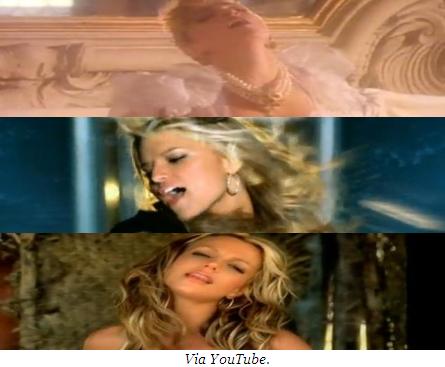
“While many commentators argue that video clips over-sexualise women, the real problem is they actually deny the sexuality of women all together. Instead of analysing the clothes and dance moves within these clips, we should look at how desire functions.

“As so often in popular culture, women are expected to appear desirable, but to be completely lacking in all desire of their own. The best example of this is Britney Spears in her Hit me baby days and Jessica Simpson circa 2002. Both Spears and Simpson stated they were virgins and intended to remain so until marriage. Meanwhile, they would grind back and forth wearing tiny outfits all designed to titillate. In other words their sexuality was to be consumed and enjoyed by everyone except themselves.

“The ‘sexually rapacious virgin’ is just one paradox of our sexualised pop culture. But a while back I began to wonder where our sexualised pop culture is really heading. At some point all the bouncy hair, big boobs and tiny skirts just gets old. These days humping a pole is not so much risqué as passé.

“So once sex (or rather, the limited and stereotypical representations of pop-culture sex) gets tired, what becomes the new frontier in risqué representation?…

“The clip is not only interested in fetishizing female bodies—it revels in fetishizing female pain, female passivity, female suffering and female silence. The ultimate female is the quiet, passive female—a mannequin—who accepts violence, abuse and suffering while remaining hot and sexy.

“As another commenter writes, ‘There’s nothing [overly] shocking or “taboo” about this video. Men’s sexual desire to dominate passive, docile, “lifeless” women has been a common theme in the arts throughout history. Indeed, many men disingenuously hide behind “art” to defend this proclivity. But how often do you see black men hanging from trees or Jews being gassed in ovens “artistically” to make a comment on racism or genocide, for example? It’s not likely to happen because that would be deeply offensive, even in the name of art. Women on the other hand are apparently fair game, even in a world where sexual and other male violence against women and girls is epidemic.’”

Related: Like a Virgin.

More Madonna.

Madonna (and Her Brand of Feminism) on the Rocks.

The Underlying Message in Glee‘s “Britney/Brittany” Episode.

Katy P. VS. Lady G.

Britney Spears: Not That Innocent.

Bad Taste Foxymorons.

Whipped Cream Feminism: The Underlying Message in Katy Perry’s “California Gurls” Video.

Elsewhere: [MamaMia] Kanye West Thinks Dead is the New Sexy.

The Internet is for Porn.


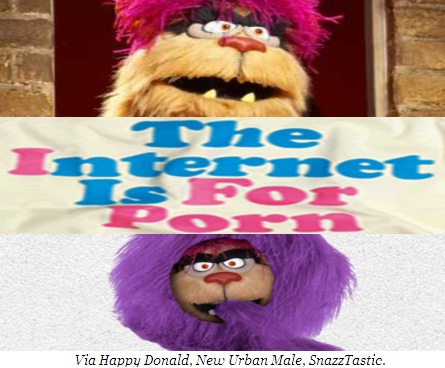
From “Hard Core” by Natasha Vargas-Cooper on The Atlantic:

“… Debby Herbenick, believes that Internet porn now ‘plays a role in how many Americans perceive and become educated about sex.’ How this influence actually works is speculative—no one can ever really know what other people do in their bedrooms or why. Some experts postulate a sort of monkey-see, monkey-do explanation, whereby both men and women are conforming to behaviors they witness on their browser media players. But in many ways this explanation doesn’t account for the subtle relationship between now-ubiquitous pornography and sexuality. To take anal sex again, porn doesn’t plant that idea in men’s minds; instead, porn puts the power of a mass medium behind ancient male desires. Anal sex as a run-of-the-mill practice, de rigueur pubic waxing for girls—and their mothers—and first-date doggy-style encounters (this is but a small sampling of rapidly shifting sexual mores) have been popularized and legitimized by porn. Which means that men now have a far easier time broaching subjects once considered off- putting—for instance, suburban dads can offhandedly suggest anal sex to their bethonged, waxed wives.

“It seems like almost every teenager in America—and hardly just the teenagers—has heard of or taken a dip into sites like RedTube and YouPorn, which alone account for roughly 2 percent of all daily Internet traffic. These are free, open, enormous sites, in which anybody can upload, distribute, and view whatever porn they please; even porn in which they star. It’s amateur hour—and like all amateur hours, it’s an honest, if often not-pretty, catalog of the desires and insecurities of regular folk.

“And it’s largely a grim parade of what women will do to satisfy men: young wives fingering themselves on the family couch, older wives offering themselves to their hubby’s Army buddies, aging moms in shabby corsets shoving their sagging rear ends into the camera. When it comes to contemporary porn, you don’t have to look like a porn star to be sexually desired. Indeed, porn stars no longer look like porn stars. The image of Jenna Jameson, America’s most famous professional porn star (and a best-selling author)—with her comically huge breasts, overextended blond extensions, and artificially tanned skin—has been supplanted by the new face of pornography: a pale, naughty, 19-year-old with A-cups and a bad haircut, her face illuminated only by the bluish glow of her Mac.”

Elsewhere: [The Atlantic] Hard Core.

Loving… Grace Kelly as Lisa Fremont in Rear Window.


I can’t say I’ve really gotten into much Hitchcock in my lifetime (that’s more my mum’s forte), however I loved Rear Window from the moment I inserted into the DVD player.

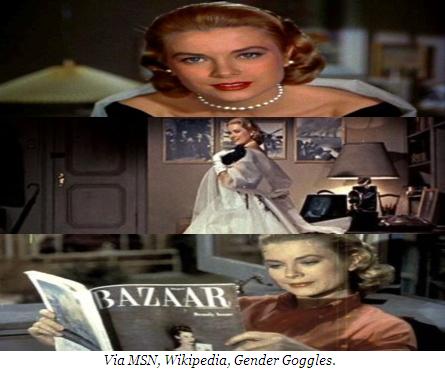
However, after a second watching this Christmas, I realised the power of Grace Kelly’s character, Lisa Fremont, as the girlfriend of central protagonist L.B. Jeffries (played by James Stewart).

Sure, she comes across as a vapid socialite on first glance, but when she opens her mouth, it is revealed that she has a job (astonishing for that period in time!), albeit as a gossip columnist, and is very self-sufficient.

Jeffries goes on about how she is somewhat pampered (being a socialite) and could never hack it on one of his photography missions.( Evidently it is he who could not hack it on his own photography assignment, managing to get his leg broken whilst documenting a car race.)

When Lisa volunteers to snoop in Jeffries’ neighbours’ apartment whilst he is out, on one hand she is proving herself to him; proving that she can get her hands dirty and is up for some adventure. But, as Lizz Yeh points out in her comment in response to Gender Goggles“Hitchcock & Feminist Theory in Suspicion & Rear Window, “we have to remember that a lot of the plot is driven by Lisa and L.B. It is only after Lisa concurs with L.B. that L.B. decides to take any sort of action.” In addition, she’s the one who points out that a woman doesn’t leave her favourite handbag and wedding ring when she goes on a trip, and doesn’t leave her jewellery jumbled up in a bag. On Yeh’s comments, it does seem that Jeffries often strives for Lisa’s approval. Whilst I wouldn’t say he’s a “weak” male character by any means, Lisa is certainly his “better half”.

On that, Lisa proves that women can be multifaceted. She can read fashion magazines and attend balls in gorgeous couture gowns, but she can also investigate a murder and accompany her man on adventurous trips. Her attitude also flies in the face of feminism’s detractors: she can please her man by reading the kinds of books he thinks she should (but swapping back to her glossy du jour when he falls asleep!) and helping him in his time of need, but she also does what she thinks and feels is right. Ultimately, Jeffries and Lisa are equals in a Hitchcockian world.

Related: Women in Fiction: Are Our Favourite Female Characters Actually “Strong”, Or Stereotypes?

Women in Fiction: My Favourite Fictional Females.

Elsewhere: [Gender Goggles] Hitchcock & Feminist Theory in Suspicion & Rear Window.

[Overthinking It] Why Weak Male Characters Are Bad for Women.


Music Videos: More Madonna.

A revised version of a third year media studies group presentation on obscenity and race in Madonna’s music, and more specifically, her music videos:

Our topic is “Pop Music, Obscenity and Race”, and we chose to speak about Madonna, and her controversial career in music and as a pop culture icon. While the reading, “Expert Witnesses and the Case of Rap” by Houston A. Baker, Jr., is more about rap music and the 1990s rap group 2 Live Crew, we have taken some aspects of the article and applied them to Madonna’s works.

Firstly, we chose to analyse some music videos by Madonna, namely “Like a Prayer” (1989), “Justify My Love” (1990) and “What it Feels Like for a Girl” (2001), for their controversial nature.

“Like a Prayer” depicts images such as an attack on a woman in an alley, burning crosses, stigmata, Madonna’s revealing outfit as she sings in a church, and her love affair with the black Saint Martin de Porres, who some have interpreted as being a black Jesus Christ. Here she deals not only with race, but also religion.

One of Madonna’s most controversial and heavily censored videos is “Justify My Love”, in which Madonna and the actors in the clip engage in sadomasochism, bondage, domination, voyeurism, same-sex and group-sex relations, cross-dressing and possibly prostitution. Baker, Jr. speaks of voyeurism in the reading, and relates it to the fact that such taboo subject matter in videos by 2 Live Crew, and also Madonna, doesn’t allow viewers to critically and objectively view them. This leads to our focus question: “If religious groups, conservatives, feminists etc. weren’t condemning and censoring Madonna’s videos, would the public find them shocking and controversial, or at least as shocking and controversial?”

Finally, we briefly discussed Madonna’s video for “What it Feels Like for a Girl”. We personally didn’t find the video offensive or overly violent, however that was the reason given for banning it. In the video, Madonna kidnaps an old woman and goes on a crime spree with her, robbing banks and stealing cars. Madonna openly defended the video, saying that if she were a man, the violence wouldn’t be an issue, because they get away with the same or worse in their videos. Similarly, she defended the “Justify My Love” video’s content, even though the banning of it made her more money than if it was aired freely. This once again relates back to our focus question and what Baker, Jr. contends about 2 Live Crew.

Funnily enough, in an interview with Adam Lambert about his controversial same-sex kiss on-stage at the American Music Awards whilst performing “For Your Entertainment”, he got fired up how his actions were vilified because he was a man, while female pop stars have been behaving sexily since the dawn of time the music video. Hello, “Like a Virgin” at both the inaugural MTV VMAs in 1984 and with Britney and Christina in 2003!

I intended to elaborate more in this post on the points briefly mentioned here, however due to time constraints, I thought maybe I could use this post as a sort of “jumping off point to start negotiations”, as fellow Madonna-lover Cher Horowitz would say. I hope to put up more posts in the future on Madonna’s influence on the music video and religion in pop culture.

Related: Madonna (and Her Brand of “Feminism”) On the Rocks.

Katy P VS. Lady G.

Whipped Cream Feminism: The Underlying Message in Katy Perry’s “California Gurls” Video.

Elsewhere: [MTV] Adam Lambert Says AMA Kiss Was “In the Moment”.

Whipped Cream Feminism: The Underlying Message in Katy Perry’s “California Gurls” Video.

I’d been wanting to break out a whipped cream bra for a future Halloween, but seeing as I’ve already got my costumes planned for the next five years, my friend April suggested I bust it out (get it?) for our friend Eddie’s bad taste themed birthday this past weekend, thus keeping it relevant.

I was enormously nervous about it, as it’s probably one of the most attention-seeking costumes I’ve ever worn—and that’s saying something! Also, the party was held at a pub in Melbourne Central! Luckily, I had the company of Joel Monaghan to share the humiliation with.

But, there was a message behind the madness; well, several actually. Allow me to elaborate.

#1. Though not related to the underlying message of Katy Perry’s video, in essence, my costume was totes an oxymoron. Because although it was derived from the worst taste film clip of the year, thus making it perfect bad taste party fodder, the costume actually tasted good (as photos of partygoers sampling my cans will attest).

#2. While “California Gurls” is highly sexualised, Perry is literally using her sexuality as a weapon: taking down Snoop Dogg’s “troop of gangsta gummis” with her whipped cream cans. In some ways, she is subverting the common perception of woman as sex object and turning her into a subject. It’s just heavily sugar coated and therefore easy to miss.

#3. As someone who is not such a fan of Perry’s (love her music; hate her), I tend to lean more towards shock value and über-sexuality as the means behind the video as opposed to the above argument.

Laura Money mentions in her guest post “On Stripping” the notion of “lipstick feminists”; I would argue that Perry is very much the “lipstick feminist”, though in this case she could be labelled a “whipped cream feminist”; using her sexuality purely for entertainment and shock value—and thus record sales and YouTube views.

So, Perry’s video and my costume were both making a statement; the former shock value and the latter best (worst?) bad taste costume (yes, I did win the unofficial vote!). While I tried to incorporate the above points into my costume to make a statement on feminism and to provide blog ammo, somehow I’m not so sure Perry did the same thing…

Related: Bad Taste Foxymorons.

The Witching Hour: Halloween/My Birthday at Witches in Britches Cabaret.

On Stripping.

’Tis the Season…

Beauty & the Bestiality.

Elsewhere: [SodaHead] Is Katy Perry’s “California Gurls” Video Exploitation or Feminism?

Madonna (and Her Brand of “Feminism”) on the Rocks.


From “The Revival of Feminism: Cher VS. Madonna” by Ginger Glynn:

“Madonna seemed to market toward, and target young girls, tweeners, prepubescent girls. So many ate it up and asked for more. The new feminism. The pretty girls feminism. Where do these sexy, sexualized young girls utilize this inspiration? How do they use their purchased, packaged sexuality for power? Britney Spears was mentored by and followed Madonna, the not quite so innocent tease. Oops, we did it again, we targeted young girls and taught them that being attractive is all we have to offer, that being intelligent is not feminine. We are supposed to believe Britney was able to use her sex appeal intelligently. She sold it, gained millions and with that, power? She got married, divorced and married again. She divorced again. Partied every night and shaved off her hair. Oh, and her ex-husband got the kids. All that sexuality and feminism, so little power. But wait, she grew back her hair, she lost weight, she may or may not have found her panties and for this we may love her again. We continue to give our daughters the financial means to support and emulate these images and models.”

Elsewhere: [More] The Revival of Feminism: Cher VS. Madonna.

“With a Gun Between Her Legs,” Take 2.


From “Is Female-on-Male Violence on the Rise?” by Lynn Harris:

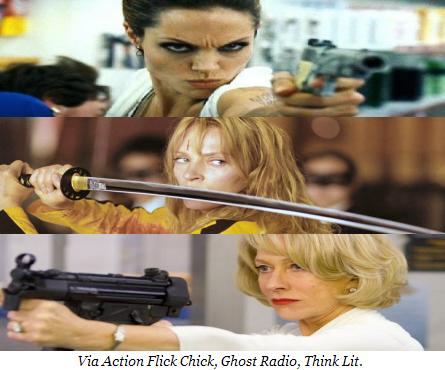
“… ‘we are fascinated by girls’ and women’s violence’. For those who like to see womenAngelina Jolie, even Helen Mirrenwielding serious, even heretofore forbidden, power, it’s hot. For those who fear women in that role, it’s… not. ‘For all the increased tolerance, even celebration, of aggressive women in pop culture, in daily life there’s still a lot of disapproval of women even speaking up at meetings or asking for a raise, let alone committing a physically aggressive act,’…”

Related: “With a Gun Between Her Legs”Why “Strong” (AKA “Sexy” Whilst Being “Strong”) Female Characters Are Bad for Women.

Elsewhere: [Salon] Is Female-on-Male Violence on the Rise?