TV: Surfing the Third Wave—Second Wave VS. Third Wave Feminism on Gossip Girl.


Not only was last week’s Gossip Girl one of the best episodes I’ve ever seen, with one of the most gorgeous dresses I’ve ever seen (see above), but it also addressed some feminist issues that have been rotating around the blogosphere of late: second wave versus third wave feminism and slut-shaming.

*Spoiler alert* The episode dealt with a Gossip Girl blast suggesting that Serena might have an STI, and the turmoil the rumour created amongst the group. Of course, Little Miss Juliet was the one who tipped Gossip Girl off, in the hopes of taking Serena down and getting her kicked out of Columbia. After all, the episode is titled “Goodbye, Columbia”…

Without giving too much away (What’s that you say? I already have? Whoops!), Serena comes face to face with the dean, who says of Serena’s (alleged) wayward behaviour:

“Women of my generation had to fight for every opportunity. And to be taken seriously, and your attitude, Miss van der Woodsen, makes a mockery of that.”

Now if that isn’t the second wave looking down upon the third wave for our apparent flippancy about “activism”, our “obsession with technology” (Gossip Girl’s blasts are a prime example of this), our “unwilling[ness] to challenge sexual exploitation for fear of pissing off men” (hello, Serena), and our infatuation with Lady Gaga (well, Gossip Girl did feature the Lady herself in an episode…), I don’t know what is.

Susan Faludi recently wrote about this phenomenon in “American Electra: Feminism’s Ritual Matricide”, Amanda Marcotte responded to the article on Pandagon (from which the above quotes were taken), and I featured a link to the latter in last week’s “On the (Rest of the) Net”.

In the article, Faludi asserts that

“despite its [feminism’s] many victories, it seems to falter along a ‘motherdaughter’ divide. A generational breakdown underlies so many of the pathologies that have long disturbed American [or, rather, Western] feminism… its bitter divisions over sex… [and] alongside the battle of the sexes rages the battle of the ages.”

Faludi feels that second wavers ask questions and make comments such as “Why does it feel like we’re sliding backwards?”, “Young women are narcissists who don’t care about politics”, and “We’re really furious with these young women, aren’t we?”

Indeed, this seems to be the attitude of Dean Reuther towards Serena who, granted, isn’t the best feminist role model, but perhaps doesn’t deserve to have such comments hurled at her. Vanessa Abrams is probably the most feminist-y of all the characters on Gossip Girl, and I could almost take her seriously, if she wasn’t so damn annoying. Even Blair could be seen as a third-waver; she refuses to be held down by Chuck, rolls with the boys, strives for academic excellence by conniving her way into becoming Miss Chamberlain’s student assistant, and dumped Chuck for using her sexuality as a bargaining chip. Plus, she’s feisty and rocks a headband.

Of course, I’m not sure Gossip Girl consciously chose to comment on the debate, and no doubt this will be the last we hear of it, but it would be interesting to see Serena fight back and declare herself “sick to death of hearing about the glory days of Seventies feminism”, whilst older women, like Dean Reuther, “decalring themselves sick to death of being swept into the dustbin of history.” However, being the dean at an Ivy League university is hardly being “swept into the dustbin”.

On a final note, Faludi spends a lot of time criticising (via her second wave subjects) the technology third wavers use, specifically blogging: “All they want to do is sit at their computers and blog.” Ouch.

I’m sure Gossip Girl would have something to say about that.

Elsewhere: [Harpers] American Electra: Feminism’s Ritual Matricide.

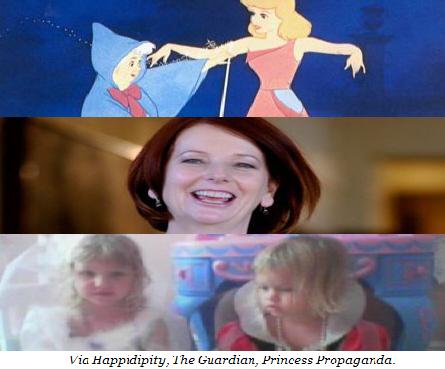
Julia Gillard as Feminist Fairy Godmother?

In an article about Disney Princesses and the effect they have on young girls, this paragraph really resonated with me:

“The princess as superhero is not irrelevant. Some scholars I spoke with say that given its post-9/11 timing, princess mania is a response to a newly dangerous world. ‘Historically, princess worship has emerged during periods of uncertainty and profound social change,’ observes Miriam Forman-Brunell, a historian at the University of Missouri-Kansas City.

“‘The original folk tales themselves,’ Forman-Brunell says, ‘spring from medieval and early modern European culture that faced all kinds of economic and demographic and social upheaval—famine, war, disease, terror of wolves. Girls play savoir during times of economic crisis and instability.’ That’s a heavy burden for little shoulders. Perhaps that’s why the magic wand has become an essential part of the princess get-up. In the original stories—even the Disney versions of them—it’s not the girl herself who’s magic; it’s the fairy godmother…”

While we may not be in times of “economic and demographic and social upheaval”rather, we’re just emerging from themPrime Minister Julia Gillard has certainly taken the reigns of our country and is steering it in a new direction.

Some of her policies (namely the outmoded same-sex marriage ban) I don’t agree with, but she is certainly a beacon of aspiration for young Australian girls, who now realise they could “end up becoming lawyers, doctors, mothers or princesses…”or Prime Minister.

In that way, Gillard surely is a feminist fairy godmother for us all.

P.S. Happy 49th Birthday, Julia!

Elsewhere: [NYTimes] What’s Wrong With Cinderella?

Has Feminism Failed?

Last Wednesday evening, I went to a debate about the state of feminism and whether it’s failed at the Melbourne Town Hall on Swanston Street.

Entitled “Feminism Has Failed”, I went into the debate with my own preconceived notions about feminism’s success and came out of it with similar feelings, as I think most of the attendees did, if the vote before and after the debate was anything to go by.

I felt that for someone like me, a young, white, middle-ish class Australian female, feminism hasn’t failed, but for most other women around the world who don’t have access to such things I’m afforded (education, employment, food, water, shelter, the ability to do/be almost anything I want), feminism has certainly failed.

And that was the basis of the first speaker for the affirmative team, Virginia Haussegger’s speech.

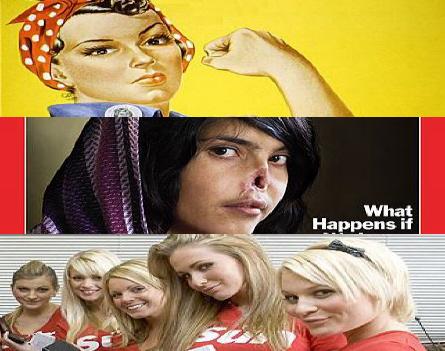
Instead of feminism working for women all over the globe, the rest of the world has waged a “global war against women”, or a “gendercide”, if you will. An example of this is the recent Time magazine cover in which an Afghani woman, or girl rather, was depicted with her nose and ears cut off by her husband, after trying to flee his abusive household.

To rebut this argument was Jennifer Byrne, who said she was taking a “working girl’s view” of feminism, and mentioning a phrase we’ve heard a lot of in third-wave feminism“wonder woman”. (Funnily enough, Haussegger has published a book of the same name.) She noted that we have so much choice now that we “scarcely notice feminism” now.

Stephen Mayne, the only male on either debate team, took a business point of view, and harped on about the dismal number of women on ASX publicly traded company boards. He mentioned that his fellow team member, Gaye Alcorn, who spoke last, editor of The Sunday Age, is only given one day a week, as opposed to the six other days of the week in which a man edits the newspaper. Mayne said that feminism surely HAS failed if a phenomenon such as Britain’s Page 3 girls exist, and if “this country came this close to electing Tony Abbott.” All in all, Mayne was the best speaker of the night and really brought it home for his team, in my opinion.

Next up was Monica Dux, whom Haussegger verbally attacked during her speech as “the snooty head girl [of feminism] with the key”, who wouldn’t let her become part of the club because she has views that aren’t necessarily Dux’s own.

Dux addressed the negative connotations feminism sometimes has, asserting that feminism doesn’t have a Bible, as it’s “constantly evolving and changing”, and is “not a cult” with Germaine Greer at the helm.

Gaye Alcorn confuted Byrne’s former assertion that “we hardly notice feminism anymore” with “sexism has become so embedded in our culture that we no longer notice it”, making reference to the David Jones sexual harassment suit that Mayne also spoke about.

Alcorn also mentioned Naomi Wolf’s The Beauty Myth and the great porn debate (more on that to come this week), and that in some ways it’s harder for womenbody image-wisebecause the culture that young people grow up in has changed.

Controversially, Alcorn referenced the Body Image Advisory Board and it’s chairwomen, the “gorgeous” Mia Freedman, Sarah Murdoch and Kate Ellis, saying that of course they had beautiful women to front the campaign, because it wouldn’t have gotten any publicity with Plain Janes. Out of everything the affirmative team said, this was the only thing I took issue with. “Like, sorry those women happen to be genetically blessed, but they have as much right to talk about body image and beauty as a less fortunate-looking woman does. You can’t help the way you’re born,” I said to my friend, who satirically replied, “Well, it’s about beauty, hello?!” Gold.

Finally, Wendy McCarthy spoke, saying that “feminism is the most significant social movement” of the last fifty years. She mentioned that feminism has “created space for men to be better fathers” which, to me, signals that perhaps feminism has failed if that’s the main point she can come up with; that it benefits men.

The debate ended with the final vote, in which the results stayed pretty much the same. While the affirmative team definitely won the debate, in the minds of the audience members, at least, feminism has not failed, and is still alive and well in our culture.

But as the affirmative team mentioned, Western feminists need to stand up for women in less fortunate countries, and by the same token, “feminists can’t be accountable for all feminist issues at all times.”

Prime Minister Barbie.


You may remember that last week I mentioned an article about feminine feminists and Barbie.

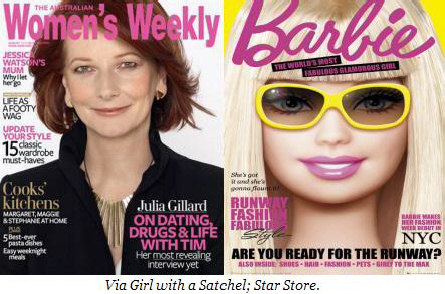
Well, in the comments to the original article, Lexi wrote that “in the 51 years since Barbie’s creation, Barbie has never had a child or a husband [“P.S. Ken is a boyfriend, not a husband”]. Barbie encourages strength and intelligence, not motherhood and obedience.”

Hmm, husbandless and childless? Sounds like a certain Prime Minister of ours. Go Barbie and Julia Gillard!

Related: On the (Rest of the) Net.

In Defence of Barbie.

Sisters Are Doing it For Themselves… But Not the Gays.

Elsewhere: [Em & Lo] Confession: I’m a Feminine Feminist.

In Defence of Barbie.

Last week I posted a story about my favourite fictional females, and Barbie was one of them.

Granted, she’s not exactly fictional, but she’s by no means “real”, and doesn’t represent real women in any way. So much so that if Barbie were alive, she would be so underweight she wouldn’t be able to menstruate, and so out of proportion that she would fall over.

These factors aside, I loved Barbie as a kid. Still do. Being as innocent and ignorant as children are, I was oblivious to the fact that Barbie is allegedly a bad role model for kids. Sure, I often wished I was blonde haired and blue eyed like Barbie (which probably stemmed from both my mother and younger sister possessing these traits, and me feeling like the odd one out), but mostly Barbie instilled in me the ideal that I could be anyone I wanted to be.

Hello?! Barbie has had such occupations as a teacher (in nine different subjects, no less!), doctor, police and army officer, astronaut, ballerina, gymnast and even a McDonald’s employee, amongst many, many others (see the full list here).

Of course, some of these occupations required Barbie to rely on her looks (Baywatch lifeguard, model), but most of her occupations require legitimate skills in real life. And also in real life, some jobs do depend on workers’ appearances.

Barbie also acts as a blank canvas for young girls (and boys) to project their ideals onto her. Most times I played Barbies with my sister, we often put our dolls in high school situations. When the aforementioned Baywatch Barbie came out, with an accompanying dolphin toy, we transformed the bathroom into the beach. Even as I got older, my teenage friends and I used our Barbies as art projects and pop culture experiments. I remember a certain Michael Jackson version of Ken that totally kicked butt!

I changed my mind several times as I grew up about what I wanted to be when I actually did grow up, and Barbie came on that journey with me. From violinist, to vet, to actress to journalist (I wonder if there will be a blogger Barbie in the future…?), Barbie was there, helping me craft out my ambitions and, like, what I would wear.

Yes, Barbie is unrealistically beautiful and thin and leads a charmed life, but this doesn’t govern how she is perceived by little girls (and, again, boys) and how they play with her. She may serve as a guinea pig for Toy Story’s Sid-like torture, a model for the latest buzz-cut á la an aspiring hair-dresser, “a happy hetero, a lipstick lez, or a bitchin’ CEO” (my preference was for the power-suited latter), a way to express juvenile sexual interest while her owner remains a “good girl” (which perhaps contributes to the negative perception surrounding the doll), or remain exactly as Mattel intended her to be: an immaculate representation of femininity. And that’s okay.

Primarily, I think, again, that Barbie allows girls to be whoever they want to be. I don’t necessarily think young girls have a clear-cut perception of the perfection Barbie represents in the grown-up world; for them, she’s just a cool doll with a fab convertible, ever-changing wardrobe and a resume that will get her where she wants to go. Importantly, too, Ken is not a deciding factor in her life, and Barbie will do whatever she wants with or without the approval of the man in her life. And now that she’s divorced, perhaps she doesn’t need or want a man in her life at all.Maybe I’m just lucky; the presence of Barbie and exposure to pop-cultural representations of “traditional” femininity in my life at a young and susceptible age, I feel, has enriched my life rather than hindered the development of a healthy body image. Who can say what factors contribute to food, weight and body image issues in young (and old) women alike? I know I definitely can’t put my finger on the defining aspects in my life that have allowed me to think critically and actively about such things. But I do think a little too much emphasis is conveniently placed on Barbie as the culprit.

Related: Women in Fiction—My Favourite Fictional Females.

Is There Really a Beauty Myth?

Elsewhere: [Yahoo! Answers] What Would Barbie’s Measurements Be If She Were a Real Person?

[Wikipedia] Barbie’s Careers.

[Greteman] In Defence of Barbie.

The Beautiful, Bigmouthed Backlash Against Katherine Heigl & Megan Fox.


Recently, there has been a bit of a backlash against Megan Fox, whothe consensus seems to beshould keep her mouth shut and be grateful for her break in Transformers. Much the same could be said about Katherine Heigl, who left Grey’s Anatomy amidst a storm of controversy earlier this year, when she complained about 17 hour days, which were allegedly scheduled around her movie filming and new mum timetable.

New York magazine went as far to give a “definitive… analysis” on both women, and whether their stock in Hollywood amounts to “buy, sell or hold.”

While Heigl managed to escape with a “hold” verdict, due to her ability to “get a project green-lit just by signing on” (the other four actresses in this category are Julia Roberts, Reese Witherspoon, Sandra Bullock and Angelina Jolie, out of which “Heigl is the only one who will work in a young romantic comedy”), Fox’s future is cloudy (“sell”).

I actually like both ladies, who also happen to be two of the most beautiful women on the planet. But apparently being beautiful and outspoken do not a feminist heroine make.

New York notes that some see Heigl as “refreshingly outspoken”. Others? “A headstrong, self-immolating, gaffe-spewing, headache-inducing diva freak.” Or, perhaps, she’s both?

She has stood up for her co-star T.R. Knight after fellow Grey’s Anatomy doc Isiah Washington dissed him with homophobic slurs. She also called her big-break film Knocked Up sexist, which I wholeheartedly agree with. Then there was the whole withdrawing-her-name-from-Emmy-contention debacle, due to insufficient storylines for her character, Izzie Stevens, on the show. Finally came her David Letterman rant about working seventeen hour days, and that the Grey’s producers should be “embarrassed”.

Some of these things perhaps weren’t the smartest, nor correct, things to say in the public arena, at the risk of coming off as a “diva freak”, but who the freak cares?! It takes a pretty gutsy woman to speak up about those kinds of things, as a lot of people would want to in any workplace; it just so happens that when Heigl does it, the world hears it.

Speaking of smart, Fox isn’t really known for espousing intelligent quid pro quos, but she is arguably Hollywood savvy, as “Fox’s appeal is all about simultaneously exaggerating her sexuality and then downplaying it as just Hollywood silliness.”

The exaggeration? Writhing around in denim cut-offs on a motorcycle in Transformers 2, girl-on-girl makeout sessions with Amanda Seyfried in Jennifer’s Body and lingerie ads, which is what she’s known for.

A recent Jezebel article asserts that “people really, really hate Megan Fox” (apparently, there’s a Tumblr hate-blog, “the description of which reads, ‘Fuck you, Megan Fox. No, really. Keep your trap shut’”) purely for the fact that she’s outspoken. (I’m a goner, then!)

When she criticised Transformers director Michael Bay for being a sexist “jerk”, he laughed it off, and this exchange of words carried on for the good part of a year, until she was let go from the franchise in May.

But in dismissing her from Transformers 3 and casting Victoria’s Secret model Rosie Huntington-Whiteley as her replacement (who’s “most notable acting role was as “Woman in Underpants” in Michael Bay’s own Victoria’s Secret commercial”), this should give Fox “a sense of how she’s viewed”, by Bay, at least.

This is further reiterated by the fact that Bay allegedly made her wash is car in her bikini in place of an audition (casting couch, much?), to which Jezebel says:

“Which she should apparently be really, really grateful for, since whenever people talk about her, they like to throw in the ‘don’t bite the hand that feeds you’ admonishment. To which I say, what if that hand is also trying to grab your ass?

(Perhaps she’s asking for it then, because of the way she looks? But that’s material for a whole different blog post.)

Unfortunately, though I think she’s awesome and has much more to offer, I see Fox going the way of so many sex-pots who are no longer relevant: Tara Reid, Carmen Electra, Denise Richards.

So it seems you can’t win either way. Either shut up, sit tight and look pretty. God forbid you speak your mind, as you run the risk of being labelled an outspoken, ungrateful harpy worthy of your own hate brigade.

Elsewhere: [Vulture] The Definitive Vulture Analysis of Divisive Rom-Com Queen Katherine Heigl.

[Vulture] What is Professional Provocateur Megan Fox’ Valuation in Hollywood?

[Jezebel] Women Who Want Attention.

[Musings of an Inappropriate Woman] Guest Post: Video, Consent & Kendra Wilkinson.

Guest Post: Double Standards.

When Scarlett said that she would appreciate an infrequent, but regular contribution to her blog from an anti-feminist perspective, I had no idea where to start. Everybody knows that various feminists all present an enormous variety of contrary positions masquerading as undeniable truths. However, due to a happy accident, I came across some of her inspiration, and found it inspired me as well.

“If a girl is thin, she is accused of being ‘anorexic’; if her weight is higher than the cruelly restrictive ideal, she’s ‘fat’ and ‘doesn’t take care of herself’ or ‘has no self control.’ If she wears cute, trendy clothes she ‘only wants attention’ and if she wears sweats and jeans, she ‘doesn’t make an effort.’ If she’s perceived as sexually attractive, andespeciallyif she shows her own sexual side, she’s likely to be called a ‘slut.’ If her sexuality and her body are concealed, she’s a ‘prude.’ As you’ve probably figured out, the cards are stacked against you. You cannot win, at least not if you define winning as dressing and behaving in a way likely to win approval (or at least decent respect) from everyone.”

This can be found at Musings of an Inappropriate Woman, where this situation is blamed upon the masculine expression of cultural contempt for girls and women. And listen up ladies: these dirty old men, I’m sure, exist. There are lines, and they are crossed. By men. Dirty old men. Who ultimately want to have sex with you. But they’d probably be thrilled with less. Yes, it’s true, the dirty old men with no self respect operating on the fuel of hedonism are definitely horrid, even when viewed objectively rather than through the contemporary cultural lenses through which all gender issues are presently perceived.

But consider this: If a guy approaches you attempting to discern whether or not you are interested, he’s a sleaze. Doesn’t approach you: gutless. If he doesn’t hook up that night, he’s a loser amongst mates. If he does: player to the other women. If he pursues a woman that does not have the approval of others, he’s bagged out by said mates. In contrast, if she’s “too hot” for him he’s punching above his weight class and it’ll never last. If he’s a virgin, the girls will giggle and the guys guffaw. But if he goes home with too many women per week, month or year, his life is shallow according to the women and he risks going against the man-code of “bros before hos”.

So, you see, it’s not just women who are open to cultural interpretations that label them with contempt. Furthermore, as the composition of troops that hold the “battle lines” between feminism and masculism continue to conform less and less to the genders of the combatants, the criticisms on modern man begin to flow from both sides of the gender divide.

The point being? These girlsthese womenwho cannot win with how they are perceived, are not alone. In addition, why be so up in arms about the concept of a “slut” when you would use the term “man-slut” willy-nilly? If a man advances on a woman and is told no, and continues, I’ll help any feminist paint the sign that says “DOM” then hold my gun on him while she hangs it round his neck. But it seems to me that blaming the men who suffer the same conditions and lack the political correctness women enjoy when blaming the other gender deserve a voice as well. Blaming the problem on the dirty old menmany of whom may not, perhaps, be as dirty or as old as they seemis a fallacy. If they had vaginas they’d be called cougars, and that’s, like, totally cool. If you want to strike at the foundations of the problem, attack constructions of gender perception, rather than blaming people who are subject to exactly the same problem as the females in question.

And just because I want anyone who reads this to knowI paused halfway through composing this post to cook my own dinner, wash my own clothes, and iron my own shirts. Seriously.

— Andrew Frank.

Elsewhere: [Musings of an Inappropriate Woman] Guest Post: Your Body is Never the Problem—A Letter to a 16-Year-Old on Clothing, Style & Creepy Old Men.

Why Are Famous Men Forgiven for Their Wrongdoings, While Women Are Vilified for Much Less?

In Perez Hilton’s words, “2010 has really been the year of the cheater”. First we had Tiger Woods’ cheating scandal, which broke late last year but has continued to be a headline grabbing story, then Jesse James’ spiral of shame, and now David Boreanaz, who went public a few weeks ago with news that he cheated on his wife of almost nine years, Jaime Bergman.

And last year was the year of the sports scandal, you might say, with the Matthew Johns group sex story coming to light in May.

What do all these men, with, perhaps, the exception of James, have in common? Their shady pasts have virtually been forgotten in favour of their more positive talents. Boreanaz plays the lead in hit TV series Bones, Johns now hosts his own self-titled show, and Tiger is back on the Masters tour.

While the wrongdoings of the Australian underworld are being glorified on Underbelly no one bats an eyelid. To take it even further, O.J. Simpson, although acquitted of double murder, was held up as a hero amongst African Americans in Los Angeles following his trial, despite being thought of as guilty in the court of public opinion.

Perhaps this is just a sign of the times changing; that our society has become so desensitised to notions of war, violence, drugs and sexual depravity that they are not longer taboo. I would argue that this is true to some extent it is not reflected on the other end of the spectrum.

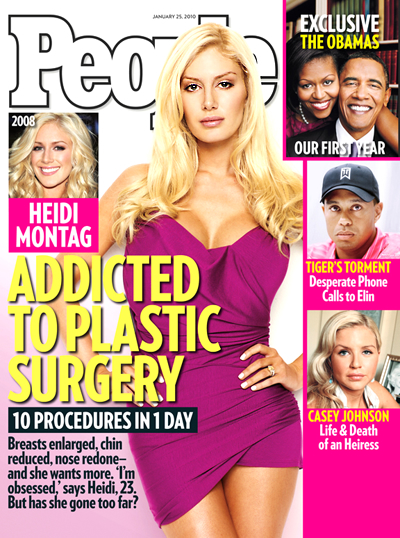
For example, a recently refurbished Heidi Montag admitted to undergoing 10 cosmetic surgical procedures in one day because she wasn’t happy with the way she looked. She obviously has deep-rooted body dysmorphic issues, however instead of helping and supporting her, the public has turned on her.

The same could be said of the Britney Spears’ and Lindsay Lohans’ of the world. A recent Jezebel article, “In Defence of Lindsay Lohan”, was in support of the former child star everyone loves to hate.

Sure, Lindsay has a father who “is a nightmare… and her mother is more of a friend than a parental figure. So perhaps she is lacking in guidance and role models. But who among us, in some way, is not? Her experience [of growing up in the spotlight]… is not one many people can relate to, anyway.”

The author surmises that the public’s fascination with Lindsay and their “build-you-up-to-take-you-down” mentality is much simpler: “She’s 23-years-old and being ripped to shreds in the press mostly because she goes out at night.”

Right. Someone like Colin Farrell has had a sex tape released, sexual misconduct allegations brought against him and has battled substance abuse problems, however he is still held up as a Golden Globe-winning actor. We all know Lindsay has the acting chops, it’s just a matter of her getting out of her own way. Double standard? In the words of Sarah Palin, you betcha!

The beautifully tragic Marilyn Monroe and Anna Nicole Smith were, and still are, vilified for being just that. Even in death, the girls can’t catch a break.

So that brings us back to the question, why do men get away with so much more than women can? Or, more to the point, why are men almost celebrated for their wrongdoings while women are banished into social oblivion?

I think, in a nation that celebrates sport as the highest level of achievement, especially, we want to give our sportsmen the benefit of the doubt. While I do think we focus too much on sport as the be all and end all of success in Australia, and the very nature of being “Australian”, it can be seen as admirable to offer someone a second chance. Johns, for example, could be seen as brave for coming forward and being the only one of his Cronulla Sharks teammates to own up to his mistake. But I do think it’s a bit soon to be running a television show off his back.

However, we also like to kick people when they’re down. Britney Spears, for example, was heralded as the princess of pop in her golden days, but when she started donning pink wigs, speaking to herself in a British accent in the gutter, and being carted off to the looney bin, we wanted nothing to do with her. Oh, I’m sorry, only to denigrate her on the cover of tabloid magazines.

Then last year she launched her comeback tour, and everyone was back on her side. That is, until, she lip synched (come on, it’s Britney! When has she ever not lip synched?) her way through Australia and out of our collective consciousness.

But how many second chances are we going to give these men, in particular? Charlie Sheen was embroiled in his latest domestic dispute over Christmas last year. But what of his past child pornography, prostitute and drug allegations? Not to mention the shooting of ex-girlfriend Kelly Preston in a domestic dispute. Do we just sweep them under the rug too so that Sheen can keep the $1.2 million per episode of Two & a Half Men coming?

When these mistakes are hurting people other than themselves, maybe it’s time to take a step back and look at the bigger picture. Do we really care if Lindsay, Britney or Mischa are off to rehab again? And shouldn’t we be caring that Jesse James allegedly ran dog fights out of his West Coast Choppers headquarters and is apparently a white supremacist? Or that Sheen is essentially being rewarded by the cash cow that is Hollywood for his reprehensible behaviour? Or that Tiger sleptand somehow found time to golfhis way across the country in a narcissistic bubble of admiration from his countrymenand women?

Related: All Eyes on Marilyn.

Elsewhere: [Jezebel] In Defence of Lindsay Lohan.

Is There Really a Beauty Myth?

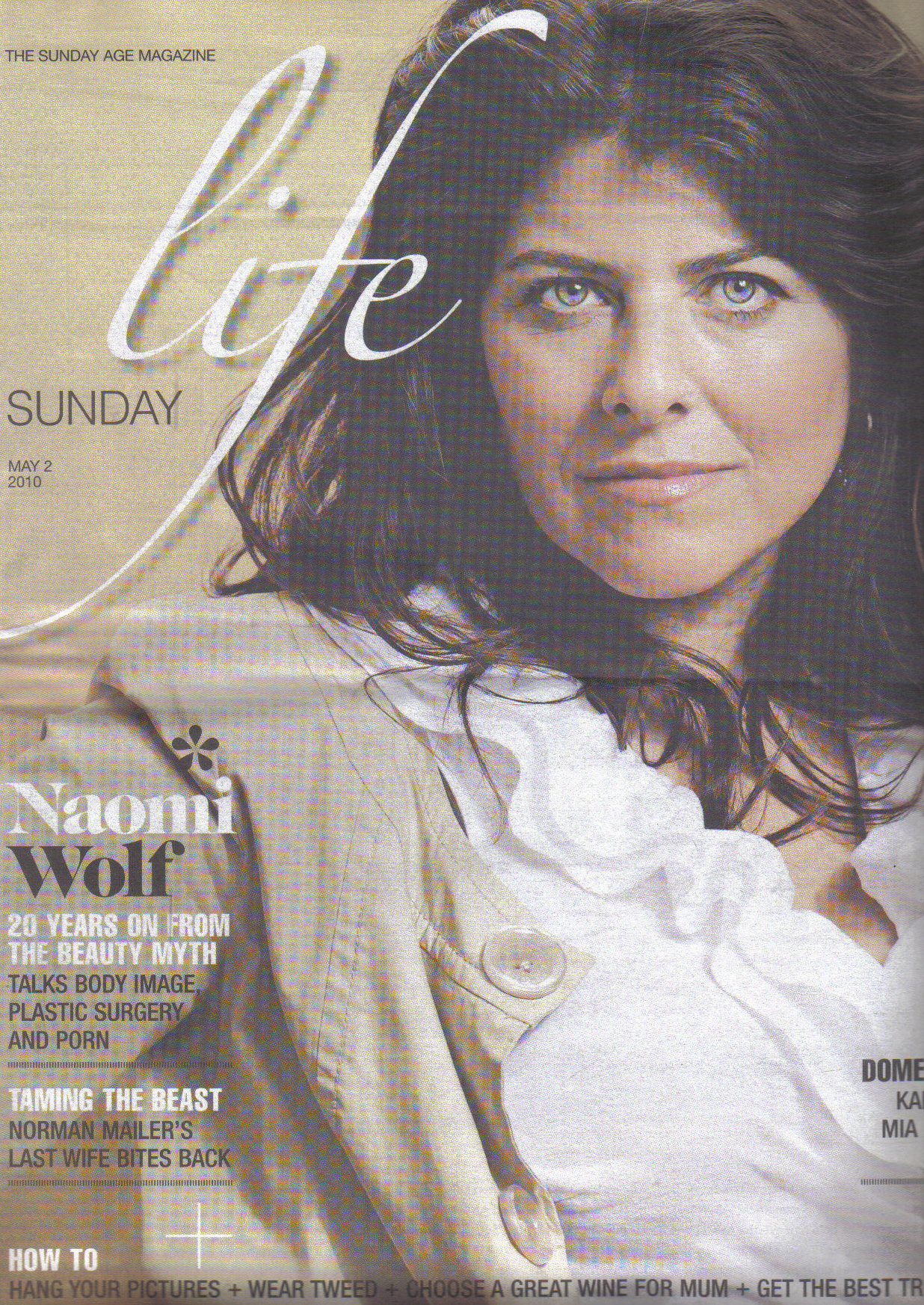
sunday-life-naomi-wolf

Following on from Tuesday’s earth-moving post about beautiful women and heart health, last night I went to see prolific feminist author Naomi Wolf speak on her book, The Beauty Myth, and how images of beauty in the media are used against women at the Wheeler Centre for Books, Writing & Ideas in Melbourne.

The common perception about “feminists” is that they’re allto borrow a quote from Bring It On“big, dikey losers” who burn their bras and don’t shave under their arms. But at the risk of sounding cliché, I don’t believe you can be female and not be a feminist.

There was an overwhelming amount of people packed into the Capitol Theatre, off Swanston Street, and the majority were your average woman on the street, most coming from work or uni, with the odd flanny-wearing, mullet-rocking stereotype. And a few men, too, one of whom posed the question as to whether women’s magazines facilitate the media’s ideal of what a woman should look like. (More on that later.)

I also don’t like the notion, and nor does Wolf, that to be a “feminist”, or to even be interested in the topic without adopting the extremist views that some “second-wave feminists” espouseCatharine MacKinnon, I’m talking to youis to be a Germaine Greer tome-thumping man-hater. She touched on this when she mentioned that whenever there’s a move forward for women (ie. the right to vote, the availability of the birth control pill meaning women could have “sex without the punishment of pregnancy”, Jennifer Hawkins posing nude and unairbrushed on the cover of Marie Claire), there is the inevitable backlash.

It was interesting to note the fact that that the three most important pieces of literature on feminismThe Second Sex by Simone de Beauvoir, Greer’s The Female Eunuch, and The Beauty Mytheach have twenty-one years between their publication dates, a “coming of age” of sorts in understanding the “lexicon of feminism”, the MC said.

Another point of interest was the beauty and vivacity of the author herself, not to mention her fab shoes!

Wolf said she loved Australia because we’re so candid and unselfconscious in our responses to the issues she raises, and that nowhere else do “visiting feminists get treated like rock stars.”

Speaking of rock stars, an certain icon in history has been not only a rock star, but a gymnast, teacher, astronaut and mother, amongst many other occupations. This icon is Barbie, and she was a hot topic on the night.

Barbie represents the “universal ideal” of “transcendental beauty”, in the Western world in particular and, according to Wolf, she is a valuable media tool in the cosmetics, dieting and plastic surgery industries.

Wolf asked why we never see women who are not under 40, thin, tanned, blonde, blue-eyed and Caucasian (ie. Barbie) in the media (which I personally disagree with; Penelope Cruz, Salma Hayek, Ellen DeGeneres, Christina Hendricks, Kim Kardashian, Meryl Streep, Oprah Winfrey and the Grey’s Anatomy women are a few examples that counter this theory). Here is the one word answer: advertisers. They are the reason the Barbie-stereotype is on the cover of magazines every month.

Sure, magazines get most of their revenue from the advertisers, and if they think their brand ideal will be jeopardised by running an ad in Glamour magazine, which has been running a lot of plus-sized photo shoots recently and garnering a lot of attention for it, for example, they will not give their ad money to that magazine. So therefore, Glamour has a lower budget to promote itself to readers every month. Then its loyal readers receive less of the content they keep coming back for, ie. women who look like them, and will stop buying that magazine.

On the other hand, as Mia Freedman talks about in her memoir, Mama Mia: A Memoir of Mistakes, Magazines & Motherhood, and editor of Shop Til You Drop magazine Justine Cullen writes in this month’s issue, women don’t buy the Ellens, Meryls and Kims, they buy the Jennifers and Kates. So, Wolf said last night, “it’s something you’re doing” as media consumers.

So it’s a double-edged sword. We complain that we want to see more “real women” in magazines, however we’re not willing to shell out for them, therefore sales go down, advertisers move elsewhere, and “we don’t know what we’re missing” because “women doing interesting things are omitted” from the mainstream media, and instead we get another story on Jennifer Aniston’s desperation over Brad and Angelina’s marriage, or some crap. I think Wolf is right in saying that we need to consciously refuse to buy into those kinds of stories and look towards other instances of women in the media.

However, I don’t agreeand this seems to be the consensus, especially amongst those who don’t actually consume women’s magazines on a regular basiswith the belief that all women’s magazines try to sell us are diets, $350 beauty products that don’t actually work, and low self-esteem. To people with this view, I say, try picking up a copy of Cosmopolitan, Frankie or Girlfriend magazines. These are all publications that are geared towards different demographics of femalessexually active and assertive women in their late teens to mid-to-late twenties; alternative, crafty women, most likely studying design or politics; and the teenage set, respectivelythat DO NOT run diets, do recommend fashion and beauty products at the affordable end of the spectrum, and present women of all shapes and sizes in a positive light. Not all women’s magazines are at the crux of this “beauty myth”.

Another major point in Wolf’s theory is the abundance of pornography in today’s society, which she also talks a lot about in this past weekend’s Sunday Life supplement in Melbourne’s The Age and The Sydney Morning Herald. She argues that this lowers the sexual confidence of both men and women, but young women, in particular, feel they have to offer an array of sexual activities they’re not necessarily comfortable with in order to “feel competitive in the sexual marketplace”. Because men, in particular, have such “strong, Pavlovian responses” to porn, excessive consumption can lead to desensitisation to the real thing, which is why there is such a surge in impotence in young men.

Where once it were supermodels who determined the sexual ideal of women, it is now female porn stars, with their svelte, childlike torsos, fake breasts and meticulously trimmed pubic region, society uses as the benchmark. Bodies that share similarities with who else?! Barbie.

One could argue that Brazilian and XXX waxing is a way for the male-geared porn industry to beat women into submission, so that they become childlike and are able to be dominated. Another intriguing point Wolf puts forward can be traced back to the dieting industry, in that striving to look the way of the porn star, with a super-slim body and low body mass index actually diminishes the libido. Is this really what society wants whilst pushing such a sexual culture? Or is it in tune with the subservient nature of females in porn?

Wolf also addressed the perception that women with eating disorders and negative body image are “crazy”. As an anorexic in her teens, Wolf debunked this, saying that “physiologically, low calorie count causes mental impairment,” and is a “form of control” by the dieting industry, the media, and society to control and suppress women’s ambitions. Because when you’re thinking about food and exercising and the way you look, you’re not thinking about education and work and your future.

She added that a way to counteract this is to form “active critical thought” about images of beauty, which apparently 33% of women do. Another 18% become obsessed by these images, which in turn leads to eating disorders and body dysmorphia. The rest of us hover somewhere in between.

During question time, one audience member asked why shewho comes from an educated, loving and supportive background; is surrounded by encouraging and non-judgemental friends and family; who does form critical opinions about the media’s portrayal of womenfeels ugly, fat, not good enough and constantly compares herself to other women, in the media or no, and how “active critical thought” can really alter this.

I thought this was a very brave and fascinating question put to Wolf, however her response was more disheartening. In a nutshell, she basically said that at the end of the day, if being open to different images of beauty, both from the mainstream and non-mainstream media worlds, and being able to confidently and objectively realise that not everyone looks like that and that is not the real-life ideal, still makes you feel like crap, there may be some underlying issues that only a therapist can fix.

Which poses another question: how far have we really come? From the 1920s “flapper body style” that emerged when women first won the vote and somehow felt they had to look more masculine to adapt to this, to an auditorium full of beautiful, successful, smart and “critically thinking” independent women in 2010, does this notion of the “beauty myth” really exist? Is there a beauty myth that we have to expose?

Beautiful Women Cause Earthquakes AND Heart Attacks, Apparently.

I’ve heard of the odd Eva Herzigova Wonderbra billboard-related car crash, but earthquakes? Seriously?!

Last night I was reading the current issue of Grazia, which publishes a quote from an Iranian cleric, who claims that “women who do not dress modestly lead young men astray, corrupt their chastity and spread adultery in society, which”get this!“(consequently) increases earthquakes” (p. 74)! If that’s not a Sheikh al-Hilaly uncovered meat-esque comment, I don’t know what is!

For my money, there is not always a direct correlation between being beautiful and dressing provocatively. Audrey Hepburn is considered one of Hollywood’s most classically beautiful stars, yet she favoured classy, covered up clothing. Paris Hilton, on the other hand, is often scantily clad, however a lot of people don’t think of her as beautiful. At the other end of the spectrum, you have Marilyn Monroe, who was both sexy and physically stunningif anyone could prove this theory correct, it would be Marilyn!

Then this morning, I was reading a study by a Spanish university, which asserts that courting a beautiful woman is “equivalent to jumping from a plane” stress-wise! Not only does the study show “trying to woo a beautiful woman could be bad for a man’s heart and even increase the risk of heart attacks and strokes,” but actually getting the girl proves to be even worse! The study goes on to claim that the stress of being in a long-term relationship with said stunner “could cause ‘chronic’ levels of cortisol, leading to impotence”.

Where is all this hating on the females coming from? If a woman is not perceived as conventionally beautiful, or pretty at the very least, by society, she is chastised. If she does happen to satisfy social norms in terms of the way she looks, she apparently causes natural disasters and ill heart health.

It seems like the ladies just can’t win!

Stay tuned later this week for more beauty debate, as I will be reporting on The Beauty Myth author Naomi Wolf’s talk in Melbourne on Thursday night. Get your tickets here.