Movie Review: Burlesque.


“Did you notice the mistake in that movie?” my friend Sallie asked me as we left the cinema.

“The only mistake in that movie was Christina Aguilera’s acting,” I replied.

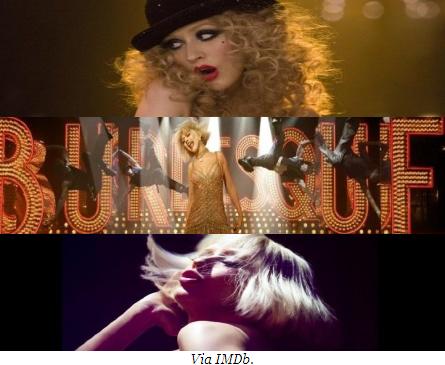
I went into Burlesque expecting three things: acting so bad it hurt, quality musical numbers and Aguilera’s ’90s strawberry blonde ’do to be cut off once her character made the big time. Well, two out of three ain’t bad. (For those of you who haven’t yet seen the film, the latter point is the one that remains.)

The movie starts out with country Christina (Ali) quitting her job in a bar on a whim, and moving to the big smoke. She notices a burlesque bar one night on a walk through the city; “the best view on the Sunset Strip without any windows”. After seeing the girls perform a number, with Cher at the helm as club owner Tess, Ali begs Tess for a job onstage, but settles for working under bartender Jack (literally; but as if we couldn’t see that coming!) as a waitress.

When the alcoholic star of the show, Nikki, played by Kristen Bell, fails to turn up, Ali takes her place. Nikki is so incensed that she interferes with the music for the set, forcing Ali to use her spectacular voice—which previously no one had heard—to save the performance. Tess then begins to build her burlesque show around Ali.

This is where the film starts to get bearable, as we see more of Christina Aguilera in all her ’40s pin-up/voice-that-brings-down-the-house glory, and less of mousy, weak, annoying Ali.

There are some pretty good musical numbers in the film (a 2011 Golden Globe for Best Original Song doesn’t lie), my favourites being a dance-off between Nikki and Juliannne Hough to “Diamonds Are a Girl’s Best Friend” and one of the only legitimate “burlesque” performances in the film, “Guy What Takes His Time”, where pearls and feather fans are used as props.

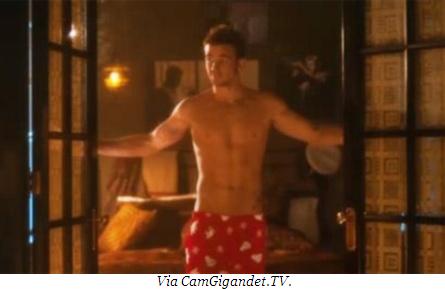
Really, though, the only things that saved this movie were Christina’s performances, Eric Dane’s face, Stanley Tucci in general, and Cam Gigandet’s cookie box scene. Google it.

Movies: Blondes Have More Fun—And They’re Magical!—In Tangled.


The premise of the latest Disney princess effort—a retelling of the story of Rapunzel—is that the damsel in distress is locked away in her tower so that mean baddies won’t be able to find her and steal her supernatural healing powers.

The clincher is that if she cuts her long hair, it turns brown and loses its magical properties. A blatant favouritism of blondes over brunettes if ever there was one!

Granted, the brunette Disney princess has seen somewhat of a resurgence in recent years, with the first African American princess, Tiana, in The Princess & the Frog, Mulan, Esmeralda of The Hunchback of Notre Dame, Pocahontas, Jasmine from Aladdin, Beauty & the Beast’s Belle, and even the flame haired Little Mermaid. Perhaps the blonde haired heroines (okay, I wouldn’t exactly class Cinderella and Aurora as “heroines” per se, but Rapunzel certainly kicked some but in Tangled) wanted a shot at the multi-dimensional princess crown.

Other than that, I really enjoyed Tangled. I usually find Mandy Moore supremely annoying, her voice especially, but I could barely tell it was her throughout the movie. Chuck’s Zachary Levi was great as the misunderstood Flynn Rider/Eugene Fitzherbert. Unfortunately, I missed the first ten minutes or so due to a delicious brunch and Saturday morning traffic on Chapel Street, however it was fairly easy to pick back-story up at the tear jerking pinnacle.

“With a Gun Between Her Legs,” Take 2.


From “Is Female-on-Male Violence on the Rise?” by Lynn Harris:

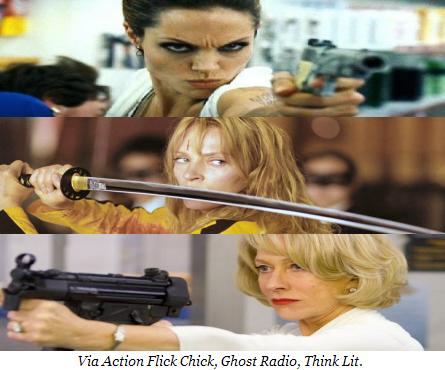
“… ‘we are fascinated by girls’ and women’s violence’. For those who like to see womenAngelina Jolie, even Helen Mirrenwielding serious, even heretofore forbidden, power, it’s hot. For those who fear women in that role, it’s… not. ‘For all the increased tolerance, even celebration, of aggressive women in pop culture, in daily life there’s still a lot of disapproval of women even speaking up at meetings or asking for a raise, let alone committing a physically aggressive act,’…”

Related: “With a Gun Between Her Legs”Why “Strong” (AKA “Sexy” Whilst Being “Strong”) Female Characters Are Bad for Women.

Elsewhere: [Salon] Is Female-on-Male Violence on the Rise?

Movies: The Best Movies I’ve Seen This Year.


Tomorrow, When the War Began. Check out my review to see how strongly I feel about it.

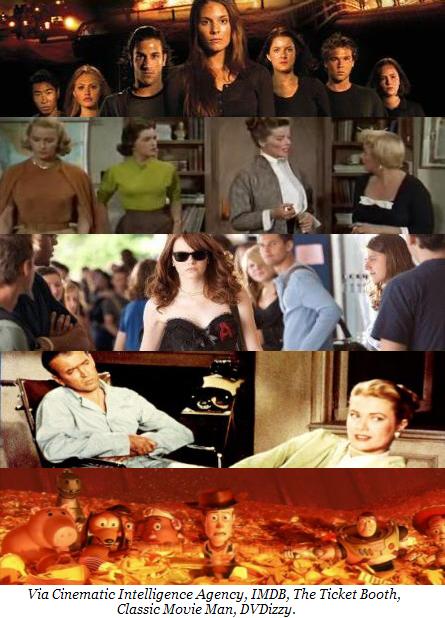
Desk Set. This 1957 romantic comedy starring Katharine Hepburn and Spencer Tracy takes place in a reference library, and deals with the incorporation of computers to help the ladies in their cataloguing. With a healthy dose of the trademark ’50s slapstick rom-com dynamic and TDF fashion, I loved this one.

Easy A. Again, another I’ve done a review on. While I had high hopes for this one, it didn’t live up to them fully, but it is one of the smarter teen movies in recent memory. On par with Mean Girls, perhaps?

Rear Window. What took me so long, right? I watched this one for the first time last Christmas, and continued the tradition again this holiday season. Grace Kelly is luminous as “his girl Friday” to James Stewart’s L.B. Jeffries, who is the ultimate leading man. Hitchcock at his best.

Toy Story 3. It is unanimous that Toy Story 3 is one of the best movies released in 2010. Perhaps the best of the Toy Story franchise? Nah, my money’s on the first instalment.

Desperately Seeking Susan. So bad it’s good. The fashion is fabulous (on Madonna’s part, anyway) and Her Madgesty is surprisingly likable in it.

Sorry about the dismal effort in this post, but seriously; there were no good movies this year! You only have to look at Sex & the City 2 (which I quite liked, but will admit was baaad), The Expendables and Killers for proof of that.

That’s why I spent a lot of my cinema-going money on the classics, such as Gentlemen Prefer Blondes and Beauty & the Beast in 3D. That counts as a movie I haven’t seen before this year, right? Right…?

Related: Tomorrow, When the War Began by John Marsden Review.

Easy A Review.

Sex & the City 2 Review.

The Expendables Review.

Elsewhere: [Jezebel] Is Easy A The Next Mean Girls?

[Jezebel] I Went to See Killers & It’s All Your Fault.

Attack of the Three-Dimensional Disney Character.

So there’s the vanilla damsels in distress of early Disney films, like Snow White, Sleeping Beauty and Cinderella. And there’s the first independent princess, Belle, “who enjoyed reading and learning, and who lived her life according to her standards”.

But there’s a new kind of three dimensional Disney character, in the form of the villain.

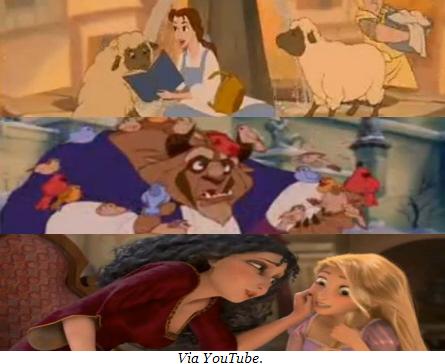
Now, The Beast from Beauty & the Beast isn’t exactly new (he’s pushing 20 years old), but seeing the process the Disney animators went through to create him in Dreams Come True: The Art of Disney’s Classic Fairytales (there’s also some featurettes on the DVD, which has been re-released from the vault) reveals just how complex a character he is.

Incorporating features from a buffalo, bear, gorilla, lion, boar and wolf, but with gentle cows ears, ensures The Beast doesn’t come across as completely horrible.

Both in the exhibition and in the curator’s talk I attended, it was mentioned that despite his ugly exterior, the Beast had to have attributes (both physicalthe aforementioned cows ears, and blue eyesand personality-wise) that a beautiful woman of Belle’s integrity, intelligence and courage could fall in love with. (It could be argued that there are some classic abusive relationship markers in Belle and the Beast’s union, but more to come on that next week.)

Elsewhere, in the upcoming Tangled, which is also featured in Dreams Come True, Mother Gothel, Rapunzel’s keeper, is the movie’s villain. However, she and Rapunzel share a more complicated relationship than that of Snow White and the Evil Queen, Cinderella and her evil stepmother, or Aurora and Maleficent (whose appearance was based on Katharine Hepburn, FYI), in that the animators wanted Mother Gothel to be “believable for Rapunzel to love”. God knows I’ve had my fair share of love-hate with my mother, so I think this movie will be quite relatable in that respect.

Can’t wait to see it in January!

Related: You Can Ring My Belle.

Women in Fiction: Are Our Favourite Female Characters Actually Strong, or Stereotypes?

Women in Fiction: My Favourite Fictional Females.

Elsewhere: [Overthinking It] Why Strong Female Characters Are Bad for Women.

[Overthinking It] Why Weak Male Characters Are Bad for Women.

Smiling Assassin.


From “Sexist Beatdown: Revenge of The Smiler Edition” by Sady Stein on Tiger Beatdown:

“In adolescence, no-one is normal. That’s why it’s adolescence, for fuck’s sake. The girl who can pull off ‘normal’ the most convincingly is usually the girl who’s best at lying. And all too often, she is The Smiler. The Smiler is nice. The Smiler is pretty. The Smiler is popular, but not too popular; she’s just normal folks, you know? The Smiler is good in school and her teachers love her, but she’s not the valedictorian. The Smiler is in show choir and is cast in all the theatre productions, and she makes sure of her position by purposefully fucking with people’s heads and making them cry during auditions with ‘helpful advice’ about how nobody likes them and they should leave to make people happy, but she’s smiling. (Actual true story.) The Smiler is a respected youth group leader, a pillar of her community, and she tells the girl who’s been abused by her boyfriend that it wouldn’t have happened if she hadn’t presented herself so provocatively, but she promises that Jesus can make it better, and she’s smiling. (Also actual true story.) Sometimes, the Smiler is so good at what she does that the Smiler is your friend: Talk to the Smiler! Hang out with the Smiler! The Smiler only wants to help! Tell the Smiler your troubles—your many secret troubles that no-one knows about because you’d prefer to keep them private! But surely you can trust the Smiler? Except that two weeks later, everybody somehow knows a distorted Grand Guignol disastrous version of exactly what you told the Smiler, and your life is effectively over until college. (I was home-schooled.)

“… What I feel is that I am hanging out with the youth group leader/glee club star/all-around nice girl who also spreads a rumour about how you went to third base with Derek and are a total skank.”

Sounds a lot like Amanda Bynes’ character in Easy A, don’t you think?

Related: Easy A Review.

Elsewhere: [Tiger Beatdown] Sexist Beatdown: Revenge of The Smiler Edition.

You Can Ring My Belle.

From Disney’s Dreams Come True: The Art of Disney’s Classic Fairytales:

“Arthur Rackham, the famed British illustrator of children’s fairytale books, said that there is no doubt that ‘we should be behaving ourselves very differently if Beauty had never been united to her Beast.’

“In Belle, Disney had its first independent female character, one who enjoyed reading and learning, and who lived her life according to her standards. Longing for substance in her life, she shunned the vacuous Gaston, over whom all the other ladies in town swooned. Belle’s genuine selflessness also distinguished her from the other women in town, including, most particularly, the ladies who pursued Gaston.

“While anyone else would have been overcome with fear, Belle’s devotion to her father gave her the courage to stay alone with the fearsome Beast in his remote castle.

“Her strong will earned the respect and devotion of the Beast.”

While some would say the Beast is the Disney equivalent to an emotionally abusive boyfriend (watch this space), this description of Belle shows that you have to love yourself before someone else will.

Plus, it proves that Belle is the most bitchin’ of the Disney princesses.

Related: Drug of Choice: The Disney Heroine.

Women in Fiction: My Favourite Fictional Females.

Women in Fiction: Are Our Favourite Fictional Females Actually Strong, or Stereotypes?

The Representation of Trees in the World of Walt Disney.

It’s All About Popular… Lar, Lar, Lar, Lar!

From this weekend’s Good Weekend in The Age, in an article by Tom Ballard entitled “Too Cool for School”:

“If Footyheads are the oafish kings of high school, Popular Girls are assuredly the vapid queens. Deemed ‘The Plastics’ in the 2004 film Mean Girls, this clique is made up of attractive females who are attractive and wear make-up and are attractive and giggle and are attractive and fully hot.

“The members of this group are often the first among their peers to produce any inkling of breast and to discover foundation. Their classroom catch cry“So, like… what are we doing?”is well known and feared.

“Popular Girls enjoy chewing gum, looking vacant and protesting about the confiscation of jewellery. They feed on expensive formal dresses. They’re really, really popular.”

Examples of the Popular Girl in Popular Culture include, as Ballard mentioned, the Plastics in Mean Girls; Cher Horowitz of Clueless, who sees the light in the end; Louise from ’80s cheese fest Teen Witch, who gains popularity from a supernatural amulet; and “good” witch Galinda from Wicked, who tries to make over the self-conscious and “green” Elphaba during the musical’s “Popular” tune, from which the title of this post was derived.

Related: Women in Fiction: My Favourite Fictional Females.

Women in Fiction: Are Our Favourite Fictional Females Actually Strong, or Stereotypes?

The Representation of Trees in the World of Walt Disney.

This is an edited version of a research article I wrote in 2008; one of the most inspiring and fun essays to write for uni, which was reflected in my mark. It’s a left of centre topic, and maybe a bit left of centre for this blog, but it’s just something I’m trying out. Go with it.

When we think of the wonderful world of Disney, trees aren’t usually the first thing that comes to mindunless you’re a horticulturalist!

You might think of the magic of such classics that bring back childhood memories, like Peter Pan or Dumbo; the crown jewel of Disney that is Snow White and the Seven Dwarfs: or the somewhat negative public perception of Disneyland, Disney World and the subsequent “Disneyfication” of the Western world. The one thing we definitely don’t immediately associate with Disney is trees.

But the tree is a very important aspect of not only Disney films, but the whole universe that Walt Disney created. Did you know that there are over 5,000 different types of trees at Anaheim, California’s Disneyland theme park, including Australia’s own eucalyptus tree?

And in almost every movie the action, at some point, takes place in a forest or woodland area, abundant with lush growth. In Snow White, the title character is stalked by the huntsman and seeks solace in the Seven Dwarves’ cottage in the woods. Sleeping Beauty’s Aurora ponders her future love in the forest amongst her animal friends. Beauty and the Beast’s heroine Belle and her noble steed are attacked by wolves in the snow-covered wilderness surrounding the Beast’s castle.

So where did the mastermind Walt Disney gain his inspiration for the use of trees? Some of his first fairytales he adapted into feature films came from the Brothers Grimm, who wrote Snow White and Cinderella, undoubtedly two of the most popular and well loved fairytales and, thereby, characters.

The Brothers Grimm, writing about the lush green countryside of the European settings for these stories, inspired Disney through their gift of writing. Walt Disney also had a fascination with animals (from crickets in Pinocchio to lobsters in The Little Mermaid ), so much so that he produced a series of documentaries on the animal kingdom and nature, called True Life Adventures. Titles in this series included “Seals Island”, “In Beaver Valley”, and “The Living Desert”. An article on Walt Disney in a 1963 edition of Modern Mechanix magazine said that, “Walt’s early edict for… all the True Life Adventure pictures was to get the complete natural history of the animals with no sign of humans: no fences, car tracks, buildings, or telephone poles.”

Disney wasn’t only interested in portraying animals on film, but also conserving species and their environments for future generations. This is evident in the construction of the Tree of Life at Orlando, Florida’s Disney World Animal Kingdom sub-park. While the tree is fake (it consists of about 100,000 silk leaves sewn onto over 8,000 branches), it has carvings of numerous animals on it, allowing children to experience an African Safari with illustrated depictions of animals that may not be around for much longer.

The “Tree of Life” was drawn directly from the incredibly successful 1994 movie, The Lion King. In the movie, the tree is shown only a few times, where the mandrill Rafiki draws symbols of Simba when his life seems to be in danger.

Gail Krause says that, “… Rafiki is the wise ‘shaman’ of the animal community; he writes the image of the lost and then found king, Simba, on a central tree, making real for himself the ‘death’ and ‘resurrection’ of the true leaderan interesting parallel to the Jesus myth. The Disney company then created the park Animal Kingdom with a majestic Tree of Life…”.

The Tree of Life in The Lion King also serves as a marker for where Simba left his old life as heir to the King of the Jungle and his new life in exile with the feisty meerkat, Timon, and Pumbaa the rotund warthog. The fact that the Tree is in the middle of the desert where scarcely any animal roams signifies the neutrality of the Tree: the halfway point between the corrupt leadership of Scar and the carefree new life that Simba leads.

But the Tree of Life isn’t the only perennial woody plant in The Lion King. The other tree that acts as a signpost for where the action picks up is the almost half-dead, lone branch in the gorge. This tree is the framing point for the stampede that Simba gets caught up in; the stampede in which his father, Mufasa, is killed. It’s not a full, live tree, but its skeleton-like appearance is parallel to the dark, cold soul of Scar and his hyena followers, and the subsequent reign of darkness the animal kingdom is ruled by.

The Tree of Life shows that trees are not only markers for where certain actions will take place or where the central protagonist should turn, but they are somewhat characters in their own right. Trees are key characters/motifs in the Disney films Pocahontas, Peter Pan and Alice in Wonderland, as they provide turning points or revelations in the story.

Mark I. Pinsky, author of The Gospel According to Disney: Faith, Trust and Pixie Dust, says, “Providence will show up in the form of a fairy, wizard [or] talking willow tree,” if ever you should lose your way. Or rather, in Alice’s case, stumbling down the rabbit hole underneath the tree she falls asleep in is how she begins her wayward journey.

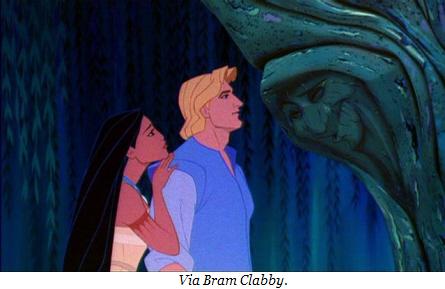
Pocahontas, the story of a Native American girl who promotes acceptance between white settlers and her own people, is the obvious example of a Disney film with a tree as an actual, personified character in Grandmother Willow. According to the Living Arts Originals website, “Willow tree symbolism includes magic, healing, inner vision and dreams… Forests are the abode for the nature spirits”. A lot of research probably went into the character of Grandmother Willow, as these classic Native American qualities of the tree are evident in her. She acts as Pocahontas’s “fairy godmother”. Although Grandmother Willow could be personified as any nationality, she is fittingly a Native American like Pocahontas and her people, because that’s who Pocahontas identifies with (as evident in the conflict between Pocahontas’s tribe and John Smith’s men). When Pocahontas brings John Smith to Grandmother Willow, she shows him her magic and opens up the Native American culture to him, and thereby the settlers, as Pocahontas did in reality many centuries ago. Grandmother Willow, using her virtues of inner vision and dreaming, encourages Pocahontas to follow her path, shown to her by the spinning arrow of John Smith’s compass, thus orchestrating great change in conflict between the “savages” and the whites.
Alice in Wonderland, the most eccentric of all Disney’s films, uses trees in a number of ways. Firstly, the tree in which Alice is studying in at the beginning of the story is the tree under which the white rabbit escapes, and she follows. A magic mushroom (perhaps a reflection of the author Lewis Carroll’s drug use?), makes Alice grow to the height of a tree, where a nosey pigeon refuses to believe she’s “just a little girl!”.

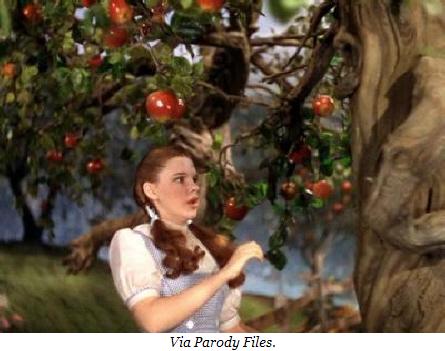
One image of the tree, or woods/forest, that rampant not only in Disney films, but many other contemporary movies, is the personification of the treetaking on human characteristics, such as eyes and arms, to give off a menacing vibe. In Alice in Wonderland, the Tulgey Woods’ trees observe Alice as eyes appear , which then turn out to be a gathering of characters with eyesducks with horns, flamingos with umbrella bodies, and glasses that seem to resemble the fake-nose-and-moustache disguise that children are fond of. Treebeard, in J. R. R. Tolkien’s Lord of the Rings trilogy, both text and film is another, non-Disney example. The forest in The Wizard of Oz comes to life and the trees throw their apples at Dorothy, Scarecrow and little Toto. If I listed the numerous other movies that show trees in this way, we’d be here all day.

But, they’re all derived from one Disney flick in particular: Snow White and the Seven Dwarfs. The first ever feature length animated film was also one of the first to depict a forest coming to life in such a way, where the trees grow arms and eyes, and bark floating in the river turns into crocodiles! No doubt other Hollywood productions have used Snow White and Disney as inspiration, especially The Wizard of Oz, with it’s out-of-this-world plot and unmistakably Disney-esque characters.

Even before Snow White, though, was the Disney short animated film Flowers and Trees, shown in 1932, which won the first ever Academy Award for an animated short. This undoubtedly would have been the starting point for trees as more than just “trees”, not only in Disney, but in film in general.

If ever there was a documentary explaining all about the depiction of trees in Disney films, it’s Four Artists Paint One Tree, a special feature that can be accessed via the 2003 special edition DVD release of Sleeping Beauty. In the doco, Walt Disney narrates as four animators go out into the field to demonstrate how they would paint an old oak tree. The first artist, Walt Peregoy, views the tree as an architectural monument, and his finished painting is evidence of the animation of the backdrop of Sleeping Beauty. Josh Meador, an effects artist for Sleeping Beauty, references the Druids, who believed trees had personalities. Maybe he was a key artist in personifying trees and bringing them to life? The next painter, Eyvind Earle, is primarily interested in the trunk, and uses watercolours to fill in the fine detail. Finally, Marc Davis represents the tree as an explosion out of the earth, with branches spraying out from the body of the trunk. After watching this documentary, you can see which aspects of each artists tree, or their style of painting scenery, that has gone into creating Sleeping Beauty. Walt ends the documentary by paraphrasing the artist Robert Henri: “The great painter has something to say. He does not paint men, landscapes or furniture, but an idea.” This seems to be the consensus amongst not just Disney’s approach to filmmaking, but the studio’s approach to letting audiences believe what they want to believe (some would beg to differ on this point).

M. Lynne Bird backs this theory up in her article titled “Ecological Ambivalence in Neverland from The Little White Bird to Hook in the tome Wild Things: Children’s Culture and Ecocriticism. She discusses the idea that trees are just treesnature is just naturein Disney films, but it’s the children’s imaginations, and in turn, Walt Disney’s child-at-heart imagination that makes a tree something more, such as in the films mentioned above. She writes, “‘The Neverland is always more or less an island, with astonishing splashes of colour here and there’… This mix drops nature and privileges both imagination and society. The island can only become real as children look for it.”
Though not a “tree” specifically, the Smoke Tree Ranch, Walt Disney’s holiday home in Palm Springs, California, was used as collateral in the funding of Disneyland. While it was hard for him to part with the ranch, it turns out Disney made the right choice: sacrificing a symbolic and sentimental place in his personal life to create a symbolic and sentimental place for millions of others.

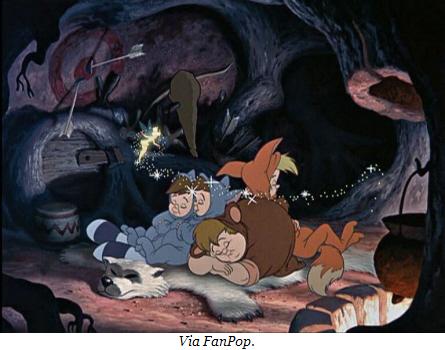
Walt Disney was obviously a kid at heart, as can be seen in the tales he chose to adapt and bring to a worldwide audience. Tarzan’s Treehouse, from the movie Tarzan (and was also adapted from the tree house in Disney’s Swiss Family Robinson) and located in the Disneyland theme park as an attraction, and the creation of the Hangman’s Tree, the home of Peter Pan and the Lost Boys, are more blatant examples of trees in the world of Walt Disney. Hangman’s Tree exemplifies everything a child could want in a tree house.

While, once again, trees are definitely not the first thing Disney-enthusiasts think of when sitting down to watch their favourite film, but the next time you do, keep an eye out for the trees: after all, that’s what a horticulturalist would do!

Elsewhere: [Modern Mechanix] The Magic Worlds of Walt Disney Part 1.

[MSMC] The Cipher: The Mythological Tree in Various Cultures.

[Living Arts Originals] Find Your Tree: The Deep-Rooted Symbolism of Trees.

[Google Books] Ecological Ambivalence in Neverland from The Little White Bird to Hook.

Women in Fiction: Are Our Favourite Fictional Females Actually Strong, or Stereotypes?

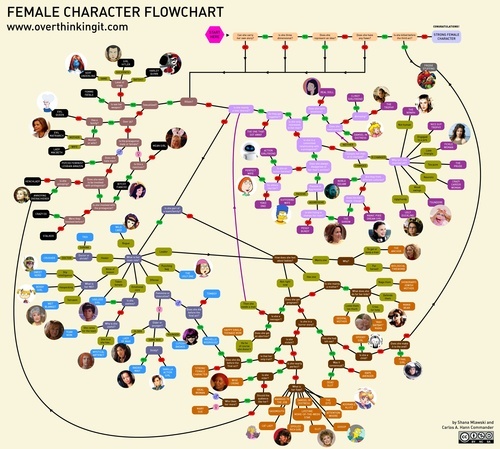
I’ve been wanting to write a post on Overthinking It’s “Female Character Flowchart” since I saw it on both Jezebel and Musings of an Inappropriate Woman about two weeks ago, and the time has finally come I’ve finally gotten around to compiling a list of my favourite fictional female characters and whether they qualify as “strong” ones.

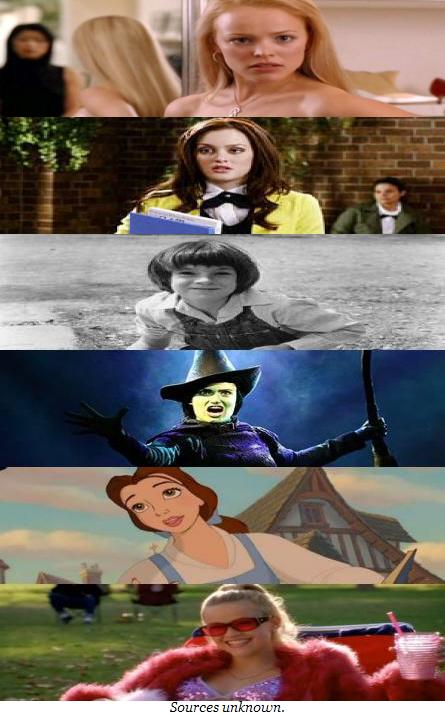
Without compromising the quality of the image, I wasn’t able to enlarge the chart, nor add my own annotations as per the below characters of my choosing. Instead, I’ve reproduced their equations below, as well as Mean Girls’ Regina George, who appears on the chart, and Blair Waldorf, whom Rachel Hills believes is a “girl Hitler”, but who I find to be much more of a genuine strong female character.

Regina George (Mean Girls): Can she carry her own story? YES. Is she three dimensional? NO. Villain? YES. Sexualised? NO. (I would argue yes. Hello? Have you seen her Halloween getup?) Over 35? NO. Is the protagonist male or female? FEMALE. Is this a rom/com? NO=Mean Girl.

Blair Waldorf (Gossip Girl): Can she carry her own story? YES. Is she three dimensional? YES. Does she represent an idea? NO. Does she have any flaws? YES. Is she killed before the third act? NO=Strong female character.

Belle (Beauty & the Beast): Can she carry her own story? YES. Is she three dimensional? NO. Villain? NO. Is she mainly a love interest? YES. Do they get together? YES. Is she only interested in her man? NO. Is she in a committed relationship with a protagonist? NO. Changes her man or is changed? CHANGES. Are they from different cultures? YES=Nobel Squan, whatever the hell that is! (Looks like something out of Avatar, though.)

Scout Finch (To Kill a Mockingbird): Can she carry her own story? YES. Is she three dimensional? YES. Does she represent an idea? YES. Villain? NO. Is she mainly a love interest? NO. Is she part of a team/family? YES. What is her main role? LEADER. How does she feel about babies? NOT RIGHT NOW. Does she get pregnant? NO. Is she in a horror story? NO. Is she violent? NO. Is she nearly perfect? NO. What is her flaw?=sassmouth, which I guess is true, but Scout is so much more.

Elphaba (Wicked): Can she carry her own story? YES. Is she three dimensional? YES. Does she represent an idea? YES, many. Villain? NO. Is she mainly a love interest? NO. Is she part of a team/family? YES. What is her main role? ROGUE=wildcard.

Elle Woods (Legally Blonde): Can she carry her own story? YES. Is she three dimensional? YES. Does she represent an idea? YES. Villain? NO. Is she mainly a love interest? NO. Is she part of a team/family? YES. What is her main role? LEADER. How does she feel about babies? NOT RIGHT NOW. Does she get pregnant? NO. Is she in a horror story? NO. Is she violent? NO. Is she nearly perfect? YES. Is she older? NO. Should the audience like her? YES. Who likes her more? WOMEN=Mary Sue.

Related:  Women in Fiction: My Favourite Fictional Females.

Elsewhere: [Overthinking It] The Female Character Flowchart.

[Overthinking It] Why Strong Female Characters Are Bad for Women.

[Jezebel] Flowchart: Know Your Female Character Stereotypes.

[Musings of an Inappropriate Woman] Flowchart: Know Your Female Character Stereotypes.