TV: Private Practice—Pro-Choice?


I’ve recently finished watching the latest series of Private Practice, the final of which aired here just over a month ago. The season dealt with the brutal rape of Dr. Charlotte King, about which you can read here and here, as well as the abortion debate that is raging across the world, but particularly in the U.S., with the rise of the über-conservative Tea Party, and 2012 presidential hopeful Michele Bachmann.

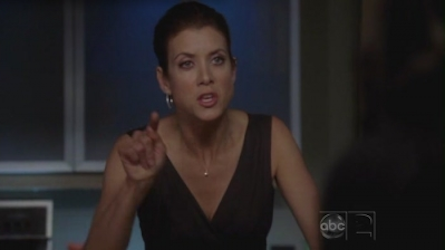
The second last episode of the season was said “abortion episode”. A woman named Patty came to see Dr. Addison Montgomery with pain, cramping and nausea after getting an abortion a month or two prior. When Addison does an ultrasound, she regrettably informs her patient that she’s still pregnant: the abortion didn’t take.

Patty’s foetus is now at 19 weeks, which would make the pregnancy in its second trimester, at which time an abortion is dubbed a “partial-birth abortion” by pro-lifers, as Dr. Naomi Bennett points out. Addison chides her for using political terminology, and that an abortion at 19 weeks is still perfectly legal, reiterating Patty’s right to choose, especially since she already made her decision the first time around several weeks ago.

Television and the media have a responsibility to present both sides of the story on such a contentious issue, even if they don’t live up to this most of the time. That’s why, when a show like Private Practice represents the abortion debate in such a refreshingly honest manner, it can be seen as revolutionary. (And it’s not the first time, either.) Not as revolutionary as Maude’s title character choosing to abort her unwanted pregnancy back in 1972, before the groundbreaking Roe VS. Wade decision, as this article points out, but still.

Naomi is a character I’ve never been a big fan of. She overreacts to everything (granted, overreaction may be warranted when your 16-year-old daughter gets pregnant and your best friend starts dating your ex-husband) and has a self-righteous, holier-than-thou attitude to most things, and her interference with Patty is no exception.

She uses her granddaughter Olivia to potentially guilt Patty into going ahead with her pregnancy, completely ignoring that Patty is single, after her deadbeat boyfriend took off when she told him she was pregnant, works two jobs, is poor, and is on her feet eight hours a day.

I had a real problem with this. Doctors should not push their personal beliefs on patients. If I were to fall pregnant tomorrow, I would be hitting up my nearest abortion clinic in a second, expecting to be given the care I’ve chosen, not to be lectured or threatened. As Addison says:

“… Even after you make the most difficult and personal decision that there is, it’s still not safe. Because you have some fanatic who claims to value life who can walk into an abortion clinic and blow it up.”

She continues:

“Why can’t Patty get what she needs, a safe and legal abortion without judgement?  Why does she have to go through this?  Why do I have to go through this?  I hate what I am about to do but I support Patty’s right to choose.  It is not enough to just have an opinion because in a nation of over 300 million people there are only 1700 abortion providers.  And I am one of them.”

The statistics are grim.

But, while trying to express the “pro-life” argument as well, Private Practice manages to remain pro-choice, which is no mean feat in the wake of reproductive rights being ripped from women across the world, and another PP, Planned Parenthood, being defunded en masse.

Related: Grey’s Anatomy Final Asks “When Does Life Begin?”

Cristina Yang as Feminist.

Elsewhere: [New York Magazine] Emily Nussbaum on the Rape Episode of Private Practice.

[E! Online] The Morning After: Let’s Talk About Private Practice.

[Feminist in the City] Private Practice Tackles Abortion.

[Televisual] The Changing Economics of the TV Abortion.

[Fuck Yeah Choice] Just Keep Swimming: Abortion on Private Practice’s “God Bless the Child”.

[Dakota Women] And the Abortion Portrayal Award Goes to… Private Practice?

Images via Kate Walsh Fan.
TV: In Defence of Rachel Berry.


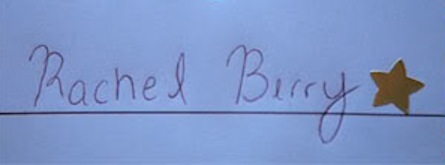
In the first season of Glee, Rachel Berry was introduced as an attention- and approval-seeking know-it-all diva, who sticks a gold star next to her name on the New Directions’ sign-up sheet because that’s what she sees herself as. Season two showed the glee clubber soften her resolve a bit, realising that she’s still only in high school, and has her post-high school years to carve out a Broadway career and have the world see her as the star she knows she is. The season final saw her choose a relationship with Finn Hudson in her senior year at McKinley High, despite having to leave him to head to New York when she graduates.

Not all young girls have to wrangle their feelings for the school jock whilst contemplating a move to the big city to make their dreams come true, but many of Rachel’s problems are shared by the show’s audience.

In the most recent Lady Gaga-themed episode, Rachel struggles to accept her “Jewish nose” and considers rhinoplasty. She also strives for the acceptance of her New Directions band mates, and to be seen as fashionable and popular.

It’s in the character’s nature to be highly-strung, goal-oriented and ambitious, so it’s not likely she’ll change any time soon. And why should she? While there are certainly other young women out there who identify more with the saccharine Quinn Fabray, the sassy soul sisters Santana Lopez and Mercedes Jones, or badass Lauren Zizes, there are plenty who see Rachel as their Glee counterpart, myself included.

A recent New York Times article by Carina Chocano praised the “relatable” and “realistically weak female character”, like Kristen Wigg’s Annie in Bridesmaids—“a jumble of flaws and contradictions”—over the “strong” one. “We don’t relate to [the weak character] despite the fact that she is weak, we relate to her because she is weak,” Chocano writes.

But what exactly does she mean by “weak”?

Pop culture commentator Dr. Karen Brooks notes that talented, beautiful, popular and successful female characters need to be broken down before they can be seen as relatable. “The more talented and beautiful you are, the greater the threat you pose and so ‘things’ are introduced to reduce that threat,” she says. Just look at the “women falling down” video on YouTube.

While Rachel’s had her fair share of setbacks, it seems Glee’s audience is finally beginning to understand her. “We’ve been given time to understand Rachel’s initially painful personality and to identify both her strengths and weaknesses. Her ambitions and drive haven’t shifted, but the context for understanding them has,” Brooks says.

“Rarely are unpleasant characters redeemed, they are simply ‘punished’, while the ‘good’ characters soar to impossible heights, not on the back of hard-work and self-belief, but usually [because of] a love interest and wishing hard. Rachel is a healthy and welcome exception to that,” Brooks continues.

So she’s an unlikely heroine we can all get behind, you might say? “A girl who reminds you of you,” as Chocano opines. An everywoman, if you will?

If Rachel Berry encourages more young women to see themselves as gold stars striving to have their accomplishments recognised, then so be it!

Related: The Underlying Message in Glee’s “Born This Way” Episode.

Do “Strong Female Characters” Remind You of You?

Elsewhere: [The New York Times] A Plague of Strong Female Characters.

Image via Noelle’s Means of Escape.

Fictional Friends.

Last week, Alissa Warren on MamaMia listed her top five fictional friends. You know, people you’d be friends with… “if they were real.”

Let me know in the comments who you’d be fictional friends with but, until then, here are my top picks:

Elphaba Thropp, Wicked.

It’s no secret Elphaba is my favourite fictional female: someone you can look up to, who rises above hatred and discrimination, and who will stand up for her beliefs no matter what. Plus, she’s a witch! Galinda wouldn’t be too bad either…

Elle Woods from Legally Blonde.

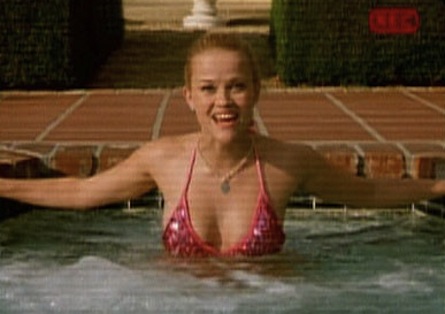
She’s fun, she’s quirky, she’s got a cute little dog and an awesome wardrobe. And underneath it all, she’s not as ditzy as she seems. Awesome friend material.

Cher Horowitz, Clueless.

Again, someone who seems carefree and Clueless on the outside, but whose heart is in the right place. Maybe she’ll let you come over and program your wardrobe into her computer. Just think of the outfit-planning time you’ll save.

Gus Bailey.

The fictional version of the late Vanity Fair columnist and man about town Dominick Dunne, Gus Bailey, would always give you the inside scoop, and probably feature you in his gossip columns! Anonymously, of course. You’ve got to keep up appearances.

Blair Waldorf/Dan Humphrey, Gossip Girl.

I’m not sure which one I’d like better as, personality-wise, they’re pretty much the same person. They exchange emails and phone calls whilst ploughing through their identical Netflix queues. They enjoy art, foreign films, being “in” with the “in crowd” and bygone eras. You could borrow Blair’s clothes, but Dan’s nice to look at… I can’t choose!

Kat Stratford, 10 Things I Hate About You.

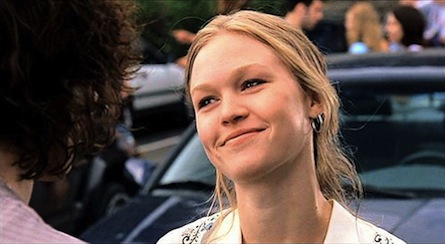
She’s everything I’m not. She’ll shun the prom (but actually ends up going!) due to its patriarchal confines. She’s musical. She loves the riot grrl scene. She ploughs through feminist literature whilst listening to Spiderbait. And she don’t give a rats what anyone thinks of her. Total. Feminist. Icon.

Heather Mooney, Romy & Michele’s High School Reunion.

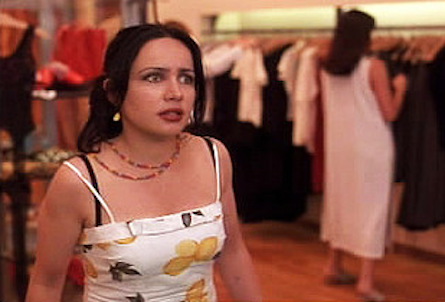
Anyone who openly tells people they don’t like to “fuck off” is someone I want to get to know! Plus she’s hilarious despite her best efforts to come across as cold and callous.

Scout Finch, To Kill a Mockingbird.

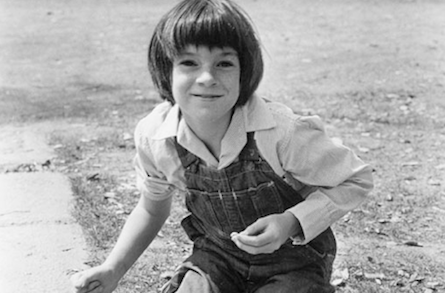
Sure, she’s a little young to be best buds with, but maybe I could be her babysitter?!

Related: Women in Fiction: My Favourite Fictional Females.

Women in Fiction: Are Our Favourite Fictional Females Actually Strong, or Stereotypes?

It’s All About Popular… Lar, Lar, Lar, Lar.

Strong Female Characters in the Land of Oz.

Pop Culture Power Women.

So Misunderstood.

Pop Culture Role Models.

In Defence of To Kill a Mockingbird.

Another City, Not My Own by Dominick Dunne Review.

Images via Freewebs, IG Style, Abhishek Tiwari, USA Today, TV.com, Inspired Ground, Flickr, The Hero Construction Company.

TV: Cristina Yang as Feminist.


When it comes to “likeable” female characters on TV, you might think of Buffy Summers. Or Rachel Green. Or the Gilmore girls. But Grey’s Anatomy’s Cristina Yang probably isn’t one of them.

She’s abrasive, unfeeling, career-driven, ruthless and selfish. Everything a woman shouldn’t be, according to patriarchal norms.

Perhaps she could be more like the ousted Izzie Stevens, who was bubbly and sexy and baked cookies. Or the virginal and highly-strung April Kempner, whom Cristina praises for having “virgin super powers”, enabling her to be super-organised.

But I like Cristina just the way she is. She’s got her eye on the prize, won’t compromise her personal beliefs or goals to be liked or for a man, and she’s got “tiny little genius” hands that enable her to roll with the big guns.

This is why Cristina Yang is one of the only “feminist”—or “strong female”—characters on television. Nay, in all of fiction.

For one thing, she refuses to rely on her looks or her feminine wiles to get ahead. In “This is How We Do It” in season seven, she rejects Owen’s compliment about her beauty, saying, “If you want to appease me, compliment my brain.” (Stay tuned for more on beauty versus brains this week.)

And in last week’s final, we saw Cristina exercise her right to choose, and schedule her second abortion on the show, after much (mostly solo) deliberation. While excluding the opinion of her significant other and father of the future child wasn’t the most respectful thing to do, ultimately it came down to her choice, and she chose to terminate the pregnancy.

In season two, Cristina divulges that she’s pregnant to Dr. Burke and, again, makes the decision to get an abortion on her own. Whereas a character like Izzie seems to serve the pro-life agenda (she gave up her own baby for adoption when she was a teenager growing up in a trailer park, and convinced a HIV-positive woman to carry her pregnancy to term), Cristina resists the societal pressures to tap into her maternal instincts and give birth to a child she does not want.

Regardless of whose agenda could be seen as being served by Cristina’s character, she acts without fear of what other people will think of her.

As a person, no matter what gender, it is seemingly second nature to want others to like us, and to portray our best selves to them. Just look at the ritual of the date or the job interview. That Cristina defies this action (though we have seen her star struck when meeting surgeons like Tom Evans, and Preston Burke for the first time) makes her not just a feminist character, but a truly humanist one.

There are people in this world who challenge us, grate on us, and whom we genuinely don’t like or approve of. But that’s what makes the world go around. Cristina Yang being one of these kinds of people, and being portrayed to us as a whole person on television, with hopes and dreams and trials and tribulations and relationships and a career and no desire for children, and not just as the bitchy mother-in-law who lives off her husband’s money and needs a good fuck, is truly a sight to behold.

Related: Grey’s Anatomy Final Asks “When Does Life Begin?”

The Underlying Meaning in Grey’s Anatomy’s “Superfreak” Episode.

Sookie as Feminist? Hear Her Roar.

Are Our Favourite Fictional Females Actually Strong, or Stereotypes?

Elsewhere: [The Feel of Free] Cristina Yang + You Can’t Compromise on a Baby.

[Marinagraphy] Motherhood, Cristina Yang & Grey’s Anatomy.

Image via Home of the Nutty.

TV: Grey’s Anatomy Final Asks “When Does Life Begin?”


Last night’s Grey’s final saw the seeming collapse of Derek and Meredith’s marriage over Meredith tampering with the Alzheimer’s clinical trial just as baby Zola came into their lives, pending the finalisation of the adoption papers.

Derek chided Meredith for swapping the active drug with the placebo for Richard’s wife, Adele, asking her how she couldn’t differentiate between right and wrong. Meredith replied that to her, things aren’t just right and wrong; there are shades of grey (hello, her last name’s Grey!), and that she’d do it all over again if it meant that Adele got better.

Derek should know this. Back in season five, when Derek introduces Meredith to his mother, she exclaimed that Meredith was good for him: he’s black and white and she’s grey.

But it didn’t stop him walking out on his wife for failing to see her reasoning, much like Owen failed to see Cristina’s reasoning, and kicked her out after she scheduled an abortion without his input.

Yes, that’s right: Cristina’s pregnant, much to her dismay.

She doesn’t want a baby. Never has, and never will. But Owen can’t understand this, and pushes her to see his side.

Now, this is where it starts to get messy. I’m not ashamed to say I’m staunchly pro-choice, so much so that I take the line of reasoning that if in doubt, abort. Especially if the woman in question is young, a victim of rape or incest, or can’t afford to have a baby. To me, life begins when the foetus is out of the womb and has taken its first breath. But I agree with Owen in that Cristina should have allowed him to have a say in the matter of abortion. But I also think that if Owen married Cristina knowing she didn’t want children but thinking he could persuade her anyway, he’s an idiot.

Cristina echoes this notion somewhat when she informs her husband she’s pregnant. Owen is overjoyed; Cristina has a migraine.

She tells him flat out that she doesn’t want a baby, and he responds with, “Well, you have one.”

“Are you getting all lifey on me?!” she remarks in disbelief, while he proceeds to ask her how far along she is, and if the foetus has feet and hands. How dare he tell her when life begins, she reasons.

While the storyline is clearly personal, not medical, it seems that Owen leans towards pro-life, though that could just be because the foetus in question contains his DNA. I don’t think doctors should push their personal opinions onto a pregnant woman who is coming to terms with the “unwanted tissue” inside her. I would go as far to say that I don’t think doctors with pro-life beliefs should be practicing medicine.

Still, Cristina is absolutely right when she says she’s not “compromising” on a baby: “You don’t have half a baby!… You don’t ‘give a little’ on a baby.”

While it’s perhaps easier for the father to bow out on raising their biological child, mothers usually don’t have that (ad)option. Cristina just plain and simply doesn’t. Want. A. Baby. But if she has it, she knows she’ll love it. (That’s the risk women run when they give their children up for adoption.) Owen shouldn’t have put her in the position to do something she doesn’t want to do (“It’s not like pizza or Thai.”), thinking she will “come around” later.

While Derek and Meredith deal with the fall out of Meredith’s “wrong” decision, how will Owen deal with Cristina’s decision? Was it “right” or “wrong”? And how will Grey’s Anatomy continue to discuss the “when does life begin?” question?

Related: The Underlying Message in Grey’s Anatomy‘s “Superfreak” Episode.

Elsewhere: [The Feel of Free] Cristina Yang + You Can’t Compromise on a Baby.

[Marinagraphy] Resisting Motherhood in Grey’s Anatomy.

Images via VideoBB.

Does Pop Culture Glamourise Our Carbon Footprint?

Carbon tax. It’s got everyone in a tizzy, and has given Julia Gillard the lowest approval rating of any Prime Minister since Paul Keating. Oh Julia, you had so much potential… but that’s another blog post for another day.

What I want to write about here is the factors that have caused us to need a carbon tax, the front runner being popular culture!

I know, it seems like an odd thing to deduce, but hear me out.

On the nights when I get home from work or being out with friends and my housemate is home before me, oftentimes I’ll walk into the apartment to be greeted by every light in the place blaring, the heater and TV on, and I wonder why my housemate feels the need to make our home look like it belongs in a decor magazine or, at the very least, a television show. But if you’re looking to television and movies to guide your lifestyle, no wonder Australia (not to mention America, the beacon of all things consumerist and anti-environmental) is up shit creek without a paddle.

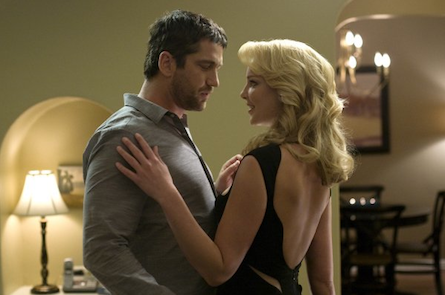
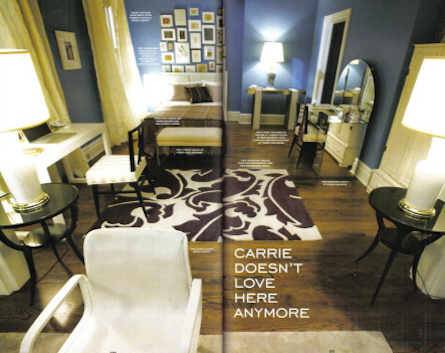
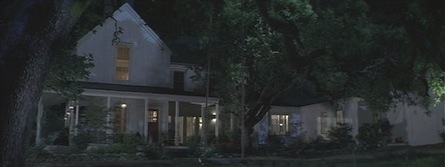
Look at any major mainstream TV show or movie staged in an affluent location: every single light is on, adding to the unrealistic “ambiance” of the place. Below are just a few screenshot examples:

Charmed.

The Ugly Truth.

Sex & the City.

Scream.

Also, inhabitants of houses/apartments/sheds/any building one can reside in onscreen have a penchant for leaving their blinds open. This is a pet hate of mine and one I’ll never understand. Not only does it practically invite psycho killers into your home (okay, I’ve been watching too much Scream), but in winter, it completely undoes all the good work of your trusty little heater. (I see this not only in movies and TV, but in real life, too. My friend Katrina recounted to me how she once saw her neighbour walking around topless in her bedroom without the blinds drawn!)

And hard-yakka Aussies wonder why they’re being asked to fork out for a carbon tax.

Girl with a Satchel Erica Bartle put it well when she wrote that we’re “not so hard up, are we?” when it came to light that “the average Aussie household now has multiple computers, wireless broadband internet, a Nintendo Wii or similar game console and a plasma TV”. Also, how much are the media contributing to our carbon footprint when they’re firing up the chopper to get aerial views of Cate Blanchett’s eco-mansion whilst condemining her for deigning to support the tax. (I read this on The Drum  or The Punch or one of those sites, but can’t seem to find the link, sorry.)

Can you think of any other TV shows and movies that perpetuate this lights on = glamour at the expense of practicality and our carbon footprint?

Elsewhere: [Girl with a Satchel] “Carbon Cate” for T Magazines & the Prius Effect.

Images via YouTube, IMDb, Film in America.

TV: My Response—Go Back to Where You Came From.


Last night marked the “where are they now?” special of SBS’s groundbreaking reality TV series social experiment, Go Back to Where You Came From, which aired over three emotional nights last week. The episode was called Go Back to Where You Came From: The Response, so I thought I’d offer my response to the show.

Firstly, I’d like to say that I thought it was one of the best things I’ve seen all year. Hell, I’ll even go as far as saying it’s one of the best things I’ve ever seen. Given the opportunity, I would have loved to go along with Raye, Adam, Darren, Raquel, Gleny and Roderick to Malaysia, Jordan, Kenya, Iraq and the Democratic Republic of Congo. Certainly, I would think twice about going to those countries on my own, but were the participants in any real danger with a camera crew and, I’m guessing, copious amounts of security around? My money’s on no.

While there has been a lot of criticism of Darren and Raquel, especially, and I was (and still am) one of those naysayers, a lot has to be said for the participants’ willingness to enter into the experiment; their willingness to let the experiment change their views.

I still think Raquel is a bit ignorant and sheltered, but I was really proud of her embracing an offer of friendship from a woman in a “teatowel” on the special last night. She said it right when she said “we all have hearts”, and witnessing what they did would be enough to soften even the hardest heart. Darren notwithstanding.

In fact, I think Raquel hit the nail on the head when she kept complaining throughout the journey that she’s an “Austraylyan” (is that the phonetic spelling for the bogan pronunciation of our country?), that she hasn’t been brought up like this, and—especially—that in the refugee camps, everyone was staring at her and she felt like she didn’t belong. I’m sure these are all feelings refugees have. We’re lucky enough to be raised in the “lucky country”, so to speak. Don’t you think we should extend some of those privileges to those not as lucky?

Another one of the participants I was really proud of was Adam, the Cronulla lifeguard. He certainly came into the program with a set of prejudices from his upbringing in the affluent beachside suburb and his involvement in the 2005 riots there, but I almost cried in the second episode when he sheepishly admitted that he would get on a boat: the very action that he’d been decrying from the beginning. I was happy he changed his mind because a face like that goes to waste on a person so right-wing!

Raye was another who had a marked turnaround. In most of her scenes I wept along with her, and it was great to see her spending time with the Masudi’s, the eldest child of which is coming to stay with her and her husband this weekend.

That leaves Gleny (yay!), Darren (boo!) and Roderick (meh!).

I felt that Roderick didn’t get much screen time and therefore we weren’t really clear on his motivations for going on the program, nor his beliefs. I wasn’t such a big fan of his Tony Abbott t-shirts but, as he said on last night’s special, he believes in the freedom of speech and religion, which is what the Liberal party stands stood for.

Gleny was super awesome and I applaud her efforts to more fully understand the plight of refugees and her offer to house some should it come to that. And if it comes to that, I would be there right alongside her. If people are complaining about people from other countries “infiltrating” the Aussie society and that they should “speak our language”, what better way to integrate them than to have them live with you? Next SBS “social experiment” right there!

Darren was someone I couldn’t really understand; to witness everything he did and the only result be downgrading his vilification of asylum seekers from “queue jumpers” to “system dodgers” is pretty cold-hearted. Especially seeing as his wife is Taiwanese, and could very well have been an asylum seeker if her circumstances were different. A lot of attention was drawn to his children, as well: would he put his family on a boat if it meant the possibility of a better, safer life for them? (The answer was no.)

One of the many things I found interesting was the different reactions from different participants when their views were challenged. Raye and Adam were quick to change their status on refugees and became the darlings of the show, somewhat. But Darren and Raquel, who had the furthest journeys to take in terms of changing their opinions, dealt with this with anger and frustration. The angrier they got, the more the audience could see just how uncomfortable they were with this. Again, as Raquel said, “we all have hearts”.

You’d have to be positively heartless for this show not to affect you. Most of the people I spoke to who watched it said they cried at some point each night. Them and me both. I just hope what eventuates from this show is a deeper understanding of the plight of asylum seekers, and a fire being lit under the government’s ass to make some actual change happen.

Elsewhere: [SBS] Go Back to Where You Came From.

Image via SBS.

TV: “What? A Woman Can’t Rescue a Man?”


“I’m still waiting for it to happen,” warlock Malcolm replies to Prue when she gets herself transported into a painting in the season two episode “The Painted World”.

“Yeah, well keep waiting, pal!” she replies.

You’ll be seeing a bit more about Charmed over the next few months as I work my way through the seasons.

Related: Witch Trial: Burning at the Stake on Charmed.

Image via YouTube.

Reality TV & Porn Stars Go Together Like “Peas & Carrots”.

From “The Reality TV/Porn Connection” by Tracie Egan Morrissey on Jezebel:

“By baring it all, be it emotionally or physically, both reality stars and porn stars have a certain vulnerability about them that’s relatively uncommon for Hollywood celebrities. Neither porn stars nor reality stars are removed; their brand of entertainment is the exact opposite. And this unabashed openness makes them more relatable than their mainstream counterparts; these stars are human. They’re sweaty. Their faces are animated. Their makeup gets smudged. Their hair gets fucked up. They’re not perfect, and they’re comfortable presenting that to the world.”

Elsewhere: [Jezebel] The Reality TV/Porn Connection.

Image via Celebabylon.

TV: Witch Trial—Burning at the Stake on Charmed.


2009: The year Michael Jackson died, 173 people perished on Black Saturday, and America’s first black president, Barack Obama, took office.

However, in Charmed’s imagining of a futuristic 2009, 1999’s flashforward episode “Morality Bites”, witches have been exposed and are now being burned at the stake.

Phoebe is set to burn for taking justice into her own hands and using her powers to avenge a friend’s death, “seeking to defy human nature with her way of life”.

Fastforward two years to 2011, and it’s not such a different place.

Uganda tried to push through the Kill the Gays bill, women still have to march in (Slut)walks to exert freedom of sexuality and reject blame for sexual assault, and Australia is still floundering over a carbon tax.

I’ve written on this here blog before that sometimes I get the feeling the world is regressing, especially in terms of the environment and reproductive rights.

We still vilify those who dare to lead a lifestyle outside the norm, whether it is viewed as a “choice” or not. In Charmed’s fictional world, witches could be seen as a metaphor for the “other”: people of colour, the gays, people with disabilities and, most pertinently in 2011, transpeople.

The episode could also be a metaphor for the death penalty.

When Phoebe kills baseballer Cal Greene for killing her friend, she takes the law into her own hands, and is therefore sentenced to death. An eye for an eye.

Before Phoebe accepts her fate and submits to burning alive, she tells her executioner, Nathaniel Pratt, that while she’s paying for her crime, there will come a day when he’ll have to pay for his, too. While the death penalty isn’t an issue in Australia (if it were I’d be—controversially, perhaps—for it. However, there seems to be something sickly satisfying for victims and their families to see a perpetrator rot in prison for life… Jaycee Duggard’s abductors, anyone?), the question of who decides if a person dies and who administers the lethal injection (or in this case, “gathers the kindling”) remains. And how can a person live with that on their conscience.

Charmed may be all fluff, unrealistic demon-fighting outfits and “nipple fats”, as my friend Eddie noted, but every now and then it does deal with the big issues, consciously or not.

Related: Ain’t Nothin’ Gonna Break My Slutty Stride.

Rihanna’s “Man Down”: Revenge is a Dish Best Served in Cold Blood.

Images via Wikia, Gamespot, PPP The Power of 3, Hopeless Obsession.