Music Videos: More Madonna.

A revised version of a third year media studies group presentation on obscenity and race in Madonna’s music, and more specifically, her music videos:

Our topic is “Pop Music, Obscenity and Race”, and we chose to speak about Madonna, and her controversial career in music and as a pop culture icon. While the reading, “Expert Witnesses and the Case of Rap” by Houston A. Baker, Jr., is more about rap music and the 1990s rap group 2 Live Crew, we have taken some aspects of the article and applied them to Madonna’s works.

Firstly, we chose to analyse some music videos by Madonna, namely “Like a Prayer” (1989), “Justify My Love” (1990) and “What it Feels Like for a Girl” (2001), for their controversial nature.

“Like a Prayer” depicts images such as an attack on a woman in an alley, burning crosses, stigmata, Madonna’s revealing outfit as she sings in a church, and her love affair with the black Saint Martin de Porres, who some have interpreted as being a black Jesus Christ. Here she deals not only with race, but also religion.

One of Madonna’s most controversial and heavily censored videos is “Justify My Love”, in which Madonna and the actors in the clip engage in sadomasochism, bondage, domination, voyeurism, same-sex and group-sex relations, cross-dressing and possibly prostitution. Baker, Jr. speaks of voyeurism in the reading, and relates it to the fact that such taboo subject matter in videos by 2 Live Crew, and also Madonna, doesn’t allow viewers to critically and objectively view them. This leads to our focus question: “If religious groups, conservatives, feminists etc. weren’t condemning and censoring Madonna’s videos, would the public find them shocking and controversial, or at least as shocking and controversial?”

Finally, we briefly discussed Madonna’s video for “What it Feels Like for a Girl”. We personally didn’t find the video offensive or overly violent, however that was the reason given for banning it. In the video, Madonna kidnaps an old woman and goes on a crime spree with her, robbing banks and stealing cars. Madonna openly defended the video, saying that if she were a man, the violence wouldn’t be an issue, because they get away with the same or worse in their videos. Similarly, she defended the “Justify My Love” video’s content, even though the banning of it made her more money than if it was aired freely. This once again relates back to our focus question and what Baker, Jr. contends about 2 Live Crew.

Funnily enough, in an interview with Adam Lambert about his controversial same-sex kiss on-stage at the American Music Awards whilst performing “For Your Entertainment”, he got fired up how his actions were vilified because he was a man, while female pop stars have been behaving sexily since the dawn of time the music video. Hello, “Like a Virgin” at both the inaugural MTV VMAs in 1984 and with Britney and Christina in 2003!

I intended to elaborate more in this post on the points briefly mentioned here, however due to time constraints, I thought maybe I could use this post as a sort of “jumping off point to start negotiations”, as fellow Madonna-lover Cher Horowitz would say. I hope to put up more posts in the future on Madonna’s influence on the music video and religion in pop culture.

Related: Madonna (and Her Brand of “Feminism”) On the Rocks.

Katy P VS. Lady G.

Whipped Cream Feminism: The Underlying Message in Katy Perry’s “California Gurls” Video.

Elsewhere: [MTV] Adam Lambert Says AMA Kiss Was “In the Moment”.

Jennifer Hawkins VS. Miranda Kerr.

Following on from last week’s post reflecting on Jennifer Hawkins’ nude cover for Marie Claire, I started thinking about the flak Hawkins received for it.

Why was Hawkins vilified for daring to bare her unairbrushed body, knowing full well the potential criticisms that could come with it? Just because she’s a hot model doesn’t make her any less qualified to comment on the body image debate.

Another prominent Australian model who gets her kit off, but at a far more frequent rate than Hawkins, is David Jones ambassador Miranda Kerr.

While Hawkins’ employer Myer may have come out on top in the wake of the David Jones sexual harassment case, Kerr seems to be the model who came out on top, continuing to bare her baby belly in all the publications.

Demi Moore, Christina Aguilera et al. have proved that the pregnant female is a creature of beauty; one that should be celebrated on all the glossies. The same is true for Kerr, whose bump has spent a great deal of time in the limelight: she announced her pregnancy in Spanish Vogue in September, paraded down the Balenciaga runway at five months along, and was the first pregnant cover model for Vogue Australia. In addition, she shunned Demi and Christina’s cover-ups and went completely starkers for W’s December issue.

Frankly, I’m a bit sick of Kerr, her baby bump and her bits. It seems you can’t open a magazine or blog post without seeing her naked body plastered all over it, even before she got knocked up. Sure, she’s nice to look at, but if you’ve seen her once, you’ve seen her a million times.

So why is it that Kerr can get her kit off every second week and be celebrated for it, while Jennifer Hawkins, who posed for Marie Claire for charity, and whose private bits we are yet to see, was chastised and her star somewhat faded since the incident?

Can someone answer that for me?

Related: One Year On: The Jennifer Hawkins/Marie Claire Scandal.

On the (Rest of the) Net.

“Christina Aguilera: Always the Second Fiddle.”

I don’t believe in New Years resolutions anymore, namely because I could never realise mine. But I like Rachel Hills’ idea of writing an obituary for the year passed. In this case, her 2008 in review.

HuffPo on the absence of modern technology in modern literature:

“The average fictional character is either so thoroughly disinterested in email, social media, and text messages he never thinks of it, or else hastily mentions electronic communications in the past tense. Sure, characters in fiction may own smart phones, but few have the urge to compulsively play with the device while waiting to meet a friend or catch a flight. This ever-present anachronism has made it so that almost all literary fiction is science fiction, a thought experiment as to what life might be like if we weren’t so absorbed in our iPhones but instead watched and listened to the world around us at a moment’s rest.”

Girl with a Satchel ponders the price of a pretty picture.

“Caring for Your Introvert” is one of the best articles I’ve read all year (and considering it was written in 2003, that’s saying something). Here, an excerpt:

“With their endless appetite for talk and attention, extroverts also dominate social life, so they tend to set expectations. In our extrovertist society, being outgoing is considered normal and therefore desirable, a mark of happiness, confidence, leadership. Extroverts are seen as bighearted, vibrant, warm, empathic. ‘People person’ is a compliment. Introverts are described with words like ‘guarded’, ‘loner’, ‘reserved’, ‘taciturn’, ‘self-contained’, ‘private’—narrow, ungenerous words, words that suggest emotional parsimony and smallness of personality. Female introverts, I suspect, must suffer especially. In certain circles, particularly in the Midwest, a man can still sometimes get away with being what they used to call a strong and silent type; introverted women, lacking that alternative, are even more likely than men to be perceived as timid, withdrawn, haughty.

“The worst of it is that extroverts have no idea of the torment they put us through. Sometimes, as we gasp for air amid the fog of their 98-percent-content-free talk, we wonder if extroverts even bother to listen to themselves. Still, we endure stoically, because the etiquette books—written, no doubt, by extroverts—regard declining to banter as rude and gaps in conversation as awkward. We can only dream that someday, when our condition is more widely understood, when perhaps an Introverts’ Rights movement has blossomed and borne fruit, it will not be impolite to say ‘I’m an introvert. You are a wonderful person and I like you. But now please shush.’”

Furthermore, The Los Angeles Times notes that despite the introverted minority, television doesn’t reflect their existence very well. (Does television reflect anything very well?):

“Watch Seinfeld or Friends or Sex & the City or Community or Men of a Certain Age—the list is endless—and you’ll see people who not only are never ever alone but people whose relationships are basically smooth, painless, uninhibited and deeply, deeply intimate—the kind of friendships we may have had in college but that most of us can only dream about now. How many adults do you know who manage to hang out with their friends every single day for hour after hour?”

On that, Gossip Girl is notorious for misrepresenting reality. While she knows I love her, GG often makes me feel guilty about the clothes I’m not wearing, the sex I’m not having, and the events I’m not going to. Apparently, it’s not true to the books, either.

Check out The Washington City Paper for their musings on masculinity over the past decade, with a special focus on boy bands, metrosexuals, hipsters and guidos, à la Jersey Shore.

Gwyneth Paltrow: You either love her or hate her. I hated her with a passion until I saw her on Glee, in which she came across as carefree, cool and sexy and made her a tiny bit more relatable to the general populus who don’t subscribe to her Goop musings. Mia Freedman writes hilariously on this conundrum, with a focus on a related article from Salon.

Also at MamaMia, “17 Arguments Against Gay MarriageAnd Why They’re Bullocks” is brilliant.

Tangled will be the last fairytale Disney releases in a while.

Can you still be a feminist and dress in a bra top? (Of course you can; stay tuned for more on this next week.) Or espouse archaic notions of heterosexual relations, for that matter?

“The Ongoing, Albeit Amusing, Battle to Save Bristol” on Dancing with the Stars:

“‘This seems like a case of the rich, popular cheerleaders looking like they’ve sucked on a lemon when they learn that the poor girl in school, the one in the home-made clothes and religious family, gets elected Prom Queen.’

“I’ve rarely seen such a clean-cut example of the conservative tendency to say up is down and black is white. Or, more precisely, to bemoan how oppressed white, rich, and highly privileged people are.

“… But Bristol Palin hasn’t really done squat. She is literally famous for having a baby at an inopportune time. And now she continues to get promoted over more talented people than her because she was born into the right family… Bristol Palin is a hero to wingnut America because she’s a great example of rewarding someone for being born into privilege instead of on their merits.

“… I just find it extremely funny that the wingnutteria is backing someone with no talent on a show with no real importance to stick it to liberals who by and large don’t really care, and they’re doing so because they’re intoxicated by privilege and kind of wish they had a monarchy, but they’re pretending that they’re doing it because they want to see the oppressed rise above. I suppose after Dancing with the Stars is done, they should start sticking it to the liberals by defending poor, oppressed Paris Hilton, who is definitely the weird girl with handmade clothes that is picked on by cheerleaders.”

Mel Gibson and the curse of the “Sexiest Man Alive” tag.

On Stieg Larsson and the “disturbing”, “torturous” patriarchy of his Millennium trilogy.

Women are funny, too.

Newspaper Clipping of the Week.


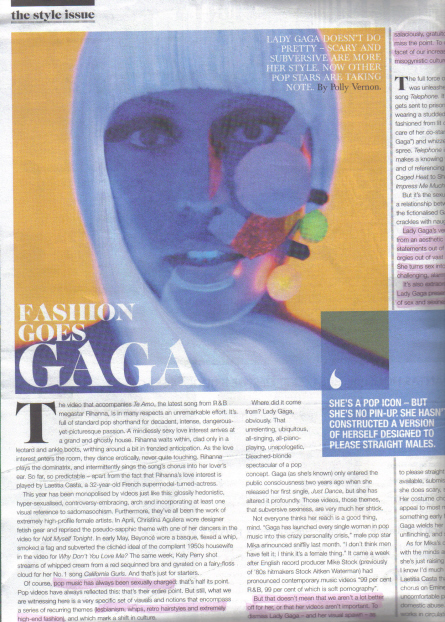
In Sunday Life’sStyle Issue, new editor Sarah Oakes’ Midas touch is already evident.

Especially in commissioning the piece “Fashion Goes Gaga” by Polly Vernon, in which Vernon argues that “pop music has always been sexually charged”, referencing Rihanna’s “Te Amo” and Gaga wannabe (which I don’t agree with) Christina Aguilera, just not in the way that Lady Gaga has revolutionised it. Vernon says, “To dismiss Lady Gagaand her visual spawnas salaciously, gratuitously, unnecessarily sexual is… just plain wrong.”

True, because “Gaga’s version of sexuality is extraordinary from an aesthetic perspective. She makes fashion statements out of gimp masks and gaffer tape, and orgies out of vast synchronised dance segments. She turns sex into camp theatre, and the result is challenging, alarming, powerful and exciting”: a far cry from “the cynical, soulless titillation of your average Britney Spears video.”

But with the mention of gaffer tape and gimp masks, it sounds more like a certain Aguilera effort than Britney, doesn’t it? ;)

Related: Everything They Touch Turns to Gold.