On the (Rest of the) Net.


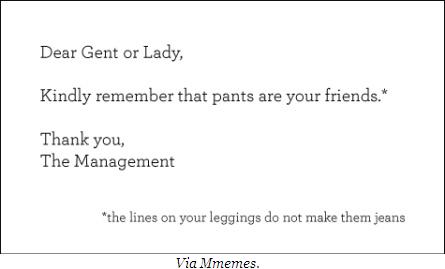
The perils of pants-less ladies.

Does Gossip Girl care about women in politics?

Bryce Corbett in defence of Nicole Kidman:

“… it seems to me that Nicole Kidman is engaged in what must be a most dissatisfying unrequited love affair with her homeland. She flies to Australia to pimp her country on Oprah. She makes a film with Baz Luhrmann which (whatever you may have thought of the final product) was a massive shot in the arm for the local film industry and a two-hour love-song to her country of birth. She fronts up to G’Day USA every year to flog the myriad wonders of Down Under. And following the Victorian bushfires, she donated half-a-million dollars of her own money to the Red Cross relief fund. What a cow.”

“Sexual Assault & the Super Bowl.”

Anna Chong, a designer from the London College of Fashion, has re-imagined Lady Gaga’s most popular get-ups into Barbie-sized outfits. But she’s not the first to do it

“Why is Captain America Ruling Our Screens & Not Wonder Woman?”

Seinfeld’s Elaine Benes as modern-day hipster fashion icon.

The New York Times profiles “nice-guy blogger” Jared Eng on his “cheery, quotidian, Britney-goes-to-Starbucks” blog, JustJared.com.

Also at The New York Times, The Catcher in the Rye’s Holden Caulfield is un-relatable.

Jacob Lambert on “The Paper-Reader’s Dilemma”:

“No longer are books being pitted against pixels; pointing out that paper isn’t reflective either seems very 2007.  The war is now between tablets, as if the book never existed at all.”

Yet more dispelling of the Nicole Kidman vitriol, this time in a vintage (2008) article on Girl with a Satchel.

In the same vein of “17 Arguments Against Gay Marriage & Why They’re Bollocks” and “10 Things You Need to Understand About Asylum Seekers”, comes John Birmingham’s defence of Sandra Reynolds, via MamaMia.

I’d been searching for this article for awhile to reference in a few Lady Gaga musings, and finally came across it again last week and re-read it in the bath. Bliss. A fine example of quality journalism.

Reblogged from Fuck Yeah, Gender Studies, Rachel Hills runs a post on the question of “Who Sexualises Children?”:

“God, it doesn’t even make sense—HOW can a child be sex vixen? When I look at a child, I see a child. Regardless of costume. Dressed like Mary Poppins or dressed like Britney Spears, a kid is a kid! If you see something sexual, the problem is with you.”

I haven’t been shy about my hatred of Charlie Sheen (I know hate is a strong word, but honestly, he is a despicable human being), especially when he gets a free pass because he happens to be the star of TV’s most successful show, while Lindsay Lohan’s career is in ruins. Jezebel reiterates this:

“In recent years no stars (with the possible exception of the oddly lovable Celebrity Rehab cast members) have had their problems with addiction more publicized than Charlie and Lindsay. However, the way these stars are treated by the media and the public is vastly different, mainly due to the double standard for female celebrities.

“The scorn for Lindsay is particularly strange because compared to Charlie, she’s only hurting herself. Let’s review some of Lindsay’s biggest tabloid scandals: Two DUI arrests, four stays in rehab, missing numerous court hearings, going to jail for failing a drug test, battling bulimia, battling her father, and breaking up with her girlfriend. As for Charlie, he’s been in and out of rehab for years, he “accidentally” shot fiancee Kelly Preston in the arm, he was named as a frequent visitor to brothels owned by Heidi Fleiss, he’s dated numerous porn stars, he ODed on cocaine, allegedly shoved Denise Richards and verbally abused her during their marriage, and was arrested for domestic violence against Brooke Mueller, but avoided jail time due to a plea deal. Lindsay has never been married and has no children. Charlie has been married three times and has five kids, four of whom are under the age of 10.”

The Problem with Pop Music.


From The Quietus“Givin’ It to the Homegirl: The Trouble with Kelis” by Neil Kulkarni:

“I hear no shattered women on the radio right now, no one swallowing men like air or devouring worlds or commanding the cosmos or even telling the truth. Only empty-headed little girls skweeming and squeaking about what rockstars they are. Well we get the pop we deserve, the pop Fearne Cotton likes, but even if I were white skinny and pretty I’d feel lagged behind, let down, and I’d be wondering why the fuck these drippy bitches like Flo and Ke$h think they deserve to be famous. Good taste? Where’s the fucking bravery? Where’s girls like I know, rather than the girls and guys I’d cross streets, change clubs, emigrate, to avoid. If pop is a club right now, I find myself walking past all the tables packed full of braying twats and simpering saps and desperate to recognise a friendly face, a real face, smart people who are a laugh, rather than all these desperately needy, charmless loudmouth ignoramuses and fucking students.

“Look at what pop’s women are wearing. Even in Gaga’s orbit of influence, it’s so fucking dull out there. It’s as if Girl pop looks at ’30s Vogue, ’70s Cosmo, ’80s Face/ID, looks at the dress-up-games the high-street makes easy and search-free, throws shit on and waits for those old spirits to reinhabit the body beneath and the mind behind such carelessness… Those old moments of beauty, those looks so steely, timed and timeless were animated and arranged by folk who worshipped new gods, the camera and the motorcar and the mirrorball and the MDMA and that spirit cannot be conjured off-the-peg, cribbed from an idiot’s guide or splattered on with a sequin gun. [Scarlett Woman note: Or a love glue gun, as Gaga would say?]

“Which does beg the question—what real female figureheads are there for girls to idolise, aspire to, learn from in music right now? In a pop world in which female ‘presence’ is in glut/spreadthin, it’s startling how little of femme-import is being given, how so many of the supposed ‘divas’ in modern pop have now to offer young minds bar money-hunger, man-dependence and just-dumped aggravation… make the colossal strategic error of listening to the charts, and you’ll see girls talk about themselves, sure, but always ONLY in relation to their relationships, only in relation to how near/far they are from love, only in relation to how much they can lose/claw back of themselves in the permanent night-out that is pop’s sole focus and context in 2010. Crucially, whilst you’ll see lots of girls, you won’t hear a single word that dares to antagonise you, that really addresses how scarily fast and furious with innovative invective girls can be. Obvious why girls are so ill-served at the moment, why none of pop’s chat and cattiness (exceptions: Gaga, Britney and Beyonce on their good days; Shakira—all of whom crucially don’t try and talk to/for their young fans, just luxuriate in their own supra-identities) actually matches up to the way girls talk/live/think—somewhere along the line middle-aged fanboys started whispering to pop that if it wants to cut deep it must only thieve from the past the fanboys curate, that it can’t do politics, that being a poetess is less important than simply being a witty conduit for the babble of what’s contemporary, a simpering squeaker of lad-mag-friendly spunkiness. ‘I really like your beard.’ Jesus. They’re being catered for.”

Elsewhere: [The Quietus] Givin’ It to the Homegirl: The Trouble with Kelis.

On the (Rest of the) Net.

Rachel Hills discusses Naomi Wolf’s response to WikiGate here, whilst also doing a fine job of unpacking the fun for twenty-somethings = lots of casual sex myth.

On that, “How to Be A 20-Something”:

“Be really attractive. Your acne is gone, your face has matured without having wrinkles and everything on your body is lifted naturally. Eat bagels seven days a week, binge-drink and do drugs: you’ll still look like a babe. When you turn thirty, it’ll become a different story but that’s, like, not for a really long time.

“Reestablish a relationship with your parents. You don’t live with them anymore (hopefully) so start to appreciate them as human beings with thoughts, flaws and feelings rather than soulless life ruiners who won’t let you borrow their car.”

What Would Phoebe Do? on the pretentiousness of Francophilia:

“Gratuitously adding French words to conversation is a time-honoured way of signalling pretentiousness.”

Next year’s Halloween costume sorted!

“How to Be A Complete Douche” has a certain Patrick Bateman feel to it.

Hugh Hefner defends his May-December engagement to Crystal Harris to The Daily Beast.

“How to Live in New York City”:

“Certain moments of living in the city will always stick out to you. Buying plums from a fruit vendor on 34th street and eating three of them on a long walk, the day you spent in bed with your best friend watching Tyra Banks, the amazing rooftop party you attended on a sweltering hot day in July. These memories might seem insignificant but they were all moments when you looked around the city and felt like you were a part of it all.”

Sarah at Feministe recalls “How I Learned to Stop Caring and Admit I Love Pop”.

Jezebel chronicles “The Evolution of Moms” from Soccer Mom (Mater Adidas) to a future robot-mom who encompasses all the admirable features of stage and helicopter mothers alike, with a special focus on the parent Sarah Palin made famous, the Mama Grizzly.

Memo to Lady Gaga: leggings are not pants. Nor, more to the point, are leotards.

On the (Rest of the) Net.


It’s a smorgasbord of Katy, Ke$ha, Britney and Gaga as Complex counts down “The 25 Greatest ‘Slutwave’ Songs of All Time”.

In other Katy and Ke$ha-related news, Feminist Music Geek critiques their acts.

Finally, closing off a Katy Perry heavy week, Jezebel ponders the similarities between “Firework” and Christina Aguilera’s “Beautiful”.

Sady Doyle on Charlie Chaplin’s paedophilia on film:

“I… kind of forgot, actually, that Charlie Chaplin was a pedophile?… Boy howdy, this movie sure didn’t!… It invites you to get off on this… We got a scene where the FBI tried to go after Chaplin for his dangerous left-wing activities, BY PERSUING STATUATORY RAPE CHARGES AGAINST HIM. “It’ll ruin him,” the evil right wing poo-hating US government cackles.”

Hmm… strangely echoes a certain left-winger accused of rape in the media at the moment…

Hermione Granger perfects her “judgemental badger” face.

“Empty Bellies Do Not Beget Genius”.

Now this is how “self-marriage” is done. Glee, take note.

Following on from last week, “Is Lara Bingle the new Paris Hilton?”

Is the antidote to “Taylor Swift’s Endless Reign” a Lindsay Lohan singing career revival?

Coco Rocha reveals “The One That Got Away”.

Gala Darling detoxes her closet.

MamaMia asks, “Do You Have Mother Issues?” Oh hell yes! And daddy ones, too!

More on why Gwyneth Paltrow is just that damn unlikeable.

JWoww’s heinous ex calls her pre-surgery body “deformed” by cellulite. Nice.

2010 was the year of the mistress.

In defence of May-December romances.

What does your ponytail say about you?

Guest Post: On Stripping.

“A striptease is an erotic or exotic dance in which the performer gradually undresses, usually to music, either partly or completely, in a seductive and sexually suggestive manner.”Richard Wortley, A Pictorial History of Striptease (1976).

Well, I guess someone forgot to tell the one I saw that it was supposed to be a subtle gradation of undress.

But let’s back up: I am a feminist and proud of it. As a feminist, I am mature enough to recognise that women have control over their bodies and can do as they please with them. But, when asked recently to a friend’s birthday celebration culminating in seeing a stripper in a private hotel room, I must admit, it did not sit well with me.

For the week prior to “The Big Exposure”, as I like to call it, I debated between endorsing the empowerment of the stripper and condemning the voyeurism of myself and my friends. I tried to look at it from the point of view of a “lipstick feminist”, as Ariel Levy mentions in Female Chauvinist Pigs, who believes that stripping is empowering for women and that “putting on a show to attract men, e.g. through make-up, doing girl-on-girl physical contact, is not contrary to the goals of feminism.” Still, no matter how hard I tried to see it as empowering, I could see nothing empowering about gyrating up and down in front of men whose eyes were popping out of their sockets. I couldn’t help but feel that women who objectify their own bodies for others had no respect for themselves or other women. How could we possibly advance as respectable members of society when we are endorsing nude gymnastic moves in a spectator arena?

With all these things in mind, and a pit in my stomach, I went to the hotel room with my friends. I’d like to point out that the friend whose birthday it was is a lesbian. So, I guess we were in more progressive company. Not really.

The ratio was still bizarre: seven straight girls, three lesbians, five straight guys and one gay man. It was even. Only 50% of the crowd was supposed to be stereotypically aroused by this performance.

When she arrived, I was surprised to see her “manager”, a man in his forties wearing a tracksuit looking more like a swimming coach than an accomplice to a stripper. (What was I expecting, a pimp?) He proceeded to lay blankets and an ominous shower curtain over the carpet and plugged in the CD player. After blasting us with Lady Gaga, she arrived.

She wasn’t what I expected; tall, long black-dyed hair, a face like Layne Beachleybut with none of the talentcomplete with one grey tooth, tattoos all over and quite small breasts. I must admit, I was disappointed! I was picturing a Marilyn Monroe-esque bombshell, or at least a healthy, glowing Jennifer Hawkins type.

The complete lack of sex appeal of this particular stripper made it a lot easier to find stripping degrading. I wondered how conflicted I would have felt if I found her attractive; because, in my eyes, someone who is sexy and confident is also empowered.

There was no element of teasing, of gradually taking clothes off, as Wortley describes above. She walked in wearing a school-girl costume, with a skirt so short I could see her breakfast, and immediately bent over in front of the birthday girl. So much for the game.

From there it continued to be a sordid and debasing mixture of gyrating and splits with each layer of clothing being unceremoniously ripped off and thrown towards the manager who was “keeping an eye on us.”

I felt weird. I knew that my gaze (masculine) was objectifying her body (feminine) but, by the same token, I felt that I was being objectified by the manager’s gaze.

Once all clothing had been removed, it was time for interaction. I can tell you, there is nothing empowering about having whipped cream licked off of your breasts by a pair of lesbiansone at each breast!

A memorable act of horror occurred when one of the guys was whipped with his own belt… he very quickly stopped her and sat down again. It was interesting, as I guess everyone felt that it was okay for her to debase herself, as she’s “just a stripper” and therefore an object, but the festivities crossed the line when a man was forced to feel degraded and objectified by the gaze of his peers.

The culmination of the evening was when she proceeded to insert a man’s spectacles into her vagina… proving that she was nothing but a spectacle herself under the scrutiny of the male gaze. It almost felt like a (horror) movie moment to be discussed in a feminist studies lecture!

Mary Wollstonecraft wrote in The Vindication of the Rights of Women, the “public [male] fixation upon the female person [body] has entailed and sustained the subjection of women,” and I agree. If we didn’t live in a society that objectified women and perpetuated the notion that we are only sexy when playing to masculine fantasies, we wouldn’t be watching strippers in hotel rooms, or at all.

For me though, that’s the last time I say “whatever you want, it’s your birthday” to a friend!

Laura Money.

Valley of the Dolls.


From “The Tyranny of Self-Perfection” by Anne Summers on The Australian website:

“… voicing her concerns that, overall, women were slipping backwards from the promise of equality that she, the daughter of a feminist, had grown up with. Another guest demurred: ‘Young women now have good role models, they are forging ahead,’ Anne McElvoy, deputy editor of the London Evening Standard told her ‘Why do you think things are bad for them?’

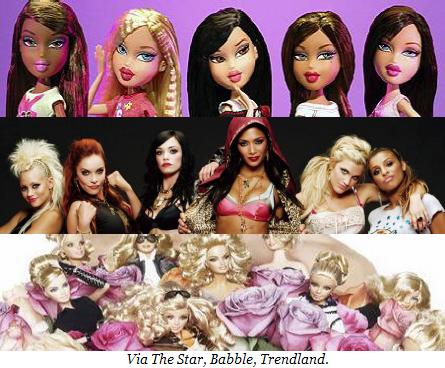
“It is entirely possible that McElvoy had never seen a Bratz doll or watched a Lady Gaga video. Unless she has young daughters or other close relatives she might not be aware of the ubiquity of pink or the Playboy logos that are now de rigueur adornments on the pencil cases of the pre-teen set.

“This reviewer has to confess a comparable ignorance. Sure, I’ve seen little girls dressed inappropriately for travel in pink tutus at airports. I’ve checked myself from disapproving of the skimpy outfits sported by 10-year-old daughters of friends. Gee, I still thought Barbie was bad.

“It’s partly that she now has daughters and has discovered that the ‘slutty and sultry’ Bratz with its wardrobe for clubbing and shopping has displaced innocent blonde Barbie as the top-selling doll for girls. It’s partly the growing use of the language of liberationmost often the word ‘empowering’to describe the new sexual thraldom. And it’s also the realisation that ‘the rhetoric of choice may have burgeoned in this generation, but in many ways the range of female characters and role models available for young girls has narrowed’.

“Girls want to be WAGS, ‘glamour models’ (pose naked without displaying genitals) or even prostitutes because they have been led to believe that these vocations will deliver them the celebrity lifestyle so relentlessly documented in magazines and on television…”

… and in the aisles of toy stores, too, if the Bratz pack has anything to do with it.

Elsewhere: [The Australian] The Tyranny of Self-Perfection.

On the (Rest of the) Net.

Indeed, “What Is the Difference Between Charlie Sheen and Lindsay Lohan?”

Again, in the wake of Sheen’s “drug-alcohol-and-woman abusing” bender, Girl with a Satchel asks if men’s mags focussing on UFC and, alternatively, retro Mad Men style sensibilities is a result of the “soggy” men’s mag market trying to inject some much needed zest:

“In the current socio-cultural context, where women assert more power and influence, the ‘reality’ may be why more men are turning into Don Draper lookalikes and turning to UFC. It doesn’t take Two & a Half Men to work [sic] out that in magazines, men need escapism, inspiration and style tips, too. The appeal of men’s magazines is to service wants, needs and desires; I just wonder what men really aspire to.”

Tiger Beatdown’s response to Beyonce’s “Why Don’t You Love Me?” video is, in a word, hilarious (more on it to come next week):

“A blog post, we hear, should be short, and timely, and probably pegged to some manner of news item. This ensures that it can be part of the blog conversation on the Interwebs. Where immediate response is king! And that, of course, is why we write 3,000 to 5,000 word posts about long-running TV shows, and movies we rented from iTunes, and also, albums that came out when we were twelve.

“However, sometimes it only takes us weeks to respond to something! For example, a music video, of the sort that the kids enjoy today. A music video like this one!”

Joan Holloway’s Mad cartoon curves are poured into a Little Miss book.

In other Mad Men-related news, The Washington Post writes in defence of the show’s alleged sexism:

Mad Men’s writers are not sexist. The time period was.”

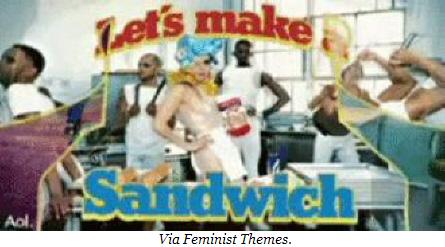
Feminist Themes on Lady Gaga and Beauty.

Slate asks “How Long Has the ‘Dumb Blonde’ Meme Been Around?”:

“The poet Propertius, for example, wrote: ‘All beauty is best as nature made it… In hell below may many an ill befall that girl who stupidly dyes her hair with a false colour!’ So while he didn’t connect blondeness with idiocy exactly, he implied that wish to be blondes, and contrive to be blondes using artificial means, don’t have much going on.

“As for why the dumb-blonde idea resonatesone idea is that it’s basically Propertius’ logic at work. It’s a fairly well-known fact that few adults are naturally blond[e], and that many apparent blondes actually die their hair. If you die your hair, you must be superficial or vapid, Q.E.D. There’s also a theory, outlined in The Encyclopedia of Hair, that blondeness connotes youth, since children are far more likely than adults to have naturally blond[e] hair. Blondeness, then, seems innocent but also naïve.”

Steve Pavlina discusses which aspects of your life are worthy of your attention, and which aren’t.

Organisational Post-It porn at MamaMia.

From The Awl, “How to Lose [Facebook] ‘Friends’” and alienate people:

“Christopher Sibona… explains the top reasons fro defrienestration: updating too frequently about boring things, posting about controversial subjects like politics or religion, and writing racist or sexist stuff. It’s a lot like life, although in life these people are actually friends and not some random body count you’ve assembled through networking or total availability.”

Godammit, I’m Mad profiles “Bloggers With Influence”, and has some particularly scathing words to say about Gala Darling. Ouch.

Along the same lines, The Feminist Breeder says not to “assume that more ‘fans’ or ‘followers’ means they’ll all be adoring. The truth is, the more people who read you, the more bullshit you’re going to have to put up with…”

In the wake of those controversial GQ photos and last week’s Rocky Horror episode, Glee is questioned as to whether it has a “Body Image Problem” or not.

As Halloween is swallowed back into the underworld for another year, Gawker has some All Hallows Eve etiquette tips on how to tell if your costume is racist:

“… When the entirety of your costume is ‘I am a person of a different race, LOL,’ that qualifies as a racist costume.”

But is it racist if, like, you’re of Native American descent? (FYI, I actually am.) Paris Hilton, take note.

Chase You Down Until You Love Me, Paparazzi…

The following is based on a 2006 uni essay I wrote about the camera as an intruder, so sorry for any overly academic phrasing. I have attempted to bring it into the modern day with less formal language after reading an article on Jezebel, “The Day I Trailed a Paparazzi” in which—what else?—one of the blog’s writers trailed a paparazzo for a day.

Is the camera an intruder? Some would say that, in this day and age, with advanced photographic technology and increased access by photojournalists to worldwide events, it is. However, others assert that because of this advanced photographic technology and increased access, paired with the public’s growing need, and right, to know and see, that the camera it is not.

In terms of the cult of celebrity and the growing phenomenon of the paparazzi, privacy is a major issue. Peter Howe, in his book Paparazzi, provides this definition of the occupation:

“It refers to those photographers who seek out and follow celebrities… in order to photograph them in their most unguarded moments. In short, it’s taking photographs you shouldn’t take in places you shouldn’t be”.

However, some might argue that in becoming a movie star or rock star, and thereby a celebrity, you give up your right to privacy. Privacy laws in the US, specifically in Los Angeles where most paparazzi dwell, state that “if the subject of the photograph can reasonably expect privacy in a specific situation, such as inside his home, photographs of such situations cannot be published without permission”. And, as is evident in any glossy tabloid, most paparazzi shots are taken in public places, such as shopping strips and restaurants. “The consensus of opinion among the paparazzi is that the celebrities get the privacy they deserve, and that if you really don’t want to be photographed, then you don’t go to eat at Mr. Chows or the Ivy, where there are always photographers,” says Howe.

French theorist Roland Barthes states that “people change when they’re aware they’re being photographed.” So “when long lenses can ‘trespass’”, “the traditional definitions of privacy may not apply”.

The paparazzi are viewed as the most morally and ethically irresponsible photographer in the business but, “if everyone hates their work, why are they the best-paid and busiest photojournalists in the world?” asks Howe.

Our obsession with celebrity has only grown since I originally wrote this article back in 2006, a time which was already seeing the tabloid market explode, causing “the number of paparazzi to quadruple”, explains co-owner of L.A. paparazzi firm Bauer and Griffin, Randy Bauer, in an article from Cosmopolitan that same year.

Increasingly, blogs have become the stratosphere through which paparazzi pics circulate, however magazines still pay the big bucks. The first pictures of Brad Pitt, Angelina Jolie and their adopted son Maddox on a beach in Africa sold for $100,000; a far cry from the $6.68 million People magazine paid for the exclusive photographs of Pitt, Jolie and their first biological child, Shiloh.

In the five years since Pitt & Jolie got together and were hunted by the paparazzi (Wagner, a paparazzo who participated in a story on Jezebel, asserts that family pics of the couple are still the highest fetching shots), reality TV has reached its pinnacle, with celebs like Kim Kardashian milking their celebrity for all its worth; sad sacks like Lindsay Lohan and Heidi Montag tipping off the paparazzi in order to sell shots of themselves and keep their names in the media; and those in a league of their own, like Lady Gaga, whose song “Paparazzi” and albums “The Fame” and “The Fame Monster” take the piss out of the very machine that made them and creating a new definition of the über-celebrity/icon.

As above, though, the paparazzi are predominantly viewed in a negative light, not only by serious art photographers and the general public but, obviously, the stars they photograph. Kristen Stewart, for example, is one star who has been vocal in her dislike for the paparazzi; those in opposition to her stance might use the argument above, that to have success in the acting world is to accept the constant presence of photographers. Especially when you’re one half of the most talked about couple since the Jolie-Pitts. Elsewhere, the Jezebel article, written by Dodai Stewart, has a focus on Michael Douglas, who is receiving treatment for throat cancer, and the unremitting swarm of photographers outside his house every day. Is hounding a sick man taking our obsession with celebrity too far? American author and journalist Nathaniel Parker Willis says that, “the idea [is] that to really know someone, we must know their private life”.

From the Cosmo article: “[the paparazzi] can make celebrities feel anxious, depressed, and even mildly agoraphobic” That explains the notorious picture of Cameron Diaz, with then-boyfriend Justin Timberlake, attacking a paparazzo, then!

But, increasingly celebs are embracing the paparazzi, realising that if they work in cooperation with them, their public lives will be less tumultuous.

Stewart relays her story about Wagner trailing Liev Schreiber and his son with Naomi Watts, into the subway. After talking to the subject for several minutes, Wagner tells Schreiber that he’s “gotta get a picture of you”, and “Liev said sure, put the kid on his shoulders and let Wagner snap away… No other photographers were around, so it’s an exclusive shot.” Wagner gets paid, Schreiber comes across as a cool family man; it’s a win-win situation.

Celebs with kids can get a bit weird about them being photographed, understandably, and in the same article, when Wagner encounters Watts with the kids, she kindly asks him not to take pictures, and he obliged. See, Hollywood dwellers? There’s no need to get violent with the paps. (Granted, the pics of Schreiber and Watts were taken in New York City, where the paparazzi scene is less brutal than in Los Angeles, and there seems to be a certain air of respect between subject and object.)

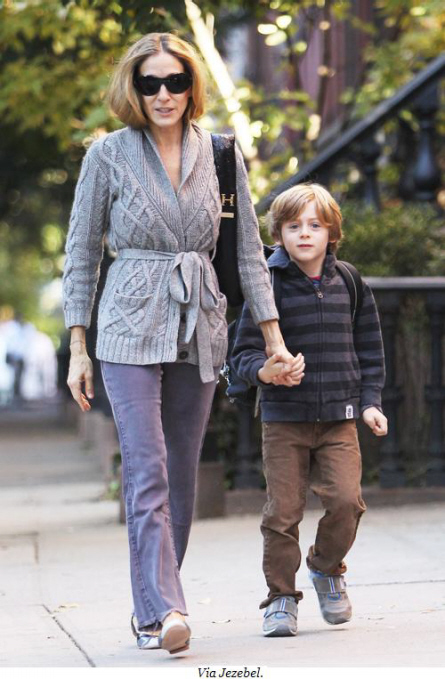
Other NYC dwellers such the cunning Sarah Jessica Parker, have some up with ways of making themselves less desirable targets:

“‘[SJP] wears the same thing everyday,’” he [Wagner] says. ‘On purpose. Because you talk about this today, then she wears it tomorrow, then what do you have to say? Nothing.’”

There is almost an element of protection there, too: provided both parties behave themselves and there exists a certain professional relationship, when your every move is recorded on camera, it’s got to be mighty hard to be mugged or attacked. Although, the victims of Alexis Neiers and her young-Hollywood burglary bling ring probably don’t subscribe to this school of thought.

Still, the opinion among the stars, the paps and the consumers who view their snaps on blogs and in magazines and newspapers, is that celebrities need the paparazzi to generate publicity around them, and the paps need to earn a buck. “An interdependency develops between them,” says Howe.

Stewart sums the cycle up nicely:

“We’re interested in celebrity minutiae. Despite ourselves. It is possible to be fascinated and repulsed at the same time. You can find celebrities appealing while finding the gossip culture appalling. We buy the magazines, hate them for lying to us, critique them, laugh at them, talk about them with our friends and buy the magazines again the next week. If you’ve ever read a gossip site or flipped through a celebrity weekly, you’re part of the system: the paparazzi take pictures for the mags and blogs, the mags and blogs exist because there is an audience.”

Related: Poor Little Rich Girl: Lindsay Lohan in Who.

Poor Little Rich Girl: Who Cover Girl Heidi Montag.

Elsewhere: [Jezebel] The Day I Trailed a Paparazzo.

[Vanity Fair]: The Suspects Wore Louboutins.

On the (Rest of the) Net.


After my Mick Foley rant last week, I’ve started reading his blog, Countdown to Lockdown, and I’m loving it. Here are some choice articles:

Remembering female pro-wrestling pioneer, Luna Vachon, who passed away on August 27 this year.

“That Time I Met… Tina Fey… and Alec Baldwin!”

“That Time I Met… President William Jefferson Clinton!” (I really love this one; some heart-warming stuff.)

“Mick’s Favourite Things: Top Ten Matches”, three of whichCactus Jack VS. Randy Orton at Backlash 2004 (above), Mankind VS. The Undertaker in Hell in a Cell in June, 1998, and Mick Foley VS. Edge in a Hardcore Match at WrestleMania XXII (that’s WrestleMania 22 in 2006 for you wrestling laymen)I 100% agree with.

In defence of Buffy’s whining.

“To the Teenage Boy in Your Life”:

“An important thing to remember is that girls are not from a different planet, nor are they even a different species. They’re just people, they’re just like boys, except with vulvas instead of penises.

“Mainly you need to remember this when you’re trying to figure out what a girl is thinking. See, if you didn’t know what a BOY was thinking, how would you go about finding out? You might ask him, right? The same goes for girls.”

I’m a bit behind the eight-ball on this one, as No Make-Up Week was a month ago, but Alle Malice’s guest post on Rabbit Write goes over the reasons “Why We Wear Make-Up”. I especially like this one:

“It makes me look good in photos. Almost everything we do now is documented by someone and posted in Facebook albums for the world to see, because if you aren’t having fun on Facebook, you aren’t really having fun. And if you aren’t pretty on the internet, you aren’t pretty in real life. Enter makeup.”

Nick Sylvester, on Riff City, discusses “How Kanye West’s Online Triumphs Have Eclipsed Kanye West”:

“Maybe there are people working with him… but I get the sense that Kanye is generating the [sic] lot of these ideas. I imagine he likes being in control of every aspect of the production, the medium being the message and so on. Online he is a wise fool, first playing into people’s perceptions of ‘Kanye West’, then off those very perceptions, sending himself up, pulling back his own veil… Despite many attempts, Kanye West is incapable of being parodied, largely because Kanye West has already figured out a way to be a parody of Kanye West.”

Much like Megan Fox in this New York Times Magazine article. Could I even go as far as to say that blonde bombshell Pamela Anderson has employed this strategy? I believe I could. And for that matter, Lindsay Lohan sending herself up on Funny or Die and promos for the MTV VMAs are along the same lines.

Sylvester goes on to say that “artists like Kanye West have to be ‘good at Twitter’ in order to put a dent in the zeitgeist.”

Furthermore,

“‘Nowadays rappers, they like bloggers,’ is what Swizz Beatz says… Slowly the work itself becomes secondary, less ambitious; slowly people becomes ‘really proud of their tweets’.”

Is it “The End of Men”?

Disney’s latest offering, Tangled, based on the story of Rapunzel, takes us back to a time when the Disney Princess reigned supreme, according to io9.

Feminist Themes examines Lady Gaga’s “Telephone” clip:

“… the objectification, glamorising of lesbian fetishism, and excessive girl-on-girl violence… [are aspects of the video that] feminist Gaga fans can try to justify… as another example of how she subversively turns what we usually find hot into something that leaves a nasty taste in our mouths and therefore makes a statement, but if any other artist (particularly any male artist) incorporated this much objectification and violence against women we would be outraged. Is it any different just because it’s a woman, or because it’s specifically Gaga?

“… What sets Gaga apart from other sexpot pop stars for me is that I just can’t imagine men being honestly turned on by hernot because she isn’t gorgeous (she is), but because she is so avant-garde, aggressive and self-driven which takes that arousal and turns it into something atypical, uncomfortable, and threatening.”

Also at Feminist Themes, the cause of the she-blogger in “Why I Blog”.

In other Gaga news, The Cavalier Daily reports that the University of Virginia is now running Lady Gaga classes! This sooo makes me want to re-enrol in university in a post-grad, transfer to UV, and take this kick-ass class!

The Daily Beast puts forth two differing opinions on Glee’s stereotypes: Andy Dehnart discusses the show’s “Harmful Simplicity”, while Thaddeus Russell applauds the walking stereotype that is Kurt Hummel, as “history tells us that those unafraid to be ‘too gay’ won far more freedomsfor all of usthan those who dressed the part of straights.”

Beautifully satiric The Frenemy reveals the recipe to “The Teen Romantic Comedy”, which “does not work for Mean Girls, 10 Things I Hate About You, or John Hughes films”, unfortunately. The truth about Disney Princes is also profiled, in which Eric from The Little Mermaid “wanted to kiss a girl who doesn’t speak words and doesn’t know how to use a fork. What the hell are you, caveman?”, while Mulan’s Captain Shang is in truth, a “gay liar” who made young, susceptible viewers the girls who have “crushes on a lot of her gay friends. [A] big Will & Grace fan.” Hey, that’s me!

Rachel Hills discusses intersectionality in feminism:

“For those of you who aren’t familiar with the term, ‘intersectionality’ is a way of talking about power and privilege that recognises that recognises that these things operate on multiple axes. People aren’t just female, or Black, or Asian, or straight, or working class, or trans, or a parent, or prone to depressioneveryone falls into a number of different categories that colours their experience of the world in specific ways. In the feminist context, it serves as a useful reminder that not all women have the same experiences, and calls into question the still dominant notion that the neutral ‘female’ experience is one that is white, heterosexual and middle-class.

“I’m also a fan because it just makes feminism a whole lot more interesting.”

Girl with a Satchel profiles Melissa Hoyer’s media career, which is a must-read for any budding wordsmith.

I am staunchly pro-choice when it comes to the abortion debate. In fact, I lean so far to the left that I’m borderline pro-abortion. (I’m sure that’ll ruffle some feathers!) But no matter what your feelings on the subject, MamaMia’s post, “The Couple Facing Jail Because They Tried To ‘Procure an Abortion’. Hello, Queensland? It’s 2010” is worth checking out.

Jezebel’s “5 Worst Mean (Little) Girls of All Time” includes Willy Wonka’s Veruca Salt and, from one of the most heart wrenching films of all time, A Little Princess, Lavinia, who looks a lot like modern-day mean girl, Angelina Pivarnick, from Jersey Shore.

“Why Strawberry Shortcake Was a Progressive Pioneer.”

TV: Surfing the Third Wave—Second Wave VS. Third Wave Feminism on Gossip Girl.


Not only was last week’s Gossip Girl one of the best episodes I’ve ever seen, with one of the most gorgeous dresses I’ve ever seen (see above), but it also addressed some feminist issues that have been rotating around the blogosphere of late: second wave versus third wave feminism and slut-shaming.

*Spoiler alert* The episode dealt with a Gossip Girl blast suggesting that Serena might have an STI, and the turmoil the rumour created amongst the group. Of course, Little Miss Juliet was the one who tipped Gossip Girl off, in the hopes of taking Serena down and getting her kicked out of Columbia. After all, the episode is titled “Goodbye, Columbia”…

Without giving too much away (What’s that you say? I already have? Whoops!), Serena comes face to face with the dean, who says of Serena’s (alleged) wayward behaviour:

“Women of my generation had to fight for every opportunity. And to be taken seriously, and your attitude, Miss van der Woodsen, makes a mockery of that.”

Now if that isn’t the second wave looking down upon the third wave for our apparent flippancy about “activism”, our “obsession with technology” (Gossip Girl’s blasts are a prime example of this), our “unwilling[ness] to challenge sexual exploitation for fear of pissing off men” (hello, Serena), and our infatuation with Lady Gaga (well, Gossip Girl did feature the Lady herself in an episode…), I don’t know what is.

Susan Faludi recently wrote about this phenomenon in “American Electra: Feminism’s Ritual Matricide”, Amanda Marcotte responded to the article on Pandagon (from which the above quotes were taken), and I featured a link to the latter in last week’s “On the (Rest of the) Net”.

In the article, Faludi asserts that

“despite its [feminism’s] many victories, it seems to falter along a ‘motherdaughter’ divide. A generational breakdown underlies so many of the pathologies that have long disturbed American [or, rather, Western] feminism… its bitter divisions over sex… [and] alongside the battle of the sexes rages the battle of the ages.”

Faludi feels that second wavers ask questions and make comments such as “Why does it feel like we’re sliding backwards?”, “Young women are narcissists who don’t care about politics”, and “We’re really furious with these young women, aren’t we?”

Indeed, this seems to be the attitude of Dean Reuther towards Serena who, granted, isn’t the best feminist role model, but perhaps doesn’t deserve to have such comments hurled at her. Vanessa Abrams is probably the most feminist-y of all the characters on Gossip Girl, and I could almost take her seriously, if she wasn’t so damn annoying. Even Blair could be seen as a third-waver; she refuses to be held down by Chuck, rolls with the boys, strives for academic excellence by conniving her way into becoming Miss Chamberlain’s student assistant, and dumped Chuck for using her sexuality as a bargaining chip. Plus, she’s feisty and rocks a headband.

Of course, I’m not sure Gossip Girl consciously chose to comment on the debate, and no doubt this will be the last we hear of it, but it would be interesting to see Serena fight back and declare herself “sick to death of hearing about the glory days of Seventies feminism”, whilst older women, like Dean Reuther, “decalring themselves sick to death of being swept into the dustbin of history.” However, being the dean at an Ivy League university is hardly being “swept into the dustbin”.

On a final note, Faludi spends a lot of time criticising (via her second wave subjects) the technology third wavers use, specifically blogging: “All they want to do is sit at their computers and blog.” Ouch.

I’m sure Gossip Girl would have something to say about that.

Elsewhere: [Harpers] American Electra: Feminism’s Ritual Matricide.