Event: Melbourne Writers Festival — In Conversation with Zoe Foster.

Former Cosmo and Harper’s Bazaar beauty writer turned “chick lit” novelist Zoe Foster has always been someone I’ve looked up to: since reading Comso from age 15, her and Mia Freedman are two writers I’ve tried to emulate, not so much career-wise but more style-wise.

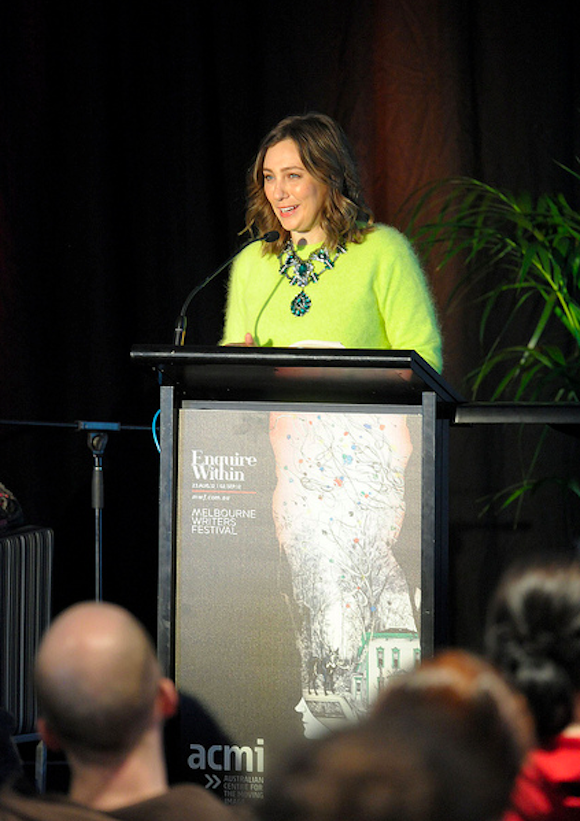
Foster appeared at one of the first events of the Melbourne Writers Festival on Friday morning, in conversation with freelancer and Crikey literary columnist, Bethanie Blanchard.

Dressed in pink sparkly pants and looking flawless as usual, Foster, who now writes from home and whom I remember writing about spending a “working” holiday in New York City a few months (or maybe it was a year? Time flies!) ago, managed to make me believe that there is hope for me as a successful, stay-at-home writer yet.

Granted, Zoe writes the kind of prose I try to avoid: beauty and chick lit. Foster explained how she got the job as beauty editor of Cosmo because Freedman liked that Foster had no beauty knowledge whatsoever and that she’d be writing from a readers’ perspective. Zoe said she never reads the beauty pages, and I have to concur with her there: unless it’s written by Zoe, beauty is the most mundane thing in the world to me.

But where chick lit is concerned, Foster gave an anecdote from Puberty Blues author Kathy Lette who, when Foster told her that she writes in that genre, spat her drink out and said, “No, don’t ever call it that. It’s commercial first-person narrative.”

I have to admit, when I see that phrase or a book cover with a suspiciously chick litty-esque cover, I steer clear. However, when I heard Foster read from her latest effort, The Younger Man, the following morning at The Morning Read (from which the above photo was taken), along with the hilarious Sloane Crosley, I had a hankering to pick it up and give it a whirl. From the excerpt Zoe read, her fiction writing sounds exactly like her beauty columns for MamaMia and her dating advice for Cosmo.

But that’s something I have a whole different issue with: in this month’s Cosmo, Zoe advises not to make an effort in the early stages of courtship: it’s his job to chase you. Firstly, this advice doesn’t work for me because I much prefer the chase (maybe I should take some of Zoe’s advice and perhaps I wouldn’t be single!). And secondly, it’s a bit backwards, which Foster concedes to in the article. She also mentioned that she sometimes “cops a bit of shit” for her… traditional would be a nice way of putting it… views on dating.

Finally, another valuable thing I got out of the session was a glimpse into Zoe’s writing schedule and how she plans her day. While she doesn’t read in the genre she writes in whilst she’s in the drafting process lest she start writing another version of 50 Shades of Grey, she does get up at 6am to get a few hours of non-interrupted fiction time in before email, Twitter and other distractions hit. Ahh, I remember those days. You know, when I was bright eyed and bushy tailed and responsible. Interestingly, Zoe also favours a solitary drafting process in which she doesn’t let anyone read her work before the first draft is submitted to her editor. One conscientious audience member asked how, or more pertinently why, she only relies on herself and doesn’t seek outside insight. Zoe replied that she’s on her fourth novel at the moment, so she’d kind of an old hand and should know what she’s doing by this point. But also, I think, some people are just better at assessing their own work than others. I know I don’t like to have any input from anyone, or even tell people what I’m working on. Once it’s out there, I know it’s mine and mine only; good or bad. The writers’ life is a solitary one, after all.

Images via The Vine, MWF Flickr.

Why Young Feminists Still Have “A Long, Long Way To Go” in the Eyes of Second-Wave Feminists.

Last week I wrote about the Melbourne Writers’ Festival event, entitled A Long, Long Way to Go: Why We Still Need Feminism, presented by Sophie Cunningham and Monica Dux.

On the whole, Cunningham’s presentation was thought-provoking, if a little small-minded, but my main point of contention is as follows.

Cunningham brought up third/fourth wave feminism (the feminism we’re experiencing now, by most accounts), saying that while she applauds the grassroots feminist movements such as SlutWalk, she wasn’t sure 25-year-old women could fully understand the concept of feminism because they still have men fawning all over them at that age.

Now that’s just a whole lot of wrong.

First of all, I am soon-to-be-24 and I don’t have men falling at my feet (well, except when it’s unwanted), and nor do my similarly-aged friends.

Secondly, who’s to say that even if we did, we wouldn’t recognise that, unless they had had some kind of interaction with us other than staring at our boobs, they were interested in us purely for our looks, and that’s anti-feminist. (Then again, I know girls who do have men fawning all over them purely for their looks and couldn’t care less.)

And thirdly, this kind of feminism in fighting is exactly what has been undoing the feminist movement in recent years. As I wrote:

“… Cunningham saw a sort of ‘bottleneck’ in modern feminism, where white, privileged feminists like myself don’t understand the problems facing feminists of colour, feminists with sexual orientation other than straight, feminists with gender other than cis, and feminists with disabilities…”

This is not to mention conflict between the ages, or waves, of feminism.

In Susan Faludi’s attempted takedown of young feminists in her article, “American Electra: Feminism’s Ritual Matricide”, last year, she writes:

“… Despite its [feminism’s] many victories, it seems to falter along a ‘mother–daughter’ divide. A generational breakdown underlies so many of the pathologies that have long disturbed American [or, rather, Western] feminism—… its bitter divisions over sex… [and] alongside the battle of the sexes rages the battle of the ages.”

I can’t think of a better example than, oddly enough, an episode of Gossip Girl from its most recent season, in which it addresses the clash between young and old feminists after Serena van der Woodsen is accused of having an STD. Her dean at Columbia University tells her:

“Women of my generation had to fight for every opportunity. And to be taken seriously, and your attitude, Miss van der Woodsen, makes a mockery of that.”

I wrote in response at the time, in reference to Faludi’s article:

“Now if that isn’t the second wave looking down upon the third wave for our apparent flippancy about ‘activism’, our ‘obsession with technology’ (Gossip Girl’s blasts are a prime example of this), our ‘unwilling[ness] to challenge sexual exploitation for fear of pissing off men’ (hello, Serena), and our infatuation with Lady Gaga (well, Gossip Girl did feature the Lady herself in an episode…), I don’t know what is.

“… It would be interesting to see Serena fight back and declare herself ‘sick to death of hearing about the glory days of Seventies feminism’, whilst older women, like Dean Reuther, ‘declaring themselves sick to death of being swept into the dustbin of history.’

“Faludi spends a lot of time criticising (via her second wave subjects) the technology third wavers use, specifically blogging: ‘All they want to do is sit at their computers and blog.’ Ouch.

“I’m sure Gossip Girl would have something to say about that.”

Exhibit A: SlutWalk as an anti-testament to Faludi’s assertion.

Could it be jealousy these second-wavers are suffering from? I’d like to think feminism is above that, but it is one of the seven deadly sins and can get the better of us. Contrary to what Cunningham said, I don’t think it’s because of the way we look. Everyone knows age is not a precursor to looking hot. I think second-wavers might long for their glory days of making things happen, being invigorated and excited by feminism, instead of seeing their options shrivel up and die the older they get. Again, please see exhibit A. While I don’t know the ages of those who were critical of the SlutWalk, but if they were older it might be easy to see why they were a bit miffed by the anti-slut-shaming and -victim-blaming movement that they felt left them behind.

There needs to be something done to rectify this. Not only the gap between the ages, but the gap between the races, the abilities, the genders and the sexual orientations.

I don’t pretend to know how we’re going to do this, but it will have to start with listening and understanding, empathy, perhaps some mentoring and—what feminism is all about, not just between the sexes, but between all those I mention above—equality.

Related: Melbourne Writers’ Festival: A Long, Long Way to Go—Why We Still Need Feminism.

Ain’t Nothin’ Gonna Break My Slutty Stride.

The Taboos of Sexual Harassment.

Will Boys Be Boys When it Comes to Objectifying Women?

Surfing the Third Wave: Second-Wave VS. Third-Wave Feminism on Gossip Girl.

Elsewhere: [Harper’s Magazine] American Electra: Feminism’s Ritual Matricide.

Event: Melbourne Writers’ Festival—Beyond White Guilt.

The final day of the Melbourne Writers’ Festival brought Beyond White Guilt, taken from the name of author Sarah Maddison’s Beyond White Guilt: The Real Challenge for Black-White Relations in Australia and hosted by Tony Birch.

Maddison and Birch spoke about the crux of Maddison’s book, published in June—guilt and shame—and how they can both be “deeply personal experiences” in the way we look at race relations in Australia.

The absence or a certain “whitewashing” of black history in Australia can induce guilt, a feeling of “sick” and “anxiety”, and can “immobilise” us in striving for a more equal Australia.

On this, Birch spoke about being honoured by the Victorian East Timorese community* for doing not a whole lot other than sitting in front of the TV and thinking, “how awful”.

I think a lot of Australians feel this way, whether it be watching World Vision ads on TV, seeing homeless people begging in the street, or watching boats crash and people perish as they try to seek asylum in Australia (although, from the barrage of “fuck off, we’re full” jibes in response to that tragedy, perhaps it is the minority of Australians).

Maddison spoke of Australia’s roots as “a land of people who dig stuff up and chop stuff down”; an “Aussie battler” sentimentality, if you will. And I think that mentality lends itself to the bigotry we express towards the “other”, ie. people trying to get a “free ride” as asylum seekers, the poor and Indigenous on welfare, the homeless, the disabled, etc.

Unfortunately, when this kind of attitude rears its ugly head, such as in the Redfern and Cronulla riots, and the inaugural Indigenous protesting of Australia Day in 1988, as Maddison mentioned, it usually pits “true blue Aussies” against un-Australians. (Birch wrote a 2001 article entitled “The Last Refuge of the Un-Australian”, which is available for download from the University of Melbourne’s website.)

Whichever way you put it, none of us are truly happy with our country. Lefties abhor the way our environmental and human rights sensibilities are heading, whilst conservatives want to stop the boats, abortions, taxing the rich etc. One thing I think we all can agree on, as Maddison noted, is that our current government sucks.

Birch asked, “How are we going to love our country wholly?” An Aboriginal elder in the audience suggested Maddison’s book become compulsory reading for all Australians as a solution. One thing’s for sure: like feminism, we’ve got a long, long way to go, baby.

*Updated 09/09/11: The original version of this post cited Birch as being honoured by a Papua New Guinean community. In actual fact, it was the East Timorese community of Victoria.

Related: Cowboys VS. Aliens & Indians… Does It Really Matter? They’re All the Same Anyway, According to the New Movie.

My Response: Go Back to Where You Came From.

It’s Not Easy Being Green: The Latest Trend in Discrimination.

Melbourne Writers’ Festival: A Long, Long Way to Go—Why We Still Need Feminism.


Event: Melbourne Writers’ Festival—Journalists & Trauma.

Journalists & Trauma was a free event that occurred on Saturday morning.

I had originally planned to go to an advanced screening of The Help and associated brunch put on by Sunday Life magazine, however tickets sold out way in advance, so I thought I might as well fill my morning with something else worthwhile.

The event was hosted by Margaret Simons, and featured Dennis Miller, author of a new book on Black Saturday and the role of the media in it, and Di James, a survivor of the Marysville bushfires.

The talk focused on a report by the Centre for Advanced Journalism entitled “In the Media Spotlight: The Survivor Series”, which studies the role of the media in gathering material in the event of a tragedy, consent from those they gather material from, and the problems faced by both the media and the public affected in those situations.

There was a heavy focus on the first 48 hours of a tragedy, in which Di recounted her story of fleeing to a neighbour’s home to watch her house, car and business (the famed Marysville lolly shop) go up in flames, being cut off from communication and being unable to tell her children she was okay, having the a media chopper arrive before the authorities, and using the media to her advantage to get the message out that a) there were people there who needed to be evacuated, and b) she was alive.

James was, understandably, a bit teary in recounting these events, but all in all, she agreed with Miller’s findings that the media needs to be more sensitive when covering tragedies and trauma.

While I can see where James is coming from, having been involved in Black Saturday and seeing images of herself and her friends (some of whom didn’t make it) plastered on newspapers and being shown on television two years later (without her consent), I do believe the public has a right to know about these things.

Mia Freedman wrote in her most recent Sunday Life column about suicide and its coverage in the media. Personally, I am a sucker for details, and will go to extreme lengths to find them out. (Googling crime scene pictures of Nicole Brown Simpson and Ron Goldman wasn’t my finest moment.) Enquiring minds want to know. But do they need to?

And in this day and age of Twitter, blogs and live streaming (Journalists & Trauma was live Tweeted and streamed), most details do get out. Like anything, I think we should have the option of seeking this information out if we so wish, and shunning it if we have no interest in it.

I understand the hardships of those who are involved in tragedies, and wouldn’t wish any undue stress to them, but in the long run, I think if said enquiring minds are satisfied, they will move on to something else, leaving those affected to grieve in peace.

Thoughts?

Elsewhere: [MamaMia] Suicide Contagion. Does it Exist?

Image via Melbourne Writers Festival.

Event: Melbourne Writers’ Festival—A Long Long Way to Go: Why We Still Need Feminism.

We’re in a post-feminist era. Feminism is dead. Has feminism failed?

From the arguments presented by Sophie Cunningham in her Melbourne Writers’ Festival address, titled after the line in Helen Reddy’s “I Am Woman” (and the title of a book I thought Cunningham mentioned she’d had/is having published, but upon further inspection, this doesn’t seem to be the case), these post-feminism assertions are null and void.

While Cunningham stated at the beginning, after her introduction by Monica Dux, that she’d be focusing purely on feminism as it relates to Western women, but to keep the big picture in mind, I was disappointed that she kept her key points to the lack of women (or recognition of women) in writing, music, film and the arts in general.

Having said that, though, she made some pertinent points: that in 2009 and 2011, the Miles Franklin Award shortlists were all male; that for a woman in Australia to be paid the same as a man in the same job, she would have to have a PhD to his Bachelor degree; that a 25-year-old woman will earn $1.5 million over the next 40 years, whereas a male will earn $2.4 million (to which Dr. Anne Summers responded, “There’s a $1 million penalty for being a woman in Australia today.”); it’s safer to be a soldier in one of the most dangerous countries in the world, the Democratic Republic of Congo, than to be a woman; women do two thirds of the world’s work for 10% of the pay; that when literary submissions are read blind, the inclusion/choosing of women increases sevenfold. (This is epitomised in The Big Issue’s latest fiction edition, in which six competition pieces were read without names attached, and five [possibly six; it isn’t clear if Nic Low, whose piece Slick appears in the anthology, is male or female] are from women writers.)

To really illustrate the “invisible woman” syndrome in the “writing culture crisis”, and amongst many other industries, Cunningham used an anecdote about a female reporter who attended a Liberal rally organised by Tony Abbott and was taunted by the crowd for daring to question Malcolm Turnbull (I think; don’t quote me on this)*. To escape the abuse that threatened to get physical, she disappeared into the crowd, becoming “invisible”. If only Lara Logan, whom Cunningham spoke about, was able to do this in Tahrir Square.

Cunningham brought up the notion that in terms of women’s equality and feminism, our society is regressing somewhat. This is a contention I agree with. Therefore the “invisibility” of women has become “normalised”.

Aimless Panther writes on Feminaust:

“Yay, Aussie women now make up 12% of board members! Wait… seriously, is 12% something to CELEBRATE?!?!”

My sentiments exactly.

In film, Cunningham talked about the Bechdel test and how the feminist movie of the year, Bridesmaids, makes the cut, whereas Cowboys & Aliens doesn’t. Not to toot my own horn (okay, I’ll toot away!), but has Cunningham been reading The Scarlett Woman?!

She also mentions Pixar’s first film featuring a female protagonist, 2012’s Brave, about a strong, assertive and “brave” (duh!)—hence “ugly”—redhead. My, how far we’ve come!

Where Cunningham saw a sort of “bottleneck” in modern feminism, where white, privileged feminists like myself don’t understand the problems facing feminists of colour, feminists with sexual orientation other than straight, feminists with gender other than cis, and feminists with disabilities, she praised the “grassroots” feminism sprouting in the young feminist community, epitomised by SlutWalk. (SlutWalk has been criticised by non-white, non-middle-class feminists for excluding them. Cunningham defended the protest, but by only speaking about issues that affect the feminists SlutWalk caters to, perhaps she could be seen as contributing to this bottleneck?)

She longs for a fourth wave feminism, and finished the talk with this. Some would say we are in/entering a fourth wave, where sexual liberation and reproductive rights still reign supreme, but there is more of a focus on the needs of different types of feminists, as mentioned above, and “serious”, Third-World feminism, where some view the movement is most needed.

Those who are instigating these grassroots movements; this fourth wave; these feminist blogs; are arguably the 25-year-olds who “don’t get feminism”, as Cunningham asserted. While I don’t wish to demonise her for questioning my, and my peers’, motivations and understanding of the movement we so lovingly work towards, I was thoroughly offended by this comment. If Cunningham, and an elderly audience member who spoke up during question time by reiterating that young people don’t “get” what “real” feminism is all about, took a look around the function room at BMW Edge at Federation Square, they would have realised that the majority of people in attendance were under or around 25. Some of them were men, which signifies that yes, while we do still have “a long long way to go”, there are people on our side.

Furthermore, I remember last year there was a bit of tension in the ranks between second- and third-wave feminists, which has also contributed to the bottleneck Cunningham speaks of.

I think we, as feminists, need to be careful about who we call a “real feminist”. Is she the man-hating “HLL (Hairy Legged Lesbian)” stereotype? The woman who shuns all pain-killers to have a natural, home birth, and shames all those who don’t? The “expert”? The grassroots SlutWalk organisers? According to Cunningham, perhaps it’s not the young, beautiful women who “don’t understand” the real issues of concern for feminism because, well, they’re 25 and still have men drooling at their feet. (I’m paraphrasing here, but this is basically the gist of what I interpreted Cunningham to mean). There’ll be more on this to come throughout the week. In the meantime, what do you think?

*Updated 05/09/11: It was actually Alan Jones, at the Rally of No Confidence in Canberra, who lead the crowd in a verbal barraging of journalist Jacqueline Maley after she asked him if he had been paid to speak. I have added the link to this information below.

Related: Has Feminism Failed?

“Who the Bloody Hell Are We?”: The Sentimental Bloke at the Wheeler Centre.

Witch Trial: Burning at the Stake on Charmed.

Bridesmaids Review.

Cowboys VS. Aliens & Indians… Does it Really Matter? They’re All the Same Anyway, According to the New Movie.

Rachel Berry as Feminist.

Ain’t Nothin’ Gonna Break My Slutty Stride.

Melbourne Writers’ Festival: Never, Ever, Again—Why Australian Abortion Law Needs Reform by Caroline de Costa Book Launch.

Surfing the Third Wave: Second-Wave VS. Third-Wave Feminism on Gossip Girl.

Elsewhere: [ABC’s The Drum] A Prize of One’s Own: The Case for an Aussie Orange.

[Feminaust] Welcome to Monday August 29 2011.

[Sydney Morning Herald] The Fee, Me & Alan Jones: How Question of Money Turned Crowd Nasty.

Image via Melbourne Writers’ Festival.

Event: Melbourne Writers’ Festival—Never, Ever, Again: Why Australian Abortion Law Needs Reform by Caroline de Costa Book Launch.

Last year’s Melbourne Writers’ Festival was pretty lackluster, and I didn’t attend any events.

This year, however, is jammed packed with hard-hitting seminars, news-related talks and all-day workshops. There are more events I’m interested in than there is money in my pocket.

But to kick things off was a free, no-bookings-necessary book launch at ACMI’s The Cube on Friday afternoon for Caroline de Costa’s second edition of Never, Ever, Again: Why Australian Abortion Law Needs Reform (review to come in the next few weeks).

Honestly, I didn’t think I’d heard of de Costa before, and just saw the word “abortion” and knew I had to attend!

However, when the author began speaking about the abortion drug RU486, I remembered reading her work a few weeks ago on MamaMia, and featuring said article in “On the (Rest of the) Net”. It is an article I recommend checking out wholeheartedly.

In this article, De Costa asserts that we need to increase sex education and access to contraceptives in order to bring Australia’s high abortion rate down.

In de Costa’s address at the event, she said no woman enjoys having an abortion and that there’s “no such thing” as “pro-abortion”, an assertion that I don’t 100% agree with, but I do think it is a damaging label pro-lifers sometimes paint pro-choicers with.

Ultimately, de Costa says we “should be concerned about the health and safety of every pregnant woman” as opposed to the biologically dependent mass of “unwanted tissue” in her body.

The other speakers at the event—the MC whose name I didn’t catch, long-time pro-choicer Dr. Jo Wainer, former Minister for Women’s Affairs from 2007 to 2010, Maxine Morand, and Dr. Chris Bayly from the Royal Women’s Hospital—reiterated de Costa’s sentiments in her book, that the “hidden business that is women’s business” of abortion needs to be destigmatised and legalised in order to increase access to safe pregnancy terminations.

Finally, the revised edition of the book includes an extra chapter on the Queensland trial of Tegan Leach and Sergie Brennan, who were charged with procuring an illegal abortion in 2009 when they purchased the drug RU486.

Dr. Wainer noted that when Leach was on the stand being questioned as to why she felt the need to abort her baby, it was the “21st century equivalent of putting women in the stocks”. Or burning at the stake for her “crimes”, if you will.

It’s something that, as the book’s title suggests, should happen never, ever, again.

That’s why abortion law in Australia needs to be reformed.

Related: Grey’s Anatomy Final Asks “When Does Life Begin?”

Private Practice: Pro-Choice?

Elsewhere: [MamaMia] RU486, Sex Education & Contraception. That’s All We Need.

[MamaMia] The Couple Facing Jail Because They Tried to “Procure an Abortion”. Hello, Queensland? It’s 2010.

[Televisual] The Changing Economics of the TV Abortion.

Image via Melbourne Writers’ Festival.

Book Review: American Psycho by Bret Easton Ellis.


When I heard Bret Easton Ellis was coming to Melbourne for the Writers Festival, I was intrigued to hear him speak in person, to say the least.

My first, and only, exposure to Easton Ellis prior to reading American Psycho was his 1998 release, Glamorama. I had high expectations for that book, and I was sorely disappointed. I found it too fast paced and celebrity-obsessed which, granted, was the point of the story. However, the graphic depictions of violence (a plane crash with flying pieces of sheet metal decapitating whole rows of passengers, anyone? Or how about a massive miscarriage followed by internal haemorrhaging and subsequent death of the main character’s, Victor Ward, girlfriend?) and sex were far too much.

So needless to say, I was very apprehensive about entering into a literary relationship with American Psycho, but I wanted to at least have read Easton Ellis’ most famous work before seeing him live. (Alas, this is not meant to be, as tickets to his talk sold out within minutes of going on sale! As he, and Buffy creator Joss Whedon, whose talk also sold out, are the only writers I’m interested in seeing at this years surprisingly uninspiring Melbourne Writers Festival, I guess I’ll be giving it a miss this year.)

This time around, however, I was pleasantly surprised.

Again, American Psycho is hard to get into initially, as it jumps straight into a boys night out with protagonist Patrick Bateman and his equally materialistic and über-boring posse of yuppie acquaintances (Bateman is too narcissistic to have actual “friends”). But after persevering up to the first kill, I liked what I read.

Even squirming along Struggle Street during the gory descriptions of the murderson public transport, no less!was still a fairly enjoyable literary journey. To give you a taste of just how well Easton Ellis does horrific homicide in print, here’s a description of Bateman’s first kill:

“… I reach out and touch his [the bum’s] face gently once more with compassion and whisper, “Do you know what a fucking loser you are?” He starts nodding helplessly and I pull out a long, thin knife with a serrated edge and , being very careful not to kill him, push maybe half an inch of the blade into his right eye, flicking the handle up, instantly popping the retina.

“The bum is too surprised to say anything. He only opens his mouth in shock and moves a grubby, mittened hand slowly up to his face. I yank his pants down and in the passing headlights of a taxi can make out his flabby black thighs, rashed because of his constantly urinating in the pantsuit. The stench of shit rises quickly into my face and breathing through my mouth, down on my haunches, I start stabbing him in the stomach, lightly, above the dense matted patch of pubic hair. This sobers him up somewhat and instinctively he tries to cover himself with his hands and the dog starts yipping, really furiously, but it doesn’t attack, and I keep stabbing at the bum now between his fingers, stabbing the backs of his hands. His eye, burst open, hangs out of its socket and runs down his face and he keeps blinking which causes what’s left of it inside the wound to pour out like red, veiny egg yolk. I grab his head with one hand and push it back and then with my thumb and forefinger hold the other eye open and bring the knife up and push the tip of it into the socket, first breaking its protective film so the socket fills with blood, then slitting the eyeball open sideways, and he finally starts screaming once I slit his nose in two, lightly spraying me and the dog with blood, Gizmo blinking to get the blood out of his eyes. I quickly wipe the blade clean across the bum’s face, breaking open the muscle above his cheek. Still kneeling, I throw a quarter in his face, which is slick and shiny with blood, both sockets hollowed out and filled with gore, what’s left of his eye literally oozing over his screaming lips in thick, webby strands. Calmly, I whisper, “There’s a quarter. Go buy some gum, you crazy fucking nigger.” Then I turn to the barking dog and when I get up, stomp on its front legs while it’s crouched down ready to jump at me, its fangs bared, immediately shattering the bones in both its legs, and it falls on its side squealing in pain, front paws sticking up in the air at an obscene, satisfying angle. I can’t help but start laughing and I linger at the scene, amused by this tableau. When I spot an approaching taxi, I slowly walk away.”

Now if that didn’t make you wince and writhe vicariously, there’s also the attacks of several other dogs, the tortures of countless prostitutes, the dissolving of several friends’ bodies in lime, cannibalism, the murder of a child, the capture of a sewer rat to use in later tortures, and in a comical scene that illustrates just how sad and detached Bateman has become in his life of depravity, he feeds his girlfriend (just one of many he has on the go at any given time) a frozen urinal cake coated in chocolate and served in a decadent Godiva chocolate box.

If the reader needs more proof of Bateman’s derangement and obsessive compulsive consumerism, they need only to look at the chapters interspersed throughout the narrative on business cards, sound systems and musical artists of the time (1991), like Genesis, Whitney Houston and Huey Lewis & the News.

Here is another example:

“Another choir, on Lexington, sings ‘Hark the Herald Angels’ and I tap-dance, moaning, in front of them before I move like a zombie to Bloomingdale’s, where I rush over to the first tie rack I see and murmur to the young faggot working behind the counter, “Too, too fabulous,” while fondling a silk ascot. He flirts and asks if I’m a model. “I’ll see you in hell,” I tell him, and move on.

“… vases and felt fedoras with feather headbands and alligator toiletry cases with gilt-silver bottles and brushes and shoehorns that cost two hundred dollars and candlesticks and pillow covers and gloves and slippers and powder puffs and hand-knitted cotton snowflake sweaters and leather skates and Porsche-design ski goggles and antique apothecary bottles and diamond earrings and silk ties and boots and perfume bottles and diamond earrings and boots and vodka glasses and card cases and cameras and mahogany servers and scarves and aftershaves and photo albums and salt and pepper shakers and ceramic-toaster cookie jars and two-hundred-dollar shoehorns and backpacks and aluminium lunch pails and pillow covers…

“Some kind of existential chasm opens up before me while I’m browsing in Bloomingdale’s and causes me to first locate a phone and check my messages, then, near tears, after taking three Halcion (since my body has mutated and adapted to the drug it no longer causes sleepit just seems to ward off total madness), I head toward the Clinique counter where with my platinum American Express card I buy six tubes of shaving cream…”

This kind of stream-of-consciousness and disjointed conflict between the Patrick Bateman that is presented to the outside worldthe one that manages to convince a cop investigating the murder of one of Bateman’s lime victims that he has nothing to do with the disappearanceand the inner workings of his own mind, and even again with the superhuman he becomes when killing, continues and only becomes more frequent as the tale continues.

While there is no finite conclusion to the storyone might guess that Bateman was caught during the murder of a taxi driver, when the tone switches from first person to third person, however it is later revealed that he escaped, but is recognised by another cab driverthat only makes it all the more disturbing.

Easton Ellis is a very cleverthough slightly disturbed; you would have to be to write as graphically and as convincingly as he doesauthor, and I would have loved to hear him speak about his most prolific work.

However, while I rate this one highly, I probably won’t return to, nor enjoy, his other novels.