On the (Rest of the) Net.


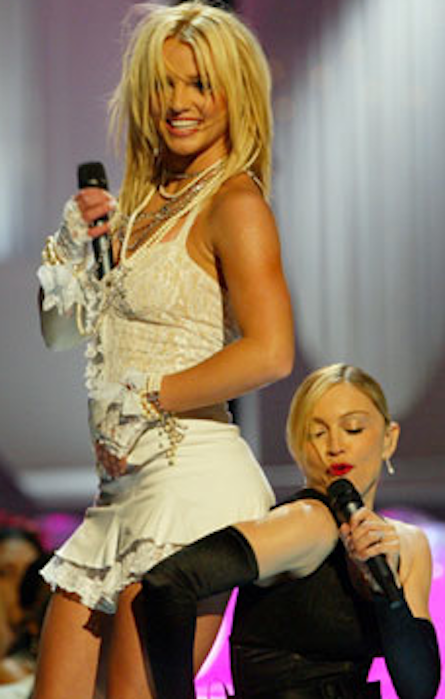
Did Madonna call Britney fat? [The Vine]

Clementine Ford’s take on the Australia Day protest hullabaloo. [ABC Unleashed]

And here, what really went down outside the Lobby restaurant. [RedStache]

All the single ladies: are you sick of continuously being asked why you’re single? Bailey Elliot is, too:

“Why is it socially acceptable to comment on someone’s single status, but definitely not OK to comment on someone’s relationship? There have been many times when someone has said something offensive to me, and I will look at their relationship and wish that I could fire something judgmental back. Some of the people who have said the worst things to me are the ones in the most dysfunctional relationships: married to a raging alcoholic who abuses pets while drunk, a patronising and controlling man, or a man who refuses to communicate in any real way. Are we so enamoured with the idea of marriage that we believe that any marriage, no matter how dysfunctional, is better than singledom?” [Jezebel]

Why is it that everywhere you turn (family restaurants, the gym, the bowling alley), there’s a Pussycat Doll spreading her legs, asks Mia Freedman. [MamaMia]

For the U.S.’s Black History Month, let’s remember that Rosa Parks did much more than just refuse to give up her seat on the bus. [Ms. Magazine]

What the?! The banning of naked A-cup adult breasts lest they promote pedophilia?! Granted, this story is two years old, but interesting nonetheless. [Crikey]

How to be a celebrity in this era of “16th minute”, “I am me”, reality fame. [New York Magazine]

The apparent conservative agenda of the Susan G. Komen foundation which has come to light in their refusal to funnel through donations to Planned Parenthood. [Jezebel]

It’s all happening in the world of MamaMia: no more SkyNews show, but an e-publishing sector instead! And deputy editor Bec Sparrow had a baby! [MamaMia]

Erica Bartle’s thoughts on the whole Melinda Tankard Reist debacle. I’m still ruminating over her post, and I might be back with a response of my own. [Girl with a Satchel]

Image via Pop Sugar.

I Think I’m Beginning to Understand This #MenCallMeThings Thing. Except It’s Not Just Men & It’s Not Really Me.

When the #MenCallMeThings hastag started trending on Twitter and feminist writers galore started detailing their internet abuse at the hands of misogynists, I thanked a higher power that I hadn’t experienced online harassment because, in a nutshell, of my gender. (That’s probably because my blog and extra-blog writings aren’t that well-known [yet].)

But we only have to think back to the vitriol spewed at Mia Freedman when she dared to question our worship of sports “heroes” to realise that members of the “fairer sex” are guilty of it, too. Or how about that recent “leggings are not pants” debacle?

And how about Melinda Tankard Reist? As someone who blogs about conservative feminism, anti-porn and anti-raunch, she’s bound to get her fair share of criticism, which came to a head a few weeks ago after Rachel Hills’ article on her was published in Sunday Life, and subsequently launched a thousand blog posts.

Some of MTR’s ideas are worthy of criticism, in my opinion, but she often gets comments, emails and other forms of communication hurled at her that are anything but constructive. I believe one choice comment in the wake of Hills’ article was that MTR should be raped with a coffee cup. Nice.

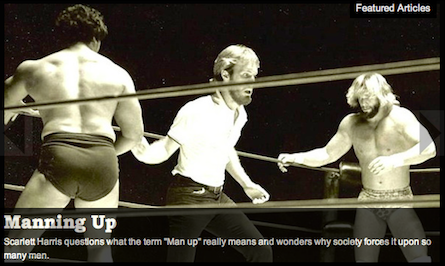
A couple of weeks ago I had my first article for The Good Men Project published, followed by a second one last week. While the first article, “Manning Up” was originally written with a feminist—or at least female—audience in mind and I probably should have thought twice before pitching it to the guys at GMP, I proceeded to get torn to shreds in the comments. I stand by the article and I’m sorry if it offended, but I’ve been around these parts long enough to know that when you’re writing about contentious issues such as gender relations, you’re bound incite people who don’t like what you have to say.

Because these articles were published on a site that is not my own, I was lucky enough not to see the more personal comments that were not approved by the moderators. But I can imagine… If it’s not an attack on my womanhood (whether that be my integrity as a human being because of my feminist leanings, my appearance, or my sex life), it’s an exercise in “mansplaining”, but rest assured, when you’re writing about gender (or race, equality, sex, disability etc.) on the interwebs, it’s a common perception that you’re fair game for the trolls.

Have you experienced gender-related trolling?

Related: In Defence of Mia Freedman.

Conservative Feminist Melinda Tankard Reist for Sunday Life.

Is Big Porn Inc. Anti-Vaccination As Well As Anti-Porn?

Elsewhere: [MamaMia] Female Commentators & the Fuckability Factor.

[Fat Heffalump] Cut the Snarky Fashion Judgement Crap.

[Sydney Morning Herald] Who’s Afraid of Melinda Tankard Reist?

[Musings of an Inappropriate Woman] Melinda Tankard Reist and Me.

[The Good Men Project] Manning Up.

[The Good Men Project] You Give Men a Bad Name.

[Tiger Beatdown] Chronicles of Mansplaining: Professor Feminism & the Deleted Comments of Doom.

On the (Rest of the) Net.


Check me out on The Good Men Project!

On sex work by a sex worker. [The Age]

“Have you lost weight?” is not a compliment. One of my close male friends has recently lost a lot of weight, and the resounding comment that seems to follow him wherever he goes is, “You look so hot now that you’ve lost weight,” or something to that effect. Firstly, what did he look like before? Hideous? Unlovable? Gross? And secondly, is he worthy of affection and admiration now because he’s not fat anymore? Just. Plain. Wrong. [Broadist]

Rick Santorum, the Iowa caucus and what the 2012 Republican landscape could very well look like. Hint: not good. [The Punch]

And some more on Santorum’s scary reproductive rights views. [Jezebel]

AND, a rundown of what the Iowa caucus actually entails, anyway. [Jezebel]

How my heart warms: a child with Down Syndrome is modeling for Target in the U.S.! [Jezebel]

Mia Freedman on Deborah Hutton’s nude posing for The Australian Women’s Weekly. [MamaMia]

Sometimes it’s okay to be a quitter. [Gala Darling]

Camilla Peffer on street harassment. [Girls Are Made From Pepsi]

How to really talk to girls about beauty. [Jezebel]

Images via The Good Men Project, MamaMia.

On the (Rest of the) Net: Catch-Up Edition.


Raising awareness about breast checks, one superheroine at a time. [io9]

Ladies of the year: Taylor Swift VS. Lady Gaga. Who do you choose? [Girl with a Satchel]

Why women fear the “n” word in relationships: “needy”. [Jezebel]

“The Turned-On Woman’s Manifesto.” Amen! [Turned-On Woman’s Movement]

How to talk to women, for men. [MamaMia]

Gah! Anti-vaccination extremists. Why are people like this allowed to promote views like that? Oh right, that pesky little thing called “freedom of speech”… [MamaMia]

Are you a woman and do you love your body, damned what conventional norms say you should be feeling about it in an effort to appease other women? Then sing it, sister! [Musings of an Inappropriate Woman]

Wow. Mia Freedman offers some throwaway fashion advice to her 5-year-old daughter; shitstorm ensues. I think it’s a bit of an overreaction, but each to their own. [MamaMia, Fat Heffalump]

Male body objectification: in comparison to female body objectification, is it even a thing worth worrying about? [Lip Magazine]

Atheism = nihilism? [New York Times]

The latest trend in protesting: the Muff March. [MamaMia]

While we’re on the topic, is pubic hair making a comeback? NSFW [Jezebel]

Stop that booze-related victim-blaming. [Jezebel, via Feministe]

Who has late-term abortions? [Jezebel]

Hmm, Lego for girls? I’m not such a fan. What was wrong with the original, male-centric version, apart from the absence of female characters? We all know kids are imaginative enough to make toys whatever they want them to be. [MamaMia]

On beauty, failure and “this is the best I can do”. [Musings of an Inappropriate Woman]

The pros and cons of anal sex. [Jezebel]

Are princesses really that bad, Naomi Wolf asks. [New York Times]

The Good Men Project for boys. [Jezebel]

It’s been just over a year since the St. Kilda Schoolgirl released those photos, and I’ve only just gotten around to reading this article by Anna Krien from The Monthly’s April 2011 issue on sex and the treatment of women in the AFL. Let me say, it was well worth the wait.

Even if you’re not espousing misogynist bile to women (on the internet or IRL), not standing up to it is just as bad, says Mark Sorrell. [Beware of the Sorrell]

Alyx Gorman defends Miranda Kerr, asserting that there probably is more than meets the eye, but she just “won’t let us see it”:

“Even more problematic than its existence in the first place is the fact that Kerr’s construct is damaging to women and girls. By looking and speaking the way she does (when she has other options in terms of presentation), Kerr is intrinsically linking sensuality with stupidity. She is demonstrating that being ditzy and appearance-obsessed (albeit under the guise of being healthy) is what it takes to be one of the most desirable women in the world. By refusing to express a well reasoned opinion on anything of note, and then pushing the point of self esteem, she is sending a message that the source of girl-power, of pride in one’s womanhood, must always be grounded not in who you are, but how you look. Kerr has crafted an image that is the ultimate expression of the immanence de Beauvoir railed against, and she has done so (I suspect) knowingly.

“Instead of being brave enough to show what a beautiful, clever girl looks like, to delve into the nuances of what it means to be a wife, woman, mother and object of desire, Kerr plays to our worst stereotypes of femininity, giving an organic-almond-milk 21st century update to the image of the perfect  50s housewife.” [The Vine]

The Breaking Dawn Bechdel test. [Lip Magazine]

What’s the difference between a rapist and a men’s mag? Hmm, you tell me. [Jezebel]

On being a recluse. [MamaMia]

The allure of the May-December romance… for the December, not so much the May. [The Good Men Project]

Image via io9.

TV: Top 11 TV Moments of 2011.

Paper Giants.

One of the best shows this year. Unfortunately, it only ran over two nights.

The Kennedys.

Wow. Just wow. I loved this miniseries that was cancelled by the History Channel in the U.S. because it allegedly portrayed the Kennedy family in too negative a light. Luckily, it was picked up by the ABC here. I am now officially in love with Greg Kinnear.

Go Back to Where You Came From.

Apart from Sarah Ferguson’s Four Corners expose on the meat industry (below), SBS’s Go Back to Where You Came From was the most groundbreaking television this year. Unfortunately, I don’t think it changed anyone’s minds about the plight of refugees in this country, because those who already empathise with asylum seekers were the show’s target audience, and those who think refugees should go back to where they came from snubbed the show.

Sookie & Eric Finally Get Together on True Blood.

While I’m more of a Sookie and Bill fan, and an Alcide-in-general fan, Eric’s turn as sensitive Sookie-lover in True Blood’s fourth season was a must-watch. But thankfully, the Nordic vampire is back to his old, heartless self.

Charlotte King’s Rape in Private Practice.

Private Practice is an oft-shunned show, in favour of its Seattle counterpart, Grey’s Anatomy, but season four dealt with abortion and rape particularly sensitively and realistically.

Four Corners’ Expose on the Meat Market.

This was probably one of the most talked about news stories in Australia, if one of the most poorly rated episodes of Four Corners. Not because people didn’t care, but because it was so hard to watch. It’s perhaps too soon to tell, but I think we are seeing a chance in meat practices in Australia because of this story.

The Slap.

I found one of ABC’s most anticipated shows of the year to be a spectacular letdown. I’d had Christos Tsiolkas’ novel on my reading list since it was released, however I missed out on reading it before the show premiered in October. Perhaps if I had read the book first I would feel differently about the show, but I found it to be stereotypical and tokenistic, and a massive disappointment from the screen version I had hyped up in my mind. Fail.

MamaMia Gets Its Own TV Show.

Probably not many TV watchers outside of the insular community of MamaMia and Sky News would have known about Mia Freedman’s lifestyle website making the switch to TV. I don’t have pay TV but, luckily, the shows are available to watch on the MamaMia website, YouTube and Facebook, where the panelists talk about all manner of things, like sex, mental illness, celebrity, porn, religion, parenthood and more.

Angry Boys.

I hadn’t watched any of Chris Lilley’s stuff before Angry Boys and, while a lot who had thought the show was a bit of a letdown, I really enjoyed it.

Housos.

Another one that was a bit hit-and-miss, I’d anticipated the show all year. While some moments were gold, others were just supremely unfunny.

At Home With Julia.

Finally, the cherry on top of a parody-tastic television year. I really enjoyed Amanda Bishop’s portrayal of Julia Gillard, but I still found the fact that there was a show about a sitting prime minister pretty offensive.

Any TV moments I missed here that you thought defined 2011?

Related: Paper Giants: The Birth of Cleo Review.

My Response: Go Back to Where You Came From.

Private Practice: Pro-Choice?

The Slap & Men Who Cheat.

At Home with Julia: Funny or Disrespectful?

12 Posts of Christmas: In Defence of Mia Freedman.

In the spirit Christmas, I’ve decided to revisit some of my favourite posts of the year in the twelve days leading up to December 25th. 

You might remember back in July when Cadel Evans won the Tour de France, Mia Freedman said on the Today show that sportspeople aren’t heroes, and a shitstorm ensued. You can read the original post here.

Mia Freedman’s copped it pretty hard in the media the last couple of weeks, ever since her comments about Cadel Evans and sports stars being held up as heroes.

It’s no secret that Freedman is my idol, so I will go to bat for her til the cows come home. She’s the reason I became a writer. She’s the reason I did work experience at Cosmo. I share a lot of her views. Whether it’s just a happy coincidence, or I’ve shaped my views around hers (I started reading Cosmo at 15, a very impressionable age, so it’s more than likely the latter), I don’t know.

I’ve written about my love for Freedman, followed closely by formerGirlfriend and Cleo editor, and current Sunday Life editor, Sarah Oakes, numerous times, and how the incestuous nature of the magazine world ensures a similar writing and editing style from those who work together. Take Freedman and Zoë Foster, for example. Or Oakes and Girl with a Satchel’s Erica Bartle and Musings of an Inappropriate Woman’s Rachel Hills.

Speaking of Sunday Life, Freedman’s column last weekend solidified why she’s a woman after my own heart.

She wrote about spending time with her family, and how planning big events are always a disaster and it’s the little, “mundane moments” that are memorable.

But back to the issue at hand: sportspeople as heroes.

I agree wholeheartedly that sportsmen and women aren’t heroes. (I threw up in my mouth a little bit when Karl Stefanovic and Lisa Wilkinson stood for the national anthem after Evans won the Tour de France.) Yay, they can “swim fast”, “kick a ball with accuracy”, “run quickly” and “jump over high things”. But how does this make them heroes? It makes them superficial “heroes” or emblems of sporting events in which they did good, but not actual heroes. We can leave that title to soldiers, doctors, activists, social workers, firefighters and others who face death and social injustice to save lives and make the world a better place.

As Freedman reiterates:

“I roll my eyes every time another Australian of the Year is named and it’s a sportsperson. I cringe at the CONSTANT sycophancy and praise heaped on sportspeople and the way they are forever lauded as heroes… How does being highly physically capable make you a hero?”

I read somewhere that it is highly likely Evans will be named 2011’s Australian of the Year, so start warming up those eye sockets, Mia!

I brought this notion up with a coworker last week, who said doctors aren’t heroes just because they’re saving lives. But what about Doctors Without Borders, or doctors and nurses with the armed forces? “Well, that’s different,” he said. Why? Because they’re facing their own death whilst trying to prevent someone else’s? But sportspeople aren’t facing death (okay, sometimes they are), and their payoff is purely selfish.

Said coworker mentioned some AFL “hero” who, back in the ’70s (I think; don’t quote me on this), finished the grand final with a torn ligament and brought the premiership home. Some might call it heroism; others stupidity.

And I think the sportsperson=hero dichotomy is abhorrent, considering the extracurricular allegations levelled at some of them. Is Nick D’Arcy a hero for punching some guy and leaving him with irreparable facial damage? Are the Collingwood FC guys heroes for winning last year’s premiership, with some of them subsequently going on to allegedly sexually assault one or some groupies? How about the world class douchebag Brendan Fevola? Or Tiger Woods? O.J. Simpson? Hardly heroes.

Perhaps we should be looking to sportspeople like Glenn McGrath, who works tirelessly for his late wife’s breast cancer foundation. Or the Essendon FC, who work with schools to improve literacy. While not exactly heroes per se, at least they’re doing something other than hitting and kicking balls.

Freedman writes in a related piece:

“Sporting stars may have great physical skills but that’s all. They’re no smarter or better or nicer or more well intentioned than the average Australian. In fact, I would argue that generally (and of course this is a generalisation), they are less informed, less aware and less street smart than the average bear.

“This is because to become a great athlete, you have to spend many years from the time you are very young, refining your skills. That’s years swimming up and down a pool. Years running around a track. Years kicking a ball or hitting it with a bat.

“Years…

“I’m happy for anyone who CHOOSES to spend years of their life dedicated to their sport. Go for it. But let’s not pretend it’s a selfless or noble pursuit.

“Professional athletes do it for many reasons. Sponsorship dollars. Personal satisfaction. A desire to represent their country or be the best at swimming or kicking or hitting or whatever it is they’re good at.”

Without humiliating anyone, I find the “less informed, less aware and less street smart” contention is particularly true of one of my physically gifted friends.

While he has a Masters and is one of the most book-smart people I know, he admitted to me that until he was in his late teens, he was completely sheltered by his parents. So much so that he didn’t buy his first CD until around this age. Up to that point, he listened to whatever his parents wanted to listen to, because it was pretty much school, practice, competitions, and the only musical exposure he got was in the car on the way to said school, practice, competitions.

Now the kind of sports he plays aren’t exactly your true blue AFL or cricket (in fact, they’re so obscure I won’t mention them here at the risk of giving him away!), so he’s in another boat altogether: his sports would be, and have been, ridiculed by both your Aussie bogan and your highbrow cultured Australian.

Now, from what I’ve read, Cadel Evans is involved in other noble pursuits, like charity. Unfortunately, I think Freedman’s point was sullied by using Evans to bring it up on national television. Perhaps if she were talking about Stephanie Rice or Ben Cousins her contention would have been more well received. But that’s the risk you run when you voice an opinion that’s not of the norm.

And that’s why I love her. Sure, she got crapped on by most of Australia for making a valid point. But she was able to return to voicing her opinion on Today the same time the following week, joking about going into witness protection, but getting a haircut instead. She was able to find the humour in the situation, and see where she might have been wrong.

For the record, I don’t think she was wrong.

Related: In Defence of Mia Freedman.

Everything They Touch Turns to Gold.

Mama Mia: A Memoir of Mistakes, Magazines & Motherhood By Mia Freedman Review.

Mia Culpa: Confessions from the Watercooler of Life by Mia Freedman Review.

Elsewhere: [MamaMia] Cadel Evans: Is He a Hero?

[MamaMia] Cadel: Here’s What I Learned.

[MamaMia] Is Being Australian Really So Much About Gold Medals?

[MamaMia] Stephanie Rice. Enough With the Hero Worship.

[MamaMia] When Family Time is a Nightmare.

12 Posts of Christmas: Paper Dwarves, Digital Giants.

In the spirit Christmas, I’ve decided to revisit some of my favourite posts of the year in the twelve days leading up to December 25th. 

This one was written after Paper Giants aired on ABC in April, comparing the heyday of magazines with the impact of the digital world. You can read the original post here.

A few weeks ago, in response to ABC’s Paper Giants: The Birth of CleoMia Freedman wrote on MamaMia about her thoughts on the state of the (mag) nation and if magazines are still relevant and the amount of influence they wield in 2011:

“… Not that much excitement goes on in magazines anymore… [It’s a struggle to] get them [those who work on a magazine] to try and think about something that hasn’t been done before, something that will start a conversation and boost sales.”

Freedman compares pay TV’s Park Street, a The Devil Wears Prada-esque reality show about ACP’s head offices, featuring the editors of DollyCleoCosmoMadison and Shop Til You Drop, which received dismal ratings and poor audience response, to the critical success and brilliant take on Cleo in her influential heyday of Paper Giants. She says, “Gemma Crisp [editor of Cleo] explained the editorial process that a story undergoes from conception to publication. It takes a minimum of three months… When was the last time you waited three months for something? Life doesn’t happen in increments of months anymore. It happens in moments, in text messages, in Tweets. It’s fast and it’s relentless and if it takes you three months (or even three weeks) to get from thought to print then that’s just too long to retain the attention of your audience.”

When she puts it like that, Freedman makes me long for a simpler time, when I hung on the every word magazines published, as opposed to reading hundreds of articles a week, mostly on blogs, but also in magazines, in an attempt to stay on top of my blogging game.

Erica Bartle, creator of Girl with a Satchel and a former mag girl herself, says Freedman’s “blog-cum-website” “deals in what everyone’s talking about TODAY. It feeds off the 24-hour news cycle. And Mia’s own profile. And her opinion… It’s like a current affairs program for women online.” And now with MamaMia launching on SkyNews, Freedman’s brand is literally a current affairs program.

Not all blogs can operate this way. MamaMia has a team of bloggers, editors and techs who keep the site running smoothly which thus, as Bartle said, allows it to operate on a 24-hour news cycle.

Personally, I have a part-time paid job I go to four times a week, this means I only get to blog two or three days a week, and with so much info to process and a maximum of 15 posts per week to churn out in a small amount of time, this means I can’t always post as early and as often as I’d like.

But even for those who blog fulltime, like Bartle, it’s not always about what’s happening right NOW as it is about maintaining the blog’s integrity.“I personally operate on a different plane, because my beliefs very much inform my work. For that, I’m willing to sacrifice certain economic constraints,” she says.

Still in the blogging world, you have someone like Gala Darling, who is very much a self-made businesswoman as a result of her über-successful blog of the same name. She’s gone from strength to strength over the past few years; something she could never have done had she been a magazine editor (bar the select few, like Anna Wintour, Anna Dello Russo and yes, Freedman).

But, essentially, MamaMia has the advantage of possessing “a figurehead with credibility whose background is in traditional media. She has the gut instinct of an editor. Online you need news nous as well as technological nous and business nous.”

Another editor who has these qualities in spades is former Cleo and Girlfriend editor, Sarah Oakes, whom Bartle worked under at Girlfriend. Bartle says she invoked an atmosphere of ghosts of magazines past, creating “camaraderie, creativity and positivity, which I think she achieved. She gave you more work if she thought you could be stretched; gave you a talking to if you had crossed a line; gave you a pat on the back for a job well done.” Very Ita-like, wouldn’t you say?

Oakes is now editor of The Age Sydney Morning Herald’s Sunday Life supplement, a title which has improved markedly since she took over. (I have also blogged here about how I think both Girlfriend and Cleo became better titles under her leadership.)

In fact, newspaper inserts are giving the glossies on the newsstand a run for their money, as they “are getting exclusives and have strong writing and design teams, as well as columnists and styling/shoots. These free weekly titles, because of the mastheads they reside within, have enviable readerships and access to celebrities. They are also respectable, well executed and FREE,” Bartle notes.

But at the end of the day, are magazines relevant?

Freedman writes:

“The internet has not only sucked up their readers, it has also gobbled up their purpose: to be a way women form tribes and communicate. Now there’s YouPorn and any other number of sites for titillation, Google for questions about sex, and any number of websites or free newspaper magazines if you’re looking for other types of content or a magazine-style experience. Women don’t want to be spoken TO anymore. They want to be part of the conversation, something which the internet allows, in fact depends on… the internet has taken the sting out of the raunch-factor for mags like Cosmo and Cleo.”

Yes, as Freedman says, there are much raunchier locales to get what would have been included in a sealed section only a few years ago. There’s also Perez Hilton, TMZ and even shows like Entertainment Tonight and E! News that monopolise celebrity content, while the fashion blogs are more of a go-to for what kids are wearing these days.

Sure, Vogue’s always going to be a premiere source for high fashion shoots from photographers the likes of Annie Leibovitz, Patrick Demarchelier and David LaChapelle, but magazines “seem to exist on a strangely distant planet where all the people look like plastic and the sole pursuit is ‘perfection’. Except that perfection doesn’t really exist,” says Freedman.

When sites like JezebelCover Girl Culture and, yes, MamaMia and Girl with a Satchel are debunking photoshop myths and striving for more realistic representations of women in the media, magazines are doing this movement any favours. (Except maybe Brigitte.)

And when you can get most of a magazine’s content online anyway (I passed on a near-$20 copy of US Harper’s Bazaar in favour of accessing interviews with Kim Kardashian and Hillary Clinton on their website), are they really worth it?

Bartle doesn’t think so. “No, but they need to be distinctive from what we can get online or elsewhere if we are going to part with $5-$10 to purchase one. Premium magazines, which I have no qualms spending extra on, include The Gentlewoman and O The Oprah Magazine, because they cater to my tastes, sensibility and need for a good read on a Saturday afternoon with a cup of tea.”

I agree with Bartle’s sentiments.

While online is great for content from individuals not curated and/or watered down by magazines editors to fit the mold of their magazine, holding a truly great glossy in your hands, like the appeal of a physical book, while at the hairdressers, a café or tucked up in bed, means magazines will always hold a place in our hearts.

Right next to the Kindle and Google Reader.

Related: Paper Dwarves, Digital Giants.

Paper Giants: The Birth of Cleo Review.

Everything They Touch Turns To Gold.

Evolution of the Bookshop at The Wheeler Centre.

Elsewhere: [MamaMia] Paper Giants VS. Park Street: Why Magazines Are Not What They Used to Be.

[MamaMia] MamaMia Gets a TV Show.

[Girl with a Satchel] Homepage.

[Girl with a Satchel] Mid-Week Media Musings.

[Gala Darling] Homepage.
Magazines: Just Because You’re Beautiful Doesn’t Mean You Can’t Have an Opinion.


I’ve encountered this thinking before.

At a feminism debate this time last year, Gaye Alcorn scoffed that Mia Freedman, Sarah Murdoch and Kate Ellis shouldn’t be the faces of (and brains behind) the Body Image Advisory Group because they happen to be physically attractive. Like, sorry that they have good genes, but should that make them any less qualified to comment of feminist issues? I thought we were working towards an all-inclusive feminism…

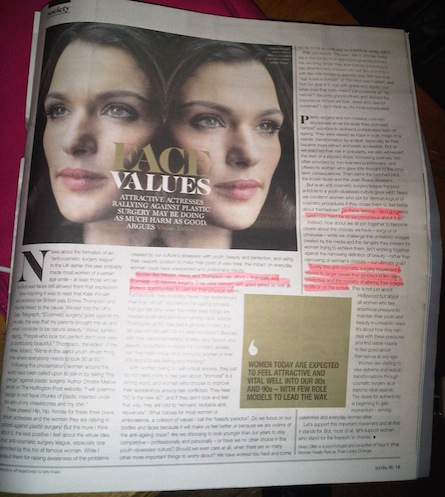
Anyway, similar views were brought up in last weekend’s Sunday Life magazine by Vivian Diller, who wrote in “Face Values” that perhaps Kate Winslet, Rachel Weisz and Emma Thompson aren’t the best advocates from Hollywood’s anti-plastic surgery movement because they don’t need it.

Diller writes:

“Women like Winslet, Weisz and Thompson can afford—financially and otherwise—to oppose surgery. They were blessed with good genes as well as limitless opportunities to care for their physical selves.

“… Do these famous—and gorgeous—celebrities need to be so sanctimonious about it all?

“… Surely this anti-cosmetic surgery movement is related to larger issues that go beyond film stars, celebrities and the morality of altering their images in life or on the screen…”

I’m sure most actresses, models and regular people don’t need cosmetic surgery, per se, but it seemed like everyone else was doing it. Now there’s an outlet for those who have similar outlooks to beauty as Winslet et. al. to just say “no”.

Thoughts?

Related: Has Feminism Failed?

Is There Really a Beauty Myth?

In Response to Questions About “Erotic Capital”.

A few weeks ago, Rachel Hills blogged at Musings of an Inappropriate Woman about “beauty positivity” and “erotic capital”. At the end of the post, she asked these questions of the blogosphere:

“Am I on the right track with the idea that it’s not valuing beauty that’s the problem, but the fact that we’re socialised to believe that we’re never beautiful enough? Is this experience of ‘lack’ just a ‘neurotic Rachel’ thing, or an ‘other people’ thing as well?

“Moreover, is it just a female thing, or do men experience it as well?

“Have you managed to develop a positive approach to the way you look? What did it look like and how did you get there?

“How do we stop beauty positivity from turning into beauty privilege?”

So, here I will attempt to give my opinions on “erotic capital.”

Firstly, I have to start by saying that, miraculously, I feel I have come away from my media-influenced adolescence relatively unscathed. I love my body and the way I look, and enjoy dressing to reflect this. Sure, every now and then I have my “fat”, “ugly” and “bad hair” days, but on the whole, I am happy with how I look.

But, I have to agree with Hills’ summation that liking beautiful things and people isn’t the problem, as everyone has their own unique perception of beauty (the way the media tries to influence this to make it a “one-size-fits-all” lens is another problem—and blog post—entirely), but that, as women especially, we’re never good enough.

Again, I have high self-esteem and I will never let anyone or anything make me think I’m not “good enough” or deserving of the things I want. But often I will go out of my way to “prove” these things. When I go out dancing or to parties, I make an effort to wear the tightest, sluttiest thing I own. If I’ve been a bit lax on the work out regimen, I’ll double up on the control underwear, or wear something a bit more flowing.

My most insecure point is probably when I’m seeing someone new. I’ll have thoughts of, “I can’t get naked with this person until I’ve eradicated all my love handles and cellulite,” which is something that I’ve never been able to do nor am interested in doing since they appeared when I was about 13 or 14. I enjoy having a curvier figure, but I guess that’s the influence of “pornification of culture”, and all the pretty young things we see getting their kit off on TV manifesting.

But, in my experience, this isn’t exclusively a “female thing”. Two of the most in-touch men I’ve ever met are two of my closest friends, and the fact that they aren’t afraid to voice their body image concerns or the pressure put on men to look and be a certain way is a refreshing change to the stereotype of either “ripped football bogan” or “beer-bellied goofy bogan”. While it can certainly be an either/or representation of ripped men (NRL players and the True Blood stars come to mind) versus the incompetent, pudgy father seen most commonly in advertisements for nappies and spray and wipe, at the end of the day that’s nothing compared to what women have to deal with in the media. As Mia Freedman put it in her book, Mia Cupla:

“Pretend the world was full of pictures of naked men. On billboards and the sides of buses, in magazines and ads for beer, cars and deodorant. Imagine there were penises everywhere you turned and you couldn’t escape seeing them every day.

“And all the images of nude men were fake. Every male model and celebrity had had penile enlargement surgery, and afterwards, his penis had been extensively photoshopped to make it look even bigger. So now, all the penises you saw in the media every day were knee-length and as thick as an arm.

“One day, next to a magazine article about a celebrity with a foot-long penis, you read the headline: ‘This is what a 43-year-old penis looks like’. The caption underneath read: ‘Asked for the secret to his long schlong, former male model Markus Schenkenberg insists he was just born that way. “I wear cotton boxer shorts and I exfoliate in the shower,” he shrugs. “That’s all I do.”’

“After reading a hundred stories like that and being bombarded by 10,000 images of men with surgically altered and digitally enhanced penises, do you think you might look down at your natural, un-photoshopped trouser snake and feel a little… deflated? Inadequate? Insecure? Angry?”

As I said before, it is amazing that I managed to emerge from adolescence without a lingering negative thought about my body. Sure, I don’t like my legs or my stomach, but I dress to reflect this, and try not to get too paranoid about it. I prefer not to lounge by the pool in a bikini all day, and won’t wear a miniskirt without stockings or pantyhose to hold everything in place, but I won’t let these insecurities stop me from having fun.

My mum was very insecure about the way she looked, and this was projected onto my sister who, I believe, suffered the beginnings of an eating disorder a few years ago. Considering I was the one who was very into movies, TV, magazines and pop culture in general, it would be more likely—at least in the eyes of body image scaremongers—that I would be the one with the eating disorder.

One thing I did inherit from my mum, though, was her bad skin. She’s had skin conditions like dermatitis, allergies and surface veins all her life, and I was (un)lucky enough to get these, too. However, while she’s had relatively clear skin, pimple-wise, I suffered for several years with huge, painful zits which left scars, some of which I still have today. After years of trying to find products to prevent and get rid of these pimples, I finally realised that simple is best when it comes to skincare. I still get a large pimple every now and then (unfortunately, it’s large or it’s not there at all), but I’ve learned how to manage them. But the scars on my face are my biggest insecurity, and the humiliation was exacerbated by both the media, where the aforementioned pretty young things would frolic “make-up free” at the beach or when they woke up, and by people I encountered in my everyday life, who wouldn’t look me in the eye, but rather in the eye of my pimple.

Sometimes I look back on my younger years and I want to kick myself for being so typically self-conscious. I would apply a mask of makeup every day when I didn’t need it at all. I think age and wisdom are the only ways to really appreciate what you’ve currently got.

Finally, I have no idea “how to stop beauty positivity from turning into beauty privilege”. Personally, I don’t think the media plays the most important part in this. I think it starts at home: if parents, teachers and close family and friends can encourage “critical thought” about representations of not just beauty, but stereotypes of women and men, in the media, then young people have a better chance of understanding that what we see on TV, in magazines and advertisements isn’t real. This can be found elsewhere, in books, on blogs and using resources such as the Body Image Advisory Group, chaired by Freedman.

Of course “beauty privilege” is something we see more of in the media than in real life, as beauty campaigns and the lead role in movies like She’s Out of My League depend on the calibre of physical beauty a person woman possesses, whereas friendships, romantic relationships, business partnerships etc. involve other aspects.

So, I will now pass on Hills’ original questions to you, reader: what are your thoughts on “erotic capital” and beauty privilege?

Related: Mia Culpa: Confessions from the Watercooler of Life by Mia Freedman Review.

Is There Really a Beauty Myth?

Will Boys Be Boys When it Comes to Objectifying Women?

Elsewhere: [Musings of an Inappropriate Woman] Some Questions I Have About “Erotic Capital” & Beauty Positivity.

What Makes a Good Person?

Recently, Erica Bartle wrote about her Christian angst on Girl with a Satchel.

She said her “newfound sensibility” has made her “hyper-sensitive” to all that is wrong in the world. “Why can’t everything just be nice and Christian?!” she bemoans.

I wrote in response in the comments section that I don’t think what she’s experiencing is an exclusively faith (in the religious sense of the world; I’m an agnostic, yet I still believe in a higher power of some kind and that all things that are meant to be will eventuate. I know atheists who, like George Michael, have faith.) -based problem.

Last week, a former colleague and Facebook friend wrote an anti-refugee status along the lines of “fuck off, we’re full”. Classy. I commented, saying that as the “lucky country”, we should be extending our resources and welcoming asylum seekers with open arms, as they have a legal right to seek asylum in whichever country they can gain access to which is safer than their own. To cut a long story short, a shitstorm ensued, and bigoted bogans far and wide chimed in to berate me and asylum seekers alike.

They claimed “boat people” were making their local kinders stop celebrating Easter and Christmas and that while people like me have to pay for my education, they get it for free. I don’t know where they get this misinformation (middle-right mainstream media, step right up), which is what I wrote, albeit in a more forceful manner, and was attacked personally for it.

There is a fine line between standing up for what you believe in and berating all others who don’t subscribe to the same school of thought. If bigotry means not being able to see the other side and thinking less of those on it, then call me one, because I just can’t see the reasoning behind being so uncaring and un-compassionate. (The downside to free speech.)

So if standing up for what you believe in and the rights of others makes you a “good person” by a lot of peoples’ definitions, which side makes you a “better” person? The side that wants to protect our country’s borders and focus our money and resources on people already in it, or the side that believes we should extend those privileges to those in need, no matter which country they hail from? And why isn’t the latter the more mainstream and accepted view?

Bartle writes that sometimes her hypersensitivity to issues not unlike the one I just mentioned makes her wail, “Why can’t I just be NORMAL?!”

What is normal, anyway?

If normal means having the prejudiced views of the friends of my Facebook friend and, indeed, the two main governmental parties in this country, then normal is something I do not want to be. From the last two and a half years of content Bartle has posted on her blog (not to mention the two years before I discovered GWAS), I doubt it’s something she would really strive for, either.

But, to be a woman of God means to “let go of the idea of your awesomeness, your pride and your talents” and “burning ambitions/dreams/desires”. Forgive me, but the “god” I believe in wants me to be the best I can possibly be at whatever I choose. (“God” is starting to sound an awful lot like “mum”.) I want me to be, too. There’s that pride thing Bartle’s talking about…

So does being a “good person” mean being agreeable, having no passion and being boring? I know some of these people and, to my mind, they mightn’t be bad people, but they’re not much brighter than “normal”, either. To be a good person you need to buck the status quo, and be both passionate and compassionate. These things make you anything but boring and “normal”.

But we see what these things lead to, and it’s anything but compassion.

Take the Mia Freedman/Cadel Evans saga, for example. Freedman has made a career out of giving her opinion on all things media- and woman-centric, which is exactly why the unwashed masses turned on her when she deigned to question the focus we put on sportspeople at the expense of other, perhaps more deserving, people.

Bartle includes an excerpt from Get Her Off the Pitch: How Sport Took Over My Life by Lynne Truss, in which the author writes that sport can sometimes be a waste of time (my thoughts exactly!) which, in turn, got me thinking about pack mentality, both in sport and in religion.

We’ve seen how mobs of sports fans engage in rioting, amongst other pack-like behaviour. Even the very act of cheering and booing your favourite/least favourite team in the stands is inherently mob-like. Not to mention the “group-bonding” sessions of gang rape and group sex amongst teammates. (This is not to say all sport is bad; it’s just not for me, and this is just one of the myriad of reasons why.)

Religion, I believe, also encourages such actions. The use of deities to justify all manner of wars, massacres, executions, terrorism, riots, rapes, murders, stonings, and law reform, amongst many others. (This is not to say all those who are religious subscribe to such extremities, but I do believe that all organised religion is a crock.)

And we, as a society, accept such behaviours because they are hidden under the cloak of Godliness, or Australianess. (More on what is considered Australian and un-Australian tomorrow.)

So, this has gotten a little off-track, but I suppose I’m putting the question out there: “What makes a good person?” Obviously, this is a never-ending debate, but I do know that being one is certainly not dependent on religion or “patriotism”.

I think it’s dependent on being courageous, compassionate, respectful, which in turn generates respect, standing up for what you believe in and having the courage of your convictions, staying true to yourself, standing up for the underdog and yes, being a little bit proud and selfish every now and then. ’Cause no one respects a “yes” (wo)man.

Related: In Defence of Mia Freedman.

Elsewhere: [Girl with a Satchel] I’m a Christian, Get Me Outta Here!