On the (Rest of the) Net.


Post of the week: Catherine Deveny on body love. [MamaMia]

On sexual harassment and “nightclub feminist success”. [Musings of an Inappropriate Woman]

Atheists are just as bad as rapists… and feminists. [Jezebel]

Lingerie football. What do you think? Personally, I’m not a huge fan of playing sports in underwear, but I don’t have much of a problem with it. [MamaMia]

“The Problem with My Week with Marilyn.” [Jezebel]

All long-term monogamous relationships are a transaction, says Ms. Elouise, so what’s the big problem with “paying your wife for sex”? [Feminaust]

Facebook, girl-hate and “I’m a better feminist than you” tête-à-têtes. [Howling Clementine]

XOJane on the message Breaking Dawn sends to virgins.

The Manic Pixie Dream Girl trope extends to indie films, too. [The Atlantic]

iPhone 4S’ Siri is pro-life, apparently. [Gizmodo]

When hemlines rise, so does bitchiness. [Jezebel]

Stella Young on the disability pension myth. [MamaMia]

Former Wordsmith Laner Sarah Ayoub-Christie tries to reconcile her modern marriage with her traditional Lebanese upbringing. [MamaMia]

“Teaching Good Sex” in school. What a novel idea! [New York Times]

Men in porn:

“The straight male performer must be attractive enough to serve as a prop, but not so attractive that he becomes the object of desire. As [porn publicist, Adella] Curry puts it, ‘No one wants to alienate the male audience’.” [Good]

Image via MamaMia.

On the (Rest of the) Net.


“In Defence of the Short-Haired Woman”:

“I think… that a lot of men believe they prefer long hair—and wrong in that when it comes down to it, they don’t actually care all that much.

“I’m sure there are plenty of straight men who truly, inherently prefer long hair on women. But in my experience, the bulk of straight men who default to liking long hair on women just like women.” [Jezebel, via The Beheld]

Beauty truly comes from within. [MamaMia]

How guys really feel about going down on us. One question: where can I find this guy?!

“What I think is ‘holy shit is this hot!’ I notice the varieties in taste during certain parts of a girl’s cycle. It tastes sort of tart right after her period ends, gets musky around ovulation and then has full blown feminine sex scent right before her period. I loved doing it from the first time I tried it. In fact, I came without touching myself the first time I went down on a girl. There is no learning to like it. Heck, it puts me even closer to pussy than fucking does. How could a guy who likes girls possibly not like it. Overall it’s my favorite sexual experience. You don’t have the pressure of ‘fuck if I get too into this I’m going to cum too soon and disappoint her but if I hold off and take forever to cum I’m going to end up boring her/making her sore/making her think I’m not that into it’ that you get from intercourse. You just to get to dive into the best smell and taste in the world and be there until you see, feel, hear and taste her having an orgasm. It’s a powerful feeling. I think oral sex is awesome and the best form of contraception mankind has ever come up with. Same great orgasms, no risk of changing diapers down the line.” [Jezebel]

Harrowing TV birth scenes as contraceptives. [NYTimes]

It’s not just the Disney princesses we need to worry about. It’s the princes, too. [Sociological Images]

Why are the new Snow White movies so… white?

“The filmmakers missed a chance to bring a truly new perspective to the story by integrating it. Snow White is a made-up story, taking place in a made-up land. Why can’t the handsome prince be black? Why can’t the queen be black? There seems to be an Asian dwarf in the Mirror Mirror project, but none of the major characters in either film are of colour.” [Jezebel]

The woman used as a reason to commit adultery by cheating website Ashley Madison speaks out:

“There is an enormous problem in this world in regards to female body shaming, and not solely in regard to fat women, but all women. A size 2 woman who sees this ad sees the message: ‘If I don’t stay small, he will cheat’. A size 12 woman might see this ad and think “if I don’t lose 30lbs, he will cheat”. A size 32 woman could see this ad, and feel ‘I will never find love’. It’s horrific. Not all women are necessarily insecure, but it’s no secret that body insecurity is endemic, regardless of size. This kind of message is extremely damaging to self worth. Eating disorders may have lost their place in the media spotlight, but continue to effect people of all ages, especially teens. This sort of behavior can easily be triggered from the careless cruelty of advertisements like the one in question.” [Jezebel]

10 other things that should be worthy of “Personhood”. [Jezebel]

The history of Ms. magazine. [New York Magazine]

Eve Ensler is over rape jokes and Facebook pages. [HuffPo]

Images via Jezebel, Sociological Images.

On the (Rest of the) Net.

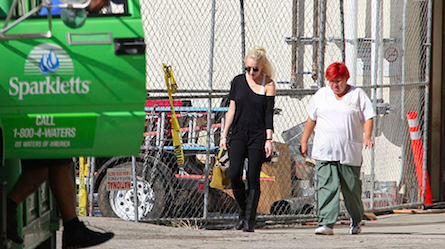
How to make friends and not alienate people whilst working at the morgue, Lindsay Lohan-style. [Gawker]

Mitt Romney’s history with abortion. [New York Times, via Jezebel]

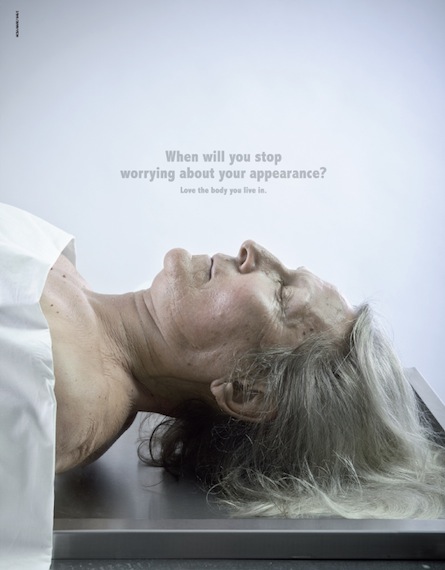
South African Marie Claire attempts to draw attention to body image with their most recent campaign, to lukewarm effect. My pick for the most hard hitting design is the one above. What’s yours? [MamaMia]

How does the word “fat” affect others’ body image? [Jezebel]

Gala Darling, her husband and their Halloween costumes.

E-book VS. real book. [MamaMia]

It’s all about me, I mean you, I mean me. [Already Pretty]

“Accidental rape” and enthusiastic consent:

“While the legal standard of rape is increasingly well-defined… common sense suggests that at its most basic, rape is nonconsensual sex. Too many of us, men and women alike, define consent as the absence of a clear ‘no,’ rather than the presence of a clear, unmistakable, eager ‘yes.’ The opposite of rape, in other words, is mutual enthusiasm.

“The root of consent is the Latin consentire, which means ‘with feeling.’ Consent is not just about words ‘no’ or ‘yes’—it’s about the unambiguous presence of desire.”

[The Good Men Project, via MamaMia]

The case for vaccination Barbie! [Washington Post]

A history of slutty Halloween costumes. [Jezebel]

Still with Halloween: costumes and racism:

“Halloween was the day where women could bring out their inner sluts… Halloween is also the day where people can bring out their inner… racism…” [Eternal Sunshine of the Spotless Mind]

“Who Cares About Amber Cole?” the black teenage girl who was caught on camera by two male friends giving her boyfriend a blowjob, which subsequently got circulated around the internet, thus distributing child porn. [Jezebel]

Images via Gawker, MamaMia, Gala Darling, High Snobiety, Toys R Us, Clutch Magazine.

On the (Rest of the) Net.


Spice World as metatext madness! [Thought Catalog]

Are we living in the post-ideas age? [New York Times]

“The Opposite of ‘Man’ is ‘Boy’, Not ‘Woman’” by Hugo Schwyzer:

“… Men who long for a vanished world of all-male preserves are making a fundamental mistake about masculinity. They think that the opposite of ‘man’ is ‘woman’ and that in order to prove oneself the former they must do (perform) things that no woman can. But it makes good sense to suggest that the better antonym of ‘man’ is ‘boy.’ To ‘perform masculinity’ isn’t about doing what women don’t. It’s about doing what boys lack the will or the maturity to do.

“If we really are in a ‘man crisis’ in America, I suspect it’s rooted as much as anything else in this fundamentally mistaken belief that manhood needs to be about rejecting anything that smacks of the feminine.” [The Good Men Project, via Jezebel]

How they got Osama bin Laden. [The New Yorker]

“Talking to an Abortion Clinic Protester.” [Jezebel]

The “proper etiquette” for drunk Jersey Shore sluts. [Jezebel]

Cutting off your animal cruelty to spite your feminism. Feminaust’s Ms Elouise on PETA’s latest anti-animal cruelty porn site:

“Is using Pamela Anderson’s body as a sex object and comparing it with a piece of meat an acceptable way of drawing attention to the plight of animals in the meat industry?

“PETA’s use of women’s bodies as a means to furthering their animal rights activism undermines their claims to ‘we all have the same parts’ because they’re saying the exact opposite, they’re saying:

“‘LOOK BOOBIES! Now that we have your attention, meat is bad.’”

While this is a great article, I don’t agree with its sentiments 100%. Yes, some of PETA’s campaigns have been unnecessarily focused on the female form, illustrating no real point, but I do think the “I’d rather go naked than wear fur” and the Pamela Anderson campaigns use it in a positive way. Both for women and animals. What do you think?

“Do You Prefer ‘Fashion Victim’ or ‘Ensembly Challenged’?” Squee! All of Cher Horowitz’s outfits in less than 60 seconds! [Worn Fashion Journal]

Questions for “perfect-looking women”, if there is such a thing. [Thought Catalog]

A letter to Gloria Steinem. [Ms. Magazine]

Rachel Rabbit White on “femme-guilt, beauty-privilege and the phenomenon of girls slut-shaming other girls.”

Everything Sarah Hepola learned about New York City. [The Morning News]

The victim-blaming of Lara Logan for deigning to be hot, bare cleavage and get raped. [Broad Street Review]

“Feminism, Colonialism and Islamophobia” at Qantara.

Image via Fan Pop.

On the (Rest of the) Net.


“The Case for Dry Humping: Why Being Prude is a Feminist Statement.” [HuffPo]

Alone time is my siren call. Here, Jezebel’s Social Minefield tells you how to get more “me time” without offended those who want to have “we time” with you.

One woman goes mirror-free for a year. [Jezebel]

Lady Gaga’s run out of people to plagiarise, so she’s turned to herself for inspiration in her latest video for “Yoü & I”. [Fashionista]

Nipple slips from Khloe Kardashian, Nicki Minaj and Kelly Rowland in quick succession: shock, horror! [The Washington Post] (SFW)

Camilla Peffer on Beyonce as the anti-feminist. [Girls Are Made From Pepsi]

The gender politics of Justin Bieber. [FBomb]

Is there a need for women to have their periods?:

“… I do want to raise the question that while we do the work of destigmatising menstruation and teach young girls to be proud and excited about their menarche don’t we also have a responsibility to question its necessity? We tell women they don’t have to have sex to have children, that breast cancer can be beaten, that they can have their tubes tied and then re-connected and their faces lifted and de-wrinkled. We live in a modern world with modern solutions, isn’t it time we started seriously thinking and talking about the need to bleed?” [Feminaust]

Porn star and new mum displays picture of her breastfeeding her newborn daughter in an exhibition challenging the Madonna/whore dichotomy of motherhood, controversy ensues:

“The idea that there is something inherently prurient about a porn star breast-feeding plays right into that classic either-or thinking: Her breasts are erotic in one venue, so they can’t be wholesome in another. It’s a wonder anyone lets her breast-feed at all! On the one hand, it’s surprising to see this attitude coming from a pornographer; on… [yet an]other hand, it’s perfectly appropriate given the way motherhood is fetishised in porn.

“…We don’t like to think of moms as sexual beings—except for in the taboo-busting world of porn (paging Dr. Freud). It’s fitting for a porn star mama, the rare industry ‘MILF’ who is actually a mom, to remind folks that, generally speaking, one has to have sex in order to become a mom.” [Salon]

Anne Hathaway’s new effort, One Day, has a “bleak worldview of co-dependence where men need women to improve them, and women need to improve themselves to deserve men’s notice and achieve their purpose,” with The Film Stage dubbing it “the most toxic romance of the year”.

Also at The Film Stage, a breakdown of Katherine Heigl’s stereotype-reinforcing rom-coms, from the career-making Knocked Up, which she subsequently dissed for being sexist, to the just-as-sexist Killers and Life as We Know It.

Here’s an extended version of Erica Bartle’s debut piece for Sunday Life. While I don’t necessarily agree with her sentiments on faith most of the time, this is a great read. Better than the published piece, dare I say? [Girl with a Satchel]

Taylor Swift VS. feminism. [Autostraddle]

Is it “time for an abortion pride movement”?:

“… Women should not merely have the right to end unwanted pregnancies, they should have the right to be proud of having done so. Surely, there is enough suffering in this world already without adding infants with Tay-Sachs disease and Lesch-Nyhan syndrome to the mix. Women who step up to the ethical plate and have the strength to say, ‘This is the wrong time,’ or ‘This is the wrong fetus,’ should hold their heads high in the streets.” [Opposing Views]

Oh, the hilarity of Photoshop on this Glee/Vogue/Fashion’s Night Out advertisement. [Styleite]

It’s not just women who get the short end of the stick when it comes to Disney films: “Sexism, Strength & Dominance—Masculinity in Disney Films.” [FBomb]

The awesomeness that is Adam Lambert. [Autostraddle]

One from the vault: Buffy’s Willow Rosenberg destroys the world when her lesbian love is killed, calling into question the show’s support of the LGBT community. [Salon]

A mother’s perspective on the dysfunctional Twilight-saga relationship between Edward and Bella. [Persephone Magazine]

The politics of the SlutWalk. [New York Times]

Five of The Simpsons’ best recipes, including 64 slices of American cheese and Vaseline toast! [Warming Glow]

Image via Chubby Wubby Girl, Styleite, Salon.

TV: In Defence of Rachel Berry.


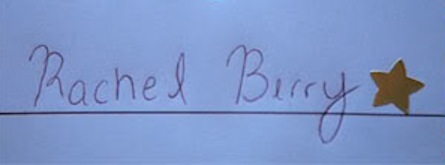
In the first season of Glee, Rachel Berry was introduced as an attention- and approval-seeking know-it-all diva, who sticks a gold star next to her name on the New Directions’ sign-up sheet because that’s what she sees herself as. Season two showed the glee clubber soften her resolve a bit, realising that she’s still only in high school, and has her post-high school years to carve out a Broadway career and have the world see her as the star she knows she is. The season final saw her choose a relationship with Finn Hudson in her senior year at McKinley High, despite having to leave him to head to New York when she graduates.

Not all young girls have to wrangle their feelings for the school jock whilst contemplating a move to the big city to make their dreams come true, but many of Rachel’s problems are shared by the show’s audience.

In the most recent Lady Gaga-themed episode, Rachel struggles to accept her “Jewish nose” and considers rhinoplasty. She also strives for the acceptance of her New Directions band mates, and to be seen as fashionable and popular.

It’s in the character’s nature to be highly-strung, goal-oriented and ambitious, so it’s not likely she’ll change any time soon. And why should she? While there are certainly other young women out there who identify more with the saccharine Quinn Fabray, the sassy soul sisters Santana Lopez and Mercedes Jones, or badass Lauren Zizes, there are plenty who see Rachel as their Glee counterpart, myself included.

A recent New York Times article by Carina Chocano praised the “relatable” and “realistically weak female character”, like Kristen Wigg’s Annie in Bridesmaids—“a jumble of flaws and contradictions”—over the “strong” one. “We don’t relate to [the weak character] despite the fact that she is weak, we relate to her because she is weak,” Chocano writes.

But what exactly does she mean by “weak”?

Pop culture commentator Dr. Karen Brooks notes that talented, beautiful, popular and successful female characters need to be broken down before they can be seen as relatable. “The more talented and beautiful you are, the greater the threat you pose and so ‘things’ are introduced to reduce that threat,” she says. Just look at the “women falling down” video on YouTube.

While Rachel’s had her fair share of setbacks, it seems Glee’s audience is finally beginning to understand her. “We’ve been given time to understand Rachel’s initially painful personality and to identify both her strengths and weaknesses. Her ambitions and drive haven’t shifted, but the context for understanding them has,” Brooks says.

“Rarely are unpleasant characters redeemed, they are simply ‘punished’, while the ‘good’ characters soar to impossible heights, not on the back of hard-work and self-belief, but usually [because of] a love interest and wishing hard. Rachel is a healthy and welcome exception to that,” Brooks continues.

So she’s an unlikely heroine we can all get behind, you might say? “A girl who reminds you of you,” as Chocano opines. An everywoman, if you will?

If Rachel Berry encourages more young women to see themselves as gold stars striving to have their accomplishments recognised, then so be it!

Related: The Underlying Message in Glee’s “Born This Way” Episode.

Do “Strong Female Characters” Remind You of You?

Elsewhere: [The New York Times] A Plague of Strong Female Characters.

Image via Noelle’s Means of Escape.

On the (Rest of the) Net.


In praise of Meredith Brooks’ “Bitch” music video fashion. Takes me right back to grade six… [XOJane]

Rachel Hills laments the lustre of the It Girl. [Musings of an Inappropriate Woman]

Should recreational drugs be decriminalised? [MamaMia]

Consent, ignorance and “The Unintentional Rapist”. [Persephone Magazine]

Charlie Fine: boy wonder. I hope my future 11-year-old is a switched on as this kid. [MamaMia]

“Your pussy isn’t pretty enough” and other vulva-shaming myths. [Rachel Rabbit White]

The perils of being a black woman dating. [Jezebel]

Feminism is NOT a dirty word, Beyonce. [Jezebel]

The feminine girl geek mystique. [Persephone Magazine]

New show The Playboy Club as feminist text? [Jezebel, via NPR]

“When The Rapist is a She.” [Salon]

“Lest we forget” about asylum seekers? [MamaMia]

Muslim Americans: they’re just like other Americans! [Salon]

Mitt Romney’s abortion history. [Salon]

On Generation X nostalgia. [The New York Times]

Breastfeeding: a feminist issue. [Persephone Magazine]

In defence of Rihanna’s “Man Down” video. [Persephone Magazine]

“What Happened to Obama’s Passion?” [The New York Times]

Does “sport get way too much attention in Australia to the detriment of other national heroes?” [BBC News]

Clark Gable’s old Hollywood “Scandal that Wasn’t”:

“But the studio didn’t quite have a handle on his [Gable’s] image, casting him as an unrepentant villain and a laundryman. This was akin to casting Channing Tatum as a bad guy or smart person, when everyone knows he should only be taking off his shirt and/or doing dance moves, preferably while in the rain. Even cast in the wrong roles, Gable was remarkable. MGM’s head of publicity thus decided to further refine Gable’s image, capitalizing on his rural past and six-foot frame to create Clark Gable, The Lumberjack in Evening Clothes.” [The Hairpin]

How to be a dead body on TV. [The Wall Street Journal]

Fashion’s next big thing: a 10-year-old French girl. [Jezebel]

Image via XOJane.

The Perils of Living with the Parentals.

I’m writing this after spending five nights over Christmas at my mum’s place; the home I moved out of eleven months ago.

It’s no secret that our mother-daughter relationship was strained in the final years of me paying board, and at sporadic intervals over the past year, so I approached this Christmas with some trepidation.

But I was oh-so-pleasantly surprised that there were no major arguments or fights (like last Christmas… and the Christmas before that, come to think of it!), and I found myself wanting to spend time at the family home, as opposed to only being there to sleep, eat and catch up on my TV shows, as was the case in the few months before I moved out.

MamaMia had a post up a few weeks ago from site contributor Lucy Ormonde, who is 23and still lives at home. Ormonde detailed the benefits of living at home, such as a free laundry service, lower rent/board costs and the comforts of having your family around.

Well I’m here to rebut those comments, listing my top five reasons for leaving…:

1. I needed some “me” time (long-time readers of this blog will know how important that is to me), without parents hounding me to hang out my washing or sisters yelling at me to turn my TV down. Now I hang out my damn washing when I can be bothered, and have to TV as loud as my heart ears desire (see above).

2. Independence. I’m quite an independent, solitary person by nature, and whilst living alone is hard fiscally, it helped me gain financial independence that I otherwise might not have.

3. Overstaying my welcome. While Ormonde is 23 and her living arrangement with her parents is still going strong, I feel I overstayed my welcome about two or three years. While I was not ready to go out into the big, wide world and fend for myself, my mum felt that I was, and that caused friction.

4. I’d been studying and working in Melbourne for four years before I made the move here from country Victoria, so it only made sense. It was also one of the best decisions I’ve ever made.

5. Cutting the apron strings. In this day and age, the apron strings are cut much later in life, as about half of my good friends would attest to. The other half would probably default to the rest of the points on this list as reasons for severing their family ties.

… and those for loving living out of home:

1. Doing what I want, when I want.

2. Developing my own decorating style, as opposed to working within the limits of my mother’s.

3. Having parties, board game nights and as many people stay over after a big night out as I want (or as many as my sofa arrangement will allow).

4. Getting up as early as I want to vacuum, make smoothies or watch morning television. Most normal people would say “sleeping as late as I want”, but since I grew out of the sleeping-til-1pm phase in high school, I’ve been an early riser. Now I can do noisy things in the morning without risking the wrath of late sleepers.

5. Taking the next step. A study in the New York Times lists “completing school, leaving home, becoming financially independent, marrying and having a child” as the milestones of “emerging adulthood”. Well I’ve achieved three of the five, so now I just need to get married and pop out some babies. Although, getting a boyfriend first might help…

Related: The 10 Commandments of Work/Life Balance.

Elsewhere: [MamaMia] I’m 23, I Live At Home & Here’s Why.

[The New York Times] What is it About 20-Somethings?