Mama’s Boys & Women’s Work.

My male housemate isn’t the greatest when it comes to household duties. He claims he “forgets” to hang the shower curtain up after a shower and turn the fan on during it in our mold-susceptible bathroom after nine months of it being part of our daily routine. He also “doesn’t notice” the rack of clean dishes waiting there for him to put them away, two days after washed them. When I complain about this to friends, colleagues and mutual acquaintances, the inevitable response—even from the supposedly progressive ones— is, “Oh, he’s a guy; you can’t expect him to remember to do those things.” While said semi-daily occurrences infuriate me to no end, I refuse to believe he does them because of his gender.

Rachel Hills wrote about mama’s boys last week on Daily Life and had this to say:

“It is not an excess of emotional intimacy and support that breeds a man who can’t take care of himself, after all… It’s a society that says that men shouldn’t need to know how to take care of themselves, and that puts women in constant competition for male attention and validation.”

A friend commented on Facebook that the patriarchy is to blame for the mama’s boy phenomenon:

“… [Mothers’] value to their family is generally based around being the main homemaker and not teaching their son any independent life skills because they assume they will marry someone in the same defined gender role who will do the same thing… [M]others who treat their sons this way often do not treat their daughters the same.”

Which, in turn, got me thinking about an article Sarah Ayoub-Christie wrote a while ago about her struggles marrying a traditional Lebanese upbringing in which the women lived to serve the men with her modern marriage.

My argument that all men aren’t household-hopeless dolts and all women don’t thrive in domesticity isn’t held up by any men I know personally, but (in addition to the foundation of my feminism essentially being that the genders aren’t alien to each other; we’re all just people) it is by a lot of women I know, whose homes, apartments and (let’s be honest; most of my friends still live at home!) bedrooms look like a bomb’s hit where cleanliness and hygiene aren’t top priorities.

I just refuse to believe that 1) women are inherently better at homemaking whilst men shun all domestic responsibility, and 2) that this is because of their relationship with their mother. If this is a gender-exclusive trope, then the fact that my mum used to be my “slave”, as I semi-affectionately called her, waiting on me hand and foot certainly flies in the face of my modern-day incarnation as domestic goddess in comparison with my housemate. Mum is somewhat of a Martha Stewart herself, though…

Elsewhere: [Daily Life] Myth of the Mama’s Boy.

[MamaMia] “I’m Not the Partner I Thought I’d Be.”

On the (Rest of the) Net.


Ashley Judd slaps down body- (and face-) shamers. [Daily Beast]

A fictional tale (though a very realistic one) of what it’s like to promise your purity to your dad. [Jezebel]

So Tony Abbott’s sister is gay. Now what? [MamaMia]

Kim Kardashian, Paris Hilton et al: don’t hate the player, hate the game. [Daily Life]

Republicans aren’t the only ones making jokes at the ladies’ expense. Obama does it too :( [Jezebel]

The Hunger Games killed it at the box office because Katniss Everdeen was portrayed as a subject as opposed to a “Fighting Fuck Toy”. [Ms. Magazine]

Following on from last week’s Rachel Hills asexuality article, Rachel Rabbit White on “graysexuality”:

“… ‘But sex itself is just a set of physical activities, it’s easy to imagine someone who’s not into them once you take all the symbolism away.’

“Sex positivity works to broaden our understanding of what sex is (e.g., not just penis in vagina, but body part + body part = pleasure). But what if we also set out to broaden our understanding of intimacy—intimacy is not just sex, but also…—perhaps a new picture would unfold. One where people realize they don’t need to have sex when what they want is intimacy. One where, maybe, there would be a little more gray in our sex-drives.” [Jezebel]

An interesting take on all the Snow White reboots. [io9]

What it’s like to be a guy who reads (or read) Judy Blume. [Jezebel]

Women don’t hate other women for being beautiful. They hate them for having delusions of grandeur, like Samantha Brick. [MamaMia]

Mia Freedman interviews Dr. Michael Carr-Gregg about Matthew Newton. Carr-Gregg seems to think we need to reexamine our views around mental illness and give Newton a fair go. Um, the kid’s been charged three times in the past year and beats up people on a regular basis. I’d say he’s been more than given a fair go. What do you think? [MamaMia]

Image via MSNBC.

On the (Rest of the) Net Comes a Day Early—Easter Edition.


Happy Easter to all Scarlett Woman readers. See you on the flipside (that’s Tuesday!).

On Megan Fox’s old nose. [Jezebel]

Gala Darling is going without TV for a month. Could you do it?

Kate Spencer responds to an insulting op-ed in the New York Post about women who move to New York City only being interested in an image-based, money-obsessed Sex & the City lifestyle. But it’s the Post, what do we expect? [The Frisky]

Still with SATC, five things Carrie Bradshaw failed to mention about NYC. [Bailey Powell]

Is the blowjob dead? [Jezebel]

Sharing your miscarriage on Facebook: do or don’t? [Jezebel]

The racist reactions to The Hunger Games. [Jezebel]

How to be a woman girl. [Jezebel]

Rachel Hills on asexuality. [The Atlantic]

Queensland’s new Premier, Campbell Newman, vetoes the state’s Literary Awards, in the Year of Reading and in a time when 1 in 5 Indigenous children are illiterate. This is why you don’t vote Liberal. [Courier Mail]

How an article about how hard it is to be a beautiful-looking woman written by an average-looking woman entices readers to hate troll. [Jezebel]

Fat-shaming Jessica Simpson for gaining weight during pregnancy. [Jezebel]

Clementine Ford unpacks the widespread need for other people to tell women what they should and shouldn’t be wearing. [Daily Life]

Image via Ask Men.

On the (Rest of the) Net.

Elizabeth Nolan Brown writes in defence of Hugo Schwyzer’s inclusion in feminism. Brilliant; it’s kind of what I wish I had written.

On Katherine Heigl’s failed career and women in Hollywood:

“Much has been said… about how Heigl herself has created the fiasco that has become her career—her alleged difficult behaviour on set, her unpopular public statements about the projects she’s involved in, her perceived irritability—but this has more to do with media gender bias than Heigl herself. For instance, Daniel Craig and Matt Damon have recently taken to making increasingly brash public statements about projects they’ve worked on, their personal politics and views on modern society—and no one has criticized them, questioned their box-office viability or used their gender to explain their remarks. Like Sean Penn, they’re men in an industry dominated by men—and unless they’re saying something overtly racist, they can say just about whatever they like, and in the case of Charlie Sheen, they might even be applauded for it.” [HuffPo]

Rick Morton attempts to dissect the “frothy mixture of lube and fecal matter that is sometimes the byproduct of anal sex” that is Rick Santorum. [MamaMia]

Madonna and black culture. [Steven Stanley]

The latest trend in YouTubing: asking viewers if you’re ugly. [Jezebel]

Rachel Hills on the launch of Sunday Life’s daily website, Daily Life, its viral pet name #DailyWife, and how women’s issues are relegated to the “lifestyle” pages:

“… I’ve wondered why everything pertaining to women is classified under ‘Life and Style’, and I’ve wondered why ‘lifestyle journalism’ is so often boiled down to advertorial for fashion and beauty products (answer: probably because the associated advertising is what pays for writers like me). I’ve wondered if the fact that writing related to gender politics is usually published in ‘Life and Style’ or colour magazine supplements contributes to the perception that… female journalists write pointless ‘pap’.” [Musings of an Inappropriate Woman]

Why atheism is akin to being a pariah in the U.S. [Slate]

And now for the Chris Brown portion of the program…

Russell Simmons is a Brown apologist and compares his assault on Rihanna to the problems of Disney kids. Yeah, except Britney Spears, Lindsay Lohan and Demi Lovato never hurt anyone but themselves. [Global Grind]

Why Brown’s behaviour sucks, this time from a psychological point of view. [Slate]

We failed the young ladies who tweeted they’d let Chris Brown beat them:

“We failed you when Charlie Sheen was allowed and eagerly encouraged to continue to star in movies and have a hit television show that basically printed him money after he shot Kelly Preston ‘accidentally’ and he hit a UCLA student in the head when she wouldn’t have sex with him and he threatened to kill his ex-wife Denise Richards and he held a knife to his ex-wife Brooke Mueller’s throat. We failed you when Roman Polanski received an Oscar even though he committed a crime so terrible he hasn’t been able to return to the United States for more than thirty years. We failed you when Sean Penn fought violently with Madonna and continued a successful, critically acclaimed career and also received an Oscar.

“We fail you every single time a (famous) man treats a woman badly, without legal, professional, or personal consequence.” [The Rumpus]

One of my favourite professional wrestlers, straightedger CM Punk, challenges Brown to fight someone his own size. [Jezebel]

And ANOTHER stand up guy challenges Brown to a fight! [Deadspin]

On the (Rest of the) Net.


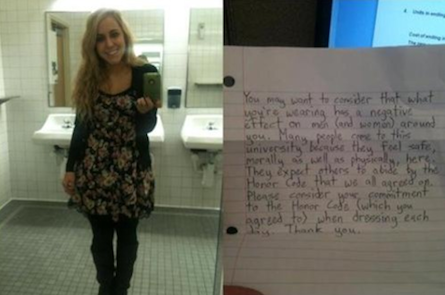
How a uni student wearing a modest floral dress, tights and a cardi inspired a fellow (male) student to give her a note detailing all the reasons her outfit was slutty and distracting. [Footage Not Found]

Why Bridesmaids should win an Oscar. [Daily Life]

Some snarky ways your Personhood-holding feotus can have their constitutional rights granted. [Jezebel]

A timeline of Chris Brown’s heinousness. [BuzzFeed]

Rachel Hills is a Friday feminaust. [Feminaust]

Why is it okay for gay men to bag women when we would never accept the same behaviour from a straight man? Is it because we don’t see gay men as “real men”? [Daily Life]

Nicki Minaj has got the same sized hands as Marilyn Monroe? [The Grio]

My year as a rom-com watcher. [Jezebel]

Hugo Schwyzer responds to Bettina Arndt’s assertion that women who dress provocatively and then complain about attention from the “wrong” type of men are teases:

“The calculus of entitlement works like this: if women don’t want to turn men on, they need to cover up. If they don’t cover up, they’ll turn men on. If they turn men on, women are obligated to do something to assuage that lust. Having turned them on, if women don’t give men what they want, then women are cruel teases who have no right to complain if men lash out in justified rage at being denied what they’ve been taught is rightfully theirs.” [Jezebel]

Image via Footage Not Found.

Book Review: Big Porn Inc. Edited By Melinda Tankard Reist and Abigail Bray.


As I’ve written here before, I don’t really see a problem with porn. So long as it’s consumed in a healthy way, viewed in perspective and is made in an ethical way (no child pornography, for example, which Big Porn Inc. focuses heavily on), I don’t see a problem with it.

However, the contributors and editors of Big Porn Inc., a tome that’s made a splash since its release, thinks all porn is bad, okay? They don’t take into account things like upbringing, socio-economic background and other factors, such as peer groups, in the affect porn can have on consumers. When those aspects are relatively good, I don’t think porn is a problem.

But it’s not just consensual, enthusiastic porn the book focuses on. Take the chapters on sex with animals, child porn and degradation. “Slavefarm” (p. xx) and “the ‘crack’ of an infant’s pelvis while you are penetrating them” (p. 199) are some of the most extreme and abhorrent examples in the book (I’ll pause while you throw up over that last one, especially), but are by no means the norm. Bestiality, rape and pedophilia are mental illnesses and are about control; they’re not just something you decide to do after stumbling upon the wrong porn link.

Not only does Big Porn Inc. focus on the extreme, it’s also quite sexist. The majority of articles see women as needing to be protected from porn and the men who view it. Militant anti-porn feminist Catharine MacKinnon writes that “women have long known” the evils of pornography (p. 12), while “Caroline” writes pathetically about how discovering her husband used porn was the ultimate betrayal (p. xxix).

I also found Big Porn Inc. to be anti-choice and anti-feminism. Renate Klein, in “Big Porn + Big Pharma: Where the Pornography Industry Meets the Ideology of Medicalisation” (p. 86–104), asserts that female bodies are being “cut, modified, drugged and penetrated—all in the name of ‘choice’ and ‘it is my right’.” The footnote to this sentence admonishes sexual reassignment procedures as a bi-product of the pornography industry.

This is not to mention its anti-vaccination sentiments.

Pseudoscience reigns supreme, also, when Maggie Hamilton writes, “… boys and girls generally do not have a natural [original emphasis] sexual sense until they are between 10 and 12 years old.” I studied psychology in high school, and even at its base level, we know that young children are very aware of their sexuality. I remember playing the “sex game” (whatever we thought that meant!) in my first year of primary school. Observing children in the playground as part of my Year 10 childhood psychology class they, too, were playing the “sex game”! Sure, we don’t want kids that age accessing porn and getting all these fucked up ideas about what naked bodies and (porn) sex looks like, but their natural curiosity will ensure they will try to at some stage. That’s where healthy discussion from parents, teachers and other adults about what sex, in all its carnations, means.

Not all of the contributors are people I disagree with. Sex and anti-violence writer Nina Funnell is someone I admire, and whose inclusion in Big Porn Inc. was what compelled me to read it. She writes about sexting and the intrusion of the camera in our lives (p. 34–40), topics on which she is writing a book. While teen sexting and “peer-to-peer porn” can be dangerous (child pornography charges and having your image on the internet til the end of time before you’ve even come of age are frightening thoughts), I think they are a little out of place in the Big Porn scope of things. In my opinion, they are worlds away from actual consensual porn; the making and consumption of. Again, as long as parents and teachers are there to advise why sexting is something that should be done after careful thought and your 18th birthday, I don’t see it as the problem porn is made out to be.

When I spoke to Rachel Hills about her profile on Melinda Tankard Reist and her thoughts on Big Porn Inc., she contended that the book could have done away with the multitude of contributors in favour of fewer, more in-depth essays. This would perhaps allow Big Porn Inc. to be taken more seriously by pro-porn (or at least anti-anti-porn) people like ourselves. I have to say I agree, as by about two thirds of the way through I was ready to put it down, especially as the last section reads like an advertorial for Anti-Porn Inc., which is something I’m not buying.

Related: In Defence of Porn.

Is Big Porn Inc. Anti-Vaccination As Well As Anti-Porn?

Picture Perfect.

Elsewhere: [Sydney Morning Herald] Who’s Afraid of Melinda Tankard Reist?

Image via Melinda Tankard Reist.

I Think I’m Beginning to Understand This #MenCallMeThings Thing. Except It’s Not Just Men & It’s Not Really Me.

When the #MenCallMeThings hastag started trending on Twitter and feminist writers galore started detailing their internet abuse at the hands of misogynists, I thanked a higher power that I hadn’t experienced online harassment because, in a nutshell, of my gender. (That’s probably because my blog and extra-blog writings aren’t that well-known [yet].)

But we only have to think back to the vitriol spewed at Mia Freedman when she dared to question our worship of sports “heroes” to realise that members of the “fairer sex” are guilty of it, too. Or how about that recent “leggings are not pants” debacle?

And how about Melinda Tankard Reist? As someone who blogs about conservative feminism, anti-porn and anti-raunch, she’s bound to get her fair share of criticism, which came to a head a few weeks ago after Rachel Hills’ article on her was published in Sunday Life, and subsequently launched a thousand blog posts.

Some of MTR’s ideas are worthy of criticism, in my opinion, but she often gets comments, emails and other forms of communication hurled at her that are anything but constructive. I believe one choice comment in the wake of Hills’ article was that MTR should be raped with a coffee cup. Nice.

A couple of weeks ago I had my first article for The Good Men Project published, followed by a second one last week. While the first article, “Manning Up” was originally written with a feminist—or at least female—audience in mind and I probably should have thought twice before pitching it to the guys at GMP, I proceeded to get torn to shreds in the comments. I stand by the article and I’m sorry if it offended, but I’ve been around these parts long enough to know that when you’re writing about contentious issues such as gender relations, you’re bound incite people who don’t like what you have to say.

Because these articles were published on a site that is not my own, I was lucky enough not to see the more personal comments that were not approved by the moderators. But I can imagine… If it’s not an attack on my womanhood (whether that be my integrity as a human being because of my feminist leanings, my appearance, or my sex life), it’s an exercise in “mansplaining”, but rest assured, when you’re writing about gender (or race, equality, sex, disability etc.) on the interwebs, it’s a common perception that you’re fair game for the trolls.

Have you experienced gender-related trolling?

Related: In Defence of Mia Freedman.

Conservative Feminist Melinda Tankard Reist for Sunday Life.

Is Big Porn Inc. Anti-Vaccination As Well As Anti-Porn?

Elsewhere: [MamaMia] Female Commentators & the Fuckability Factor.

[Fat Heffalump] Cut the Snarky Fashion Judgement Crap.

[Sydney Morning Herald] Who’s Afraid of Melinda Tankard Reist?

[Musings of an Inappropriate Woman] Melinda Tankard Reist and Me.

[The Good Men Project] Manning Up.

[The Good Men Project] You Give Men a Bad Name.

[Tiger Beatdown] Chronicles of Mansplaining: Professor Feminism & the Deleted Comments of Doom.

Magazines: Conservative Feminist Melinda Tankard Reist for Sunday Life.


Sunday Life is back with a bang for 2012, featuring Rachel Hills’ fantastic article on “anti-raunch, anti-porn, pro-life” activist, Melinda Tankard Reist.

I’ve been reading Tankard Reist’s work for about a year or two now, and I have to say, like Hills and many other feminists, I don’t always agree with her views. Hell, I barely ever agree with her views. I’ve got her latest book, Big Porn Inc., which you can read a bit about in the article, on my bedside table ready to go. I have some trepidation about the book, as I don’t see a huge problem with porn, but MTR does. She also views our culture as an increasingly raunch-filled and pornified one, which I also disagree with.

The article details MTR’s “brand of feminism” and also quotes some of her supporters and detractors, which I think rounds out the article very nicely. There’s also a side box about some other notable conservative “feminists”, Sarah Palin and Michele Bachmann. If ever there were two women who used feminism to further their (clearly non-feminist) political agenda, it’s them. Writes Hills:

LA Times columnist Meghan Daum [writes], ‘If [Palin] has the guts to call herself a feminist, then she’s entitled to be accepted as one.’

“‘I was at a debate recently where a lot people were saying we needed to reinvent feminism because it has become loaded with too much negativity,’ says Eva Cox. ‘But if it’s negative, it is interesting that the right is picking it up.’

“Still, Cox warns: ‘Those who don’t want feminism to be co-opted by the Palins and the Tankard Reists need to do some thinking about what direction they want to take it in instead.’”

I can be a bit of a snobby feminist when I want to be, and don’t think that everyone can call themselves a feminist. But, in a Facebook exchange on the topic, the idea that anyone can call themselves a feminist and has the right to that label was prevalent. I’ve been known to opine that my personal feminism isn’t as radical as second-wave feminism is perceived to be. Just as MTR’s feminism is just as radical, if not more.

Hills rounds out the article by asserting that, “whether you agree with her or not… Tankard Reist is now one of Australia’s best-known feminist voices… It is her language—and that of her supporters—that increasingly frames our debates on sex, gender and popular culture.”

Maybe I’m not hanging out in the right places, but I disagree. Those who shape the debates on sex, gender and pop culture that I read and listen to are the ladies at Feminaust, Jezebel and Feministe, and Hills herself. It just goes to show that everyone does subscribe to their own personal feminism. Mine just isn’t akin to MTR’s.

Related: In Defence of Porn.

Elsewhere: [Rachel Hills] Who’s Afraid of Melinda Tankard Reist?

[Musings of an Inappropriate Woman] Melinda Tankard Reist & Me: Meditations on My Sunday Life Cover Story.

Image via Musings of an Inappropriate Woman.

12 Posts of Christmas: Why is Feminism Still a Dirty Word?

In the spirit Christmas, I’ve decided to revisit some of my favourite posts of the year in the twelve days leading up to December 25th. 

Despite how far I feel I’ve come as a feminist in the last year or two, I find most people have “a long long way to go” in terms of realising what feminism actually means. I wrote this post in response to Beyonce’s musings on the topic, as well as the release of Caitlin Moran’s How to Be a Woman, “Sarah Palin feminism” and Tina Fey, amongst other things. The original version is here, and you can read an update here.

Recently, when asked in an interview with UK Harper’s Bazaar if she’s a feminist, Beyonce said she wanted to invent a new word for feminism, because she doesn’t feel it “necessary” to define whether she is one or not.

Why, in this day and age, do we still distance ourselves from the word “feminism”?

And it’s not just Beyonce. Keri Hilson, Lady Gaga, and even (kind of)Tina Fey, have been called a feminist in one instance, and tried tobacktrack on it in the next.

In response to all this, Jezebel ran a contest to come up with “a catchy new word for feminism”, like Beyonce suggested. Some suggestions were “FUCK PATRIARCHY”, “Flesh-Hungry Young Slutism” (seemingly appropriate given it has been the year of the SlutWalk, if you will), “Vaginist”, “Diva-is-a-female-version-of-a-hustla-ism” (how you like that, Beyonce?), but the one that came out on top was “Equalism” which, in my experience, is what young feminists today strive for.

Speaking of young feminists, I would probably only define a handful of my friends as this, and even they are hesitant to describe themselves this way.

One says she’s not a feminist because she wants to “cook for her boyfriend”. Since when did not cooking and feminism become mutually exclusive?

Another says he’s (yes, he’s) could never truly be a feminist because he doesn’t have a vagina, so therefore will never know what those who do have to go through on a daily basis in a patriarchal society, and have gone through for centuries in patriarchal societies.

I have another who, just by looking at her, screams feminism before she even opens her mouth. Yet sometimes, when she says things I morally disagree with, I think, “she’s not feminist enough”. (Abhorrent, I know, and something I strive not to think and say as a feminist. And, by my own admission, some might say I’m “not feminist enough” because of the way I talk and how I dress.)

It’s a far cry from Beyonce, Gaga et al., who try to distance themselves from feminism, while young feminists (and old!) bicker amongst themselves about who’s more feminist! And it perfectly illustrates the discrepancies between what self-described feminists project onto the movement, and what lay, non-feminist Generation Yers believes it to be about.

Camilla Peffer over at Girls Are Made From Pepsi writes:

“I think most women associate feminism with radicalism and the whole bra burning hulla-balloo. Which is RI-DUNK-U-LOUS. And a lot of people see the term feminist [as] biased towards females in the sense that the whole movement promotes this idea of women being better than men.”

Indeed, there is a far cry between the first wave suffragist movement, second wave “bra-burning” and the sexual revolution, and current third-wave feminism. Some would even say that we have passed third-wave feminism and are now living in a post-feminist society.

When I first started getting into feminism about two years ago, I subscribed to this notion. Now, having been exposed to all manner of blogs, academic articles, events etc. to put the sexism, discrimination and harassment I’ve experienced as a woman into perspective, I can see that we sure as hell aren’t living in a post-feminist world and that we still need feminism, perhaps more than ever with the rise of the Tea Party and Michele Bachmann and the closure of Planned Parenthoods in the U.S., the blatant harassment most women experience on the street and in their workplaces every day, the attacks on SlutWalk, and the atrocities facing Third World women, to name but a few.

Taking on these battles shouldn’t be seen as something “dirty”; it should be seen as something we can all get behind, if it leads to our daughters experiencing a world free from harassment and discrimination based on what genitals she possesses and what she looks like, no matter what part of the world she hails from.

Sadly, as Rachel Hills muses, “it can be a bit uncool to care. Feminism means caring and wanting to change things, ergo it makes people uncomfortable—especially people who are comfortable with the status quo.”

Are you comfortable with the status quo? Do you think feminism is still a dirty word?

Related: Why is Feminism Still a Dirty Word?

UPDATED: Why is Feminism Still a Dirty Word?

How to Be a Woman by Caitlin Moran Review.

Why Young Feminists Still Have “A Long, Long Way to Go” in the Eyes of Second-Wave Feminists.

So Misunderstood.

Melbourne Writers’ Festival: A Long, Long Way to Go: Why We Still Need Feminism.

Has Feminism Failed?

I Ain’t No Hollaback Girl: Street Harassment in CLEO.

The Taboos of Sexual Harassment.

Ain’t Nothin’ Gonna Break My Slutty Stride.

Elsewhere: [Jezebel] Let’s Invent a Catchy New Word for Feminism.

[Jezebel] The Catchy New Word for Feminism.

[Jezebel] Keri Hilson is a Feminist, Not That She Wants to Say So, Exactly.

[Jezebel] Tina Fey on the Message of 30 Rock’s “Joan of Snark” Episode.

[Feministe] Time to Check In With Tina Fey’s Feminism.

[The Frisky] Tina Fey: Not Feminist Enough?

[Girls Are Made From Pepsi] The Post in Which I Talk About Beyonce, Feminism & Equality For All.


12 Posts of Christmas: In Defence of Mia Freedman.

In the spirit Christmas, I’ve decided to revisit some of my favourite posts of the year in the twelve days leading up to December 25th. 

You might remember back in July when Cadel Evans won the Tour de France, Mia Freedman said on the Today show that sportspeople aren’t heroes, and a shitstorm ensued. You can read the original post here.

Mia Freedman’s copped it pretty hard in the media the last couple of weeks, ever since her comments about Cadel Evans and sports stars being held up as heroes.

It’s no secret that Freedman is my idol, so I will go to bat for her til the cows come home. She’s the reason I became a writer. She’s the reason I did work experience at Cosmo. I share a lot of her views. Whether it’s just a happy coincidence, or I’ve shaped my views around hers (I started reading Cosmo at 15, a very impressionable age, so it’s more than likely the latter), I don’t know.

I’ve written about my love for Freedman, followed closely by formerGirlfriend and Cleo editor, and current Sunday Life editor, Sarah Oakes, numerous times, and how the incestuous nature of the magazine world ensures a similar writing and editing style from those who work together. Take Freedman and Zoë Foster, for example. Or Oakes and Girl with a Satchel’s Erica Bartle and Musings of an Inappropriate Woman’s Rachel Hills.

Speaking of Sunday Life, Freedman’s column last weekend solidified why she’s a woman after my own heart.

She wrote about spending time with her family, and how planning big events are always a disaster and it’s the little, “mundane moments” that are memorable.

But back to the issue at hand: sportspeople as heroes.

I agree wholeheartedly that sportsmen and women aren’t heroes. (I threw up in my mouth a little bit when Karl Stefanovic and Lisa Wilkinson stood for the national anthem after Evans won the Tour de France.) Yay, they can “swim fast”, “kick a ball with accuracy”, “run quickly” and “jump over high things”. But how does this make them heroes? It makes them superficial “heroes” or emblems of sporting events in which they did good, but not actual heroes. We can leave that title to soldiers, doctors, activists, social workers, firefighters and others who face death and social injustice to save lives and make the world a better place.

As Freedman reiterates:

“I roll my eyes every time another Australian of the Year is named and it’s a sportsperson. I cringe at the CONSTANT sycophancy and praise heaped on sportspeople and the way they are forever lauded as heroes… How does being highly physically capable make you a hero?”

I read somewhere that it is highly likely Evans will be named 2011’s Australian of the Year, so start warming up those eye sockets, Mia!

I brought this notion up with a coworker last week, who said doctors aren’t heroes just because they’re saving lives. But what about Doctors Without Borders, or doctors and nurses with the armed forces? “Well, that’s different,” he said. Why? Because they’re facing their own death whilst trying to prevent someone else’s? But sportspeople aren’t facing death (okay, sometimes they are), and their payoff is purely selfish.

Said coworker mentioned some AFL “hero” who, back in the ’70s (I think; don’t quote me on this), finished the grand final with a torn ligament and brought the premiership home. Some might call it heroism; others stupidity.

And I think the sportsperson=hero dichotomy is abhorrent, considering the extracurricular allegations levelled at some of them. Is Nick D’Arcy a hero for punching some guy and leaving him with irreparable facial damage? Are the Collingwood FC guys heroes for winning last year’s premiership, with some of them subsequently going on to allegedly sexually assault one or some groupies? How about the world class douchebag Brendan Fevola? Or Tiger Woods? O.J. Simpson? Hardly heroes.

Perhaps we should be looking to sportspeople like Glenn McGrath, who works tirelessly for his late wife’s breast cancer foundation. Or the Essendon FC, who work with schools to improve literacy. While not exactly heroes per se, at least they’re doing something other than hitting and kicking balls.

Freedman writes in a related piece:

“Sporting stars may have great physical skills but that’s all. They’re no smarter or better or nicer or more well intentioned than the average Australian. In fact, I would argue that generally (and of course this is a generalisation), they are less informed, less aware and less street smart than the average bear.

“This is because to become a great athlete, you have to spend many years from the time you are very young, refining your skills. That’s years swimming up and down a pool. Years running around a track. Years kicking a ball or hitting it with a bat.

“Years…

“I’m happy for anyone who CHOOSES to spend years of their life dedicated to their sport. Go for it. But let’s not pretend it’s a selfless or noble pursuit.

“Professional athletes do it for many reasons. Sponsorship dollars. Personal satisfaction. A desire to represent their country or be the best at swimming or kicking or hitting or whatever it is they’re good at.”

Without humiliating anyone, I find the “less informed, less aware and less street smart” contention is particularly true of one of my physically gifted friends.

While he has a Masters and is one of the most book-smart people I know, he admitted to me that until he was in his late teens, he was completely sheltered by his parents. So much so that he didn’t buy his first CD until around this age. Up to that point, he listened to whatever his parents wanted to listen to, because it was pretty much school, practice, competitions, and the only musical exposure he got was in the car on the way to said school, practice, competitions.

Now the kind of sports he plays aren’t exactly your true blue AFL or cricket (in fact, they’re so obscure I won’t mention them here at the risk of giving him away!), so he’s in another boat altogether: his sports would be, and have been, ridiculed by both your Aussie bogan and your highbrow cultured Australian.

Now, from what I’ve read, Cadel Evans is involved in other noble pursuits, like charity. Unfortunately, I think Freedman’s point was sullied by using Evans to bring it up on national television. Perhaps if she were talking about Stephanie Rice or Ben Cousins her contention would have been more well received. But that’s the risk you run when you voice an opinion that’s not of the norm.

And that’s why I love her. Sure, she got crapped on by most of Australia for making a valid point. But she was able to return to voicing her opinion on Today the same time the following week, joking about going into witness protection, but getting a haircut instead. She was able to find the humour in the situation, and see where she might have been wrong.

For the record, I don’t think she was wrong.

Related: In Defence of Mia Freedman.

Everything They Touch Turns to Gold.

Mama Mia: A Memoir of Mistakes, Magazines & Motherhood By Mia Freedman Review.

Mia Culpa: Confessions from the Watercooler of Life by Mia Freedman Review.

Elsewhere: [MamaMia] Cadel Evans: Is He a Hero?

[MamaMia] Cadel: Here’s What I Learned.

[MamaMia] Is Being Australian Really So Much About Gold Medals?

[MamaMia] Stephanie Rice. Enough With the Hero Worship.

[MamaMia] When Family Time is a Nightmare.