TV: New Girl Should Attend a SlutWalk Sometime…


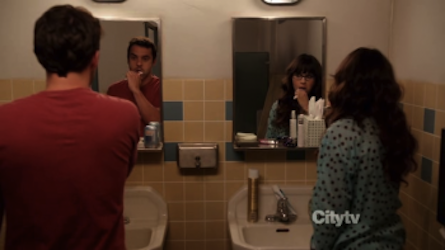
On last night’s New Girl the inevitable pairing of Jess and Nick began, with Jess’s model friend CeCe crashing the loft and watching the sparks fly between them.

Jess is oblivious to Nick’s interest, and tells CeCe that not everyone wants to have sex with everyone else, like CeCe thinks they do. CeCe begs to differ, and Jess asks, in horror, if her clothes are too revealing or if she should wear thicker pyjamas. Really?!

If SlutWalk has taught us anything it’s that the amount or type of clothing a woman is wearing has nothing to do with the interest she ignites in a man, whether that man is a potential rapist or harasser, or just a regular Joe with a crush on his housemate. We’re at episode four now, so Nick has gotten to know Jess and all her (at times insanely annoying) quirks. God knows if he’s expressing interest it’s in spite of the abovementioned quirks and not because of how she looks or what she’s wearing. (Although last week’s nudie run could throw a spanner in this theory!)

Related: Ain’t Nothin’ Gonna Break My Slutty Stride.

Body Acceptance on New Girl.

Image via HelloGiggles.

Magazines: The Protester May Be Time’s Person of the Year, But SlutWalkers Aren’t.


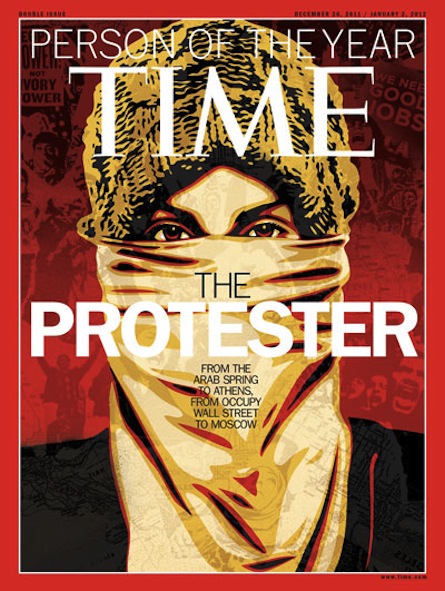
It’s been a couple of weeks since Time’s Person of the Year issue came out and it, along with the majority of 2011, was all about The Protester.

The Arab Spring, Occupy and SlutWalk took centre stage in news stories across the world throughout 2011, however Time chose to focus on just the former two, with only one small mention of SlutWalk’s Toronto origins on page 52, “The Protest Network”.

While SlutWalk may not have inspired as much change as The Arab Spring did (it remains to be seen how influential Occupy can be, but it seems like it’s been making headlines for sexual assault and police brutality rather than any real change on Wall Street and amongst the world’s 1%), it was still certainly headline making and, personally, greatly affecting.

Occupy has no real vision nor authority in charge to determine what is to eventuate from the protest, while each SlutWalk was pretty well organised and had a clear expected outcome, whether that was reclaiming the word slut, ending victim-blaming, or simply raising awareness that what a woman was wearing when she was sexually assaulted or harassed has no bearing on why she was targeted.

Call me biased, but I think SlutWalk should have had a more prominent position in Time’s protester issue.

Related: Ain’t Nothin’ Gonna Break My Slutty Stride.

Elsewhere: [Time] People Who Mattered in 2011: The Protester.

Image via Time.

12 Posts of Christmas: The Taboos of Sexual Harassment.

In the spirit Christmas, I’ve decided to revisit some of my favourite posts of the year in the twelve days leading up to December 25th. 

Sexual harassment seems to be the theme of my (and a lot of those around me) life lately, and the blog has had a heavy focus on it in recent months. The original article can be found here.

The other day at work I was sexually harassed by a customer.

I was just standing there, and a short (probably around my height), bald, fat man in a dirty navy blue polo shirt, who was about 50–55, came up to me and asked me where the toilets were. I told him, then he asked “how’ve you been”, with a tone that implied he knew me. I said fine, and he looked me up and down and said in a sleazy voice, “Ooo, I’d like to take you home.” I immediately walked away and told three of my colleagues who were stationed nearby. As I left, he said something to the effect of, “I probably shouldn’t have said that.”

No, he shouldn’t have.

Now, sexual harassment probably isn’t anything new to a lot of women. It’s just something we have to face because we have a vagina.

I’ve been harassed at work before, not as blatantly as Sunday’s episode, but I’ve never felt comfortable enough to eject myself from the situation. As someone who works in customer service, I think I placed not being rude above keeping myself safe. But, post-SlutWalk, I now have the confidence not to put up with that shit.

But I didn’t report it.

I told a few colleagues, until I eventually mentioned it several hours later to a security guard, who also happens to be a close friend of mine. He sternly asked me if I’d reported it to my manager. I told him no, and he asked me what I would do if he came back? If he stalked me? If he attacked me? If he attacked someone else? His older-brother protectiveness made me decide to report it.

It’s funny that I didn’t think to report it the moment it happened. I guess that’s the stigma of sexual harassment (and don’t even get me started on the stigma of sexual assault!). I think I thought that because I can handle myself and I won’t put up with that shit, that it wasn’t a big deal.

It was.

I filed a report with my manager, security know about it and have footage of the man, and it’s been forwarded to the appropriate department.

The responses I got from fellow colleagues were at each end of the spectrum. Some expressed outrage and encouraged me to report it, others asked me if he touched me, as if that would be the only thing to warrant filing a report. No, he didn’t, because that would be sexualassault. (Why do we not bat an eyelid when verbal harassment occurs, but are quick to leap into action when the physical barrier is breached? Both are violations of a person based on the fact that their harasser thinks they’re public property, or available for them to make comments on/touch.)

But these responses really illustrate the abovementioned taboo of sexual harassment. That boys will be boys. That as a young, pretty woman, you just have to suck these things up. That it doesn’t really count because you were only verbally violated.

I am somewhat ashamed that I was so quick to brush it off. (Let’s be clear: I’m not ashamed that I was harassed. I’m ashamed that I didn’t take it seriously to begin with. Rape is my biggest fear, but if I was ever raped, you can be damn sure I wouldn’t keep quiet about it because I was ashamed.) This is 2011. This kind of thing shouldn’t be happening. But it does. So as modern women, we should be able to say that making comments about our physical appearance without our consent is a no-go. Just like making physical contact with our bodies without our consent is.

Related: The Taboos of Sexual Harassment.

I Ain’t No Hollaback Girl: Street Harassment in CLEO.

Ain’t Nothin’ Gonna Break My Slutty Stride.

So a Tattoo Makes Me Public Property, Huh?

Will Boys Be Boys When it Comes to Objectifying Women?

12 Posts of Christmas: Slut-Shaming as Defence Mechanism.

In the spirit Christmas, I’ve decided to revisit some of my favourite posts of the year in the twelve days leading up to December 25th.

This one’s about the good ol’ slut-shaming most girls experience at some stage in their life and how it is often, at the hands of other women, a defence mechanism. Original post is here.

A good male friend of mine has recently started dating someone new.

When I asked him how it was going, he said fine, blah blah blah, but that one thing she said really offended him. I was intrigued, so I asked him to tell me more. She must have been looking through his Facebook photos, and came across several in which we’re tagged together. She confronted him about it, saying, “Who’s that Scarlett girl, huh? She looks like a bit of a skank.” He proceeded to set her straight and defend my honour.

Upon going through the photos we’re tagged in myself, I have to say she made a fair call! They’re mostly from costume parties where my skank switch is on full throttle.

But, more than that, it is not uncommon for me to be called names like this. I’m not going to deny it, because if SlutWalk taught me anything, it’s that denying you’re a slut means that you’re acknowledging that other women are. What is a slut/skank, anyway?

But I know why she called me that: she’s jealous. Instead of asking nicely who I was and why my friend looked so chummy with me in the photos she saw, she was threatened by our relationship, so in lieu of admitting this, she questioned the relationship by insinuating that he shouldn’t be hanging around with someone (who seemed) so skanky.

I don’t begrudge her for this; I kind of think it’s funny and a bit sad. In this day and age, people are going to have to start accepting that men and women can be platonic friends. This is why I wrote on my online dating profile that if a man wants to date me, they have to be comfortable with the other men in my life. Especially since my new roommate come Saturday is one of my closest (male) friends.

What to you think? Have you ever experienced this kind of jealousy from another woman, manifesting itself as slut-shaming?

Related: Slut-Shaming as Defence Mechanism.

When Girl-Hate Turns Into Obsession.

’Tis the Season…

SlutWalk.

Glee—The Right & Wrong of It.


In lieu of a new episode of Glee last week, I attended a debate about the pros and cons of McKinley High and its glee club.

I was super excited, because I assumed the debate would entail a for Glee side, and an against. And it did. But while I thought the against side, consisting of Clem Bastow and Jess McGuire, would discuss the blatant sexism, racism, homo/transphobia, ableism, fatism and the many other phobias and -isms the show incorporates (feel free to add them in the comments), both panelists ultimately praised Glee for it’s inclusiveness and handling of the tough issues.

I’ve heard this rationalisation about Glee before. When my tuba-playing gay friend finally got into the show this season and fell hard for it, he thought I would sing its praises with him because he knew I watched it. (Evidently, he does not read this blog as he would know the main reason I like Glee is because I know I’ll always get a blog post out of it!) When I invited him to the debate, he had something else on but wondered what they would be debating, exactly. I referred to the list of problems I have with it (above and elaborated on below) and he replied, “But I thought Glee was about acceptance.” That’s what it wants you to think, and it blinds you to all the other issues with Katy Perry songs. As panelist for the “pro-Glee” side, Mel Campbell, said, “It’s best not to ask questions.”

While McGuire did touch on Glee’s pro-gay stance, and perhaps its best, and most underutilised, storyline of Brittany and Santana’s forbidden love, I was expecting SlutWalk Melbourne organiser and noted feminist Bastow to knock Glee out of the park for its anti-women portrayals. I was also sorely disappointed, as Bastow, a keen musical aficionado, chose to focus on the shows’ butchering of classic musical numbers.

So, I thought I’d take this opportunity to write about the issues I wished the panel had discussed last Thursday night.

Sexism.

I’ve written about feminism in Glee before, specifically as it’s embodied in the character of Rachel Berry. It annoys me to no end that Rachel is deemed “ugly” (though Lea Michele is anything but) because she’s annoying. And she’s annoying because she eschews traditional gender roles that are perhaps embodied by Quinn by being ambitious, voicing her opinions and unapologetically going after what she wants.

In a clip shown at the debate of the inaugural Glee mash-up in which Mr. Shuester separates the girls from the boys, Kurt attempts to join the girls’ side. Since when did being a gay man amount to the equivalent of a straight female?

Finally, I wouldn’t say sexism is the main problem in Mercedes’ perpetual (okay, she seems to have a boyfriend this season, but more on that later) bachelorettehood, rather some other issues I will address later in the piece.

Racism.

Now is as good a time as any to discuss Mercedes’ aforementioned singleness. Was she literally the only character in season two who didn’t have a significant other because she’s black? (Or because she’s fat?) Sure, she dated Sam for all of a few minutes in the season two final, but before that the only action she got was Kurt condescendingly suggesting she should date one of the guys on the football team because he was black and, like, they’d probably have heaps in common.

If that’s not enough proof of Glee’s insensitivity to race, all you need to do it look at any one episode for a myriad of references to Tina and Mike’s “Asianness”, Roy Flanagan’s “Irishness” (or leprechaunnes, as Brittany might refer to it) and Puck and Rachel’s “Jewishness” (though that also falls under religious prejudice as well).

Homophobia & Transphobia.

Sure, Glee’s pretty much a vehicle for Kurt and, increasingly, Blaine, to showcase their voices, fashion sense and flamboyance. McGuire chose to speak at length about how sensitively the show handled Kurt coming out to his dad and Kurt and Blaine’s first time, and I have to agree with her. And yes, seeing two men make gay love (okay, the implication of them making gay love) on primetime network television without a stink being kicked up is pretty groundbreaking, as panelist for Glee and MC, Tim Hunter, noted. But they still single out Kurt for his gayness (“Single Ladies [Put a Ring on It]” and “Le Jazz Hot!”, anyone?), not to mention how Finn went about outing Santana in “Mash Off”.

They’ve handled the Brittany/Santana thing the best out of every relationship in the show, so that’s one point for lesbianism, but at the expense of other sexual orientations and gender identities, perhaps?

Just look at “The Rocky Horror Glee Show”, for example. Not only to Mike’s parents make him pull out because they don’t want him associated with a “tranny” musical, but the show even substitutes the lyrics “I’m just a sweet transvestite from transsexual Transylvania” for “sensational Transylvania”. Pardon me, but I don’t see what all the fuss is about in using the word “transsexual”.

Finally, we can’t forget Coach Beiste. When she debuted on the show, her sexuality and gender was thrown up in the air, when she’s really just an unconventionally attractive, masculine straight woman who happens to coach a men’s football team. But of course attention is drawn to her 40-year-old virgin status every time there’s a virginity-themed episode. Because, you know, she’s old and funny-looking and has never been on a date! Riotous!

Ableism.

Where do I start? There’s Emma’s OCD, which is made fun of by everyone from Gwyneth Paltrow’s Holly Holiday to her own parents (not to mention Will trying to come to her rescue by attempting to “cure” her). Artie’s wheelchair-bound way of life, which was even pointed out during the debate, only for the panelists to laugh at Artie wanting to give Blaine a standing ovation, “because he can’t”, and a whole episode, “Wheels”, insensitively dedicated to his disability.

I will applaud the show for their inclusion of, and remarkable sensitivity to, Down’s syndrome sufferers. But then they go and use undiagnosed Asperger’s syndrome as an excuse for anti-social and selfish behaviour. Cutting off their nose to spite their face…

Fatism.

Puck’s rendition of “Fat Bottomed Girls” was a clip played at the talk, and was received by audible groans. To see Lauren so uncomfortable as Puck serenaded her was awkward for the audience, and the patronisation was palpable. Like, oh Glee has a plus-sized girl who doesn’t hate herself and is being chased by the hottest guy in school; we’ve come so far.

But when Mercedes is relegated to backing vocals in favour of the slim lined Rachel, can’t get a date and suffers from an alleged eating disorder which is swept under the rug with some sage advice and a granola bar from Quinn, it’s all just tokenism.

So there you have it: the debating of the issues I wished had’ve been brought up by the panel. As my friend, housemate and fellow debate-goer put it: “It was just like Glee: it slightly touched on the issues, but ultimately didn’t add anything new to the discourse.” So feel free to add anything I, or the panel, didn’t cover in the comments.

Related: The Underlying Message in Glee’s “Original Song” Episode.

Brown Eyed Girl.

The Underlying Message in Glee’s “Duets” Episode.

The Underlying Message in Glee’s “The Rocky Horror Glee Show” Episode.

Glee: T.G.Inappropriate.F.

Ain’t Nothin’ Gonna Break My Slutty Stride.

Rachel Berry as Feminist.

Is Lea Michele Too Sexy?

In Defence of Rachel Berry.

Boys Will Be Boys, Revisited.

Glee Season 2 Final in Pictures.

The Underlying Message in Glee’s “Asian F” Episode.

The Underlying Message in Glee’s “The First Time” Episode.

Glee: Santana is Forced Out of the Closet.

The (Belated) Underlying Message in Glee’s “Never Been Kissed” Episode.

Glee “Sexy” Review.

Glee Back in Full Force.

Elsewhere: [Bitch Magazine] The Transcontinental Disability Choir: Glee-ful Appropriation.

[Xhibit P] Fat Girls Singing Backup: Body Images in Glee.

[TV.com] Is It Okay to Find Glee’s Plus-Sized Character, Lauren Zizes, Gross?

[Jezebel] Why Won’t Glee Give Mercedes a Boyfriend?

Image via Meg. All Things Me.
Event: The Catholic Church Is Not a Force For Good in the World.

I’ve always thought religion is bullshit, so when I saw a debate with the topic sentence “the Catholic Church is a force for good in the world” as part of the Intelligence2 debate series, I bought a ticket with my friend Laura immediately.

Going in, we’d both had our minds made up that the Catholic Church certainly wasn’t a force for good in the world, as did 34% of our fellow debate-goers, a door poll reflected.

The affirmative side didn’t do much to sway anyone’s opinion, as lawyer Julian McMahon and Sister Libby Rogerson were pretty poor debaters.

McMahon spoke about how love is the driving force behind the Church and Jesus’ teachings, which has obviously been lost in a lot of hot-button religious topics such as gay rights, and instead we have the “language of The Simpson’s”. I’d say this was true even ten years ago, but the language of today is very much a cyber one, which is perhaps why the Church is losing influence and followers. (Albeit, speaker for the opposition, Anne Summers A.O., pointed out that followers of Catholicism have increased less than one percent in recent years.)

Sister Libby went on to talk about Catholics who volunteer and work in Indigenous communities and in prisons. I don’t know too much about how the Catholic Church has been more of a hindrance than a help in Indigenous Australia, but Laura was obviously upset by the Sister’s assertion, rolling her eyes and groaning. My beef with volunteering being a primarily religious domain is that yes, perhaps a lot of Catholics volunteer, but a lot of non-Catholics volunteer, too. For example, I’m agnostic and I used to volunteer at the RSPCA. As event facilitator Simon Longstaff said, quoting Thomas Aquinas, “Not even the pope has sovereignty over a well-informed conscience.” Amen to that.

In the face of criticism, Sister Libby said the Church is a “flawed, human institution” and makes mistakes just like anyone else. Where have we heard that before?

The affirmative’s only saving grace was Helen Coonan, who actually read from her notes instead of waffling on about dot points. She said there is no excusing the past injustices of the Church, but we need to focus on the present. Coonan spoke at length about the Occupy movement, using their non-hierarchy (un)structure and myriad of messages to undercut all anti-establishment movements. (SlutWalk comes to mind.) That’s the trouble with Occupy: those in opposition to it judge all movements by its measuring stick. But that’s another post for another time.

She spoke at length about wealth in the Catholic Church and using it as a metaphor for how the world should structure its monetary dealings. Hmm… To be honest, as well as Coonan spoke, her focus on economics kind of bored me.

To rebut this, Father Peter of the opposition said the Church favours the idea of “pray, pay, obey” and doesn’t give its followers a voice.

Still with the opposition—debating for the notion that the Catholic Church isn’t a force of good—consisting of Summers, the excommunicated Father Peter Kennedy and writer David Marr, they brought the house down with their poignant points.

Summers spoke about the women’s movement in relation to the Church which, when Summers and fellow Catholic school-educated feminists such as Germaine Greer were at school, consisted of either “being a nun or a mother of six”. She spoke about abortion, birth control and choosing whether and when to become a mother.

During the floor debate, one woman about my age tried to debunk Summers’ theory that women who subscribe to the teachings of the Church don’t make their own choices. The fact that her mother was born in the ’30s, has several (Catholic school?) degrees and NINE CHILDREN leads me to believe that she wasn’t making a choice to do these things so much as she was brainwashed to do them. As Marr said during his time, sex as a non-reproductive act is frowned upon by the Church.

Speaking of Marr, he was by far the best debater and is my new favourite person! He talked about sex as a sin and that followers of the Catholic Church are supposed to engage in “no sex at all, ever!” unless it’s between a married, heterosexual man and woman for the purpose of procreation. How boring!

He pointed out four main problems with the view the Catholic Church has of sex:

1. Celibacy as purity. And we all know how damaging that is to young sexuality, in particular.

2. Condoms being outlawed. When Marr asked the affirmative panel if they support the banning of condoms to stop the spread of disease, like HIV/AIDS in Africa, McMahon awkwardly and roundaboutly agreed with the Church’s position. He said that abstinence and sex only within marriage would stop the spread of disease in Africa, forgetting that in countries like the Democratic Republic of Congo rape is rife and abstinence only sex education doesn’t work. His response was laden with racism and rape-apologist attitudes, in my opinion. For all his accomplishments, this debate illustrated that McMahon is severely out of touch with the realities of our world.

3. Homosexuals are bad, okay? I think we all know the Church’s stance on homosexuality, despite most Catholics, according to Marr, believing in granting the right of marriage to the gays.

4. Shame. That sex, being sexual and looking sexy is shame-worthy. I would argue that this attitude has permeated secular society, but that secular society also laughs in the face of point #1, and also prude-shames those who aren’t having sex, being sexual or looking sexy. You can’t win either way.

By the end of the debate, in which Coonan rebutted that “ordinary Catholics”—those who acknowledge and agree with most points from both sides of the argument, and who aren’t caricatures of fanatical militant Catholics—“need a voice”, which I certainly agree with, 57% of the audience was against the Catholic Church as a force for good in the world. Hope for atheism—or at least agnosticism, which is the philosophy I subscribe to—isn’t dead yet, which is more than I can say for the Catholic Church.

Related: Feminism Respects Women More Than Anything, Including the Catholic Church!

“Who The Bloody Hell Are We?”: The Sentimental Bloke at the Wheeler Centre.

Ain’t Nothin’ Gonna Break My Slutty Stride.

The Underlying Message in Glee‘s “The First Time” Episode.

Elsewhere: [The Telegraph] Tiger Woods Says “I’m Only Human” After Mystery Crash.

Guest Post: On Stalking.

I am standing at a tram stop in Brunswick waiting when a poster catches my eye. Someone has stuck it over the City of Moreland sign—a prominent place. Its headline screams: “Women Should Be Careful.” I’m hooked.

Upon reading the article I become increasingly angered as it goes on to explain how women should cover up and not expose their bodies to men as men can’t help but be attracted to that “provocative attire.” Not only should women expect to be sexually assaulted if showing skin, they are actually “asking for it.” I am outraged and start tearing the poster down but the man (I would assume and hope) has stuck it on with liquid nails. I manage anyway, throwing the wad of paper in the bin with a satisfying clunk. A woman is sitting on the bench near me also waiting for the tram. She turns to me and asks, “Didn’t like what it said?” No, I didn’t like it at all.

*

The idea that a woman is asking for it if she wears revealing clothing is repugnant. Not only is it outdated in 2011, it also allows men to get off scot-free. Whatever the length of my skirt, I refuse to be an excuse for a man’s behaviour. It is a common misconception that most women are harassed, attacked and stalked because of their provocative clothing or behaviour.

When I asked a group of friends to define the look of a stalking victim the consensus was a young (18–25) woman, thin, attractive, large breasts and, most importantly, wearing “slutty” clothing. It was also decided that most of these women will be stalked by men who had seen them out at a club/pub and followed home at very late hours. This profile is not true. According to California State University, 77% of female victims and 64% of male victims know their stalker and 59% of female victims and 30% of male victims are stalked by an intimate partner. This changes the image of a creepy guy hanging out in your garden after watching you dance at a party.

In a study by the Australian Centre for the Study of Sexual Assault it was revealed that only 1% of women surveyed were raped by a stranger. Clearly there is a different representation of this in the media. Still, even if most cases of stalking and rape will be carried out by someone who knows the victim, there are still instances when a stranger will take a shine to them.

*

I am on the train, coming home from work. I’m wearing a black dress, black stockings and a black coat and holding a bag of groceries. I sit down and accidentally knock the man in front of me with my bag.

“Sorry,” I say giving him a small apologetic smile.

“That’s okay,” he says, looking me up and down. “Are you coming home from work?”

“Yes.” I reply, not impolitely.

He then asks me where I work, what I do etc. I proceed to tell him, being polite but not particularly inviting. He then brags about working in an industry with a lot of money and invites me to join him at his work one day soon. I decline and then get off at my stop. He also gets off at my stop and I feel a tug at my bag of groceries. He offers to carry them for me and asks if I am married. I say no but that I have a boyfriend and he tells me that “we could always break up.”

He then asks where I live and follows me home. At this point I am pretty scared. It isn’t dark, it’s not isolated, I’m not wearing anything revealing… this isn’t how I expect the stalking story to play out. I panic and actually walk down my street before common sense kicks in and I stop two houses down from mine, pretending that it is my house, even going so far as to fumble with the letterbox pretending to check for mail. I get out my keys and ask him to leave. He then tries to invite himself in for coffee, then dinner, then a chat. I say no and am rude to him for the first time.

“Aren’t you going to go inside?” he asks, as if calling my bluff.

“Not until you are down the end of this street,” I say.

Then he says the words that stop me cold: “That’s ok, I know where you live. I can come anytime.”

The problem I had after this occurred was that I felt that it had been my fault. I shouldn’t have spoken to him, I shouldn’t have smiled at him, I should have been wearing a sack… all sorts of irrational thoughts went through my mind. Actually, the only thing I should regret is practically leading him to my door. That was stupid. When I told people, I was actually asked by one friend what I was wearing. Another told me I shouldn’t have used my “devastating” smile. The most common feedback I got, however, was that I’m just too nice. I shouldn’t be so polite and friendly to men because they take it as a sign that I’m flirting. This isn’t right! It just confirms what the poster said, that it’s the woman’s responsibility not to be stalked or get raped. I’m getting quite sick of men being blameless in these situations. It is the narrative that is constantly being touted by the media, in ads like the Razzamatazz stockings where you only see a woman’s legs in Razzamatazz and in the background are the men’s reactions to her sexy legs, implying they can’t help it. One of them spills a coffee, another trips over and a third is slapped by his girlfriend for looking. Unless ads like this stop then we will forever live in a sexist society that backs up the theory that the sexualisation of women is innate and part of our evolutionary journey.

At this point, I would like to say that I was living in fear every time I got on a train. I switched to the tram, I started calling my boyfriend to meet me at the station so we could walk home together and told all of my friends what had happened.

*

I am at work, re-entering the building after a break. He’s there in the foyer greeting me like an old friend. My colleague thinks we know each other, so walks ahead and leaves us alone. I am scared. I tell him I am busy and that I finish at 5pm. Why do I say that? The fear makes me irrational.

I try to tell him I’m busy after work and not to meet me, but he just smiles and says he’ll see me at five. I walk into the administration area, call my boss and start hyperventilating. Security sees me out at 5pm. I am flanked by two friends but I don’t see him. I can only hope that he is bothering another girl instead, then feel terrible for inflicting him on someone else.

*

I haven’t seen him since. I do live with the idea of him in that back of my mind, though. I just wish that other victims of stalking don’t blame themselves. Whatever I wear, wherever I go, yes means yes and no means no.

—Laura Money.

Related: Ain’t Nothin’ Gonna Break My Slutty Stride.

The Taboos of Sexual Harassment.

On Stripping.

Elsewhere: [California State University Department of Police Services] Stalking, Threats & Annoying/Harassing Calls.

[Australian Centre for the Study of Sexual Assault] Statistical Information.


Why Young Feminists Still Have “A Long, Long Way To Go” in the Eyes of Second-Wave Feminists.

Last week I wrote about the Melbourne Writers’ Festival event, entitled A Long, Long Way to Go: Why We Still Need Feminism, presented by Sophie Cunningham and Monica Dux.

On the whole, Cunningham’s presentation was thought-provoking, if a little small-minded, but my main point of contention is as follows.

Cunningham brought up third/fourth wave feminism (the feminism we’re experiencing now, by most accounts), saying that while she applauds the grassroots feminist movements such as SlutWalk, she wasn’t sure 25-year-old women could fully understand the concept of feminism because they still have men fawning all over them at that age.

Now that’s just a whole lot of wrong.

First of all, I am soon-to-be-24 and I don’t have men falling at my feet (well, except when it’s unwanted), and nor do my similarly-aged friends.

Secondly, who’s to say that even if we did, we wouldn’t recognise that, unless they had had some kind of interaction with us other than staring at our boobs, they were interested in us purely for our looks, and that’s anti-feminist. (Then again, I know girls who do have men fawning all over them purely for their looks and couldn’t care less.)

And thirdly, this kind of feminism in fighting is exactly what has been undoing the feminist movement in recent years. As I wrote:

“… Cunningham saw a sort of ‘bottleneck’ in modern feminism, where white, privileged feminists like myself don’t understand the problems facing feminists of colour, feminists with sexual orientation other than straight, feminists with gender other than cis, and feminists with disabilities…”

This is not to mention conflict between the ages, or waves, of feminism.

In Susan Faludi’s attempted takedown of young feminists in her article, “American Electra: Feminism’s Ritual Matricide”, last year, she writes:

“… Despite its [feminism’s] many victories, it seems to falter along a ‘mother–daughter’ divide. A generational breakdown underlies so many of the pathologies that have long disturbed American [or, rather, Western] feminism—… its bitter divisions over sex… [and] alongside the battle of the sexes rages the battle of the ages.”

I can’t think of a better example than, oddly enough, an episode of Gossip Girl from its most recent season, in which it addresses the clash between young and old feminists after Serena van der Woodsen is accused of having an STD. Her dean at Columbia University tells her:

“Women of my generation had to fight for every opportunity. And to be taken seriously, and your attitude, Miss van der Woodsen, makes a mockery of that.”

I wrote in response at the time, in reference to Faludi’s article:

“Now if that isn’t the second wave looking down upon the third wave for our apparent flippancy about ‘activism’, our ‘obsession with technology’ (Gossip Girl’s blasts are a prime example of this), our ‘unwilling[ness] to challenge sexual exploitation for fear of pissing off men’ (hello, Serena), and our infatuation with Lady Gaga (well, Gossip Girl did feature the Lady herself in an episode…), I don’t know what is.

“… It would be interesting to see Serena fight back and declare herself ‘sick to death of hearing about the glory days of Seventies feminism’, whilst older women, like Dean Reuther, ‘declaring themselves sick to death of being swept into the dustbin of history.’

“Faludi spends a lot of time criticising (via her second wave subjects) the technology third wavers use, specifically blogging: ‘All they want to do is sit at their computers and blog.’ Ouch.

“I’m sure Gossip Girl would have something to say about that.”

Exhibit A: SlutWalk as an anti-testament to Faludi’s assertion.

Could it be jealousy these second-wavers are suffering from? I’d like to think feminism is above that, but it is one of the seven deadly sins and can get the better of us. Contrary to what Cunningham said, I don’t think it’s because of the way we look. Everyone knows age is not a precursor to looking hot. I think second-wavers might long for their glory days of making things happen, being invigorated and excited by feminism, instead of seeing their options shrivel up and die the older they get. Again, please see exhibit A. While I don’t know the ages of those who were critical of the SlutWalk, but if they were older it might be easy to see why they were a bit miffed by the anti-slut-shaming and -victim-blaming movement that they felt left them behind.

There needs to be something done to rectify this. Not only the gap between the ages, but the gap between the races, the abilities, the genders and the sexual orientations.

I don’t pretend to know how we’re going to do this, but it will have to start with listening and understanding, empathy, perhaps some mentoring and—what feminism is all about, not just between the sexes, but between all those I mention above—equality.

Related: Melbourne Writers’ Festival: A Long, Long Way to Go—Why We Still Need Feminism.

Ain’t Nothin’ Gonna Break My Slutty Stride.

The Taboos of Sexual Harassment.

Will Boys Be Boys When it Comes to Objectifying Women?

Surfing the Third Wave: Second-Wave VS. Third-Wave Feminism on Gossip Girl.

Elsewhere: [Harper’s Magazine] American Electra: Feminism’s Ritual Matricide.

The Taboos of Sexual Harassment.

The other day at work I was sexually harassed by a customer.

I was just standing there, and a short (probably around my height), bald, fat man in a dirty navy blue polo shirt, who was about 50–55, came up to me and asked me where the toilets were. I told him, then he asked “how’ve you been”, with a tone that implied he knew me. I said fine, and he looked me up and down and said in a sleazy voice, “Ooo, I’d like to take you home.” I immediately walked away and told three of my colleagues who were stationed nearby. As I left, he said something to the effect of, “I probably shouldn’t have said that.”

No, he shouldn’t have.

Now, sexual harassment probably isn’t anything new to a lot of women. It’s just something we have to face because we have a vagina.

I’ve been harassed at work before, not as blatantly as Sunday’s episode, but I’ve never felt comfortable enough to eject myself from the situation. As someone who works in customer service, I think I placed not being rude above keeping myself safe. But, post-SlutWalk, I now have the confidence not to put up with that shit.

But I didn’t report it.

I told a few colleagues, until I eventually mentioned it several hours later to a security guard, who also happens to be a close friend of mine. He sternly asked me if I’d reported it to my manager. I told him no, and he asked me what I would do if he came back? If he stalked me? If he attacked me? If he attacked someone else? His older-brother protectiveness made me decide to report it.

It’s funny that I didn’t think to report it the moment it happened. I guess that’s the stigma of sexual harassment (and don’t even get me started on the stigma of sexual assault!). I think I thought that because I can handle myself and I won’t put up with that shit, that it wasn’t a big deal.

It was.

I filed a report with my manager, security know about it and have footage of the man, and it’s been forwarded to the appropriate department.

The responses I got from fellow colleagues were at each end of the spectrum. Some expressed outrage and encouraged me to report it, others asked me if he touched me, as if that would be the only thing to warrant filing a report. No, he didn’t, because that would be sexual assault. (Why do we not bat an eyelid when verbal harassment occurs, but are quick to leap into action when the physical barrier is breached? Both are violations of a person based on the fact that their harasser thinks they’re public property, or available for them to make comments on/touch.)

But these responses really illustrate the abovementioned taboo of sexual harassment. That boys will be boys. That as a young, pretty woman, you just have to suck these things up. That it doesn’t really count because you were only verbally violated.

I am somewhat ashamed that I was so quick to brush it off. (Let’s be clear: I’m not ashamed that I was harassed. I’m ashamed that I didn’t take it seriously to begin with. Rape is my biggest fear, but if I was ever raped, you can be damn sure I wouldn’t keep quiet about it because I was ashamed.) This is 2011. This kind of thing shouldn’t be happening. But it does. So as modern women, we should be able to say that making comments about our physical appearance without our consent is a no-go. Just like making physical contact with our bodies without our consent is.

Related: I Ain’t No Hollaback Girl: Street Harassment in CLEO.

Ain’t Nothin’ Gonna Break My Slutty Stride.

So a Tattoo Makes Me Public Property, Huh?

Will Boys Be Boys When it Comes to Objectifying Women?

Event: Melbourne Writers’ Festival—A Long Long Way to Go: Why We Still Need Feminism.

We’re in a post-feminist era. Feminism is dead. Has feminism failed?

From the arguments presented by Sophie Cunningham in her Melbourne Writers’ Festival address, titled after the line in Helen Reddy’s “I Am Woman” (and the title of a book I thought Cunningham mentioned she’d had/is having published, but upon further inspection, this doesn’t seem to be the case), these post-feminism assertions are null and void.

While Cunningham stated at the beginning, after her introduction by Monica Dux, that she’d be focusing purely on feminism as it relates to Western women, but to keep the big picture in mind, I was disappointed that she kept her key points to the lack of women (or recognition of women) in writing, music, film and the arts in general.

Having said that, though, she made some pertinent points: that in 2009 and 2011, the Miles Franklin Award shortlists were all male; that for a woman in Australia to be paid the same as a man in the same job, she would have to have a PhD to his Bachelor degree; that a 25-year-old woman will earn $1.5 million over the next 40 years, whereas a male will earn $2.4 million (to which Dr. Anne Summers responded, “There’s a $1 million penalty for being a woman in Australia today.”); it’s safer to be a soldier in one of the most dangerous countries in the world, the Democratic Republic of Congo, than to be a woman; women do two thirds of the world’s work for 10% of the pay; that when literary submissions are read blind, the inclusion/choosing of women increases sevenfold. (This is epitomised in The Big Issue’s latest fiction edition, in which six competition pieces were read without names attached, and five [possibly six; it isn’t clear if Nic Low, whose piece Slick appears in the anthology, is male or female] are from women writers.)

To really illustrate the “invisible woman” syndrome in the “writing culture crisis”, and amongst many other industries, Cunningham used an anecdote about a female reporter who attended a Liberal rally organised by Tony Abbott and was taunted by the crowd for daring to question Malcolm Turnbull (I think; don’t quote me on this)*. To escape the abuse that threatened to get physical, she disappeared into the crowd, becoming “invisible”. If only Lara Logan, whom Cunningham spoke about, was able to do this in Tahrir Square.

Cunningham brought up the notion that in terms of women’s equality and feminism, our society is regressing somewhat. This is a contention I agree with. Therefore the “invisibility” of women has become “normalised”.

Aimless Panther writes on Feminaust:

“Yay, Aussie women now make up 12% of board members! Wait… seriously, is 12% something to CELEBRATE?!?!”

My sentiments exactly.

In film, Cunningham talked about the Bechdel test and how the feminist movie of the year, Bridesmaids, makes the cut, whereas Cowboys & Aliens doesn’t. Not to toot my own horn (okay, I’ll toot away!), but has Cunningham been reading The Scarlett Woman?!

She also mentions Pixar’s first film featuring a female protagonist, 2012’s Brave, about a strong, assertive and “brave” (duh!)—hence “ugly”—redhead. My, how far we’ve come!

Where Cunningham saw a sort of “bottleneck” in modern feminism, where white, privileged feminists like myself don’t understand the problems facing feminists of colour, feminists with sexual orientation other than straight, feminists with gender other than cis, and feminists with disabilities, she praised the “grassroots” feminism sprouting in the young feminist community, epitomised by SlutWalk. (SlutWalk has been criticised by non-white, non-middle-class feminists for excluding them. Cunningham defended the protest, but by only speaking about issues that affect the feminists SlutWalk caters to, perhaps she could be seen as contributing to this bottleneck?)

She longs for a fourth wave feminism, and finished the talk with this. Some would say we are in/entering a fourth wave, where sexual liberation and reproductive rights still reign supreme, but there is more of a focus on the needs of different types of feminists, as mentioned above, and “serious”, Third-World feminism, where some view the movement is most needed.

Those who are instigating these grassroots movements; this fourth wave; these feminist blogs; are arguably the 25-year-olds who “don’t get feminism”, as Cunningham asserted. While I don’t wish to demonise her for questioning my, and my peers’, motivations and understanding of the movement we so lovingly work towards, I was thoroughly offended by this comment. If Cunningham, and an elderly audience member who spoke up during question time by reiterating that young people don’t “get” what “real” feminism is all about, took a look around the function room at BMW Edge at Federation Square, they would have realised that the majority of people in attendance were under or around 25. Some of them were men, which signifies that yes, while we do still have “a long long way to go”, there are people on our side.

Furthermore, I remember last year there was a bit of tension in the ranks between second- and third-wave feminists, which has also contributed to the bottleneck Cunningham speaks of.

I think we, as feminists, need to be careful about who we call a “real feminist”. Is she the man-hating “HLL (Hairy Legged Lesbian)” stereotype? The woman who shuns all pain-killers to have a natural, home birth, and shames all those who don’t? The “expert”? The grassroots SlutWalk organisers? According to Cunningham, perhaps it’s not the young, beautiful women who “don’t understand” the real issues of concern for feminism because, well, they’re 25 and still have men drooling at their feet. (I’m paraphrasing here, but this is basically the gist of what I interpreted Cunningham to mean). There’ll be more on this to come throughout the week. In the meantime, what do you think?

*Updated 05/09/11: It was actually Alan Jones, at the Rally of No Confidence in Canberra, who lead the crowd in a verbal barraging of journalist Jacqueline Maley after she asked him if he had been paid to speak. I have added the link to this information below.

Related: Has Feminism Failed?

“Who the Bloody Hell Are We?”: The Sentimental Bloke at the Wheeler Centre.

Witch Trial: Burning at the Stake on Charmed.

Bridesmaids Review.

Cowboys VS. Aliens & Indians… Does it Really Matter? They’re All the Same Anyway, According to the New Movie.

Rachel Berry as Feminist.

Ain’t Nothin’ Gonna Break My Slutty Stride.

Melbourne Writers’ Festival: Never, Ever, Again—Why Australian Abortion Law Needs Reform by Caroline de Costa Book Launch.

Surfing the Third Wave: Second-Wave VS. Third-Wave Feminism on Gossip Girl.

Elsewhere: [ABC’s The Drum] A Prize of One’s Own: The Case for an Aussie Orange.

[Feminaust] Welcome to Monday August 29 2011.

[Sydney Morning Herald] The Fee, Me & Alan Jones: How Question of Money Turned Crowd Nasty.

Image via Melbourne Writers’ Festival.