So a Tattoo Makes Me Public Property, Huh?

Most of my friends have seen my tattoo by now; if not, there’s a pic above.

I love it, I’d been wanting it for about seven years, and it’s in a place I can’t see, so I’m not likely to get sick of it. If I do, there’s always laser removal, right…? ;)

The other night I was out dancing, celebrating a friend’s birthday. I was wearing one of my favourite dresses, from By Johnny, which is a LBD with cut outs around the chest/breast area. I usually wear my hair “in a prim and proper bun” with this dress, so as to avoid looking slutty (as per a Facebook status the night I debuted the dress at another friend’s birthday. I’m 90% sure I’ll be wearing it to SlutWalk, too [stay tuned for more on this tomorrow]). As daring as the outfit is, I always get compliments when I wear it, of the “you look really classy” variety, so go figure.

But this dress and the accompanying hairstyle allows my tattoo to be fully visible, and apparently, it really attracts the opposite sex.

Men love to touch it. I don’t have a problem with my guy friends touching it or asking to see it, but when random strangers on the dance floor just reach out and poke it, you could imagine I’m not such a fan.

Since when does having a tattoo make you public property? If it was on my ass, would people be touching it then? No, because that would be sexual harassment.

But this is something pregnant women, or people with injuries, young children (and not-so-young children, depending on if your mother is very overbearing, or you’ve got long lost relatives who haven’t seen you in a while) and probably people with all manner of curious novelties adorning their bodies endure, whether they wish to or not.

It would be another, somewhat welcome, thing if someone just tapped me on the shoulder and told me they liked my tattoo. But I don’t take well to being poked and prodded when I’m trying to have fun with my friends.

It’s only happened twice (granted, in the space of a couple of hours), and it’s sure as hell not enough to make me wish I hadn’t gotten it, but having a tattoo, or a shaved head, or a baby growing inside of you, is not an invitation for the unwashed masses to touch you!

Thoughts?

Book Review: Mia Culpa—Confessions from the Watercooler of Life by Mia Freedman.


Mia Freedman really is a brand unto herself. We all know she revolutionised the magazine world at age 25 as editor of Cosmopolitan. Her blog, MamaMia, really came into its own during last year’s federal election, offering a different take on politics for modern women. And she’s now a three-time published author with her own television show on SkyNews!

Of course she credits her husband, Jason, her kids, friends, family and MamaMia team with supporting her and helping run her media juggernaut, all of whom she writes about—sometimes anonymously, but oftentimes not—in her latest memoir-cum-“long, wonderful dinner-party conversation”, Mia Culpa: Confessions from the Watercooler of Life.

A lot of the material that makes up Mia Culpa I’ve read before, I will admit, in Freedman’s Sunday Life column, her blog, and various other publications she makes appearances in. But I’ve been known to revisit favourite blog posts and articles before, so it was very enjoyable to read Freedman’s musings on everything from sex to SNAGS (p. 64–67) to showering (p. 290) to breastfeeding (p. 175–179) to interior design (p. 129) to social stamina (read: non-existent when you have a young family, p. 131–136) to Christmas (p. 148–152) to how many children you want/have (p. 71–75) to the hypocrisy of being a certain-meat eater (“I’ve never eaten things like duck or rabbit or deer because I relate to those animals in a way I don’t relate to chickens—perhaps because many of them were storybook characters. Bambi, anyone?” [p. 145]. Guilty as charged) to Disney princesses (p. 180) to The Secret (p. 301).

Some of my favourite parts existed in the first chapter and were a nice way to begin the book. In it, Freedman writes about grooming standards in long-term relationships (p. 4–12), choosing between your ass or your face as you grow older (p. 13–16), skinny-shaming VS. fat-shaming (p. 16–23) and the pre-requisite rant on unrealistic portrayal of women VS. men in the media (p. 23–32). But when she puts it like this, it’s hard not to see Freedman’s point:

“Pretend the world was full of pictures of naked men. On billboards and the sides of buses, in magazines and ads for beer, cars and deodorant. Imagine there were penises everywhere you turned and you couldn’t escape seeing them every day.

“And all the images of nude men were fake. Every male model and celebrity had had penile enlargement surgery, and afterwards, his penis had been extensively photoshopped to make it look even bigger. So now, all the penises you saw in the media every day were knee-length and as thick as an arm.

“One day, next to a magazine article about a celebrity with a foot-long penis, you read the headline: ‘This is what a 43-year-old penis looks like’. The caption underneath read: ‘Asked for the secret to his long schlong, former male model Markus Schenkenberg insists he was just born that way. “I wear cotton boxer shorts and I exfoliate in the shower,” he shrugs. “That’s all I do.”’

“After reading a hundred stories like that and being bombarded by 10,000 images of men with surgically altered and digitally enhanced penises, do you think you might look down at your natural, un-photoshopped trouser snake and feel a little… deflated? Inadequate? Insecure? Angry?”

There’s also some of Freedman’s fascinating thoughts on being a “try-sexual” as per Katy Perry’s “I Kissed a Girl” (p. 241–244), which has been written about extensively on sites like MamaMia and Rachel Hills, and tattoos (more on that to come later today).

You don’t have to be a Freedman fan-girl to enjoy this book; I would recommend it to anyone who happens to be of the female gender, and even those who don’t happen to be but are just looking for some enlightenment on the species.

Related: MamaMia: A Memoir of Mistakes, Magazines & Motherhood by Mia Freedman Review.

UPDATED: Skinny-Shaming VS. Fat-Shaming.

“Who the Bloody Hell Are We?”: The Sentimental Bloke at the Wheeler Centre.

Elsewhere: [MamaMia] MamaMia Gets a TV Show.

[MamaMia] Cindy Crawford is Naked in Allure Magazine. And 43.

[MamaMia] I Kissed a Girl. Because I Had Something to Sell.

[MamaMia] Kissing a Woman Does Not a Lesbian Make.

[Rachel Hills] The Rise of the Guy-On-Guy Kiss.

Image via Australian Women Online.

On the (Rest of the) Net.


These iconic images, taken by photographer Lennart Nilsson for Life magazine in 1965, and later used for pro-life propaganda materials, have actually been taken of aborted embryos, not living fetuses in the womb:

“Although claiming to show the living fetus, Nilsson actually photographed abortus material obtained from women who terminated their pregnancies under the liberal Swedish law. Working with dead embryos allowed Nilsson to experiment with lighting, background and positions, such as placing the thumb into the fetus’ mouth.”

“Does Carrying Condoms Make You Easy?” Will.I.Am seems to think so.

Erica Bartle on maintaining the balance between “frothy and bubbly and frivolous” and her passion for writing about her faith and God on Girl with a Satchel, which she understands can sometimes be “like receiving a knock on the door from a Jehovah’s Witness  (or a pamphlet in the postbox)” for some. (Okay, I’ll admit it: I’m one of them.) Food for “critical thought”.

Should the government be pouring money into funding to fight domestic violence against women and children, when there are also men who are victims of domestic violence out there?

Girl crush porn in Mia Freedman’s new weekly post, “A Week in the Life” on MamaMia.

The importance of “good, old-fashioned” sub-editing.

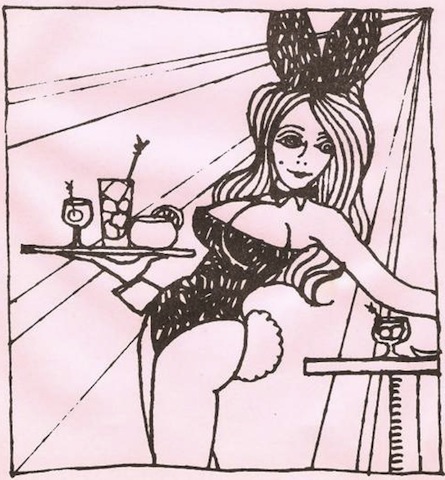
How to be a Playboy Club Bunny, circa 1968.

Love, domestic violence and Gossip Girl.

On Hillary Clinton being photoshopped out of the situation room photo in Hasidic newspaper Der Tzitung:

“The religious paper never publishes pictures of women, as they could be considered ‘sexually suggestive.’ Apparently the presence of a woman, any woman, being all womanly and sexy all over the United States’ counterterrorism efforts was too much for the editors of Der Tzitung to handle…

Der Tzitung edited Hillary Clinton out of the photo, thereby changing history. To my mind, this act of censorship is actually a violation of the Jewish legal principle of g’neivat da’at (deceit).”

Would you rather be blind or obese? According to an Arizona State University study, 1 in 6 women would choose the former…

Images via The Hairpin, Sociological Images.

Event: Go Back to Booktown This Weekend.

Yes, for those of you who’ve been with The Scarlett Woman from the beginning, I have already used this title for a blog post this time last year.

But it is that time of year again when the Clunes Back to Booktown book fair rolls around again.

I’ve been dying to go for the past two years, but canceling friends and no drivers license meant I’ve had to sit it out. But this year I managed to wrangle a friend with a car, and will finally be making an appearance at the fair.

I tell you what, it’d better bloody be worth it!

I’ll regale you with my tales of the city country town next week.

See the website for the location, times and how to get there.

Related: Go Back to Booktown This Weekend.

Armistead Maupin in Conversation with Noni Hazlehurst.

Elsewhere: [Back to Booktown 2011] Homepage.

Osama bin Laden & Racism.


So, yay. Osama bin Laden is dead. If you haven’t been living under a rock for the past week and a half, you would know that.

It’s very cut and dry: they captured bin Laden in a hideaway compound in Pakistan after months of observation, they shot him dead in the head and chest, did a DNA test against his dead sister’s genes, and buried him at sea once it was confirmed it was him.

But the emotions surrounding bin Laden are anything but cut and dry.

The news showed masses celebrating in the streets in the U.S., and his followers mourning him in the East.

But the mistake a lot of people make, I think, is thinking that everyone in the East holds bin Laden in high esteem.

I encountered such racism the day of the martyr’s death, when I sent the equivalent of an office email around my workplace when I heard the news in the mid-afternoon. At this point it wasn’t common knowledge, so I thought most people would like to know that the man who single-handedly changed the world on September 11, 2001, was dead.

A couple of hours later, a colleague approached me and said he thought my message was a bit inappropriate. I asked how, as it is not uncommon for the AFL grand final results or who won the Melbourne Cup to be broadcast around my workplace, as this was a news story just like them.

He said there are Muslims in our workplace and they might have found it offensive.

I told my colleague—and friend, might I add—that I was offended by his small-mindedness, and to get out of my face. In the nicest possible way, of course!

But, legitimately, I was offended by the fact that he thought all Muslims were proud to have bin Laden as their figurehead; the person who represents their religion and culture to the rest of the world. That’s like saying that someone like George W. Bush, Sarah Palin or—God forbid!—Adolf Hitler is adored by the white masses, not taking into account that these people are morons (the former two) who slaughtered millions of people (the latter). This is an abhorrent worldview that, unfortunately, a lot of people hold true.

I followed this altercation up with a friend who happens to be Muslim, just to be sure that I wasn’t overreacting, and he assured me I wasn’t.

There’s always going to be people who have a bigoted attitude to people and cultures they aren’t familiar with, but hopefully bin Laden’s death can be used as a stepping stone in the right direction.

(Note: in reference to a post on the day of the Royal Wedding where I hypothesised that the decade between 2001 and 2011 would be book ended by two of the most important events in our history—September 11 and the Royal Wedding—it looks like I was wrong. The decade has been defined by one horrible man who introduced us to “the age of terror”, and has now escaped it to “rot in hell”, as the headlines have espoused. Not to become a martyr and move on to paradise, or Jannah, as one simple television commentator argued as a reason why they should have captured, not killed, bin Laden. Oh, the ignorance.)

(Note #2: Also check out Mia Freedman’s latest Sunday Life article, in which she demystifies the niqab and addresses bigots.)

Related: The Royal Wedding: The Other Event of the Decade?

Back to the Draw-ing Board: Australia’s Year of Indecision.

Elsewhere: [MamaMia] A Normal Face.

Images via Huffington Post, Zimbio, Sydney Morning Herald.

The Gender Politics of the Royal Wedding.


From “Theory: Why Women Care About Princesses” by Echidne of the Snakes on Jezebel:

“… What is it that little girls seem, once again, to be emulating in their play? Cinderellas and ballet dancers. I believe that the reasons for those choices (by their parents and the toy industry and the society) are the same old ones: Here are role models for girls which apply even in a world of gender inequality, yet don’t truly alarm more egalitarian parents. Those role models are not that different from the models given to boys: football players, space heroes, characters with gigantic muscles and super-powers. That they are fewer and more anemic goes with the territory of gendered expectations.

“Sure, children grow past those types of toys, and they even grow past the gender-policing stage. But perhaps something remains, something which is then evoked by a royal wedding in women or a football game in men.”

Related: The Royal Wedding: The Other Event of the Decade?

Elsewhere: [Jezebel] Theory: Why Women Care About Princesses.

[Echidne of the Snakes] Homepage.

Images via Legitimate News, Vipfuly, Coco Perez.

TV: The Underlying Message in Glee’s “Born This Way” Episode.


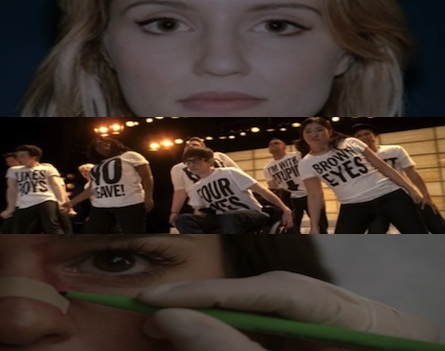
The underlying message this week is that there is none: acceptance—of Rachel’s Jewish nose, Quinn’s chubby-checker past and Tina’s “Orient descent”—was right there on the surface for all to see.

This is Glee’s second Lady Gaga-themed episode, the first of which was very Gaga-centric, however this week’s effort kicked last seasons’ butt!

The storyline began with Rachel getting hit in the face by Finn during a dance number, and her doctor recommending she get a nose job to fix her deviated septum, like big-nosed babes, Jennifer Aniston and Ashlee Simpson, before her.

She decides to take angel-faced Quinn along to the appointment, using her nose as an example of what she wants the new and improved Rachel to look like.

This is followed up by a tear-jerking rendition of “Unpretty” by TLC by unlikely soul-sisters Rachel and Quinn.

You might remember a few episodes back (although it’s been so long since a new episode has aired, both on Ten and in the U.S., that you could be forgiven for not remembering) when Quinn morphed from struggling with her social standing after giving birth last season to prom-queen obsessed, “I’m relatively sane for a girl”-espousing zombie.

I didn’t buy it then, and I’m glad we get a more in-depth look at her life now.

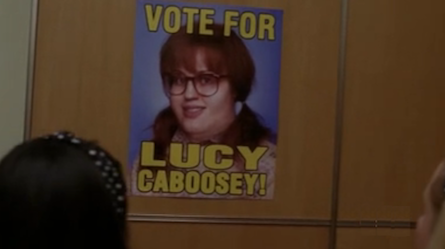
Lauren Zizes decides to run for prom queen, with Puck by her side as her king. Most of the non-size-two students at McKinley are ecstatic to see someone who looks like them running for prom queen, which should have given Lauren the heads up that her plan to take down Quinn wouldn’t work: she unearths Quinn’s past as Lucy Fabray, before she transferred to McKinley in eighth grade.

Lucy was overweight, uncool, and bullied constantly at her old school, until she joined ballet, gymnastics and cheerleading, lost weight and asked her parents for a nose job, at which point they began to call her by her middle name, Quinn.

Lauren plasters posters of Quinn as Lucy all over the school, which inadvertently sees Quinn’s approval rating go up 40% because her student body realises she’s not just a vapid beautiful person, but someone with problems and a past, just like them.

But not all of the glee club’s members are accepting that they were “born this way” out in the open.

Santana manages to convince Dave Karofsky to help her get Kurt back to McKinley, or else she’ll tell everyone he’s gay. In turn, her “Macbethian” and “Latina Eve Harrington” ways, she believes, will help her become prom queen.

Eventually, word gets back to Kurt about what’s really going on, and he agrees to return to McKinley on the condition that Karofsky be schooled in acceptance of gays and lesbians, even if he doesn’t come out.

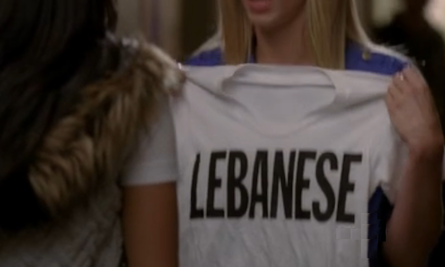
Santana could do well to adopt this school of thought, as she is still in the closet and still in pain that Brittany can’t be with her. Brittany makes Santana a “Lebanese” t-shirt for her to wear in this week’s performance (it was meant to say “lesbian”, but it’s a nice tie in to the “Born This Way” lyrics!)

Of course all the storylines are neatly wrapped up into a special 90 minute package, as is Glee’s style. Emma even manages to address her crippling OCD and goes to therapy.

But I think the most interesting “underlying message” of the episode was Santana’s view at the three-minute mark on changing things you’re not happy with.

As much as, on the one hand, our society preaches self-love and acceptance, what of all the beauty products, foods and exercise regimes that are spruiked to us on a daily basis via all mediums?

I don’t want to turn this into a rant on body image and the affect advertisements, magazines, TV, movies etc. have on it, but Santana does raise a good point: if changing things about you, like Rachel’s nose, Tina’s eye colour, or Sam’s “guppy lips”, makes you feel better about yourself, then so be it.

I got a tattoo a couple of weeks ago because I didn’t like the way the back of my neck looked without one; does that make me “hate myself”? Hell no! Anyone who knows me will tell you that I am confident in who I am, both on the inside and the outside. (Those who don’t just think I’m an arrogant bitch!)

But I think that if you are happy with yourself in general in most aspects of your life and can engage in “active critical thought” about the things you aren’t, what’s a little hairdo change here or gym membership there?

Or—dare I say it?—a nose job?

Related: The Underlying Message in Glee’s “Original Song” Episode.

Gwyneth Paltrow Addresses Tabloid Culture & Her Haters.

Glee “Sexy” Review.

The Underlying Message in Glee’s “Blame it on the Alcohol” Episode.

How to Make a Woman Fall in Love With You, Glee Style.

Glee “Silly Love Songs” Review.

The Underlying Message in Glee’s “Furt” Episode.

The (Belated) Underlying Message in Glee’s “Never Been Kissed” Episode.

The Underlying Message in Glee’s “The Rocky Horror Glee Show” Episode.

The Underlying Message in Glee’s “Duets” Episode.

The Underlying Message in Glee’s “Grilled Cheesus” Episode.

The Underlying Message in Glee’s “Britney/Brittany” Episode.

Is There Really a Beauty Myth?

Images via Megavideo.
Poor Pippa.


She’s in possession of the ass that launched a thousand Facebook groups. She’s sister to the future Queen of England. She’s from a self-made millionaire family. But I kind of feel sorry for Pippa Middleton.

Why?!, you ask? She’s got everything a girl could ever want!

No, she’s got everything her sister could ever want. Kate’s—sorry, Catherine, Duchess of Cambridge—the one who signed up for a lifetime of scrutiny and the weight of the world on her and her husband’s shoulders, not Pippa. And Kate’s had ten years to prepare for it.

Despite being there when Kate was falling out of clubs and into cars in her let’s-show-Wills-what-he’s-missing days, the world only really took notice of Pippa when she spilled her curves into that dress two weeks ago.

To be clear, I think she looked great. Healthy, fit, glowing, and a booty the envy of most girls… and guys! But could she have realised the furor that has erupted ahead of time?

Sure, she wanted to be there for her sister, and no doubt her dress will be copied the world over as much as Kate’s.

But for all the good press, there’s just as much bad.

A friend of mine mentioned the amount of freckles Pippa has, and how she “won’t age well”. Jesus, she’s only 27!

And the inevitable nude photo scandal has emerged, to the delight of Facebook fans and the chagrin of the royal family.

Only time will tell whether Pippa can handle the microscope of the public, whether she be put under a good or bad lens.

Image via Pop on the Pop.

Guest Post: Living Below the Line.

For a week this May, I will be living on $2 a day to raise money and awareness for the Oaktree Foundation, in their increasingly successful Live Below the Line campaign. I’ve pledged to live on just $2 a day for five days, from May 16th to 20th.

At first it seems an impossibly small amount, but then you realise that actually a truly ridiculous number of people live on that amount every day.

$2 is the Australian equivalent of the international extreme poverty line—and through this challenge I’m hoping to raise awareness about the issue, but also money to make a difference. You might think that the $2 would go further and buy more in developing countries (that’s what I thought too)—but actually the $2 is worked out to be the Australian equivalent of what life is like for over a billion people. Extreme poverty means $2 per day buying Australian stuff, with Australian dollars. It’s pretty incredible to think about.

It’s definitely going to be hard (those of you who know me, know how much I like good food and wine). There’ll be no coffee, no sugar, no flavour, no alcohol, no snacks and not much nutrition. But if through this I can get a better insight into what life is like for those trapped in poverty—and raise money to make a difference for them—then it’s a sacrifice I’m willing to make. Particularly if you consider that the average Australian spends more per year on confectionary than people living in extreme poverty have to spend in their entire budget. I will spend my $2 a day on food, but if I were one of the people this campaign is raising funds and awareness for, my $2 a day would also have to cover shelter, education, and healthcare as well as food and other basic needs.

Those of you who are able, please donate generously:

  • $50 will provide a classroom in remote PNG with all the stationery they need for a year.
  • $100 will provide a scholarship for a poor student in Cambodia so they can attend school for the first time.
  • Any amount will make a big difference, so please sponsor me with whatever you can spare.  Even $2 each can add up quickly, so dig deep, or take the challenge yourself to raise funds!

Anyone who has any tips on how to survive of this amount, they will be most welcome, so please leave your comments bellow. I will be sure to keep you posted via The Scarlett Woman, with how the challenge is developing and would appreciate any insight that can be offered, because I am not a good cook—I can’t even cook rice!

—Tess Keane.

UPDATED: Skinny-Shaming VS. Fat-Shaming.

This is a post that is constantly evolving, as the skinny- VS. fat-shaming debate is always growing and changing. Below, a snippet from Kim Powell’s News with Nipples, in response to Bob Ellis’ take on the ADFA sex scandal, which I linked to last week:

“The belief that women’s bodies are public property is all around us. News websites and tabloid mags are filled with body policing—’evidence’ of a baby bump, boob jobs, nose jobs, a hint of cellulite helpfully circled and ridiculed, weight gains, weight losses, muffin tops, what a ‘real’ woman should look like, skin and muscles in motion decried as freakish, etc etc. (My personal belief is that if you’re going to enlarge a photo of a thigh in motion and hysterically scream ‘See! Cellulite! Here! Here! This woman’s body is disgusting!’ then you need to include exactly the same photo of your own thighs. Fair’s fair. Sure, there are people who make a living from their bodies looking a certain way, but we all know the magazines insist the photos are digitally altered so frankly, they can fuck right off with their body policing.)”

More on this to come next week.

*

I originally wrote this article in December last year in relation to my mum and her weight problems.

Now, I’m updating with a comment my friend April posted around the same time:

“My mum is faced with the same skinny-shaming as yours. She gets called anorexic all the time. She has always been thin. Her bones have always been visible. And although she is of a rather small stature, her average weight of 42kg is well below the normal weight range. However, my mum doesn’t have an eating disorder or even a problem with food (if you don’t factor in her aversion to vegetables!). My mum put on quite a lot of weight when pregnant with me, peaking at a size 14. That is the biggest she’s ever been and it took a toll on her poor skin. The fact she has stretch marks or even wrinkles that have come with age do not affect her self esteem anywhere near as much as people pointing out her weight (or lack there of!). I don’t know if it’s ever brought her to tears but I have witnessed her get angry about it. There is only so much judgment we can take. My mum still has a womanly figure, with child bearing hips and thighs that touch. It’s what she’s been given and she’s learnt to live with it. But when it comes down to it, if people ever actually saw a real anorexic they would definitely see my mother’s au natural body in a different light.”

I’ve met April’s mum before, and can’t say her size was the first thing I noticed about her. Then again, I’m used to tiny mums!

But on the weekend I went to a part at April’s auntie’s house, which her mother also attended. Some comments about April’s mothers’ weight I overheard prompted me to republish this post, with an added musing: JUST BECAUSE YOU’RE NOT COMMENTING ON SOMEONE’S FAT DOESN’T MAKE ANY OTHER NEGATIVE COMMENTS JUSTIFIABLE. If you don’t have anything nice to say (like, “You look great” or “Wow, you’ve got a lovely shape”), don’t say anything at all.

*

My mum is very thin.

She wasn’t always, though. In her late teenage years and early twenties, she was quite overweight. Dare I say, borderline obese?

Now, though, she’s tiny. At 52 years of age (and about 47kgs on the scale), she struggles to put and keep weight on.

She is constantly told how skinny she is by friends, family and even people she’s just met. If she were heavier, do you think people would be drawing as much attention to her weight; at least to her face? I doubt it (with the exception of the media if she were a public figure).

Why do people feel the need to objectify and vilify thin women—using their weight as a weapon against them? Is it because it’s un-PC to do so with a fat person? Because they’re jealous? I would tend to lean more towards the former.

I have received this treatment myself, and while my body is nowhere near the slight size of my mother’s, I do try to take care of it by exercising. And to offset the fattening effects of my sweet-tooth indulgences. (The other day I ate a whole block of Cadbury Top Deck. And another whole block the following day!)

I wasn’t always the size I am now, either. (Truth be told, however, I have always hovered around a size 12; now I’m just more toned and lean towards a size 10.) In high school, my weekends usually consisted of sitting on the couch watching Friends and Will & Grace and eating. I led a very sedentary lifestyle back then; the difference between me then and me now is the fact that I exercise to counteract hours spent at the desk (okay, I won’t lie; it’s usually the couch!) blogging, or evenings spent chilling out with some books, magazines, blogs and TV.

So what gives people the right to blatantly draw attention to a small frame to the inhabitant of that frame? Don’t get me wrong; inhabitants of a larger frame have attention drawn to them all the time. But we usually have the decency to not do it to their faces. I don’t know which is worse; personally, that kind of thing is water off a duck’s back to me. Because I come across as cold, aloof and feeling-less, people think I have emotions of steel and they can say and do anything they want to me. I can take a lot of shit, but people like my mother can’t. People pointing out her pin-thinness is a sore subject for her; it’s not like she wants to be that thin.

I think it comes down to a similar school of thought that slut-shaming belongs to. And that seems to be that women who sell their bodies out to succumbing to the ideal shape or to receiving sexual pleasure are at the mercy of ridicule from others.

In this day and age, we’re learning to accept the curves of a larger woman (but only as large as the advertising and magazine industry displays as acceptable). But when can we learn to accept that women do take care of their bodies, and shouldn’t be singled out for doing so. More importantly, though, when will we learn to accept that some people really just can’t put weight on, and they shouldn’t be targeted as succumbing to the narrow beauty ideal presented by society. Much the same way as overweight people shouldn’t be targeted for not succumbing to it.

Thoughts?

Elsewhere: [News with Nipples] Bob Ellis & Believing You Own Someone’s Body.

Images via Holy Taco, Losing Weight Zone, Pink Sheep of the Family.