On the (Rest of the) Net.


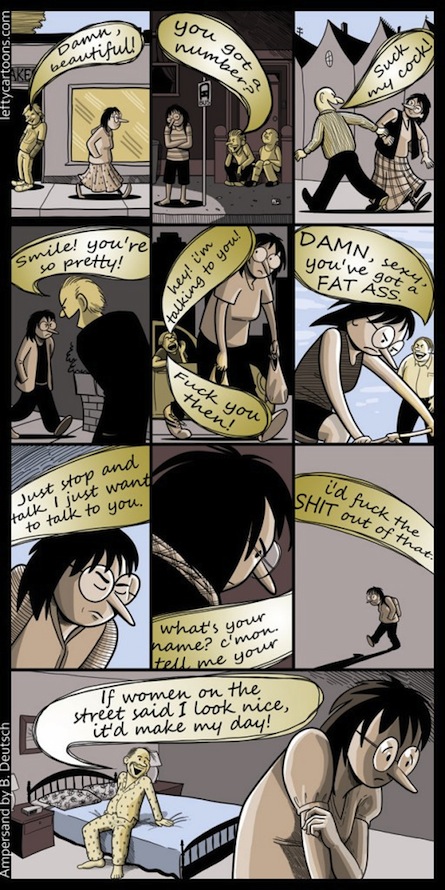
Street harassment in pictures. [Sociological Images]

There may be a link between professional athletes and domestic violence. [Jezebel]

Gay men have body angst, too. [MamaMia]

Naked children: pornography or art?:

“It would be more dangerous and damaging to tell this child that it’s not okay for her mum to photograph her naked, that she should be afraid [of] a loving parent who finds her body beautiful and artistic and that she should avoid being naked with any audience because of the potential to arouse someone predatory.” [Feminaust]

On girl love:

“Don’t be a hater. Try girl-love for a change.  It doesn’t mean you have to hug women with your legs, but try dedicating less of your energy to shit feelings of self-hatred and jealousy, and more towards being supportive of your fellow sistahs.” [Girls Are Made From Pepsi]

Yet another reason not to become a teacher! Parental disrespect. [MamaMia]

Julia Gillard on women’s rights. [MamaMia]

Also at MamaMia, “how women bond by bitching about their looks.”

Erotic capital. Very thought provoking, and something I might return to on this here blog at a later date. [Musings of an Inappropriate Woman]

The aftermath of 9/11 for an Australian kid aged 10 when the World Trade Centre came down. [The Punch]

Some more 9/11 “perspective” from The Punch.

Lady Gaga justifies her love of Madonna, YSL’s “Mondrian” dress, and Salvador Dali, amongst others, in her “Born This Way” video. [V Magazine]

“The Time I Became Hated on the Internet” for being a feminist. [Air or Fire or Pizza]

To trust or not to trust when it comes to birth control. [HuffPo]

Image via YouTube, Sociological Images.

TV: Glee Back in Full Force.


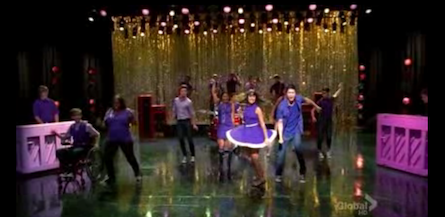
Last night’s season three premiere had a certain musical flair, with songs from Hairspray, Annie Get Your Gun, Anything Goes, and The Wizard of Oz. There was even a nod to Grease in Quinn’s rebellious turn as a pink(-haired) lady and one of the potential New York Academy of Performing Arts students playing Rizzo in an all-male production of the musical.

The colours and vibrancy of the episode, with Quinn’s new hair, the indigo costumes for New Directions’ “You Can’t Stop the Beat” performance, the purple pianos—and let’s not forget the Cheerio’s costumes and Sue Sylvester’s tracksuit—was also a highlight.

There were also some “underlying messages” in Sue’s campaign to shut down arts programs in public schools (an issue that has been rampant in schools, especially in the U.S., for as long as I can remember), whether following your dreams is a feasible option for everyone and whether Rachel and Kurt are good enough to make it to New York. The latter two were particularly poignant for me, as these are issues I have been struggling with of late.

In typical Glee fashion, there were still some offensive comments (Sue likening “Chopsticks” to the national anthem for “whichever country” Tina and Mike come from; the “self-diagnosis” of Asperger’s syndrome to explain away new student Sugar’s blatant uncouthness) but, if this episode in an indication of what’s to come in season three, I like this new direction. See what I did there?

Images via VideoBB.

Manic Pixie Dream Bitch.


From “The Pinup of Williamsburg” by Jada Yuan in New York Magazine, via Jezebel:

(500) Days Of Summer… told almost entirely through Tom’s perspective, was ‘actually very misunderstood,’ [Deschanel] says. ‘I can’t tell you how many guys, and girls, are like, “You did him wrong!” What, she’s a bitch because she didn’t want to date that guy? So? Are we bitches because we have our own opinions? If that makes me a bitch, or that makes women bitches, then maybe we’re all bitches.’”

Elsewhere: [New York Magazine] The Pinup of Williamsburg.

[Jezebel] Zooey Deschanel: “Maybe We’re All Biches”.

[Musings of an Inappropriate Woman] Elizabethtown, Garden State & the Alternative Flat Fantasy Female.

Image via Robray Burn.

Movies: The Change-Up Does Nothing to Change Stereotypes.


Remember when Katherine Heigl bit the hand that fed her and criticised Knocked-Up for being sexist and perpetuating women/wives-as-shrews stereotypes? Where was Leslie Mann, who played Heigl’s sister in the movie, and is director Judd Apatow’s wife, during all this?

Certainly she didn’t take Heigl’s valid-but-ill-received criticisms of the 2007 runaway hit to heart, as she is basically playing the exact same character in The Change-Up: shrewish, run-off-her-feet with three children and a seemingly successful job (she discusses something in the vein of building planning, so perhaps she’s an architect? What does it matter, right?), and stuck in an unhappy marriage in which her husband doesn’t find her attractive.

And what about Jason Bateman and Ryan Reynolds’ characters? Reynolds, playing man-child Mitch Planko, is a loser stoner who only peels himself off the couch to score 9-months-pregnant women, a job in a soft-core porno, and weed.

Bateman’s Dave Lockwood, on the other hand, is a successful lawyer who’s been with the same woman for 18 years and no matter how much he accumulates, he’s never happy.

The only other woman in the film with more than a few lines and a tit-shot is Sabrina, played by Olivia Wilde. If Mann’s Jamie is the overworked and undersexed Madonna, Sabrina is the work-hard, play-hard whore. She espouses clichés like “I prefer to be sexually harassed in my private life,” or something to that effect. Way to stand up for women’s rights there!

There was one redeeming quality to the film, if you look really hard. Jamie makes an astute observation about women and marriage, and is somewhat representative of a lot of women in long-term relationships or marriages who no longer feel loved or desired by their husbands, who are taken for granted and who are run off their feet with 2.5 kids and a job (although Dave helps to break the stereotype of absentee father who doesn’t engage with his kids). But this also does a disservice to other kinds of wives and mothers and families, who don’t have rich husbands and live in a mansion, by all accounts.

Oh, and the unrealistically pert breasts of a breastfeeding mother of three and the ass of a 17-year-old on a lady pushing 40 don’t do much to help real women, either.

Related: The Taboos of Sexual Harassment.

Elsewhere: [MamaMia] These Are the Un-Retouched, Un-Fake Breasts of a 33-Year Woman Who Has Breastfed Two Babies.

Image via YouTube.

On the (Rest of the) Net.


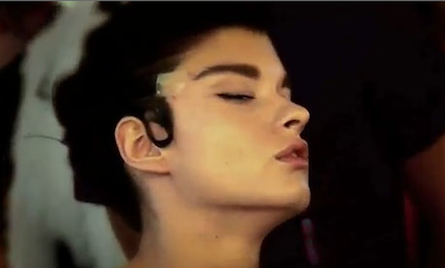
Crystal Renn explains the whole eye-taping scandal. [Jezebel]

Sex & the City, post 9/11. [New York Magazine]

And what has changed about New York since that fateful day just over ten years ago? [New York Magazine]

Reminiscing about 9/11, Mia Freedman writes about “grief porn”. [MamaMia]

The problem with Jezebel. [Slate]

Charing Ball on the hullabaloo surrounding Beyonce’s pregnancy announcement and how she’s “doing it the right way”:

“Many of the same folks, who once chastised Beyonce for waiting for motherhood, are rushing to sing the praises of how the couple, but more specifically Beyonce, ‘did it the right way.’ You know, the correct order of things: dating, marriage and then the kid. Never mind that her better half is a 41-year-old man, who still grabs his crotch out in public and wears his hat turned backwards. But more to the point, this whole ‘look at the positive role Bey is setting for young women’ conversation, which is now happening around the blogosphere, reeks of slut-shaming.

“Beneath the celebratory ‘she did it the right way’ discussion is an underlining message, which seeks to shame and stigmatise women, who for whatever reason, go in on motherhood alone. Some bloggers see Beyonce’s pregnancy as some sort of triumph over single women, who have gotten pregnant before or outside of marriage. And as such, Beyonce’s baby bump and wedding ring have now become kindling to further flame the existence of these unwed women, who by virtue of their singledom, are obviously failures at motherhood and are incapable of rearing a child with morals and values worthy of society.” [Atlanta Post]

“Cartoon Characters & Their Teenage Alter Egos.” [Rookie]

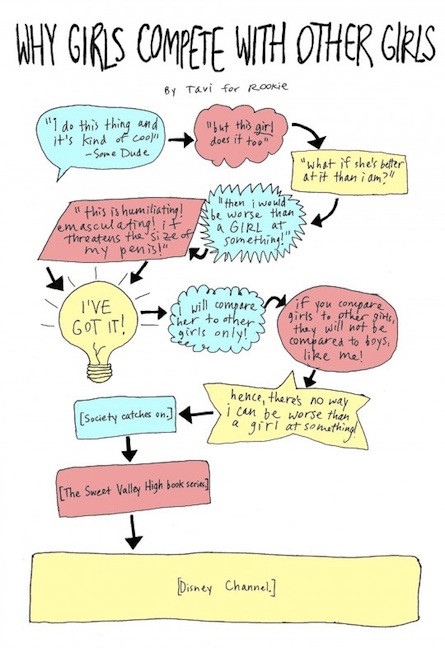
Also from Rookie, Tavi Gevinson on girl hate:

“She walks a certain way, answers questions in class a certain way, wears stuff no one else could pull off? Look: confidence is not a crime. It does not mean a girl is a bitch or a slut, or thinks she’s better than you. It just means that she likes herself. And personally, I don’t wanna live in a world where any girl with healthy self-esteem is labeled a whore, or where you have to dislike yourself to be considered a nice person.”

The Help Isn’t Racist. Its Critics Are.” [The New Republic]

Should pedophiles be granted the right to redefine their “mental illness” to “minor-attracted persons”? [Salon]

I commented on Aimless Panther’s post on Feminaust from a couple of weeks ago, on whether fat is a “feminist issue”, asking what her views on control underwear were. Ask and you shall receive.

Panther also laments the “fall back on[to] gender stereotypes. It may give me great material to mock, but in the end it makes all our efforts harder”:

“You can take your real men, [Bryony] Gordon, your philandering, fat dickheads, and just bugger right off. Give me the men who struggle against gender roles and straighten their hair, worry about their health and have the art of conversation. I reckon they’ll be more interesting.” [Feminaust, The Age]

Getting to know the Prime Minister a year (when it was published) on from her ousting of K. Rudd. Interesting stuff. [The Monthly]

Discussing male body image. [Bitch]

Also on masculinity, exploring it in televisions best shows. [The Good Men Project, via Jezebel]

“How Much Alcohol to Drink So You Never Die.” Spoiler alert: you will die. [Jezebel]

In the vein of sexual harassment and stalking on The Scarlett Woman in the last week or so, Jezebel’s Jenna Sauers gets masturbated to on the subway and the cops did nothing.

Also with street subway harassment, Chloe at Feministing lets us know the “things you should not say to a stranger on the subway”, in case we didn’t already.

Plus-sized Nancy Upton gives the plus-sized American Apparel model competition a run for its money. [Jezebel, MamaMia]

Thank Your Wank. Hmm… A website that allows wankers, in every sense of the word, to thank their fantasy subjects. There’s even a “to-do” list. Vile, or just a bit of fun? [Jezebel, MamaMia]

Erica Bartle on the work/life balance. [Girl with a Satchel]

Still with GWAS, Erica explores the role of the media in the wake of the News of the World phone hacking scandal, the Nine News-Daniel Morcombe “live” cross, the “burden v. benefit” of airing our opinions online, and the anonymous comment.

The case for anti-discrimination laws and welfare benefits for the “ugly”, whatever that means. [The New York Times]

Dirty Dancing as feminist text. [The Guardian]

This post, about what happened with Maureen Shaw went off the pill, made me rethink doing so myself! [Jezebel]

The transphobic, ignorant and just plain vile response to Chaz Bono being featured on U.S. Dancing with the Stars makes me think freedom of speech may be a bad thing. -Phobic and -ist speech, anyway. [Jezebel]

Images via The Guardian, Jezebel, Rookie.

Movie Review: The Help*.


Up until I heard about The Help’s release as a movie a month or two ago, I’d managed to miss all the brouhaha surrounding the release of Kathryn Stockett’s 2009 novel of the same name, and therefore didn’t even know it was previously released in book form.

I promptly jumped online to devour the racial criticisms on blogs of the book, and so was expecting a similarly clichéd film.

Much to my delight, the film manages to steer clear of most of these stereotypes, though in some parts, such as Minny miraculously deciding to take her five or six kids and leave her abusive husband, and the standing ovation the local black church gives to Aibileen and Minnie, who defied the social norms of the time and told their stories as undervalued and blatantly discriminated against “help” to Emma Stone’s Skeeter, are pretty unrealistic.

But Jessica Chastain’s Celia Foote, the naïve, Marilyn Monroe-esque housewife outcast from the social scene in Jackson by fellow stay-at-home wife Hilly Holbrook, played wonderfully by Bryce Dallas Howard, stole the show. She showed that not all white people felt disdain towards the black “underclass”, making them use a specially-installed outside bathroom and take separate taxis, which is one of the main driving plotlines of the story.

I can’t talk this film up enough. While it’s not the best movie ever made, it’s one you should see regardless. Also, look out for cameos by Private Practice’s Dell and True Blood’s Lafayette and Sarah Newlin. And make sure to bring the tissue box!

*It has come to my attention that I give away too much in my movie reviews, so the asterisk will now serve as a blanket *spoiler alert* from now on.

Image via YouTube.

Why is Feminism Still a Dirty Word?

Recently, when asked in an interview with UK Harper’s Bazaar if she’s a feminist, Beyonce said she wanted to invent a new word for feminism, because she doesn’t feel it “necessary” to define whether she is one or not.

Why, in this day and age, do we still distance ourselves from the word “feminism”?

And it’s not just Beyonce. Keri Hilson, Lady Gaga, and even (kind of) Tina Fey, have been called a feminist in one instance, and tried to backtrack on it in the next.

In response to all this, Jezebel ran a contest to come up with “a catchy new word for feminism”, like Beyonce suggested. Some suggestions were “FUCK PATRIARCHY”, “Flesh-Hungry Young Slutism” (seemingly appropriate given it has been the year of the SlutWalk, if you will), “Vaginist”, “Diva-is-a-female-version-of-a-hustla-ism” (how you like that, Beyonce?), but the one that came out on top was “Equalism” which, in my experience, is what young feminists today strive for.

Speaking of young feminists, I would probably only define a handful of my friends as this, and even they are hesitant to describe themselves this way.

One says she’s not a feminist because she wants to “cook for her boyfriend”. Since when did not cooking and feminism become mutually exclusive?

Another says he’s (yes, he’s) could never truly be a feminist because he doesn’t have a vagina, so therefore will never know what those who do have to go through on a daily basis in a patriarchal society, and have gone through for centuries in patriarchal societies.

I have another who, just by looking at her, screams feminism before she even opens her mouth. Yet sometimes, when she says things I morally disagree with, I think, “she’s not feminist enough”. (Abhorrent, I know, and something I strive not to think and say as a feminist. And, by my own admission, some might say I’m “not feminist enough” because of the way I talk and how I dress.)

It’s a far cry from Beyonce, Gaga et al., who try to distance themselves from feminism, while young feminists (and old!) bicker amongst themselves about who’s more feminist! And it perfectly illustrates the discrepancies between what self-described feminists project onto the movement, and what lay, non-feminist Generation Yers believes it to be about.

Camilla Peffer over at Girls Are Made From Pepsi writes:

“I think most women associate feminism with radicalism and the whole bra burning hulla-balloo. Which is RI-DUNK-U-LOUS. And a lot of people see the term feminist [as] biased towards females in the sense that the whole movement promotes this idea of women being better than men.”

Indeed, there is a far cry between the first wave suffragist movement, second wave “bra-burning” and the sexual revolution, and current third-wave feminism. Some would even say that we have passed third-wave feminism and are now living in a post-feminist society.

When I first started getting into feminism about two years ago, I subscribed to this notion. Now, having been exposed to all manner of blogs, academic articles, events etc. to put the sexism, discrimination and harassment I’ve experienced as a woman into perspective, I can see that we sure as hell aren’t living in a post-feminist world and that we still need feminism, perhaps more than ever with the rise of the Tea Party and Michele Bachmann and the closure of Planned Parenthoods in the U.S., the blatant harassment most women experience on the street and in their workplaces every day, the attacks on SlutWalk, and the atrocities facing Third World women, to name but a few.

Taking on these battles shouldn’t be seen as something “dirty”; it should be seen as something we can all get behind, if it leads to our daughters experiencing a world free from harassment and discrimination based on what genitals she possesses and what she looks like, no matter what part of the world she hails from.

Sadly, as Rachel Hills muses, “it can be a bit uncool to care. Feminism means caring and wanting to change things, ergo it makes people uncomfortable—especially people who are comfortable with the status quo.”

Are you comfortable with the status quo? Do you think feminism is still a dirty word?

Related: Why Young Feminists Still Have “A Long, Long Way to Go” in the Eyes of Second-Wave Feminists.

So Misunderstood.

Melbourne Writers’ Festival: A Long, Long Way to Go: Why We Still Need Feminism.

Has Feminism Failed?

I Ain’t No Hollaback Girl: Street Harassment in CLEO.

The Taboos of Sexual Harassment.

Ain’t Nothin’ Gonna Break My Slutty Stride.

Elsewhere: [Jezebel] Let’s Invent a Catchy New Word for Feminism.

[Jezebel] The Catchy New Word for Feminism.

[Jezebel] Keri Hilson is a Feminist, Not That She Wants to Say So, Exactly.

[Jezebel] Tina Fey on the Message of 30 Rock’s “Joan of Snark” Episode.

[Feministe] Time to Check In With Tina Fey’s Feminism.

[The Frisky] Tina Fey: Not Feminist Enough?

[Girls Are Made From Pepsi] The Post in Which I Talk About Beyonce, Feminism & Equality For All.

The More Things Change, The More They Stay the Same.

From “The Last Refuge of the Un-Australian” by Tony Birch:

“Recently, when a Pakistani migrant who had been granted permanent Australian residency in 1996 set himself on fire outside the federal parliament, as a result of his unsuccessful application to the Immigration Department to have his wife and child join him here, the Immigration Minister, Phillip Ruddock stated ‘it’s [self-immolation] not something we are used to or experienced with… sadly he sought to do so.’

“This man had done something that was very ‘un-Australian’. He had publicly expressed his grief and anguish at his treatment at the hands of Australian government officials. He had raised an issue that might tap away at all of those clichés of national foundation and celebration. It is not only ‘un-Australian’ to be, through experience, a whistle-blower against nation-building mythology. Simply ‘to be’ one of those who have been abused by the Australian nation is to be ‘un-Australian’.

“It is also ‘un-Australian’ to intern people without trial for up to four years, to subject people to months of isolation in solitary confinement. It is ‘un-Australian’ to remove those people to remote parts of the country where they cannot be visited by family or friends, to where the activities of the multi-national company that profits from their incarceration cannot be scrutinised by the media or the imprisoned’s legal representatives. It would be ‘un-Australian’ in the extreme to use water cannon, tear gas and truncheons against people imprisoned without trial, who are rightfully protesting about the abuse of their human rights.

“I cannot, as a trained historian, state this with empirical certainty, but it is a mathematical probability that it is ‘un-Australian’ to disparage and devalue the worth and lives of refugees by claiming, without evidence, that many of them ‘may be’ associated with ‘terrorists’. Likewise, the propagandist need to focus more closely on the supposed threat that the approximately 8,000 ‘illegal’ arrivals in the last ten years post to ‘our way of life’ rather than overturn a policy that contributed to more than 350 people drowning trying to get here in just one year (1999), is somewhat ‘un-Australian’ I would think.

“But of course the representatives of the Australian people, the federal government, engage in such behaviour on a daily basis. To ensure that such practices are not perceived as ‘un-Australian’ we not only transfer refugees to remote areas of the country, we un-people those who arrive here by reconfiguring them as ‘the ungrateful’, ‘the terrorist’, ‘the queue-jumper’ and legally as ‘the non-person’. ‘We’ can then protect Australia and ‘our way of life’ against the alien invader as ‘we’ did against ‘the Aborigines’ in the past, because they failed to adhere to the doctrine of terra nullius by unpatriotically refusing to reclassify themselves as ‘non-people’, in claiming their rights and identity as indigenous people.

“The Department of Immigration lists 37 countries that it regards as a threat to Australia, in that visitors who arrive from these countries, by boat or otherwise, are regarded as the most ‘at risk for overstaying their visa’. The countries listed include Bangladesh, Chile, India, Poland, Samoa and Vietnam. Most are non-white and none are Anglo or English speaking (as a first language). And yet approximately 20 per cent of arrivals to Australia who overstay their visas are British. There is no mention of Britain in the blacklisted countries. Nor do we see the fair skin of the backpacker behind the barbed-wire of the detention camps…

“We have a situation in Australia today where we are witnessing the human rights abuses of many people. Aboriginal people continue to be abused as a result of the crimes committed by white Australia both in the past and contemporary society. The abusive treatment of refugees is similar to the treatment of Aboriginal people in the country in that they pose a threat which, more than being based on any material manifestation, either real or imagined, is a threat to a way of life erected on xenophobia, selfishness and a fear of difference.

“We must transform the culture of Australian life by screaming to our politicians that such an idea is genuinely un-Australian and that we will not tolerate it. And we must do this beyond the act of the political gesture. Activism can be a loaded word, but still, to be active in some way, to speak, to write, to march, to protest, to be angry and to put that anger into expression and action is a suitably un-Australian idea at this time.”

This was written… wait for it… in April 2001. More than ten years ago and, indeed, before the September 11 attacks, and nothing has changed. Being young and naïve, I didn’t realise there was as strong an anti-Muslim culture as there is today, just over ten years on. And it’s appalling to have it made aware that Birch’s words are just as poignant today as they were a decade ago.

Related: Melbourne Writers’ Festival: Beyond White Guilt.

My Response: Go Back to Where You Came From.

September 11, 10 Years On.

Cowboys VS. Aliens & Indians… Does it Really Matter? They’re All the Same Anyway, According to the New Movie.

Elsewhere: [New York Magazine] 9/11 Encyclopedia: Xenophobia.

What Makes a Good Person?

Recently, Erica Bartle wrote about her Christian angst on Girl with a Satchel.

She said her “newfound sensibility” has made her “hyper-sensitive” to all that is wrong in the world. “Why can’t everything just be nice and Christian?!” she bemoans.

I wrote in response in the comments section that I don’t think what she’s experiencing is an exclusively faith (in the religious sense of the world; I’m an agnostic, yet I still believe in a higher power of some kind and that all things that are meant to be will eventuate. I know atheists who, like George Michael, have faith.) -based problem.

Last week, a former colleague and Facebook friend wrote an anti-refugee status along the lines of “fuck off, we’re full”. Classy. I commented, saying that as the “lucky country”, we should be extending our resources and welcoming asylum seekers with open arms, as they have a legal right to seek asylum in whichever country they can gain access to which is safer than their own. To cut a long story short, a shitstorm ensued, and bigoted bogans far and wide chimed in to berate me and asylum seekers alike.

They claimed “boat people” were making their local kinders stop celebrating Easter and Christmas and that while people like me have to pay for my education, they get it for free. I don’t know where they get this misinformation (middle-right mainstream media, step right up), which is what I wrote, albeit in a more forceful manner, and was attacked personally for it.

There is a fine line between standing up for what you believe in and berating all others who don’t subscribe to the same school of thought. If bigotry means not being able to see the other side and thinking less of those on it, then call me one, because I just can’t see the reasoning behind being so uncaring and un-compassionate. (The downside to free speech.)

So if standing up for what you believe in and the rights of others makes you a “good person” by a lot of peoples’ definitions, which side makes you a “better” person? The side that wants to protect our country’s borders and focus our money and resources on people already in it, or the side that believes we should extend those privileges to those in need, no matter which country they hail from? And why isn’t the latter the more mainstream and accepted view?

Bartle writes that sometimes her hypersensitivity to issues not unlike the one I just mentioned makes her wail, “Why can’t I just be NORMAL?!”

What is normal, anyway?

If normal means having the prejudiced views of the friends of my Facebook friend and, indeed, the two main governmental parties in this country, then normal is something I do not want to be. From the last two and a half years of content Bartle has posted on her blog (not to mention the two years before I discovered GWAS), I doubt it’s something she would really strive for, either.

But, to be a woman of God means to “let go of the idea of your awesomeness, your pride and your talents” and “burning ambitions/dreams/desires”. Forgive me, but the “god” I believe in wants me to be the best I can possibly be at whatever I choose. (“God” is starting to sound an awful lot like “mum”.) I want me to be, too. There’s that pride thing Bartle’s talking about…

So does being a “good person” mean being agreeable, having no passion and being boring? I know some of these people and, to my mind, they mightn’t be bad people, but they’re not much brighter than “normal”, either. To be a good person you need to buck the status quo, and be both passionate and compassionate. These things make you anything but boring and “normal”.

But we see what these things lead to, and it’s anything but compassion.

Take the Mia Freedman/Cadel Evans saga, for example. Freedman has made a career out of giving her opinion on all things media- and woman-centric, which is exactly why the unwashed masses turned on her when she deigned to question the focus we put on sportspeople at the expense of other, perhaps more deserving, people.

Bartle includes an excerpt from Get Her Off the Pitch: How Sport Took Over My Life by Lynne Truss, in which the author writes that sport can sometimes be a waste of time (my thoughts exactly!) which, in turn, got me thinking about pack mentality, both in sport and in religion.

We’ve seen how mobs of sports fans engage in rioting, amongst other pack-like behaviour. Even the very act of cheering and booing your favourite/least favourite team in the stands is inherently mob-like. Not to mention the “group-bonding” sessions of gang rape and group sex amongst teammates. (This is not to say all sport is bad; it’s just not for me, and this is just one of the myriad of reasons why.)

Religion, I believe, also encourages such actions. The use of deities to justify all manner of wars, massacres, executions, terrorism, riots, rapes, murders, stonings, and law reform, amongst many others. (This is not to say all those who are religious subscribe to such extremities, but I do believe that all organised religion is a crock.)

And we, as a society, accept such behaviours because they are hidden under the cloak of Godliness, or Australianess. (More on what is considered Australian and un-Australian tomorrow.)

So, this has gotten a little off-track, but I suppose I’m putting the question out there: “What makes a good person?” Obviously, this is a never-ending debate, but I do know that being one is certainly not dependent on religion or “patriotism”.

I think it’s dependent on being courageous, compassionate, respectful, which in turn generates respect, standing up for what you believe in and having the courage of your convictions, staying true to yourself, standing up for the underdog and yes, being a little bit proud and selfish every now and then. ’Cause no one respects a “yes” (wo)man.

Related: In Defence of Mia Freedman.

Elsewhere: [Girl with a Satchel] I’m a Christian, Get Me Outta Here!
September 11, 10 Years On.


It’s hard to believe it’s been 10 YEARS since two planes crashed into the World Trade Centre, the enduring image of the Twin Towers collapsing burned into our memories. Not to forget the additional two planes which crashed into the Pentagon and a field in Pennsylvania.

I was 13 at the time of the attacks. I’ve grown up in the “age of terror”, where conspiracy theories, airport security, racism and top-television-moments countdowns are influenced by the event.

At the time, I couldn’t really care less. I was a teenager, consumed with adolescent angst and lost interest about five minutes after I first saw the shocking footage on TV. A testament to the desensitivity and limited attention span of my generation, I suppose.

We weren’t allowed morning television in our house at the time, so I’m pretty sure my parents were none the wiser as to the attacks the following day. My mum was telling me something about some environmental issue in California (a Google search for news results around that time produced little enlightenment).

I got on the school bus and someone said, “Did you hear what happened in America?” I was like, “yeah, totes, something environmental in California”, or something to that effect (and yes, I know “totes” wasn’t a word then. Some would say it isn’t even a word now.). I was received by puzzled looks.

That’s really all I remember from that time. Oh, that and the thing that consumed my life at that time, World Wrestling Entertainment (then World Wrestling Federation), was the first live televised event after the attacks. WWE SmackDown! was originally scheduled to be taped the night of September 11, however was postponed til the 13th, and was seen as somewhat of a patriotic (ST)FU to the terrorists. Below is a tear jerking clip from the opening scene of the show.

The following year, however, I was fully immersed in my love for the USA, and considered donning full Uncle Sam garb to school that day! Since September 11, I’d been known to bust out an American flag item of clothing here and there, and even had one made for my birthday that year.

Again, it’s just so hard to believe it’s been 10 years since then. In some ways, we’ve come so far, but in others (the fact that 20% of Americans believe, wrongfully, that Barack Obama is a Muslim, the violent disapproval of a mosque being built near the Ground Zero monument, the niggling feeling we get when we see Muslims at airports)… not so much.

Where were you on September 11, 2001, and what do you think has changed since then?

Below, some links published in tribute to the almost 3,000 people who died on that fateful day 10 years ago.

Elsewhere: [Washington Post] Poll Shows More Americans Think Obama is a Muslim.

[New York Magazine] The Encyclopedia of 9/11.

[New York Magazine] Day’s End.

[Time Magazine] Timeline.

[The New Yorkers] Video: The Skyline Redrawn.

Image via Yahoo News.