Will Boys Be Boys When it Comes to Objectifying Women?

It’s been a beauty-centric week here at The Scarlett Woman.

We’ve talked about Grey’s Anatomy and beauty as represented by Cristina Yang, and brains over beauty.

I’d already planned to post those two articles last week before a beauty-related scandal came to light at my workplace.

Apparently, two of my male co-workers had devised a “ranking system” for the hottest to nottest girls in our department.

This is sickening on four levels.

One: it’s sexual harassment and discrimination based on gender and appearance, and those who were victimised by the “ranking” could take those who were responsible for it to H.R. Just look at the Pricewaterhouse Coopers incident. Or the Duke “Fuck List”, on the other side of the coin.

Two: we interact with these men boys (as that’s what they are: one has just turned 21, and the other is 23. But age really has nothing to do with maturity) as friends, colleagues; PEOPLE. Not as objects for them to rate and pit against each other in terms of how we look and nothing else.

Three: I don’t want to have to stoop to their level, but if we were ranking them, one would be at the top in terms of looks, but both would be at the bottom in terms of personality, morals and decency, which is all that really matters. So what gives them the right to judge us?

Four: this is not the ’50s and women are not reduced to what they look like.

The men boys who devised this ranking are sexist misogynists, one of whom I am deeply ashamed to have dated for a short period. Thank God I never got naked with him, ’cause who knows what he would have to say about me then!

What gives them the right to rank us? The same right men’s magazine editors have to rank female celebrities in terms of hotness, I suppose. But the difference there is that, while it’s still pretty sexist but somewhat understandable and accepted, most of the women on the list don’t work with and consider(ed) them friends.

How can you separate the things you know about someone—their personalities, interests, history, temperament etc.—with how they look? I know I can’t.

I was taken aback recently when a coworker praised me for being close friends with a man who’s not super attractive. Unlike the two who ranked me, I don’t make friends in terms of looks. If anything, I find it easier to be myself around and make friends with men I don’t find attractive.

But my so called “ugly” friend has an awesome personality; anyone would agree. And that makes him attractive. And at the end of the day, it’s what’s on the inside that counts.

As I mentioned above, one of the men who devised this ranking is probably about an eight in terms of looks, but knowing this about him, in addition to other undesirable traits that lead to our dating demise, makes him a one in the personality department.

Now, I don’t know where I ranked on this list and, frankly, I don’t care. My self-esteem is high enough to not give a shit about what other people think of the way I look. But that’s not the point. How would someone who doesn’t have such high self-esteem feel? As much as we say looks don’t—or shouldn’t—matter, to them, it does.

So is this just a case of “boys will be boys”, as one co-worker who knows about the list put it?

I don’t think it is. You will notice that two out of about thirty were involved in this. The overwhelming majority chose not to act as boys do, whatever that means these days. Again, this is 2011: not 1951.

Another co-worker said “judging” is just what people do. Sure, I judge young mothers who leave their kids with a babysitter so they can go out clubbing, the guidos/ettes from Jersey Shore and, certainly, these two men in light of this list. But I’m judging them on their behaviours and attitudes, not what they look like. And who am I, really, to judge them based on any factor? No one. The same as the makers of this list are to judge us. Nobodies.

At the end of the day, beauty is in the eye of the beholder. Ellen DeGeneres brought this up when she interviewed FHM AND Maxim’s Most Beautiful Woman, Rosie Huntington-Whiteley, on her show last week. DeGeneres compared Rosie’s “ranking” to her own as “Most Beautiful Woman” on This Old House magazine’s cover. We know Ellen, we like her, and that’s what makes her beautiful, in addition to her physical beauty. Bitch looks good at 53!

And true beauty comes from within. Don’t ever let someone else’s “ranking” of how you look make you forget that.

Related: Beauty VS. Brains.

Cristina Yang as Feminist.

Elsewhere: [Gawker] The “Top 10” Office Email That’s Scandalising Ireland.

[Jezebel] College Girl’s PowerPoint “Fuck List” Goes Viral.

Daughters.

From Musings of an Inappropriate Woman, via “How to Talk to Little Girls” by Lisa Bloom in The Huffington Post:

“Try this the next time you meet a little girl. She may be surprised and unsure at first, because few ask her about her mind, but be patient and stick with it. Ask her what she’s reading. What does she like and dislike, and why? There are no wrong answers. You’re just generating an intelligent conversation that respects her brain. For older girls, ask her about current events issues: pollution, wars, school budgets slashed. What bothers her out there in the world? How would she fix it if she had a magic wand? You may get some intriguing answers. Tell her about your ideas and accomplishments and your favourite books. Model for her what a thinking woman says and does…

“Here’s to changing the world, one little girl at a time.”

Related: Beauty VS. Brains.

Elsewhere: [Musings of an Inappropriate Woman] Try this the next time you meet a little girl…

[The Huffington Post] How to Talk to Little Girls.

TV: Cristina Yang as Feminist.


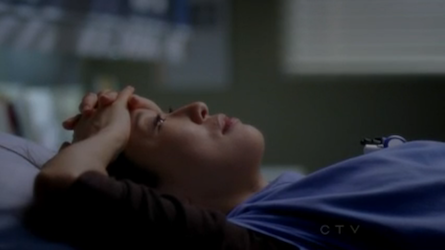
When it comes to “likeable” female characters on TV, you might think of Buffy Summers. Or Rachel Green. Or the Gilmore girls. But Grey’s Anatomy’s Cristina Yang probably isn’t one of them.

She’s abrasive, unfeeling, career-driven, ruthless and selfish. Everything a woman shouldn’t be, according to patriarchal norms.

Perhaps she could be more like the ousted Izzie Stevens, who was bubbly and sexy and baked cookies. Or the virginal and highly-strung April Kempner, whom Cristina praises for having “virgin super powers”, enabling her to be super-organised.

But I like Cristina just the way she is. She’s got her eye on the prize, won’t compromise her personal beliefs or goals to be liked or for a man, and she’s got “tiny little genius” hands that enable her to roll with the big guns.

This is why Cristina Yang is one of the only “feminist”—or “strong female”—characters on television. Nay, in all of fiction.

For one thing, she refuses to rely on her looks or her feminine wiles to get ahead. In “This is How We Do It” in season seven, she rejects Owen’s compliment about her beauty, saying, “If you want to appease me, compliment my brain.” (Stay tuned for more on beauty versus brains this week.)

And in last week’s final, we saw Cristina exercise her right to choose, and schedule her second abortion on the show, after much (mostly solo) deliberation. While excluding the opinion of her significant other and father of the future child wasn’t the most respectful thing to do, ultimately it came down to her choice, and she chose to terminate the pregnancy.

In season two, Cristina divulges that she’s pregnant to Dr. Burke and, again, makes the decision to get an abortion on her own. Whereas a character like Izzie seems to serve the pro-life agenda (she gave up her own baby for adoption when she was a teenager growing up in a trailer park, and convinced a HIV-positive woman to carry her pregnancy to term), Cristina resists the societal pressures to tap into her maternal instincts and give birth to a child she does not want.

Regardless of whose agenda could be seen as being served by Cristina’s character, she acts without fear of what other people will think of her.

As a person, no matter what gender, it is seemingly second nature to want others to like us, and to portray our best selves to them. Just look at the ritual of the date or the job interview. That Cristina defies this action (though we have seen her star struck when meeting surgeons like Tom Evans, and Preston Burke for the first time) makes her not just a feminist character, but a truly humanist one.

There are people in this world who challenge us, grate on us, and whom we genuinely don’t like or approve of. But that’s what makes the world go around. Cristina Yang being one of these kinds of people, and being portrayed to us as a whole person on television, with hopes and dreams and trials and tribulations and relationships and a career and no desire for children, and not just as the bitchy mother-in-law who lives off her husband’s money and needs a good fuck, is truly a sight to behold.

Related: Grey’s Anatomy Final Asks “When Does Life Begin?”

The Underlying Meaning in Grey’s Anatomy’s “Superfreak” Episode.

Sookie as Feminist? Hear Her Roar.

Are Our Favourite Fictional Females Actually Strong, or Stereotypes?

Elsewhere: [The Feel of Free] Cristina Yang + You Can’t Compromise on a Baby.

[Marinagraphy] Motherhood, Cristina Yang & Grey’s Anatomy.

Image via Home of the Nutty.

TV: Grey’s Anatomy Final Asks “When Does Life Begin?”


Last night’s Grey’s final saw the seeming collapse of Derek and Meredith’s marriage over Meredith tampering with the Alzheimer’s clinical trial just as baby Zola came into their lives, pending the finalisation of the adoption papers.

Derek chided Meredith for swapping the active drug with the placebo for Richard’s wife, Adele, asking her how she couldn’t differentiate between right and wrong. Meredith replied that to her, things aren’t just right and wrong; there are shades of grey (hello, her last name’s Grey!), and that she’d do it all over again if it meant that Adele got better.

Derek should know this. Back in season five, when Derek introduces Meredith to his mother, she exclaimed that Meredith was good for him: he’s black and white and she’s grey.

But it didn’t stop him walking out on his wife for failing to see her reasoning, much like Owen failed to see Cristina’s reasoning, and kicked her out after she scheduled an abortion without his input.

Yes, that’s right: Cristina’s pregnant, much to her dismay.

She doesn’t want a baby. Never has, and never will. But Owen can’t understand this, and pushes her to see his side.

Now, this is where it starts to get messy. I’m not ashamed to say I’m staunchly pro-choice, so much so that I take the line of reasoning that if in doubt, abort. Especially if the woman in question is young, a victim of rape or incest, or can’t afford to have a baby. To me, life begins when the foetus is out of the womb and has taken its first breath. But I agree with Owen in that Cristina should have allowed him to have a say in the matter of abortion. But I also think that if Owen married Cristina knowing she didn’t want children but thinking he could persuade her anyway, he’s an idiot.

Cristina echoes this notion somewhat when she informs her husband she’s pregnant. Owen is overjoyed; Cristina has a migraine.

She tells him flat out that she doesn’t want a baby, and he responds with, “Well, you have one.”

“Are you getting all lifey on me?!” she remarks in disbelief, while he proceeds to ask her how far along she is, and if the foetus has feet and hands. How dare he tell her when life begins, she reasons.

While the storyline is clearly personal, not medical, it seems that Owen leans towards pro-life, though that could just be because the foetus in question contains his DNA. I don’t think doctors should push their personal opinions onto a pregnant woman who is coming to terms with the “unwanted tissue” inside her. I would go as far to say that I don’t think doctors with pro-life beliefs should be practicing medicine.

Still, Cristina is absolutely right when she says she’s not “compromising” on a baby: “You don’t have half a baby!… You don’t ‘give a little’ on a baby.”

While it’s perhaps easier for the father to bow out on raising their biological child, mothers usually don’t have that (ad)option. Cristina just plain and simply doesn’t. Want. A. Baby. But if she has it, she knows she’ll love it. (That’s the risk women run when they give their children up for adoption.) Owen shouldn’t have put her in the position to do something she doesn’t want to do (“It’s not like pizza or Thai.”), thinking she will “come around” later.

While Derek and Meredith deal with the fall out of Meredith’s “wrong” decision, how will Owen deal with Cristina’s decision? Was it “right” or “wrong”? And how will Grey’s Anatomy continue to discuss the “when does life begin?” question?

Related: The Underlying Message in Grey’s Anatomy‘s “Superfreak” Episode.

Elsewhere: [The Feel of Free] Cristina Yang + You Can’t Compromise on a Baby.

[Marinagraphy] Resisting Motherhood in Grey’s Anatomy.

Images via VideoBB.

Megan Fox Too “Spicy” for Transformers?


A few weeks ago I caught a snippet from a Shia LaBeouf interview in the back pages of Famous, claiming that “Megan [Fox] developed this Spice Girl strength, this woman-empowerment [stuff] that made her feel awkward about her involvement with Michael [Bay] who some people think is a very lascivious filmmaker, the way he films women,” but wasn’t able to locate it again til this week.

Love her or hate her (personally, I lurrrrve her!), you’ve got to admire Fox for her outspokenness and, if that means, in this day and age, that she’s “Spice Girl”-esque, then so be it.

It’s kind of sad, actually, that to stand up to a cretinous misogynist and say “actually, no, I don’t want to be involved in a film where all my character does is lay about on a motorcycle while you direct the cameraman to get up-skirt shots of me” equates to being a caricature of pop-feminism from fifteen years ago.

I think LaBeouf was trying to remain loyal to both sides of the coin, but he has been critical of Transformers director Bay in the past. It’s just that he’s a guy and the star of the film, so they look the other way, whereas Fox is an apparently replaceable sex object who’ll never work in this town Hollywood again.

At least, that’s according to this week’s Famous, which has a somewhat-outdated story on Fox’s firing from the franchise, her replacement with Victoria’s Secret model Rosie Huntington-Whiteley, and her allegedly anti-Semitic remarks against Bay. The article references a 2009 interview with Wonderland magazine, and an open anonymous letter posted on Bay’s website, which was written at least a year ago.

When talking about the release of the latest Transformers flick with a male friend, he said Fox was an idiot for trash-talking Bay and expecting not to get fired for it. (There is no evidence to suggest Fox did think that, FYI.) I wondered why Fox is the scapegoat to illustrate not biting the hand that feeds you in standing up for herself and refusing to be objectified in such a “way that appeals to a 16-year-old’s sexuality”, while Bay is lauded for his special effects and partnership with Steven Spielberg.  He said he didn’t care; having a car with a button that you could press which turns it into your very own gigantic friend was cooler. Right: who cares how horrible the people making movies are, as long as the end product is good fulfills some boyish childhood fantasy, right?

Related: The Beautiful, Bigmouthed Backlash Against Katherine Heigl & Megan Fox.

“She Just Wants Attention.”

Gay Chicken: Latent Homophobia in “Why Would You Go Gay For?”

“With a Gun Between Her Legs”: Why “Strong” (AKA “Sexy” Whilst Being “Strong”) Female Characters Are Bad for Women.

Minus Two & a Half Men.

Elsewhere: [IndieWire] Shia LaBeouf Claims Megan Fox’s “Spice Girl Strength” Got Her Fired From New Transformers Movie.

Image via Semaj Blogeater.

TV: “What? A Woman Can’t Rescue a Man?”


“I’m still waiting for it to happen,” warlock Malcolm replies to Prue when she gets herself transported into a painting in the season two episode “The Painted World”.

“Yeah, well keep waiting, pal!” she replies.

You’ll be seeing a bit more about Charmed over the next few months as I work my way through the seasons.

Related: Witch Trial: Burning at the Stake on Charmed.

Image via YouTube.

Feminism is an Ocean… Or Some Sh*t.

From Shit My Students Write:

“Feminism is an ocean. It’s large sea of ideals created a powerful current of changes in waves. The waves of feminism beat the status quo for women just as the ocean’s tide beats and erodes the ocean.”

(Thanks to April for the link.)

Elsewhere: [Shit My Students Write] Feminist Bodies (of Water).

TV: The Problem with Serena van der Woodsen.


She’s got the clothes, the hair, and she’s mighty fine to look at. But that’s about all Gossip Girl’s Serena van der Woodsen boils down to.

I really liked Serena in season one of the show. I could relate to her because everyone thought she was this spoiled, vapid princess, but she showed her true self to her first love Dan Humphrey.

By the end of season two, she’d stopped evolving, though, and it turns out she was just a spoiled, vapid princess, intent on upstaging Blair Waldorf at every opportunity, stringing a multitude of guys along, and having her antics and dirty laundry on the cover of all the tabloids.

Like in the Cecily von Ziegesar (she made an appearance in last night’s final, telling Serena she’d “read a lot about her”) novels of the same name, Serena is the central protagonist of Gossip Girl. But unlike the books, the show has run with Blair and Chuck Bass in the driver’s seat; characters who have grown, changed and become more likeable as a result. Serena, along with her male counterpart Nate Archibald, followed closely by Dan, has remained a stagnant shell of a human being, like the kinds you overhear on the tram and thank God you don’t know them or, worse, aren’t like them.

There have been many a fan disappointed in and perturbed by Serena’s lack of development. Why has she languished in and regressed to the mindset of a highschooler, albeit with better clothes, more freedom and a more active sex life? Is she just “coasting on cuteness”? Most of her storylines seem to revolve around her busting her bust out in an evening gown or standing around looking bored and Amazonian-like. Just because she looks the way she does, doesn’t mean she shouldn’t be as well written as Gossip Girl’s other characters. In real life, how many of this type of woman do you know? Personally, I don’t associate myself with people with no personalities, who’ll turn on their besties for a taste of the spotlight, and who have no opinions save for what outfit they’re going to wear that day, so I don’t know anyone with the personality of a napkin Serena van der Woodsen.

But, let’s face it, Gossip Girl isn’t exactly a realistic interpretation of life. 20-year-olds don’t flit around the city unemployed, never wearing the same outfit twice, depending on Mummy and Daddy’s trust funds. And if they do, then that’s a reality I’m glad I’m not a part of.

This unreality and lack of character development makes the audience not care about Serena’s storylines. Personally, I loved the Juliet/Ben/Serena storyline, but it was because of the mystery surrounding who Juliet and Ben actually were and what their connection to Serena was, not because of Serena. And the latest development in the character’s tumultuous yet über-boring life leads me to make comparisons to the actress who portrays her, Blake Lively’s, life.

I remember when Gossip Girl first came out, Lively said in an interview that she was very low-key, didn’t like to go out to events and preferred to stay home and work on her Martha Stewart skills.

Flashforward four years and Lively’s oft-papped lifestyle is far from the one she naively spoke about. She’s Karl Lagerfeld and Anna Wintour’s muse, flitting from one European country to the next to attend fashion shows and sun herself on yachts. Not to mention her latest nude photo scandal.

While her acting’s not anything to write home about, Lively still has much more to offer than naked pics and Chanel ads. I just hope that it isn’t a case of life imitating art when it comes to Blake Lively and Serena van der Woodsen.

Related: The Beautiful & Damned: Serena Settles for Second Best.

Who Speculates About Domestic Violence in the Affleck/Garner Household.

Picture Perfect.

So Misunderstood.

Breaking the Mould.

Elsewhere: [Jezebel] Is Kate Hudson Coasting on Cuteness?

Images via Gossip Girl Fashion, Link Random, Fashion Under 100.

Event: Ain’t Nothin’ Gonna Break My Slutty Stride.

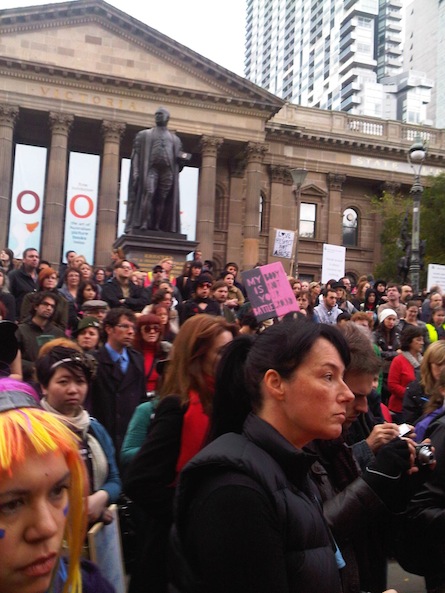
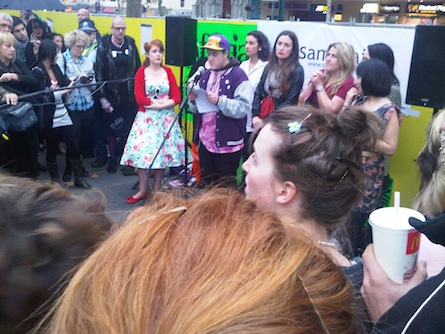
Ralliers outside the State Library on Swanston Street.

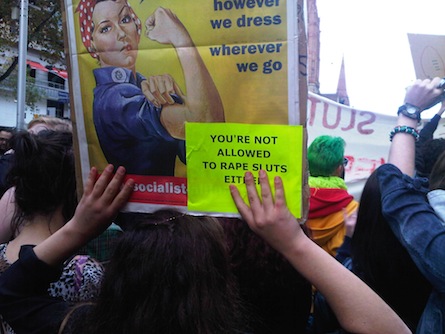
Best. Sign. Ever.

Last Saturday the highly anticipated SlutWalk occurred in several Australian cities, and I attended the Melbourne event with my fellow anti-slut-shamer friend Laura (both of us below).

We rocked up in our sluttiest outfits, which you can see above, complete with permanent marker declarations of our proud sluthood to boot. Some of the other outfits we noticed were short skirts with knee-high skull print socks and customised Doc Martins, worn by event organiser Clem Bastow (below), lace dresses and gym gear, the latter of which adorned a short-haired tattoo fan with a body Tracy Anderson would envy.

Clem Bastow.

Monica Dux.

As Bastow commented when she gave one of the opening addresses, along with fellow event organisers Karen Pickering and Lauren Clair, and noted feminists Monica Dux (above) and Leslie Cannold, amongst others: “thank you, God, it looks like you’re going to rain on me”. But no one was gonna rain on our parade and, despite the chilly temperatures, we still walked tall and proud in whatever get-ups we chose to wear.

Dux said this is the beginning of a movement, which I have to disagree with. SlutWalk is not the beginning of a movement; it is part of the reignited battle to stop victim-blaming and slut-shaming based on one cop’s archaic musings on rape and how much a woman was “asking for it”. Here’s a fun fact: WE’RE NEVER ASKING FOR IT! (See Bastow’s sign, above). No matter how we are dressed, where we are, how much we’ve had to drink, or what we do for work.

Speaking of, I was really proud to see the representation of sex workers at the event, and president of the Australian Sex Workers’ Association, the Scarlet Alliance (represent!), Elena Jeffreys (above) spoke about her sexual assault and that even though she was paid for sex, she was not consenting to assault. Her opinions on the SlutWalk were really interesting and I hope they receive as much publicity as the negative perceptions of the rally have in the media.

In the days leading up to SlutWalk, I was embroiled in a heated debate on Facebook with a friend who disagrees with the SlutWalk. I think he confused—like a lot of people—the meaning of the SlutWalk with an excuse to get gussied up in a very risqué manner when, in fact, that was not at all what it was about. That didn’t stop protestors on the steps of Parliament House at the top of Bourke Street brandishing their “rape is horrifying, but so is immodesty” placards (above). Like one of the speakers (whose identity escapes me: should have used my BlackBerry voice recorder!) said: it’s not up to us to curb our behaviour (and that includes how we choose to dress) at the risk of potentially being sexually assaulted; it’s up to those who sexually assault to curb their behaviour!

I think most people against the SlutWalk had a problem with the use of the word slut. As Cannold said, “words matter…: … we won’t stand for one, the same one, being slung at us over and over again to demean and degrade us.” Lori Adelman, in a post on Feministing, said she didn’t agree with the term “slut” and that she “would much rather have attended a ‘Do Not Rape’ Walk”:

“I find that the term disproportionately impacts women of colour and poor women in order to reinforce their status as inherently dirty and second-class, and hence more rape-able.”

To me, “slut” is just a word. It meant as much to me to be called a slut when I was 12 as it does today; as they (and Rihanna) say, sticks and stones will break my bones but names can never hurt me. It’s not about the term “slut”, it’s about the backwards and extremely offensive views that go along with that word. As coordinator of the first SlutWalk in Toronto, Sonya Barnett, told Rachel Hills: “if he [the policeman] had said something else, we would have called it something else.”

The speaker who garnered the most attention, though, was transgendered man, Cody Smith (above), who had been raped both as a biological female, and as a trans man. There were tears a plenty during his speech!

It was nice to see such a welcoming, non-judgmental turnout of everyday men, women and children of all walks of life, wearing all sorts of garb, not just the fishnetted and cut-out body con dresses that certain attendees chose to wear (guilty as charged!). After all, rape is not about what you’re wearing, what you look like, what size you are, how old you are, what your sexual orientation or gender is, or any other denomination that you happen to belong to as a person. It is about the perpetrator, and nothing you can or cannot do will stop them from attempting to rape you.

As Smith said, it shouldn’t be the victims of sexual assaults’ responsibility to educate the general public on sexual assault and victim-blaming. And I thought the sexual revolution happened several decades ago: it shouldn’t be up to members of a fringe movement to educate the general public on the sexual rights of women to express themselves however they please without the threat of retaliation. In fact, feminism—which is what the SlutWalk was all about—shouldn’t be considered as on the fringe in 2011.

Related: SlutWalk.

So a Tattoo Makes Me Public Property, Huh?

Has Feminism Failed?

Rihanna’s “S&M”: Is it Really So Much Worse Than Her Other Stuff?

Elsewhere: [Feministing] SlutWalk: To March or Not to March.

[Musings of an Inappropriate Woman] Ask Rachel: What Are Your Thoughts on SlutWalk?

Black and white images via Ali Ryan Photography.

Sucker Punch’s Emily Browning on Slut-Shaming in Hollywood.


From an interview with the cast of Sucker Punch, “Fight Club”, in NYLON:

“I had a very tame and mild love scene with Jon Hamm. It was like, heavy breathing and making out. It was hardly a sex scene. Baby Doll has been sexually taken advantage of by her stepfather, and the idea of the scene is that, at the end, she’s finally taking control of her own sexuality because she’s realised how she needs to find her own freedom. And it correlates with that sex scene. It’s her essentially coming on to him.

“[Jenna Malone, who plays Rocket in the movie says] ‘She’s in control!’

“Exactly! And I think that it’s great for this young girl to actually take control of her own sexuality. Well, the MPAA [Motion Picture Association of America] doesn’t like that. They don’t think a girl should ever be in control of her own sexuality because they’re from the Stone Age…”

The scene was cut.

Maybe if it had remained, Sucker Punch could have lived up to its girl-power hype and not amounted to what it did.

Related: Sucker Punch Review.

Image via IMDb.