I Scream, You Scream, We All Scream for Feminism!


Scream 4 marked the most recent installment of the horror franchise, which ended in much the same similar way as the past three chapters.

The killer comes back from the dead, gun-wielding Gale Weathers fires a bullet and central scream queen Sidney Prescott gets the last laugh, with fellow original Woodsboro survivor Dewey fumbling around on the sidelines.

Fifteen years after the original, it is still unbelievable as to how Dewey is on the police force, Gale is still a ball-busting rogue sleuth, albeit with a lot more Botox than the last time we saw her, and Sidney has finally wiped that weepy-eyed look off her face and is kicking ass and taking names.

In the first instalment, Sidney is an ineffectual twit who berates horror movie starlets for “running up the stairs when they should be going out the front door” when, only moments later, she does exactly the same thing!

But as I watched each movie, I slowly started to root for Sid. Not only was she dealing with the fallout of her mother’s death and the wrongful allegation against Cotton Weary for the crime in the first film, but she was also dealing with a rat of a boyfriend, Billy, friends, high school and trying not to crumble under the pressure of it all. So I’ll cut her a break.

In the second film, Sidney undergoes remarkable growth due, in part, to going off to college, but the audience can see in the way Sidney carries herself that she believes the murders are over. Oh, how wrong she was! I especially love the final scene in Scream 2, with Sidney outsmarting (one of) the killer(s), Mrs. Loomis, with the help of Cotton. Gale’s there, too, holding on til the bitter end.

The Scream franchise, after all, is about the women. It could be argued that most horror movies are about the women; female victims make for easy targets and garner more of a reaction from the audience. But Scream was one of the first mainstream horrors to advocate for equal-opportunity killing: where the men are as fair game as the girls, and two out of the seven killers have been women. More than that, they’ve been the masterminds of the whole operation; using the clueless and fame-hungry men as pawns in their bloody chess game.

Traditional horror operates on the premise that “she alone looks death in the face”. Not Scream, though.

Ashley Smith in “Final Girl(s) Power: Scream, writes of not only Sidney, but Gale and Dewey, staring death in the face:

“The success of the narrative is predicated now on not an individual woman, extraordinary and significantly boyish, but on the cooperation of two women who together stab, shoot and electrocute the two killers into oblivion. This moment is also notable because it is one of the many instances in Scream that utilizes very self-referential language, not only does it rework the figure of the Final Girl, it talks about itself reworking the figure of the Final Girl. This moment is an example of how the film explicitly works on behalf of the female spectator. Sydney/Campbell is speaking for and speaking as one of the girls in the horror audience who want to see active female characters fighting for each other, and significantly not even bound by a sentimentalised friendship.”

Sidney and Gale start out as sworn enemies (as murdered bestie Tatum Riley says after Sidney punches Gale: “‘I’ll send you a copy.’ Bam! Bitch went down! Sid: super bitch! You’re so cool!”), but I suppose bonding over the murders of pretty much everyone you know will solidify your connection, whether or not it’s one of mutual affection for each other, or mutual hatred for the killer(s).

And then there’s Dewey. He’s a funny character and David Arquette plays him to perfection, but the sum of his survival involves him always arriving to the party 10 seconds late and missing all the action. Sure, he’s been stabbed a few times, but he’s more of the token surviving male than a fully well-rounded character. As Smith writes, “the text allows for powerful and active female figures [that] it compensates [for] with weak, ineffective male ones”.

Before Scream, to survive as a “final girl” you had to be a virgin. This works well for high school victims, as a lot of high school students are virgins. And hey, this is the movies, so so what if it doesn’t reflect real life?

The first Scream begins with Sidney as a virgin, but in the height of the killings, she throws caution her virginity to the wind and has sex with Billy. In any other horror film, this would mean she dies. (Casey Becker, Drew Barrymore’s character, and her boyfriend, Steve, die in the opening scene, as does Tatum, girlfriend of Stu, later on in the movie in the doggy-door scene, above. You might imagine these kids to be non-virgins, as they’re in seemingly committed, loving relationships, but this is never directly addressed.) But Scream, being the “meta-text” that it is, takes a page out of Buffy’s book, and the non-virgin fights to live another day.
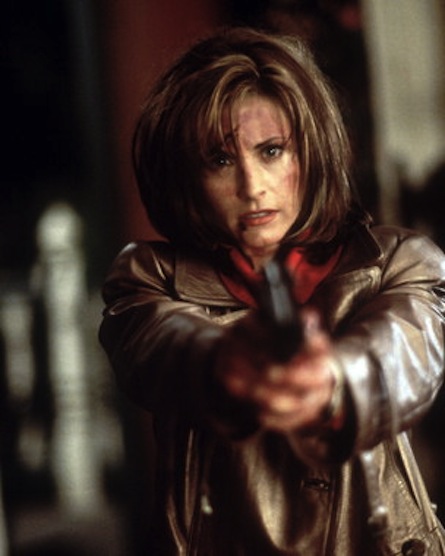
But the exemplar of a strong female character in Scream is Gale. She’s not only a ball-busting, high-powered tabloid journalist who fights to see an innocent man go free but, as I mentioned above, she’s always the last one standing, alongside reluctant partner-in-crime Sidney.

In Scream 4, she’s a struggling stay-at-home novelist with writer’s block, so when Sidney—and the subsequent murders—return to Woodsboro, she jumps at the chance to help with the investigations. Dewey, and his lovesick underling Deputy Judy, don’t want her interfering with the case, so Gale goes rogue.

It is Gale who uncovers most of the developments in the case, including who the killer is. And, according to Melissa Lafsky at The Awl, she’s breaking a lot of other ground, too :

“She [Courteney Cox] slashes her way out of the 40-something female stereotype, and takes over this movie with a flick of her scorn-ready… brow. Let’s face it: Few film archetypes are more brutal than the ‘older woman in a horror movie’—either you’re the psycho nutcase… or you’re the pathetic victim… And no matter what, you’re ALWAYS an obsessive mother.

“Cox pulls off a pretty impressive coup, upstaging not only the cute flouncing teens, but also her 15-years-younger self. Her character—now successful, childless(!), and utterly bored with the ‘middle-aged wife’ role—shrugs off all orders to ‘stay out of it’ and leaps back into the murderous fray, husbands, younger blondes and kitchen knives be damned. She takes nothing for granted, and thinks not a second about sneaking into dark corners to catch homicidal fruitcakes (and bitch is 47!!!). While Arquette and Campbell slide into their ’90s cliché groove, Cox reinvents and one-ups, kicking this meta-fest to life and providing the only sexy thing onscreen, gelatinous lips and all. Gale Weathers is shrewd, aggressive, cunning, but never heartless; despite it all, she still loves that stupefied ass clown Dewey. And she does it all while sporting a better ass than the 20-somethings. And… she doesn’t even have to die for it!”

You go, Gale!

Related: Scream 4 Review.

Elsewhere: [Girl Power: Feminism, Girlculture & The Popular Media] Final Girl(s) Power: Scream.

[Wikipedia] Scream Queen.

[Wikipedia] Final Girl.

[The Awl] Scream 4: The First Mainstream Feminist Horror Film.

Images via The Mary Sue, Dinoray, IMDb.
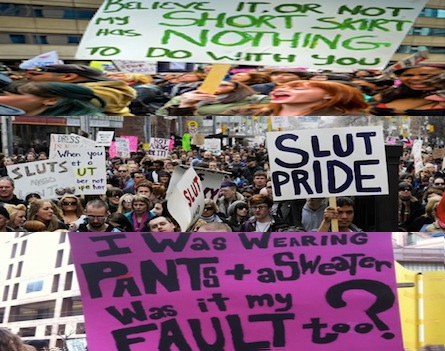
UPDATED: SlutWalk.

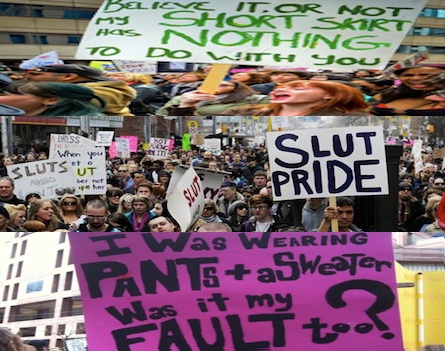
For those of you yet to be persuaded to join in the SlutWalk festivities this Saturday 28th May at the State Library, here are some excerpts from SlutWalker Jaclyn Friedman’s talk at the Boston, Massachusetts event, from Feministing:

“Is a slut a girl who has sex too young? With too many partners? With too little commitment? Who enjoys herself too much? Who ought to be more quiet about it, or more ashamed? Is a slut just a woman who dresses too blatantly to attract sexual attention? And what do any of these words even mean? What’s too young, too many partners, too little commitment, too much enjoyment, too blatant an outfit? For that matter, what’s a woman, and does a slut have to be one?

“… You can call us that name, but we will not shut up. You can call us that name but we will not cede our bodies or our lives. You can call us that name, but you can never again use it to excuse the violence that is done to us under that name every single fucking day.

“… We can be called sluts for nearly any reason at all. If we’re dancing. If we’re drinking. If we have ever in our lives enjoyed sex. If our clothes aren’t made of burlap. If we’re women of colour, we’re assumed to be sluts before we do a single thing because we’re ‘exotic.’ If we’re fat or disabled or otherwise considered undesirable, we’re assumed to be sluts who’ll fuck anyone who’ll deign to want us. If we’re queer boys or trans women, we’re called sluts in order to punish us for not fearing the feminine. If we’re queer women, especially femme ones, we’re called sluts because we’re obviously ‘up for anything,’ as opposed to actually attracted to actual women. If we’re poor, we’re gold diggers who’ll use sex to get ahead. And god forbid we accuse someone of raping us—that’s the fast track to sluthood for sure, because it’s much easier to tell us what we did wrong to make someone to commit a felony violent crime against us than it is to deal with the actual felon.

“You know what I expect will happen when I’m dressed like a slut? People will want to get with me. You know what I don’t mean when I dress like a slut? That anyone I encounter can literally do anything at all they want to me. I know. It’s shocking. Because clearly you thought me wearing my tits out like this gives every single one of you carte blanche to do anything whatsoever you might want to do with my body. I’m very sorry to disappoint.

“… I just want to point out how ridiculous it all sounds when you spell out the meaning of ‘she was asking for it.’ Because the rapists are not confused. Those tiny percentage of guys doing most of the raping? They’ve told researchers that they know full well they don’t have consent. It’s the rest of us that seem confused. We’re the ones that let them off with a little ‘boys will be boys’ shrug and focus our venom on ‘sluts’ instead, leaving those boys free to rape again and again.

“… There’s nothing wrong with being a slut. Not a thing. It’s OK to like sex. Sex can be awesome. It can be life-alteringly awesome, but even when it’s not, it can be a damn good time. Our sexual desire is part of our life force. And as long as you’re ensuring your partner’s enthusiastic consent, and acting on your own sexual desires, not just acting out what you think someone else expects of you? There’s not a damn thing wrong with it. Not if it’s a hookup, not if you’re queer, not if you like it kinky, not if your number’s too high. If you’re playing on your own terms and you’ve got an enthusiastic partner? Please, I beg of you, just have a fucking awesome time. Our lives are way too often full of struggle and pain. If you can do something with someone else that brings both of you pleasure and joy? You’re increasing the pleasure and joy in the world.

“There has been a lot of misunderstanding about the meaning of the SlutWalk, and none more egregious than those who claim our agenda is to encourage all women to be sluts. Whatever that means, our mission could not be further from that. Our mission here today is to create a world in which all of us are free to make whatever sexual and sartorial choices we want to without shame, blame or fear. If you dress and experience your sexuality in decidedly unslutty ways, and you know that there’s nothing we can do to make someone rape us, the SlutWalk is your walk, too…”

*

Never before (okay, this year) have I been so excited for something. That includes the multitude of costume parties I’ve been to this year.

About a month ago, I cottoned on to the buzz surrounding SlutWalk, an event spawned by Sonya Barnett and Heather Jarvis, after they heard a Toronto police officer telling a rape victim that she wouldn’t have been attacked had she been dressed less provocatively.

The first march was in early April, and was met with great success. Other events have been staged in Dallas, Texas and Boston, Massachusetts.

Next Saturday 28th May, SlutWalk comes to Melbourne, and I am beside myself with excitement. The only rally I’ve ever marched in was when I was 15, for (or rather, against) nuclear power with my mum, sister and bestie. I wasn’t really informed enough to have views on nuclear power back then, and I’m still undecided about it. Obviously the disaster in Japan highlights the question mark surrounding the idea of nuclear power in Australia.

However, I do have strong views about slut-shaming, rape, sex and reproductive rights, and I will be immensely proud to walk alongside my fellow sluts, as we reappropriate the word, much like the gays have reclaimed “fag”.

Obviously, rape is not about how a woman is dressed or how much lust she inspires in men, regardless of what she’s wearing. Women are raped when they’re on their morning jog, walking to and from work, out at night in their nicest outfit, or in their home by a friend or family member. I resent the comments that police officer made, and I will be wearing my “sluttiest” outfit in protest. But I’ll be wearing it with a prim and proper bun.

To join the SlutWalk, visit their Facebook page.

Related: Apocalypse Now: 2012 Come Early?

So a Tattoo Makes Me Public Property, Huh?

Elsewhere: [Feministing] “You Can Call Us That Name, But We Will Not Shut Up.”

[Facebook] SlutWalk.

Images via MamaMia.

Event: SlutWalk.

Never before (okay, this year) have I been so excited for something. That includes the multitude of costume parties I’ve been to this year.

About a month ago, I cottoned on to the buzz surrounding SlutWalk, an event spawned by Sonya Barnett and Heather Jarvis, after they heard a Toronto police officer telling a rape victim that she wouldn’t have been attacked had she been dressed less provocatively.

The first march was in early April, and was met with great success. Other events have been staged in Dallas, Texas and Boston, Massachusetts.

Next Saturday 28th May, SlutWalk comes to Melbourne, and I am beside myself with excitement. The only rally I’ve ever marched in was when I was 15, for (or rather, against) nuclear power with my mum, sister and bestie. I wasn’t really informed enough to have views on nuclear power back then, and I’m still undecided about it. Obviously the disaster in Japan highlights the question mark surrounding the idea of nuclear power in Australia.

However, I do have strong views about slut-shaming, rape, sex and reproductive rights, and I will be immensely proud to walk alongside my fellow sluts, as we reappropriate the word, much like the gays have reclaimed “fag”.

Obviously, rape is not about how a woman is dressed or how much lust she inspires in men, regardless of what she’s wearing. Women are raped when they’re on their morning jog, walking to and from work, out at night in their nicest outfit, or in their home by a friend or family member. I resent the comments that police officer made, and I will be wearing my “sluttiest” outfit in protest. But I’ll be wearing it with a prim and proper bun.

To join the SlutWalk, visit their Facebook page.

Related: Apocalypse Now: 2012 Come Early?

So a Tattoo Makes Me Public Property, Huh?

Elsewhere: [Facebook] SlutWalk.

Images via MamaMia.

The Gender Politics of the Royal Wedding.


From “Theory: Why Women Care About Princesses” by Echidne of the Snakes on Jezebel:

“… What is it that little girls seem, once again, to be emulating in their play? Cinderellas and ballet dancers. I believe that the reasons for those choices (by their parents and the toy industry and the society) are the same old ones: Here are role models for girls which apply even in a world of gender inequality, yet don’t truly alarm more egalitarian parents. Those role models are not that different from the models given to boys: football players, space heroes, characters with gigantic muscles and super-powers. That they are fewer and more anemic goes with the territory of gendered expectations.

“Sure, children grow past those types of toys, and they even grow past the gender-policing stage. But perhaps something remains, something which is then evoked by a royal wedding in women or a football game in men.”

Related: The Royal Wedding: The Other Event of the Decade?

Elsewhere: [Jezebel] Theory: Why Women Care About Princesses.

[Echidne of the Snakes] Homepage.

Images via Legitimate News, Vipfuly, Coco Perez.

Tina Fey on Women in Comedy, Olivia Munn & “Joan of Snark”.


From “Tina Fey on the Message of 30 Rock’s ‘Joan of Snark’ Episode” by Margaret Hartmann on Jezebel:

“That story [the controversy surrounding hottie Olivia Munn’s hiring by The Daily Show] is so loaded and complex that I was really glad that we did it and I think it has confused and sort of delighted the internet in a way because it sort of opens up more questions than it answers. For me it was about Liz is in the wrong. She thinks she’s doing the right thing by trying to correct this woman, by trying to say ‘you don’t have to be this way’ and at the same time, this girl has every right to be whoever she wants …

“It’s just such a tangled-up issue, the way that women present themselves—whether or not they choose to, as I say, put their thumbs in their panties on the cover of Maxim, and the way women judge each other back and forth for it. It’s a complicated issue, and we didn’t go much further saying anything about it other than to say, ‘Yeah, it’s a complicated issue and we’re all kind of figuring it out as we go.’

“In the episode we have a fake website, that we’re referring to a feminist website called JoanOfSnark.com that the women at Jezebel.com immediately recognized that it was their website basically. And it was a reaction to the way I saw Olivia Munn … treated on The Daily Show.

“… I don’t have the answer, but I find it interesting. That’s all I can say. I find it interesting that Olivia gets people who go after her sometimes on these sites—because she’s beautiful, I think is part of it. I think if she were kind of an aggressive, heavier girl with a Le Tigre mustache posing in her underpants, people would be like, ‘That’s amazing. Good for you.’ But because she is very beautiful, people are like, ‘You’re using that.’ It’s just a mess! We can’t figure it out.”

“Since Fey is probably the most prominent woman in comedy today, it can be frustrating when she raises thoughtful issues, then throws her hands up and says she just doesn’t know where she stands. It also seems she missed an important part of the discussion. People didn’t question Munn’s place on The Daily Show because attractive women can’t do comedy, but because she’s not particularly funny.”

Elsewhere: [Jezebel] Tina Fey on the Message of 30 Rock’s ‘Joan of Snark’ Episode.

Images via Jezebel, Complex, Daily Contributor.

Pretty Girl Bullshit.


White Girl Problems is the latest Twitter phenomenon to sweep the pop culture world, with such gems as “Fine, if that’s the way you’re going to act, then you’re uninvited to my Elizabeth Taylor memorial cocktails” and “I’m sorry you think I’m being a bitch”; the passive-aggressive “apology” heard in relationships the world over.

While the Twitter profile is poignantly taking the piss out of the problems of the privileged, there is the issue of race there, also.

Like, why is it called White Girl Problems? Why not Privileged Girl Problems? Or Rich Girl Problems? But even with that, it would be feeding into the classism debate. Whichever way you look at it, White Girl Problems is a double entrendre of racism and classism.

It also highlights the body image battle a lot of young girls face, be they white, black, rich, poor, or whatever. Here are a couple of examples:

While I’m not personally offended by the Twitter feed (I am a white girl with [first world] problems, after all), I can understand why some might be.

Racialicious, actually writing about the Alexandra Wallace/“Asians in the Library” scandal, says that it all comes down to “white female privilege”, meaning “you can say more outrageous shit because you’re a pretty white lady”.

That may be so (I have been known to voice my opinion on all manner of topics that may be deemed controversial: the baptism of babies being bullshit, pretentious parenting, and abortion [more to come on that last one in coming weeks]), but how long have men—of all races but, yes, particularly Caucasian ones—been getting away with it? And still are. Charlie Sheen and Chris Brown are two names that spring to mind…

Related: First World Problems.

Rihanna’s “S&M”: Is It Really So Much Worse Than Her Other Stuff?

Guilty Until Proven Innocent: Charlie Sheen’s Witness.

Why Are Famous Men Forgiven for Their Wrongdoings, While Women Are Vilified for Much Less?

Elsewhere: [Twitter] White Girl Problems.

[Racialicious] Go After the Privilege, Not the Tits: Afterthoughts on Alexandra Wallace & White Female Privilege.

Images via TV.IGN, Anu News, Film Junk.

Event: “Who the Bloody Hell Are We?”—The Sentimental Bloke at the Wheeler Centre.

I was so looking forward to “So Who the Bloody Hell Are We?: The Sentimental Bloke”, held on Monday night at the Wheeler Centre, which I attended with my staunchly feminist friend Laura (who has written for The Scarlett Woman here, and whom I’ve written abouthere) and staunchly MRA friend Andrew (who has also guest posted here and here).

I was rudely disappointed.

I expected the panel to delve into the masculinity crisis facing Australian men today by addressing such issues as rape culture in sport, domestic violence, metrosexuality and parenting. Well, three out of four ain’t bad.

I’m not the only one who felt that way, as Andrew Frank writes:

“I’ve got two words for you: Sarah Palin”—Dr. Anne Summers, AO.

I didn’t get it. Based on the participation rates of the laughter that followed, I don’t think half the audience did either.

Using a right wing American female politician to attempt to illustrate that there are no gender issues related to  men that hunt in contemporary Australia, only cultural ones, is using a form of logic that I can’t understand. But then again, she claims to be a feminist.

The setting was The Wheeler Centre, and the discussion loosely titled, “So Who the Bloody Hell Are We?: The Sentimental Bloke”. The presenter: Michael Cathcart. The panel was comprised of Craig Reucassel, founding editor of The Chaser newspaper and ABC television personality, Craig Sherborne, memoirist, poet and playwright, and Dr. Anne Summers AO, “best-selling author, journalist, and thought leader”. About that last one: I am worried.

Initially, the discussion promised to focus upon being a man, as individuals and as an ideal, in contemporary Australian society. This would include several aspects of particular relevance, such as parenting, the workplace, and various social settings. It would also examine the evolution of the ideals of masculinity, over the 20th century to the present. I was sadly disappointed.

After being egged on by Scarlett and Laura to “man up” [Scarlett Woman note: I say that sarcastically; I strongly disagree with “man-up” as motivation to be courageous.], I decided to ask the question that plagued me from the start, and gets under my skin from time to time. My question went something like this:

“I am a very passionate hunter. I do it because I love it, not because I need to feel manlier. This is something for which I am socially criticized, in a manner that suggests I use it as a method of compensation for feelings of being emasculated. Do any of you perceive any distinction between the social pressures placed on men of decades past to be the stiff-upper-lipped, emotionally suppressed and distant figure, and the social pressures contemporary Australian men are subject to in terms of being ‘metrosexual’ or the ‘Sensitive New Age Guy’?”

I missed Sherborne’s reaction, but Reucassel mocked hunting as an activity for the royal family {unbeknownst to him, I also fence!). Dr Anne Summers, screwed up her face and said, “Between being a SNAG and hunting?” in as condescending a tone as you can imagine.

It was asked that the microphone be returned to me. Reucassel asked me how I started hunting. I replied that it came to me through my Dad, and my Dad’s Dad. I then turned my attention to Summers again and stated that the hunting’s relevance here rested in the fact that according to my friends, hunting and masculinity were, for the distant father figure, and are, now, according to my friends, inextricably intertwined. It is the quintessential example of men today not conforming to the metrosexual, SNAG criteria.

Reucassel then said that the idea of hunting abhors him; that It is definitely an antiquated recreation, but it takes bravery to pursue in light of contemporary attitudes and if I want to, then more power to me. I respect his viewpoint. I would never force someone to hunt who didn’t want to, and he reflects my right to be autonomous in deciding where I get my food. But he missed the vital issue: is there a difference between my social pressure not to hunt and the social pressure on men from decades past to be emotionally restrained?

Insert Summers’ initial right-winged impression here, to which I didn’t get another chance to respond.

Sarah Palin hunts. I think Summers was trying to say that dealing with the bad rap that being a hunter carries is not specifically a male problem. And in that single fact, she is correct. So therefore, the issue faced here by hunters is not gendered, but cultural. However, to go so far as to imply that because Palin hunts, the social criticism of male Australian hunters—or indeed other men who engage in traditionally masculine recreational activities—does not warrant discussion is a fallacy. I believe that is what she intended to say. And soon after it became apparent from the comments of Cathcart and Sherborne that they believed she had jumped on the “cultural, not gendered” tack as well. However, because I did not warrant a detailed response, evidenced in hindsight by her curt reply and insulting tone, we cannot be sure. Perhaps she meant to say that Palin is an idiot, and therefore, all hunters are. But I shall continue through with the interpretation that Laura helped me conclude.

If we accept the premise of Summers, any criticism of my masculinity with hunting as evidence is blatantly flawed. Speaking regarding men in contemporary society, Summers has decided that the social reality is… wrong? Because a number of women engage in hunting, including the prominent Palin, they must be subject to exactly the same social criticisms that the men who engage in this statistically dominated male activity, right? If we accept this, Summers did not respond to me, as she intended. She responded to those that undermine the masculinity of Australian male hunters. Undermining my “masculinity in the metrosexual sense” because I hunt is wrong because women hunt, too. Unfortunately for her, your average person that rips on a hunter seems unaware of the tradition that hunting is a male thing. By the way: I hate that tradition. I really, really do.

On that count, any person seeking a discourse regarding being a man in contemporary Australia rather than trying to fulfill a feminist agenda would disagree. It’s like saying because both men and women are in the police force they obviously have precisely the same experience—I would have loved to get her started on that one pertaining to rape cases. If the topic for the evening had been, “The Sentimental Bloke and the Empowered Woman: Being a Man, Or a Woman, in Contemporary Society”, then perhaps it would have been a valid vein of thought. But could anyone really think that her premise was not flimsy and tenuous? She, too, missed the point: attempting to discern the differences and similarities of social pressure on males not to hunt and the social pressure on men from decades past to be emotionally restrained.

Discussion that followed pigeonholed me into the “shooter” stereotype as if I wasn’t even there. I won’t forget for a long time the sneer in her voice: “He’s a shooter”. I despise hoons that are hunters according to external perception, blazing through the bush with a beer in one hand and a gun in the other. Summers was perfectly willing to condemn me using a stereotype to which I do not conform. This after using a prominent female American politician, a single example, to attempt to nullify two gendered stereotypes and the resulting social pressures of two different eras that I wished to contrast. Yeah, that woman totally understood the topic for the evening. She is sooo smart! And yes, I’m bitter I didn’t get to verbally tear her to shreds.

The presenter, in my opinion, then made an awful mistake. Cathcart asked the panel, “Have any of you killed a mammal, and eaten it?” I think this was asked with the goal of illustrating the cultural differences between the contemporary and past societies in which hunters and men have existed. This wandered further still from the vital issue, as whether or not someone has killed an animal they have eaten and whether or not hunting is ethical does not address the relevant gendered issues. Reucassel said no, and then admitted to being a meat eater which, he realised, weakened his argument. Sherborne said yes, and told stories of how he grew up on a farm. Summers said no, and her admission to being a meat eater was accompanied with a bowed head.

In order to further display her tight grasp on the issues that were, but should not have been at hand, I remember Sherborne raising the following issue, when asked if he himself has ever hunted:

Sherborne: “Is fishing hunting?”

Summers: “No.”

Cathcart: “Why not?”

Summers: “I don’t know”

Cathcart ended that portion of the discussion with, “Well, I don’t know if we answered your question, but they certainly had fun ridiculing you”.

Subsequent audience questions referred to mine. They tried again to get at my “underlying question.” As far as I could tell, no such luck. My spirits were buoyed somewhat as I exited the room, as I heard the word hunting on the lips of four or five people, was complimented by a few others, and heard several chide the panel’s incorrect interpretation and inadequate response to my questioning. Walking down the street five minutes later I fortuitously heard an elderly couple discussing the exact same issue, and they could not have approved of my thoughts more.

Perhaps my motivation to have written all this down rests in the fact that I wanted answers—validation—and I didn’t get any. I am a hunter. I am also a kind, caring and sensitive man, who fully acknowledges the depths of his emotion wherever possible. I even have passing interests in skin care from time to time. The people on the stage were supposed to confirm my belief that pressures on me to be the latter (SNAG) are directly related to pressures not to be the former (strong, silent and conventionally “masculine”), and that the same situation with different polarities existed for men decades ago. Or, they were supposed to admonish this point of view, and provide me with enlightenment such that I could embrace my modern masculinity as the sensitive young man and the hunter with no sense of conflict.

But they didn’t. Aspects of life difficult for the contemporary sentimental bloke didn’t exist for every sentimental bloke. Consequently they were considered circumstantial and did not warrant discussion. Or difficulties that didn’t apply only for men, as women suffered similarly, meant that they did not warrant discussion. Or difficulties founded in culture were dealt with in a manner that suggested their gendered implications were irrelevant. Honestly, the only issue duly treated, was the evolution of male parents who now change nappies and push prams, juxtaposed against past male parents who would only pace outside the birthing room then work to support the child, occasionally throwing in a life lesson. Everything else was glossed over in a cursory fashion, played way, way down, or even straight out denied, suggesting that none of the panel members were prepared to really get their hands dirty and discuss issues that contemporary Australian men deal with in defining who and what we are. After all, even though the title of the event was “So Who the Bloody Hell Are We?: The Sentimental Bloke” it just wouldn’t be fair to deal with the impact issues have on men when they also effect women, would it?

Related: How to Make a Woman Fall in Love with You, Glee Style.

Double Standards.

On Stripping.

Unfinished Business at the Melbourne International Comedy Festival.

Images via The Wheeler Centre, Indie Posted.

So Misunderstood.

Do you ever feel like you’re misunderstood?

Rachel Hills does, in “Lessons in Feminist Activism, From Someone Who Has Been on Both Sides”:

“I felt like I was being mischaracterised… by 20 I was well and truly a feminist. A bottle-blonde, Elle Woods style feminist with a penchant for pink, perhaps, but very definitely a feminist nonetheless.”

And I certainly do sometimes. The other day I was called a “closet feminist”, which I found as offensive as if I had been homosexual and called closeted. Or, just because I take pride in my appearance and like me a new clothing purchase here or there, the copious amounts of blogs, articles, books and non-fashion-related magazines I read mean nothing, because people think all I read about is fashion. (To be honest, I find nothing more boring than reading about fashion.) Or, when I asked to borrow a copy of a friend’s Time magazine when they were done with it, they retorted with “why?! There’s no fashion or celebrity items in there!” (It was the 100 Most Influential People issue with Lady Gaga on the cover, so technically, there were celebrity items in there!)

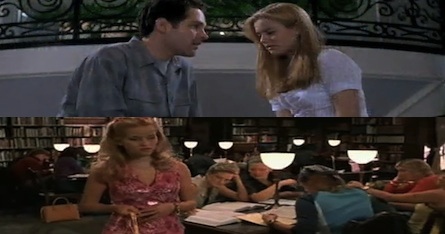
Sometimes I feel like my life is one big Clueless repeat. When Cher cracks it with Josh for telling her not to worry about her dad’s business going under and to go shopping instead, that is a constant conversation I seem to have with people in my life.

Or, in Legally Blonde, which Hills refers to, when Elle is shunned from Enid Wexler’s study group when she approaches them in her signature uniform of pink, bearing a basket of muffins; I can’t say an incident like that has ever happened to me, but I can definitely empathise with Elle’s dejected feeling when she’s deemed not worthy (or not smart) enough to join their group.

Not everybody makes me feel like this: I have a handful of very close friends who know me inside and out, and know that what I present myself as on the outside is not necessarily a reflection of what’s on the inside.

My defense mechanism is to put on a cold, ditzy, Valley Girl-esque persona, which is why most people don’t like me when they meet me. But at the end of the day, it’s not about what people who don’t know you think about you; as long as you, and the people close to you, are happy with who you are, not what you wear or what you choose to do in your own time, that’s all that matters.

Related: It’s All About Popular… Lar, Lar, Lar, Lar.

Women in Fiction: My Favourite Fictional Females.

What’s the Use of Being Supergirl if I Can’t Even Get a Date?

Pop-Culture Power Women.

Elsewhere: [Musings of an Inappropriate Woman] Lessons in Feminist Activism, From Someone Who Has Been on Both Sides.

[Musings of an Inappropriate Woman] Have You Ever Seen Yourself Through Someone Else’s Eyes?

Images via YouTube.

Kate Middleton is Nothing But an Accessory.


From “Falling Stars: The Plight of the Windsors” by Peter Conrad in The Monthly, February 2011:

“Some feminist critics complain that during the decade Kate spent waiting for William to propose, she worked only one year, as an accessories buyer for the fashion label Jigsaw. I’d say this was astute training for her role, since she is to function as an accessory.”

Image via This Memphis Belle.

“Oh My God, That Britney’s Shameless”—Britney Spears VS. Beyonce.


From an excerpt of “Pride from Behind” by Shabiki Crane in “Feminism for Real: Deconstructing the Academic Industrial Complex of Feminism” by Latoya Peterson on Racialicious:

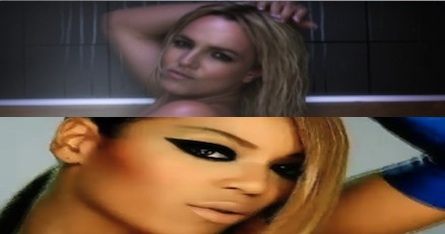
“… When white women like Britney Spears presented themselves in a sexual manner it was because they were asserting their sexuality; however when black women, like Beyonce did, they were simply being puppets and degrading themselves…

“Feminism dictates that women deserve to be equal to men; but the truth is it’s telling us that some women are more deserving than others.”

I disagree.

With Britney’s breakdown in 2007/8, the star’s mental health issues have come to light, leading most to make the assumption that Spears is more of a puppet, writhing—naked—to the beat of her management’s drum, while Beyonce—to me—is more of a woman in charge.

She’s one of the richest females in the business (granted, so is Spears), but she backs it up with talent, the courage of her convictions, and a keen eye for what the public want to see.

I agree with Crane’s latter assertion, that feminism works for some women, not all, but she’s watching a different media Circus if she thinks Beyonce comes across as the “puppet” in this equation.

What do you think?

Related: Feminist-Bot.

Britney Spears: Not That Innocent.

Like a Virgin, Take 2.

Did Rosie the Riveter Wear Hotpants?

Elsewhere: [Racialicious] Feminism for Real: Deconstructing the Academic Industrial Complex of Feminism.

[MamaMia] Is This Officially a Comeback?

Images via Fanpop, Supercrunked.