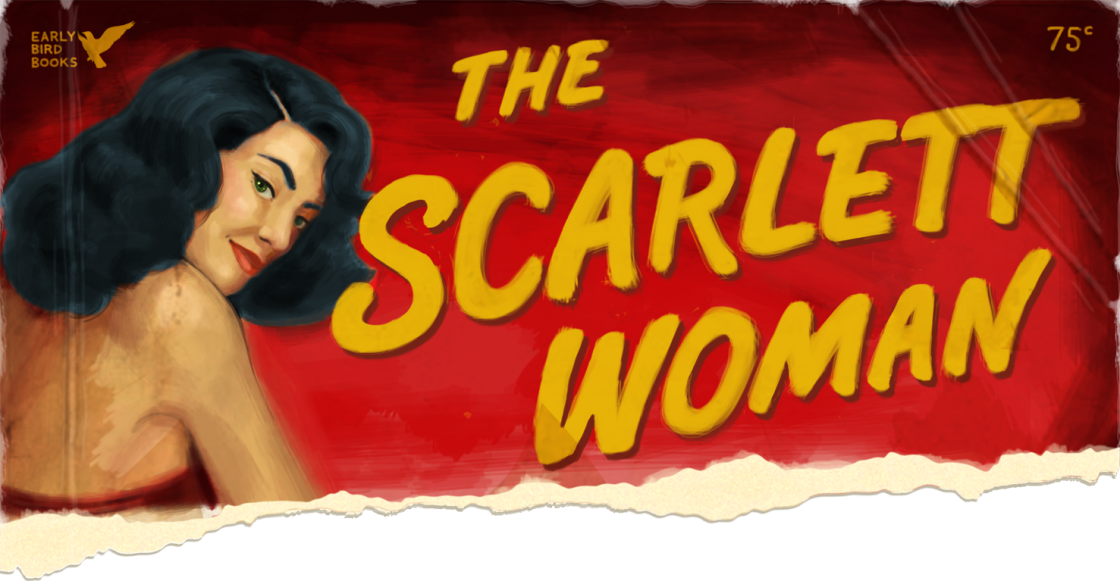
Magazines: Size Matters—Independent Zine ZINm Plays with Proportion.


You’d never catch a newsstand glossy changing its size, except for the occasional handbag edition of Cleo or Marie Claire.

But independent zines can afford to experiment with size, as this month’s edition of Marc Bonnici’s independent ZINm does.

Inside, Bonnici profiles his favourite magazine covers, from Ginnifer Goodwin on Lucky, to Adam Lambert for Galaxie, Elizabeth Taylor on her People tribute issue, and Nicole Scherzinger for Pride.

Related: ZINm Review, Issue 6.

George Michael Paper Dolls in Independent Zine ZINm.

Independent Zine ZINm Preview.

Elsewhere: [Marc Bonnici] Homepage.

Magazine Review: Time: The End of bin Laden, May 20, 2011.

I love a good Time cover, as the picture I used to have up in my loungeroom of Time’s 2008 Person of the Year, Barack Obama, would attest.

Needless to say, Time’s latest cover—of Osama bin Laden with a big red cross over his face—is a contender for cover of the year. (Stay tuned later on this week for another bin Laden-inspired contender.)

But this isn’t the only time in Time’s history that a dictator or human face of terror has been crossed out by the magazine. In managing editor Richard Stengel’s “Editor’s Desk” letter, he notes that the same was done for Adolf Hitler after his death in May, 1945, Saddam Hussein in April 2003, and Abu Mousab al-Zarqawi, “the scourge of Iraq,” in June 2006.

The issue is a September 11-heavy one, with interviews with Rudy Giuliani, mayor of New York City when that fateful day in 2001 occurred (p. 11) and CIA director Leon Panetta (p. 48–53).

In addition, there’s “Death Comes for the Terrorist” by David von Drehle, a detailed account of what went down the night of bin Laden’s death, and how his actions on 9/11 have affected the U.S.—and the world—between then and now (p. 12–25).

“Obama 1, Osama 0” (p. 26–31) is more about how Obama’s classy presidency brought down bin Laden instead of George W. Bush’s, which focused more on him making an ass(y?) out of himself. In the article, reporter Joe Klein calls Obama “discreet, precise, patient and willing to be lethal”, and wonders “whether Bush would have had the patience or subtlety to conduct this operation with the same thoroughness…”. He also addresses the President’s ability to laugh at himself (and his apparent 2012 presidential competition, Donald Trump), at the White House’s correspondents’ dinner 24 hours before the bin Laden announcement came, when he said deciding who to fire on The Apprentice is something that would keep him up at night. “… Two nights earlier Obama had been kept up trying to decide whether to launch the Seal team against bin Laden or take the stealth-bomber route,” Klein writes. That whole birther thing seems pretty trivial now, doesn’t it, Trump?

In Peter Bergen’s article, “A Long Time Going” (p. 38–41), he asserts that 9/11 was the beginning of the end for bin Laden’s “poisonous ideology”, and Aryn Baker asks “How Can We Trust Them?” (p. 54–57) of Pakistan, “the most dangerous country in the world”.

On a more lighthearted note, James Poniewozik compares “bin Laden’s bloody end” to “life imitating 24:

“The Twitter trending-topics list… filled up with references to OBL’s demise: ‘Navy Seals’, ‘Abbottabad’, ‘God Bless America’. And one more: ‘Jack Bauer’.”

I read an article on MamaMia the week the news of bin Laden’s death broke, where Mia Freedman recounted her life at the time of September 11, and recalls trying to protect her young son from the horrific images of the Twin Towers coming down. Fast forward almost ten years, and he’s studying it in history:

“I was jolted when he told me that. Partly, because I had tried so hard to shield him from the horror of 9/11 when it happened. But also by the fact he was studying it in ‘history’. In some ways, it seems so recent.”

But just how do you protect your kids from something like that?

Nancy Gibbs tells of this conversation between her 4- and 7-year-olds:

“‘They should have been more careful… They should have watched where they were going, the men flying the planes—they shouldn’t have knocked those buildings down.’

“‘… That wasn’t an accident. They meant to knock the buildings down.’

“Silence. Stubborn. ‘No, they didn’t.’

“‘Yes. They did. They wanted to kill those people. They were bad men.’”

But, Gibbs argues, children who grew up in the age of terror, “reached for their flags—the kids whose childhoods bin Laden had twisted, kids whose parents woke them up in the middle of the night to hear the President’s speech, kids who painted stars and striped on their cheeks as they danced off to school in the morning, kids who are more global, more diverse, more tolerant, more curious and more hopeful than ever before… Our kids learned early about evil. But they grew up learning how it is fought.”

Related: Osama bin Laden & Racism.

The Royal Wedding: The OtherEvent of the Decade?

Elsewhere: [Time] The Story of X.

[Time] 10 Questions for Rudy Giuliani.

[Time] A Revival in Langley.

[Time] Death Comes for the Terrorist: How the U.S. Finally Got Its Man.

[Time] Obama 1, Osama 0.

[Time] A Long Time Going.

[Time] How Can We Trust Them?

[Time] The 25th Hour.

[Time] Where Victory Lies.

[MamaMia] Osama bin Laden is Dead.

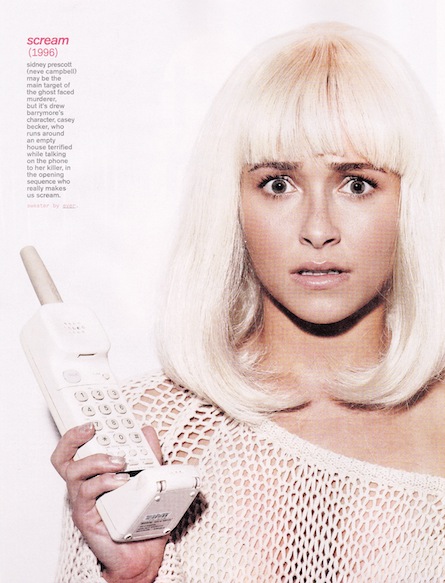
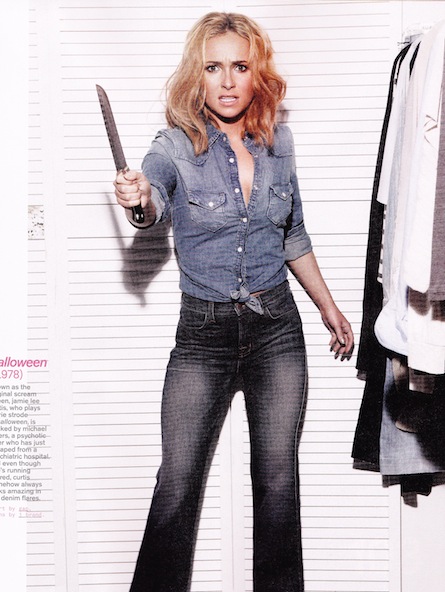
Hayden Panettiere Brushes Up On Her Horror Hottie History.


While Hayden’s got a long way to go before she reaches scream queen territory (her character, Kirby, *spoiler alert* dies in Scream 4, so she’ll have to achieve that feat elsewhere), she does a fine job of emulating horror heroines Carrie White (from Carrie, duh!), Drew Barrymore’s Casey Becker from Scream 1 and, especially, Laurie Strode—played by the “original scream queen”, Jamie Lee Curtis—from Halloween, in Nylon’s May issue, with Hollywood heirs and Scream 4 stars, Emma Roberts and Rory Culkin on the cover.

They say imitation is the sincerest form of flattery…

Related: Scream 4 Review.

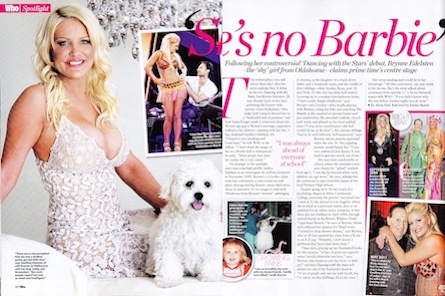
Brynne Edelsten’s “No Barbie”, But Should She Aspire to Be?

In this week’s Who magazine, Dancing with the Stars contestant Brynne Edelsten (formerly Gordon) divulges her “normal” childhood in “a modest four-bedroom home” in Oklahoma, and says that while she played with Barbies, don’t mistake her for one.

I’ve blogged numerous times about the virtues of Barbie; I jut don’t think she’s a damaging toy—or role model—for girls.

Edelsten, on the other hand, may be sweet and “shy”, but she’s got a long way to go if she wants to be viewed as someone other than Geoffrey Edelsten’s young, surgically enhanced trophy wife and un-co DWTS contestant.

Whereas Barbie is smart, confident, does dare to bare on the red carpet like Edelsten, but never looks trashy and, judging from her numerous careers in the physical field, is bodily synchronised. Then again, it’s hard not to be when you’re plastic.

Edelsten seems harmless enough, and the Who article reveals that she wants to be taken more seriously as not just Geoffrey Edelsten’s “shallow, pretty” wife.

She unbelievably survived the first elimination on DWTS; overcoming the odds. Now that’s something Barbie could relate to.

Related: Toy Story 3’s Barbie: Not as Dumb as She Looks.

Don’t Just Blame Barbie.

Is There Really a Beauty Myth?

Prime Minister Barbie.

In Defence of Barbie.

Magazines: Everyone’s a Little Bit Racist.


frankie’s latest edition is somewhat underwhelming, but there was one diamond in the rough: Justin Heazlewood’s “honest look at his relationship with Indigenous Australia” in “Black or White”.

I will admit that up until about two years ago when I started working in the cultural/tourism sector and really immersed myself in the Melbournian way of life, I was “a little bit racist”, as the Avenue Q song goes.

Now, I’m taken aback when friends, family members and, yes, even colleagues, express their racist views. Dare I say I’m offended on behalf of the racial minorities who are victims of racism on a daily basis. (I am primarily a white Australian, but I do have Native American heritage, and I have been the victim of latent racism on several occasions throughout my life). And there’ll be more to come on that later in the week.

Heazlewood references the homeless Aboriginals out the front of Woolworths on Smith Street in Fitzroy, who often get the short end of the stick when it comes to preconceived notions, but I was hanging out in Fitzroy last week and saw just as many drunk and intimidating bums who happened to be non-Indigenous.

But, as I discussed with a workmate over the weekend, city people are far more tolerant than country folk when it comes to race relations. I grew up in a small country town which claims to be the epicenter of Chinese immigration during the gold rush, and it certainly is. But I can only remember one indigenous kid and one Chinese kid at school… and I attended six different institutions!

It’s an interesting take on the cultural/racial gap in Australia, and probably the only reason to pick up a copy of the mag this (bi)month.

Related: VCE Top Designs: frankie Editor Jo Walker Talks to Media Students.

frankie Review: January/February 2011.

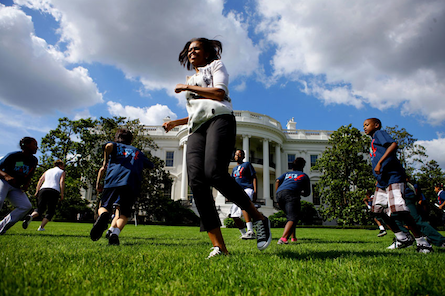
Magazines: Michelle Obama Combating Childhood Obesity Makes Her One of Time’s Most Influential People.


But that didn’t stop US conservative political commentator Rush Limbaugh from weighing in on Obama’s contribution to the cause:

“I’m trying to say that our First Lady does not project the image of women that you might see on the cover of the Sports Illustrated Swimsuit Issue, or of a woman Alex Rodriguez might date every six months or what have you. I mean, women are under constant pressure to look lithe, and Michelle My Belle is out there saying if you eat the roots and tree bark and the berries and all this cardboard stuff you will live longer, be healthier and you won’t be obese. Okay, fine, show us.”

It looks like she just did.

Elsewhere: [Time] The 2011 Time 100: Michelle Obama.

[MamaMia] Michelle Obama is Too Fat to Fight Childhood Obesity.

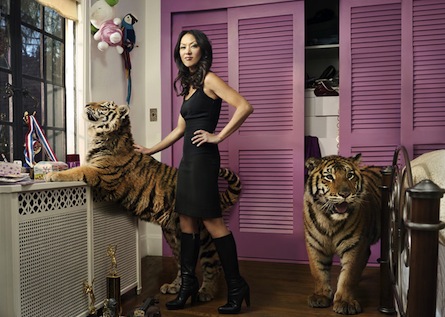
Magazines: Tiger Mom Must Be Doing Something Right. She Made Time’s 100 Most Influential People List.


Amy Chua, author of The Battle Hymn of the Tiger Mother, insists her memoir is a tongue-in-cheek look at parenting, not a how-to guide, or an exact account of how she raised her two daughters, Lulu and Sophia, who has her own blog to debunk the parenting myths surrounding her mother.

Like the burning of stuffed toys and destroying of Mother’s Day Cards because they weren’t up to standard. Speaking of, it’s Mother’s Day coming up…

Elsewhere: [Time] The 2011 Time 100: Amy Chua.

[Jezebel] Amy Chua’s Daughter Starts Blog to Defend Tiger Mom.

Image via Asia Finest.

Magazines: The “Evil” Woman.


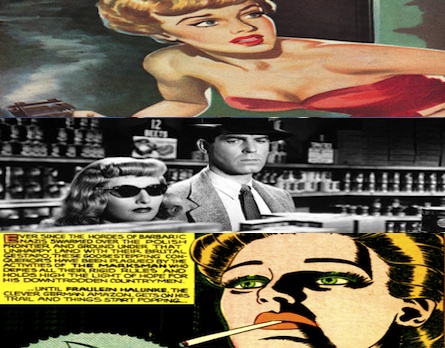
From “Women Behaving Badly” by Gabriella Coslovich in The Saturday Age’s “Life & Style” supplement, 30th April, 2011:

“The classic bad girl of popular culture is the femme fatale, a cunning criminal with a vixen-like beauty, usually pouty, platinum-haired, buxom and arch—from her stiletto heels to her finely plucked and penciled eyebrows…

“Meanwhile… there remain lingering assumptions about the way a woman should behave. One need only look at Prime Minister Julia Gillard, whose childlessness is often used to demean her, most recently by former Labour leader Mark Latham, who viciously accused her of lacking empathy and love (because having children has clearly given Latham copious quantities of both).

“In short, women whose ambitions waver from the ‘norm’, who have the temerity, say, to become prime minister, without having fulfilled their ‘God-given’ role of procreation, are still treated with suspicion. Audacity, it seems, is fine, to a point, especially if it adheres to the stereotype of woman as fashion-loving sex-object: Lady Gaga and her outlandish garb, Madonna and her extreme muscles. But try bucking convention in perhaps more profound ways—wanting to run the country, or fight for it—and female nonconformity suddenly becomes threatening. Which is why bold and rule breaking women are still worth celebrating.”

Images via Art Geelong, Yunch Time, unknown.

Magazines: Reality TV & Tabloids Take the Place of Soap Operas.

From “Cancelled: All My Children & One Life to Live” by James Poniewozik in Time’s Most Influential People issue:

“Soap operas, after all, are about immersion in the details and drama of a set of people’s lives. But they’re no longer alone in that. The Real Housewives shows, for instance, indirectly compete for the same mind space, offering a similar kind of serial storytelling, personal intrigue and shadenfreude—as do the offscreen narratives of the likes of Kate Gosselin and the Kardashians. For too many viewers, soaps are now just an alternative, which is why one of TV’s oldest formats is running out of lives to live.”

Images via Gamayca, Reality TV Magazine, Zimbio.

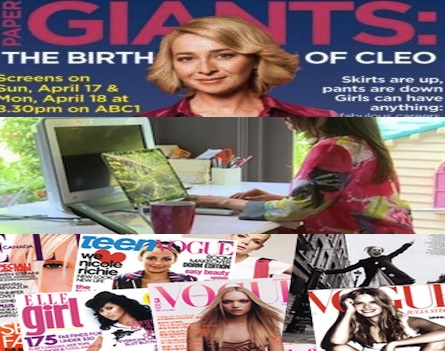
Magazines: Paper Dwarves, Digital Giants?


A few weeks ago, in response to ABC’s Paper Giants: The Birth of Cleo, Mia Freedman wrote on MamaMia about her thoughts on the state of the (mag) nation and if magazines are still relevant and the amount of influence they wield in 2011:

“… Not that much excitement goes on in magazines anymore… [It’s a struggle to] get them [those who work on a magazine] to try and think about something that hasn’t been done before, something that will start a conversation and boost sales.”

Freedman compares pay TV’s Park Street, a The Devil Wears Prada-esque reality show about ACP’s head offices, featuring the editors of Dolly, Cleo, Cosmo, Madison and Shop Til You Drop, which received dismal ratings and poor audience response, to the critical success and brilliant take on Cleo in her influential heyday of Paper Giants. She says, “Gemma Crisp [editor of Cleo] explained the editorial process that a story undergoes from conception to publication. It takes a minimum of three months… When was the last time you waited three months for something? Life doesn’t happen in increments of months anymore. It happens in moments, in text messages, in Tweets. It’s fast and it’s relentless and if it takes you three months (or even three weeks) to get from thought to print then that’s just too long to retain the attention of your audience.”

When she puts it like that, Freedman makes me long for a simpler time, when I hung on the every word magazines published, as opposed to reading hundreds of articles a week, mostly on blogs, but also in magazines, in an attempt to stay on top of my blogging game.

Erica Bartle, creator of Girl with a Satchel and a former mag girl herself, says Freedman’s “blog-cum-website” “deals in what everyone’s talking about TODAY. It feeds off the 24-hour news cycle. And Mia’s own profile. And her opinion… It’s like a current affairs program for women online.” And now with MamaMia launching on SkyNews, Freedman’s brand is literally a current affairs program.

Not all blogs can operate this way. MamaMia has a team of bloggers, editors and techs who keep the site running smoothly which thus, as Bartle said, allows it to operate on a 24-hour news cycle.

Personally, I have a part-time paid job I go to four times a week, this means I only get to blog two or three days a week, and with so much info to process and a maximum of 15 posts per week to churn out in a small amount of time, this means I can’t always post as early and as often as I’d like.

But even for those who blog fulltime, like Bartle, it’s not always about what’s happening right NOW as it is about maintaining the blog’s integrity.“I personally operate on a different plane, because my beliefs very much inform my work. For that, I’m willing to sacrifice certain economic constraints,” she says.

Still in the blogging world, you have someone like Gala Darling, who is very much a self-made businesswoman as a result of her über-successful blog of the same name. She’s gone from strength to strength over the past few years; something she could never have done had she been a magazine editor (bar the select few, like Anna Wintour, Anna Dello Russo and yes, Freedman).

But, essentially, MamaMia has the advantage of possessing “a figurehead with credibility whose background is in traditional media. She has the gut instinct of an editor. Online you need news nous as well as technological nous and business nous.”

Another editor who has these qualities in spades is former Cleo and Girlfriend editor, Sarah Oakes, whom Bartle worked under at Girlfriend. Bartle says she invoked an atmosphere of ghosts of magazines past, creating “camaraderie, creativity and positivity, which I think she achieved. She gave you more work if she thought you could be stretched; gave you a talking to if you had crossed a line; gave you a pat on the back for a job well done.” Very Ita-like, wouldn’t you say?

Oakes is now editor of The Age & Sydney Morning Herald’s Sunday Life supplement, a title which has improved markedly since she took over. (I have also blogged here about how I think both Girlfriend and Cleo became better titles under her leadership.)

In fact, newspaper inserts are giving the glossies on the newsstand a run for their money, as they “are getting exclusives and have strong writing and design teams, as well as columnists and styling/shoots. These free weekly titles, because of the mastheads they reside within, have enviable readerships and access to celebrities. They are also respectable, well executed and FREE,” Bartle notes.

But at the end of the day, are magazines relevant?

Freedman writes:

“The internet has not only sucked up their readers, it has also gobbled up their purpose: to be a way women form tribes and communicate. Now there’s YouPorn and any other number of sites for titillation, Google for questions about sex, and any number of websites or free newspaper magazines if you’re looking for other types of content or a magazine-style experience. Women don’t want to be spoken TO anymore. They want to be part of the conversation, something which the internet allows, in fact depends on… the internet has taken the sting out of the raunch-factor for mags like Cosmo and Cleo.”

Yes, as Freedman says, there are much raunchier locales to get what would have been included in a sealed section only a few years ago. There’s also Perez Hilton, TMZ and even shows like Entertainment Tonight and E! News that monopolise celebrity content, while the fashion blogs are more of a go-to for what kids are wearing these days.

Sure, Vogue’s always going to be a premiere source for high fashion shoots from photographers the likes of Annie Leibovitz, Patrick Demarchelier and David LaChapelle, but magazines “seem to exist on a strangely distant planet where all the people look like plastic and the sole pursuit is ‘perfection’. Except that perfection doesn’t really exist,” says Freedman.

When sites like Jezebel, Cover Girl Culture and, yes, MamaMia and Girl with a Satchel are debunking photoshop myths and striving for more realistic representations of women in the media, magazines are doing this movement any favours. (Except maybe Brigitte.)

And when you can get most of a magazine’s content online anyway (I passed on a near-$20 copy of US Harper’s Bazaar in favour of accessing interviews with Kim Kardashian and Hillary Clinton on their website), are they really worth it?

Bartle doesn’t think so. “No, but they need to be distinctive from what we can get online or elsewhere if we are going to part with $5-$10 to purchase one. Premium magazines, which I have no qualms spending extra on, include The Gentlewoman and O The Oprah Magazine, because they cater to my tastes, sensibility and need for a good read on a Saturday afternoon with a cup of tea.”

I agree with Bartle’s sentiments.

While online is great for content from individuals not curated and/or watered down by magazines editors to fit the mold of their magazine, holding a truly great glossy in your hands, like the appeal of a physical book, while at the hairdressers, a café or tucked up in bed, means magazines will always hold a place in our hearts.

Right next to the Kindle and Google Reader.

Related: Paper Giants: The Birth of Cleo Review.

Everything They Touch Turns To Gold.

The Evolution of the Bookshop at The Wheeler Centre.

Elsewhere: [MamaMia] Paper Giants VS. Park Street: Why Magazines Are Not What They Used to Be.

[MamaMia] MamaMia Gets a TV Show.

[Girl with a Satchel] Homepage.

[Girl with a Satchel] Mid-Week Media Musings.

[Gala Darling] Homepage.

Images via ABC, MamaMia, Teacup.