
Movies: Breaking Dawn—Sex is Bad, Okay? And You Will Be Punished for Having It With a Life-Sucking Vampire Foetus. Sorry, Life-Sucking Vampire BABY!*


Much has been made of Stephenie Meye’s Mormon ways in the Twilight saga.

Breaking Dawn was the first installment in the franchise I’d seen since I started this blog and steering it in a more feminist, gender studies-related direction, so I was thoroughly looking forward to all the anti-feminist sentiment the film would be imbued with.

Sure, there was the inspiration for the title of this post—that sex is bad—along with pro-life and abusive partner-sympathising messages, but all in all, the movie bombed. Big time.

The first half was meant to fulfill diehard fans’ fantasies of Bella and Edward’s wedding, which was filled with angsty Bella’s fear as her father walked her down the aisle, which dissipated when she saw Edward because, you know, she’s nothing without him who keeps her grounded and ready to face her life-altering circumstances, and their first bed-breaking love making session, which I will return to momentarily.

The second half consisted of talking CGI werewolves, a life-sapping foetus—sorry, “baby!” as Rosalie so adamantly reminds us—turning Bella into a shell of her former self (who was fairly shell-like to begin with) and her transformation into a vampire.

I have many problems with Bella and Edward’s relationship, but I’ll try to confine them to the bounds of Breaking Dawn’s storyline.

On their honeymoon, Edward and Bella have sex for the first time. Even though Stephenie Meyer did her darndest to save the consummation of the relationship til the confines of marriage, she makes clear, by Bella getting pregnant, that any kind of sex that’s not solely for reproductive purposes is bad. And if a wife tries to seduce her husband, who is so selfless that he forgoes his own pleasure so as not to hurt his new bride, she will be punished with a fast-growing, nutrient-depleting, monster foetus—sorry, baby! On her very first try at lovemaking! Talk about anti-sex sentiments!

(I will say that the role reversal here was interesting; when do you see the female essentially begging for sex from a withholding husband?)

The bruises and the broken bed that occurs from Bella and Edward’s first night together seem a little too close to what might eventuate from a domestic violence incidence. Bella has been brainwashed by her emotionally abusive partner so that she rationalises that his violent behaviour was somehow her fault that he couldn’t control himself. Classic Stockholm syndrome if ever I saw it.

And, of course, there’s the pro-life proselystisation that comes with Renesmee’s accelerated conception and birth. Fitting, considering the hullabaloo in the States, particularly, over abortion and “personhood”. (Does “personhood” apply when the foetus—sorry, BABY!—is only half human?) Under the failed personhood amendment, abortion would be outlawed, even in the case of rape, incest and when the life of the mother is threatened. Stupidity reigns supreme. I would like to think anyone in their right mind would terminate a life-threatening pregnancy, especially when the baby could potentially be a monster. At the very least, I’m sure a rich doctor who has an operating room (albeit one with floor to ceiling windows. Privacy much?) could have delivered the baby prematurely and placed it in an incubator.

Finally, what is up with Jacob imprinting on a newborn? And does Renesmee even have a say in Jacob’s undying love for her? Does Jacob’s imprinting mean that Renesmee essentially imprints on him, too? Or does she have to go about her life with Jacob waiting in the wings, whether she wants him there or not? If you though Edwards stalker tendencies were bad, you ain’t seen nothing yet!

Thank God there’s only one more movie left!

*Blanket spoiler alert.

Related: The Catholic Church is Not a Force for Good in the World.

Elsewhere: [Nightmares & Boners] Feminism, Sex, Abortion & Twilight’s Breaking Dawn.

[The Vine] Twilight Saga: Breaking Dawn, Part 1 Review.

Image via IMDb.
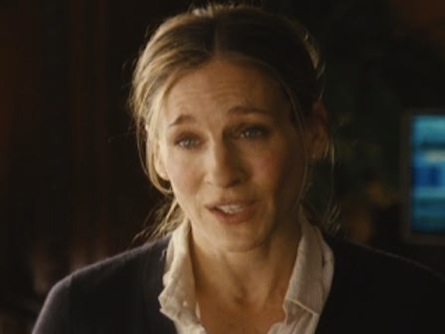
Movies: I Don’t Know Why They Keep Making Chick Flicks Like This*.


Even though I’m still young and don’t have a potential baby daddy on the horizon, I’ve been contemplating children lately. How many I want, whether they’ll be biological or adopted, and how I’m going to handle (a) tiny human(s) demanding my attention 24/7. I just don’t know how parents do it!

In this day and age, with the rise of the stay-at-home dad, it’s not always the mothers’ responsibility to look after the home, the family and her workplace.

I Don’t Know How She Does It would have you think otherwise, though. Sarah Jessica Parker’s Kate Reddy is a high-flying investment banker who has a nanny during the day, but tries to spend as much time as she can with “the cutest guy she knows”, her husband, played by Greg Kinnear, and her two kids. I got the feeling that she never slept (the constant list making in bed at all hours of the night probably lent itself to this), was a walking zombie, spent minimal time with her husband and kids, spent her weekends hosting kids’ birthday parties and never had a spare moment for herself. If this is what motherhood and family life is like, I’m withdrawing my application.

But it’s not just the “out of touch”-ness of IDKHSDI, as Dana Stevens called it in her Slate review (my friend, Tess, who I went to see the movie with, drew ire with Kate’s “chronic over-apologising” and “persecution complex”, and I have to say I agree), nor the unrealistic and polar opposite portrayal of stay-at-home mums (Busy Phillips’ character, Wendy, attends the gym from 8am to 2pm every school day. My mum was a stay-at-home one and I can tell you THAT JUST DOES NOT HAPPEN! I’m insulted on behalf of housewives everywhere.) that infuriated me. It was the blatant pro-life message the film pushed.

Kate’s junior co-worker, Momo, played brilliantly by Olivia Munn, was all about work, with some occasional no-strings-attached sex to balance it out. Momo is socially awkward, hates children, and thinks Kate’s family compromises her ability to do her job.

So when Momo finds out she’s pregnant and tells Kate she’s going to “take care of it”, Kate launches into a “creepy pro-life proselytisation”. In the next scene, Momo is keeping the baby. If that’s not a unabashed punishment for a young, attractive woman enjoying sex without commitment, I don’t know what is.

As Irin Carmon puts it, “… Why, if having a choice was so awesome, the young woman in the movie couldn’t have made another one. You know, the one she convincingly would have wanted to make.”

*Blanket spoiler alert.

Elsewhere: [Slate] I Don’t Know How She Does It Reviewed: Sarah Jessica Parker Rides the Rapids of Upper-Middle-Class Parenthood.

[Jezebel] My Group Therapy Session with Sarah Jessica Parker.

Image via BoxOffice.com.

Movies: Generation Y, Fame & Technology According to Scream 4.


Jill: “See, with you the world just heard about what happened but with us, they’re gonna see it. It’s going to be a worldwide sensation. I mean, people have gotta see this shit! It’s not like anyone reads anymore. We’re gonna know fame like you never even dreamed of… I told so many lies I actually started to believe them. I really think that I was born for this… Do you know what it was like growing up in this family; related to you? I mean, all I ever heard was ‘Sidney this’ and ‘Sidney that’. And ‘Sidney, Sidney, Sidney’. You were always just so fucking special! Well, now I’m the special one… What the media really loves, baby, is a sole survivor. Just ask you know who.”

Sidney: “[You killed] even your friends?”

Jill: “My friends?! What world are you living in?! I don’t need friends. I need fans. Don’t you get it?! This has never been about killing you. It’s about becoming you. I mean, for fuck’s sake, my own mother had to die… so I could stay true to the original. It’s sick, right? Well sick is the new sane. You had your fifteen minutes, now I want mine! I mean, what am I supposed to do? Go to college, grad school, work?! Look around; we all live in public now, we’re all on the internet. How do you think people become famous anymore? You don’t have to achieve anything. You’ve just gotta have fucked up shit happen to you.”

The meta madness that is Scream 4 really delves into the fame obsession Generation Y has, as well as the importance of technology: Billy Loomis was a suspect in the first Scream because he had a cell phone; now, as Jill said, everyone’s on the internet and anyone could be getting up to “fucked up shit”. Just ask that guy from The Collectors or that Melbourne couple on the run.

The movie also plays on living up to the standard of famous older relatives: Jill Roberts (meta!) to Neve Campbell’s Sidney could be seen as a reflection of Emma Roberts growing up with Julia as an aunty, or Rory Culkin forever living in the shadow of big brother Macaulay.

Related: Scream 4 Review.

I Scream, You Scream, We All Scream for Feminism!

Image via IMDb.

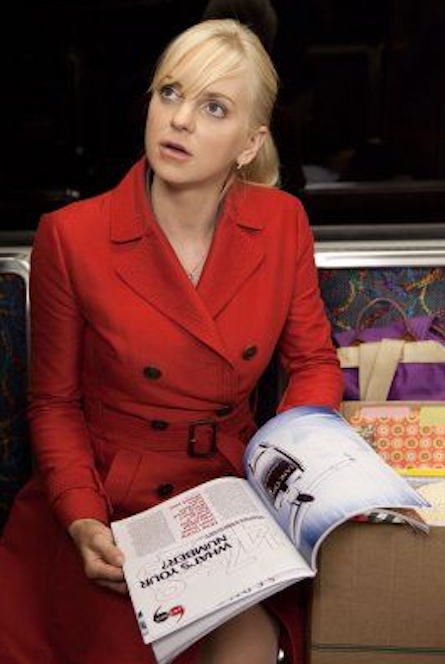
Movies: What’s Your Number Breaks Some Boundaries, Upholds Others*.


I’d been looking forward to What’s Your Number for a while; Anna Faris is not someone you always see in a leading role in a mainstream, big box office rom com with Chris Evans; there’s a whole host of up-and-coming actors and established comedians (Joel McHale, Andy Samberg); and it deals with the issue of slut-shaming, the first in my memory to do so since Easy A, to name but a few reasons.

But if 20 lovers is the be all and end all in a woman’s quest to get married, then Faris’ character, Ally Darling, is up shit creek without a paddle.

When she discovers after reading a women’s magazine article that she’s slept with 19 men, thus significantly lowering her chances of getting married, she vows not to sleep with one more man until she’s sure he’s the one. One drunken bachelorette party later, and she’s slept with her ex-boss (played by McHale).

During her quest to seek out all her exes so she doesn’t have to go above 20, she meets her across-the-hall neighbour, Colin (Evans). And you can guess what happens next…

While I did enjoy the storyline, and I do love me some Faris and Evans, I was sorely disappointed in two aspects of the climax: that Ally clichély falls down when she runs out of her sister’s wedding to find Colin (see the Women Falling Down video for just how cliché this really is), and that after she’s slept with Colin she gets a phone call from one of her past lovers claiming they never slept together, just that she got really drunk, gave him a mediocre lapdance and handjob, and then passed out in the shower. So yay, right?! Ally’s back to 20 and a) will get married, and b) isn’t a whore!

I particularly liked it, though, when the guy Ally dumps Colin for—her high school sweetheart-turned-big time philanthropist, Jake—discovers she didn’t lose her virginity to him in high school, straying when he was out of town. He says, “Big deal. So you’ve only slept with two guys in your life.” I laughed out loud at this point. I’m not sure how old Ally is meant to be (considering she says she didn’t go to her high school reunion at the beginning of the movie, my guess is she’s around 30), but Jake—or any guy, for that matter—is deluded if they think a 30-year-old woman is going to remain celibate from her first sexual encounter in high school til she meets her husband later in life. Sure, there are some women who this is true for, but it’s the exception, not the norm.

Jake then proceeds to judge Ally on how many people she’s slept with, evening saying “Eww!”

On the other hand, Colin in the embodiment of a modern man. He couldn’t care less how many people Ally’s slept with, just as long as she sleeps with him, I suppose! But really, who does care? Why is your “number” so important?

*Blanket spoiler alert.

Related: Easy A Review.

In Defence of Rachel Berry.

Elsewhere: [YouTube] Women Falling Down in Romantic Comedies.

Image via FanPix.

Movies: The Smurfette Principle.


I saw The Smurfs over the weekend, and let me tell you, don’t waste your money!

The Smurf era kind of bypassed me as a kid, so I had to get my housemate Eddie to explain to me that the Smurf’s village is the ultimate patriarchy in every sense of the word, with Smurfette (voiced by Katy Perry in the movie who, once again, is doing no favours for feminism) being created by the evil wizard Gargamel in an attempt to lure the Smurfs to him so he can capture their essence. Until then, the Smurfs went about their day to day activities female-free. Living the dream, right boys?

While there are of course racial stereotypes (the Scottish Smurf, Gutsy, who wears a kilt and has orange sideburns; the Italian Smurf who makes pizzas; Grouchy, played by George Lopez, who tokenises the angry American immigrant), with only one female Smurf and two other female non-Smurf characters (Jayma Mays’ Grace and Sofia Vergara’s Odile), I expected the film to be appropriately sexist. I wasn’t disappointed.

The fact that each Smurf is named for its personality was really the nail in the coffin, though. While Grace attempts to soothe Clumsy Smurf by saying that “no one is just one thing,” Smurfette would be the exception, with “likes dresses” being her only other personality trait aside from “girl”. The writers even make this a whole subplot point for her! But all girls like fashion, right, so we’re back to square one.

Related: Whipped Cream Feminism: The Underlying Message in Katy Perry’s “California Gurls” Video.

Image via Starcasm.

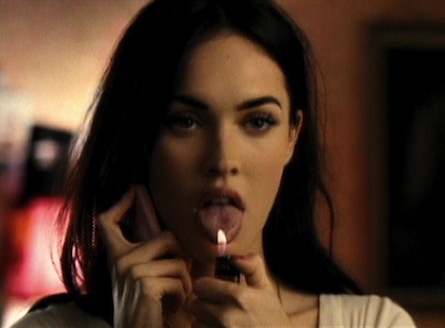
Megan Fox Transforms From “Android Ice Queen” to Relatable Person.


From an interview with Megan Fox on Moviefone:

“[Interviewer] This role seems to…

“[Fox] Make me seem human?…

“I just think the idea is that because most of the way that people have seen me, it’s the glorified pin-up girl with motorcycle boots who is also fighting to save the world. It’s not necessarily someone who you connect with because they’re not real people necessarily who exist like that—the glossy lips in the middle of the desert… You don’t necessarily see the human side of whoever is playing that person. And I just think [in] the media, in general, I just don’t really get portrayed as someone who has feelings or who is sympathetic. Or I sort of am portrayed as this—I feel—like a self-absorbed ice queen.

I feel people think I’m almost like a robot—like an android. And that I’m all about me and my thoughts are all about me. That I want to be famous.”

I can relate to these feelings expressed by Fox, albeit on a much smaller scale. I’m often accused of being a bitchy ice queen with no feelings because I choose not to express them in public. I feel like I’m also torn between citing my opinions and ideas and being attention-seeking or, at least, I think this is how people perceive my actions. I try not to let these things get the best of me, and it seems Fox subscribes to a similar school of thought. I can’t imagine how hard it would be for her to be dragged through the mud in the tabloids and the blogs when, to me, she seems like a genuine, relatable person, especially in this interview.

What do you think?

Related: Megan Fox Too “Spicy” for Transformers?

“She Just Wants Attention.”

The Beautiful, Bigmouthed Backlash Against Katherine Heigl & Megan Fox.

Elsewhere: [Moviefone] Megan Fox on Shia LaBeouf, Her Public Image & Starting Over with Friends with Kids.

Image via Broad Recognition.

Manic Pixie Dream Bitch.


From “The Pinup of Williamsburg” by Jada Yuan in New York Magazine, via Jezebel:

(500) Days Of Summer… told almost entirely through Tom’s perspective, was ‘actually very misunderstood,’ [Deschanel] says. ‘I can’t tell you how many guys, and girls, are like, “You did him wrong!” What, she’s a bitch because she didn’t want to date that guy? So? Are we bitches because we have our own opinions? If that makes me a bitch, or that makes women bitches, then maybe we’re all bitches.’”

Elsewhere: [New York Magazine] The Pinup of Williamsburg.

[Jezebel] Zooey Deschanel: “Maybe We’re All Biches”.

[Musings of an Inappropriate Woman] Elizabethtown, Garden State & the Alternative Flat Fantasy Female.

Image via Robray Burn.

Movies: The Change-Up Does Nothing to Change Stereotypes.


Remember when Katherine Heigl bit the hand that fed her and criticised Knocked-Up for being sexist and perpetuating women/wives-as-shrews stereotypes? Where was Leslie Mann, who played Heigl’s sister in the movie, and is director Judd Apatow’s wife, during all this?

Certainly she didn’t take Heigl’s valid-but-ill-received criticisms of the 2007 runaway hit to heart, as she is basically playing the exact same character in The Change-Up: shrewish, run-off-her-feet with three children and a seemingly successful job (she discusses something in the vein of building planning, so perhaps she’s an architect? What does it matter, right?), and stuck in an unhappy marriage in which her husband doesn’t find her attractive.

And what about Jason Bateman and Ryan Reynolds’ characters? Reynolds, playing man-child Mitch Planko, is a loser stoner who only peels himself off the couch to score 9-months-pregnant women, a job in a soft-core porno, and weed.

Bateman’s Dave Lockwood, on the other hand, is a successful lawyer who’s been with the same woman for 18 years and no matter how much he accumulates, he’s never happy.

The only other woman in the film with more than a few lines and a tit-shot is Sabrina, played by Olivia Wilde. If Mann’s Jamie is the overworked and undersexed Madonna, Sabrina is the work-hard, play-hard whore. She espouses clichés like “I prefer to be sexually harassed in my private life,” or something to that effect. Way to stand up for women’s rights there!

There was one redeeming quality to the film, if you look really hard. Jamie makes an astute observation about women and marriage, and is somewhat representative of a lot of women in long-term relationships or marriages who no longer feel loved or desired by their husbands, who are taken for granted and who are run off their feet with 2.5 kids and a job (although Dave helps to break the stereotype of absentee father who doesn’t engage with his kids). But this also does a disservice to other kinds of wives and mothers and families, who don’t have rich husbands and live in a mansion, by all accounts.

Oh, and the unrealistically pert breasts of a breastfeeding mother of three and the ass of a 17-year-old on a lady pushing 40 don’t do much to help real women, either.

Related: The Taboos of Sexual Harassment.

Elsewhere: [MamaMia] These Are the Un-Retouched, Un-Fake Breasts of a 33-Year Woman Who Has Breastfed Two Babies.

Image via YouTube.

Movie Review: The Help*.


Up until I heard about The Help’s release as a movie a month or two ago, I’d managed to miss all the brouhaha surrounding the release of Kathryn Stockett’s 2009 novel of the same name, and therefore didn’t even know it was previously released in book form.

I promptly jumped online to devour the racial criticisms on blogs of the book, and so was expecting a similarly clichéd film.

Much to my delight, the film manages to steer clear of most of these stereotypes, though in some parts, such as Minny miraculously deciding to take her five or six kids and leave her abusive husband, and the standing ovation the local black church gives to Aibileen and Minnie, who defied the social norms of the time and told their stories as undervalued and blatantly discriminated against “help” to Emma Stone’s Skeeter, are pretty unrealistic.

But Jessica Chastain’s Celia Foote, the naïve, Marilyn Monroe-esque housewife outcast from the social scene in Jackson by fellow stay-at-home wife Hilly Holbrook, played wonderfully by Bryce Dallas Howard, stole the show. She showed that not all white people felt disdain towards the black “underclass”, making them use a specially-installed outside bathroom and take separate taxis, which is one of the main driving plotlines of the story.

I can’t talk this film up enough. While it’s not the best movie ever made, it’s one you should see regardless. Also, look out for cameos by Private Practice’s Dell and True Blood’s Lafayette and Sarah Newlin. And make sure to bring the tissue box!

*It has come to my attention that I give away too much in my movie reviews, so the asterisk will now serve as a blanket *spoiler alert* from now on.

Image via YouTube.

Movie Review: Horrible Bosses*.


Horrible Bosses, despite being a “sophomoric”, Judd Apatovian-esque, “toilet-humour”-filled outing, was much better than I thought it would be.

However, putting aside how hilarious it was much I enjoyed it, there were some race and sex issues I wanted to discuss.

  • “Take us to the most dangerous bar in the city.” Which just happened to be full of black people. Racist much?
  • Men being sexually harassed by their hot female boss isn’t an issue. While Jason Bateman’s Nick and Kurt, played by Jason Sudeikis, have douchebag-asshole-psycho male bosses who are making their lives hell, Charlie Day’s Dave is being sexually harassed and manipulated by his “maneater” boss, Julia, played by Jennifer Aniston. She accosts him in her office wearing nothing by suspenders and a lab coat, she sprays him with a dental irrigation hose in the crotch to “make out the shape of his penis” and blackmails him with photos she took of them together while he was passed out in the dentists chair and she was half-naked. While the movie made it plain as day that what Dave was experiencing was pretty distressing, his buddies brushed it off, saying that in comparison to their bosses, his doesn’t sound so bad.
  • Crazy, manipulative bitches can have “the crazy fucked out of them”. This is an age old trope whereby uptight, bitchy, mentally ill and a myriad of other negative personality traits in women can have them gone, so long as they get a good fuck. Apparently, this isn’t the case, as Julie’s just as crazy as she was before Kurt slipped and fell into her during his reconnaissance mission.
  • Male rape doesn’t exist. Much like how True Blood dealt with it, when Dave cries rape after Julie shows him the aforementioned photos, his friends brush it off with a guffaw, saying there’s no such thing and if only they were “raped” by a boss as hot as his. Fail.
  • There’s such a thing as being “more rapable” than someone else. When their plot looks all but foiled by a comedy of errors, someone (probably Nick, the most level headed one) mentions the possibility of going to jail. Kurt says he can’t go to jail because he’d get raped like there’s no tomorrow. Nick says he would too, and Kurt asserts that he’s more rapable than Nick. They bring Dave in as tiebreaker, and he sides with Nick being more rapabale, as prison rapists go for “weakness” and “vulnerability”. Regular rapists do, too, if Dave’s dental chair experience is anything to go by!

*It has come to my attention that I give away too much in my movie reviews, so the asterisk will now serve as a blanket *spoiler alert* from now on.

Related: Bridesmaids Review.

Rachel Berry as Feminist.

Male Rape on True Blood.

Elsewhere: [Persephone Magazine] Gorgeous, Sexy, “Crazy”: The Fetishisation of On-Screen Mental Illness.

Image via IMDb.