The Changing Face of the Reality Singing Competition.

american idol judging panel jlo steven tyler randy jackson

There was a time, ten or so years ago, when American, and then Australian Idol, hit our screens and was judged by washed-up middle-aged music industry big wigs, like Simon Cowell, Mark Holden, Ian “Dicko” Dickson and the token women on the panel, Marcia Hines and Paula Abdul. These judges were mostly respected, if unfamiliar to Idol’s target demographic. Apart from Abdul’s “Opposites Attract”, I wouldn’t have known any of them from a bar of soap.

Not only was this before Britney, J.Lo, Mariah et al. demanded millions to sit in the judging chair, but it was also prior to the influx of talent shows; reality shows in general, really. Now we have myriad Got Talent’s, Voices’s, X-Factor‘s and the truckload of former and current stars it brings with it.

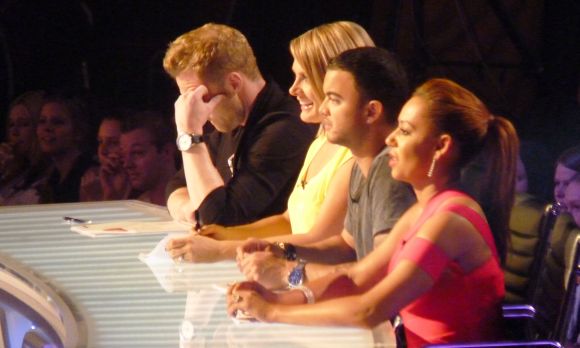
x factor australia judges

For every Britney and Christina, whose careers have been languishing in the pop wasteland for the last few years and could be helped by a judging role, there’s a Nicki Minaj, whose choice to judge the latest season of American Idol in the prime of her career baffles me. And we can’t forget Jennifer Lopez, who was the epitome of irrelevance prior to taking on the gig, and is now once again one of the highest earning performers in the industry (thanks, in no small part, to her franchise of perfumes) and deservedly so, as I saw her in concert last year and she is the consummate performer. Closer to home, Guy Sebastian, a reality singing competition winner himself, had a sprinkling of top ten and number one hits in the last few years, but really hit the big time with the Eve and Lupe Fiasco collaborations, “Who’s That Girl?” and “Battle Scars”, respectively, released after his turn as a judge on The X Factor.

x factor judging panel britney spears demi lovato simon cowell

So the “expert” record industry execs have pretty much gone the way of Dicko, albeit with the mainstays Cowell (The X Factor in the U.S.), L.A. Reid (ditto) and Randy Jackson from the original series of Idol, to make way for younger, sexier and more relevant judges, sometimes with an overhaul in between each season. And then there are the performers so out of place that were obviously hired ’cause everyone else turned them down: Demi Lovato, Khloe Kardashian (as a host) and, arguably, Nicki Minaj.

I think the new season of Idol’s focus on the feud between Mariah Carey and Minaj hinders not only the show (it’s about the TALENT), but also Nicki’s career in the long run. 2012 was perhaps Minaj’s strongest year to date, with “Superbass” being certified platinum, and “Starships” dominating the airways. While she’s never had a number one hit on the U.S. Billboard charts, Minaj was infiltrating pop culture at warp speed, so to her it might have seemed logical to dominate reality television as well. But, to me, singing competition judging panels are the domain of has-beens; people who’ve been down a similar road and can offer advice on the highs and lows of stardom. Who knows? Maybe Minaj will be the one to change that.

What do you think? Do you long for the no-frills early days of Idol, or are you all for big names on the judging panel overshadowing the talent?

Images via People, Wikipedia, Digital Spy.

On the (Rest of the) Net.

original

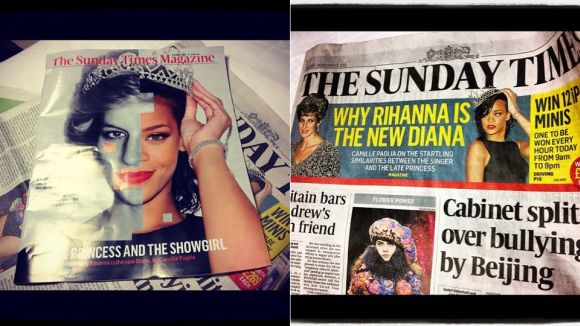
Are Princess Diana and Rihanna one in the same? Camille Paglia misguidedly seems to think so. [The Sunday Times]

Clementine Ford interviews Anne Summers as part of Daily Life‘s first birthday celebrations. Brilliant!

The face of porn (SFW). [Jon Millward]

Speaking of porn, is James Deen harmful to his young female fans? [Daily Life]

Lena Dunham isn’t “brave”. [Vulture]

How many models of colour walked in New York Fashion Week? Not many. [Jezebel]

Why have so many “contestants” on Celebrity Rehab with Dr. Drew died? [Jezebel]

Downton Abbey VS. Girls. [Daily Beast]

Why do we flinch when a woman says she’s beautiful? [Daily Life]

“Is There Such a Thing as ‘Asian Privilege’?” [Daily Life]

Stop the presses: Men Are From Mars, Women Are From Venus debunked. [The Age]

Reporting Reeva  Steenkamp’s murder at the hands of her Paralympian partner, Oscar Pistorius. [News with Nipples]

“In Defence of Diablo Cody.” [Female Gaze Review]

Kurt Cobain: feminist? [Daily Life]

In the vein of Nice Guys of OKCupid comes the racist guys of OKCupid: Creepy White Guys.

Image via Jezebel.

TV: The Underlying Message in Glee’s “Sadie Hawkins” Episode.

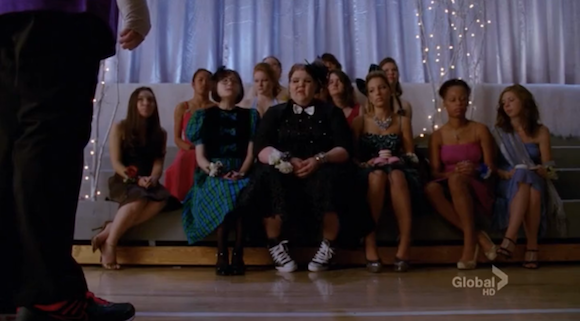
glee sadie hawkins dance

And that is: empowerment! Yay! ’Cause nothing is more empowering than a heteronormative school dance where the women ask the men to be their dates, right?

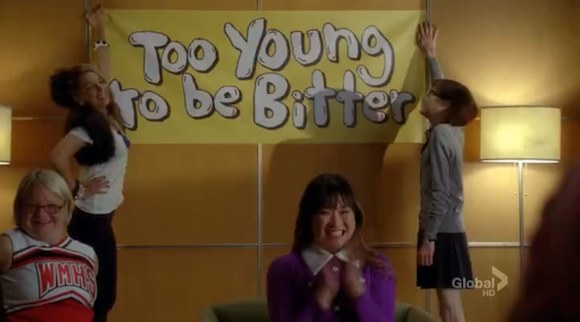
glee sadie hawkins too young to be bitter club

That’s according to Tina Cohen-Chang, at least, who comes up with the idea for a myriad of reasons: a prelude to the upcoming prom, an excuse to get close to gay crush Blaine, and something for her fellow “Too Young to Be Bitter” club members to get behind in their quest to become, um…, less bitter.

Coach Beiste is all for the dance, because Sadie Hawkins is a metaphor for empowerment, duh, as we’ve already established in the opening paragraph. But it’s not just about socio-sexual empowerment, Beiste says it’s also about gaining the strength to follow your dreams, as she did after her first Sadie Hawkins dance when she decided to follow her passion for football.

glee sadie hawkins lauren zizes

Beiste’s overweight and unconventionally unfeminine student counterpart, Lauren Zizes (who, by the way, hasn’t been seen since the end of season two. Way to go with the continuity, Glee writers), is part of the “Too Young to Be Bitter” club, too, and by the end of the episode has the courage to both ask Joe to dance at Sadie Hawkins and apply for a wrestling scholarship at Harvard. This, along with the other members’ success at the dance, apparently calls for the disbanding of the club because everyone’s empowered now.

But the undercurrent flowing through this episode was Blaine and Sam’s sleuthing regarding the Warblers: Sam seems to think the team is using human growth hormones because of their energetic stage presence, a video of Hunter Carrington allegedly ‘roid raging in a coffee shop, the Warblers’ suddenly larger physical appearance, and the testimony of former Warbler, sunshiney Trent.

Apart from being a suspiciously similar plotline to Pitch Perfect, it just goes to show that “Sadie Hawkins” was about completely superficial lipstick feminism and it was the boys who really saved the day.

Images via Ch131.

On the (Rest of the) Net.

girls patrick wilson

Is Girls‘ Hannah Horvath physically worthy of the sexual interest of a successful, hot, rich doctor? While detractors thought this week’s episode was the worst in the series, presumably because Lena Dunham’s “refreshing, yet displeasing to the eye” (to borrow a line from Elizabeth Banks in Pitch Perfect) naked body was front and centre perhaps more than any other episode, I actually thought it was the best of this season’s bunch, and I had no qualms buying Patrick Wilson’s character being so sexually into Hannah that he begs her to stay in his apartment for a 48-hour fuck- and naked ping-pong-fest. I will say that the gratuitous nudity and the continuous lack of people of colour is really getting my goat, though. [Jezebel]

Also related, apparently the utter disbelief at the abovementioned May-December Girls romance completely goes against a middle-aged man’s biological inability to resist a younger woman. A bit closed minded, but still valid. [Jezebel]

Let’s all stop bagging Rihanna for taking Chris Brown back and maybe look at why she did and what support we can give domestic violence victims. [Jezebel]

That time someone made a blog about all those times Michelle Williams was ostracised from the Destiny’s Child fold. Funny but cruel but also kinda true? [Poor Michelle]

Class divisions in Richard Scarry’s What Do People Do All Day. [Elsevier] 

James Bulger: 20 years on from his abduction and brutal murder. [Daily Life]

More equal opportunity nudity and sex on camera, please. [Jezebel]

The beauty myth: are people we perceive as beautiful really just average? [TheVine]

Following on from last week’s links on whitewashing in Hollywood, check out the ten most racist portrayals of characters of colour by white actors. [TheVine] 

Image via Rolling Stone.

TV: Modern Family is Anything But.

modern family mud portrait

After a recent spat with my housemate about the apparent modernity of Modern Family, in which he defended the show for its gay couple with an adopted Vietnamese baby and a strong Latino presence while I cried stereotyping, I decided I should actually watch an episode or two of it before I denounce Modern Family as an archetype perpetuating farce.

Now, with three and a half seasons and some informed opinions under my belt, I can wholeheartedly say I abhor the sexist tropes of the fiery Latina, Gloria, and the shrill, controlling housewife, Claire, and Modern Family’s blatant racism, homophobia and slut-shaming. Let me count the ways…

Right off the bat in the sixth episode of season one, “Run for Your Wife”, there were some troubling stereotypes about stay-at-home mums. When the Dunphy kids head off to their first day of school for the year, mum Claire looks forward to some downtime to get started on a new book. Phil, who’s supposed to be the breadwinner of the family, is also home and wants to hang out with his wife. After blowing off some open-houses he’s supposed to be putting on as part of, you know, his job as a real estate agent, Phil gets embroiled in a mid-afternoon jogging race with Claire.

As a child who grew up with a stay-at-home mum, I can tell you that I never once saw her sitting down to read a book in the middle of the day or challenge my dad to a childish competition. There was too much cooking, cleaning, washing, shopping and picking up to do. In fact, my dad was barely home and often working more than one job in order to put food on the table and keep us in a home one fifth of the size of the Dunphy’s, which is more than we can say for Phil who is rarely shown at work.

While the acting of Ty Burrell (Phil) and Julie Bowen (Claire) is something to write home (or at least the awards shows) about, their characters leave a lot to be desired. Phil is always dropping the ball (or getting it thrown into his face, as in “Door to Door” in season three) on being a functioning human being, let alone a good husband and father, and Claire often refers to him as her fourth child (she technically only has three: Haley, Alex and Luke). The trope of wife-as-replacement-mother is a tired one, but that doesn’t stop Modern Family for milking it for all it’s worth.

This brings us to Gloria, who is anything but. She’s young, sexy and, most notably, a loud, sassy Latin woman who’s always getting arked up about something. In season one’s “Up All Night”, Gloria’s son Manny’s dad comes to visit. While Gloria is now remarried to the older and dependable Jay, ex-husband Javier is a fellow fiery Latino who tries to make up for his absence by showering Manny with extravagant gifts. In the episode, Javier takes Jay and Manny to a baseball field in the middle of the night, and the next day comes bearing motorbikes. Gloria becomes audibly incensed that Jay’s falling for Javier’s tricks, like she used to, and storms off, yelling in Spanish. Every portrayal of a Hispanic woman in pop culture doesn’t have to be that of the “hot blooded” Latin mama; just look at the gay, Latina orthopedic surgeon Dr. Callie Torres in Grey’s Anatomy, a show that is far more modern than one with that word in its title, for example.

Speaking of the gays, what portrayal of contemporary American life would be complete without the requisite homosexual couple with an adopted Asian baby? Certainly not Modern Family, which turns the gay dial up to eleven with stay-at-home dad, former farm-dweller and part-time clown Cam, the uptight, dogmatic (unsurprisingly the brother of Claire) lawyer Mitchell and their über inappropriate ways. For example, in “Run for Your Wife”, Mitchell accidentally bumps baby Lily’s head against a door frame, and they take her to the doctor. The doctor happens to be Asian-American, so Cam embarks on a sermon about how he and Mitchell intend to raise Lily with influences from her Asian roots, completely disregarding the fact that the doctor was born and raised somewhere in middle America and identifies first and foremost as an American.

Later on, in season two’s “Unplugged”, Cam and Mitchell try to get Lily into a preschool. When they realise Lily’s going up against an adopted African-American boy with disabled-lesbian parents for the last spot at a prestigious private school, Cam flubs the interview by emphasising his 1/16th Cherokee heritage and speaking in pidgin English. As someone who is also 1/16th Cherokee, I’m sure you can imagine my offence at this.

Cam, as I’m sure you can imagine if you don’t already watch Modern Family, is the flamboyant half of the couple, and enjoys dressing Lily up as famous gay icons and encouraging her creative side. In the episode “Chirp”, in season two, Cam goes against Mitchell’s wishes and has Lily film a commercial for a furniture store. The ad is completely racist, using emphasised Asian accent voiceovers and Godzilla, and when Mitchell points this out, Cam uses the defence of hipsters the world over: “It’s ironic.” I suppose because they have an Asian kid, they’re allowed to be racist…?

While there are some redeeming qualities throughout the show’s run, such as the “Mother’s Day” (season two), “After the Fire” (season three), and “Schooled” (recently aired as part of season four) episodes which seek to unpack gay parenting and stereotypes of femininity, masculinity and homosexuality, it’s also rife with slut-shaming (Jägermeister is a magic potion that puts girls to sleep but instead of waking up “in a castle, you wake up in a frat house with a bad reputation” in “Moon Landing”, whilst Phil marvels in “Travels with Scout” that with his “emotionally distant father” it’s a miracle he didn’t end up as a stripper), homo- and transphobia (dad Jay insinuates that Mitchell is a cross-dresser because he’s also gay in “Starry Night”), and jokes about domestic violence (when Mitchell asks his dad to teach him how to fight in “Game Changer”, Jay asks if he’s having problems with Cam).

As I’m sure Glee can attest, an after school special-esque episode here and there doesn’t make up for Modern Family’s utter lack of modernity the majority of the time.

Related: The Underlying Message in Glee‘s “On My Way” Episode.

Elsewhere: [Chica & the City] Casting Call for “Hot Blooded” Latina Moms Makes My Blood Boil.

Image via BuddyTV.

On the (Rest of the) Net.

beyonce superbowl

What was so great about Beyonce’s SuperBowl performance, anyway? In fact, the article could be titled, “What’s so good about Beyonce, period?” Don’t get me wrong, she’s an incredible performer with an amazing voice and I love pretty well all of her songs, but she does push a pretty conservative message (“Independent Women” really just want to “Cater 2 U” and “Put a Ring On It”) and is blandly uncontroversial. Her most scandalous moments are the rumoured fake baby bump and lip synching at the Inauguration. What do you think? Is Beyonce a positive black female role model, another pop star pandering to the patriarchy or do you just not care that much about her? [TheVine]

A 5-year-old girl was caught with her mouth on a 5-year-old boy’s penis: cue outrage. This article brilliantly highlights the importance of letting kids be kids, and that sometimes means “playing doctor”, playing “the sex game” and mucking around pretending to be “sexy” and “do sex” when they have no idea what those words mean.

“Kids aren’t gonna stop rubbing themselves, each other, and tetherball poles, so what’s the point of making it a scary, bad thing? Besides, this isn’t really about sex, so let’s not make it about sex. It’s learning about our bodies and the bodies of other kids, and doing things that feel good.

“You have to wonder how a big hubbub over truly normal shit can affect a kid in the long run. Will they eventually develop a sex-negative attitude? Will developing a happy, healthy sexuality be more difficult for them? As many of us know, childhood scars run deep.” [Jezebel]

Iron Man 3 is just the latest in a long line of films (Breakfast at Tiffany’s, The Last Airbender, The Lone Ranger, and Snow White & the Huntsman when it comes to able-bodied actors playing the seven dwarves) to use a white actor portraying a character of colour. [Kotaku]

In a similar vein, whitewashing non-white stories in Hollywood. [Daily Life]

The conundrum of being sexy but not sexual in the Japanese pop world. [Daily Life]

Reexamining Paris Hilton as a cultural icon. [Thought Catalog]

In praise of Liz Lemon. [Jezebel]

Image via Buzzfeed.

TV: The Carrie Diaries—“Mumbling Incoherently Does Not Mean She’s ‘Into It’.”

the carrie diaries fright night larrissa passed out

Last week the female anatomy and empowerment were addressed, and this week The Carrie Diaries was all about the disenfranchisement possession of the female anatomy can sometimes beget.

It was Halloween, and Carrie took Walt to another one of Larissa’s fabulous parties in the city. (How these 16-year-olds manage to club- and party-hop without any mention of fake IDs is beyond me.) Carrie met a hot young writer for her bible, Interview magazine, and ditched Larissa and Walt for him, who both happened to be high on ecstasy and LSD. Later, while Carrie was tending to a strung out Larissa, her crush, Bennett,  was cruising Walt, who flipped out and left the party for the streets of New York. When Carrie left Larissa passed out on a bed that doubled as a coat rack (isn’t that the beginning of an episode of Law & Order: SVU…?) to get back to flirting, she finds out that Walt’s gone missing. Carrie admonishes Bennett for letting her friend go missing, when she was the one who left him at a party in the city whilst he was high for the first time. Whilst Carrie’s stressing out about one friend going missing, the other is getting molested while she’s unconscious by a guy in a lion costume. Carrie employs her newfound feminism to tell the extra from the cast of Cats that “mumbling incoherently does not mean she’s into it” and that being unconscious is not an invitation for sexual advances.

The Cowardly Lion calls her what all feminists have been labelled at one point or another, a killjoy, and Bennett tells Carrie that “Larissa got herself into this mess” by taking drugs. After smoothing things over, Carrie entrusts victim-blaming Bennett to watch over Larissa while she takes to the streets to look for Walt. You’d think someone as small-minded as Bennett would insist she stay indoors while he heroically braves the parasites of the city to find her friend, lest she bring on a sexual assault herself. But Carrie just tells him not to “take advantage of her while she’s passed out” to which Bennett replies, “She’s not my type.” You mean unconscious women aren’t sexually attractive to him? There may be hope for Bennett yet—oh wait, he was insinuating that women in general aren’t his type, not just passed out ones. Nevermind…

Related: The Carrie Diaries—The Vagina Monologues.

Image via Ch131.

Book Review: Vagina—A New Biography by Naomi Wolf.

an-Vagina-20a-20new-20biography-20by-20Naomi-20Wolf-20120914122340310908-300x0

The title of Naomi Wolf’s latest, Vagina: A New Biography, promised great things, to my mind. I envisioned the book taking aim at the stigma, use and abuse of the female sex organ throughout history, both physically and ideologically, and why we still think of it as ugly, dirty, alien and taboo.

Vagina certainly analyses this for the bulk of the middle part of the book, talking about the actual chastity belt (p. 143) and the “similarly constructed device” called a “scold’s bridle”, “made of iron and leather, locked around a talkative or argumentative woman’s head” to “gag her mouth” (p. 144). Here, we see that the vagina has been a metaphor for the female voice, insinuating that headstrong and opinionated women are also “loose” women. Wolf goes on to mention William Shakespeare’s Titus Andronicus and the heroine “Lavinia’s mouth and vagina are both assaulted in repeated acts of silencing and control” (p. 144). When it comes to sexual assault, it seems not much has changed, then.

Wolf also touches on hysteria, which literally derives its meaning from the Greek word for uterus, hystera, but for the most part, Vagina is an excruciatingly heternormative and cisgendered look at what it means to be a woman. Wolf may claim that erotic literature such as 50 Shades of Grey portrays women as having “no existence separate from her vagina” (p. 178), but Vagina essentially makes the same statement: if you’re not having vaginal orgasms (presumably via the penetrative properties of a real, live penis!) and your “Goddess Array” (the things a woman needs to experience her best lovemaking: foreplay, respect, help around the house, understanding. On a side note, the nod to the “Inner Goddess” really is just like 50 Shades!) stimulated, you’re just not a real woman.

For example,

“… [I]t comes as no surprise, then, to discover that many women find that vibrators alone or masturbation alone do not do exactly what lovemaking does for them emotionally” (p. 74)

and

 “This ideology [women don’t need men] does nothing to help women of any sexuality understand why, often, the vibrator and a pint of Häagen-Dazs are pleasurable but that other longings for connections can remain strong” (p. 75).

Ladies without access to a peen, you’re out of luck: vibrators, ice cream and a rom-com won’t cut it. ’Cause isn’t that what all miserable single women resort to in between boyfriends?

Going back to loud mouth=loose vagina, it would seem the reverse is also true, as an uptight vagina also begets an outspoken woman:

“Straight men would do well to ask themselves: ‘Do I want to be married to a Goddess—or a bitch?’ Unfortunately, there is not, physiologically, much middle ground available for women. Either they are extremely well treated sexually, or, if solo, treat themselves well sexually—or else they are at risk of becoming physically uncomfortable and emotionally irritable” (p. 301).

We just can’t win.

Wolf also talks about the sympathetic and automatic nervous system and how stress contributes to unsatisfactory sex lives:

“Marital counsellors tell women and men to talk through their problems; fertility doctors send men into rooms to masturbate and then they inject the semen themselves into the vaginas of women who are suffering from irregular periods or with low fertility levels. Again, if you understand the profound nature of the animality of women, you see that these practices are incomplete. Marital counsellors should start by telling men to hug women; to stroke if the women are open to that; to take women, if they are willing, ballroom dancing. Fertility specialists should make sure, before anything else, that women are getting well and regularly cuddled and brought to orgasm by their men” (p. 314).

Coming from someone who insinuated that the women who accused Julian Assange of rape were “honey trapping” him, this sounds awfully like a “legitimate rape” apology…

Because we’re such paranoid creatures obsessed with talking our feelings out, “[t]his, I believe, is why so many marital fights take place just when both members of the couple have entered the house after a day’s work—her brain is agitated and desperate to talk things through, which is how it calms down and feels better, while his is desperate to have some downtime doing nothing, or in front of the TV, which is how his brain calms down and feels better” (p. 319). I don’t know about the rest of you ladies, but my brain tends to work the opposite of how Wolf says it should: after a particularly mentally grueling day, I need to veg out in front of the TV and speak to no one. Kind of like Carrie feels when Aiden moves in with her in that episode of Sex & the City.

But maybe us modern, Western women are just living with too many distractions in our lives that prevent us from connecting with our partners, our “Goddess Arrays” and whatever else Wolf thinks we’re lacking. Maybe we’d be better off in the Third World?

“In virtually every culture outside the West, many women spend some time, usually on a daily basis, only with other women (and children)… While women in these societies face immense hurdles and inequities, they often seem to be much less irritated with the men they live with than women tend to be in the West. (I am not addressing here physical abuse.) The burden is not on the husband to somehow, heroically, alone, fill that deep neural need for talk, which his brain chemistry makes difficult to impossible” (p. 320).

Speaking of the Third World, women often give birth at home there (through lack of access to medical practitioners, not necessarily by choice), and hardly anything goes wrong *cue sarcasm*!

“A low-stress environment of soft lighting, soothing music, caring attendants, and the loving presence of family, all actually helped the female body birth a baby, and then feed a newborn, successfully, in clinically measurable ways. Many studies also confirm that stressful hospital birthing environments, in which women in labour are hooked up to intravenous devices, or to fetal monitors that consistently shows false-positive ‘fetal distress’, causes so much ‘bad stress’ in the mother that the stress itself biologically—not just psychologically—arrests labour contractions and inhibits lactation” (p. 34).

Not all Wolf’s points are ignorant ones: she does talk about porn use and modern relationships, scientific studies about the Pill and how it affects the way women physically respond to their significant others and, as I said above, the parts where Wolf discusses the vagina throughout history are quite informative.

However, I kind of wish she had’ve continued the vagina’s “biography” throughout the rest of the book, instead of harping on about her own experience with her retarded pelvic nerve, the luxury operation she underwent to correct it, and that a vagina that’s getting a lot of penetrative action resulting in vaginal orgasms makes for a more creatively fulfilled owner.

Related: 50 Shades of Grey by E.L. James Review.

Image via The Age.
On the (Rest of the) Net.

One Direction and performing straight-queer masculinity. [Daily Life]

Why India is the worst country in which to be a woman. [Daily Life] 

FOMO (fear of missing out) on YOLO (you only live once). I can totally relate to Mia’s predicament: at the moment I’m kind of experiencing a guilt or anxiety about not getting out and being social enough and doing things, but at the same time, as Mia writes, no matter how much you want to want to do something, you can’t force yourself to want to do it. So I’m taking solace in that fact. [MamaMia] 

I’ve been in two minds about the show in recent episodes, but looking back, I’m sad to see Don’t Trust the Bitch in Apartment 23 go. [Jezebel] 

We need to talk to our partners about porn. [Jezebel] 

Gala Darling has some fab tips for getting inspired and your time organised as a blogger. For those of you who visit this site regularly, you’ll have noticed that I’ve been pretty slack with content over the past couple of months, and that’s because I’ve been so uninspired. Now, as I start to get back into the swing of things and I’ve made a concerted effort to get inspired and start thinking of blog and freelance ideas, I think The Scarlett Woman will start looking more like the blog you know and (hopefully!) love. Thanks, Gala!

TV: The Carrie Diaries—The Vagina Monologues.

carrie diaries read before use vagina

The Carrie Diaries, Fox8’s new series based on Candace Bushnell’s Sex & the City prequel publication of the same name, was not a show I had high hopes for. Maybe that’s why I like it so much!

It’s successfully carved out a niche for itself that’s very separate from the HBO series that made Carrie Bradshaw famous, and even though it’s set in the ’80s, it’s so relatable it could be unfolding in the present day. Unlike Rock of Ages, for example, which was so distracting in its bid to recreate the ’80s, The Carrie Diaries just gets the fashion, hair and music so right.

Not only that, but last night’s episode, “Read Before Use”, really tapped into the essence of Carrie and Sex.

Carrie and Mouse attend an art exhibition in the city with Larissa in which former porn star Monica Penny displays her vagina for a penny in what Larissa calls a reclamation of her power. When it’s Carrie’s turn to place a penny in the jar and view her vagina, Monica takes a liking to the young ingénue and tells her never to let a man make decisions for her and to own her power. This, of course, means Carrie should take to Monica’s throne and show her own vagina.

Being underage but still faking it masterfully, Carrie declines, which leads Larissa to tell her that she’s not the girl she thought she was. Larissa thought Carrie would one day be on a billboard or “on the side of a bus”, in a throwback (forward?) to SATC and Carrie’s column promo. Carrie, exhibiting shades of feminism, tells Larissa it’s her choice not to show her vagina, and asks if that isn’t a form of power, too?

For a show that’s aimed primarily at the high school set, you have to applaud it for using the word vagina more than many other cable television shows. In using “vagina” so unashamedly and weaving the politics of choice and power into the fabric of the episode so seamlessly, “Read Before Use” was like feminism in training for the show’s young viewers. Let’s hope they keep it up.

Image via YouTube.