Magazines: Disturbing Behaviour—Terry Richardson Does Glee.


Über-inappropriate fashion photographer Terry Richardson has done it again, using his magic creepy touch on the cast of Gleeor rather, the most vanilla cast members from Glee, Cory Monteith (Finn Hudson), Dianna Agron (Quinn Fabray) and Lea Michele (Rachel Berry)to turn them into “porny” high schoolers to rival Britney Spears in “Baby, One More Time” (which Michele did a cover of, complete with schoolgirl tartan and feathers in her hair, on the “Britney/Brittany” episode) for the November cover of GQ.

Seriously, when will people stop employing him to work with subjects who, granted, aren’t underage but portray underage characters on a family show, when he is a known predator of underage and vulnerable women?

And does anyone else find Michele extremely offputting, in more ways than one? Or is it just me?

Related: The Underlying Messages of Glee’s “Britney/Brittany” Episode.

Food Fight.

Elsewhere: [GQ] Glee Gone Wild.

[Jezebel] Terry Richardson Makes Glee All Porny.

Women in Fiction: Are Our Favourite Fictional Females Actually Strong, or Stereotypes?

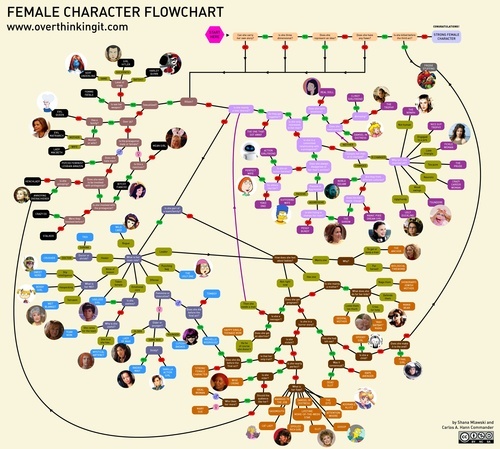
I’ve been wanting to write a post on Overthinking It’s “Female Character Flowchart” since I saw it on both Jezebel and Musings of an Inappropriate Woman about two weeks ago, and the time has finally come I’ve finally gotten around to compiling a list of my favourite fictional female characters and whether they qualify as “strong” ones.

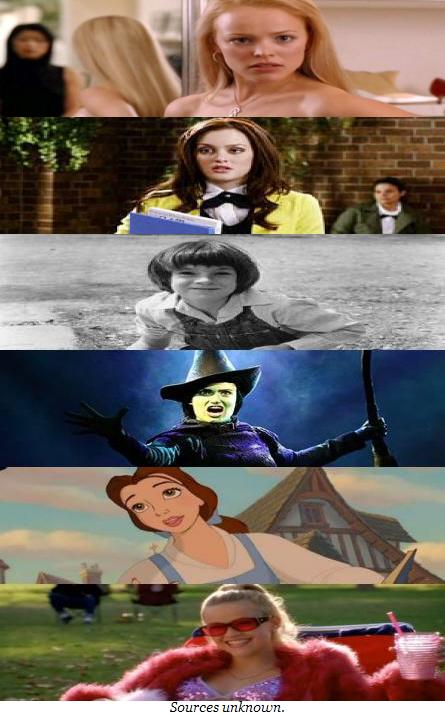
Without compromising the quality of the image, I wasn’t able to enlarge the chart, nor add my own annotations as per the below characters of my choosing. Instead, I’ve reproduced their equations below, as well as Mean Girls’ Regina George, who appears on the chart, and Blair Waldorf, whom Rachel Hills believes is a “girl Hitler”, but who I find to be much more of a genuine strong female character.

Regina George (Mean Girls): Can she carry her own story? YES. Is she three dimensional? NO. Villain? YES. Sexualised? NO. (I would argue yes. Hello? Have you seen her Halloween getup?) Over 35? NO. Is the protagonist male or female? FEMALE. Is this a rom/com? NO=Mean Girl.

Blair Waldorf (Gossip Girl): Can she carry her own story? YES. Is she three dimensional? YES. Does she represent an idea? NO. Does she have any flaws? YES. Is she killed before the third act? NO=Strong female character.

Belle (Beauty & the Beast): Can she carry her own story? YES. Is she three dimensional? NO. Villain? NO. Is she mainly a love interest? YES. Do they get together? YES. Is she only interested in her man? NO. Is she in a committed relationship with a protagonist? NO. Changes her man or is changed? CHANGES. Are they from different cultures? YES=Nobel Squan, whatever the hell that is! (Looks like something out of Avatar, though.)

Scout Finch (To Kill a Mockingbird): Can she carry her own story? YES. Is she three dimensional? YES. Does she represent an idea? YES. Villain? NO. Is she mainly a love interest? NO. Is she part of a team/family? YES. What is her main role? LEADER. How does she feel about babies? NOT RIGHT NOW. Does she get pregnant? NO. Is she in a horror story? NO. Is she violent? NO. Is she nearly perfect? NO. What is her flaw?=sassmouth, which I guess is true, but Scout is so much more.

Elphaba (Wicked): Can she carry her own story? YES. Is she three dimensional? YES. Does she represent an idea? YES, many. Villain? NO. Is she mainly a love interest? NO. Is she part of a team/family? YES. What is her main role? ROGUE=wildcard.

Elle Woods (Legally Blonde): Can she carry her own story? YES. Is she three dimensional? YES. Does she represent an idea? YES. Villain? NO. Is she mainly a love interest? NO. Is she part of a team/family? YES. What is her main role? LEADER. How does she feel about babies? NOT RIGHT NOW. Does she get pregnant? NO. Is she in a horror story? NO. Is she violent? NO. Is she nearly perfect? YES. Is she older? NO. Should the audience like her? YES. Who likes her more? WOMEN=Mary Sue.

Related:  Women in Fiction: My Favourite Fictional Females.

Elsewhere: [Overthinking It] The Female Character Flowchart.

[Overthinking It] Why Strong Female Characters Are Bad for Women.

[Jezebel] Flowchart: Know Your Female Character Stereotypes.

[Musings of an Inappropriate Woman] Flowchart: Know Your Female Character Stereotypes.

On the (Rest of the) Net.


After my Mick Foley rant last week, I’ve started reading his blog, Countdown to Lockdown, and I’m loving it. Here are some choice articles:

Remembering female pro-wrestling pioneer, Luna Vachon, who passed away on August 27 this year.

“That Time I Met… Tina Fey… and Alec Baldwin!”

“That Time I Met… President William Jefferson Clinton!” (I really love this one; some heart-warming stuff.)

“Mick’s Favourite Things: Top Ten Matches”, three of whichCactus Jack VS. Randy Orton at Backlash 2004 (above), Mankind VS. The Undertaker in Hell in a Cell in June, 1998, and Mick Foley VS. Edge in a Hardcore Match at WrestleMania XXII (that’s WrestleMania 22 in 2006 for you wrestling laymen)I 100% agree with.

In defence of Buffy’s whining.

“To the Teenage Boy in Your Life”:

“An important thing to remember is that girls are not from a different planet, nor are they even a different species. They’re just people, they’re just like boys, except with vulvas instead of penises.

“Mainly you need to remember this when you’re trying to figure out what a girl is thinking. See, if you didn’t know what a BOY was thinking, how would you go about finding out? You might ask him, right? The same goes for girls.”

I’m a bit behind the eight-ball on this one, as No Make-Up Week was a month ago, but Alle Malice’s guest post on Rabbit Write goes over the reasons “Why We Wear Make-Up”. I especially like this one:

“It makes me look good in photos. Almost everything we do now is documented by someone and posted in Facebook albums for the world to see, because if you aren’t having fun on Facebook, you aren’t really having fun. And if you aren’t pretty on the internet, you aren’t pretty in real life. Enter makeup.”

Nick Sylvester, on Riff City, discusses “How Kanye West’s Online Triumphs Have Eclipsed Kanye West”:

“Maybe there are people working with him… but I get the sense that Kanye is generating the [sic] lot of these ideas. I imagine he likes being in control of every aspect of the production, the medium being the message and so on. Online he is a wise fool, first playing into people’s perceptions of ‘Kanye West’, then off those very perceptions, sending himself up, pulling back his own veil… Despite many attempts, Kanye West is incapable of being parodied, largely because Kanye West has already figured out a way to be a parody of Kanye West.”

Much like Megan Fox in this New York Times Magazine article. Could I even go as far as to say that blonde bombshell Pamela Anderson has employed this strategy? I believe I could. And for that matter, Lindsay Lohan sending herself up on Funny or Die and promos for the MTV VMAs are along the same lines.

Sylvester goes on to say that “artists like Kanye West have to be ‘good at Twitter’ in order to put a dent in the zeitgeist.”

Furthermore,

“‘Nowadays rappers, they like bloggers,’ is what Swizz Beatz says… Slowly the work itself becomes secondary, less ambitious; slowly people becomes ‘really proud of their tweets’.”

Is it “The End of Men”?

Disney’s latest offering, Tangled, based on the story of Rapunzel, takes us back to a time when the Disney Princess reigned supreme, according to io9.

Feminist Themes examines Lady Gaga’s “Telephone” clip:

“… the objectification, glamorising of lesbian fetishism, and excessive girl-on-girl violence… [are aspects of the video that] feminist Gaga fans can try to justify… as another example of how she subversively turns what we usually find hot into something that leaves a nasty taste in our mouths and therefore makes a statement, but if any other artist (particularly any male artist) incorporated this much objectification and violence against women we would be outraged. Is it any different just because it’s a woman, or because it’s specifically Gaga?

“… What sets Gaga apart from other sexpot pop stars for me is that I just can’t imagine men being honestly turned on by hernot because she isn’t gorgeous (she is), but because she is so avant-garde, aggressive and self-driven which takes that arousal and turns it into something atypical, uncomfortable, and threatening.”

Also at Feminist Themes, the cause of the she-blogger in “Why I Blog”.

In other Gaga news, The Cavalier Daily reports that the University of Virginia is now running Lady Gaga classes! This sooo makes me want to re-enrol in university in a post-grad, transfer to UV, and take this kick-ass class!

The Daily Beast puts forth two differing opinions on Glee’s stereotypes: Andy Dehnart discusses the show’s “Harmful Simplicity”, while Thaddeus Russell applauds the walking stereotype that is Kurt Hummel, as “history tells us that those unafraid to be ‘too gay’ won far more freedomsfor all of usthan those who dressed the part of straights.”

Beautifully satiric The Frenemy reveals the recipe to “The Teen Romantic Comedy”, which “does not work for Mean Girls, 10 Things I Hate About You, or John Hughes films”, unfortunately. The truth about Disney Princes is also profiled, in which Eric from The Little Mermaid “wanted to kiss a girl who doesn’t speak words and doesn’t know how to use a fork. What the hell are you, caveman?”, while Mulan’s Captain Shang is in truth, a “gay liar” who made young, susceptible viewers the girls who have “crushes on a lot of her gay friends. [A] big Will & Grace fan.” Hey, that’s me!

Rachel Hills discusses intersectionality in feminism:

“For those of you who aren’t familiar with the term, ‘intersectionality’ is a way of talking about power and privilege that recognises that recognises that these things operate on multiple axes. People aren’t just female, or Black, or Asian, or straight, or working class, or trans, or a parent, or prone to depressioneveryone falls into a number of different categories that colours their experience of the world in specific ways. In the feminist context, it serves as a useful reminder that not all women have the same experiences, and calls into question the still dominant notion that the neutral ‘female’ experience is one that is white, heterosexual and middle-class.

“I’m also a fan because it just makes feminism a whole lot more interesting.”

Girl with a Satchel profiles Melissa Hoyer’s media career, which is a must-read for any budding wordsmith.

I am staunchly pro-choice when it comes to the abortion debate. In fact, I lean so far to the left that I’m borderline pro-abortion. (I’m sure that’ll ruffle some feathers!) But no matter what your feelings on the subject, MamaMia’s post, “The Couple Facing Jail Because They Tried To ‘Procure an Abortion’. Hello, Queensland? It’s 2010” is worth checking out.

Jezebel’s “5 Worst Mean (Little) Girls of All Time” includes Willy Wonka’s Veruca Salt and, from one of the most heart wrenching films of all time, A Little Princess, Lavinia, who looks a lot like modern-day mean girl, Angelina Pivarnick, from Jersey Shore.

“Why Strawberry Shortcake Was a Progressive Pioneer.”

On the (Rest of the) Net.


“A Guide to Eating Food Off the Floor.”

Feminist Themes’ regular “Wait… What?” column features The View co-host, Elisabeth Hasselbeck, and her take on the pro-choice versus pro-life debate.

In The Atlantic’s thought provoking piece on “The End of White America?”, Hua Hsu “discuss[es] Obama, football, hip-hop, and the elusive notion of a ‘post-racial’ society.”

Pandagon responds to Susan Faludi’s piece on third-wave feminism (which I haven’t read yet, but expect it to be included in an upcoming On the [Rest of the] Net), in which “she puts out evidence that younger feminists are sometimes unfair and ungrateful to older feminists, and that older feminists are sometimes so afraid of younger women that they go out of their way to exclude them… complaining that younger women don’t care.” Furthermore:

“… she reinforces a jumble of often conflicting stereotypes on younger feminists to discredit us: that we’re obsessed with navel-gazing over activism, that our obsession with technology comes at the expense of actual work, that we don’t know our history and don’t care about systemic issues, that we’re materialist[ic] and unwilling to challenge sexual exploitation for fear of pissing off men, that we’re so busy cultivating our graduate degrees writing about Lady Gaga… that we can’t be bothered to worry about real world issues.”

I do agree with some of this summary of Faludi’s piece, but Lady Gaga’s meat dress drew attention to vegetarianism, animal welfare and gay rights. They’re, like, real world issues, aren’t they?

Liz Greene delivers some particularly poignant points on parental relationships and “the family triangle” in “The Eternal Triangle”.

Buffy is “The Third Wave’s Final Girl”.

Jezebel reasons “Why Glee Still Needs to Work on Diversity”, while Brittany and Santana are “Queer Idols”:

“It wasn’t even until halfway through Glee’s first season that the first hint of queerness was even mentioned… Maybe you’d call it bisexual, maybe you’d call it heteroflexible, maybe you’d call it bicurious: whatever they are, it’s definitely a bit queer… Brittany is, if you will, an equal opportunity slut: one who’s willing to make out with whatever hotness crosses her path, regardless of gender… And among fellow fans of the show, my designation of Brittany and Santana as queer icons has met with some derision: their relationship is played for laughs, I’ve been told. They’re just straight girls making out for male attention… [But]… with the exception of their joint date with Finn, Brittany and Santana have hardly been shown using their relationship to win over boys… For me, Brittany and Santana represent a new mode of queer figure… : fluidly sexual, comfortable with same sex contacts, and more interested in finding happiness than finding the right label. They may not fit into the rigid structures of traditional sexual identities, but they’re comfortable enough with themselves not to care.”

More Jezebel: They’ve really been getting on the “slut-shaming bandwagon”, especially with their endorsement of Easy A. Now, they give their take on the “Ancient Slut-Shaming” of Cleopatra, as well as the “sexual double standards” on Jersey Shore. About the latter, they say:

“… The slut-shaming of Angelina… revealed their thoughts on sexual double standards. (The ‘thoughts’ being that sexual double standards exist, and that’s just the way it is.)… Pauly said about Angelina: ‘She brought all these random people home. She’s a girl. You don’t do that. That’s a guy thing. Guy’s do that, no girls.’… Shouldn’t Pauly and The Situation be grateful for sluts? If there were no sluts then they would never be able to have sex. Do they think for one minute that they would even want to live in a world in which all girls acted the way they’re ‘supposed’ to?”

“Who Stole Feminism?”, asks The Nation. Sarah Palin, Christine O’Donnell and all those right-wing extremists, that’s who!

“Sarah Palin opposes abortion and comprehensive sex education. While mayor of Wasilla she made sexual assault victims pay for their own rape kits. She also calls herself a feminist. Delaware GOP Senate nominee Christine O’Donnell has said that allowing women to attend military academies ‘cripples the readiness of our defence’ and that wives should ‘graciously submit’ to their husbandsbut her website touts her ‘commitment to the women’s movement. Pundits who once mocked women’s rights activists as ugly bra burners are abuzz over the ‘new conservative feminism’, and the Tea Party is lauding itself as a women’s movement.

The right once disparaged feminism as man-hating and baby-killing, but now ‘feminist’ is the must-have label for women on the right.”

“Geeks Versus Hipsters” is the equivalent of the passionate versus the apathetic, respectively, according to Gizmodo. And from the hipsters I’ve come into contact with, I’m inclined to agree.

Can Newsanchor Barbie be both hot and a feminist?

Jessica Rudd (yes, Kevin’s daughter) discusses the differences between chick-lit and (the nonexistent) dick-lit in a guest post on MamaMia.

Beneath the “campy sensationalism” of True Blood lies “the weird, seemingly reactionary politics” of “the right’s worst nightmare about post-gay-liberation America come to life.”

In Appreciation of Mick Foley.


For long-time readers of this blog (does six months qualify as a long-term blog-reading relationship?), you will be familiar with my fondness for professional wrestler turned author, Mick Foley.

When I first started watching World Wrestling Entertainment (then still WWF) in 2001, Foley had a sporadic recurring role, after resigning as fictional “commissioner” of the company. Little did I know just how affecting he had been to the hardcore wrestling scene.

In a nutshell, Foley started out in the independent wrestling scene, then gradually made his way through the ranks, beginning in squash matches (where a bigger star beats a newcomer or unknown in very little time and with very little effort) in WWE, then World Championship Wrestling (WCW) and finally Extreme Championship Wrestling (ECW), where he made a namewell, technically, three namesfor himself.

As an unorthodox professional wrestler, with an out of shape body and not a lot technical mat moves, Foley needed that extra something, which he came up with in the form of his three alter egos: Mankind, Dude Love and Cactus Jack.

Mankind is the one many wrestling fans would be most familiar with, with Foley wearing a Hannibal Lector-esque mask and brandishing a personified sock on his hand, affectionately known as Mr. Socko, which would be used in his Mandible Claw move. Mankind teamed up with The Rock in The Rock n’ Sock Connection in the late ’90s.

Dude Love favours tie-die and espouses the 1960’s hippie frame of mind, and is probably the least well-known of the three.

Finally, Cactus Jack is quintessential “Hardcore Legend”, using thumbtacks and Barbie (a baseball bat encased in barbed wire, oftentimes set on fire), wearing leopard print leggings and a flanny, and is often invoked in matches such as Hell in a Cell and especially his Last Man Standing matches in his feud with Triple H, again in the late ’90s.

After some time in Japan, where a lot of professional wrestlers believe you need to spend time if you wish to be taken seriously as an athlete, Foley debuted in the WWE, where he had some of his most memorable matches, mentioned above.

While my forbidden love for wrestling introduced me to many sub-categories (like my favourite band, Our Lady Peace, American geography, and my obsession an subsequent research articles and blog posts on the Chris Benoit double murder-suicide), none is more dear to my heart than discovering Mick Foley as a memoirist, children’s storybook writer, and novelist.

I own all three of his memoirs, Have a Nice Day: A Tale of Blood & Sweatsocks, Foley is Good: And the Real World is Faker Than Wrestling, and The Hardcore Diaries, as well as his first novel, Tietam Brown (watch this space to see if I can muscle a review out of a friend who’s had my copy on loan for months), which I serendipitously found in a second-hand book store and could barely contain my excitement. Yes, I love rare and obscure authors, okay?!

Foley has recently published his fourth memoir, Countdown to Lockdown: A Hardcore Journal, which I can’t wait to get my grubby little mitts on. In addition, Foley’s much publicised computer illiteracy has been conquered, with the advent of his blog, Countdown to Lockdown, and Jezebel has cottoned on to the awesomeness that is Mick Foley”, with two feature articles on the Hardcore Legend in the past week.

Foley paved the way for wrestlers with brains to parlay into other areas they could be useful in, with Chris Jericho (memoirist, musician, actor/host, commentator) and Edge (memoirist) springing to mind. And now he is speaking out for sexual assault victims in a category that has traditionally been termed “women’s issues”.

Foley is a truly smart, talented, funny, inspiring and admirable man, and if you like what you’ve read here, I urge you to pick up one of his books (or if reading’s not your thing, YouTube a match of his; but reading probably is your thing if you’re looking at this here blog) and prepare to have your lifeor at the very least, your perception of professional wrestlingchanged.

Elsewhere: [Countdown to Lockdown] Homepage.

[Jezebel] Wrestling Star Mick Foley Blows Our Collective Mind.

[Jezebel] The Day I Beat Down Mick Foley.

[Slate] The Wrestler & the Cornflake Girl.

The Awesomeness That is James Van Der Beek.


As Dawson Leery on late ’90s teen angst television staple, Dawson’s Creek, James Van Der Beek was a whiny pushover who always lost the girl to the sexy and witty and aptly-named Pacey Witter. With the exception of getting drunk and singing the blues with Andy on his birthday, Dawson’s Creek perhaps would’ve been better without its titular character.

Van Der Beek hasn’t done a whole lot since Dawson’s Creek ended in 2003, but what he has done has been a far more apt use of his acting talents.

I recently watched the movie adaptation of Bret Easton Ellis’s Rules of Attraction, in which Van Der Beek plays Sean Bateman, American Psycho’s Patrick Bateman’s little brother. While the film, like the book, is quite left of centre and something not everyone is likely to have seen, Van Der Beek is chilling as a narcissistic, drug-taking/dealing, death-faking rich college boy, alongside Ian Somerhalder in a similarly affecting performance.

And anyone who watches Criminal Minds would be hard pressed to forget the formerly innocent Dawson as Tobias Hankel, the serial killer who was so damaged by his abusive father, that he took on said father’s demeanour in order to carry out his killings. In addition, he injected everyone’s favourite agent, Spencer Reid, with heroin, causing Reid to struggle with his newfound addiction in later episodes.

Angus, Van Der Beek’s debut film role in 1995, is a much lauded cult teen movie in which he plays the popular jock to Angus’s overweight outcast. I haven’t seen the film personally (I plan to watch it during my convalescence from wisdom teeth surgery at the end of the week), Jezebel seems to like it, and that’s good enough for me!

Van Der Beek is not unfamiliar to parodying himself, either, with cameos in Scary Movie and Jay & Silent Bob Strike Back (worst movie ever, but the running Ben Affleck joke is a cracker!), and comedic turns in Ugly Betty and How I Met Your Mother.

If you’re indifferent to James Van Der Beek, like I was until I really paid attention to his acting life after Dawson’s Creek, I suggest you take a look at his post-Dawson’s résumé to truly understand the awesomeness that is Van Der Beek.

Related: American Psycho by Bret Easton Ellis Review.

Elsewhere: [Jezebel] Important Life Lessons From B-List Teen Movies of the ’90s.

On the (Rest of the) Net.


Once upon a time, a disillusioned Los Angeles writer bemoaned the fact that when you start getting dermal fillers and can’t speak to someone else who hasn’t, “you realise there is actually something quite wrong with L.A… And then along comes Heidi Montag and you feel normal again.”:

“The amount of women, like Heidi, I see in Los Angeles walking around like blow up dolls, victims to the horrific mental disorder of body dysmorphiais huge. Body dysmorphia is as much a disease as anorexia, as bulimia, as over-eating, as alcoholism, drug addiction. These are mental disorders which manifest themselves in physical self-harm.”

Like the compulsion to have DDD size boobs implanted on your tiny, surgically-sculpted frame that cause you constant pain and prevent restful sleep and exercise.

Girl with a Satchel asks if new British magazine “…Just as Beautiful [is] Fetishising & Sexualising Fuller Female Figures?”

From “Gender is Not Just a Performance”:

“It is a crass oversimplification, as ridiculous as saying all gender is genitals, all gender is chromosomes, or all gender is socialisation. In reality, gender is all of these things and more.”

To celebrate No Make Up Week, Rachel Hills contemplates why we feel there’s something wrong with us if we don’t go around looking flawless at all times.

Still with Rachel Hills: her “Kanye West Syndrome” article, “I’mma Let You Finish…” and “Himglish & Femalese”, about how men are women are the same, but different, are stand-outs.

The New York Times, in an article from last year, ponders the vampire’s place in fashion.

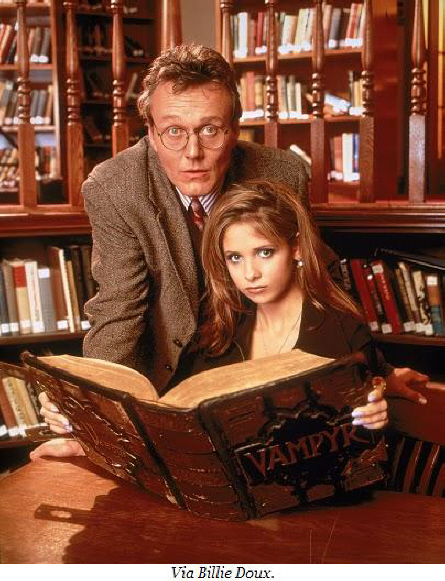
In more vampire news, Billie Doux offers up Buffy Quotes for Every Occasion”, paying special attention to librarianship, in which these gems pop up: “I love the smell of desperate librarian in the morning,” and “I mean, I can’t believe you got into Oxford… That’s where they make Gileses”.

Gender blogger Greta Christina lists the “5 Stupid, Unfair & Sexist Things Expected of Men”, in which she states that “… sexism hurts men. In particular, … our society’s expectations of men, [and] our very definitions of maleness. I’ve been looking at how rigid and narrow many of these expectations are…”, such as “being tall”! Not much a man can do about his height… much like the stupid, unfair and sexist things expected of women.

We all know how much I love professional wrestler cum author cum sexual assault crusader, and finally, Jezebel has cottoned on to the awesomeness that is Mick Foley, even going as far as to say that “we need more men like him.” Amen to that. Also, check out his blog.

There’s a lot of debate over whether a straight man and a straight woman can be “just friends” (FYI, I believe they can), and this article favours the notion that having “Platonic Female Friendships Can Make For a Better Man”.

If my love for Beauty & the Beast (the DVD is currently out of the Disney vault on re-release; I have a birthday coming up…) is anything to go by, “Brunettes Love Beauty & the Beast”. As “princess hero”-affirming as that might be, the article ends on a negative note, saying that “a brunette [is] more prone to rational expectations of life and thus… the ‘We Love Belle’ fan-club must be an awfully boring place to be… Blondes: 1 Brunettes: 0”. Ouch.

ScreenCrave on why Twilight’s Bella Swan is a Feminist’s Nightmare”.

In the spirit of such Girls Night In staples as Mean Girls and Bring It On (more on my Girls Night In to come next week), Jezebel advocates for the “5 Life Lessons Learned from The Ladies of 00s Teen Films”.

In “Print This Out & Give it to Every Boy You Know”, Jezebel debunks the myths of the feminist. For example:

“[Myth:] Feminists are angry/predominantly lesbians/man-haters/all of the above… Some women are angry, yes. Some are lesbians. And some probably hate or fear men. Some women also identify as feminists. These characteristics exist independently of each other. If there’s overlap, it’s coincidental and correlated or causal…”

and

“Feminism has more flavours than Baskin-Robbins and a hundred and one areas of focus, covering everything from reproductive rights to international development to political reform or popular culture. Beyonce is a feminist and so is Hilary Clinton. And men can be feminists, too! It’s a big tent party, y’all! Heck, some women live their entire lives according to feminist principles, but never use the term.”

I would like to tell that to a certain “I hate feminism” espousing lady I know…

Magazines: Twenty-five to Life—Elle’s Favourite 20-Somethings.

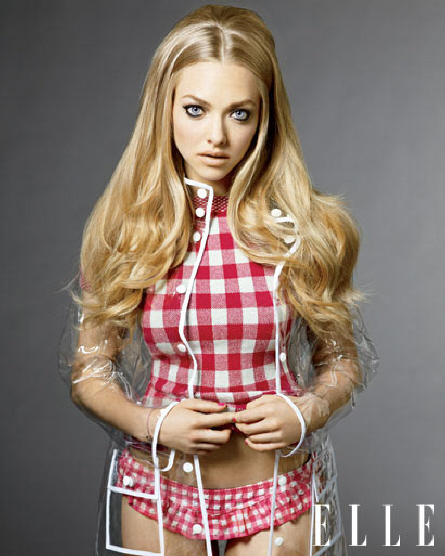
Needless to say, Lindsay Lohan won’t be making the list, but some others include Gabourey Sidibe (and the accompanying scandal), Lauren Conrad, Megan Fox, and Amanda Seyfried, who grace the cover of the mag in four separate newsstand editions, and then again inside. Here, take a look for yourself…

Related: Poor Little Rich Girl—Lindsay Lohan in Who.

Elsewhere: [Jezebel] Gabby Sidibe’s ELLE Cover is Another Reason Why Black Fashion Directors Are Necessary.

Movie Review: Easy A.


As with a lot of things lately, I’ve hyped them up in my mind so much that when they actually eventuate, they’re a let down.

Some such things that come to mind are a recent work training seminar (can’t give too much information away as it is top secret ;)), the Britney Spears episode of Glee, and Easy A.

Don’t get me wrong, I thought it was a really good movie; Emma Stone is a fantastic actress, Stanley Tucci played the dad (I want a dad like Stanley Tucci!), Gossip Girl’s Pen Badgley played the gorgeously mellow love interest Todd, and it dealt with slut shaming, sex, lies and gossip.

But I felt that some of the actors could have toned their performances down a notch. The always over-the-top Lisa Kudrow played the guidance counsellor who was married to Olive’s (Stone) favourite teacher, but *spoiler alert* cheating on him with a member of the high school’s religious clique. Amanda Bynes was the school bitch and president of said church group and, quite frankly, I find it hard to take her seriously as an actress after seeing an episode of The Amanda Show. And while I do love Tucci, he could have toned down the camp-quality he tends to have in moviesespecially as he was playing the straight father.

Other than that, the film was very smart, funny and highlighted the dark undertones that high school can have.

The premise of Easy A is that Olive Penderghast feels sorry for her gay best friend, *again, spoiler alert* so she agrees to fake sleep with him he will stop being ridiculed by the lynch mobs that are his fellow high school students. What Olive doesn’t bargain for, however, is that she’s labelled the school slut, and boys start paying her money to say they had sex. When her female bestie turns on her, Olive takes to sewing a red “A” on all her clothing, à la The Scarlet Letter, which Easy A is loosely based on“but not the Demi Moore film version”.

Without giving too much more away, Easy A has a certain Mean Girls quality to it, and also harkens back to the teen movies of the ’80s, like The Breakfast Club and Sixteen Candles, which appear in a montage at the end of the film.

And Badgley is more likeable here than he is in Gossip Girl, and in a funny twist, the first time Olive “didn’t and said she did” kiss a boy in the eighth grade, she did it to boost Todd’s social standing. Unlike in most teen movies, where the girl/guy does something shady and spends the rest of the movie trying to win back their guy/girl love interest, *final spoiler alert* Todd stands by Olive through her tenure as faux slutty liar, because he knows she did it with good intentions in mind.

Related: The Underlying Message in Glee‘s “Britney/Brittany” Episode.

Elsewhere: [Jezebel] Easy A Tackles Slut-Shaming, Gossip & What We Expect From Girls Now.

[Jezebel] Is Easy A the New Mean Girls?

TV: The Underlying Messages of Glee’s “Britney/Brittany” Episode.


In what was one of the most anticipated episodes of Glee, alongside the Madonna and Lady Gaga episodes, Britney Spears made all of a minute’s appearance on the show last week.

I was expecting a lot more, but we all know acting is not one of Britney’s strong suits (Crossroads, anyone?). However, Brittany S. Pierce, played by Heather Morris, stole the show and cemented her reign as my favourite Glee character.

While Britney’s lacklustre performance was the drawcard for the episode, there were a few underlying messages about fame using Spears as the beacon for what can go wrong if young stars abuse their fame.

“The episode opens with Kurt informing Mr. Schue that there’s a five person Facebook group campaigning for New Directions to sing Britney Spears songs at the homecoming assembly. But Schue shoots down this movement (even [though] these kids have already performed “Push It” in front of the whole school, for the purposes of our story, Brit Brit is too trashy or something).” [Jezebel]

The kids fought for their right to perform Britney, as she’s an inspiration to all of them, and the reason they want to be stars. Perhaps this way of thinking was better suited to the Lady Gaga episode, as she truly is an inspiration. On the other hand, if Mr. Schue let them perform songs by Madonna, Lady Gaga and, as Jezebel mentioned, Salt N Pepa, Britney is probably the most tame and PG-rated of them all. But I could see Schue’s point: while Britney may be an inspiration, she’s also one of the least talented pop stars who permeated the late ’90s/early ’00s zeitgeist and “not suited” to New Directions.

But, when Brittany goes to see guidance counsellor Emma Pillsbury’s new boyfriend and the school dentist Carl, played by guest star John Stamos, and is put under anaesthesia, she has a Britney Spears fantasy, which makes her realise her true potential as a star, and she demands to have all the solos from now on.

Santana wants to have a Britney fantasy too, so they both go to see the dentist and demand to be put under. Santana uses her doctor father’s health insurance to bribe Carl into succumbing. This could be seen as a reference to the enablers in young stars’ lives (Lindsay Lohan comes to mind) and the drug use that many such stars (again, Lindsay) are rumoured to have engaged in.

In a scene from last week, Sue Sylvester kicks Santana off the Cheerios for defacing her young and still-growing body with breast implants. This seems to be a specific dig at Britney, and a prelude to this week’s episode. Santana is probably only 17 years old, perhaps even 16, which is the age Britney is rumoured to have gotten implants.

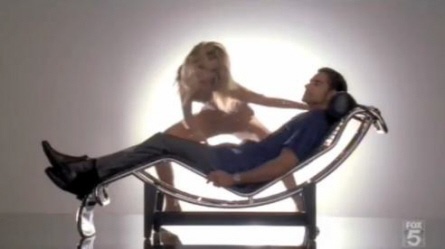
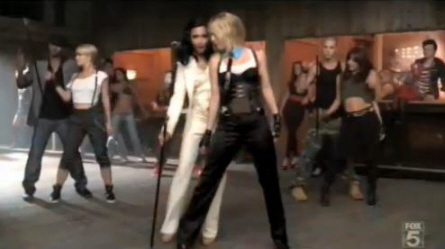
Finally, the episode culminates in most of the Glee club having had hallucinations and a “Britney Spears sex riot”, caused by Sue. Britney has been criticised her whole career for being too sexy, which is evident in the opening Britney/Brittany video mash-up of “Slave 4 U”, “Toxic” and “Oops… I Did It Again”, as well as Brittany and Santana channelling “Me Against the Music”, which would have had far more impact, I think, if Britney was used in the whole montage, instead of just at the very end for about .5 seconds.

Related: Poor Little Rich Girl—Lindsay Lohan in Who.

Elsewhere: [Jezebel] Glee: The Britney Spears Stuff You Want to See.