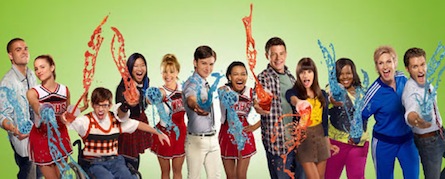
TV: The Underlying Message in Glee’s “I Kissed a Girl” Episode.


“You know, with all the horrible crap I’ve been through in my life, now I get to add that,” Santana responds to Finn’s efforts to show her New Directions and the Troubletones are there for her by staging a week of lady-on-lady music.

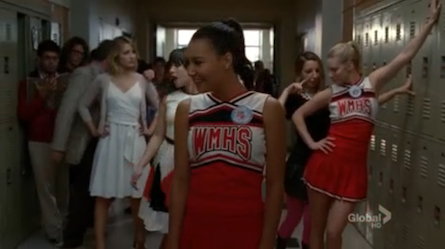
Watching Santana be forced out of the closet was pretty uncomfortable for all those involved on either side of the screen, no matter how many Katy Perry songs were there to ease the pain.

Naya Rivera portrayed Santana’s grief, sadness and discomfort perfectly, as both glee clubs essentially patronised her into coming out. Sure, as Finn points out, she’s going to be outed by Sue’s Congressional opponent’s campaign video anyway, but watching someone be coerced into doing something they really don’t want and aren’t ready to do was painful to watch.

But, in the spirit of the episode’s title, midway through the episode Santana and her glee club comrades told a douchey rugby captain who claimed he could “straighten her out” where to go. The rushed exchange between Josh Coleman and glee girls really summed up the issues surrounding being gay in America:

“Easy girls, I’m just trying to make her normal.”

“She is normal.”

“It’s not a choice, idiot, but even if it were you’d be our last choice.”

“Oh, I get it. You’re all a bunch of lesbos.”

“So what if we are? You don’t stand a chance either way.”

Also interestingly, when the girls sing “I Kissed a Girl”, they engage in the very girl-on-girl-for-guys performance that genuinely non-straight women are trying to tackle. Whilst I did enjoy the rendition, it reminded me of the high-school experimentation my peer group engaged in at the appeal of and for the opposite sex. Sure, there’s nothing inherently wrong with that, I guess, but it undoes all the work of gay and bisexual women to be seen as having legitimate sexual orientations that don’t revolve around how the patriarchy wants them to perform their sexuality.

Indeed, it undid all the work Glee was trying to do in this episode.

Related: Glee: Santana is Forced Out of the Closet.

The Underlying Message in Glee’s “The First Time” Episode.

Glee: T.G.Inappropriate.F.

The Underlying Message in Glee’s “Asian F” Episode.

The Underlying Message in Glee’s “I Am Unicorn” Episode.

Glee Back in Full Force.

Image via VideoBB.

Music: Top 11 Songs of 2011.

“Born This Way”, Lady Gaga.

Before it was even released, the world knew that “Born This Way” was going to define 2011, if not for its controversial comparison to Madonna’s “Express Yourself”, then for Glee’s 90-minute special dedicated to the anthem. Gaga was accused of racism and plagiarism for the song, which spawned a website in which gay users can upload images and affirmations. Like it or loath it, you’ve got to agree that Gaga has her heart in the right place with this one.

“Friday”, Rebecca Black.

Ahh, the song that you can never get out of your head. While I think “Friday” is the work of a genius (Lady Gaga thinks so, too!) and enjoy bopping around to it, grabbing my bowl, grabbing my cereal, going to the bus stop, choosing which seat to take, I understand that the majority of the world doesn’t feel the same. But for a viral video, you’ve got to give the girl props for permeating the zeitgeist so.

“Rolling in the Deep”, Adele.

I’ve only recently gotten into Adele, but now that I have, I could listen to her voice for hours. Whether it’s “Someone I Used to Know”, “Turning Tables” or “I Can’t Make You Love Me”, as opposed to “Rolling in the Deep”, you can’t deny that Adele was everywhere in 2011. And she was warmly welcomed for her heartbreaking love songs and her alternative look.

“Party Rock Anthem”, LMFAO.

Up until a few days ago when I asked my friend April which songs she thought I should include in this list, I thought this song was called “Shuffling”! No matter; the whole world has picked up on the gist and beat of the song, and that’s all that really matters, right?

“Moves Like Jagger”, Maroon 5.

Another song that I was oblivious to until recently. Rather, I was oblivious to who sung it, even though the vocals of Christina Aguilera were unmissable. My awakening to “Moves Like Jagger” came the night of my birthday party, when a random partygoer likened my moves to being even better than Jagger’s!

“Last Friday Night (T.G.I.F.)”, Katy Perry.

The song is somewhat forgettable, but Katy Perry’s “Last Friday Night” was all about the film clip, featuring the aforementioned Rebecca Black, some guys from Glee, Hanson, and Kenny G.

“(Run the World) Girls”, Beyonce.

While “(Run the World) Girls” isn’t by a long shot the best song on Beyonce’s latest album, 4, it was the one that set the ball rolling for total 2011 Beyonce domination. For my money, “Countdown” and “Best Thing I Never Had” are better, but the controversy the song stirred up and the film clip are what make the song rate.

“Somebody I Used to Know”, Gotye.

Until I YouTubed this song just then, I’d never heard it before. But I’d heard the hype surrounding it. While alternative Australian music isn’t really my cup of tea, it does invoke a certain nostalgia of music my parents would play when I was a child, like Cat Stevens and some others I can’t quite put my finger on.

“Super Bass”, Nicki Minaj.

If it weren’t for the Ellen show sensations Sophia Grace and Rosie, “Super Bass” wouldn’t hold such a special spot in my heart(beat running away)! Is that wrong…?

“On the Floor”, Jennifer Lopez.

This time last year J.Lo couldn’t have been less relevant. Whether it’s the calibre of “On the Floor” (one friend is particularly irked by the “Back it up like a Tonka truck” line from Pit Bull!) or her highly publicised divorce from Marc Anthony (how fitting that the title of her latest album should be Love?), J.Lo was back in a big way in 2011.

“We Found Love”, Rihanna.

Rihanna also had a big 2011, and it was hard to choose just one of her myriad of songs from the past year. I have a penchant for “Only Girl in the World”, which was officially released in 2010 but seemed to transfer over into 2011, and there’s also “Man Down”, “S&M”, “California King Bed” and “Cheers (Drink to That)” that were hits last year. And of course, we can’t forget the hullabaloo that resulted from the filming of the video for “We Found Love”. Farmers and Irish fields, anyone?

So which were your favourite songs of 2011?

Related: The Underlying Message in Glee‘s “Born This Way” Episode.

Battle of the Friday Anthems: Rebecca Black VS. Katy Perry.

Beyonce: Countdown to Overexposure.

Rihanna’s Man Down—Revenge is a Dish Best Served in Cold Blood.

Rihanna’s “S&M”: Is It Really So Much Worse Than Her Other Stuff?

Glee—The Right & Wrong of It.


In lieu of a new episode of Glee last week, I attended a debate about the pros and cons of McKinley High and its glee club.

I was super excited, because I assumed the debate would entail a for Glee side, and an against. And it did. But while I thought the against side, consisting of Clem Bastow and Jess McGuire, would discuss the blatant sexism, racism, homo/transphobia, ableism, fatism and the many other phobias and -isms the show incorporates (feel free to add them in the comments), both panelists ultimately praised Glee for it’s inclusiveness and handling of the tough issues.

I’ve heard this rationalisation about Glee before. When my tuba-playing gay friend finally got into the show this season and fell hard for it, he thought I would sing its praises with him because he knew I watched it. (Evidently, he does not read this blog as he would know the main reason I like Glee is because I know I’ll always get a blog post out of it!) When I invited him to the debate, he had something else on but wondered what they would be debating, exactly. I referred to the list of problems I have with it (above and elaborated on below) and he replied, “But I thought Glee was about acceptance.” That’s what it wants you to think, and it blinds you to all the other issues with Katy Perry songs. As panelist for the “pro-Glee” side, Mel Campbell, said, “It’s best not to ask questions.”

While McGuire did touch on Glee’s pro-gay stance, and perhaps its best, and most underutilised, storyline of Brittany and Santana’s forbidden love, I was expecting SlutWalk Melbourne organiser and noted feminist Bastow to knock Glee out of the park for its anti-women portrayals. I was also sorely disappointed, as Bastow, a keen musical aficionado, chose to focus on the shows’ butchering of classic musical numbers.

So, I thought I’d take this opportunity to write about the issues I wished the panel had discussed last Thursday night.

Sexism.

I’ve written about feminism in Glee before, specifically as it’s embodied in the character of Rachel Berry. It annoys me to no end that Rachel is deemed “ugly” (though Lea Michele is anything but) because she’s annoying. And she’s annoying because she eschews traditional gender roles that are perhaps embodied by Quinn by being ambitious, voicing her opinions and unapologetically going after what she wants.

In a clip shown at the debate of the inaugural Glee mash-up in which Mr. Shuester separates the girls from the boys, Kurt attempts to join the girls’ side. Since when did being a gay man amount to the equivalent of a straight female?

Finally, I wouldn’t say sexism is the main problem in Mercedes’ perpetual (okay, she seems to have a boyfriend this season, but more on that later) bachelorettehood, rather some other issues I will address later in the piece.

Racism.

Now is as good a time as any to discuss Mercedes’ aforementioned singleness. Was she literally the only character in season two who didn’t have a significant other because she’s black? (Or because she’s fat?) Sure, she dated Sam for all of a few minutes in the season two final, but before that the only action she got was Kurt condescendingly suggesting she should date one of the guys on the football team because he was black and, like, they’d probably have heaps in common.

If that’s not enough proof of Glee’s insensitivity to race, all you need to do it look at any one episode for a myriad of references to Tina and Mike’s “Asianness”, Roy Flanagan’s “Irishness” (or leprechaunnes, as Brittany might refer to it) and Puck and Rachel’s “Jewishness” (though that also falls under religious prejudice as well).

Homophobia & Transphobia.

Sure, Glee’s pretty much a vehicle for Kurt and, increasingly, Blaine, to showcase their voices, fashion sense and flamboyance. McGuire chose to speak at length about how sensitively the show handled Kurt coming out to his dad and Kurt and Blaine’s first time, and I have to agree with her. And yes, seeing two men make gay love (okay, the implication of them making gay love) on primetime network television without a stink being kicked up is pretty groundbreaking, as panelist for Glee and MC, Tim Hunter, noted. But they still single out Kurt for his gayness (“Single Ladies [Put a Ring on It]” and “Le Jazz Hot!”, anyone?), not to mention how Finn went about outing Santana in “Mash Off”.

They’ve handled the Brittany/Santana thing the best out of every relationship in the show, so that’s one point for lesbianism, but at the expense of other sexual orientations and gender identities, perhaps?

Just look at “The Rocky Horror Glee Show”, for example. Not only to Mike’s parents make him pull out because they don’t want him associated with a “tranny” musical, but the show even substitutes the lyrics “I’m just a sweet transvestite from transsexual Transylvania” for “sensational Transylvania”. Pardon me, but I don’t see what all the fuss is about in using the word “transsexual”.

Finally, we can’t forget Coach Beiste. When she debuted on the show, her sexuality and gender was thrown up in the air, when she’s really just an unconventionally attractive, masculine straight woman who happens to coach a men’s football team. But of course attention is drawn to her 40-year-old virgin status every time there’s a virginity-themed episode. Because, you know, she’s old and funny-looking and has never been on a date! Riotous!

Ableism.

Where do I start? There’s Emma’s OCD, which is made fun of by everyone from Gwyneth Paltrow’s Holly Holiday to her own parents (not to mention Will trying to come to her rescue by attempting to “cure” her). Artie’s wheelchair-bound way of life, which was even pointed out during the debate, only for the panelists to laugh at Artie wanting to give Blaine a standing ovation, “because he can’t”, and a whole episode, “Wheels”, insensitively dedicated to his disability.

I will applaud the show for their inclusion of, and remarkable sensitivity to, Down’s syndrome sufferers. But then they go and use undiagnosed Asperger’s syndrome as an excuse for anti-social and selfish behaviour. Cutting off their nose to spite their face…

Fatism.

Puck’s rendition of “Fat Bottomed Girls” was a clip played at the talk, and was received by audible groans. To see Lauren so uncomfortable as Puck serenaded her was awkward for the audience, and the patronisation was palpable. Like, oh Glee has a plus-sized girl who doesn’t hate herself and is being chased by the hottest guy in school; we’ve come so far.

But when Mercedes is relegated to backing vocals in favour of the slim lined Rachel, can’t get a date and suffers from an alleged eating disorder which is swept under the rug with some sage advice and a granola bar from Quinn, it’s all just tokenism.

So there you have it: the debating of the issues I wished had’ve been brought up by the panel. As my friend, housemate and fellow debate-goer put it: “It was just like Glee: it slightly touched on the issues, but ultimately didn’t add anything new to the discourse.” So feel free to add anything I, or the panel, didn’t cover in the comments.

Related: The Underlying Message in Glee’s “Original Song” Episode.

Brown Eyed Girl.

The Underlying Message in Glee’s “Duets” Episode.

The Underlying Message in Glee’s “The Rocky Horror Glee Show” Episode.

Glee: T.G.Inappropriate.F.

Ain’t Nothin’ Gonna Break My Slutty Stride.

Rachel Berry as Feminist.

Is Lea Michele Too Sexy?

In Defence of Rachel Berry.

Boys Will Be Boys, Revisited.

Glee Season 2 Final in Pictures.

The Underlying Message in Glee’s “Asian F” Episode.

The Underlying Message in Glee’s “The First Time” Episode.

Glee: Santana is Forced Out of the Closet.

The (Belated) Underlying Message in Glee’s “Never Been Kissed” Episode.

Glee “Sexy” Review.

Glee Back in Full Force.

Elsewhere: [Bitch Magazine] The Transcontinental Disability Choir: Glee-ful Appropriation.

[Xhibit P] Fat Girls Singing Backup: Body Images in Glee.

[TV.com] Is It Okay to Find Glee’s Plus-Sized Character, Lauren Zizes, Gross?

[Jezebel] Why Won’t Glee Give Mercedes a Boyfriend?

Image via Meg. All Things Me.
TV: Glee—T.G.Inappropriate.F.


Last night marked the return of Glee after a month of baseball-related hiatus.

While the show is continuing it’s new tradition of actually following its storylines (Shelby’s new glee club, Santana and Brittany’s lady love, Quinn and Puck’s quest to get Beth back), it’s also following its long-held ritual of being wildly inappropriate and offensive.

The offensiveness was dialed down to low, with a couple of racist (nationalist?) remarks directed at Brittany’s leprechaun, also known as Roy Flanagan, but the hypersexualisation of the New Directions and the Troubletones* (the name of Shelby’s glee club, consisting of Mercedes, Sugar, and the newly recruited Santana and Brittany) was at an all-time high, singing Katy Perry’s (does she have an agreement with this show or something? “Firework”, “Teenage Dream” and “I Kissed a Girl”, the title of the episode in which Santana comes out to her family in a few weeks’ time, have all been featured.) “Last Friday Night (T.G.I.F.)” and Christina Aguilera’s “Candyman”, respectively.

I’m not so sure lyrics like, “We took too many shots… Got kicked out of the bar… Had a ménage a trios,” and, “Makes my panties drop… Makes my cherry pop… With a real big cock,” are really appropriate for fictional 17-year-olds to be singing, as several of them are twelve kinds of illegal!

But then again, they’re probably not as bad as this

*This post originally named Shelby’s all-girl glee club as the Treble Clefs.

Related: The Underlying Message in Glee’s “Asian F” Episode.

The Underlying Message in Glee’s “I Am Unicorn” Episode.

Glee Back in Full Force.

Disturbing Behaviour: Terry Richardson Does Glee.

Is Lea Michele Too Sexy?

Image via VideoBB.

Movies: The Smurfette Principle.


I saw The Smurfs over the weekend, and let me tell you, don’t waste your money!

The Smurf era kind of bypassed me as a kid, so I had to get my housemate Eddie to explain to me that the Smurf’s village is the ultimate patriarchy in every sense of the word, with Smurfette (voiced by Katy Perry in the movie who, once again, is doing no favours for feminism) being created by the evil wizard Gargamel in an attempt to lure the Smurfs to him so he can capture their essence. Until then, the Smurfs went about their day to day activities female-free. Living the dream, right boys?

While there are of course racial stereotypes (the Scottish Smurf, Gutsy, who wears a kilt and has orange sideburns; the Italian Smurf who makes pizzas; Grouchy, played by George Lopez, who tokenises the angry American immigrant), with only one female Smurf and two other female non-Smurf characters (Jayma Mays’ Grace and Sofia Vergara’s Odile), I expected the film to be appropriately sexist. I wasn’t disappointed.

The fact that each Smurf is named for its personality was really the nail in the coffin, though. While Grace attempts to soothe Clumsy Smurf by saying that “no one is just one thing,” Smurfette would be the exception, with “likes dresses” being her only other personality trait aside from “girl”. The writers even make this a whole subplot point for her! But all girls like fashion, right, so we’re back to square one.

Related: Whipped Cream Feminism: The Underlying Message in Katy Perry’s “California Gurls” Video.

Image via Starcasm.

Battle of the Friday Anthems: Rebecca Black VS. Katy Perry.

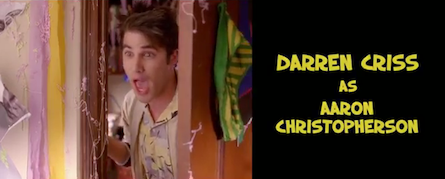
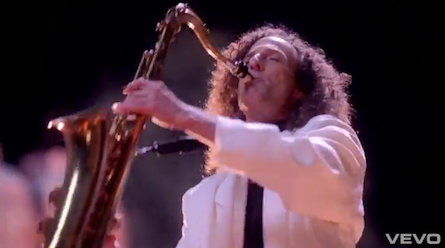
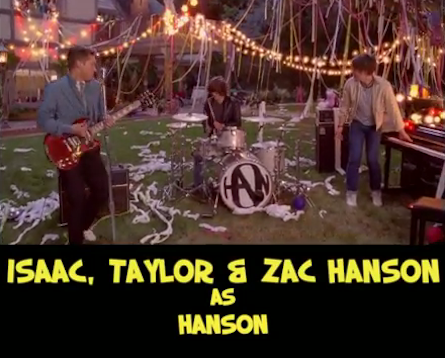
Black’s preternatural “Friday” has been removed from YouTube due to copyright reasons, so it looks like we’ll just have to get our fix of the so-bad-she’s-good teenager in “Last Friday Night (TGIF)”, in which she makes a cameo, along with Glee’s Darren Criss and Kevin McHale, Kenny G as Uncle Kenny, the Hanson brothers, and Corey Feldman and Debbie Gibson as Kathy Beth Terry’s parents!

So it turns out it’s not a battle of the Fridays, but a joining of the day before the weekend that everybody’s looking forward to (or however the ditty goes!) forces!

TGIF!

Related: Who’s the Copycat Now, Katy Perry?

Whipped Cream Feminism: The Underlying Message in Katy Perry’s “California Gurls” Video.

Katy P. VS. Lady G.

Images via YouTube.

On the (Rest of the) Net.

Embrace your inner slut:

“If someone calls you a slut, there’s nothing you can say to refute the claim because it never had any cognitive content anyway.

“If you try to argue that you’re not a slut, you’re implicitly buying into the idea that there are sluts out there. If there’s some criterion that will set you free, that standard will indict someone else—someone with a higher ‘number,’ or shorter skirt, or a later curfew. So we get bogged down in slut/non-slut border skirmishes over a line nobody should have tried to draw in the first place, and we all lose.

“Even virginity is not a defense against alleged sluttiness. Virgins can be sluts if they dress the wrong way, walk the wrong way, or even instill the wrong thoughts in other people. Some people will convict you of sluttitude because your body is the wrong shape, or the right shape.”

Sluts just can’t win. That’s why you should (as above) embrace your inner slut and join the SlutWalk next weekend in Melbourne, at the State Library from 1pm. I’ll be blogging more about this throughout next week.

Glee’s Mercedes just can’t get a date!

Video vixen VS. female bodybuilders:

“It is not ‘respectable’ to be black, female, voluptuous, and sexy on a stage for profit, but it is perfectly acceptable to be black, female, muscular, and ‘unsexy’. Is this double standard acceptable? Is one profession truly more sexualized than the other?”

I don’t entirely agree with this hypothesis. I think it’s far more acceptable to be conventionally and femininely sexy, as opposed to muscular and unconventionally masculine. Sure, the video vixen job title isn’t exactly perceived as a classy, “respectable” occupation, but neither is female bodybuilding. Society as a whole would much rather see women shaking what they were born with (or, you know, what the plastic surgeon gave them) than manipulating their bodies via hormones and free weights.

The surrogacy debate rages on at MamaMia

“$150,000 Doesn’t Make You Rich. Discuss.” Okay, I will: I come from a family where my mother stayed home with my sister and I, and my dad worked three jobs at some stages. I was very young then, so I have no idea how much money he brought in. But I can tell you, it sure as hell wasn’t $150,000, and we struggled to keep our heads above water week-to-week. We never had savings, we could never go on family holidays that required much travel because we couldn’t afford flights or accommodation. I missed out on all but one of my seven cousins’ weddings because we couldn’t make it interstate. My parents have only bought two houses in their lifetime: the other nine we resided in throughout my lifetime were rentals. I also don’t know how much my dad makes now, but it is a lot less than $100,000, and my mum’s on a pension. In my opinion, $150,000 a year is rich.

“Opposition leader Tony Abbott says the Government is punishing ‘aspiration and hard work’,” with the new middle class welfare breaks. Is working three jobs and hardly being able to see your family not hard work, Mr. Abbott?

How to deal with your boyfriend’s porn-watching habit.

The argument for Pixar movie heroines who aren’t princesses, “from all the girls with band-aids on their knees”.

The perils of being smiled at by a cute guy in a café when you’re not wearing makeup.

Texas’ “10 Hottest Female Sex Offenders”. “No doubt that 4-year-old boy, that 2-year-old boy and that 13-year-old girl are taking solace even as we speak that at least they were abused, molested and assaulted by a hot person.”

Hillary Clinton, brownies and Vanity Fair’s cover line.

The aftermath of the royal wedding and the state of Britain’s monarchy for the next 30 years.

Gay/straight chicken: when straight men insult homosexuality and “gay men insult women”.

“Is Kate Hudson Coasting on Cuteness?” My money is on “yes”. When was the last time she starred in a box-office smash, or was nominated for an award other than a Razzie?

Images via Jezebel, Fashion Fame.

Book Review: Mia Culpa—Confessions from the Watercooler of Life by Mia Freedman.


Mia Freedman really is a brand unto herself. We all know she revolutionised the magazine world at age 25 as editor of Cosmopolitan. Her blog, MamaMia, really came into its own during last year’s federal election, offering a different take on politics for modern women. And she’s now a three-time published author with her own television show on SkyNews!

Of course she credits her husband, Jason, her kids, friends, family and MamaMia team with supporting her and helping run her media juggernaut, all of whom she writes about—sometimes anonymously, but oftentimes not—in her latest memoir-cum-“long, wonderful dinner-party conversation”, Mia Culpa: Confessions from the Watercooler of Life.

A lot of the material that makes up Mia Culpa I’ve read before, I will admit, in Freedman’s Sunday Life column, her blog, and various other publications she makes appearances in. But I’ve been known to revisit favourite blog posts and articles before, so it was very enjoyable to read Freedman’s musings on everything from sex to SNAGS (p. 64–67) to showering (p. 290) to breastfeeding (p. 175–179) to interior design (p. 129) to social stamina (read: non-existent when you have a young family, p. 131–136) to Christmas (p. 148–152) to how many children you want/have (p. 71–75) to the hypocrisy of being a certain-meat eater (“I’ve never eaten things like duck or rabbit or deer because I relate to those animals in a way I don’t relate to chickens—perhaps because many of them were storybook characters. Bambi, anyone?” [p. 145]. Guilty as charged) to Disney princesses (p. 180) to The Secret (p. 301).

Some of my favourite parts existed in the first chapter and were a nice way to begin the book. In it, Freedman writes about grooming standards in long-term relationships (p. 4–12), choosing between your ass or your face as you grow older (p. 13–16), skinny-shaming VS. fat-shaming (p. 16–23) and the pre-requisite rant on unrealistic portrayal of women VS. men in the media (p. 23–32). But when she puts it like this, it’s hard not to see Freedman’s point:

“Pretend the world was full of pictures of naked men. On billboards and the sides of buses, in magazines and ads for beer, cars and deodorant. Imagine there were penises everywhere you turned and you couldn’t escape seeing them every day.

“And all the images of nude men were fake. Every male model and celebrity had had penile enlargement surgery, and afterwards, his penis had been extensively photoshopped to make it look even bigger. So now, all the penises you saw in the media every day were knee-length and as thick as an arm.

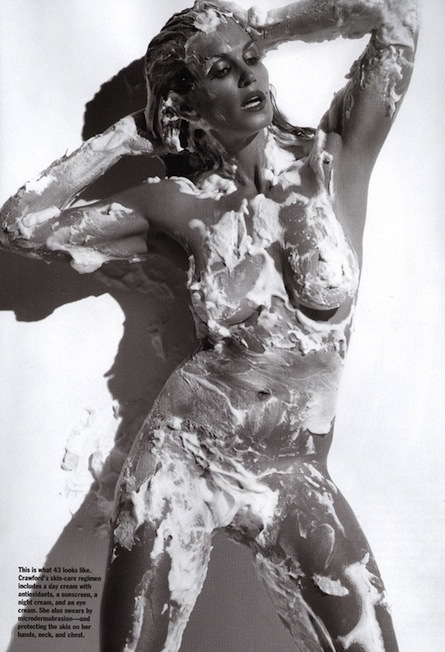
“One day, next to a magazine article about a celebrity with a foot-long penis, you read the headline: ‘This is what a 43-year-old penis looks like’. The caption underneath read: ‘Asked for the secret to his long schlong, former male model Markus Schenkenberg insists he was just born that way. “I wear cotton boxer shorts and I exfoliate in the shower,” he shrugs. “That’s all I do.”’

“After reading a hundred stories like that and being bombarded by 10,000 images of men with surgically altered and digitally enhanced penises, do you think you might look down at your natural, un-photoshopped trouser snake and feel a little… deflated? Inadequate? Insecure? Angry?”

There’s also some of Freedman’s fascinating thoughts on being a “try-sexual” as per Katy Perry’s “I Kissed a Girl” (p. 241–244), which has been written about extensively on sites like MamaMia and Rachel Hills, and tattoos (more on that to come later today).

You don’t have to be a Freedman fan-girl to enjoy this book; I would recommend it to anyone who happens to be of the female gender, and even those who don’t happen to be but are just looking for some enlightenment on the species.

Related: MamaMia: A Memoir of Mistakes, Magazines & Motherhood by Mia Freedman Review.

UPDATED: Skinny-Shaming VS. Fat-Shaming.

“Who the Bloody Hell Are We?”: The Sentimental Bloke at the Wheeler Centre.

Elsewhere: [MamaMia] MamaMia Gets a TV Show.

[MamaMia] Cindy Crawford is Naked in Allure Magazine. And 43.

[MamaMia] I Kissed a Girl. Because I Had Something to Sell.

[MamaMia] Kissing a Woman Does Not a Lesbian Make.

[Rachel Hills] The Rise of the Guy-On-Guy Kiss.

Image via Australian Women Online.

On the (Rest of the) Net.


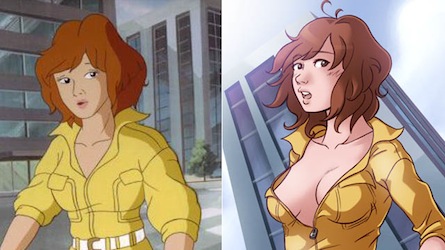
“The Evolution of April O’Neil.”

Both MamaMia & Melinda Tankard-Reist have run stories on footballers behaving badly, after the  New Zealand Warriors rugby team drafted Shaun Metcalf, who spent 18 months in jail for rallying a couple of his teammates to help him kick his pregnant teen girlfriend to cause her to miscarriage. Tankard-Reist writes:

“One of Metcalf’s key defenders and outspoken advocates is Celia Lashlie… [says]:

‘We can all get caught up in the emotional image of young men booting a young woman in the stomach to cause her to abort her baby, but these were two young people … she got pregnant, he was way out of his depth, and he did a really cruel and dumb thing.

‘He was caught in the moment, and what he did was the equivalent of a young man putting a noose around his neck because his girlfriend tossed him out. He has to be allowed to move forward and put his life together, and I think the ability of the NRL and the Warriors to take this young man in and help him do that is role modelling and something they should get credit for’…

“Oh no, we wouldn’t want to get caught up in an image of young footballers playing football with the pregnant womb of a 15-year old girl now would we?

“‘The equivalent of putting the noose around his neck’? No, it was the equivalent of putting a noose around her neck—and the neck of her child. Laslie paints the act as some kind of self-punishment. But he wasn’t assaulted. He wasn’t trying to protect the child he was carrying. It wasn’t he who might lose his life.”

“Glorified pimp” Kris Jenner VS. the “strong of character” Khloe Kardashian on her new reality show, Khloe & Lamar.

Katy Perry and Britney Spears celebrate a pop apocalypse in their new singles on Girl with a Satchel.

Also at GWAS, Erica Bartle writes in response to Mia Freedman’s take on the relevance and influence of magazines, and what that means for women.

This makes me even more upset that my body corporate won’t allow Foxtel installation: MamaMia has their own TV show on SkyNews, Tuesday nights at 8pm. Congrats to the MamaMia team; they really are showing that the blogosphere is the new media frontier.

How to make the real-life Barbie doll.

Is this what 43 looks like?

Rebecca Black’s “Friday” is more popular on—wait for it…—Fridays! Who knew?!

Hugo Schwyzer on perfection, “good guys” and respect in relationships:

“… Many young women conclude that happiness is something that you only get when you get to your goal weight. And even more troublingly, when it comes to relationships, lots of straight girls think that if their own bodies aren’t perfect, they have no right to expect too much from guys.”

Apparently, leading a sedentary, office-bound life can lead to heart disease and other health problems. Not good news for bloggers…!

Do Spanx make the world a better place?:

“… My world is a better place when I can fucking breathe. My world is a better place when someone is not trying to convince me that making myself into a human sausage will make the world a better place.”

Vintage STD-warning posters. Oh, the misogyny!

“The Public Health Problem No One Wants to Talk About”: Stillbirth.

“Stop Being ‘Shocked’ by ‘Isms’” of the rac- and sex- persuasions. And trans- and homophobia while we’re at it.

Sexualised violence is the new black.

The real-life The Wrestler: the tragic life-story of Chris Kanyon.

The perils of the unfinished book.

How to raise boys well.

Images via Jezebel, MamaMia.

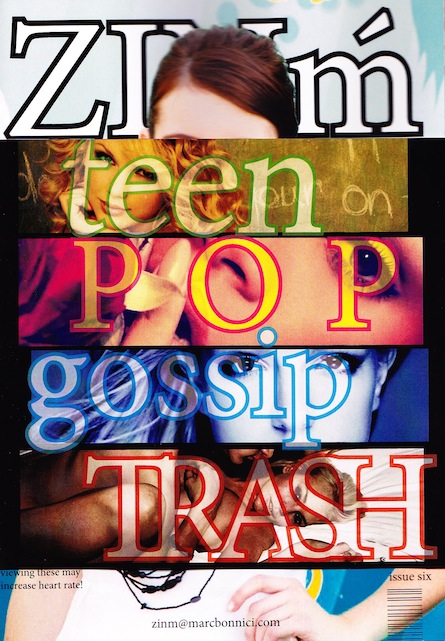
Magazine Review: ZINm, Issue Six.


With issue six released a couple of weeks ago, independent zine, ZINm, by Melbournian Marc Bonnici, is really hitting its stride.

The “Teen, Pop, Gossip, Trash” issue takes a page out of Famous’s book mag, with a snarky, funny and pop-culturally heavy tone.

On the “From the Editor” page (p. 5), Bonnici ponders the first world problems of “Britney VS. Katy: product placement in their new music videos” and “what colour scarf shall I wear to go check the mail…?”

The issues features a spread of Selena Gomez’s ever-changing hairdo (p. 6), how to correctly apply make-up (p. 9), Kellan Lutz’s obsession with exercise and long sports socks (p. 10–11), a “dear Christina Aguilera/Metro trains/couples walking in the city” letter in regular feature “Burn Book” (p. 18), and a Dolly Doctor-esque sexual advice column entitled “Doctor Chorizo” (p. 21).

Melissa George, Ryan Reynolds and Emma Roberts also make appearances.

It’s a good thing this issue comes with a “may contain possibly false information” disclaimer, ’cause the truly riotous celeb scandals in this issue couldn’t possibly be true!

The newsstand glossies should take heed: goodness knows a lot of their material is based on possibly false info!

Related: George Michael Paper Dolls in Independent Zine ZINm.

Independent Zine ZINm Preview.

First World Problems.

Elsewhere: [Marc Bonnici] Homepage.