We’ve come to learn that when Glee devotes a whole episode to a star (Madonna, Britney Spears)—bar the second Lady Gaga episode—they pretty much go the Rock of Agesroute: pack as many songs into the episode as they can without giving much thought to the dismal story lines developed in previous episodes.
I thought, in their “Michael” episode, they went the other way: using whichever Michael Jackson songs they had access to that resembled the character’s plotlines to insert into the show. Unfortunately, this meant such dull MJ songs as “I Just Can’t Stop Loving You” and “Ben.”
Rachel Berry is included in both of these renditions, and she admits at the beginning of the episode that she’s never really “gotten” what Michael Jackson is all about like the other New Directions’ have.
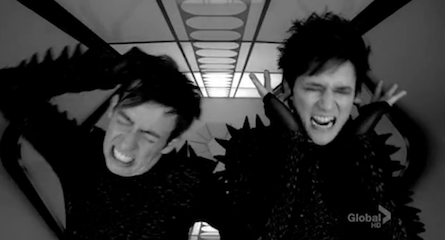
It seems the Glee writers don’t really “get” him, either (although, do they really “get” anything?), because they would have used songs like “I Want You Back”, when Sam serenades Mercedes, instead of “Human Nature” (which is a stunning song and perhaps the only example of where the writers chose melody over meaning); and when Artie gets all riled up over Blaine’s rock-salt-infused slushie attack at the hands of the Warblers, “They Don’t Really Care About Us” might have been more appropriate than Michael’s duet with sister Janet, “Scream”:
“What do you expect from us; we’re people. I know the rest of the world may not see us like that but when they tease us and throw stuff at us and toss us in dumpsters and tell us that we’re nothing but losers with stupid dreams it freaking hurts. And we’re supposed to turn the other cheek and be the bigger man by telling ourselves that those dreams and how hard we work make us better than them? But it gets pretty damn hard to feel that way when they always get to win.”
By far the best performance was the Warblers’ Sebastian and Santana’s Michael-off of “Smooth Criminal”, featuring 2 Cellos, who played at Elton John’s gig and did the same version of the song!
And, for old time’s Michael’s sake, here are the other songs from the episode:
Gah! Anti-vaccination extremists. Why are people like this allowed to promote views like that? Oh right, that pesky little thing called “freedom of speech”… [MamaMia]
Wow. Mia Freedman offers some throwaway fashion advice to her 5-year-old daughter; shitstorm ensues. I think it’s a bit of an overreaction, but each to their own. [MamaMia, Fat Heffalump]
Male body objectification: in comparison to female body objectification, is it even a thing worth worrying about? [Lip Magazine]
Hmm, Lego for girls? I’m not such a fan. What was wrong with the original, male-centric version, apart from the absence of female characters? We all know kids are imaginative enough to make toys whatever they want them to be. [MamaMia]
It’s been just over a year since the St. Kilda Schoolgirl released those photos, and I’ve only just gotten around to reading this article by Anna Krien from The Monthly’s April 2011 issue on sex and the treatment of women in the AFL. Let me say, it was well worth the wait.
Alyx Gorman defends Miranda Kerr, asserting that there probably is more than meets the eye, but she just “won’t let us see it”:
“Even more problematic than its existence in the first place is the fact that Kerr’s construct is damaging to women and girls. By looking and speaking the way she does (when she has other options in terms of presentation), Kerr is intrinsically linking sensuality with stupidity. She is demonstrating that being ditzy and appearance-obsessed (albeit under the guise of being healthy) is what it takes to be one of the most desirable women in the world. By refusing to express a well reasoned opinion on anything of note, and then pushing the point of self esteem, she is sending a message that the source of girl-power, of pride in one’s womanhood, must always be grounded not in who you are, but how you look. Kerr has crafted an image that is the ultimate expression of the immanence de Beauvoir railed against, and she has done so (I suspect) knowingly.
“Instead of being brave enough to show what a beautiful, clever girl looks like, to delve into the nuances of what it means to be a wife, woman, mother and object of desire, Kerr plays to our worst stereotypes of femininity, giving an organic-almond-milk 21st century update to the image of the perfect 50s housewife.” [The Vine]
Before it was even released, the world knew that “Born This Way” was going to define 2011, if not for its controversial comparison to Madonna’s “Express Yourself”, then for Glee’s 90-minute special dedicated to the anthem. Gaga was accused of racism and plagiarism for the song, which spawned a website in which gay users can upload images and affirmations. Like it or loath it, you’ve got to agree that Gaga has her heart in the right place with this one.
“Friday”, Rebecca Black.
Ahh, the song that you can never get out of your head. While I think “Friday” is the work of a genius (Lady Gaga thinks so, too!) and enjoy bopping around to it, grabbing my bowl, grabbing my cereal, going to the bus stop, choosing which seat to take, I understand that the majority of the world doesn’t feel the same. But for a viral video, you’ve got to give the girl props for permeating the zeitgeist so.
“Rolling in the Deep”, Adele.
I’ve only recently gotten into Adele, but now that I have, I could listen to her voice for hours. Whether it’s “Someone I Used to Know”, “Turning Tables” or “I Can’t Make You Love Me”, as opposed to “Rolling in the Deep”, you can’t deny that Adele was everywhere in 2011. And she was warmly welcomed for her heartbreaking love songs and her alternative look.
“Party Rock Anthem”, LMFAO.
Up until a few days ago when I asked my friend April which songs she thought I should include in this list, I thought this song was called “Shuffling”! No matter; the whole world has picked up on the gist and beat of the song, and that’s all that really matters, right?
“Moves Like Jagger”, Maroon 5.
Another song that I was oblivious to until recently. Rather, I was oblivious to who sung it, even though the vocals of Christina Aguilera were unmissable. My awakening to “Moves Like Jagger” came the night of my birthday party, when a random partygoer likened my moves to being even better than Jagger’s!
The song is somewhat forgettable, but Katy Perry’s “Last Friday Night” was all about the film clip, featuring the aforementioned Rebecca Black, some guys from Glee, Hanson, and Kenny G.
“(Run the World) Girls”, Beyonce.
While “(Run the World) Girls” isn’t by a long shot the best song on Beyonce’s latest album, 4, it was the one that set the ball rolling for total 2011 Beyonce domination. For my money, “Countdown” and “Best Thing I Never Had” are better, but the controversy the song stirred up and the film clip are what make the song rate.
“Somebody I Used to Know”, Gotye.
Until I YouTubed this song just then, I’d never heard it before. But I’d heard the hype surrounding it. While alternative Australian music isn’t really my cup of tea, it does invoke a certain nostalgia of music my parents would play when I was a child, like Cat Stevens and some others I can’t quite put my finger on.
“Super Bass”, Nicki Minaj.
If it weren’t for the Ellen show sensations Sophia Grace and Rosie, “Super Bass” wouldn’t hold such a special spot in my heart(beat running away)! Is that wrong…?
“On the Floor”, Jennifer Lopez.
This time last year J.Lo couldn’t have been less relevant. Whether it’s the calibre of “On the Floor” (one friend is particularly irked by the “Back it up like a Tonka truck” line from Pit Bull!) or her highly publicised divorce from Marc Anthony (how fitting that the title of her latest album should be Love?), J.Lo was back in a big way in 2011.
“We Found Love”, Rihanna.
Rihanna also had a big 2011, and it was hard to choose just one of her myriad of songs from the past year. I have a penchant for “Only Girl in the World”, which was officially released in 2010 but seemed to transfer over into 2011, and there’s also “Man Down”, “S&M”, “California King Bed” and “Cheers (Drink to That)” that were hits last year. And of course, we can’t forget the hullabaloo that resulted from the filming of the video for “We Found Love”. Farmers and Irish fields, anyone?
In the spirit Christmas, I’ve decided to revisit some of my favourite posts of the year in the twelve days leading up to December 25th.
I’m taking this final 12-Posts-of-Christmas opportunity to squeeze two Rachel Berry-related posts into the one. Think of it as one last Scarlett Woman gift to you.
The first post was written “In Defence of Rachel Berry”, while the second explores the character as a feminist one. You can access the original posts here and here, respectively.
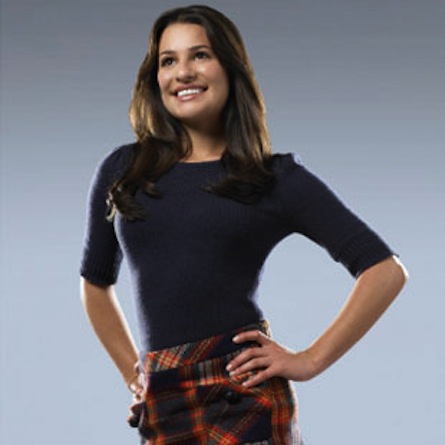
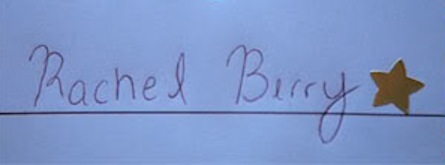
In the first season of Glee, Rachel Berry was introduced as an attention- and approval-seeking know-it-all diva, who sticks a gold star next to her name on the New Directions’ sign-up sheet because that’s what she sees herself as. Season two showed the glee clubber soften her resolve a bit, realising that she’s still only in high school, and has her post-high school years to carve out a Broadway career and have the world see her as the star she knows she is. The season final saw her choose a relationship with Finn Hudson in her senior year at McKinley High, despite having to leave him to head to New York when she graduates.
Not all young girls have to wrangle their feelings for the school jock whilst contemplating a move to the big city to make their dreams come true, but many of Rachel’s problems are shared by the show’s audience.
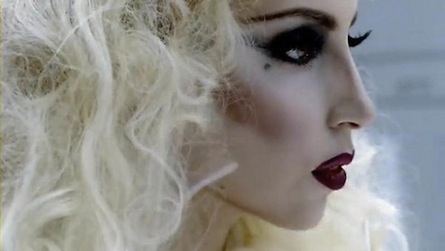
In the most recent Lady Gaga-themed episode, Rachel struggles to accept her “Jewish nose” and considers rhinoplasty. She also strives for the acceptance of her New Directions band mates, and to be seen as fashionable and popular.
It’s in the character’s nature to be highly-strung, goal-oriented and ambitious, so it’s not likely she’ll change any time soon. And why should she? While there are certainly other young women out there who identify more with the saccharine Quinn Fabray, the sassy soul sisters Santana Lopez and Mercedes Jones, or badass Lauren Zizes, there are plenty who see Rachel as their Glee counterpart, myself included.
A recent New York Times article by Carina Chocano praised the “relatable” and “realistically weak female character”, like Kristen Wigg’s Annie in Bridesmaids—“a jumble of flaws and contradictions”—over the “strong” one. “We don’t relate to [the weak character] despite the fact that she is weak, we relate to her because she is weak,” Chocano writes.
But what exactly does she mean by “weak”?
Pop culture commentator Dr. Karen Brooks notes that talented, beautiful, popular and successful female characters need to be broken down before they can be seen as relatable. “The more talented and beautiful you are, the greater the threat you pose and so ‘things’ are introduced to reduce that threat,” she says. Just look at the “women falling down” video on YouTube.
While Rachel’s had her fair share of setbacks, it seems Glee’s audience is finally beginning to understand her. “We’ve been given time to understand Rachel’s initially painful personality and to identify both her strengths and weaknesses. Her ambitions and drive haven’t shifted, but the context for understanding them has,” Brooks says.
“Rarely are unpleasant characters redeemed, they are simply ‘punished’, while the ‘good’ characters soar to impossible heights, not on the back of hard-work and self-belief, but usually [because of] a love interest and wishing hard. Rachel is a healthy and welcome exception to that,” Brooks continues.
So she’s an unlikely heroine we can all get behind, you might say? “A girl who reminds you of you,” as Chocano opines. An everywoman, if you will?
If Rachel Berry encourages more young women to see themselves as gold stars striving to have their accomplishments recognised, then so be it!
I wrote that audiences have come to know and love Rachel not because her obnoxious know-it-all persona has changed, but because “We’ve been given time to understand Rachel’s initially painful personality and to identify both her strengths and weaknesses. Her ambitions and drive haven’t shifted, but the context for understanding them has,” as Dr. Karen Brooks reiterates.
“I… have trouble with the vilification of Rachel Berry on a feminist level. How often do we dismiss women as ‘bossy,’ ‘know-it-all[s],’ or ‘control-freaks’ when their behavior would be interpreted as leadership, assertiveness, or courage if they were men?
“… In the right context, Rachel Berry’s personality would not seem ‘intolerable’ or ‘annoying’ so much as bad-ass, renegade, and hardcore.”
And Lady T, who used Rachel as her “Female Character of the Week” on The Funny Feminist, said:
“… The show wanted us to root for a girl who was ambitious, daring, and driven.”
It might be because I have been known to be seen as bossy, a know-it-all, a control-freak (just ask my new housemate!) and ambitious that I’m standing up for her, but just think of another feminist heroine in modern pop culture who could also be described using these words: Hermione Granger. The only difference is, she isn’t vilified for these attributes.
If you look back to the beginning of Glee, especially, Rachel was often deemed ugly. Now, anyone who’s seen Lea Michele knows she’s not exactly unconventionally attractive, but Rachel is characterised as this because she’s annoying. And she’s annoying because she stands up for herself, knows what she wants and how to get it. (From a racial point of view, she could also be seen as being “ugly” because of her Jewishness.)
Despite these inherently “unattractive” qualities, Rachel manages to snag her man, Finn, in what can be seen as typical Glee sexism and discrimination:
On the other hand, it can be seen as a poignant take on teenage life that the underdog is always being compared to the most popular girl in school: Quinn Fabray.
If Rachel is Glee’s feminist heroine, Quinn is her polar opposite. She has had next to no character development, which leads to her motivations changing week to week.
In “Original Song” she tore Rachel down, telling her to get over her “schoolgirl fantasy happy ending” with Finn, who would never leave Lima, taking over Burt Hummel’s mechanics business, with Quinn, a real estate agent.
But in “Born This Way”, she was “broken down” by her fat past coming back to haunt her, to come across as more “relatable”.
Sure, Rachel’s had her fair share of being “broken down” (being dumped and subsequently egged by Jesse St. James, being publicly broken up with by Finn, getting slushied… I sense a food theme here.), but in the grand Glee scheme of things, she’s actually doing pretty well for a female character.
From How to be a Woman by Caitlin Moran (review to come next week):
“‘Even though you wear very little clothing,’ I said slightly primly, gesturing to [Lady] Gaga’s bra and thong, ‘you’re not doing all this as a… prick-tease, are you?’
“‘No!’ Gaga replied, with a big, drunken beam. ‘It’s not what straight men masturbate over when they’re at home watching pornography. It’s not for them. It’s for… us.’
“And she gestured around the nightclub, filled to the brim with biker-boy lesbians and drag queens.
“Because Gaga is not there to be fucked. You don’t penetrate Gaga. In common with much of pop’s history, an particularly its women—she’s not singing these songs in order to get laid, or give the impression she wants to. She wishes to disrupt, and disturb: sunglasses made burning cigarettes, beds bursting into flame[s], dresses made of raw meat, calipers made of platinum, Gaga being water-boarded in a bathtub—eyes dilated with CGI so that she looks like her own manga cartoon. Her iconography is disconcerting, and disarranged what we are used to seeing.” [p. 260]
On the whole, Cunningham’s presentation was thought-provoking, if a little small-minded, but my main point of contention is as follows.
Cunningham brought up third/fourth wave feminism (the feminism we’re experiencing now, by most accounts), saying that while she applauds the grassroots feminist movements such as SlutWalk, she wasn’t sure 25-year-old women could fully understand the concept of feminism because they still have men fawning all over them at that age.
Now that’s just a whole lot of wrong.
First of all, I am soon-to-be-24 and I don’t have men falling at my feet (well, except when it’s unwanted), and nor do my similarly-aged friends.
Secondly, who’s to say that even if we did, we wouldn’t recognise that, unless they had had some kind of interaction with us other than staring at our boobs, they were interested in us purely for our looks, and that’s anti-feminist. (Then again, I know girls who do have men fawning all over them purely for their looks and couldn’t care less.)
And thirdly, this kind of feminism in fighting is exactly what has been undoing the feminist movement in recent years. As I wrote:
“… Cunningham saw a sort of ‘bottleneck’ in modern feminism, where white, privileged feminists like myself don’t understand the problems facing feminists of colour, feminists with sexual orientation other than straight, feminists with gender other than cis, and feminists with disabilities…”
This is not to mention conflict between the ages, or waves, of feminism.
“… Despite its [feminism’s] many victories, it seems to falter along a ‘mother–daughter’ divide. A generational breakdown underlies so many of the pathologies that have long disturbed American [or, rather, Western] feminism—… its bitter divisions over sex… [and] alongside the battle of the sexes rages the battle of the ages.”
I can’t think of a better example than, oddly enough, an episode of Gossip Girl from its most recent season, in which it addresses the clash between young and old feminists after Serena van der Woodsen is accused of having an STD. Her dean at Columbia University tells her:
“Women of my generation had to fight for every opportunity. And to be taken seriously, and your attitude, Miss van der Woodsen, makes a mockery of that.”
I wrote in response at the time, in reference to Faludi’s article:
“Now if that isn’t the second wave looking down upon the third wave for our apparent flippancy about ‘activism’, our ‘obsession with technology’ (Gossip Girl’s blasts are a prime example of this), our ‘unwilling[ness] to challenge sexual exploitation for fear of pissing off men’ (hello, Serena), and our infatuation with Lady Gaga (well, Gossip Girl did feature the Lady herself in an episode…), I don’t know what is.
“… It would be interesting to see Serena fight back and declare herself ‘sick to death of hearing about the glory days of Seventies feminism’, whilst older women, like Dean Reuther, ‘declaring themselves sick to death of being swept into the dustbin of history.’
“Faludi spends a lot of time criticising (via her second wave subjects) the technology third wavers use, specifically blogging: ‘All they want to do is sit at their computers and blog.’ Ouch.
“I’m sure Gossip Girl would have something to say about that.”
Exhibit A: SlutWalk as an anti-testament to Faludi’s assertion.
Could it be jealousy these second-wavers are suffering from? I’d like to think feminism is above that, but it is one of the seven deadly sins and can get the better of us. Contrary to what Cunningham said, I don’t think it’s because of the way we look. Everyone knows age is not a precursor to looking hot. I think second-wavers might long for their glory days of making things happen, being invigorated and excited by feminism, instead of seeing their options shrivel up and die the older they get. Again, please see exhibit A. While I don’t know the ages of those who were critical of the SlutWalk, but if they were older it might be easy to see why they were a bit miffed by the anti-slut-shaming and -victim-blaming movement that they felt left them behind.
There needs to be something done to rectify this. Not only the gap between the ages, but the gap between the races, the abilities, the genders and the sexual orientations.
I don’t pretend to know how we’re going to do this, but it will have to start with listening and understanding, empathy, perhaps some mentoring and—what feminism is all about, not just between the sexes, but between all those I mention above—equality.
Alone time is my siren call. Here, Jezebel’s Social Minefield tells you how to get more “me time” without offended those who want to have “we time” with you.
“… I do want to raise the question that while we do the work of destigmatising menstruation and teach young girls to be proud and excited about their menarche don’t we also have a responsibility to question its necessity? We tell women they don’t have to have sex to have children, that breast cancer can be beaten, that they can have their tubes tied and then re-connected and their faces lifted and de-wrinkled. We live in a modern world with modern solutions, isn’t it time we started seriously thinking and talking about the need to bleed?” [Feminaust]
“The idea that there is something inherently prurient about a porn star breast-feeding plays right into that classic either-or thinking: Her breasts are erotic in one venue, so they can’t be wholesome in another. It’s a wonder anyone lets her breast-feed at all! On the one hand, it’s surprising to see this attitude coming from a pornographer; on… [yet an]other hand, it’s perfectly appropriate given the way motherhood is fetishised in porn.
“…We don’t like to think of moms as sexual beings—except for in the taboo-busting world of porn (paging Dr. Freud). It’s fitting for a porn star mama, the rare industry ‘MILF’ who is actually a mom, to remind folks that, generally speaking, one has to have sex in order to become a mom.” [Salon]
Anne Hathaway’s new effort, One Day, has a “bleak worldview of co-dependence where men need women to improve them, and women need to improve themselves to deserve men’s notice and achieve their purpose,” with The Film Stage dubbing it “the most toxic romance of the year”.
Here’s an extended version of Erica Bartle’s debut piece for Sunday Life. While I don’t necessarily agree with her sentiments on faith most of the time, this is a great read. Better than the published piece, dare I say? [Girl with a Satchel]
“… Women should not merely have the right to end unwanted pregnancies, they should have the right to be proud of having done so. Surely, there is enough suffering in this world already without adding infants with Tay-Sachs disease and Lesch-Nyhan syndrome to the mix. Women who step up to the ethical plate and have the strength to say, ‘This is the wrong time,’ or ‘This is the wrong fetus,’ should hold their heads high in the streets.” [Opposing Views]
Oh, the hilarity of Photoshop on thisGlee/Vogue/Fashion’s Night Out advertisement. [Styleite]
In the first season of Glee, Rachel Berry was introduced as an attention- and approval-seeking know-it-all diva, who sticks a gold star next to her name on the New Directions’ sign-up sheet because that’s what she sees herself as. Season two showed the glee clubber soften her resolve a bit, realising that she’s still only in high school, and has her post-high school years to carve out a Broadway career and have the world see her as the star she knows she is. The season final saw her choose a relationship with Finn Hudson in her senior year at McKinley High, despite having to leave him to head to New York when she graduates.
Not all young girls have to wrangle their feelings for the school jock whilst contemplating a move to the big city to make their dreams come true, but many of Rachel’s problems are shared by the show’s audience.
In the most recent Lady Gaga-themed episode, Rachel struggles to accept her “Jewish nose” and considers rhinoplasty. She also strives for the acceptance of her New Directions band mates, and to be seen as fashionable and popular.
It’s in the character’s nature to be highly-strung, goal-oriented and ambitious, so it’s not likely she’ll change any time soon. And why should she? While there are certainly other young women out there who identify more with the saccharine Quinn Fabray, the sassy soul sisters Santana Lopez and Mercedes Jones, or badass Lauren Zizes, there are plenty who see Rachel as their Glee counterpart, myself included.
A recent New York Times article by Carina Chocano praised the “relatable” and “realistically weak female character”, like Kristen Wigg’s Annie in Bridesmaids—“a jumble of flaws and contradictions”—over the “strong” one. “We don’t relate to [the weak character] despite the fact that she is weak, we relate to her because she is weak,” Chocano writes.
But what exactly does she mean by “weak”?
Pop culture commentator Dr. Karen Brooks notes that talented, beautiful, popular and successful female characters need to be broken down before they can be seen as relatable. “The more talented and beautiful you are, the greater the threat you pose and so ‘things’ are introduced to reduce that threat,” she says. Just look at the “women falling down” video on YouTube.
While Rachel’s had her fair share of setbacks, it seems Glee’s audience is finally beginning to understand her. “We’ve been given time to understand Rachel’s initially painful personality and to identify both her strengths and weaknesses. Her ambitions and drive haven’t shifted, but the context for understanding them has,” Brooks says.
“Rarely are unpleasant characters redeemed, they are simply ‘punished’, while the ‘good’ characters soar to impossible heights, not on the back of hard-work and self-belief, but usually [because of] a love interest and wishing hard. Rachel is a healthy and welcome exception to that,” Brooks continues.
So she’s an unlikely heroine we can all get behind, you might say? “A girl who reminds you of you,” as Chocano opines. An everywoman, if you will?
If Rachel Berry encourages more young women to see themselves as gold stars striving to have their accomplishments recognised, then so be it!
“If the only world event worth commenting on is the most severe tragedy, then where does the pissing contest end? Yes, what happened in Norway was terrible, but what about what happened in Japan? What about what happened with the Asian tsunami? What about 9/11 here in the good ol’ US of A? (You said you’d never forget!) What about everything bad that has ever happened?” [Jezebel]
Girl with a Satchel’s Erica Bartle gets her faith on on MamaMia. You go, girl!
Four commentators, including a mum and a teen, weigh in on the Lady-Gaga-as-role-model debate. For more on this topic, check out this article. [Sydney Morning Herald, Girl with a Satchel]








 The Scarlett Woman