Event: Crepuscular at Melbourne’s City Gallery.

“Crepuscular adj.

1. Of or resembling twilight. 2. Of certain insects, birds, and other animals active at dusk.”

Crepuscular has been running since the start of May and will finish up next month in the Town Hall’s City Gallery, a small, free exhibition space in the heart of Melbourne. Which is fitting, really, as the exhibition shows off the artwork, historical photos and taxidermied specimens of the animals (some might say pests) that roam the city streets and gardens in the nighttime hours: crepuscular.

Crepuscular deals with “the origins of the wild animals that have found a niche in the city” , whether they are “a menace to our health” or if they “bring benefits”, and how we should “respond to their presence”. It features stuffed specimens of night owls, possums, rats, bats and insects (though technically you can’t stuff insects!), their introduction to Melbourne (if they’re not a native species) and their history in the city.

As a free exhibition that city-dwellers probably pass on their way home from work, there’s no excuse for missing it. On Tuesday to Friday, it’s opened til 6pm, and from 11am til 4pm on Saturdays. Mondays are 10am to 2pm. It’ll take you 20 minutes to have a browse through, and it’s quirky nature is well worth it.

On the (Rest of the) Net.


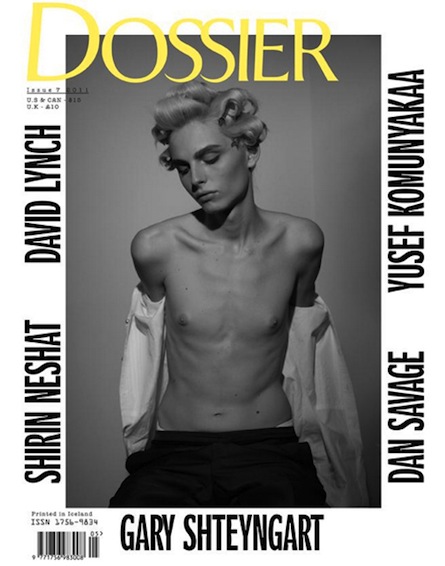
On the censorship of Andrej Pejic’s Dossier cover:

“… why is Pejic’s cover getting the same treatment as a porno mag? What message are the big bookstore chains sending—that the male torso is only appropriate [for] all-ages viewing when the man in question is ripped?”

Mia Freedman on when life begins.

SlutWalker Leslie Cannold on “the right to be equally mediocre”.

Speaking of SlutWalk, the Melbourne event’s coordinator, Clem Bastow, writes on the event for the Sydney Morning Herald.

The ostentatious disgustingness of “Push Presents”.

Glee: give fat girls a chance.

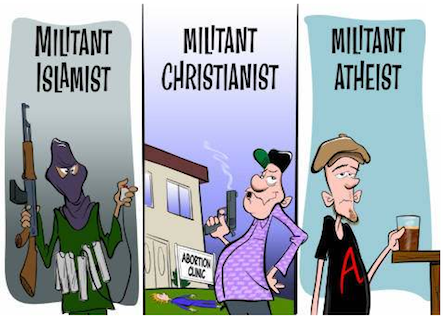
 The militant atheist doesn’t exist.

Arnold Schwarzenegger’s infidelity and Dominique Strauss-Kahn’s sexual assault allegations are one in the same, according to “The Media’s Groping Problem”.

In the same vein: why powerful men sexually assault women.

From Texas’ hottest sex offenders to Strauss-Kahn’s “hot-or-not” accuser.

What would “a word where Aspergers was the norm” look like? “Girls who spend hours a day straightening their hair are recommended for counselling,” amongst other things.

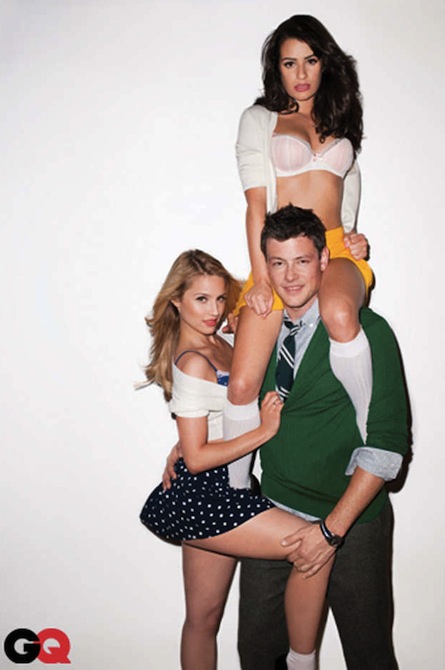
Rebecca Sparrow on “Hollywood’s Fake Teenagers”.

As if we didn’t need another reason to love Mick Foley: the Huffington Post names him their “Greatest Person of the Day”.

Meghan McCain rips the sexist and sizist Glenn Beck a new one.

Much to my mother’s—and her fellow kindy mums’—dismay, my big-for-her-age, four-year-old sister refused to walk to preschool, so Mum was forced to push her in a stroller. Check out Too Big For Stroller for more on this hideous phenomenon.

Are child murderers born evil or created?

In the case of toddler James Bulger’s murderers (one of whom re-offended after being released and is now back in jail), and Dontez Tillman and Thomas McCloud, who beat and tortured “two homeless men over the course of two days”, I tend to lean towards them being “born that way”. If Law & Order and Criminal Minds have taught us anything, it’s that children who demonstrate these kinds of behaviours usually turn out to be sociopathic serial killers.

Image via Queer Me Up, Psychology Today, Even Without Popcorn.

Event: Ain’t Nothin’ Gonna Break My Slutty Stride.

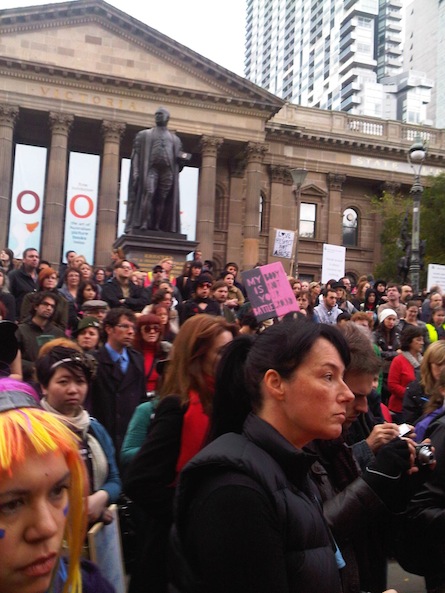
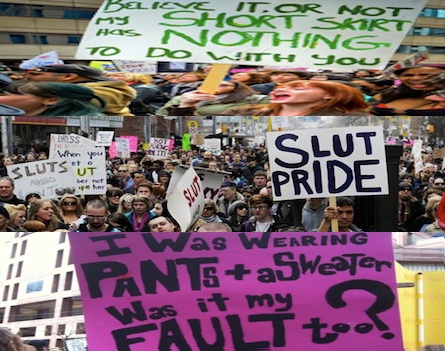
Ralliers outside the State Library on Swanston Street.

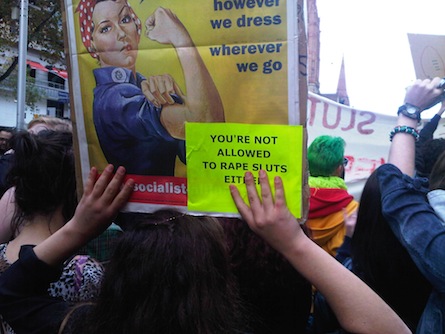
Best. Sign. Ever.

Last Saturday the highly anticipated SlutWalk occurred in several Australian cities, and I attended the Melbourne event with my fellow anti-slut-shamer friend Laura (both of us below).

We rocked up in our sluttiest outfits, which you can see above, complete with permanent marker declarations of our proud sluthood to boot. Some of the other outfits we noticed were short skirts with knee-high skull print socks and customised Doc Martins, worn by event organiser Clem Bastow (below), lace dresses and gym gear, the latter of which adorned a short-haired tattoo fan with a body Tracy Anderson would envy.

Clem Bastow.

Monica Dux.

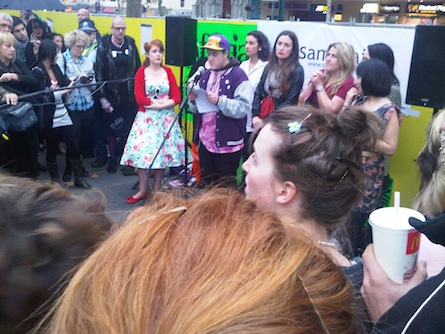
As Bastow commented when she gave one of the opening addresses, along with fellow event organisers Karen Pickering and Lauren Clair, and noted feminists Monica Dux (above) and Leslie Cannold, amongst others: “thank you, God, it looks like you’re going to rain on me”. But no one was gonna rain on our parade and, despite the chilly temperatures, we still walked tall and proud in whatever get-ups we chose to wear.

Dux said this is the beginning of a movement, which I have to disagree with. SlutWalk is not the beginning of a movement; it is part of the reignited battle to stop victim-blaming and slut-shaming based on one cop’s archaic musings on rape and how much a woman was “asking for it”. Here’s a fun fact: WE’RE NEVER ASKING FOR IT! (See Bastow’s sign, above). No matter how we are dressed, where we are, how much we’ve had to drink, or what we do for work.

Speaking of, I was really proud to see the representation of sex workers at the event, and president of the Australian Sex Workers’ Association, the Scarlet Alliance (represent!), Elena Jeffreys (above) spoke about her sexual assault and that even though she was paid for sex, she was not consenting to assault. Her opinions on the SlutWalk were really interesting and I hope they receive as much publicity as the negative perceptions of the rally have in the media.

In the days leading up to SlutWalk, I was embroiled in a heated debate on Facebook with a friend who disagrees with the SlutWalk. I think he confused—like a lot of people—the meaning of the SlutWalk with an excuse to get gussied up in a very risqué manner when, in fact, that was not at all what it was about. That didn’t stop protestors on the steps of Parliament House at the top of Bourke Street brandishing their “rape is horrifying, but so is immodesty” placards (above). Like one of the speakers (whose identity escapes me: should have used my BlackBerry voice recorder!) said: it’s not up to us to curb our behaviour (and that includes how we choose to dress) at the risk of potentially being sexually assaulted; it’s up to those who sexually assault to curb their behaviour!

I think most people against the SlutWalk had a problem with the use of the word slut. As Cannold said, “words matter…: … we won’t stand for one, the same one, being slung at us over and over again to demean and degrade us.” Lori Adelman, in a post on Feministing, said she didn’t agree with the term “slut” and that she “would much rather have attended a ‘Do Not Rape’ Walk”:

“I find that the term disproportionately impacts women of colour and poor women in order to reinforce their status as inherently dirty and second-class, and hence more rape-able.”

To me, “slut” is just a word. It meant as much to me to be called a slut when I was 12 as it does today; as they (and Rihanna) say, sticks and stones will break my bones but names can never hurt me. It’s not about the term “slut”, it’s about the backwards and extremely offensive views that go along with that word. As coordinator of the first SlutWalk in Toronto, Sonya Barnett, told Rachel Hills: “if he [the policeman] had said something else, we would have called it something else.”

The speaker who garnered the most attention, though, was transgendered man, Cody Smith (above), who had been raped both as a biological female, and as a trans man. There were tears a plenty during his speech!

It was nice to see such a welcoming, non-judgmental turnout of everyday men, women and children of all walks of life, wearing all sorts of garb, not just the fishnetted and cut-out body con dresses that certain attendees chose to wear (guilty as charged!). After all, rape is not about what you’re wearing, what you look like, what size you are, how old you are, what your sexual orientation or gender is, or any other denomination that you happen to belong to as a person. It is about the perpetrator, and nothing you can or cannot do will stop them from attempting to rape you.

As Smith said, it shouldn’t be the victims of sexual assaults’ responsibility to educate the general public on sexual assault and victim-blaming. And I thought the sexual revolution happened several decades ago: it shouldn’t be up to members of a fringe movement to educate the general public on the sexual rights of women to express themselves however they please without the threat of retaliation. In fact, feminism—which is what the SlutWalk was all about—shouldn’t be considered as on the fringe in 2011.

Related: SlutWalk.

So a Tattoo Makes Me Public Property, Huh?

Has Feminism Failed?

Rihanna’s “S&M”: Is it Really So Much Worse Than Her Other Stuff?

Elsewhere: [Feministing] SlutWalk: To March or Not to March.

[Musings of an Inappropriate Woman] Ask Rachel: What Are Your Thoughts on SlutWalk?

Black and white images via Ali Ryan Photography.

UPDATED: SlutWalk.

For those of you yet to be persuaded to join in the SlutWalk festivities this Saturday 28th May at the State Library, here are some excerpts from SlutWalker Jaclyn Friedman’s talk at the Boston, Massachusetts event, from Feministing:

“Is a slut a girl who has sex too young? With too many partners? With too little commitment? Who enjoys herself too much? Who ought to be more quiet about it, or more ashamed? Is a slut just a woman who dresses too blatantly to attract sexual attention? And what do any of these words even mean? What’s too young, too many partners, too little commitment, too much enjoyment, too blatant an outfit? For that matter, what’s a woman, and does a slut have to be one?

“… You can call us that name, but we will not shut up. You can call us that name but we will not cede our bodies or our lives. You can call us that name, but you can never again use it to excuse the violence that is done to us under that name every single fucking day.

“… We can be called sluts for nearly any reason at all. If we’re dancing. If we’re drinking. If we have ever in our lives enjoyed sex. If our clothes aren’t made of burlap. If we’re women of colour, we’re assumed to be sluts before we do a single thing because we’re ‘exotic.’ If we’re fat or disabled or otherwise considered undesirable, we’re assumed to be sluts who’ll fuck anyone who’ll deign to want us. If we’re queer boys or trans women, we’re called sluts in order to punish us for not fearing the feminine. If we’re queer women, especially femme ones, we’re called sluts because we’re obviously ‘up for anything,’ as opposed to actually attracted to actual women. If we’re poor, we’re gold diggers who’ll use sex to get ahead. And god forbid we accuse someone of raping us—that’s the fast track to sluthood for sure, because it’s much easier to tell us what we did wrong to make someone to commit a felony violent crime against us than it is to deal with the actual felon.

“You know what I expect will happen when I’m dressed like a slut? People will want to get with me. You know what I don’t mean when I dress like a slut? That anyone I encounter can literally do anything at all they want to me. I know. It’s shocking. Because clearly you thought me wearing my tits out like this gives every single one of you carte blanche to do anything whatsoever you might want to do with my body. I’m very sorry to disappoint.

“… I just want to point out how ridiculous it all sounds when you spell out the meaning of ‘she was asking for it.’ Because the rapists are not confused. Those tiny percentage of guys doing most of the raping? They’ve told researchers that they know full well they don’t have consent. It’s the rest of us that seem confused. We’re the ones that let them off with a little ‘boys will be boys’ shrug and focus our venom on ‘sluts’ instead, leaving those boys free to rape again and again.

“… There’s nothing wrong with being a slut. Not a thing. It’s OK to like sex. Sex can be awesome. It can be life-alteringly awesome, but even when it’s not, it can be a damn good time. Our sexual desire is part of our life force. And as long as you’re ensuring your partner’s enthusiastic consent, and acting on your own sexual desires, not just acting out what you think someone else expects of you? There’s not a damn thing wrong with it. Not if it’s a hookup, not if you’re queer, not if you like it kinky, not if your number’s too high. If you’re playing on your own terms and you’ve got an enthusiastic partner? Please, I beg of you, just have a fucking awesome time. Our lives are way too often full of struggle and pain. If you can do something with someone else that brings both of you pleasure and joy? You’re increasing the pleasure and joy in the world.

“There has been a lot of misunderstanding about the meaning of the SlutWalk, and none more egregious than those who claim our agenda is to encourage all women to be sluts. Whatever that means, our mission could not be further from that. Our mission here today is to create a world in which all of us are free to make whatever sexual and sartorial choices we want to without shame, blame or fear. If you dress and experience your sexuality in decidedly unslutty ways, and you know that there’s nothing we can do to make someone rape us, the SlutWalk is your walk, too…”

*

Never before (okay, this year) have I been so excited for something. That includes the multitude of costume parties I’ve been to this year.

About a month ago, I cottoned on to the buzz surrounding SlutWalk, an event spawned by Sonya Barnett and Heather Jarvis, after they heard a Toronto police officer telling a rape victim that she wouldn’t have been attacked had she been dressed less provocatively.

The first march was in early April, and was met with great success. Other events have been staged in Dallas, Texas and Boston, Massachusetts.

Next Saturday 28th May, SlutWalk comes to Melbourne, and I am beside myself with excitement. The only rally I’ve ever marched in was when I was 15, for (or rather, against) nuclear power with my mum, sister and bestie. I wasn’t really informed enough to have views on nuclear power back then, and I’m still undecided about it. Obviously the disaster in Japan highlights the question mark surrounding the idea of nuclear power in Australia.

However, I do have strong views about slut-shaming, rape, sex and reproductive rights, and I will be immensely proud to walk alongside my fellow sluts, as we reappropriate the word, much like the gays have reclaimed “fag”.

Obviously, rape is not about how a woman is dressed or how much lust she inspires in men, regardless of what she’s wearing. Women are raped when they’re on their morning jog, walking to and from work, out at night in their nicest outfit, or in their home by a friend or family member. I resent the comments that police officer made, and I will be wearing my “sluttiest” outfit in protest. But I’ll be wearing it with a prim and proper bun.

To join the SlutWalk, visit their Facebook page.

Related: Apocalypse Now: 2012 Come Early?

So a Tattoo Makes Me Public Property, Huh?

Elsewhere: [Feministing] “You Can Call Us That Name, But We Will Not Shut Up.”

[Facebook] SlutWalk.

Images via MamaMia.

On the (Rest of the) Net.

Embrace your inner slut:

“If someone calls you a slut, there’s nothing you can say to refute the claim because it never had any cognitive content anyway.

“If you try to argue that you’re not a slut, you’re implicitly buying into the idea that there are sluts out there. If there’s some criterion that will set you free, that standard will indict someone else—someone with a higher ‘number,’ or shorter skirt, or a later curfew. So we get bogged down in slut/non-slut border skirmishes over a line nobody should have tried to draw in the first place, and we all lose.

“Even virginity is not a defense against alleged sluttiness. Virgins can be sluts if they dress the wrong way, walk the wrong way, or even instill the wrong thoughts in other people. Some people will convict you of sluttitude because your body is the wrong shape, or the right shape.”

Sluts just can’t win. That’s why you should (as above) embrace your inner slut and join the SlutWalk next weekend in Melbourne, at the State Library from 1pm. I’ll be blogging more about this throughout next week.

Glee’s Mercedes just can’t get a date!

Video vixen VS. female bodybuilders:

“It is not ‘respectable’ to be black, female, voluptuous, and sexy on a stage for profit, but it is perfectly acceptable to be black, female, muscular, and ‘unsexy’. Is this double standard acceptable? Is one profession truly more sexualized than the other?”

I don’t entirely agree with this hypothesis. I think it’s far more acceptable to be conventionally and femininely sexy, as opposed to muscular and unconventionally masculine. Sure, the video vixen job title isn’t exactly perceived as a classy, “respectable” occupation, but neither is female bodybuilding. Society as a whole would much rather see women shaking what they were born with (or, you know, what the plastic surgeon gave them) than manipulating their bodies via hormones and free weights.

The surrogacy debate rages on at MamaMia

“$150,000 Doesn’t Make You Rich. Discuss.” Okay, I will: I come from a family where my mother stayed home with my sister and I, and my dad worked three jobs at some stages. I was very young then, so I have no idea how much money he brought in. But I can tell you, it sure as hell wasn’t $150,000, and we struggled to keep our heads above water week-to-week. We never had savings, we could never go on family holidays that required much travel because we couldn’t afford flights or accommodation. I missed out on all but one of my seven cousins’ weddings because we couldn’t make it interstate. My parents have only bought two houses in their lifetime: the other nine we resided in throughout my lifetime were rentals. I also don’t know how much my dad makes now, but it is a lot less than $100,000, and my mum’s on a pension. In my opinion, $150,000 a year is rich.

“Opposition leader Tony Abbott says the Government is punishing ‘aspiration and hard work’,” with the new middle class welfare breaks. Is working three jobs and hardly being able to see your family not hard work, Mr. Abbott?

How to deal with your boyfriend’s porn-watching habit.

The argument for Pixar movie heroines who aren’t princesses, “from all the girls with band-aids on their knees”.

The perils of being smiled at by a cute guy in a café when you’re not wearing makeup.

Texas’ “10 Hottest Female Sex Offenders”. “No doubt that 4-year-old boy, that 2-year-old boy and that 13-year-old girl are taking solace even as we speak that at least they were abused, molested and assaulted by a hot person.”

Hillary Clinton, brownies and Vanity Fair’s cover line.

The aftermath of the royal wedding and the state of Britain’s monarchy for the next 30 years.

Gay/straight chicken: when straight men insult homosexuality and “gay men insult women”.

“Is Kate Hudson Coasting on Cuteness?” My money is on “yes”. When was the last time she starred in a box-office smash, or was nominated for an award other than a Razzie?

Images via Jezebel, Fashion Fame.

Event: SlutWalk.

Never before (okay, this year) have I been so excited for something. That includes the multitude of costume parties I’ve been to this year.

About a month ago, I cottoned on to the buzz surrounding SlutWalk, an event spawned by Sonya Barnett and Heather Jarvis, after they heard a Toronto police officer telling a rape victim that she wouldn’t have been attacked had she been dressed less provocatively.

The first march was in early April, and was met with great success. Other events have been staged in Dallas, Texas and Boston, Massachusetts.

Next Saturday 28th May, SlutWalk comes to Melbourne, and I am beside myself with excitement. The only rally I’ve ever marched in was when I was 15, for (or rather, against) nuclear power with my mum, sister and bestie. I wasn’t really informed enough to have views on nuclear power back then, and I’m still undecided about it. Obviously the disaster in Japan highlights the question mark surrounding the idea of nuclear power in Australia.

However, I do have strong views about slut-shaming, rape, sex and reproductive rights, and I will be immensely proud to walk alongside my fellow sluts, as we reappropriate the word, much like the gays have reclaimed “fag”.

Obviously, rape is not about how a woman is dressed or how much lust she inspires in men, regardless of what she’s wearing. Women are raped when they’re on their morning jog, walking to and from work, out at night in their nicest outfit, or in their home by a friend or family member. I resent the comments that police officer made, and I will be wearing my “sluttiest” outfit in protest. But I’ll be wearing it with a prim and proper bun.

To join the SlutWalk, visit their Facebook page.

Related: Apocalypse Now: 2012 Come Early?

So a Tattoo Makes Me Public Property, Huh?

Elsewhere: [Facebook] SlutWalk.

Images via MamaMia.

Event: Clunes Back to Booktown.

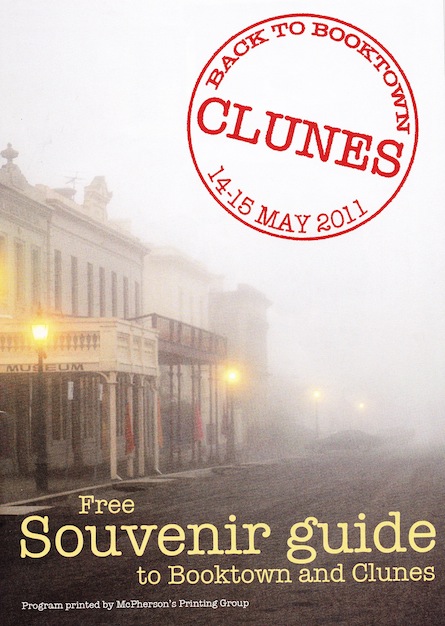
Last weekend I went to Clunes for their annual Back to Booktown event, encompassing more than 60 booksellers in almost every store on the main street, plus churches, historical buildings and marquees erected especially for the weekend.

As I’ve blogged about here and here, I’d been wanting to attend for the past two years, but the lack of public transportation and friends willing to drive there (as I don’t have a car nor a license) meant this was the first year I could go.

My friend Andrew and I trekked the two hours from Melbourne to the country town located somewhere between Ballarat, Creswick and Maryborough; a town so small it defaults to Ballarat when looking it up on a weather website. (It was sunny and 11° on Saturday. Brrr!)

Honestly, I was surprised by the sheer amount of booksellers. I was expecting a couple of old buildings and trestle tables and that was it. Granted, the town is small, but there’s a reason people flock from far and wide to Clunes for a weekend in May.

I managed to unearth a couple of Bret Easton Ellis books for under $10 each, a copy of The Catcher in the Rye for $12.50 (steep for a secondhand copy, but c’mon, it’s J.D. Salinger!), and Agatha Christie’s Death on the Nile. I also saw a copy of Perfect Murder, Perfect Town by Lawrence Schiller on the JonBenet Ramsay murder, but I wasn’t sure I could commit to a book that thick on a subject I already know a lot about. Plus, I already have Joyce Carol Oates’ My Sister, My Love ready to go after I finish The Great Gatsby, which is a fictional account of the crime. Alas, when I decided to go back for it it had already been sold. I guess it just wasn’t meant to be.

There were also some fabulous food stalls at Clunes, with baked potatoes and Dixie cups, but I was most impressed by Widow Twankey’s Lolly Shop & Ice Cream Parlour, which sold the cheapest lollies and cakes in town (or most towns, for that matter!). Of course we stocked up on Red Skins (the racist lolly of the masses), Fantails, boiled candy and Toffee Apples. Yum!

While I was planning on picking up a few more titles than I did, I will definitely be making an appearance again next year, and I urge you to, too. Book lovers will feel like they’ve died and gone to heaven.

Related: Go Back to Booktown This Weekend (2011).

Go Back to Booktown This Weekend (2010).

Elsewhere: [Back to Booktown 2011] Homepage.

[Widow Twankey’s] Homepage.

Magazines: Everyone’s a Little Bit Racist.


frankie’s latest edition is somewhat underwhelming, but there was one diamond in the rough: Justin Heazlewood’s “honest look at his relationship with Indigenous Australia” in “Black or White”.

I will admit that up until about two years ago when I started working in the cultural/tourism sector and really immersed myself in the Melbournian way of life, I was “a little bit racist”, as the Avenue Q song goes.

Now, I’m taken aback when friends, family members and, yes, even colleagues, express their racist views. Dare I say I’m offended on behalf of the racial minorities who are victims of racism on a daily basis. (I am primarily a white Australian, but I do have Native American heritage, and I have been the victim of latent racism on several occasions throughout my life). And there’ll be more to come on that later in the week.

Heazlewood references the homeless Aboriginals out the front of Woolworths on Smith Street in Fitzroy, who often get the short end of the stick when it comes to preconceived notions, but I was hanging out in Fitzroy last week and saw just as many drunk and intimidating bums who happened to be non-Indigenous.

But, as I discussed with a workmate over the weekend, city people are far more tolerant than country folk when it comes to race relations. I grew up in a small country town which claims to be the epicenter of Chinese immigration during the gold rush, and it certainly is. But I can only remember one indigenous kid and one Chinese kid at school… and I attended six different institutions!

It’s an interesting take on the cultural/racial gap in Australia, and probably the only reason to pick up a copy of the mag this (bi)month.

Related: VCE Top Designs: frankie Editor Jo Walker Talks to Media Students.

frankie Review: January/February 2011.

Magazine Review: ZINm, Issue Six.


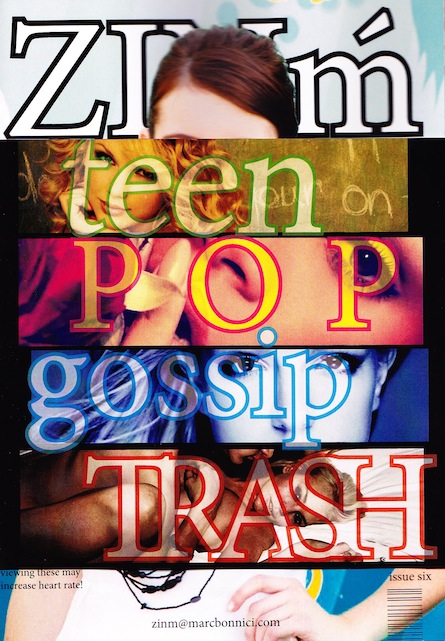
With issue six released a couple of weeks ago, independent zine, ZINm, by Melbournian Marc Bonnici, is really hitting its stride.

The “Teen, Pop, Gossip, Trash” issue takes a page out of Famous’s book mag, with a snarky, funny and pop-culturally heavy tone.

On the “From the Editor” page (p. 5), Bonnici ponders the first world problems of “Britney VS. Katy: product placement in their new music videos” and “what colour scarf shall I wear to go check the mail…?”

The issues features a spread of Selena Gomez’s ever-changing hairdo (p. 6), how to correctly apply make-up (p. 9), Kellan Lutz’s obsession with exercise and long sports socks (p. 10–11), a “dear Christina Aguilera/Metro trains/couples walking in the city” letter in regular feature “Burn Book” (p. 18), and a Dolly Doctor-esque sexual advice column entitled “Doctor Chorizo” (p. 21).

Melissa George, Ryan Reynolds and Emma Roberts also make appearances.

It’s a good thing this issue comes with a “may contain possibly false information” disclaimer, ’cause the truly riotous celeb scandals in this issue couldn’t possibly be true!

The newsstand glossies should take heed: goodness knows a lot of their material is based on possibly false info!

Related: George Michael Paper Dolls in Independent Zine ZINm.

Independent Zine ZINm Preview.

First World Problems.

Elsewhere: [Marc Bonnici] Homepage.

Event: “Who the Bloody Hell Are We?”—The Sentimental Bloke at the Wheeler Centre.

I was so looking forward to “So Who the Bloody Hell Are We?: The Sentimental Bloke”, held on Monday night at the Wheeler Centre, which I attended with my staunchly feminist friend Laura (who has written for The Scarlett Woman here, and whom I’ve written abouthere) and staunchly MRA friend Andrew (who has also guest posted here and here).

I was rudely disappointed.

I expected the panel to delve into the masculinity crisis facing Australian men today by addressing such issues as rape culture in sport, domestic violence, metrosexuality and parenting. Well, three out of four ain’t bad.

I’m not the only one who felt that way, as Andrew Frank writes:

“I’ve got two words for you: Sarah Palin”—Dr. Anne Summers, AO.

I didn’t get it. Based on the participation rates of the laughter that followed, I don’t think half the audience did either.

Using a right wing American female politician to attempt to illustrate that there are no gender issues related to  men that hunt in contemporary Australia, only cultural ones, is using a form of logic that I can’t understand. But then again, she claims to be a feminist.

The setting was The Wheeler Centre, and the discussion loosely titled, “So Who the Bloody Hell Are We?: The Sentimental Bloke”. The presenter: Michael Cathcart. The panel was comprised of Craig Reucassel, founding editor of The Chaser newspaper and ABC television personality, Craig Sherborne, memoirist, poet and playwright, and Dr. Anne Summers AO, “best-selling author, journalist, and thought leader”. About that last one: I am worried.

Initially, the discussion promised to focus upon being a man, as individuals and as an ideal, in contemporary Australian society. This would include several aspects of particular relevance, such as parenting, the workplace, and various social settings. It would also examine the evolution of the ideals of masculinity, over the 20th century to the present. I was sadly disappointed.

After being egged on by Scarlett and Laura to “man up” [Scarlett Woman note: I say that sarcastically; I strongly disagree with “man-up” as motivation to be courageous.], I decided to ask the question that plagued me from the start, and gets under my skin from time to time. My question went something like this:

“I am a very passionate hunter. I do it because I love it, not because I need to feel manlier. This is something for which I am socially criticized, in a manner that suggests I use it as a method of compensation for feelings of being emasculated. Do any of you perceive any distinction between the social pressures placed on men of decades past to be the stiff-upper-lipped, emotionally suppressed and distant figure, and the social pressures contemporary Australian men are subject to in terms of being ‘metrosexual’ or the ‘Sensitive New Age Guy’?”

I missed Sherborne’s reaction, but Reucassel mocked hunting as an activity for the royal family {unbeknownst to him, I also fence!). Dr Anne Summers, screwed up her face and said, “Between being a SNAG and hunting?” in as condescending a tone as you can imagine.

It was asked that the microphone be returned to me. Reucassel asked me how I started hunting. I replied that it came to me through my Dad, and my Dad’s Dad. I then turned my attention to Summers again and stated that the hunting’s relevance here rested in the fact that according to my friends, hunting and masculinity were, for the distant father figure, and are, now, according to my friends, inextricably intertwined. It is the quintessential example of men today not conforming to the metrosexual, SNAG criteria.

Reucassel then said that the idea of hunting abhors him; that It is definitely an antiquated recreation, but it takes bravery to pursue in light of contemporary attitudes and if I want to, then more power to me. I respect his viewpoint. I would never force someone to hunt who didn’t want to, and he reflects my right to be autonomous in deciding where I get my food. But he missed the vital issue: is there a difference between my social pressure not to hunt and the social pressure on men from decades past to be emotionally restrained?

Insert Summers’ initial right-winged impression here, to which I didn’t get another chance to respond.

Sarah Palin hunts. I think Summers was trying to say that dealing with the bad rap that being a hunter carries is not specifically a male problem. And in that single fact, she is correct. So therefore, the issue faced here by hunters is not gendered, but cultural. However, to go so far as to imply that because Palin hunts, the social criticism of male Australian hunters—or indeed other men who engage in traditionally masculine recreational activities—does not warrant discussion is a fallacy. I believe that is what she intended to say. And soon after it became apparent from the comments of Cathcart and Sherborne that they believed she had jumped on the “cultural, not gendered” tack as well. However, because I did not warrant a detailed response, evidenced in hindsight by her curt reply and insulting tone, we cannot be sure. Perhaps she meant to say that Palin is an idiot, and therefore, all hunters are. But I shall continue through with the interpretation that Laura helped me conclude.

If we accept the premise of Summers, any criticism of my masculinity with hunting as evidence is blatantly flawed. Speaking regarding men in contemporary society, Summers has decided that the social reality is… wrong? Because a number of women engage in hunting, including the prominent Palin, they must be subject to exactly the same social criticisms that the men who engage in this statistically dominated male activity, right? If we accept this, Summers did not respond to me, as she intended. She responded to those that undermine the masculinity of Australian male hunters. Undermining my “masculinity in the metrosexual sense” because I hunt is wrong because women hunt, too. Unfortunately for her, your average person that rips on a hunter seems unaware of the tradition that hunting is a male thing. By the way: I hate that tradition. I really, really do.

On that count, any person seeking a discourse regarding being a man in contemporary Australia rather than trying to fulfill a feminist agenda would disagree. It’s like saying because both men and women are in the police force they obviously have precisely the same experience—I would have loved to get her started on that one pertaining to rape cases. If the topic for the evening had been, “The Sentimental Bloke and the Empowered Woman: Being a Man, Or a Woman, in Contemporary Society”, then perhaps it would have been a valid vein of thought. But could anyone really think that her premise was not flimsy and tenuous? She, too, missed the point: attempting to discern the differences and similarities of social pressure on males not to hunt and the social pressure on men from decades past to be emotionally restrained.

Discussion that followed pigeonholed me into the “shooter” stereotype as if I wasn’t even there. I won’t forget for a long time the sneer in her voice: “He’s a shooter”. I despise hoons that are hunters according to external perception, blazing through the bush with a beer in one hand and a gun in the other. Summers was perfectly willing to condemn me using a stereotype to which I do not conform. This after using a prominent female American politician, a single example, to attempt to nullify two gendered stereotypes and the resulting social pressures of two different eras that I wished to contrast. Yeah, that woman totally understood the topic for the evening. She is sooo smart! And yes, I’m bitter I didn’t get to verbally tear her to shreds.

The presenter, in my opinion, then made an awful mistake. Cathcart asked the panel, “Have any of you killed a mammal, and eaten it?” I think this was asked with the goal of illustrating the cultural differences between the contemporary and past societies in which hunters and men have existed. This wandered further still from the vital issue, as whether or not someone has killed an animal they have eaten and whether or not hunting is ethical does not address the relevant gendered issues. Reucassel said no, and then admitted to being a meat eater which, he realised, weakened his argument. Sherborne said yes, and told stories of how he grew up on a farm. Summers said no, and her admission to being a meat eater was accompanied with a bowed head.

In order to further display her tight grasp on the issues that were, but should not have been at hand, I remember Sherborne raising the following issue, when asked if he himself has ever hunted:

Sherborne: “Is fishing hunting?”

Summers: “No.”

Cathcart: “Why not?”

Summers: “I don’t know”

Cathcart ended that portion of the discussion with, “Well, I don’t know if we answered your question, but they certainly had fun ridiculing you”.

Subsequent audience questions referred to mine. They tried again to get at my “underlying question.” As far as I could tell, no such luck. My spirits were buoyed somewhat as I exited the room, as I heard the word hunting on the lips of four or five people, was complimented by a few others, and heard several chide the panel’s incorrect interpretation and inadequate response to my questioning. Walking down the street five minutes later I fortuitously heard an elderly couple discussing the exact same issue, and they could not have approved of my thoughts more.

Perhaps my motivation to have written all this down rests in the fact that I wanted answers—validation—and I didn’t get any. I am a hunter. I am also a kind, caring and sensitive man, who fully acknowledges the depths of his emotion wherever possible. I even have passing interests in skin care from time to time. The people on the stage were supposed to confirm my belief that pressures on me to be the latter (SNAG) are directly related to pressures not to be the former (strong, silent and conventionally “masculine”), and that the same situation with different polarities existed for men decades ago. Or, they were supposed to admonish this point of view, and provide me with enlightenment such that I could embrace my modern masculinity as the sensitive young man and the hunter with no sense of conflict.

But they didn’t. Aspects of life difficult for the contemporary sentimental bloke didn’t exist for every sentimental bloke. Consequently they were considered circumstantial and did not warrant discussion. Or difficulties that didn’t apply only for men, as women suffered similarly, meant that they did not warrant discussion. Or difficulties founded in culture were dealt with in a manner that suggested their gendered implications were irrelevant. Honestly, the only issue duly treated, was the evolution of male parents who now change nappies and push prams, juxtaposed against past male parents who would only pace outside the birthing room then work to support the child, occasionally throwing in a life lesson. Everything else was glossed over in a cursory fashion, played way, way down, or even straight out denied, suggesting that none of the panel members were prepared to really get their hands dirty and discuss issues that contemporary Australian men deal with in defining who and what we are. After all, even though the title of the event was “So Who the Bloody Hell Are We?: The Sentimental Bloke” it just wouldn’t be fair to deal with the impact issues have on men when they also effect women, would it?

Related: How to Make a Woman Fall in Love with You, Glee Style.

Double Standards.

On Stripping.

Unfinished Business at the Melbourne International Comedy Festival.

Images via The Wheeler Centre, Indie Posted.