On the (Rest of the) Net.

Rachel Hills discusses Naomi Wolf’s response to WikiGate here, whilst also doing a fine job of unpacking the fun for twenty-somethings = lots of casual sex myth.

On that, “How to Be A 20-Something”:

“Be really attractive. Your acne is gone, your face has matured without having wrinkles and everything on your body is lifted naturally. Eat bagels seven days a week, binge-drink and do drugs: you’ll still look like a babe. When you turn thirty, it’ll become a different story but that’s, like, not for a really long time.

“Reestablish a relationship with your parents. You don’t live with them anymore (hopefully) so start to appreciate them as human beings with thoughts, flaws and feelings rather than soulless life ruiners who won’t let you borrow their car.”

What Would Phoebe Do? on the pretentiousness of Francophilia:

“Gratuitously adding French words to conversation is a time-honoured way of signalling pretentiousness.”

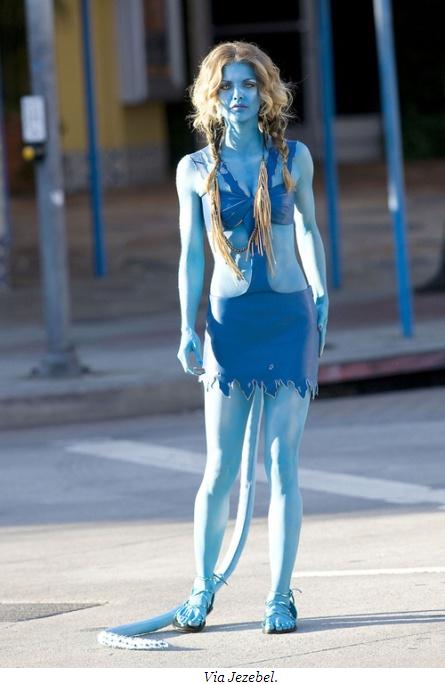
Next year’s Halloween costume sorted!

“How to Be A Complete Douche” has a certain Patrick Bateman feel to it.

Hugh Hefner defends his May-December engagement to Crystal Harris to The Daily Beast.

“How to Live in New York City”:

“Certain moments of living in the city will always stick out to you. Buying plums from a fruit vendor on 34th street and eating three of them on a long walk, the day you spent in bed with your best friend watching Tyra Banks, the amazing rooftop party you attended on a sweltering hot day in July. These memories might seem insignificant but they were all moments when you looked around the city and felt like you were a part of it all.”

Sarah at Feministe recalls “How I Learned to Stop Caring and Admit I Love Pop”.

Jezebel chronicles “The Evolution of Moms” from Soccer Mom (Mater Adidas) to a future robot-mom who encompasses all the admirable features of stage and helicopter mothers alike, with a special focus on the parent Sarah Palin made famous, the Mama Grizzly.

Memo to Lady Gaga: leggings are not pants. Nor, more to the point, are leotards.

On the (Rest of the) Net.


The Queensland schoolgirl/Nick Riewoldt scandal is still going strong, with articles at both MamaMia and Deadspin worth a look.

Also at MamaMia, “Are You Spending More or Less Time on Facebook Than Last Year?” I’d say it’s about the same for me.

The psychology of suicide bombers.

Inner confidence = shaving your pubes at Musings of an Inappropriate Woman.

Many people accused Holly Madison, Hugh Hefner’s former number one girlfriend, of being a gold digger, but after years of being “fucked in the assfiguratively and literally… she earned it”. Similar accusations follow Hef’s latest fiancé, Crystal Harris.

GWAS and Marta Wohrle on “The High Standards of Blogging”.

“How to Deal With a Neat Freak” at Lifehacker. How about when you’re the neat freak…?

On the (Rest of the) Net.

(Sorry, only one picture this week as I wrote this quite late at night—hey, 9pm is late for me, okay! I live the lifestyle of a grandma. In fact, I think my grandma stays up later than I do!—and just wasn’t inspired.)

There’s a lot of content worth reading on MamaMia at the moment:

“Would you wear Nicole Richie’s wedding dress?” Yes, if it were a little less poofy and a little more ivory. In fact, it is somewhat similar to the wedding dress I have created in my mind for my own wedding. Now, to find that pesky groom…

By the same guy who brought you the brilliant “17 Arguments Against Gay Marriage & Why They’re Bollocks” comes the equally as brilliant “10 Things You Need to Understand About Asylum Seekers”.

This is worth taking a look at if you care at all about where your supermarket eggs come from.

And finally, is Shane Warne punching above his weight? He sure is, but really, who cares? While I can’t stand Warney and think he is the king of the douches, good on him for bagging someone as hot as Liz Hurley. But shame on her for allowing herself to be seduced by said king of the douches.

Rachel Hills on what’s in and what’s out for 2011:

“Fool: Binge drinking.

“Cool: Binge thinking.

“… Fool: Staying out til 3am because it’s a Friday night and that’s what you’re supposed to do.

“Cool: Staying in on weekends if that’s what you feel like doing, going out on weeknights if there’s something cool on…

“Fool: Internet fameballs and feigning a glamorous life in the hope of inspiring envy in others. Lifecasting.

“Cool: Mindcasting. Reading other people’s blogs instead of just trying to get them to read yours.”

Tiger Beatdown’s fun facts about straight people:

  • “Most of them are not dangerous!
  • “Some of them are actually quite lovely people.
  • “Straight people are not as violent as they are portrayed in action movies.
  • “Straight people are your neighbors, your friends, members of your community. You may be related to a straight person, or even share a room with one in the hospital.
  • “I mean it TAKES ALL KINDS, amirite?
  • “Tomorrow, while you are attending the daily Straight Pride Parades that form the totality of public life in America, take a moment to tell a straight person you support their life decisions.
  • “Tell them you know many fine straight people.
  • “Then put your hand near their ear, and pretend to find a silver dollar there. They love that shit.

“Straight people will NOT:

  • “Try to make you straight.
  • “(Not that it would work, amirite?)
  • “Make it impossible for you to appreciate Ani DiFranco on rainy days.
  • “Make you want to move to Florida.
  • “Inject a lot of brown into your wardrobe.
  • “Drag you on a cruise and then spend two weeks complaining about how few deck chairs there are.”

Just one of the reasons SJP and SATC ruined NYC:

“Cheated on your boyfriend? Threw a public hissy fit? OMG, it’s just like that one episode of ‘SATC’! So don’t sweat your own stupid, overly dramatic behaviour… everything will be okay when the credits roll in 20 minutes. Or, you know, not.”

Sady Doyle on the Julian Assange rape allegations:

“.. You know who doesn’t stand to profit? Like, at all? The women pressing the charges. Because (a) rape victims almost never profit from taking their cases through the legal system, which is why so few do, and (b) they’re already facing substantive personal smearing and stereotyping and in some cases having Keith fucking Olbermann insist they have ‘ties’ to the ‘CIA’ (oh for FUCK’s sake), and (c) they’re not pressing some airtight case here. Because, as we all know, the only AIRTIGHT rape case is one where Julian Assange jumps out of the bushes with a chainsaw and an assault rifle and you try to fight him back with your bare hands but ultimately he cuts off both your arms with the chainsaw thus ‘proving’ that you ‘resisted’ him, and oh also, he’s not Julian Assange, he’s a homeless man of colour named Stabs McMurderson, and you’re not an average woman, you’re a fourteen-year-old blonde white virgin who’s walking home from the Jesus School of Sewing and Homemakery. I would add that the whole thing would have to be captured on tape, but there have been ACTUAL RAPES that were ACTUALLY CAUGHT ON TAPE and they didn’t get through, because the defence alleged that the girl was ‘faking’ unconsciousness because she wanted to ‘make porn’.”

My friend said I wasn’t unique in having a blog as every sixteen-year-old and their dog has one. Some friend, right? (Love you, April!) I’ll pay that, but according to Gawker, blogging is an old person thing now.

Mick Foley is Good.

UPDATED: Julian Assange—Modern Day Outlaw.


From The Curvature via Musings of an Inappropriate Woman:

“I am SO SICK today of people who can’t see that:

1) WikiLeaks is important and does good work;

2) Julian Assange may be a rapist;

and

3) The pursuit by the authorities for the rape charges may be motivated as much by WikiLeaks as by a desire to see justice done are not in any way contradictory positions and could all be simultaneously true.”

Also check out Rachel Hills’ further musings on WikiLeaks and Assange here.

And for some more opinions on WikiLeaks, visit MamaMia for Mia Freedman’s compilation of the most poignant, as well as her own admission of jumping to conclusions and maybe not articulating her views as well as she could have.

And here is my original post, published last week:

The Australian founder of whistleblower website Wikileaks, Julian Assange, has handed himself over to police today on “undisclosed sexual assault charges” (allegedly rape, which was then changed to having consensual sex with two women whilst claiming to have worm a condom, but didn’t).

He does have a certain creepy quality to him which makes me think it’s not unlikely he’s committed these crimes, but is that really the issue?

More than likely, these charges have been fabricated to get him behind bars, thus stopping him from publishing more confidential government documents and damaging international relations.

Do we really need to know that the U.S. thinks Kevin Rudd is an “abrasive control freak” or the common perception of world leaders such as Hillary Clinton or French president Nicolas Sarkozy? Most of the stories published in the mainstream media about Wikileaks doesn’t indicate many imperative top secret documents (related to terrorism, nuclear weapons etc.) that the general public arguably has a right to know have been leaked. Obviously there are larger issues at hand: Assange is a threat to global governments.

But here in Australia, Assange’s home country, he is viewed as a hero. Somewhat of a modern day Ned Kelly, if you will. Aussie’s appreciate an underdog sticking it to the man, so despite what his website has published, I think most Australian’s are probably rooting for him.

Elsewhere: [The Curvature] I Am So Sick of People Who Can’t See That…

[Musings of an Inappropriate Woman] I Am So Sick of People Who Can’t See That…

[Musings of an Inappropriate Woman] Quick Thoughts on Julian Assange, WikiLeaks & Those Rape Allegations.

[MamaMia] WikiLeaks: Some Food for Thought.

[MamaMia] Updated: Are WikiLeaks & Julian Assange Forces of Good or a Dangerous Menace?

On the (Rest of the) Net.


Mia Freedman on Elle’s “weird, weird choice of cover model” in Miley Cyrus for their August 2009 issue:

“Who’s next? Bindi Irwin for Harper’s Bazaar? Stop it, someone is probably organising that right now as I type. Anyway, so while I was still tut-tutting over the fact that she was ON the magazine, I came to the story inside and nearly lost my lunch. Not only did I find the clothes grotesquely inappropriate (nanna-alert!), I was disturbed by the poses. In one shot, she’s got her vagina thrust up to the camera with her stomach exposed.

“In a couple of others, she’s lying back as if waiting for… well, you know what she’s waiting for.”

Girl with a Satchel on Lara Bingle, Kristy Fraser-Kirk and “sexism in the Australian Media”, while Nicole Richie’s Who wedding cover story (out today) is a “fairytale story” of “redemption”.

Why “we need more vampire slayersjust not more Buffy”:

Buffy made a bold statement in the context of 1990s pop culture: What if this tiny blonde girl, who looks like the victim in every horror movie ever, is actually the monster-killer? What if she’s badder and tougher than everyone else? What if she’s secretly grappling with the weight of the world because she’s the only one who can save us all?

“Whedon often talks about the idea for the original Buffy movie coming from the image of a girl running from a monster, like in every other horror film—but then it turns out she’s actually hunting the monster, and she catches it by surprise. Because she’s not just your typical sacrificial cheerleader.

“That was a radical idea in 1992, and even in 1997. I would be very sad to think it would still be radical in 2012, or whenever this film comes out.”

Questionable scenes in Disney films.

Let’s Drink Tea and Get Laid references last week’s skinny-shaming post in her thoughts on body image, “property” and ownership.

Rachel Hills has some insightful notes on introversion versus extroversion, stemming from The Atlantic’s “Caring for Your Introvert”, which was featured on last week’s “On The (Rest of the) Net”.

Tiger Beatdown on the gender double standards on Glee:

“… Being attacked for being an effeminate man is terrible, and we’ll talk about it and come to a resolution, but being a masculine woman means you should just get used to being everyone’s punching bag.”

Jezebel uncovers “The Surprising Facts About Who’s Hot”, according to scientific studies in David Perrett’s book, In Your Face. So it’s totes, like, factual and shit.

On the (Rest of the) Net.

“Christina Aguilera: Always the Second Fiddle.”

I don’t believe in New Years resolutions anymore, namely because I could never realise mine. But I like Rachel Hills’ idea of writing an obituary for the year passed. In this case, her 2008 in review.

HuffPo on the absence of modern technology in modern literature:

“The average fictional character is either so thoroughly disinterested in email, social media, and text messages he never thinks of it, or else hastily mentions electronic communications in the past tense. Sure, characters in fiction may own smart phones, but few have the urge to compulsively play with the device while waiting to meet a friend or catch a flight. This ever-present anachronism has made it so that almost all literary fiction is science fiction, a thought experiment as to what life might be like if we weren’t so absorbed in our iPhones but instead watched and listened to the world around us at a moment’s rest.”

Girl with a Satchel ponders the price of a pretty picture.

“Caring for Your Introvert” is one of the best articles I’ve read all year (and considering it was written in 2003, that’s saying something). Here, an excerpt:

“With their endless appetite for talk and attention, extroverts also dominate social life, so they tend to set expectations. In our extrovertist society, being outgoing is considered normal and therefore desirable, a mark of happiness, confidence, leadership. Extroverts are seen as bighearted, vibrant, warm, empathic. ‘People person’ is a compliment. Introverts are described with words like ‘guarded’, ‘loner’, ‘reserved’, ‘taciturn’, ‘self-contained’, ‘private’—narrow, ungenerous words, words that suggest emotional parsimony and smallness of personality. Female introverts, I suspect, must suffer especially. In certain circles, particularly in the Midwest, a man can still sometimes get away with being what they used to call a strong and silent type; introverted women, lacking that alternative, are even more likely than men to be perceived as timid, withdrawn, haughty.

“The worst of it is that extroverts have no idea of the torment they put us through. Sometimes, as we gasp for air amid the fog of their 98-percent-content-free talk, we wonder if extroverts even bother to listen to themselves. Still, we endure stoically, because the etiquette books—written, no doubt, by extroverts—regard declining to banter as rude and gaps in conversation as awkward. We can only dream that someday, when our condition is more widely understood, when perhaps an Introverts’ Rights movement has blossomed and borne fruit, it will not be impolite to say ‘I’m an introvert. You are a wonderful person and I like you. But now please shush.’”

Furthermore, The Los Angeles Times notes that despite the introverted minority, television doesn’t reflect their existence very well. (Does television reflect anything very well?):

“Watch Seinfeld or Friends or Sex & the City or Community or Men of a Certain Age—the list is endless—and you’ll see people who not only are never ever alone but people whose relationships are basically smooth, painless, uninhibited and deeply, deeply intimate—the kind of friendships we may have had in college but that most of us can only dream about now. How many adults do you know who manage to hang out with their friends every single day for hour after hour?”

On that, Gossip Girl is notorious for misrepresenting reality. While she knows I love her, GG often makes me feel guilty about the clothes I’m not wearing, the sex I’m not having, and the events I’m not going to. Apparently, it’s not true to the books, either.

Check out The Washington City Paper for their musings on masculinity over the past decade, with a special focus on boy bands, metrosexuals, hipsters and guidos, à la Jersey Shore.

Gwyneth Paltrow: You either love her or hate her. I hated her with a passion until I saw her on Glee, in which she came across as carefree, cool and sexy and made her a tiny bit more relatable to the general populus who don’t subscribe to her Goop musings. Mia Freedman writes hilariously on this conundrum, with a focus on a related article from Salon.

Also at MamaMia, “17 Arguments Against Gay MarriageAnd Why They’re Bullocks” is brilliant.

Tangled will be the last fairytale Disney releases in a while.

Can you still be a feminist and dress in a bra top? (Of course you can; stay tuned for more on this next week.) Or espouse archaic notions of heterosexual relations, for that matter?

“The Ongoing, Albeit Amusing, Battle to Save Bristol” on Dancing with the Stars:

“‘This seems like a case of the rich, popular cheerleaders looking like they’ve sucked on a lemon when they learn that the poor girl in school, the one in the home-made clothes and religious family, gets elected Prom Queen.’

“I’ve rarely seen such a clean-cut example of the conservative tendency to say up is down and black is white. Or, more precisely, to bemoan how oppressed white, rich, and highly privileged people are.

“… But Bristol Palin hasn’t really done squat. She is literally famous for having a baby at an inopportune time. And now she continues to get promoted over more talented people than her because she was born into the right family… Bristol Palin is a hero to wingnut America because she’s a great example of rewarding someone for being born into privilege instead of on their merits.

“… I just find it extremely funny that the wingnutteria is backing someone with no talent on a show with no real importance to stick it to liberals who by and large don’t really care, and they’re doing so because they’re intoxicated by privilege and kind of wish they had a monarchy, but they’re pretending that they’re doing it because they want to see the oppressed rise above. I suppose after Dancing with the Stars is done, they should start sticking it to the liberals by defending poor, oppressed Paris Hilton, who is definitely the weird girl with handmade clothes that is picked on by cheerleaders.”

Mel Gibson and the curse of the “Sexiest Man Alive” tag.

On Stieg Larsson and the “disturbing”, “torturous” patriarchy of his Millennium trilogy.

Women are funny, too.

’Tis the Season…

… for office Christmas parties.

As opposed to the boring lunches a few of my friends have mentioned their workplaces hold, my employer happens to go all out on the Christmas party front.

Last year’s theme was horror (odd for that time of the year, I know), and I came up with a Bride of Chucky costume, complete with doll. However, I was struck down with the flu a few days beforehand and was unable to attend. The fact they had a dance instructor teaching partygoers “Thriller” just added insult to injury.

This year, however, the theme is pirates.

As a member of the planning committee, I fought tirelessly (and by I, I mean my friend Laura, as I was in the midst of a wisdom-tooth haze when the theme was being chosen) to push through our original idea of cartoons, and failing that, 1920s/’30s swing.

Unfortunately, misogyny won out, and a pirate theme it was.

Talk about unoriginality, though. There are about three options of pirates in popular culture to use as a reference point: Pirates of the Caribbean (how many Jack Sparrow-wannabe’s but could-never-be’s will there be walking around?), Pirates of Penzance, and Peter Pan. If someone were to really think outside the box, they could get a party of five (pardon the pun) or six together and go as The Wiggles and Dorothy the Dinosaur, with Captain Feathersword as the MVP of the group.

Notice that these three ensembles have very limited roles for women. And as a workplace that employs just as many women as men, pirates is very limiting to the fairer sex.

Serendipitously, I happened to happen upon a three-year-old post by Rachel Hills discussing exactly this.

“‘I didn’t realise the boys were meant to come as pirates and the girls were meant to come as skanks,’” Hills’ friend laments at a pirate-themed party.

My point exactly; pirates is all well and good for men who are young-at-heart, and men who perhaps want to get their gear off and go shirtless, and men in general, but women are faced with exactly two options: slutty pirate or slutty wench.

Now I’ve got some co-workers who are happy to go as more masculine pirates. (One friend, Lana, sent me a picture the other day of her costume, and you can hardly tell it’s her and she looks great.) I haven’t come across many friends who are going as wenches, which may be a testament to my own views (and thus the changing views of society?) on the topic, but that doesn’t mean there won’t be plenty of buxom babes letting the stress of the year off their chests. In what was a poignant throwback-forward, perhaps, from my friend and former co-worker Tess, she came dressed as a pirate for my Halloween-themed birthday party this year, and managed to retain her dignity.

Sure, wenches are traditionally slutty by name and by nature, as noted in the comments of Hills’ abovementioned article, but that’s not the problem I have with them.

I’m the first to put my hand up (whilst simultaneously holding my skirt down) to embrace my inner sartorial slut when it comes to hitting the town (Hello?! Have you seen my Halloween costume?), and while I will not be attending my Christmas party as a wench, there will still be a hefty dose of slut in my outfit (pictures to come next week).

The problem I have with the limiting theme is that there is no room for originality or diversity, particularly for the female members of the payroll. It’s one slut fits all.

Related: The Witching Hour: Halloween/My Birthday at Witches in Britches Cabaret.

Elsewhere: [Musings of an Inappropriate Woman] Attractive = Hot = Not Much Clothing On?

[Rabbit White] In Defence of Slut-O-Ween.

[Rabbit White] Defence of Slut-O-Ween II: Straight People’s Pride?

[The Stranger] Happy Heteroween.

Men on Chapel Street.

Even though I live quite close to Chapel Street in Melbourne, I try to avoid going there as it is not my scene at all.

The other night I ventured as far down as I’ve been in years, to Lucky Coq, on High Street, for drinks with a friend.

The outing reminded me of the last time I’d been that far down, which was back in 2008 for a uni project. Odd, I know, but stay with me.

One of my final units was a media subject entitled Men & Masculinities. I was hesitant to take on the course, but it was my final year and I’d already done all the good ones. Aside from my inept teacher, the unit was really fun, and some of the topics I studied have influenced me to this day.

The reason my study group and I trekked to Chapel Street was to examine the different types of masculinities we observed there. With the National Institute of Circus Arts and the multitude of gyms and boutiques located there, I was expecting to see a lot of buff, fashionable men concerned with their appearance. In short, I expected to see the “metrosexual” in his natural habitat.

After a bit of rummaging through my hard drive, and a quick Google search, I managed to find the articlean interview with Professor of English, Sociology & Women’s Studies at the University of California, Toby Miller, by Jenny Burton and Jinna Tayby which I used to establish some theories about men on Chapel Street.

Keep in mind that these observations were collected two years ago, and I have tried to keep my notes as close to the originals as possible (present day annotations in italics). A lot of the subject matter discussed then has entered our current vernacular; or at least, the vernacular of this here blog, and the ones I frequently read.

Metrosexuality.

“… The phenomenon of the new man, which tends to annex beauty to the wider theoretical works of fashion, with grooming making fleeting, untheorised appearances.”

That’s not so true anymore, as fashion and grooming are becoming as equally important to men who want to look good and take pride in their appearance. Even something as simple as shaving is classed as grooming, and most men we observed on Chapel Street were clean shaven, or at least were doing something different with their facial hair (such as “designer stubble” and goatees instead of a full beard). [Had it been November when the study was done, perhaps I would have seen some mo’s out there?]

“Is the metrosexual a middle- rather than working-class phenomenon?”

I think typically the metrosexual is viewed as upper- to middle-class, and we certainly did see men of these demographics whom you could call metrosexual. However, the working class (tradies, construction workers) could also be seen as metrosexual, because even though they were engaged in manual labour and had “hard” bodies [muscly; evidence of working out], they were still well-groomed and took pride in their appearance.

“Taking pleasure in one’s body, nurturing it, caring for it, protecting it from the elements and so on kind of loosens those old bonds of conventional masculinity, which forbade these behaviours for men and made them taboo.”

The theory here is that men taking pleasure in their bodies and wanting to look physically attractive, for example by going to the gym, is taboo. Do the men we see going to the gym look ashamed of, thereby succumbing to the taboo, or proud of, their hard or soft bodies? (Hard bodies at the gym; soft bodies in certain subcultures like emo, punk, grunge etc.) I wasn’t expecting to see men ashamed of their bodies, especially in a trendy, affluent place like Chapel Street. However, older, out of shape men were a bit more self-conscious than their younger, better-looking counterparts because they tended to look at the ground when they were walking and didn’t make eye contact as much as the more confident men.

“Given all the effort women make to look okay, it seems only fair that men should have to go through something approximating to that level.”

As we expected, there weren’t really any significantly out of shape, badly-groomed or badly-dressed people on Chapel Street. The women took great pride in their appearance, both in their body shapes as well as how they dressed and groomed themselves. This was echoed in the male population, who all were well-dressed, mostly in shape, and well-groomed. In that respect, it could be seen that men are taking a leaf out of the females species’ book.

“… I think it’s [metro sexuality] pretty peculiar to Australia.”

The typical Australian man is seen as a “blokey bloke” in footy shorts and a bluey, doing manual labour and playing sport recreationally. The younger generation of Australian men are challenging this stereotype by being well-dressed, well-groomed and having more unconventional jobs (according to the stereotype) like consulting, fashion, etc. There wasn’t a typical “blokey bloke” that I saw on Chapel Street; even the construction workers, who have the most “Australian” occupation, weren’t physically reflective of the stereotype. In terms of metrosexuality being unique to Australia, it’s true in that a lot of younger men are taking care of themselves, but false in the way that Australia isn’t the only country that has metrosexuals: the US does with Queer Eye for the Straight Guy and the abundance of men in the media who take pride in their appearance and endorse beauty and fashion products, like George Clooney endorsing watches, and Matthew Fox from Lost is the face of a new L’Oreal beauty range for men. I’m not so sure about the UK, because on one hand you’ve got really metrosexual men like Hugh Grant and Jude Law, but on the other there are quite scruffy men like Rhys Ifans, who was engaged to Sienna Miller, and the downright disgusting, like Pete Doherty.

Queer Eye for the Straight Guy.

“… One way to analyse Queer Eye [for the Straight Guy] is as a professionalisation of queerness; a form of management consultancy for conventional masculinity.”

This can be seen in some of the shops on Chapel Street (and Church Street). We saw gyms and health food stores selling protein shakes, etc. in clusters, as well as a beauty salon specifically for men on Church Street.

“… Queer Eye for the Straight Guy is actually about re-asserting, re-solidifying very conventional masculinity.”

Because it separates the “queer” guys, who are fashionable, neat, well groomed, from the “straight” guys, who are messy, unkempt, in need of “styling” by the “queer” guys. Men on Chapel Street challenged this idea. You could speculate about which men were straight and which men were gay, but the stereotypically “straight” ones weren’t messy or “blokey”. There were a lot of business men who needed to look tidy and well-groomed for their jobs, but there were also construction workers whom you would think were typically very masculine and therefore untidy, but even they were taking pride in their appearance, both in terms of their physically hard bodies as well as their grooming.

Sport.

“… While it’s still about toughness, sport is equally about beauty, with the NFL now marketing its players as sex symbols.”

While there weren’t really any “sports” men on Chapel Street (apart from the circus/dance performers), the masculinities we observed were as much about being physically attractive to attract a mate as they were about looking tough and hard-bodied.

Eating Disorders.

“… Clearly there are big problems with eating disorders and performance enhancing drugs amongst men… These are partly narcissistic, psychological worries to do with an image to the outside world in general… Male beauty consciousness is primarily a marketing creation… Do men use toiletries and cosmetics because advertising tells them to?”

There were a lot of advertisements on Chapel Street that would support this notion, specifically the ad in the window of a gym/health food store that promotes an unachievable body type for most men. There weren’t as many hard bodies as we expected to see, however the ones that we did see in no way reflected the extreme ideal that that specific advertisement promoted. The men who worked in fashion stores on Chapel Street succumbed to the ideal that that specific store promoted.

“… Eating disorders, insecurity about looks and image, men now being oppressed by the ‘beauty trap’ and so on, but for me this doesn’t allow for the possibility that this may also be a good thing for individual men and conventional masculinity, allowing men to indulge in some self nurture.”

The men on Chapel Street who were well-groomed obviously took pride in their appearance, and weren’t ashamed of the fact that they looked after themselves. The majority of men looked healthy, which therefore supports the claim that male grooming and “metrosexuality” (men taking care of themselves) is a good thing.

Related: The Underlying Message in Glee’s “The Rocky Horror Glee Show” Episode.

Elsewhere: [Media Culture] Metrosexuality: What’s Happening to Masculinity?

[MamaMia] Male Models: Inside Their Straaaange World.

Profile: Rachel Hills of Musings of an Inappropriate Woman.

I’ve only become familiar with Rachel Hills, sex and gender blogger at Musings of an Inappropriate Woman, in the past few months, but she’s made her way to the top of my must-read blogs. Here, she answers questions about her inspiration, future writing goals and what she does in her spare time in a new city (she recently moved from Australia to begin a new chapter of her life in London).

Can you give us a quick run-down of your professional writing portfolio thus far?

I’ve been freelancing for six years now, and have written for (in alphabetical order) the ABC, The Age, The Australian, The Big Issue, The Bulletin, The Canberra Times, Cleo, Cosmopolitan, The Courier-Mail, Girlfriend, Girls’ Life (US), Glamour (UK), The Huffington Post, Jezebel, The Monthly, New Matilda, Russh, Sunday Life, Sunday Magazine, Sydney Morning Herald, Vogue, The Walkley Magazine and YEN, as well as a bunch of smaller, indie magazines and blogs.

I got my start writing opinion pieces for the Sydney Morning Herald. These days, I usually write “think piece” features on personal-is-political type issues, or women’s mag fare with smarts.

How long have you been blogging at Musings of an Inappropriate Woman and what made you decide to start a blog?

I just did a quick scan of my archives and discovered I just reached my three year anniversary on October 30.

I’ve written for the internet pretty much ever since it was possible to (I started my first website in 1998), but I was always kind of hesitant of writing publicly under my own name. As a teenager because of my secret pop music loving shame, as a university student because I was involved in student politics and that makes you extremely paranoid (not of people digging up info on you when you become a politician, but of people digging up info on you and putting it in the student newspaper), and then as an adult because I didn’t want to cannibalise my own story ideas.

I cracked through basically because I loved reading other people’s blogs, and because I was inspired by the way that other journalistsparticularly in the USwere using blogs to connect with their audiences. My blog was quite different when I first started writing it, thoughit was more a mix of political commentary, scrapbook and lifecast, as opposed to the more reflective, personal-is-political blog it is today.

What are some of your favourite blogs?

I have a soft spot for blogs which make you feel like you’re getting to know the person writing itblogs like Gala Darling, Girl With A Satchel, Wordsmith Lane, The Ch!cktionary, Emily Magazine, Garance Dore, Style Rookie and The Scarlett Woman [that’s me!] are often at the top of my Google Reader.

I also love blogs that make me think about thingsFeministe, Pandagon, The Awl, Tiara The Merch Girl, Rabbit White, Kapooka Baby, Jezebel, Hugo Schwyzer, Racialicious. And people like Chris Brogan, Seth Godin and Chris Guillebeau are like mentors I’ve never met when it comes to things like blogging and community building.

I’ve lost count of the number of blogs I subscribe to on Google Reader, though, so that’s really just scraping the surface of what I read.

What has been your proudest writing-related achievement to date?

I don’t think I actually have one! There are lots of stories I’m fond of, and I still get excited whenever I get a story up, but there isn’t one that stands out as being more significant than the others. I suppose the one I was most proud of at the time was that first opinion piece in the SMH. And I hope my book will be my proudest writing accomplishment in a couple of years.

And your proudest non-writing achievement?

In 2006, I travelled around the US meeting some of my favourite journalists and editors: people from The Economist, The New York Times, The Huffington Post, US Cosmopolitan and so on. Very nerdy, but also very gutsy lots of people at home thought I was a bit of a weirdo for attempting it (with a couple of notable exceptions). I’m quite proud of that.

Back to your book, to be titled The Sex Myth; how is it coming along?

Haha, it’s coming along okay. I’m dedicating a lot of time to it at the moment, and there are bits of it that I really like, which is nice. I’ve shown the overview to a few high profile people, and the response has been universally very positive. I’m just trying to get everything in place at the moment to translate that positivity into a kickass book deal.

You’ve written about workaholism and the work/life balance in the past. How do you balance all your commitments?

It was much, much harder when I was living in Australia and holding down a near full-time job. Now that I’m working for myself again, it’s much easier to fit in all the things I want to work on, and living with my partner means I still make plenty of time for myself. (When he’s away, I start working later, procrastinating more and sleeping less.)

That said, even working for myself, I’m still managing four main areas of workfreelancing, book, PhD and blogonly one of which pays. So finding time for all of them can be a bit tricky.

What is your favourite way to unwind?

Having spent the past two and a half years of my life reading books on the philosophy of sex, I’ve developed a bit of a fiction obsession recently. It’s so much easier and more relaxing to read than the academic stuff I’m usually buried in.

I’m also really enjoying getting to know London, and digging out all the interesting things there are to do here. My boyfriend often asks me how I manage to find all the things we check outphotographic treasure hunts, interactive theatre, art galleries, bars with secret passage ways.

And yoga. It’s clichéd, but it relaxes me, keeps me fit and keeps my bad neck (from too much time sitting in front of a computer) in proper alignment.

Because most bloggers write about things they’re passionate about, as I know both you and I do, do you find sometimes it’s a chore to churn out posts on, for example, mag-world musings or the happenings on your favourite TV show (you and I both share a penchant for Gossip Girl) and the like, as previously you would have done those things for pleasure? Because that’s definitely something I struggle with from time to time.

Because I write for a living, one thing I’m very careful to do is keep blogging a pleasure. The main way I do this is by writing when I’m feeling inspired: if the writing doesn’t flow easily, blogging starts to feel like an obligation… and while I have no concrete evidence of this, I suspect it makes the posts less interesting to read, too. If I’m not feeling inspired and haven’t updated much that week, I’ll try to find something else around the net that I think will be of interest to my audience and share that with them instead.

What advice do you have for other bloggers?

Don’t feel like you have to get it right immediately. Sure, the internet sticks around forever, so you want to think before you post, but blogging is something you learn by doing just like anything else, and chances are it will take you a while to find your best blogging voice. (It took me a while, and I’d been writing on the net for nearly 10 years and writing professionally for three when I started. And I’m still learning.) Experiment until you find that perfect intersection of what you love, what feels authentic for you, and what people respond to.

And finally, where do you see yourself, writing-wise, in the future?

I’d like to just keep on doing what I do now, only on a bigger and better level, with all the aspects of my work (journalism, blogging, books) feeding into one another.

[Musings of an Inappropriate Woman].

On the (Rest of the) Net.

A new discovery of mine, Millennials Mag, publishes quirky, up-to-the-minute features on everything from Mad Men to youth crises to Lindsay Lohan. In fact, here’s one on Lindsay, as well as the hilarious “Bylines & Boyfriends” and “The Myth of the Plugged In Millennial”:

“Do you find that you have friends your age who still don’t understand blogs/blogging? And that it’s actual work/writing?… In a way it’s like, really dispiriting, because I have friends who still can’t understand why I’m a journalism major if I don’t want to work for The New York Times… Like I have a friend who wants to be a fashion blogger, but told me she would never get a Twitter account… Well they will clearly never be a blogger…”

Gah! I guess I’ll never be a blogger then, either. Oh wait, I am! Twitter Schmitter (Shitter?).

Rachel Hills discusses the (pop) cultural virtues of Sweet Valley High, and how Gossip Girl relates to real-life. I particularly like the latter, as it deals with the breakdown of friendships, which is something I’m dealing with at the moment. Hills says:

“… When I think about my own anger, about grudges I’ve been unable to let go of, often it has little to do with the original offence. Instead, it’s about a residual feeling I can’t get rid of, a new framework I’ve built up in my head…”

Halloween is just around the corner (more on that to come later today/next week), and Gala Darling ventured to the 20th Annual Tompkins Square Halloween Dog Parade. Check out the dressed-up dogs that were out in full force. And while you’re there, see her case for adopting rescue animals.

Britney Spears, now Miley Cyrus: Eat the Damn Cake writes about how growing up = “Girls, Take Off Most of Your Clothes”.

Betty Talk’s musings on “Western Feminism & Global Gender Justice” harkens back to the Feminism Has Failed debate I attended about a month ago, in that “Western feminists are characterised by being somewhat ethnocentric,” and trying to prevent genital mutilation in some lesser-developed parts of the world, for example, is a little bit ignorant when such societies have “practised these customs for centuries”.

Becky Sharper, on The Pursuit of Harpyness, discusses The Guardian journalist Sarah Churchwell’s rant on Bridget Jones and how the myth of the single girl stereotype affects actual single girls.

Published two years ago, Racialicious’s Latoya Peterson ponders “The Not Rape Epidemic” in the form of her own sexual assault when she was fourteen. Powerful stuff.

MamaMia defends Helen Mirren’s right to bare breasts. When you look that good at 64, all I have to say is: you go, girl!

Mad Men’s Betty Francis (nee Draper) exemplifies the cycle of abuse on Tiger Beatdown.

Is curvy Christina Hendricks getting the Kate Winslet treatment?

The male motivational power of the pinup.

In a similar vein, the consensus circulating around the blogosphere is that Hugh Hefner is to blame for all that is wrong in the world today, which is an issue I beg to differ on, however it’s not all Playmates and flamingos at the Playboy Mansion, either, according to The Washington Times.

Following on from Rachel Hills’ post on intersectionality, Hoyden About Town profiles the “squishy bits” of “Intersectionality and Privilege”.

It has never been a better time to be an out-and-proud gay man, in my opinion. This is evidenced by all my straight and single friends who are also desperate and dateless (myself included!), while my gay friends flourish in the dating world, with the added bonus of the iPhone app Grindr. If only the straight folk had an online dating service to present potential suitors to usoh wait, we do. It’s called online dating, which still has a stigma attached to it (if the disappearance and suspected murder of Zara Baker, whose stepmotherwhom her father met onlineis a suspect, is anything to go by), the likes of which Grindr has never seen.