On the (Rest of the) Net.


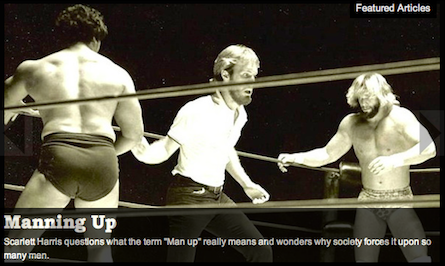
Check me out on The Good Men Project!

On sex work by a sex worker. [The Age]

“Have you lost weight?” is not a compliment. One of my close male friends has recently lost a lot of weight, and the resounding comment that seems to follow him wherever he goes is, “You look so hot now that you’ve lost weight,” or something to that effect. Firstly, what did he look like before? Hideous? Unlovable? Gross? And secondly, is he worthy of affection and admiration now because he’s not fat anymore? Just. Plain. Wrong. [Broadist]

Rick Santorum, the Iowa caucus and what the 2012 Republican landscape could very well look like. Hint: not good. [The Punch]

And some more on Santorum’s scary reproductive rights views. [Jezebel]

AND, a rundown of what the Iowa caucus actually entails, anyway. [Jezebel]

How my heart warms: a child with Down Syndrome is modeling for Target in the U.S.! [Jezebel]

Mia Freedman on Deborah Hutton’s nude posing for The Australian Women’s Weekly. [MamaMia]

Sometimes it’s okay to be a quitter. [Gala Darling]

Camilla Peffer on street harassment. [Girls Are Made From Pepsi]

How to really talk to girls about beauty. [Jezebel]

Images via The Good Men Project, MamaMia.

12 Posts of Christmas: Cristina Yang as Feminist.

In the spirit Christmas, I’ve decided to revisit some of my favourite posts of the year in the twelve days leading up to December 25th.

It’s no secret I love underdogs and Grey’s Anatomy, so what better way than to combine the doctor drama with one of its most dramatic doctors, Cristina Yang, in a post about—what else?—feminism? The original post is here.

When it comes to “likeable” female characters on TV, you might think of Buffy Summers. Or Rachel Green. Or the Gilmore girls. But Grey’s Anatomy’s Cristina Yang probably isn’t one of them.

She’s abrasive, unfeeling, career-driven, ruthless and selfish. Everything a woman shouldn’t be, according to patriarchal norms.

Perhaps she could be more like the ousted Izzie Stevens, who was bubbly and sexy and baked cookies. Or the virginal and highly-strung April Kempner, whom Cristina praises for having “virgin super powers”, enabling her to be super-organised.

But I like Cristina just the way she is. She’s got her eye on the prize, won’t compromise her personal beliefs or goals to be liked or for a man, and she’s got “tiny little genius” hands that enable her to roll with the big guns.

This is why Cristina Yang is one of the only “feminist”—or “strong female”—characters on television. Nay, in all of fiction.

For one thing, she refuses to rely on her looks or her feminine wiles to get ahead. In “This is How We Do It” in season seven, she rejects Owen’s compliment about her beauty, saying, “If you want to appease me, compliment my brain.”

And in last week’s final, we saw Cristina exercise her right to choose, and schedule her second abortion on the show, after much (mostly solo) deliberation. While excluding the opinion of her significant other and father of the future child wasn’t the most respectful thing to do, ultimately it came down to her choice, and she chose to terminate the pregnancy.

In season two, Cristina divulges that she’s pregnant to Dr. Burke and, again, makes the decision to get an abortion on her own. Whereas a character like Izzie seems to serve the pro-life agenda (she gave up her own baby for adoption when she was a teenager growing up in a trailer park, and convinced a HIV-positive woman to carry her pregnancy to term), Cristina resists the societal pressures to tap into her maternal instincts and give birth to a child she does not want.

Regardless of whose agenda could be seen as being served by Cristina’s character, she acts without fear of what other people will think of her.

As a person, no matter what gender, it is seemingly second nature to want others to like us, and to portray our best selves to them. Just look at the ritual of the date or the job interview. That Cristina defies this action (though we have seen her star struck when meeting surgeons like Tom Evans, and Preston Burke for the first time) makes her not just a feminist character, but a truly humanist one.

There are people in this world who challenge us, grate on us, and whom we genuinely don’t like or approve of. But that’s what makes the world go around. Cristina Yang being one of these kinds of people, and being portrayed to us as a whole person on television, with hopes and dreams and trials and tribulations and relationships and a career and no desire for children, and not just as the bitchy mother-in-law who lives off her husband’s money and needs a good fuck, is truly a sight to behold.

Related: Cristina Yang as Feminist.

Grey’s Anatomy Final Asks “When Does Life Begin?”

The Underlying Meaning in Grey’s Anatomy’s “Superfreak” Episode.

Sookie as Feminist? Hear Her Roar.

Are Our Favourite Fictional Females Actually Strong, or Stereotypes?

Elsewhere: [The Feel of Free] Cristina Yang + You Can’t Compromise on a Baby.

[Marinagraphy] Motherhood, Cristina Yang & Grey’s Anatomy.

Event: The Catholic Church Is Not a Force For Good in the World.

I’ve always thought religion is bullshit, so when I saw a debate with the topic sentence “the Catholic Church is a force for good in the world” as part of the Intelligence2 debate series, I bought a ticket with my friend Laura immediately.

Going in, we’d both had our minds made up that the Catholic Church certainly wasn’t a force for good in the world, as did 34% of our fellow debate-goers, a door poll reflected.

The affirmative side didn’t do much to sway anyone’s opinion, as lawyer Julian McMahon and Sister Libby Rogerson were pretty poor debaters.

McMahon spoke about how love is the driving force behind the Church and Jesus’ teachings, which has obviously been lost in a lot of hot-button religious topics such as gay rights, and instead we have the “language of The Simpson’s”. I’d say this was true even ten years ago, but the language of today is very much a cyber one, which is perhaps why the Church is losing influence and followers. (Albeit, speaker for the opposition, Anne Summers A.O., pointed out that followers of Catholicism have increased less than one percent in recent years.)

Sister Libby went on to talk about Catholics who volunteer and work in Indigenous communities and in prisons. I don’t know too much about how the Catholic Church has been more of a hindrance than a help in Indigenous Australia, but Laura was obviously upset by the Sister’s assertion, rolling her eyes and groaning. My beef with volunteering being a primarily religious domain is that yes, perhaps a lot of Catholics volunteer, but a lot of non-Catholics volunteer, too. For example, I’m agnostic and I used to volunteer at the RSPCA. As event facilitator Simon Longstaff said, quoting Thomas Aquinas, “Not even the pope has sovereignty over a well-informed conscience.” Amen to that.

In the face of criticism, Sister Libby said the Church is a “flawed, human institution” and makes mistakes just like anyone else. Where have we heard that before?

The affirmative’s only saving grace was Helen Coonan, who actually read from her notes instead of waffling on about dot points. She said there is no excusing the past injustices of the Church, but we need to focus on the present. Coonan spoke at length about the Occupy movement, using their non-hierarchy (un)structure and myriad of messages to undercut all anti-establishment movements. (SlutWalk comes to mind.) That’s the trouble with Occupy: those in opposition to it judge all movements by its measuring stick. But that’s another post for another time.

She spoke at length about wealth in the Catholic Church and using it as a metaphor for how the world should structure its monetary dealings. Hmm… To be honest, as well as Coonan spoke, her focus on economics kind of bored me.

To rebut this, Father Peter of the opposition said the Church favours the idea of “pray, pay, obey” and doesn’t give its followers a voice.

Still with the opposition—debating for the notion that the Catholic Church isn’t a force of good—consisting of Summers, the excommunicated Father Peter Kennedy and writer David Marr, they brought the house down with their poignant points.

Summers spoke about the women’s movement in relation to the Church which, when Summers and fellow Catholic school-educated feminists such as Germaine Greer were at school, consisted of either “being a nun or a mother of six”. She spoke about abortion, birth control and choosing whether and when to become a mother.

During the floor debate, one woman about my age tried to debunk Summers’ theory that women who subscribe to the teachings of the Church don’t make their own choices. The fact that her mother was born in the ’30s, has several (Catholic school?) degrees and NINE CHILDREN leads me to believe that she wasn’t making a choice to do these things so much as she was brainwashed to do them. As Marr said during his time, sex as a non-reproductive act is frowned upon by the Church.

Speaking of Marr, he was by far the best debater and is my new favourite person! He talked about sex as a sin and that followers of the Catholic Church are supposed to engage in “no sex at all, ever!” unless it’s between a married, heterosexual man and woman for the purpose of procreation. How boring!

He pointed out four main problems with the view the Catholic Church has of sex:

1. Celibacy as purity. And we all know how damaging that is to young sexuality, in particular.

2. Condoms being outlawed. When Marr asked the affirmative panel if they support the banning of condoms to stop the spread of disease, like HIV/AIDS in Africa, McMahon awkwardly and roundaboutly agreed with the Church’s position. He said that abstinence and sex only within marriage would stop the spread of disease in Africa, forgetting that in countries like the Democratic Republic of Congo rape is rife and abstinence only sex education doesn’t work. His response was laden with racism and rape-apologist attitudes, in my opinion. For all his accomplishments, this debate illustrated that McMahon is severely out of touch with the realities of our world.

3. Homosexuals are bad, okay? I think we all know the Church’s stance on homosexuality, despite most Catholics, according to Marr, believing in granting the right of marriage to the gays.

4. Shame. That sex, being sexual and looking sexy is shame-worthy. I would argue that this attitude has permeated secular society, but that secular society also laughs in the face of point #1, and also prude-shames those who aren’t having sex, being sexual or looking sexy. You can’t win either way.

By the end of the debate, in which Coonan rebutted that “ordinary Catholics”—those who acknowledge and agree with most points from both sides of the argument, and who aren’t caricatures of fanatical militant Catholics—“need a voice”, which I certainly agree with, 57% of the audience was against the Catholic Church as a force for good in the world. Hope for atheism—or at least agnosticism, which is the philosophy I subscribe to—isn’t dead yet, which is more than I can say for the Catholic Church.

Related: Feminism Respects Women More Than Anything, Including the Catholic Church!

“Who The Bloody Hell Are We?”: The Sentimental Bloke at the Wheeler Centre.

Ain’t Nothin’ Gonna Break My Slutty Stride.

The Underlying Message in Glee‘s “The First Time” Episode.

Elsewhere: [The Telegraph] Tiger Woods Says “I’m Only Human” After Mystery Crash.
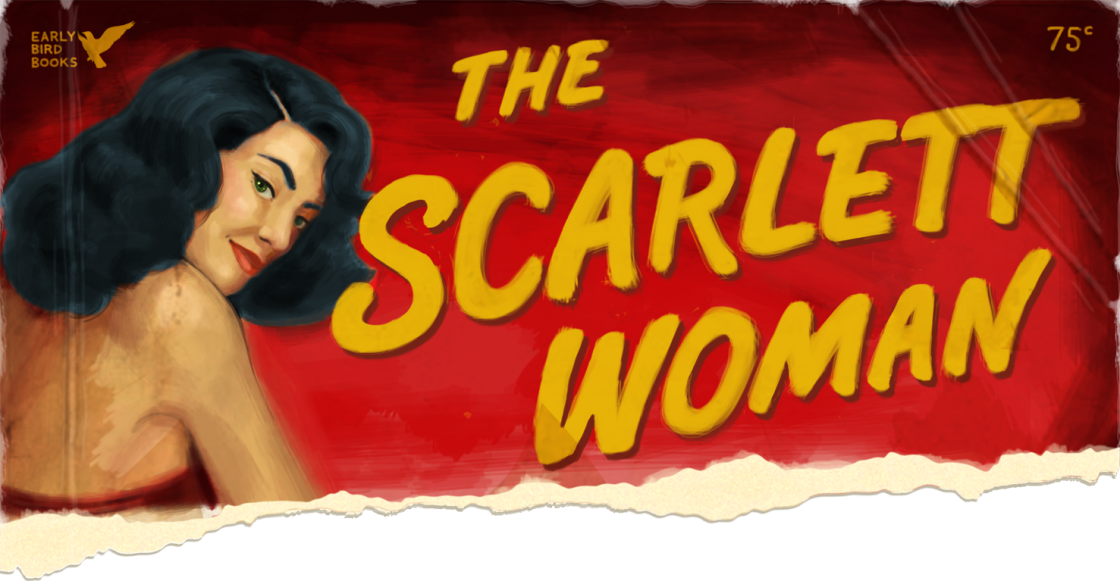
Book Review: Never, Ever, Again… Why Australian Abortion Law Needs Reform by Caroline de Costa.


Abortion activist Caroline de Costa gets the name for her book from the Queensland trial of young couple Tegan Leach and Sergie Brennan, who were charged with procuring an illegal abortion by using the “controversial abortion drug”, RU486, which is a situation that should happen “never, ever, again” (p. 24).

This unique case garnered so much media attention because it was the first time since 1959 that a woman was charged, under section 225 of the Queensland Criminal Code, with procuring her own abortion. This section of the criminal code hasn’t been changed since it was written… in 1899.

The couple were declared innocent after the trail came to a close on the 14th October last year, but it brought to a head the debate surrounding the aforementioned “controversial abortion drug” RU486.

de Costa has also written another book on RU486, and a lot of that material is rehashed in this publication. Before this case, I only ever thought there were surgical abortions, performed in a hospital using suction. I supported them nonetheless. Now that I’m aware there is an “abortion drug”, which not only assists in the safe termination of pregnancy, but “could help treat, among many other things, certain inoperable brain tumours, breast cancers, burns and, ironically enough, the fertility-inhibiting condition of endometriosis” (p. 151), I’m even more in favour of allowing access to abortion to women who don’t want to be pregnant.

de Costa continues:

“Mifepristone/misoprostol [RU486] is also an effective way of starting labour in women when it is found that the fetus has died in the uterus at any time up to mid-pregnancy, and this is now recommended practice in many countries overseas.

“Mifepristone has also been shown in trials to be useful for Emergency Contraception (EC)” (p. 152).

de Costa is quick to point out that RU486 is not the same as EC, as one assists in abortion while the other prevents an egg being fertilised in the aftermath of unprotected sex.

The drug has also been seen to be effective in small doses as a contraceptive pill, assist in the treatment of Cushing’s syndrome (the “over-production of glucocorticoids”), depression, dementia and Alzheimer’s, arthritis, “certain types of hypertension”, glaucoma, and even HIV and AIDS (p. 152, 154).

But RU486 is only available from a few medical practitioners in a few locations in Australia, hence why Leach and Brennan decided to purchase theirs from overseas. It is also a fairly recent development.

Before medical abortion was available, women tried all sorts of treatments and home remedies to abort their foetuses, a cacophony of which are detailed in Never, Ever, Again. Most of these cases resulted in the desired death of the unborn child, but also in the death of the mother.

Whilst Victoria, New South Wales, Western Australia and the Territories have abolished abortion as a crime, Queensland still considers it an illegal and punishable offence. So do, to a lesser extent, Tasmania and South Australia. Seriously, people: when some third world countries have no problem with mifepristone, why should a progressive country such as Australia?

The book talks about the majority of Australians who think abortion should be legal, and how Queensland residents and the media came out in support of Leach and Brennan during their trial. For example, “as journalist Emma Tom wrote in 2009:

“Like many people who believe women should have the right to safe, affordable and legal terminations, I don’t like being described as pro-abortion because it sounds like I think terminations are fabbo things that women should hop into as often as possible. The truth is I’d like to see a whole lot less of them, but via sex education and contraception rather than by robbing women of their right to decide whether they’re up to seeing through a pregnancy” (p. 24).

Now that’s something everyone can agree on, no?

In the final chapter of the book, a recent addition to this second edition, de Costa writes in a much more relatable and personable tone than the rest of the book. Perhaps that’s because the final chapter is an account of the trial of Leach and Brennan, which de Costa attended.

de Costa also repeatedly writes the assertion that abortion should be a matter that exists between a woman, her partner and her doctor, and not the government, the police and the legal system. In the final sentence, de Costa writes:

“It [the second chapter of abortion law reform in Australia] will be written when finally State Premiers and Attorneys-General have the wisdom and courage to remove abortion from the too-hard basket and agree on uniform decriminalization of abortion law across the country. Then, and only then, can abortion truly be a matter for a woman, her partner and her doctor.”

Amen to that!

Related: Melbourne Writers’ Festival: Never, Ever, Again: Why Australian Abortion Law Needs Reform by Caroline de Costa Book Launch.

Feminism Respects Women More Than Anything, Including the Catholic Church!

Image via Fishpond.

Event: Melbourne Writers’ Festival—Never, Ever, Again: Why Australian Abortion Law Needs Reform by Caroline de Costa Book Launch.

Last year’s Melbourne Writers’ Festival was pretty lackluster, and I didn’t attend any events.

This year, however, is jammed packed with hard-hitting seminars, news-related talks and all-day workshops. There are more events I’m interested in than there is money in my pocket.

But to kick things off was a free, no-bookings-necessary book launch at ACMI’s The Cube on Friday afternoon for Caroline de Costa’s second edition of Never, Ever, Again: Why Australian Abortion Law Needs Reform (review to come in the next few weeks).

Honestly, I didn’t think I’d heard of de Costa before, and just saw the word “abortion” and knew I had to attend!

However, when the author began speaking about the abortion drug RU486, I remembered reading her work a few weeks ago on MamaMia, and featuring said article in “On the (Rest of the) Net”. It is an article I recommend checking out wholeheartedly.

In this article, De Costa asserts that we need to increase sex education and access to contraceptives in order to bring Australia’s high abortion rate down.

In de Costa’s address at the event, she said no woman enjoys having an abortion and that there’s “no such thing” as “pro-abortion”, an assertion that I don’t 100% agree with, but I do think it is a damaging label pro-lifers sometimes paint pro-choicers with.

Ultimately, de Costa says we “should be concerned about the health and safety of every pregnant woman” as opposed to the biologically dependent mass of “unwanted tissue” in her body.

The other speakers at the event—the MC whose name I didn’t catch, long-time pro-choicer Dr. Jo Wainer, former Minister for Women’s Affairs from 2007 to 2010, Maxine Morand, and Dr. Chris Bayly from the Royal Women’s Hospital—reiterated de Costa’s sentiments in her book, that the “hidden business that is women’s business” of abortion needs to be destigmatised and legalised in order to increase access to safe pregnancy terminations.

Finally, the revised edition of the book includes an extra chapter on the Queensland trial of Tegan Leach and Sergie Brennan, who were charged with procuring an illegal abortion in 2009 when they purchased the drug RU486.

Dr. Wainer noted that when Leach was on the stand being questioned as to why she felt the need to abort her baby, it was the “21st century equivalent of putting women in the stocks”. Or burning at the stake for her “crimes”, if you will.

It’s something that, as the book’s title suggests, should happen never, ever, again.

That’s why abortion law in Australia needs to be reformed.

Related: Grey’s Anatomy Final Asks “When Does Life Begin?”

Private Practice: Pro-Choice?

Elsewhere: [MamaMia] RU486, Sex Education & Contraception. That’s All We Need.

[MamaMia] The Couple Facing Jail Because They Tried to “Procure an Abortion”. Hello, Queensland? It’s 2010.

[Televisual] The Changing Economics of the TV Abortion.

Image via Melbourne Writers’ Festival.

On the (Rest of the) Net.


“The Case for Dry Humping: Why Being Prude is a Feminist Statement.” [HuffPo]

Alone time is my siren call. Here, Jezebel’s Social Minefield tells you how to get more “me time” without offended those who want to have “we time” with you.

One woman goes mirror-free for a year. [Jezebel]

Lady Gaga’s run out of people to plagiarise, so she’s turned to herself for inspiration in her latest video for “Yoü & I”. [Fashionista]

Nipple slips from Khloe Kardashian, Nicki Minaj and Kelly Rowland in quick succession: shock, horror! [The Washington Post] (SFW)

Camilla Peffer on Beyonce as the anti-feminist. [Girls Are Made From Pepsi]

The gender politics of Justin Bieber. [FBomb]

Is there a need for women to have their periods?:

“… I do want to raise the question that while we do the work of destigmatising menstruation and teach young girls to be proud and excited about their menarche don’t we also have a responsibility to question its necessity? We tell women they don’t have to have sex to have children, that breast cancer can be beaten, that they can have their tubes tied and then re-connected and their faces lifted and de-wrinkled. We live in a modern world with modern solutions, isn’t it time we started seriously thinking and talking about the need to bleed?” [Feminaust]

Porn star and new mum displays picture of her breastfeeding her newborn daughter in an exhibition challenging the Madonna/whore dichotomy of motherhood, controversy ensues:

“The idea that there is something inherently prurient about a porn star breast-feeding plays right into that classic either-or thinking: Her breasts are erotic in one venue, so they can’t be wholesome in another. It’s a wonder anyone lets her breast-feed at all! On the one hand, it’s surprising to see this attitude coming from a pornographer; on… [yet an]other hand, it’s perfectly appropriate given the way motherhood is fetishised in porn.

“…We don’t like to think of moms as sexual beings—except for in the taboo-busting world of porn (paging Dr. Freud). It’s fitting for a porn star mama, the rare industry ‘MILF’ who is actually a mom, to remind folks that, generally speaking, one has to have sex in order to become a mom.” [Salon]

Anne Hathaway’s new effort, One Day, has a “bleak worldview of co-dependence where men need women to improve them, and women need to improve themselves to deserve men’s notice and achieve their purpose,” with The Film Stage dubbing it “the most toxic romance of the year”.

Also at The Film Stage, a breakdown of Katherine Heigl’s stereotype-reinforcing rom-coms, from the career-making Knocked Up, which she subsequently dissed for being sexist, to the just-as-sexist Killers and Life as We Know It.

Here’s an extended version of Erica Bartle’s debut piece for Sunday Life. While I don’t necessarily agree with her sentiments on faith most of the time, this is a great read. Better than the published piece, dare I say? [Girl with a Satchel]

Taylor Swift VS. feminism. [Autostraddle]

Is it “time for an abortion pride movement”?:

“… Women should not merely have the right to end unwanted pregnancies, they should have the right to be proud of having done so. Surely, there is enough suffering in this world already without adding infants with Tay-Sachs disease and Lesch-Nyhan syndrome to the mix. Women who step up to the ethical plate and have the strength to say, ‘This is the wrong time,’ or ‘This is the wrong fetus,’ should hold their heads high in the streets.” [Opposing Views]

Oh, the hilarity of Photoshop on this Glee/Vogue/Fashion’s Night Out advertisement. [Styleite]

It’s not just women who get the short end of the stick when it comes to Disney films: “Sexism, Strength & Dominance—Masculinity in Disney Films.” [FBomb]

The awesomeness that is Adam Lambert. [Autostraddle]

One from the vault: Buffy’s Willow Rosenberg destroys the world when her lesbian love is killed, calling into question the show’s support of the LGBT community. [Salon]

A mother’s perspective on the dysfunctional Twilight-saga relationship between Edward and Bella. [Persephone Magazine]

The politics of the SlutWalk. [New York Times]

Five of The Simpsons’ best recipes, including 64 slices of American cheese and Vaseline toast! [Warming Glow]

Image via Chubby Wubby Girl, Styleite, Salon.

On the (Rest of the) Net.


“If Male Superheroes Posed Like Wonder Woman.” [The Bleeding Cool, via Jezebel]

“An Open Letter to Fred Nile”, member of the Christian Democratic Party, who said the baby being expected by Federal Finance Minister Penny Wong and her partner, Sophie Allouache, has “human rights” and should not be brought up in a home with two mummies. [MamaMia]

The anti-child-model argument. And it’s a good one. [The Guardian]

The navel-gazing of the Gen Y writer. [Harvest Magazine]

Latoya Peterson “On Being Feminism’s ‘Ms. Nigga’”. [Racialicious]

The old Hollywood deception that was Rock Hudson. [The Hairpin]

The case for spoilers. I’ve been guilty of giving away the ending of movies and TV shows, saying things like “Oh yeah, and then it grows back” about Jessica’s broken hymen in her first sexual encounter—as a human or vampire—with Hoyt on True Blood, when I asked a friend which episode they were up to. Oh, you haven’t seen it? Whoops! [Jezebel]

The (Real Life) Help. [Jezebel]

And if The Help, the DSK case and Arnold Schwarzenegger’s love child have taught us anything, it’s that domestic workers are treated like shit. But hope may be on the horizon… [The Houston Chronicle]

As per Beyonce’s suggestion, a new word for feminism: equalism. Though one suggestion seems to have been submitted by Voltron… [Jezebel]

Where have all the good men gone? Not posting on Twitter thread #reasonstobeatyourgirlfriend and not being all “Post Gender Normative”, that’s for sure! [Tiger Beatdown, McSweeney’s]

Reproductive rights, consent and organ/egg donation. [Feministe]

Feminism and superheroes conference in Melbourne? So wish I was there! [The Age]

Six myths about terrorists. [MamaMia]

It’s (not) all about popular(ity) at Girl with a Satchel.

Rachel Hills on motivation and the fear of failure. And success! [Musings of an Inappropriate Woman]

Classism on True Blood. [Tiger Beatdown]

Caroline Da Costa on why we need RU486 (the “abortion drug”). [MamaMia]

A step in the right direction to welcoming asylum seekers to Australia. [MamaMia]

Still with asylum seekers, along similar lines as my post this week. [The Punch]

Larry David as “feminist hero”? [Jezebel]

“Revolution” is what we call riots we like:

“… Guilt ridden white first-world bloggers… love protests in Syria and Iran and elsewhere because they can cast those people, members of an alien culture, race, and religion, as the perfect representations of resistance while totally stripping them of the actual thorny reality of political rage. Theocratic preferences are stripped away; violent behaviour… is ignored; the re-instantiation of sexist Islamic doctrine within the structures of protest movements are conveniently elided. This is the way of all patronising attitudes from the overclass towards resistance: in order to preserve its romanticized view, it has to occlude the particular grievances and goals that make the protest meaningful in the first place….” [L’Hôte]

In the wake of the death of a toddler attacked by a pitbull, The Punch’s Anthony Sharwood decrees “pitbulls should all be killed. Every last one. It really is as simple as that.” Hmm, not sure I agree…

Do zoos have a place in 2011? [The Punch]

This profile on 2012 Republican presidential frontrunner Michele Bachmann makes me want to pray to the God she so staunchly believes in that there’s still a little bit of sense and belief in President Obama left in the U.S. [The New Yorker]

Image via Jezebel.

TV: Private Practice—Pro-Choice?


I’ve recently finished watching the latest series of Private Practice, the final of which aired here just over a month ago. The season dealt with the brutal rape of Dr. Charlotte King, about which you can read here and here, as well as the abortion debate that is raging across the world, but particularly in the U.S., with the rise of the über-conservative Tea Party, and 2012 presidential hopeful Michele Bachmann.

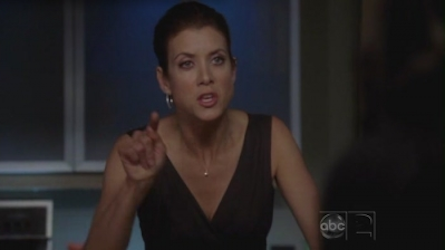
The second last episode of the season was said “abortion episode”. A woman named Patty came to see Dr. Addison Montgomery with pain, cramping and nausea after getting an abortion a month or two prior. When Addison does an ultrasound, she regrettably informs her patient that she’s still pregnant: the abortion didn’t take.

Patty’s foetus is now at 19 weeks, which would make the pregnancy in its second trimester, at which time an abortion is dubbed a “partial-birth abortion” by pro-lifers, as Dr. Naomi Bennett points out. Addison chides her for using political terminology, and that an abortion at 19 weeks is still perfectly legal, reiterating Patty’s right to choose, especially since she already made her decision the first time around several weeks ago.

Television and the media have a responsibility to present both sides of the story on such a contentious issue, even if they don’t live up to this most of the time. That’s why, when a show like Private Practice represents the abortion debate in such a refreshingly honest manner, it can be seen as revolutionary. (And it’s not the first time, either.) Not as revolutionary as Maude’s title character choosing to abort her unwanted pregnancy back in 1972, before the groundbreaking Roe VS. Wade decision, as this article points out, but still.

Naomi is a character I’ve never been a big fan of. She overreacts to everything (granted, overreaction may be warranted when your 16-year-old daughter gets pregnant and your best friend starts dating your ex-husband) and has a self-righteous, holier-than-thou attitude to most things, and her interference with Patty is no exception.

She uses her granddaughter Olivia to potentially guilt Patty into going ahead with her pregnancy, completely ignoring that Patty is single, after her deadbeat boyfriend took off when she told him she was pregnant, works two jobs, is poor, and is on her feet eight hours a day.

I had a real problem with this. Doctors should not push their personal beliefs on patients. If I were to fall pregnant tomorrow, I would be hitting up my nearest abortion clinic in a second, expecting to be given the care I’ve chosen, not to be lectured or threatened. As Addison says:

“… Even after you make the most difficult and personal decision that there is, it’s still not safe. Because you have some fanatic who claims to value life who can walk into an abortion clinic and blow it up.”

She continues:

“Why can’t Patty get what she needs, a safe and legal abortion without judgement?  Why does she have to go through this?  Why do I have to go through this?  I hate what I am about to do but I support Patty’s right to choose.  It is not enough to just have an opinion because in a nation of over 300 million people there are only 1700 abortion providers.  And I am one of them.”

The statistics are grim.

But, while trying to express the “pro-life” argument as well, Private Practice manages to remain pro-choice, which is no mean feat in the wake of reproductive rights being ripped from women across the world, and another PP, Planned Parenthood, being defunded en masse.

Related: Grey’s Anatomy Final Asks “When Does Life Begin?”

Cristina Yang as Feminist.

Elsewhere: [New York Magazine] Emily Nussbaum on the Rape Episode of Private Practice.

[E! Online] The Morning After: Let’s Talk About Private Practice.

[Feminist in the City] Private Practice Tackles Abortion.

[Televisual] The Changing Economics of the TV Abortion.

[Fuck Yeah Choice] Just Keep Swimming: Abortion on Private Practice’s “God Bless the Child”.

[Dakota Women] And the Abortion Portrayal Award Goes to… Private Practice?

Images via Kate Walsh Fan.

TV: Cristina Yang as Feminist.


When it comes to “likeable” female characters on TV, you might think of Buffy Summers. Or Rachel Green. Or the Gilmore girls. But Grey’s Anatomy’s Cristina Yang probably isn’t one of them.

She’s abrasive, unfeeling, career-driven, ruthless and selfish. Everything a woman shouldn’t be, according to patriarchal norms.

Perhaps she could be more like the ousted Izzie Stevens, who was bubbly and sexy and baked cookies. Or the virginal and highly-strung April Kempner, whom Cristina praises for having “virgin super powers”, enabling her to be super-organised.

But I like Cristina just the way she is. She’s got her eye on the prize, won’t compromise her personal beliefs or goals to be liked or for a man, and she’s got “tiny little genius” hands that enable her to roll with the big guns.

This is why Cristina Yang is one of the only “feminist”—or “strong female”—characters on television. Nay, in all of fiction.

For one thing, she refuses to rely on her looks or her feminine wiles to get ahead. In “This is How We Do It” in season seven, she rejects Owen’s compliment about her beauty, saying, “If you want to appease me, compliment my brain.” (Stay tuned for more on beauty versus brains this week.)

And in last week’s final, we saw Cristina exercise her right to choose, and schedule her second abortion on the show, after much (mostly solo) deliberation. While excluding the opinion of her significant other and father of the future child wasn’t the most respectful thing to do, ultimately it came down to her choice, and she chose to terminate the pregnancy.

In season two, Cristina divulges that she’s pregnant to Dr. Burke and, again, makes the decision to get an abortion on her own. Whereas a character like Izzie seems to serve the pro-life agenda (she gave up her own baby for adoption when she was a teenager growing up in a trailer park, and convinced a HIV-positive woman to carry her pregnancy to term), Cristina resists the societal pressures to tap into her maternal instincts and give birth to a child she does not want.

Regardless of whose agenda could be seen as being served by Cristina’s character, she acts without fear of what other people will think of her.

As a person, no matter what gender, it is seemingly second nature to want others to like us, and to portray our best selves to them. Just look at the ritual of the date or the job interview. That Cristina defies this action (though we have seen her star struck when meeting surgeons like Tom Evans, and Preston Burke for the first time) makes her not just a feminist character, but a truly humanist one.

There are people in this world who challenge us, grate on us, and whom we genuinely don’t like or approve of. But that’s what makes the world go around. Cristina Yang being one of these kinds of people, and being portrayed to us as a whole person on television, with hopes and dreams and trials and tribulations and relationships and a career and no desire for children, and not just as the bitchy mother-in-law who lives off her husband’s money and needs a good fuck, is truly a sight to behold.

Related: Grey’s Anatomy Final Asks “When Does Life Begin?”

The Underlying Meaning in Grey’s Anatomy’s “Superfreak” Episode.

Sookie as Feminist? Hear Her Roar.

Are Our Favourite Fictional Females Actually Strong, or Stereotypes?

Elsewhere: [The Feel of Free] Cristina Yang + You Can’t Compromise on a Baby.

[Marinagraphy] Motherhood, Cristina Yang & Grey’s Anatomy.

Image via Home of the Nutty.

TV: Witch Trial—Burning at the Stake on Charmed.


2009: The year Michael Jackson died, 173 people perished on Black Saturday, and America’s first black president, Barack Obama, took office.

However, in Charmed’s imagining of a futuristic 2009, 1999’s flashforward episode “Morality Bites”, witches have been exposed and are now being burned at the stake.

Phoebe is set to burn for taking justice into her own hands and using her powers to avenge a friend’s death, “seeking to defy human nature with her way of life”.

Fastforward two years to 2011, and it’s not such a different place.

Uganda tried to push through the Kill the Gays bill, women still have to march in (Slut)walks to exert freedom of sexuality and reject blame for sexual assault, and Australia is still floundering over a carbon tax.

I’ve written on this here blog before that sometimes I get the feeling the world is regressing, especially in terms of the environment and reproductive rights.

We still vilify those who dare to lead a lifestyle outside the norm, whether it is viewed as a “choice” or not. In Charmed’s fictional world, witches could be seen as a metaphor for the “other”: people of colour, the gays, people with disabilities and, most pertinently in 2011, transpeople.

The episode could also be a metaphor for the death penalty.

When Phoebe kills baseballer Cal Greene for killing her friend, she takes the law into her own hands, and is therefore sentenced to death. An eye for an eye.

Before Phoebe accepts her fate and submits to burning alive, she tells her executioner, Nathaniel Pratt, that while she’s paying for her crime, there will come a day when he’ll have to pay for his, too. While the death penalty isn’t an issue in Australia (if it were I’d be—controversially, perhaps—for it. However, there seems to be something sickly satisfying for victims and their families to see a perpetrator rot in prison for life… Jaycee Duggard’s abductors, anyone?), the question of who decides if a person dies and who administers the lethal injection (or in this case, “gathers the kindling”) remains. And how can a person live with that on their conscience.

Charmed may be all fluff, unrealistic demon-fighting outfits and “nipple fats”, as my friend Eddie noted, but every now and then it does deal with the big issues, consciously or not.

Related: Ain’t Nothin’ Gonna Break My Slutty Stride.

Rihanna’s “Man Down”: Revenge is a Dish Best Served in Cold Blood.

Images via Wikia, Gamespot, PPP The Power of 3, Hopeless Obsession.