On the (Rest of the) Net.

(No images this week as I’ve maxed out my broadband limit watching Grey’s Anatomy online!)

Style blog as “unapologetic narcissism”?

“Here is a beautiful slender girl who is constantly posting photos of herself wearing somewhat predicable outfits… Does she really have amazing style or is it just simply the case of a pretty girl wearing denim shorts and a knitted jumper?… How long can this low-on-substance form of blogging survive?’

“I am not your sex-crazy nympho dreamgirl!” at The Good Men Project, via Jezebel:

“… Surely he’d prefer the sexy, fake, plastic dreamgirl shell?

“[This]… image includes a lot of behavioural stuff: the way you squirm, the way you moan, being Super Excited about everything the guy wants to do, and Always Being Up for It—whatever ‘It’ is. When people think about ‘good in bed’, for a woman, that’s often what they think.

“This image also includes being young and thin and cisgendered of course, and that can be problematic.”

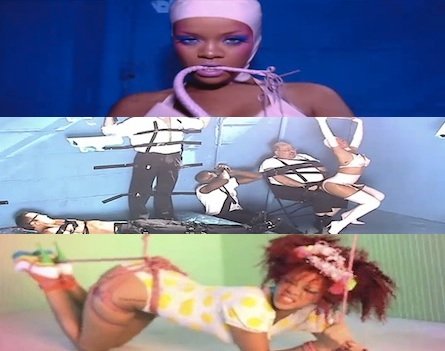
“Rihanna Shoots Her Rapist in Her New Video”, “Man Down”.

And here’s Fox News’ take on the video:

“ ‘Man Down’ is an inexcusable, shock-only, shoot-and-kill theme song. In my thirty years of viewing BET [Black Entertainment Television], I have never witnessed such a cold, calculated execution of murder in primetime.

“… She sings that she killed a man when she ‘lost her cool’ because ‘he was playing her for a fool’. This garbage from the same woman who publicly bragged to Rolling Stone recently that she likes to be spanked and tied up… Rihanna gets to have it both ways—accuse Chris Brown of domestic violence and be violent herself—because she’s a woman.”

What does Lady Gaga really have left to say?

The racism and “ugly women” involved in the Arnold Schwarzenegger scandal.

Beyonce: running the world or copying the cat?

The “endangered” and “reclusive” “North American Obeast”.

The World According to Paris [Hilton]: Same Shit, Different Show.”

Special needs kids as prom king and queen. Yay!

How many handbags do you need?

Rebecca Sparrow on Carbon Cate’s fallout:

“So who are these celebs to be loaning their support to such causes? Who are they not to be? Fame’s sidekick is a bloody big, unrelenting spotlight. With the trappings of fame comes a responsibility, I believe, to shine that light on causes you believe in. And while anonymous donations and clandestine charity work are noble—public giving, supporting and encouraging can—literally—save lives. Make a difference. Raise awareness.

“And frankly, I’d rather see [George] Clooney pimping his fame for Darfur than, say, Nespresso.”

Event: Cherchez la Femme Fatale, Take 2.

Geelong may seem like a world away for city slickers. At first, I was going to let its distance prevent me from attending the city’s latest exhibition, Femme Fatale: The Female Criminal, at the National Wool Museum. But if you take some friends and a good book (though not both at the same time. Take it from me; you’ll be stuck on the same page for the duration of the trip!), the hour’s train commute is worth it.

The exhibition juxtaposes “glamorous depictions of female felons in literature” with “the grim reality experienced by real women criminals”, such as Janet Wright, who was prosecuted for performing an abortion on a teenager who, after becoming ill, reported her, in 1928. Or “Sydney’s most beautiful prostitute”, Dulcie Markham, who probably got her fake name from Alfred Hitchcock’s Murder!, and whose real identity was never revealed. Or Louisa Collins, who poisoned—“poison was considered a particularly feminine murder weapon”—her husband in order to marry a boarder in their home just two months later, in 1887. She was sentenced to hang on 8th January, 1889, but the execution was botched by the hangman, “who was unable to open the trapdoor”. The execution was eventually carried out.

These were just some of the individuals profiled in the exhibition, which dealt with the supposed “empowered, cunning, unemotional woman who commits crime and uses her sexual allure to persuade men to sin on her behalf”—the quintessential “femme fatale”—and today’s understanding “that a wide range of factors may influence criminality including difficult childhood environments, mental illness and drug addiction.”

But back in the day, it was believed that “women lack moral fortitude and are easily tempted”, which allegedly stemmed from Sigmund Freud’s “penis envy” theory.

In 1893, Italian criminologist Cesare Lombroso wrote La Donna Delinquente (The Criminal Woman), in which he contended that masculine features, such as a “mannish jawline”, noticed in his photographical portraits of female criminals, were the “stigmata of degeneration”. Factors such as the menstrual cycle and the fables of Eve in the Garden of Eden, Medusa, and the Biblical Delilah, of Samson fame, were also taken into account when women “sinned”.

As was written in relation to the Salem witch trials in the early 1690s, “the fear of wicked women, whether real or imagined, can have horrific consequences.”

In Australia, though, in recent years “the number of female offenders incarcerated… has risen dramatically”. In the early days of female incarceration in Australia, psychological punishments such as head shaving were preferred to physical punishment. But at the State Reformatory for Women in Long Bay, Sydney, which opened in 1909, “the women were encouraged to reconnect with their ‘femininity’ and to adopt more refined, ‘ladylike’ behaviour.”

The abortion section, which I briefly mentioned above in relation to Janet Wright, was quite affecting but, as my friend Eddie pointed out, perhaps seemed out of place in the exhibition. Sure, abortion was (and still is in some parts of the country) illegal for a long time, but it kind of felt like a certain agenda was being pushed via its inclusion. Still, it is “one of the few crimes that always involves a woman”.

My favourite part of the exhibition, by far, was the genre of “femme fatale” paperbacks and films, which lured me to it in the first place. There was a highlight reel of some of the silver screen’s greatest female villains, such as Glenn Close in Fatal Attraction, next to this Italian proverb: “woman is rarely wicked, but when she is, she is worse than a man.” Another quote, from Raymond Chandler in Farewell My Lovely, which really resonated with me and my love for femme fatales, and which I posted last week: “I like smooth shiny girls, hardboiled and loaded with sin.”

But as much as the femme fatale is lauded, in her heyday the American Production Code stated that “ ‘the sympathy of the audience should never be thrown to the side of crime’. Censorship led to many implausible endings and a high level of mortality among femmes fatales.”

The exhibition finished up with crime memorabilia, which has reached fever pitch in recent years, with action figures, calendars, trading cards and true crime publications. (I, myself, have a penchant for true crime. Dominick Dunne, anyone?) This is a far cry from the assertion that “most people find it repellant that an individual can become a celebrity simply for being very good at being bad.” Reminds me of a certain Rihanna song

Overall, while each individual aspect of the exhibition was fascinating in its own right, Femme Fatale: The Female Criminal as a whole was a bit clunky and disjointed. I would still recommend seeing it, if “evil” women are your thing. But get in quick! It finishes next Monday.

Related: Cherchez la Femme (Fatale).

Raymond Chandler on the Femme Fatale.

The “Evil” Woman.

Another City, Not My Own by Dominick Dunne Review.

Minus Two & a Half Men.

Rihanna’s “S&M”: Is It Really So Much Worse Than Her Other Stuff?

Image via Art Geelong.

Event: Ain’t Nothin’ Gonna Break My Slutty Stride.

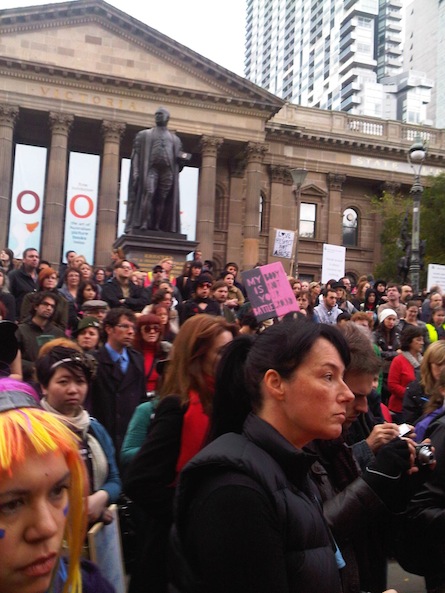
Ralliers outside the State Library on Swanston Street.

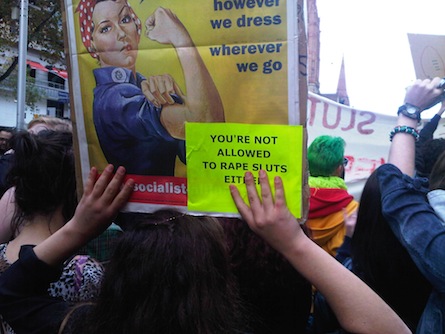
Best. Sign. Ever.

Last Saturday the highly anticipated SlutWalk occurred in several Australian cities, and I attended the Melbourne event with my fellow anti-slut-shamer friend Laura (both of us below).

We rocked up in our sluttiest outfits, which you can see above, complete with permanent marker declarations of our proud sluthood to boot. Some of the other outfits we noticed were short skirts with knee-high skull print socks and customised Doc Martins, worn by event organiser Clem Bastow (below), lace dresses and gym gear, the latter of which adorned a short-haired tattoo fan with a body Tracy Anderson would envy.

Clem Bastow.

Monica Dux.

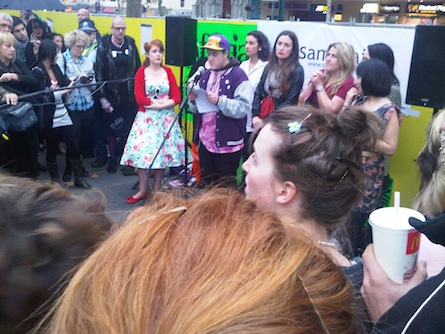
As Bastow commented when she gave one of the opening addresses, along with fellow event organisers Karen Pickering and Lauren Clair, and noted feminists Monica Dux (above) and Leslie Cannold, amongst others: “thank you, God, it looks like you’re going to rain on me”. But no one was gonna rain on our parade and, despite the chilly temperatures, we still walked tall and proud in whatever get-ups we chose to wear.

Dux said this is the beginning of a movement, which I have to disagree with. SlutWalk is not the beginning of a movement; it is part of the reignited battle to stop victim-blaming and slut-shaming based on one cop’s archaic musings on rape and how much a woman was “asking for it”. Here’s a fun fact: WE’RE NEVER ASKING FOR IT! (See Bastow’s sign, above). No matter how we are dressed, where we are, how much we’ve had to drink, or what we do for work.

Speaking of, I was really proud to see the representation of sex workers at the event, and president of the Australian Sex Workers’ Association, the Scarlet Alliance (represent!), Elena Jeffreys (above) spoke about her sexual assault and that even though she was paid for sex, she was not consenting to assault. Her opinions on the SlutWalk were really interesting and I hope they receive as much publicity as the negative perceptions of the rally have in the media.

In the days leading up to SlutWalk, I was embroiled in a heated debate on Facebook with a friend who disagrees with the SlutWalk. I think he confused—like a lot of people—the meaning of the SlutWalk with an excuse to get gussied up in a very risqué manner when, in fact, that was not at all what it was about. That didn’t stop protestors on the steps of Parliament House at the top of Bourke Street brandishing their “rape is horrifying, but so is immodesty” placards (above). Like one of the speakers (whose identity escapes me: should have used my BlackBerry voice recorder!) said: it’s not up to us to curb our behaviour (and that includes how we choose to dress) at the risk of potentially being sexually assaulted; it’s up to those who sexually assault to curb their behaviour!

I think most people against the SlutWalk had a problem with the use of the word slut. As Cannold said, “words matter…: … we won’t stand for one, the same one, being slung at us over and over again to demean and degrade us.” Lori Adelman, in a post on Feministing, said she didn’t agree with the term “slut” and that she “would much rather have attended a ‘Do Not Rape’ Walk”:

“I find that the term disproportionately impacts women of colour and poor women in order to reinforce their status as inherently dirty and second-class, and hence more rape-able.”

To me, “slut” is just a word. It meant as much to me to be called a slut when I was 12 as it does today; as they (and Rihanna) say, sticks and stones will break my bones but names can never hurt me. It’s not about the term “slut”, it’s about the backwards and extremely offensive views that go along with that word. As coordinator of the first SlutWalk in Toronto, Sonya Barnett, told Rachel Hills: “if he [the policeman] had said something else, we would have called it something else.”

The speaker who garnered the most attention, though, was transgendered man, Cody Smith (above), who had been raped both as a biological female, and as a trans man. There were tears a plenty during his speech!

It was nice to see such a welcoming, non-judgmental turnout of everyday men, women and children of all walks of life, wearing all sorts of garb, not just the fishnetted and cut-out body con dresses that certain attendees chose to wear (guilty as charged!). After all, rape is not about what you’re wearing, what you look like, what size you are, how old you are, what your sexual orientation or gender is, or any other denomination that you happen to belong to as a person. It is about the perpetrator, and nothing you can or cannot do will stop them from attempting to rape you.

As Smith said, it shouldn’t be the victims of sexual assaults’ responsibility to educate the general public on sexual assault and victim-blaming. And I thought the sexual revolution happened several decades ago: it shouldn’t be up to members of a fringe movement to educate the general public on the sexual rights of women to express themselves however they please without the threat of retaliation. In fact, feminism—which is what the SlutWalk was all about—shouldn’t be considered as on the fringe in 2011.

Related: SlutWalk.

So a Tattoo Makes Me Public Property, Huh?

Has Feminism Failed?

Rihanna’s “S&M”: Is it Really So Much Worse Than Her Other Stuff?

Elsewhere: [Feministing] SlutWalk: To March or Not to March.

[Musings of an Inappropriate Woman] Ask Rachel: What Are Your Thoughts on SlutWalk?

Black and white images via Ali Ryan Photography.

“Chains & Whips Excite Me” Take 2.

So I’ve already blogged (and reblogged) multiple times about Rihanna’s “S&M”, but the other night my friend attempted to make this joke about it:

“So if whips and chains excite Rihanna, is what Chris Brown did to her just foreplay?”

Obviously the remnants of some sick Facebook joke, but worryingly, I believe this is what some people actually think.

As I wrote originally, “the video does deal with sexual violence… which Rihanna is no stranger to, but this time around it’s consensual violence.

Jezebel explains:

“‘It’s notable, though, following her assault by Chris Brown, that in the video for “S&M,” she’s interested in exploring consensual acts of violence and aggression, and finding pleasure in pain. Although she does appear bound in the video (as well as literally restrained by the media), mostly she plays the role of a dominant, perhaps to prove (or remind us) that she’s the one in control. Is this the desire of one who’s been called a victim? To recast oneself as authoritative and commanding?’”

She also speaks of the Brown incident in Rolling Stone:

“I put my guard up so hard… I didn’t want people to see me cry. I didn’t want people to feel bad for me. It was a very vulnerable time in my life, and I refused to let that be the image. I wanted them to see me as, ‘I’m fine, I’m tough.’ I put that up until it felt real.”

And her real-life love of S&M:

“Being submissive in the bedroom is really fun… You get to be a little lady, to have somebody be macho and in charge of your shit. That’s fun to me…I like to be spanked. Being tied up is fun. I like to keep it spontaneous. Sometimes whips and chains can be overly planned—you gotta stop, get the whip from the drawer downstairs. I’d rather have him use his hands.”

Admittedly, I do think it is a tad odd that sadomasochism seems to be dominating her current public persona but, as above, it’s consensual sadomasochism. Rihanna is well within her rights to take back the power Brown took from her by assaulting her, and this just seems to be the way she wants to do it.

And no matter how a woman acts, it is never a reason to hit her.

Related: “Chains & Whips Excite Me…”: The Underlying Message in Music Videos.

Rihanna’s “S&M”: Is It Really So Much Worse Than Her Other Stuff?

Elsewhere: [Jezebel] Rihanna’s New Video Celebrates Ball-Gags, Whips & Latex.

[Rolling Stone] Rihanna Opens Up Like Never Before in Rolling Stone Cover Story.

Images via YouTube.

“Chains & Whips Excite Me…”—The Underlying Message in Music Videos.


From L’s comment on “Deconstructing 2011’s Girl Anthems” by Emma Plant on Girl with a Satchel:

“…It’s scary to think that very few people are thinking critically about what song lyrics really say, or how the video can change a meaning of a song. Look at Rihanna tied to the bed in that Eminem video with him singing out lighting the house on fire to watch her burn… this from a young woman who was previously in an abusive relationship.
What is the music we listen to really saying about us and how is it shaping our opinions and values?”

Related: Rihanna’s “S&M”: Is It Really So Much Worse Than Her Other Stuff?

Elsewhere: [Girl with a Satchel] Deconstructing 2011’s Girl Anthems.

Images via YouTube.

On the (Rest of the) Net.


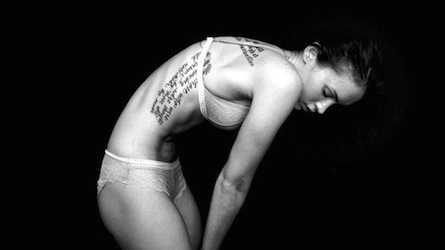
Megan Fox’s body politics:

“… You have a picture of said body—made even thinner through creative posing—that’s used to sell underwear. In other words, she is paid to be thin. Period. All the talk about her abs and her weight-training regimen don’t have anything to do with the reality: Her body is her business. Literally. It’s her business, not ours, whether she’s healthy—that’s between Ms. Fox and her doctor. And it’s her business—an integral part of her financial strategy—to be thin.”

This is a superb, graphic and thought-provoking piece of writing on waxing, vaginoplasty and the ubiquity of female lady-parts. Semi-NSFW, but I recommend reading it at any cost:

“… while we can look over with horror at a tribe of women who claim that if their five-year-old happened to bleed excessively after having her clitoris cut off, that she must have been a witch, here in our own backyard, we give it some fancy name like vaginoplasty and somehow it’s less archaic? Goodness, we’re so civilized.”

Bern Morley on song lyrics and what we let our children listen to. Good stuff.

The double standards of cheating. FYI, I don’t agree with them.

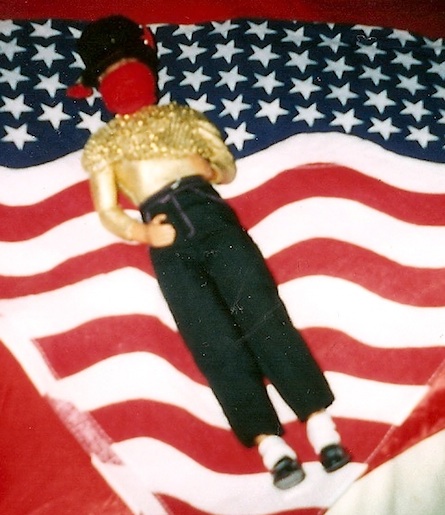
Sachar Mathias divulges her favourite black dolls. Does this make-shift Michael Jackson Ken count? It is circa late ’90s/early ’00s—his face mask, baby-dangling period—so maybe not…

Anti-Semitism in the fashion house of Christian Dior goes further back than just John Galliano’s comments.

James Franco was a jerk to Kristina Wong. I think he’s a jerk in general.

CNN recently published an article asking if “whites are racially oppressed?” That’s like saying there needs to be an international men’s day if there’s a women’s one. Seriously, someone tried to argue that to me last week!

Charlie Sheen and “The Disposable Woman”.

Thanks for the shoutout, Beauty Redefined.

Celebrities behaving badly: who’s responsible?:

“But is it the responsibility of the media to be the moral gatekeepers of what we should and shouldn’t know about? Is it their responsibility to diagnose supposed ‘mental illness’ and on that basis, stop reporting on certain stories?

“… If drug addled celebrities on the front pages didn’t sell, they wouldn’t be there. So is the problem us? Just who is egging on who[m] here?”

Alissa Warren is a bit unsure if Waity Kaity is the royal for her.

Rick Morton on Pauline Hanson’s political return.

Images via Jezebel, Carlen Altman.

On the (Rest of the) Net.


“A Brief History of the Bump Watch.”

And for any preggo Scarlett Women out there, this one’s also for you: “What You NEVER, Not in a Million Years, Expect When You’re Expecting”.

Dodai Stewart discovers the benefits of jeggings.

In the wake of St. Kilda’s most recent sex scandal (Ricky Nixon and the same underage girl who released damaging nude photos of St. Kilda players Nick Riewoldt and Nick Dal Santo in December, for those of you who have been under a rock the last week or so), Hawthorn’s Lance Franklin has released a sexist line of t-shirts.

Also with the St. Kilda Schoolgirl Scandal, Round 2, Mia Freedman writes:

“… I think it’s extremely interesting how she is indeed redressing the power imbalance between a 17-year-old girl and high profile AFL players and managers. She’s using social media and traditional media in ways that have been both surprising and disturbing to watch.”

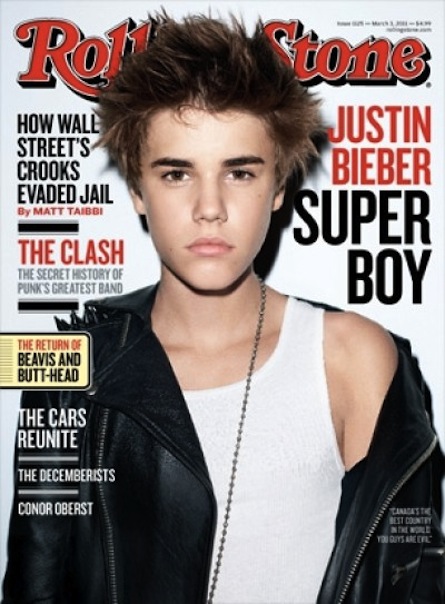
Freedman shares her views on Justin Bieber’s recent abortion comments, as well. More on this to come next week.

For all the single ladies (put your hands up!), “10 More Reasons You’re Not Married”, which include such gems as “you’re not good enough at fellatio or you’re too good at fellatio,” “you are too fat or too skinny” and “you want children too much and/or not enough”. It seems we can’t (or can) win.

Guest Girl with a Satchel blogger, Georgie Carroll of Frangipani Princess, talks teen magazines. “… My favourite day of the month is still when the newest issues hit the stand”; mine too.

On femme fatales.

Jenna Sauers attends a Fashion Week PETA party and “talks about animals with Tim Gunn”. Interesting stuff.

Are Lady Gaga and Rihanna really original, or “stealing other artists’ work”?

Are you a fan of kangaroo meat? Read this; it might change your mind:

“Like the seal trade, it’s brutal, but it happens away from our view, at night in the bush. According to the law, adult kangaroos should be killed by a single shot to the brain.  But in reality, many are injured in the neck or the body, and flee into the bush where they die slowly and painfully.

“What’s even less known is the terrible fate of joeys, just like the one Ray waded into turbulent flood waters to save: over a million a year are killed each year along with their mothers. How? The hunter stomps on the pouch joey’s head, or bludgeons him or her with a metal pipe.  This is enough to make you think twice about ever putting roo on the menu. The young outside the pouch are shot through the heart or head.”

Images via Romantic Dreaming, Juciytings.

Rihanna’s “S&M”: Is it Really So Much Worse Than Her Other Stuff?

Rihanna said it herself: “They watched ‘Umbrella’… I was full nude.”

So why so much fuss about her latest offering, “S&M”?

Sure, the title, lyrics and film clip are controversial at best, but once they are unwrapped and their true meaning is revealed, the song is more a dig at the press and Rihanna’s sadomasochistic relationship with them, hence Perez Hilton’s appearance.

The video does deal with sexual violence also, which Rihanna is no stranger to, but this time around it’s consensual violence. Jezebel explains:

“It’s notable, though, following her assault by Chris Brown, that in the video for ‘S&M,’ she’s interested in exploring consensual acts of violence and aggression, and finding pleasure in pain. Although she does appear bound in the video (as well as literally restrained by the media), mostly she plays the role of a dominant, perhaps to prove (or remind us) that she’s the one in control. Is this the desire of one who’s been called a victim? To recast oneself as authoritative and commanding?”

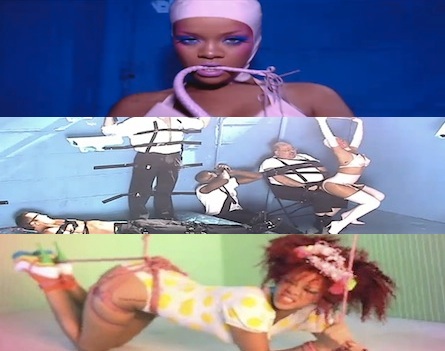
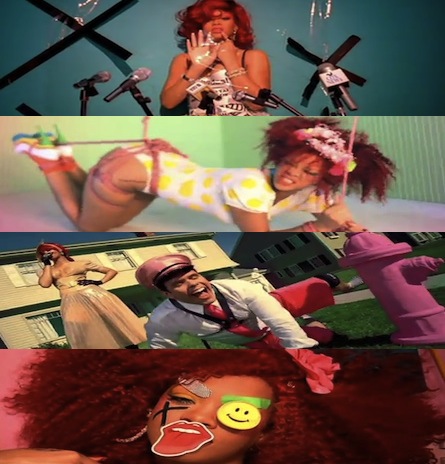
The film clip—the aspect of the song that has drawn the most controversy—is actually not that bad, in my opinion. It’s got a bright, pop-arty feel (a direction which the singer seems to be heading in these days), and “shows us a bright, vivid, eye-popping adult playground of her own imaginative making, exciting chains and whips [just happen to be] included.”

Where “Madonna and Lady Gaga have cornered the market on the black pleather and whips on white backgrounds of the S&M-themed music-video world… Rihanna is refusing to cede them the entire territory: She’ll do S&M if she wants to, she’s just going to make it really, really goofy.”

Granted, both Madonna and Lady Gaga’s videos and music are a cut above Rihanna’s, who is somewhere between Katy Perry’s “California Gurls” and Gaga’s “Telephone”, but you’ve got to admit: “S&M” is something a bit different, and something that’s getting people talking. And that’s the aim of the game, right?

Think of Rihanna’s other videos for a moment: “Te Amo” featured Laetitia Casta as Rihanna’s lesbian love interest; “Rude Boy” shows the singer peeking down the pants of a male dancer; her collaboration with Eminem in “Love the Way You Lie” dealt with domestic violence; and the aforementioned “Umbrella” marked her transition from “good girl” to “gone bad”.

Lyric-wise, “S&M” (Sex in the air, I don’t care, I love the smell of it/Sticks and stones may break my bones/But whips and chains excite me) is probably equally as graphic as “Rude Boy” (Come here rude boy, boy, can you get it up?/Come here rude boy, boy, is you big enough?). But officials in the UK don’t think so, with the song being completely reworked and renamed (“Come On”) so it can get radio play.

I do see their point—that they’re trying to protect the children or something—but if that’s the case, just don’t play the video on Video Hits; save it for cable television or late-night music programs. But that’s also the combined beauty and curse of the internet age: tech-savvy kids are just going to access the video online.

Related: Whipped Cream Feminism: The Underlying Message in Katy Perry’s “California Gurls” Video.

Elsewhere: [Digital Spy] Rihanna Video Labeled Inappropriate.

[Billboard] Sneak Peak of Rihanna’s “S&M” Video.

[Jezebel] Rihanna’s New Video Celebrates Ball-Gags, Whips & Latex.

[The New Gay] Yes, Master: Rihanna’s S&M World.

[New York Magazine] Rihanna Gets Tied Up in Technicolour for S&M Video.

Images via YouTube.

Picture Perfect.


From “No Refuge: How Webcams & Cell Phones Ratchet Up the Pressure to be Perfect” by Hugo Schwyzer:

“… A young woman who had been scrupulous about her appearance all day could return to her bedroom at night, change into what was comfortable, and have at least a little waking time where her looks didn’t matter…

“The real problem is that the webcam has stripped the bedroom and the bathroom from their role as safe refuge from the beauty-obsessed culture…”

I find Schwyzer’s points to be particularly poignant to my own life.

Until a few months ago, I had lived either at home, with family who knew me from the day I was born and had seen me in all my glory (and not-so-glorious moments) for twenty-two years, or on my own. During that time, as soon as I would get home I’d change into my pyjamas, wipe the makeup off, and pop the curlers in, not caring what I looked like.

Then I moved in with my cousin, and I kept up appearances for a few days until I realised she likes to bum around the house in holey pants and nose strips, too.

Honestly, I don’t give a crap what I look like at home, and if I don’t want to draw attention to myself, I will adopt my at-home strategy in the big wide world, too.

For example, most mornings I go for a jog as soon as I wake, and usually stop by the supermarket on the way home. I chuck a bit of lipgloss on an whip my hair (though not in true Willow Smith style) into a ponytail, but other than that, I look pretty crappy. If I wanted to be stared at while I exercised, I would go to a juice-head gym in full make-up and a crop top or jog with my friend Tess at her neighbourhood track, where the beautiful people go to workout. But I don’t.

A similar situation occurred at my work Christmas party. I was getting my slut on when I was approached by Jack Sparrow. He initiated contact (both verbal and physical), asking which department I worked in and why he’d never seen me before. Unbeknownst to him, he had seen me before…

… Earlier that day, I rocked up for a few hours to help set up in jeans, a t-shirt, work boots (okay, they were Tony Bianco) and my glasses, where he was also lending a hand. He took one glance at me and continued with his work.

What’s even funnier? The following day I reverted back to my bespectacled self, and he went about his day, not realising that I was the girl from the night before.

I don’t begrudge him that, though. I deliberately do these things to fly under (or above) the radar.

Relating more closely to Schwyzer’s point, however, I’m lucky; my generation managed to bypass the whole webcam/sexting/profile pictured frenzy that consumes the lives of teens now. Who knows what pressures I would have facedand how differently my psyche would have developedif my privacy was constantly invaded by mobile phones, Facebook and the like?

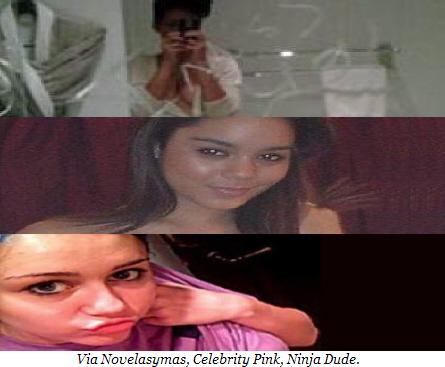
Celebrities who are a little younger than I am, though, like Rihanna, Vanessa Hudgens and (the markedly younger) Miley Cyrus have succumbed to the allure of naked photography, with the latter also dabbling in the filming of lap dances to 40-year-old directors and experimentation with bongs.

Personally, I don’t understand the pull of compromising photos. My advice to teen starlets and football players alike? If you’re going to take compromising photos, make sure you’re the only one with a copy or JUST. DELETE. THEM.

Related: ’Tis the Season…

Elsewhere: [Hugo Schwyzer] No Refuge: How Webcams & Cell Phones Ratchet Up the Pressure to be Perfect.

Newspaper Clipping of the Week.


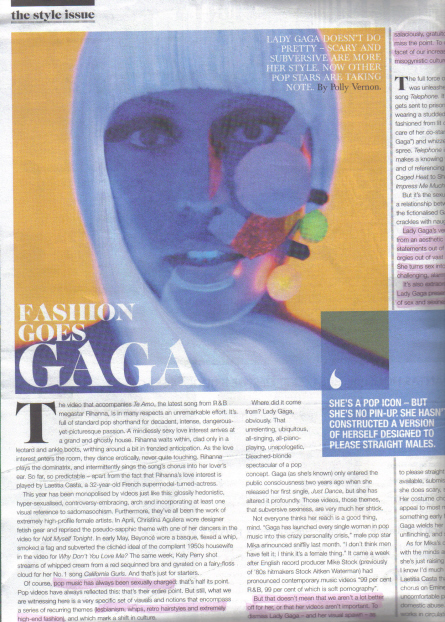
In Sunday Life’sStyle Issue, new editor Sarah Oakes’ Midas touch is already evident.

Especially in commissioning the piece “Fashion Goes Gaga” by Polly Vernon, in which Vernon argues that “pop music has always been sexually charged”, referencing Rihanna’s “Te Amo” and Gaga wannabe (which I don’t agree with) Christina Aguilera, just not in the way that Lady Gaga has revolutionised it. Vernon says, “To dismiss Lady Gagaand her visual spawnas salaciously, gratuitously, unnecessarily sexual is… just plain wrong.”

True, because “Gaga’s version of sexuality is extraordinary from an aesthetic perspective. She makes fashion statements out of gimp masks and gaffer tape, and orgies out of vast synchronised dance segments. She turns sex into camp theatre, and the result is challenging, alarming, powerful and exciting”: a far cry from “the cynical, soulless titillation of your average Britney Spears video.”

But with the mention of gaffer tape and gimp masks, it sounds more like a certain Aguilera effort than Britney, doesn’t it? ;)

Related: Everything They Touch Turns to Gold.