In the wake of Good Weekend cancelling an article on Caitlin Stasey because she wouldn’t pose nude for them, she’s taken to Jezebel to tell her side of the story in more than 140 characters.
Just when you thought Mad Max: Fury Road couldn’t be milked (pardon the pun) for any further feminist viewpoints, someone writes a breast milk article. [Bitch Flicks]
I went to see Into the Woods this week and I enjoyed it a lot more than I thought I would having read some things on the interwebs about its race and gender problems.
While it certainly still had those (*spoiler alert* both The Witch and The Baker’s Wife die because they don’t subscribe to typical notions of femininity; The Wolf wears a zoot suit in a dodgy part of the woods) it’s probably the least problematic of all the Oscars bait in cinemas at the moment.
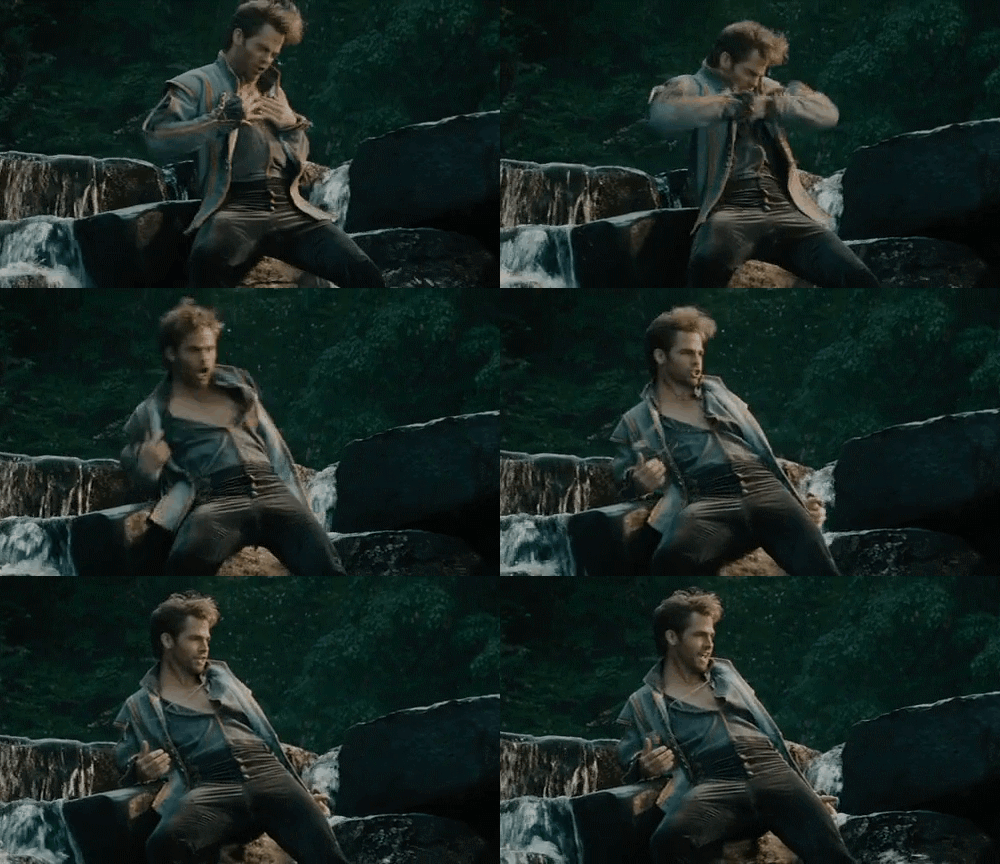
I found the politics of gender very interesting. I was surprised by how on the nose the rapeyness of The Prince was, and I thought Chris Pine played him to perfection. I was taken aback by the pedophilic undertones rife throughout the musical, exhibited by The Wolf and The Baker, amongst others. And for those unfamiliar with the stage version, in it the actor that plays The Prince also plays The Wolf! It gives a whole new meaning to the niceness/charm VS. goodness that reverberates throughout Into the Woods. If you like musicals and/or picking apart the underlying meaning of pop culture, go see it. [The Windowsill]
Disney’s Agent Carter isn’t feminist: it’s about “Disney owning feminist entertainment, and thereby being able to set the terms for it.” [In These Times]
Just as relevant to the #Tay4Hottest100 controversy as it was when it was published last year, Brodie Lancaster writes about gender-based music elitism. [Rookie]
“Authorities want to ban hoodies but not guns, sagging pants but not police murdering unarmed Black people, natural hair but not unnatural racist discrimination.” [Dame]
I’m going to be contributing a link roundup for feminaust on the first Monday of every month and guess what? My first edition went live this week. Much of it is links I’ve already posted here over the past week, but head on over and check it—and feminaust—out anyway.
ICYMI: If these links didn’t sate you enough, I’ve posted the best of Aussie and Kiwi online feminism in December for the 80th Down Under Feminists Carnival.
“We like Katniss, so we want to believe she’s important. But she isn’t a politician. She’s not a military strategist. She’s not a revolutionary thinker. She’s a survivor, and can handle a weapon, but that’s true of most soldiers. The only real value Katniss Everdeen has to the revolution is the fact that people like seeing her on television. She’s a weapon of mass sympathy; if she believes in this war, people at home will join it. And then they will die.”
And in wider, actual society:
“Taylor Swift… recently opined that ‘so many girls out there say “I’m not a feminist” because they think it means something angry or disgruntled or complaining. They picture like rioting and picketing, it is not that at all.’ Actually, it is that—rioting, picketing, and complaining, the synonym for all of these being ‘protesting,’ are pretty darn essential—but hey, who am I to stand in the way of mass appeal?” [In These Times]
“The editors have decided that pageviews are more important than protecting the lives of the people endangered by these hateful screeds.” [The Daily Dot]
Robin Thicke, along with Pharrell and T.I., came out with arguably 2013’s most controversial song, “Blurred Lines”, about this time last year.
Now the son of Growing Pains actor Alan Thicke is back with a whole new album about his estranged wife, Paula Patton, entitled simply, Paula.
Thicke was caught with his hand on a female fan’s bottom and allegedly followed this up by cheating on his high-school sweetheart Patton, with whom he’d been involved for 21 years and has a son. The unflappable Patton seemed to take the split in her stride, at least compared to Thicke, who’s taken to social media and radio waves in an attempt to win his former ladylove back.
The fact that his forthcoming album’s tracklist consists entirely of breakup-and-makeup songs is supposed to be romantic, but to the discerning eye, Thicke’s predation that was front and centre in “Blurred Lines” has come to the fore yet again.
Not only does his public begging read as more desperate than romantic, it publicly shames the other party who’s chosen to deal with the dissolution of their marriage in private.
But we all know Thicke’s favourite pastime is to “degrade a woman” and that’s exactly what he’s doing with this ill thought out album. For some perspective, the titular woman filed for divorce from Thicke in February this year, and the album’s first single, “Get Her Back” was released in May, giving Paula a lead-time of three months. And it has only been a year since Thicke’s previous album, Blurred Lines, featuring the rape anthem of the same name, came out.
The actual Marvin Gaye medleys that Thicke has become so well known—and taken to court—for and that make up Paula aren’t the worst in the world, but it’s when listeners pay mind to Thicke’s lyrics that the album really starts to run into trouble. The calypso rhythm of “You’re My Fantasy”, for example, can’t rescue it from this little ditty: “Your legs on my walls/Your body’s on my ceiling”; while Thicke makes reference to the cheating rumours on the Motown-y “Black Tar Cloud”, crooning “I thought everyone was gonna eat the chips/Turns out I’m the only one who double dipped”. (Thanks for that visual.) The mumbly “Forever Love” is luckily accompanied by a lyric video because Thicke’s enunciation is so poor it’s hard to sing along like the 14-year-old sung along in Patton’s ear to Stevie Wonder’s “Jungle Fever” upon their first meeting as teens in early ’90s Los Angeles.
“Get Her Back”, the earwormy lead single is arguably the album’s only redeeming one however its problematic video, featuring scrolling text messages that we’re to believe were sent between Thicke and Patton atop close-up shots of a fake-bloodied and allegedly crying Thicke being groped by masked women who look marginally like Patton before they plunge head-first into cavities of water, references intimate partner violence, like much of the album.
Thicke carried out a thick (so to speak) and fast social media campaign for Paula, including the hashtags #GetHerBack and #AskThicke, which ultimately backfired in a flurry of negative feminist press. Thicke even went so far as to engage in a cross-promotion with 1800-Flowers, for which the “Get Her Back” bouquet will set you back a cool $350—but it comes with a free digital download of Paula, so you’re actually saving money. But it would seem that many music consumers are holding on to their pennies this time around: just 530 fans in the UK and a dismal 54 in Australia forked out for Paula.
Thicke might not be a one-hit wonder (remember his 2002 debut, the equally as rapey as “Blurred Lines”, come to think of it, “When I Get You Alone”?), he proves that perhaps sex was the only thing that sold “Blurred Lines”.
The Hollywood that Thicke grew up in would have us believe that male persistence is the way to a girl’s heart: “the boy keeps trying to get the girl until she says yes,” writes Jessica Valenti for The Guardian. “You need to look no further than the outrageously popular Twilight series—books and movies—to know that the stalker-as-romantic lead looms large in our cultural imagination.” Real life headlines about intimate partner violence suggest that stalking is more deadly than romantic.
Further to that, Alyssa Rosenberg writes over at The Washington Post that “the simple fact of male persistence ought to be enough to bring a woman around to loving him”, while Clem Bastow asserted on Daily Life that Thicke’s quest to “Get Her Back” is “about the feelings of the man in question, not the woman he is searching for or seeking to reconcile with”.
But that’s Thicke’s pattern (pardon the pun); he’s crafting a pop cultural narrative where he’s the ultimate NiceGuy™ and if Patton continues to reject him she’s a cold-hearted bitch. And if Thicke was hoping for a deluge of sales to help him convince Patton to take him back, he’s sorely underestimated the public’s keen nose for desperation.

 The Scarlett Woman