Book Review: The Book of Rachael by Leslie Cannold—I’m Still in Love with Judas, Baby.


In Jesus’ time, nothing much was recorded about the women. So, for all we know, Jesus could have had many sisters, in addition to his brothers.

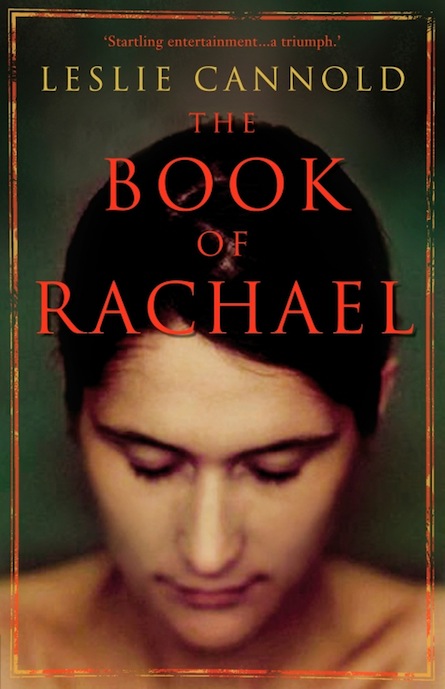
Leslie Cannold has imagined the lives of his sisters in The Book of Rachael. Shona is in love with one man but is raped by another and forced to become his wife and move far away from her family and sister Rachael, who is the rebellious one in the family. She’s inquisitive and passionate, and teaches herself to read when women weren’t allowed to. When she meets her brother’s (called Joshua in the book) friend, Judah, she falls head over heels in love with him, but the feelings aren’t reciprocated until some time after. They become married, but Rachael isn’t ready to become just a mother to Judah’s offspring, and consistently aborts his children using herbal remedies, which causes a rift in their marriage.

As a noted Aussie feminist, you’d have to expect some feminist sentiments thrown into the mix from Cannold. For example, the notorious mansplaining is invoked:

“‘Why is it,’ I asked, cutting across Judah’s lovesick cant, ‘that a female infant renders the mother more unclean than a male?… Forty days confinement if the child is a boy, twice this time for a girl,” I said, rattling off the well-known rule.

“‘The cause for difference,” Judah ventured hesitantly, ‘could be the labours. The distinct way that women labour when bearing a boy as against a girl. And the difference in the burden of guilt they acquire.’

“‘What?’ Distinct labours? Different guilt? Since my own flowering I had attended dozens of births. My preparation for initiation had required I listen to Bindy describe hundreds more. Not once had I even heard it suggested that an infant’s sex determined the severity of the trial faced by the mother. ‘Whatever are you talking about, Judah?’

“But Judah mistook my confusion for a confession of ignorance and a request for enlightenment. Relieved to have been restored to his accustomed role of authority, he set forth confidently to explain. ‘Everyone knows, Rachael, that in her hour of suffering, the mother is desperate and swears she will not live in intimacy with her husband again. If a boy is born, she repents this vow sooner because he occasions such rejoicing. But with a girl, all is gloom. Many women feel their failure keenly, so the mother’s return to her husband’s arms is delayed.’

“It was the silliest thing I had ever heard. And from a man! A man who knew nothing of monthly cycles and giving birth, yet had no hesitation in describing—explaining!—the features of that experience as if they were his own. A man, like the Great God Almighty, who had no right to say!” (p. 123–125).

Furthermore, when Rachael seeks to liberate the women tasked with midwifery duties from doing so until they “are free to serve and worship the Queen”, Bindy, her crone employer, warns, “What of the women who will be trampled in the stampede for freedom?” (p. 201). Do I detect a hint of second-wave vs. third/fourth-wave feminism?

Obviously, the unknown story of women in that time drew a feminist to them, and the characters’ plights to be seen as more than just baby- and bread-making machines are inherently feminist. Hell, to be forced to marry your rapist to restore pride to your family, and to claim that your out-of-wedlock pregnancy is the result of the consort of God, harkens back to a grim time for women, indeed. Cannold does a lovely job of trying to bring those women and their struggles to life.

Related: Surfing the Third Wave: Second Wave VS. Third Wave Feminism on Gossip Girl.

Elsewhere: [Tiger Beatdown] Chronicles of Mansplaining: Professor Feminism & the Deleted Comments of Doom.

Image via Verity La.

TV: Body Acceptance on The New Girl.


My dad called my mum fat when they first started dating, which caused her to become embattled in a lifelong struggle with her weight. There are countless other stories where someone makes a comment about someone else’s body that does irreparable damage, consciously or not.

Last night’s episode of the New Girl showed that it’s not just women who experience body insecurity. When Jess walks in on Nick dancing naked in his room before a date, she laughs. Later, on said date, Nick can’t perform and refuses to take off his shirt. It’s like the male television equivalent of having sex with your bra on.

Women have a myriad of outlets to talk about their body image (funnily enough, many of those outlets also perpetuate this phenomenon. Women’s magazines, anyone?). Guys, not so much. So when Nick confesses to Jess how her laughing at him made him feel, I was proud of the show for addressing this. But when Jess couldn’t even say penis (then ends the episode by calling her vagina by a pet name), Nick hit the nail on the head when he told her he can’t have a serious conversation with her about such issues when she can’t call reproductive organs by their names. Pet names for body parts are for three year olds and baby talkers. And, apparently, New Girls.

Related: Who’s That Girl? It’s the New Girl.

Image via Put Locker.

On the (Rest of the) Net.


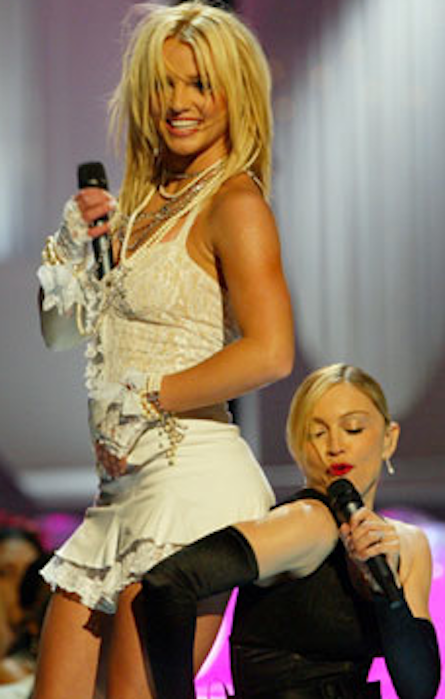
Did Madonna call Britney fat? [The Vine]

Clementine Ford’s take on the Australia Day protest hullabaloo. [ABC Unleashed]

And here, what really went down outside the Lobby restaurant. [RedStache]

All the single ladies: are you sick of continuously being asked why you’re single? Bailey Elliot is, too:

“Why is it socially acceptable to comment on someone’s single status, but definitely not OK to comment on someone’s relationship? There have been many times when someone has said something offensive to me, and I will look at their relationship and wish that I could fire something judgmental back. Some of the people who have said the worst things to me are the ones in the most dysfunctional relationships: married to a raging alcoholic who abuses pets while drunk, a patronising and controlling man, or a man who refuses to communicate in any real way. Are we so enamoured with the idea of marriage that we believe that any marriage, no matter how dysfunctional, is better than singledom?” [Jezebel]

Why is it that everywhere you turn (family restaurants, the gym, the bowling alley), there’s a Pussycat Doll spreading her legs, asks Mia Freedman. [MamaMia]

For the U.S.’s Black History Month, let’s remember that Rosa Parks did much more than just refuse to give up her seat on the bus. [Ms. Magazine]

What the?! The banning of naked A-cup adult breasts lest they promote pedophilia?! Granted, this story is two years old, but interesting nonetheless. [Crikey]

How to be a celebrity in this era of “16th minute”, “I am me”, reality fame. [New York Magazine]

The apparent conservative agenda of the Susan G. Komen foundation which has come to light in their refusal to funnel through donations to Planned Parenthood. [Jezebel]

It’s all happening in the world of MamaMia: no more SkyNews show, but an e-publishing sector instead! And deputy editor Bec Sparrow had a baby! [MamaMia]

Erica Bartle’s thoughts on the whole Melinda Tankard Reist debacle. I’m still ruminating over her post, and I might be back with a response of my own. [Girl with a Satchel]

Image via Pop Sugar.

Politicising Beyonce.


Sometimes I wish I was still at school. I had less responsibility, but a lot more was at stake. I had no life, what with classes, studying and work, but I got to learn new things. I’ve been running this blog for nearly two years now, and I’m always reading and clamouring for new things to blog about and voice my opinion on. Blogging is more fun than essay writing, so maybe I don’t wish I was still studying.

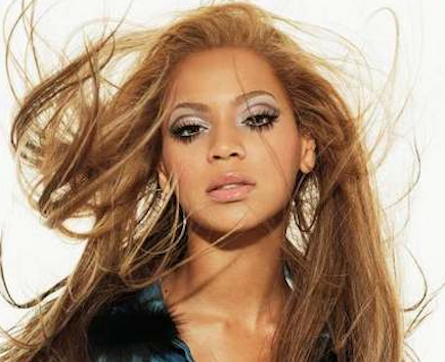
And then I read something like this: a PhD student at Rutgers university in the U.S. has devised a course called “Politicising Beyonce”.

From HuffPo:

“[Department of Women’s & Gendr Studies doctoral student and lecturer, Kevin] Allred was inspired to lecture the course following his four semesters as a Women’s Studies 101 instructor where he often found his class debating whether or not the [p]op star is a role model for today’s youth. According to the site, course topics include the extent of Beyonce’s control over her own aesthetic, whether her often half-naked body is empowered or stereotypical, and her more racy performances as her alter ego, ‘Sasha Fierce’.”

I would love to write essays on end on Beyonce’s political significance, but there’s enough on the interwebs to keep my thoughts provoked. So, because most of us won’t be able to be enrolled in “Politicising Beyonce”, here are some links to keep us entertained:

Related: Why is Feminism Still a Dirty Word?

Elsewhere: [Jezebel] Beyonce’s Pregnancy & the Debate Over Black Women “Doing it the Right Way”.

[Clutch] Beyonce, Baby Bumps & Ding it the Right Way.

[Madame Noir] How Beyonce’s Pregnancy is Being Used to Look Down Upon Single Mothers.

[Feministing] Behind Every Strong Man, There is an Even Stronger Beyonce.

[The Millions] All the Single Ladies: The Problem with Feminist Anthems.

[Jezebel] Is the Meaning Behind Beyonce’s Music Misunderstood?

[Tiger Beatdown] Why Don’t You Love Beyonce? An Inquiry.

[Jezebel] Retro Styles & Gender Play: Beyonce’s “Why Don’t You Love Me?”

[Racialicious] What Sarah Palin Taught Me About Beyonce.

[My Best Friend Gayle] Upgrade U: What We Can Learn from Beyonce.

[Jezebel] Let’s Invent a Catchy New Word for Feminism.

[Girls Are Made From Pepsi] The Post in Which I Talk About Beyonce, Feminism & Equality for All.

[HuffPo] Beyonce’s Rutgers Class: Singer’s Career the Focus of “Politicising Beyonce”.

Image via Shallow Nation.

Sexism in Fantasy.

From “Young Females as Superheroes: Superheroines in the World of Sailor Moon” from FemSpec journal:

“Further illustrating the negotiation of femininity and empowerment, girl power characters are often represented in a fantasy setting. This is a particularly significant factor when interpreting these characters in terms of their fighting abilities. The heroes generally face fantastic villains that are often unmistakably evil and are represented as protectors of innocence and humanity. This reinforces the idea that girl power heroes should have a nurturing, protective nature: both one of the conflicting femininities described by Douglas and an aspect of femininity reclaimed within third wave feminism.

“… Fantasy helps to alleviate the threat of castration because these characters are not meant to represent reality. Thus, the threat itself is marked ‘not real’.”

I think this was what Sady Doyle was trying to get at in her scathing critique of George R.R. Martin’s A Song of Ice & Fire series which, while valid, didn’t win her many fans in the fantasy community.

In a nutshell, I think she was trying to say that women experience sexism, rape, sexual harassment and value based only on their looks in everyday real life; we don’t need to be represented that way in fantasy too, where the author has the opportunity to create an alternate reality for women.

In FemSpec (an article which I originally accessed online but has since been taken down), the author studies Sailor Moon and how the heroines in that were created as a response to third wave feminism, but as a large portion of the show and manga’s audience is male, they’re typically feminised in order to eliminate threat to the status quo.

I’m not a fantasy fan, but I think we can all agree on less sexism in fantasy (nay, all fiction. Or, here’s a radical idea, in real life!) and more accurate portrayals of what it’s like to be a woman that doesn’t centre around sexuality.

Elsewhere: [Tiger Beatdown] Enter Ye Myne Mystic World of Gayng-Raype: What the “R” Stands for in “George R.R. Martin”.

[Tiger Beatdown] Chronicles of Mansplaining: Professor Feminism & the Deleted Comments of Doom.

Movies: Megan Fox Starting to Gain Some Traction in Hollywood.


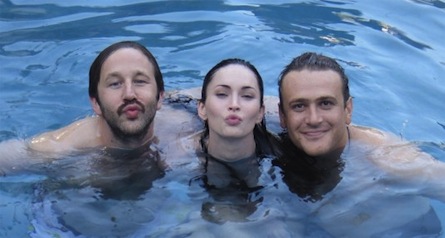
I was glad to hear that whilst filming the upcoming Judd Apatow sequel to Knocked Up, This is Forty, Chris O’Dowd (Kristen Wiig’s cop love interest in Bridesmaids) had this to say about Megan Fox:

“She was a sweetheart on set. I don’t get the whole Michael Bay thing. I hate his fucking films. They are bad. I don’t think she got enough respect.”

No do I, Chris, nor do I.

Related: Megan Fox May Be Trying to Step Away from Marilyn Monroe, But They Might Be More Similar Than She Knows.

Is Robert Pattinson the Male Version of Megan Fox?

Megan Fox Transforms from “Android Ice Queen” to Relatable Person.

Megan Fox Too “Spicy” for Transformers?

“She Just Wants Attention.”

The Beautiful, Bigmouthed Backlash Against Katherine Heigl & Megan Fox.

Image via FilmOFilia.

TV: Who’s That Girl? It’s the New Girl.


I’m not the biggest Zooey Deschanel fan. I’ve only really seen her in Failure to Launch (she was the saving grace in that unintentional horror movie) and some of Tin Man, which I wanted to like but couldn’t bring myself to get through.

But, after reading a few different takes on Deschanel’s television leading lady debut in New Girl (especially this New York magazine cover profile), I decided to give the show a shot.

I was expecting manic pixie dream girlishness galore, which there is a lot of, but I think the three guys, a girl and a pizza place apartment format makes it a bit more palatable for the mainstream sitcom crowd.

In a bid to better understand the Deschanel obsession, I borrowed (500) Days of Summer off a friend and watched it yesterday afternoon. I have to say, I quite enjoyed it; whether that was down to Deschanel’s acting or simply the storyline and filmmaking, I can’t say.

While I feel like Dechanel’s character, the titular Summer, was portrayed as the “saviour” to Joseph Gordon Levitt’s Tom, New Girl Jess is the one that needs to be saved from her social awkwardness, bad relationship and fashion faux pas. In real life I don’t see why people would need saving from these situations, but that’s the way the plot crumbles.

So, three episodes in, I’m still not really sure what I think about New Girl, or Deschanel herself. I’ll probably stick the season out (at only 12 half-hour episodes, it’s a small commitment to make) as I have a hard time not finishing things, no matter how tedious or non-enjoyable they are.

If Jess is able to break out of the mold of quirky girly girl who shows emotion and sings publicly at inopportune times, and Deschanel is able to prove her worth as a top notch TV actress who appeals to the mainstream instead of being seen as the manic pixie dream girl du jour, the New Girl might just be one I can come to know and love.

What do you think of New Girl so far?

Related: Manic Pixie Dream Girl Bitch.

Elsewhere: [New York Magazine] The Pinup of Williamsburg.

[HuffPo] Women in Hollywood: Is “Girliness” the Real Problem?

[Jezebel] New Girl is Likeable, Though Strangely Familiar.

[Musings of an Inappropriate Woman] Elizabethtown, Garden State & the Alternative Flat Fantasy Female.

Image via New Girl Things.

On the (Rest of the) Net.


Why the Marilyn meme does more harm than good for body love:

“I would prefer the focus be on health, rather than appearance. The Monroe Meme seems about the furthest thing from healthy. This is a woman who abused alcohol and sleeping pills later in her life, this is a woman who (probably) died due to depression. But, hey, as long as someone thinks she looks good, I guess that’s what matters.” [Shameless Magazine]

I’m a Friday Feminaust!

The media-perpetuated myth of the bad man. Interestingly, substitute the words “bad” and “aggressive” for “weak” and “victim”, and you pretty much have the media-perpetuated myth of the good woman. No one can win in this game. [The Good Men Project]

Why guys cat-call, explained. [Jezebel]

The making of Britney Spears: The Cabaret. [Bryant & Frank’s Blog]

Apparently conservatives are dumber than progressives. For the amount of Facebook arguments I’ve had on the topics of abortion and asylum seekers, this doesn’t surprise me. [HuffPo]

Not all registered sex offenders are dangerous: “Should Teens Be Jailed for Sex Offences?” [The Daily Beast]

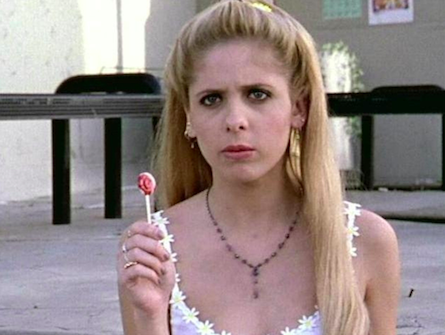
The Rodarte sisters look at their favourite Buffy episodes. I feel a marathon coming on… [Rookie]

Does Katherine Heigl have any fans left? After Killers, I’d say I’m hanging by a thread! [The Daily Beast]

Real Housewife Taylor Armstrong’s “violent marriage”. Sad. [Jezebel]

“In Defence of Rescue Dogs.” The don’t need defending in my mind, but apparently they’re seen as dirty rejects by a lot of people. [MamaMia]

2 Broke Girls hasn’t even aired here yet, but prepare yourself for racism galore! [Grantland]

The must-watch new show of the year: Revenge. [Jezebel, Gawker]

The angry, black female trope. [Washington Post]

And even more “angry” women:

“‘God, you really don’t like being a woman, do you?’

“In two short moves we’d leapt from his infidelity to my ostensible gender dysmorphia and/or self-loathing…

“What struck me was that both Rex and the attorney had delivered ill-timed, emotionally charged information, and when I’d expressed proportionate anger or irritation, the blame somehow boomeranged back onto me. I’d been expected to remain amiable… [y]et their reaction was still confusion and rancor when I pointed out their inanity.

“How do we alter the notion that a woman who stands up for herself, her loved ones, or her beliefs is the one who’s causing trouble? By accepting once and for all that legitimate female anger isn’t the hallmark of a bitch, cunt, ballbuster, or drama queen.”

[Nerve, via Jezebel]

The beauty of the corset. [Jezebel]

Images via Rookie, Rhinestone Religion, Jezebel.

Movies: Costuming in The Iron Lady*.


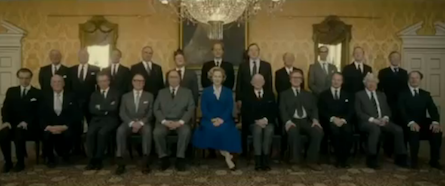
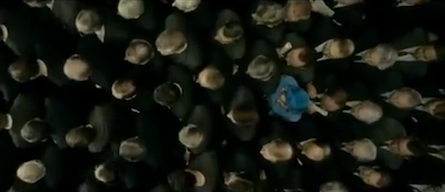
The cavalcade of blue in The Iron Lady was effective, if a bit distracting once you start to notice the sheer abundance of “Tory blue”, as it became to be known during Margaret Thatcher’s reign as prime minister.

Not only was she the only woman in many of the scenes but, as you can see from the images above, she was also the only one dressed in blue in a sea of dull suits.

However, as Margaret begins to rise up the ranks of her party and into the prime ministership, she graduates from pale blue to royal blue, and when she becomes Britain’s most hated leader and is ousted by Michael Heseltine, she’s ravishing in red and black.

The only other times she wasn’t in blue were when she was dealing with the hallucinations of her husband, Dennis. Margaret wears a tweed suit when she turns on all the appliances in the house in an attempt to drown out Dennis’ incessant nattering. When she finally says goodbye to her several-years-dead husband at the end of the film, she’s also in a dirt-coloured hue.

Tellingly, their relationship begins when Margaret tells Dennis he has to be aware that she will not be one of those women whose life begins and ends with washing a cup. As the movie draws to a close and Margaret turns her back on Dennis in said brown outfit, she’s washing up her teacup.

Elsewhere: [Final Fashion] Red Dress Blue Dress.

*Blanket spoiler alert.

Images via YouTube.

Book Review: Big Porn Inc. Edited By Melinda Tankard Reist and Abigail Bray.


As I’ve written here before, I don’t really see a problem with porn. So long as it’s consumed in a healthy way, viewed in perspective and is made in an ethical way (no child pornography, for example, which Big Porn Inc. focuses heavily on), I don’t see a problem with it.

However, the contributors and editors of Big Porn Inc., a tome that’s made a splash since its release, thinks all porn is bad, okay? They don’t take into account things like upbringing, socio-economic background and other factors, such as peer groups, in the affect porn can have on consumers. When those aspects are relatively good, I don’t think porn is a problem.

But it’s not just consensual, enthusiastic porn the book focuses on. Take the chapters on sex with animals, child porn and degradation. “Slavefarm” (p. xx) and “the ‘crack’ of an infant’s pelvis while you are penetrating them” (p. 199) are some of the most extreme and abhorrent examples in the book (I’ll pause while you throw up over that last one, especially), but are by no means the norm. Bestiality, rape and pedophilia are mental illnesses and are about control; they’re not just something you decide to do after stumbling upon the wrong porn link.

Not only does Big Porn Inc. focus on the extreme, it’s also quite sexist. The majority of articles see women as needing to be protected from porn and the men who view it. Militant anti-porn feminist Catharine MacKinnon writes that “women have long known” the evils of pornography (p. 12), while “Caroline” writes pathetically about how discovering her husband used porn was the ultimate betrayal (p. xxix).

I also found Big Porn Inc. to be anti-choice and anti-feminism. Renate Klein, in “Big Porn + Big Pharma: Where the Pornography Industry Meets the Ideology of Medicalisation” (p. 86–104), asserts that female bodies are being “cut, modified, drugged and penetrated—all in the name of ‘choice’ and ‘it is my right’.” The footnote to this sentence admonishes sexual reassignment procedures as a bi-product of the pornography industry.

This is not to mention its anti-vaccination sentiments.

Pseudoscience reigns supreme, also, when Maggie Hamilton writes, “… boys and girls generally do not have a natural [original emphasis] sexual sense until they are between 10 and 12 years old.” I studied psychology in high school, and even at its base level, we know that young children are very aware of their sexuality. I remember playing the “sex game” (whatever we thought that meant!) in my first year of primary school. Observing children in the playground as part of my Year 10 childhood psychology class they, too, were playing the “sex game”! Sure, we don’t want kids that age accessing porn and getting all these fucked up ideas about what naked bodies and (porn) sex looks like, but their natural curiosity will ensure they will try to at some stage. That’s where healthy discussion from parents, teachers and other adults about what sex, in all its carnations, means.

Not all of the contributors are people I disagree with. Sex and anti-violence writer Nina Funnell is someone I admire, and whose inclusion in Big Porn Inc. was what compelled me to read it. She writes about sexting and the intrusion of the camera in our lives (p. 34–40), topics on which she is writing a book. While teen sexting and “peer-to-peer porn” can be dangerous (child pornography charges and having your image on the internet til the end of time before you’ve even come of age are frightening thoughts), I think they are a little out of place in the Big Porn scope of things. In my opinion, they are worlds away from actual consensual porn; the making and consumption of. Again, as long as parents and teachers are there to advise why sexting is something that should be done after careful thought and your 18th birthday, I don’t see it as the problem porn is made out to be.

When I spoke to Rachel Hills about her profile on Melinda Tankard Reist and her thoughts on Big Porn Inc., she contended that the book could have done away with the multitude of contributors in favour of fewer, more in-depth essays. This would perhaps allow Big Porn Inc. to be taken more seriously by pro-porn (or at least anti-anti-porn) people like ourselves. I have to say I agree, as by about two thirds of the way through I was ready to put it down, especially as the last section reads like an advertorial for Anti-Porn Inc., which is something I’m not buying.

Related: In Defence of Porn.

Is Big Porn Inc. Anti-Vaccination As Well As Anti-Porn?

Picture Perfect.

Elsewhere: [Sydney Morning Herald] Who’s Afraid of Melinda Tankard Reist?

Image via Melinda Tankard Reist.