On the (Rest of the Net).

If you’re into music, especially the live Melbourne scene, make sure you check out my friend Linzie Meager’s newly launched blog, What Are You Listening To?

Lena Chen says “fuck feminism”. I have to say I agree with most of her statements, and sometimes I get sick of talking about gender politics. Her argument is that feminism doesn’t represent all females equally, especially women of colour and those who belong to the LGBT community.

If only we could all look this chic and quirky at the airport. Gala Darling pairs combat boots with an electric blue knit by Betsey Johnson “En Route to San Francisco”.

Who’s sick of Lady Gaga? Not me, but apparently Gawker is. I do agree that Gaga needs to lay off the reinvention shtick, however. The article also argues that she needs to churn out some new music ASAP.

Still with Gawker, they assert that “Starlets Need to Stop Dressing Up Like Other Starlets for Photo Shoots”, with an impressive roll call that includes Lindsay Lohan as everyone, everyone as Marilyn Monroe and Jennifer Aniston as Barbra Streisand on the most recent cover of US Harper’s Bazaar.

I think the burqa debate is an interesting one; one I don’t necessarily agree with. I don’t think that Islamic women should be forced to wear them, but it is certainly not the government of the Western world’s place to ban them. MamaMia brings light to the subject, asking if the “Burqa is as ‘Confronting’ as Leggings Worn as Pants”? Certainly not! Nor is it more confronting than (Prime Minister come tomorrow night?) Tony Abbott in budgie smugglers!

Meanjin’s blog Spike features a post “On Writing and Running”… or blogging and jogging, as I like to call it. Guess I’m on the right track, then. (Geddit?!)

“Like, OMG, you guys!” Anyone who knows me knows that I’m a product of my generation (or the generation below me, perhaps?). But Jezebel reasons that those who favour “like”, “you know” and “whatever” picked up such fetching colloquialisms from ’90s teen angst drama, My So-Called Life. If you haven’t heard of it, you should so, like, research it, you know? If not, whatever.

Here with more Daria goodness, The Paris Review asks “Are We Afraid of Daria?”

All the single ladies men, take note: there’s a difference between “nice guys” and “total creeps”. (Double standards?) For example, nice guys will pay you “a normal compliment” like, “You look great today”. Creeps will say “things like, ‘You look imaginary’… Did he mean to say something else? Does he know what ‘imaginary’ means?” Gold!

Continuing on from the Facebook versus women issue, Psychology Today ran a great article entitled “Cutting Off Your Vagina to Spite Your Face(book)”. Aside from the genius title, it deals with the deletion of a sexual education Facebook page about female genital mutilation.

Review: Time Magazine’s “What Animals Think” Issue—August 16, 2010.


I’m a sucker for a puppy, which adorns this week’s Time cover.

And the accompanying article, “Inside the Minds of Animals” by Jeffrey Kluger, doesn’t disappoint.

It opens with the author’s “coffee date” with Kanzi, a talking bonobo with a vocabulary of officially 384 words, “though he probably knows dozens more”. Kanzi is able to asks for hugs and kisses, which he likes, and understand the concept of pointing which, aside from humans, really only dogs “understand innately” and “seems simple, but only because we’re born with the ability”, which bonobos are not. Kanzi also understands tenses in words (“concept words like from and later”), which is a breakthrough in itself, aside from the fact that AN ANIMAL IS SPEAKING!

The article asserts that humans treat animals differently because they can’t “understand” and are possibly not even conscious (potentially the butterfly, cockroach and bivalve [oysters, muscles, clams]); but now that certain species are mastering human language how does our perception of them change?

Most agree that dolphins and great apes are the smart ones, being able to recognise their image in a mirror, which indicates a degree of social awareness, in addition to social carnivores like pack dogs. The proof is in the pudding when it comes to some of the experiments the article mentions, as well as in everyday life in the example of aid dogs. I was particularly touched by the mourning expressed by elephants when one of their herd dies, and the “respect” they exhibit “when they encounter elephant bones, gently examining them, paying special attention to the skull and tusks”.

But don’t just take my word for it; pick up a copy for yourself or see the online extract. Trust me, food for though.

Elsewhere: [Time] Inside the Minds of Animals.

Women in Fiction: My Favourite Fictional Females.

A recent post on Girl with a Satchel (which was reblogged here) inspired me to assess my favourite fictional female characters.

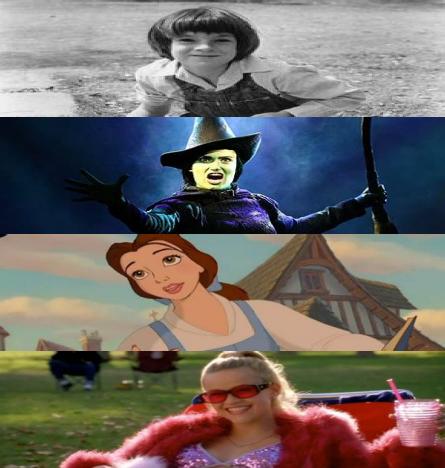
One of my favourite books is To Kill a Mockingbird, and protagonist Scout Finch is one of my favourite characters of the written word. Her innocence and naivety are super-endearing, and her past-tense narrating allows the reader to put themselves in her shoes easily.

Wicked is a niche book and musical that theatre buffs can’t get enough of, but the general public are a bit oblivious to because it hasn’t derived from/been made into a movie, like Melbourne’s current season of musicals, West Side Story, Mary Poppins and Hairspray, all of which are on my theatre-going agenda in the coming months.

I’ve seen the production three times in Melbourne, and many a friend has seen it in its various international incarnations on Broadway and the West End… oh, and Sydney! I was so touched by the story and its messages of friendship, good versus evil and judging a book by its cover, and even more so by Elphaba, better known as The Wicked Witch of the West from The Wizard of Oz. Unlike in the original story, Wicked’s Elphaba is fiercely loyal to her disabled sister Nessarose, and those who become close to her like Glinda, Doctor Dillamond and Fiyero, misunderstood because of the colour of her skin and the slander spread about her when she discovers the Wizard of Oz is a fraud and seeks revenge.

In the vein of fairytale musicals, Beauty & the Beast (which is being re-released in selected theatres in 3D from 2 September) is by far my favourite, and I love its heroine Belle so much, I have been known to fight with my friends and children alike over the fact that I AM BELLE! Hello, I have brown hair, like burly men, read a lot and have a penchant for yellow gowns! While there have been arguments circulating that the Disney princesses are beacons of anti-feminism, I maintain my stance that Belle doesn’t need a man to rescue her (in fact, she does the rescuing, helping the Beast when he is attacked by wolves, attempting to make the townspeople see the error of their ways in going after him, and ultimately, setting his heart free) and sees the Beast for who he truly is, not for what he looks like or what he can do for her. She’s a kick-ass beauty in the vein of Buffy, The Vampire Slayer and Angelina Jolie’s Lara Croft: Tomb Raider.

I’ve blogged (or reblogged) a little bit lately about Elle Woods. She’s an everywoman. Rachel Hills identifies with her, as does Satchel Girl Erica Bartle. A law-studying friend of mine recently compared herself to Miss Woods, also. And I won’t lie; I’ve fantasised about wearing a Playboy bunny suit whilst purchasing an Apple Mac! Elle Woods proves that you can take pride in your appearance and have fun whilst pursuing your dreams and making a name for yourself separate from the name of the man in your life.

There are plenty of other made-up women who I have an affinity for, including the aforementioned Buffy Summers, and Daria Morgendorffer for their kick-ass feminist mentalities; ditto for the Charmed sisters; Gossip Girl’s Blair Waldorf, who can be a psycho bitch at times, but she’s THE psycho bitch; for similar reasons as Elle Woods, Cher Horowitz; and Barbie.

Related: Guest Post—Pop Culture Power Women.

In Defence of To Kill a Mockingbird.

Event: The Way We Wear Vintage Market.

Elsewhere: [Girl with a Satchel] Women of Pop Culture & the Unashamed Use of Cutesy Clichés.

[Musings of an Inappropriate Woman] Have You Ever Seen Yourself Through Someone Else’s Eyes?

On the (Rest of the) Net.

Taking inspiration from Gala Darling: These stunning pictures make me nostalgic for summer days at the fairground… oh, that’s right, I never spent summer days at the fairground. And certainly not in a playsuit with balloons. Via The Cherry Blossom Girl.

Jezebel really has it in for Facebook, doesn’t she? My favourite anti-FB post from the site this week is “When it Comes to Women’s Issues, Facebook Still Hasn’t Figured Out How to Play Fair”.

I absolutely LOVED Through a New Lens‘s post on “How Your Audience is Like the Mogwai”! While I’m certainly not a Gremlins fan, Joey Strawn draws some good points from the film and how they relate to blog audiences. Will be keeping his thoughts in mind.

More Gala goodness; it’s an oldie but a goodie. Gala counts down her “Top 5 Fictional Female Style Icons”. I have to confess, I’ve never seen The L Word or Henry & June, so I’ll have to take her word for it. However, I am totes down with Cher Horowitz, Blair Waldorf and Carrie Bradshaw as 3, 2 and 1, respectively.

Following in the vein of her workaholism posts, Rachel Hills uses Zen Habits’ assertion “that, instead of scheduling our days and weeks and months with small tasks that eventually lead us to whatever place we’re trying to get to, we should just go with wherever our will takes us on any given day.” Like going to bed at 8 o’clock on a Monday night, sleeping through til 8 o’clock the following morning, doing a spot of blogging, and watching 90210 for the rest of the day? Definitely worth a look.

Also at Musings of an Inappropriate Woman, Hills looks at the Kyle & Jackie O rape scandal, as well as the Matthew Johns group sex scandal (which continues to get my goat), and the issue of “grey rape”.

In other GG news, this circa-season one post perfectly encapsulates the addiction to the show its audience faces. Admitting it is the first step, right? More on this post here.

Styleite lists “6 Things Elle Magazine is Doing Right”, three being their heavy online and television presences, and their intelligence section, which I couldn’t agree with more. Half the reason (okay, more than half) I continually buy Elle is because of their great articles and book reviews, and their book blog Lit Life is on my blogroll.. “Think Vogue meets Vanity Fair“.

Still with magazines on reality TV, The New York Times profiled Teen Vogue, which you may remember from (other than the newsstand/agency) The Hills.

Postcards to Alphaville “is a project dedicated to film characters featured in guest-made illustrations”. Below, my favourites.

Finally, try an enlightening personality test this weekend, with the Myers-Briggs test. I got an INFJ result, which means I’m Introverted and expend energy in social situations; iNtuitive and focus on the bigger picture and the possibilities; prefer Feeling to thinking and give more weight to emotions than logic; and I’m Judgemental and like to have my plans made well in advance. Oh, how accurate!

Newspaper Clipping(s) of the Week.

This week’s choice newspaper clippings come from The Age‘s Sunday Life supplement (Eye of the Beholder, August 8, 2010) and Good Weekend (Calendar Girl, August 7, 2010), respectively.

Calendar Girl, written by Virginia Heffernan, deals with hard-copy diaries like Filofax and the like versus the iPhone and Blackberry’s digitised versions. This is something I struggle to consolidate in my life, as I am an über-fan of stationary, but I just don’t have room in my life for physical lists, schedules etc., when the digital option is right there.

Sometimes I get a bit sick of talking about body image (what with the multitude of blogs, magazines and articles I read each week, as well as the issue being a common theme in my blog posts), but William Leith’s article, Eye of the Beholder, looks at it from a different angle. Why do women look “at a model and fall apart”, while men “shrug off [their] own belly”? Thought provoking stuff.

(Sorry about the crappy formatting—my scanner prefers A4 sized documents.)

Seven Links in Heaven.

Darren Rowse of ProBlogger has challenged his fellow bloggers to post seven links to seven blog posts in response to seven categories.

Rachel Hills did it (albeit with eleven), and now it’s my turn!

Your first post: Aside from the “Welcome” page, it was a review of Dog Boy by Eva Hornung, a book that I thoroughly enjoyed reading.

A post you enjoyed writing the most: The ones about issues that get me fired up. “Why Are Famous Men Forgiven For Their Wrongdoings, While Women Are Vilified for Much Less?”, “Is there Really a Beauty Myth?”, “Katy P VS. Lady G”, “In Defence of To Kill a Mockingbird, “Sisters Are Doing it For Themselves… But Not The Gays” about Julia Gillard’s appointment to PM, but her refusal to legalise gay marriage, and anything to do with The Hills (The Hills FinaleAll Good Things Must Come to an End” and The Hills Have (Dead) Eyes”). Of course, I love “On the (Rest of the) Net” and “Magazine Cover of the Week”, as those posts showcase my favourite things of the week.

A post which had great discussion: As a fledgling blog, none of my posts have great discussion! But a couple that spring to mind are “Beautiful Women Cause Earthquakes AND Heart Attacks, Apparently” in which the comments were longer than the actual post, and “Everything They Touch Turns to Gold” about mag editors Mia Freedman, Sarah Oakes et al. In addition, “Beauty & the Book” was meant as some fluffy man-candy, but drew criticism from the masculist crowd.

A post on someone else’s blog you wish you’d written: Anything on Jezebel, Musings of an Inappropriate Woman, Mama Mia and Girl with a Satchel. They are my muses.

Your most helpful post: This is a hard one, as none of my posts deal particularly with things that people need help with. Perhaps, “How NOT To Promote Your Book” and “Life by Numbers”?

A post with a title you are proud of: “Bad Boys, Watchya Gonna Do? Host a Seven Family Show”.

A post that you wish more people had read: “Katy P VS. Lady G” was one I had a lot of fun writing (see above), but I can take solace in the fact that Sarah Ayoub of Wordsmith Lane commented on this one! As well as “The Beautiful Bigmouthed Backlash Against Katherine Heigl & Megan Fox”, which I thought would fire people up a bit, but not a bite! And while “The Changing Face of Beauty” garnered my highest number of hits, not one comment! Would like to know what people thought of that one.

On the (Rest of the) Net.

Frock & Roll has some poignant points on how to “network, promote and get your blog out there” aka “hustle”. I’ve only read part one of the series, but you can find part two here, with part three on its way.

Who do you write like? Apparently, from the sample I typed in to the analyzer, I write like David Foster Wallace, author of one of Time magazine’s All-Time Greatest Novels, Infinite Jest! Not too shabby!

It’s no secret Prince is one of my favourite musicians, but according to Fajr Muhammad of Stylish Thought, he’s also a style icon, assless pants and all!

Edward Cullen sparkles, but feminism certainly doesn’t. Amplify Your Voice discusses “What Twilight Teaches Young Girls”.

Author Marketing Experts suggest “Seven Powerful Ways to Find New Readers For Your Blog” (there’re actually eight!).

An oldie but a goody: Inappropriate Woman Rachel Hills muses on Gossip Girl, Serena & Effortless Perfection”.

In the vein of last week’s “In Defence of Taylor Momsen” comes the case for Lindsay Lohan as she is released from jail and shipped off to rehab for the umpteenth time.

On Tuesday night, “I Went to See Killers, and It’s All Your Fault”, Jezebel!

Girl with a Satchel has two (here and here) fab pictorials up of this year’s September issues. Here’s just a little taste…

The Changing Face of Beauty.

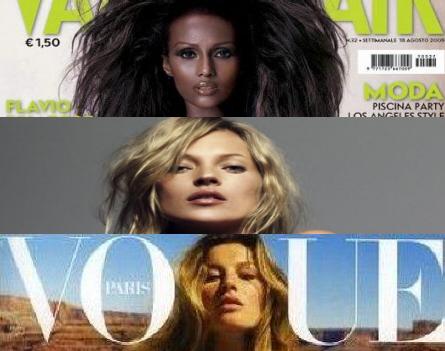
I’ve been meaning to visit Modelinia for a while now, and their History of Models timeline got me thinking about beauty norms across the ages since models became mainstream. Modelinia’s timeline begins in 1928 and follows the top faces (and bodieshello, Elle “The Body” McPherson), such as Twiggy, Iman and Lauren Hutton, through to today’s most famous faces.

Modelinia’s timeline begins with society girls like Dorian Leigh, who was perhaps the “world’s first supermodel” and appeared on the cover of Vogue seven times in 1944 and earned $300,000, “an amount that was unheard of during that time”. Leigh’s partnership with famed photographer Richard Avedon paved the way for future “model as muse” photographer-model dynamics. Leigh was also one of the models who inspired the classic, Breakfast at Tiffany’s.

The late 1940s and ’50s ushered in the age of “Hollywood glamour”, when Leigh appeared on Broadway in The Fifth Season, and “Million Dollar Baby” Lisa Fonssagrives married photographer Irving Penn. These women also proved there was life after modelling, with Fonssagrives “designing a line of leisurewear for Lord & Taylor”, and Leigh opening her own modelling school in Paris, much like Tyra Banks and Heidi Klum today.

The period beginning in 1960 was known as the “awakening” and spawned the births of McPherson, Linda Evangelista, Paulina Porizkova, Cindy Crawford, Stephanie Seymour, Christie Turlington, and Naomi Campbell, the women who would later become known as the über-models of the ’90s.

The ’60s were the years of Twiggy, whose picture was discovered hanging in a hairdresser’s window, and in 1965 she appeared on the cover of Vogue in three separate countries, landing the American edition thrice. She was also the subject of three separate documentaries that year, following on from her radio debut, with the single “Beautiful Dream” in 1964.

Around this time, Hutton refused to close the gap in her teeth, paving the way for the gap-toothed everywhere, like Madonna and Aussie model Jessica Hart.

It was a period of firsts for Hutton, which carried over into the ’70s, who was the first model to front a fragrance campaign, the first to sign an “exclusive cosmetics contract” and the first to reach $1 million in earnings.

The days of disco saw the birth days of the second wave of ü ber-models, like Klum, Shalom Harlow, Banks, Kate Moss, and Laetitia Casta, and the juxtapositioning of the all-American girl next door, Christie Brinkley, with the exotic beauty of Iman. In 1974, Brinkley signed a cosmetics contract with Covergirl, which resulted in a 20-year partnership. Iman served as muse for Yves Saint Laurent, who released his African Queen collection in 1978. While Brinkley appeared on the cover of Sports Illustrated Swimsuit Edition three years in a row (19771979), Iman proved she has commercial appeal, fronting “the June cover of Italian Cosmopolitan” in 1978.

The era of the “poster girl” (commencing with Brinkley’s aforementioned Sports Illustrated cover in 1987 and culminating in the permeation of models in the mainstream) sees models on the covers of all major magazines, from Life to Cosmo to Vogue to Playboy.

And if the saturation of popular culture in the ’80s seemed extreme, the ’90s sought to solidify this with “the rise of the supermodel”, coinciding with “the waif” ideal popularised by Moss’s “heroin chic” look (or as we would find out in 2005, cocaine chic), which was perhaps named for Calvin Klein’s Heroin Kids campaign, which Moss fronted in 1994 .

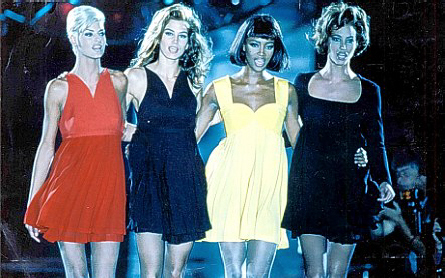
George Michael’s classic Freedom ’90 featured a bevy of supermodels, including Crawford, Turlington, Campbell, Evangelista, and Tatjana Patitz, in 1988. To accompany this, said models appeared on the cover of British Vogue, followed by the iconic group runway walk for Versace in 1989.
The rapid rise of Seymour began in 1989, when she appeared nude in Playboy, began dating Axl Rose of Guns N’ Roses and appeared in their “Don’t Cry” video clip, followed by “November Rain”. She became the first major model to sign with lingerie empire Victoria’s Secret in 1990, followed by her runway debut for Valentino.

It is interesting to note that the über-models of this time worked primarily in beauty campaigns and magazines before debuting on the runway, whereas now it’s the other way around. There are a lot of nameless and faceless models who walk on the runways and act solely as “clothes hangers” for the garments. It is rare that a model will move beyond that tag and permeate the zeitgeist, but those who have include Gisele Bündchen, Agyness Deyn, Daria Werbowy and Miranda Kerr.

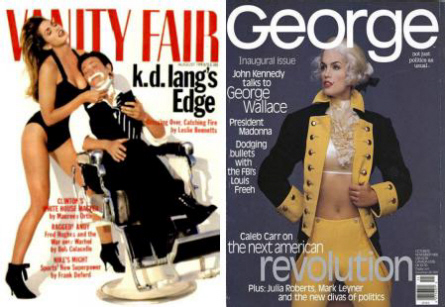
Crawford’s star also rose even higher during this period, with her marriage to Richard Gere and her constant presence on magazines cover of all kinds, including a sexy 1991 cover of Vanity Fair, in which a bathing suit-clad Crawford shaves k.d. lang in a barbers chair.

But Crawford had some competition rapidly rising alongside her: Moss. In 1991, Moss fronted the Calvin Klein Obsession for Men campaign, as well as the Calvin Klein jeans ad together with Mark Wahlberg.

1992 was also a year for sexy magazine covers, with Seymour gracing Playboy for a second time, and McPherson making her debut for the magazine.

In other mag news, Crawford was asked to posed for the cover of the groundbreaking first edition of John F. Kennedy Jr.’s publication, George, aswho else?George Washington.

19941995 was surely Harlow’s time, as she added to her resume of film roles in In & Out, as well as gracing the cover of February W, March’s Paris Vogue, and June Harper’s Bazaar US in 1994, and March W, and December Vogue with fellow model-turned-actress, Amber Valetta.

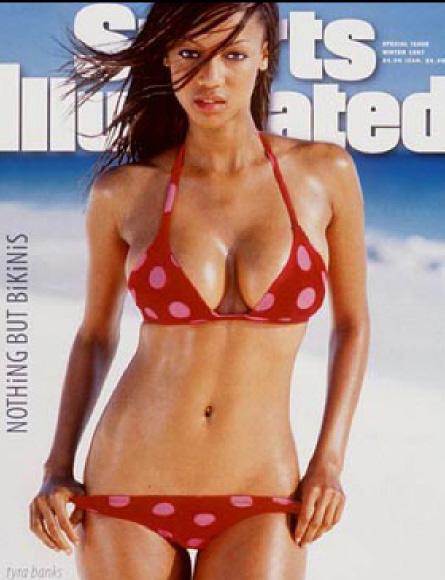
That year Banks appeared on the cover of Sports Illustrated Swimsuit Edition, the first black model to do so solo.
With Bündchen’s appointment to Vogue cover girl in July 1997 the “heroin chic” era allegedly ended, and the championing of healthy bodies like Bündchen’s began. Maybe in the modelling world, but the “heroin chic” movement has wrecked havoc on the notions of beauty, body image and popular culture.

On a side note, recently Playboy.com profiled the changing of women’s breasts over the years, and Jezebel was quick to counter that its not our breasts that have changed, but the media’sie. Playboybelief of what they should look like (NSFW). It is not dissimilar in the case of beauty magazines aimed at women.

By the turn of the millennium, the age of the supermodel subsided, which was noticeable on magazine covers across the world, which began to, and still do, feature actresses and singers on their covers.

With the retirement of the most beautiful faces and bodies in the business, models almost ceased to be relevant, and women who made achievements for something other than their looks were championed. Obviously, there is still a large gap between women on magazines and television and in advertising campaigns and movies in correspondence to how they look rather than what they do, but looking back on the dominance of beauty in the ’80s and ’90s, we are slowly starting to celebrate diversity.

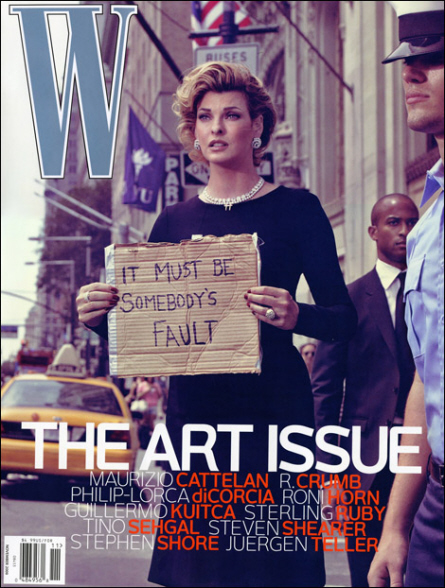
In addition, there’s the whirlwind surrounding plus-sized model Crystal Renn (is she plus-sized, isn’t she plus-sized?), and the model as somewhat of a prop for photographers, magazine editors and designers making a statement, as seen on Evangelista’s November 2009 cover for W magazine’s “The Art Issue”, or Claudia Schiffer (who, interestingly, was not featured in Modelinia’s timeline) and Karl Lagerfeld’s collaboration.
While it’s always nice to look a somethingone beautiful, it’s also nice to realise that there should be more to a model than what she looks like, and in a lot of cases, there is.

You only need to look at the aforementioned Banks and Klum’s careers in television (America’s Next Top Model and The Tyra Banks Show, and Project Runway and Germany’s Next Top Model, respectively), Erin Wasson’s foray into designing, and Kerr’s championing of a healthier life to see this in practice.

But I guess the question is, is this timeline representative of the success of certain types of models in response to our changing attitudes, or are our changing attitudes representative of the success of certain types of models?
On the (Rest of the) Net.

It’s shocking to know there are other blogs out there on the net besides this one! So I urge you to check out my favourite posts this week (and in the case of some, this year!). I hope you likey:

While I can’t exactly understand this site (it’s written in Dutch!), it’s oh-so-pretty to look at. And I love blogger Nenz’s links to other quirky sites. Below, she lists blogging as one of her fave pastimes (duh!) and THX THX THX blog for its sweet notes. More on this one coming soon!

“In Defence of Taylor Momsen”, over at Jezebel, tells us why we should just leave the 17-year-old the bloody well alone!

Jersey Shore’s Nicole “Snooki” Polizzi is subjected to a scathing profile by The New York Times.

I’ve been humming and hawing over whether to write a blog response to this article, but instead, check out Mark Sarvas’ blog, The Elegant Variation, and this article, “Advice for the Lovelorn… I Mean Writers”.

In other Momsen news, Jezebel reports on “the biggest feud of our time week” with Miley Cyrus.

One of my favourite bloggers, Rachel Hills, struggles to marry who she feels she is with who people perceive her to be. I feel ya, sister!

There’s been a bit of unrest in the Facebook ranks of late, and this Jezebel post“Why People Really Hate Facebook: It’s Complicated”asserts why it generates so much hate.

Sex & the City permeated the zeitgeist and defined a television-watching generation. Can Mad Men do the same?

US Vogue worked very hard in 2009 trying to boost its image, what with The September Issue and Fashion’s Night Out. Maybe “Vogue just might be culturally relevant” again?

Sarah Ayoub interviews impending Cleo editor, Gemma Crisp, about where she intends to steer the mag. Exciting!

And everybody’s been raving about Fashematics, which has been around for over a year, but is somehow only just coming to my attention now.

Book Review: American Psycho by Bret Easton Ellis.


When I heard Bret Easton Ellis was coming to Melbourne for the Writers Festival, I was intrigued to hear him speak in person, to say the least.

My first, and only, exposure to Easton Ellis prior to reading American Psycho was his 1998 release, Glamorama. I had high expectations for that book, and I was sorely disappointed. I found it too fast paced and celebrity-obsessed which, granted, was the point of the story. However, the graphic depictions of violence (a plane crash with flying pieces of sheet metal decapitating whole rows of passengers, anyone? Or how about a massive miscarriage followed by internal haemorrhaging and subsequent death of the main character’s, Victor Ward, girlfriend?) and sex were far too much.

So needless to say, I was very apprehensive about entering into a literary relationship with American Psycho, but I wanted to at least have read Easton Ellis’ most famous work before seeing him live. (Alas, this is not meant to be, as tickets to his talk sold out within minutes of going on sale! As he, and Buffy creator Joss Whedon, whose talk also sold out, are the only writers I’m interested in seeing at this years surprisingly uninspiring Melbourne Writers Festival, I guess I’ll be giving it a miss this year.)

This time around, however, I was pleasantly surprised.

Again, American Psycho is hard to get into initially, as it jumps straight into a boys night out with protagonist Patrick Bateman and his equally materialistic and über-boring posse of yuppie acquaintances (Bateman is too narcissistic to have actual “friends”). But after persevering up to the first kill, I liked what I read.

Even squirming along Struggle Street during the gory descriptions of the murderson public transport, no less!was still a fairly enjoyable literary journey. To give you a taste of just how well Easton Ellis does horrific homicide in print, here’s a description of Bateman’s first kill:

“… I reach out and touch his [the bum’s] face gently once more with compassion and whisper, “Do you know what a fucking loser you are?” He starts nodding helplessly and I pull out a long, thin knife with a serrated edge and , being very careful not to kill him, push maybe half an inch of the blade into his right eye, flicking the handle up, instantly popping the retina.

“The bum is too surprised to say anything. He only opens his mouth in shock and moves a grubby, mittened hand slowly up to his face. I yank his pants down and in the passing headlights of a taxi can make out his flabby black thighs, rashed because of his constantly urinating in the pantsuit. The stench of shit rises quickly into my face and breathing through my mouth, down on my haunches, I start stabbing him in the stomach, lightly, above the dense matted patch of pubic hair. This sobers him up somewhat and instinctively he tries to cover himself with his hands and the dog starts yipping, really furiously, but it doesn’t attack, and I keep stabbing at the bum now between his fingers, stabbing the backs of his hands. His eye, burst open, hangs out of its socket and runs down his face and he keeps blinking which causes what’s left of it inside the wound to pour out like red, veiny egg yolk. I grab his head with one hand and push it back and then with my thumb and forefinger hold the other eye open and bring the knife up and push the tip of it into the socket, first breaking its protective film so the socket fills with blood, then slitting the eyeball open sideways, and he finally starts screaming once I slit his nose in two, lightly spraying me and the dog with blood, Gizmo blinking to get the blood out of his eyes. I quickly wipe the blade clean across the bum’s face, breaking open the muscle above his cheek. Still kneeling, I throw a quarter in his face, which is slick and shiny with blood, both sockets hollowed out and filled with gore, what’s left of his eye literally oozing over his screaming lips in thick, webby strands. Calmly, I whisper, “There’s a quarter. Go buy some gum, you crazy fucking nigger.” Then I turn to the barking dog and when I get up, stomp on its front legs while it’s crouched down ready to jump at me, its fangs bared, immediately shattering the bones in both its legs, and it falls on its side squealing in pain, front paws sticking up in the air at an obscene, satisfying angle. I can’t help but start laughing and I linger at the scene, amused by this tableau. When I spot an approaching taxi, I slowly walk away.”

Now if that didn’t make you wince and writhe vicariously, there’s also the attacks of several other dogs, the tortures of countless prostitutes, the dissolving of several friends’ bodies in lime, cannibalism, the murder of a child, the capture of a sewer rat to use in later tortures, and in a comical scene that illustrates just how sad and detached Bateman has become in his life of depravity, he feeds his girlfriend (just one of many he has on the go at any given time) a frozen urinal cake coated in chocolate and served in a decadent Godiva chocolate box.

If the reader needs more proof of Bateman’s derangement and obsessive compulsive consumerism, they need only to look at the chapters interspersed throughout the narrative on business cards, sound systems and musical artists of the time (1991), like Genesis, Whitney Houston and Huey Lewis & the News.

Here is another example:

“Another choir, on Lexington, sings ‘Hark the Herald Angels’ and I tap-dance, moaning, in front of them before I move like a zombie to Bloomingdale’s, where I rush over to the first tie rack I see and murmur to the young faggot working behind the counter, “Too, too fabulous,” while fondling a silk ascot. He flirts and asks if I’m a model. “I’ll see you in hell,” I tell him, and move on.

“… vases and felt fedoras with feather headbands and alligator toiletry cases with gilt-silver bottles and brushes and shoehorns that cost two hundred dollars and candlesticks and pillow covers and gloves and slippers and powder puffs and hand-knitted cotton snowflake sweaters and leather skates and Porsche-design ski goggles and antique apothecary bottles and diamond earrings and silk ties and boots and perfume bottles and diamond earrings and boots and vodka glasses and card cases and cameras and mahogany servers and scarves and aftershaves and photo albums and salt and pepper shakers and ceramic-toaster cookie jars and two-hundred-dollar shoehorns and backpacks and aluminium lunch pails and pillow covers…

“Some kind of existential chasm opens up before me while I’m browsing in Bloomingdale’s and causes me to first locate a phone and check my messages, then, near tears, after taking three Halcion (since my body has mutated and adapted to the drug it no longer causes sleepit just seems to ward off total madness), I head toward the Clinique counter where with my platinum American Express card I buy six tubes of shaving cream…”

This kind of stream-of-consciousness and disjointed conflict between the Patrick Bateman that is presented to the outside worldthe one that manages to convince a cop investigating the murder of one of Bateman’s lime victims that he has nothing to do with the disappearanceand the inner workings of his own mind, and even again with the superhuman he becomes when killing, continues and only becomes more frequent as the tale continues.

While there is no finite conclusion to the storyone might guess that Bateman was caught during the murder of a taxi driver, when the tone switches from first person to third person, however it is later revealed that he escaped, but is recognised by another cab driverthat only makes it all the more disturbing.

Easton Ellis is a very cleverthough slightly disturbed; you would have to be to write as graphically and as convincingly as he doesauthor, and I would have loved to hear him speak about his most prolific work.

However, while I rate this one highly, I probably won’t return to, nor enjoy, his other novels.