Magazines: Conservative Feminist Melinda Tankard Reist for Sunday Life.


Sunday Life is back with a bang for 2012, featuring Rachel Hills’ fantastic article on “anti-raunch, anti-porn, pro-life” activist, Melinda Tankard Reist.

I’ve been reading Tankard Reist’s work for about a year or two now, and I have to say, like Hills and many other feminists, I don’t always agree with her views. Hell, I barely ever agree with her views. I’ve got her latest book, Big Porn Inc., which you can read a bit about in the article, on my bedside table ready to go. I have some trepidation about the book, as I don’t see a huge problem with porn, but MTR does. She also views our culture as an increasingly raunch-filled and pornified one, which I also disagree with.

The article details MTR’s “brand of feminism” and also quotes some of her supporters and detractors, which I think rounds out the article very nicely. There’s also a side box about some other notable conservative “feminists”, Sarah Palin and Michele Bachmann. If ever there were two women who used feminism to further their (clearly non-feminist) political agenda, it’s them. Writes Hills:

LA Times columnist Meghan Daum [writes], ‘If [Palin] has the guts to call herself a feminist, then she’s entitled to be accepted as one.’

“‘I was at a debate recently where a lot people were saying we needed to reinvent feminism because it has become loaded with too much negativity,’ says Eva Cox. ‘But if it’s negative, it is interesting that the right is picking it up.’

“Still, Cox warns: ‘Those who don’t want feminism to be co-opted by the Palins and the Tankard Reists need to do some thinking about what direction they want to take it in instead.’”

I can be a bit of a snobby feminist when I want to be, and don’t think that everyone can call themselves a feminist. But, in a Facebook exchange on the topic, the idea that anyone can call themselves a feminist and has the right to that label was prevalent. I’ve been known to opine that my personal feminism isn’t as radical as second-wave feminism is perceived to be. Just as MTR’s feminism is just as radical, if not more.

Hills rounds out the article by asserting that, “whether you agree with her or not… Tankard Reist is now one of Australia’s best-known feminist voices… It is her language—and that of her supporters—that increasingly frames our debates on sex, gender and popular culture.”

Maybe I’m not hanging out in the right places, but I disagree. Those who shape the debates on sex, gender and pop culture that I read and listen to are the ladies at Feminaust, Jezebel and Feministe, and Hills herself. It just goes to show that everyone does subscribe to their own personal feminism. Mine just isn’t akin to MTR’s.

Related: In Defence of Porn.

Elsewhere: [Rachel Hills] Who’s Afraid of Melinda Tankard Reist?

[Musings of an Inappropriate Woman] Melinda Tankard Reist & Me: Meditations on My Sunday Life Cover Story.

Image via Musings of an Inappropriate Woman.

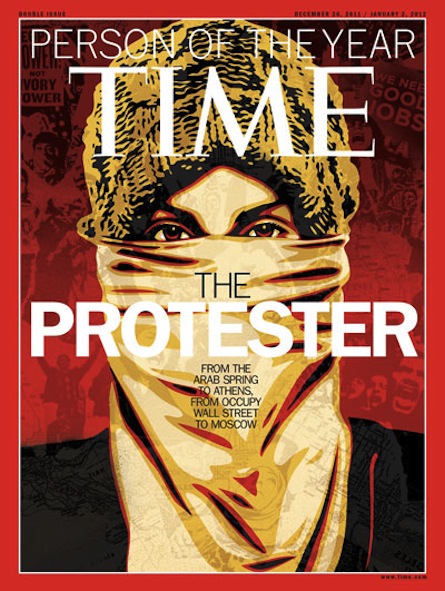
Magazines: The Protester May Be Time’s Person of the Year, But SlutWalkers Aren’t.


It’s been a couple of weeks since Time’s Person of the Year issue came out and it, along with the majority of 2011, was all about The Protester.

The Arab Spring, Occupy and SlutWalk took centre stage in news stories across the world throughout 2011, however Time chose to focus on just the former two, with only one small mention of SlutWalk’s Toronto origins on page 52, “The Protest Network”.

While SlutWalk may not have inspired as much change as The Arab Spring did (it remains to be seen how influential Occupy can be, but it seems like it’s been making headlines for sexual assault and police brutality rather than any real change on Wall Street and amongst the world’s 1%), it was still certainly headline making and, personally, greatly affecting.

Occupy has no real vision nor authority in charge to determine what is to eventuate from the protest, while each SlutWalk was pretty well organised and had a clear expected outcome, whether that was reclaiming the word slut, ending victim-blaming, or simply raising awareness that what a woman was wearing when she was sexually assaulted or harassed has no bearing on why she was targeted.

Call me biased, but I think SlutWalk should have had a more prominent position in Time’s protester issue.

Related: Ain’t Nothin’ Gonna Break My Slutty Stride.

Elsewhere: [Time] People Who Mattered in 2011: The Protester.

Image via Time.

12 Posts of Christmas: Paper Dwarves, Digital Giants.

In the spirit Christmas, I’ve decided to revisit some of my favourite posts of the year in the twelve days leading up to December 25th. 

This one was written after Paper Giants aired on ABC in April, comparing the heyday of magazines with the impact of the digital world. You can read the original post here.

A few weeks ago, in response to ABC’s Paper Giants: The Birth of CleoMia Freedman wrote on MamaMia about her thoughts on the state of the (mag) nation and if magazines are still relevant and the amount of influence they wield in 2011:

“… Not that much excitement goes on in magazines anymore… [It’s a struggle to] get them [those who work on a magazine] to try and think about something that hasn’t been done before, something that will start a conversation and boost sales.”

Freedman compares pay TV’s Park Street, a The Devil Wears Prada-esque reality show about ACP’s head offices, featuring the editors of DollyCleoCosmoMadison and Shop Til You Drop, which received dismal ratings and poor audience response, to the critical success and brilliant take on Cleo in her influential heyday of Paper Giants. She says, “Gemma Crisp [editor of Cleo] explained the editorial process that a story undergoes from conception to publication. It takes a minimum of three months… When was the last time you waited three months for something? Life doesn’t happen in increments of months anymore. It happens in moments, in text messages, in Tweets. It’s fast and it’s relentless and if it takes you three months (or even three weeks) to get from thought to print then that’s just too long to retain the attention of your audience.”

When she puts it like that, Freedman makes me long for a simpler time, when I hung on the every word magazines published, as opposed to reading hundreds of articles a week, mostly on blogs, but also in magazines, in an attempt to stay on top of my blogging game.

Erica Bartle, creator of Girl with a Satchel and a former mag girl herself, says Freedman’s “blog-cum-website” “deals in what everyone’s talking about TODAY. It feeds off the 24-hour news cycle. And Mia’s own profile. And her opinion… It’s like a current affairs program for women online.” And now with MamaMia launching on SkyNews, Freedman’s brand is literally a current affairs program.

Not all blogs can operate this way. MamaMia has a team of bloggers, editors and techs who keep the site running smoothly which thus, as Bartle said, allows it to operate on a 24-hour news cycle.

Personally, I have a part-time paid job I go to four times a week, this means I only get to blog two or three days a week, and with so much info to process and a maximum of 15 posts per week to churn out in a small amount of time, this means I can’t always post as early and as often as I’d like.

But even for those who blog fulltime, like Bartle, it’s not always about what’s happening right NOW as it is about maintaining the blog’s integrity.“I personally operate on a different plane, because my beliefs very much inform my work. For that, I’m willing to sacrifice certain economic constraints,” she says.

Still in the blogging world, you have someone like Gala Darling, who is very much a self-made businesswoman as a result of her über-successful blog of the same name. She’s gone from strength to strength over the past few years; something she could never have done had she been a magazine editor (bar the select few, like Anna Wintour, Anna Dello Russo and yes, Freedman).

But, essentially, MamaMia has the advantage of possessing “a figurehead with credibility whose background is in traditional media. She has the gut instinct of an editor. Online you need news nous as well as technological nous and business nous.”

Another editor who has these qualities in spades is former Cleo and Girlfriend editor, Sarah Oakes, whom Bartle worked under at Girlfriend. Bartle says she invoked an atmosphere of ghosts of magazines past, creating “camaraderie, creativity and positivity, which I think she achieved. She gave you more work if she thought you could be stretched; gave you a talking to if you had crossed a line; gave you a pat on the back for a job well done.” Very Ita-like, wouldn’t you say?

Oakes is now editor of The Age Sydney Morning Herald’s Sunday Life supplement, a title which has improved markedly since she took over. (I have also blogged here about how I think both Girlfriend and Cleo became better titles under her leadership.)

In fact, newspaper inserts are giving the glossies on the newsstand a run for their money, as they “are getting exclusives and have strong writing and design teams, as well as columnists and styling/shoots. These free weekly titles, because of the mastheads they reside within, have enviable readerships and access to celebrities. They are also respectable, well executed and FREE,” Bartle notes.

But at the end of the day, are magazines relevant?

Freedman writes:

“The internet has not only sucked up their readers, it has also gobbled up their purpose: to be a way women form tribes and communicate. Now there’s YouPorn and any other number of sites for titillation, Google for questions about sex, and any number of websites or free newspaper magazines if you’re looking for other types of content or a magazine-style experience. Women don’t want to be spoken TO anymore. They want to be part of the conversation, something which the internet allows, in fact depends on… the internet has taken the sting out of the raunch-factor for mags like Cosmo and Cleo.”

Yes, as Freedman says, there are much raunchier locales to get what would have been included in a sealed section only a few years ago. There’s also Perez Hilton, TMZ and even shows like Entertainment Tonight and E! News that monopolise celebrity content, while the fashion blogs are more of a go-to for what kids are wearing these days.

Sure, Vogue’s always going to be a premiere source for high fashion shoots from photographers the likes of Annie Leibovitz, Patrick Demarchelier and David LaChapelle, but magazines “seem to exist on a strangely distant planet where all the people look like plastic and the sole pursuit is ‘perfection’. Except that perfection doesn’t really exist,” says Freedman.

When sites like JezebelCover Girl Culture and, yes, MamaMia and Girl with a Satchel are debunking photoshop myths and striving for more realistic representations of women in the media, magazines are doing this movement any favours. (Except maybe Brigitte.)

And when you can get most of a magazine’s content online anyway (I passed on a near-$20 copy of US Harper’s Bazaar in favour of accessing interviews with Kim Kardashian and Hillary Clinton on their website), are they really worth it?

Bartle doesn’t think so. “No, but they need to be distinctive from what we can get online or elsewhere if we are going to part with $5-$10 to purchase one. Premium magazines, which I have no qualms spending extra on, include The Gentlewoman and O The Oprah Magazine, because they cater to my tastes, sensibility and need for a good read on a Saturday afternoon with a cup of tea.”

I agree with Bartle’s sentiments.

While online is great for content from individuals not curated and/or watered down by magazines editors to fit the mold of their magazine, holding a truly great glossy in your hands, like the appeal of a physical book, while at the hairdressers, a café or tucked up in bed, means magazines will always hold a place in our hearts.

Right next to the Kindle and Google Reader.

Related: Paper Dwarves, Digital Giants.

Paper Giants: The Birth of Cleo Review.

Everything They Touch Turns To Gold.

Evolution of the Bookshop at The Wheeler Centre.

Elsewhere: [MamaMia] Paper Giants VS. Park Street: Why Magazines Are Not What They Used to Be.

[MamaMia] MamaMia Gets a TV Show.

[Girl with a Satchel] Homepage.

[Girl with a Satchel] Mid-Week Media Musings.

[Gala Darling] Homepage.
Hollywood Pregnancies—There’s Something in the Water.


You might remember a few years ago, in 2007, when it seemed like every celebrity was pregnant, and some surprisingly so. Nicole Richie with Harlow, Christina Aguilera with Max, Nicole Kidman with Sunday, Gwen Stefani with Zuma, Angelina with the twins, Jessica Alba with Honor, Jennifer Lopez with her twins… it was just never ending!

I was surprised back then to never read an article on the phenomenon. (Then again, I wasn’t as immersed in the fledgling blogosphere at that time and kept my celebrity trend reading to the weeklies and monthlies.) Now I finally get to write about it.

Opening up this week’s Who (and Famous, which came out today, asserting that Blake Lively’s pregnant. She probably just ate too much Thanksgiving turkey. Leave her alone!), a spate of celeb mums-to-be greeted me from its pages. Kourtney Kardashian, Jessica Simpson, Beyonce, Hilary Duff, Jennifer Garner, perhaps Kate Middleton. Now this is a high-profile list! Babies by Jessica, Beyonce and Kate have been long awaited, so expect to see a lot more of their bumps in the media. That’s not to mention how often we’ll see their offspring in the pages of the glossies after the births!

I love few things more than bump-watches and babies, so I’ll be keeping a keen eye on the growing stomachs of these celebs. Especially Beyonce, who, after appearing on Sunday Night a couple of months ago, sparked a faux-bump furor over her creased belly. Do we have another Katie Holmes-Suri saga on our hands?

Related: Beyonce: Countdown to Overexposure.

Images via Who, The Hollywood Gossip.

Magazines: Who the Bloody Hell is Body-Bullying Lara Bingle?


Lara Bingle looks banging on the cover of this week’s Who.

In the article, Bingle admits her body isn’t the same as it was in her Tourism Australia days, and that she now has to watch what she puts in it and how she looks after herself.

I applaud Bingle for slamming the body police with such body-positive quotes in the article as, “Tread carefully, because it doesn’t just affect me, it affects all women who read it… They have to ask themselves, would they do that to their wives, girlfriends or sisters? It’s just a negative message that doesn’t help anyone,” and “If I’m fat, how does that make a girl who is a size 12–14 feel, and that’s the size of an average Australian woman? It’s ridiculous.” What’s ridiculous is that she even has to pose on the cover of a national weekly to defend herself for other peoples’ problems with how she looks.

I’ve always liked Bingle, and her more curvaceous, healthy and bosomy body just makes me like her even more. It also makes me feel more positive about my own body.

But in the article, Bingle laments the “ripple effect” that has occurred when the way she looks is discussed in the media makes everyday Joe Blows feel like they can comment on her, too; whether that be positively or negatively.

So I’m going to try and refrain from saying anything else about the way she looks, and liken the situation instead to a similar occurrence last week with Miley Cyrus and her own body bullies.

After some YouTube commenter labeled Cyrus fat, she took to Twitter and posted a picture of an anorexic woman:

“By calling girls like me fat, this is what you’re doing to other people. I love MYSELF and if you could say the same you wouldn’t be sitting on your computer trying to hurt others… I don’t wanna be shaped like a girl. I LOVE being shaped like a WOMAN and trust me, ladies, your man won’t mind either.”

While it’s great that these celebs are taking a stand, the fact that anyone has to justify weight gain, loss or anything appearance-related is kind of sad.

Related: Ricki-Lee: Who Cares?

Who Condemns Baby-Body Bullying…

Katie Holmes in Who: Do Celeb Bodies Make Us Feel Better About Our Own?

Elsewhere: [MamaMia] Miley 1. Weight Bullies 0.

Image via Who.

Magazines: People’s Sexiest Man as Relationship Counselling Tool?


In this weekend’s Sunday Life, Clem Bastow writes about Ryan Gosling and celebrity crushes as being good for a relationship.

The article got me thinking about how Ryan Gosling—who’s held a soft spot in most women’s hearts since The Notebook, but has really launched himself into the ideal man stratosphere in 2011, with his “Photoshopped abs” and busting up fights in the streetlost out to People’s Sexiest Man Alive Bradley Cooper in this year’s contest.

Bastow’s article heavily focuses on the (imaginary?) war between these two, which I find quite interesting. In my mind, Cooper has remained irrelevant this year, bar The Hangover Part II and his blink-and-you’ll-miss-it alleged fling with a newly single Jennifer Lopez. Perhaps if this was 2009, Cooper would have rightly won the competition. But how can you compete with Feminist Ryan Gosling, rescue dogs, faux tattoos, Emma Stone and that drawling, brooding thing Gosling has going on?

I’m not even a Ryan fan, per se, but I can see People made the wrong choice.

What do you think? Cooper or Gosling? Or someone else? Should we even be celebrating the rating of a man’s sexiness? (If it’s based on looks alone, which I believe Cooper’s win is, then perhaps it’s not such a good idea. But sexiness encompasses a whole host of qualities other than how a man looks out of his shirt, and Gosling certainly possesses said qualities.)

Elsewhere: [Sydney Morning Herald] Can a Crush Be Good for You?

[Feminist Ryan Gosling] Homepage.

[Jezebel] Watch Ryan Gosling, Hero, Break Up a Random Street Fight.

[Jezebel] Heroes Protest Ryan Gosling Losing “Sexiest Man Alive” Title Outside People Offices.

Image via Feminist Ryan Gosling.

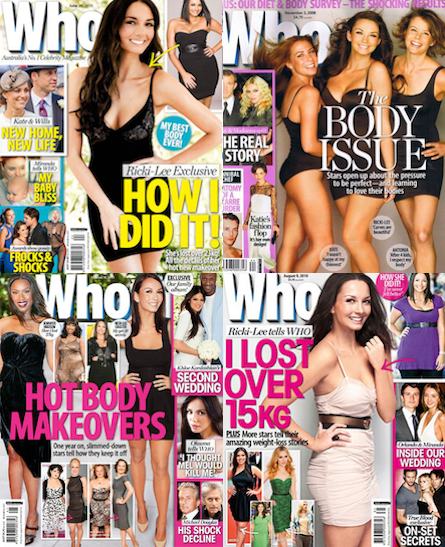
Magazines: Ricki-Lee—Who Cares?


There have been a few articles in the media over the past week or so kicking up a stink about Ricki-Lee Coutler’s Maxim photo shoot, and her need to bare her new skinny body in general.

My beef isn’t with her new, “sexy” (if sexy means being draped in some pink chiffon and a machine gun ammo belt with your mouth open and eyes half closed…) look; it’s with the inevitable fact that this time next year she will have put all the weight back on and will be on the cover of Who or Women’s Day in an “exclusive” about how she’s fat.

I’ve been wanting to write this article for at least a year now, as it seems that every twelve months or so Ricki-Lee’s espousing how she got skinny or how she got fat again in some magazine tell-all. Not to mention the endorsement deals (Big W’s Hold Me Tight range, anyone?).

My point: Who cares?

Why Ricki-Lee would voluntarily document the changes of her body reflected by the scrutiny of the media and the general public is beyond me. And also, she’s no Kardashian or Oprah; we just don’t care about her that much.

What do you think? A big hullabaloo about nothing, or are Ricki-Lee’s actions damaging to her (predominantly young female [although, with that Maxim cover…]) audience?

Elsewhere: [Sydney Morning Herald] Ricki-Lee Coutler: Too Nude, Too Often?

[MamaMia] Ricki-Lee, Why?

Images via Yahoo!, Who’s Dated Who?, MyGC.

Pop-Feminism.

From “How the Blogosphere Has Transformed the Feminist Conversation” by Emily Nussbaum in New York Magazine:

“For too long, it was the anti-feminists who owned that brand: Katie Roiphe, Camille Paglia, Caitlin Flanagan.

“And this bold style might have been lost forever, if it weren’t for the web. Lacking editors (whose intolerance for insanity tends to sand off pointy edges), lacking balance (as any self-publishing platform tends to), laced with humor and fury (emotions intensified by the web’s spontaneity), the blogosphere has transformed feminist conversation, reviving in the process an older style of activism among young women. It’s a renaissance that began around 2004, when feminist blogs were rare. Left-wing blogging was on the rise, a phenomenon that was strikingly male…

“Then, during the 2008 presidential campaign, the Net exploded with debate about Barack Obama and Hillary Clinton, not to mention Sarah Palin and Michelle Obama. At the time, the website Jezebel—the flamboyant ‘Girlie Gawker’ founded by Anna Holmes—got the biggest numbers it had seen since its launch.

“As the volume of posts increased, subjects recurred from early feminism, including outrage at sexual violence. But there were also striking differences: While seventies feminists had little truck with matrimony, feminist bloggers lobbied for gay marriage. There were deconstructions of modern media sexism, including skeptical responses to the ‘concern-trolling’ of older women who made a living denouncing the ‘hookup epidemic.’ There was new terminology: ‘slut-shaming,’ ‘body-snarking,’ ‘cisgender.’ And there were other cultural shifts as well: an acceptance (and sometimes a celebration) of porn, an interest in fashion, and the rise of the transgendered-rights movement, once seen as a threat, now viewed as a crucial part of sexual diversity.

“Perhaps most strikingly, there was a freewheeling fascination with celebrity culture and reality television, even on the most radical sites. Instead of viewing pop culture as toxic propaganda, bloggers embraced it as a shared language, a complex code to be solved together, and not coincidentally, something fun. In an age of search engines, it was a powerful magnet: Again and again, bloggers described pop­culture posts to me as a ‘gateway drug’ for young women—an isolated teenager in rural Mississippi would Google ‘Beyoncé’ or ‘Real Housewives,’ then get drawn into threads about abortion. Some of the best memes out there are the least categorisable, like Feminist Ryan Gosling, a blog that features the adorable star of Drive ‘citing’ poststructuralist philosopher ­Judith Butler. Is it a joke? A turn-on? A sly carrier for theory? It doesn’t really matter, because it’s the perfect viral pass-around.”

Related:  Yet Another Way in Which Madonna & Lady Gaga Are Alike.

Surfing the Third Wave: Second-Wave VS. Third-Wave Feminism on Gossip Girl.

Beyonce: Countdown to Overexposure.

Elsewhere: [New York Magazine] How the Blogosphere Has Transformed the Feminist Conversation.

[Feminist Ryan Gosling] Homepage.

Magazines: Scarlett Johansson on THOSE Photos.


I haven’t had a chance to pick up the new Vanity Fair yet, but after reading Scarlett Johansson’s comments on the nude photos of her that have surfaced in recent months, I can’t wait to see what else she’s got to say on sexting and slut-shaming (sext-shaming?):

“‘I know my best angles,’ she says with her trademark insouciance. ‘They were sent to my husband,’ now ex Ryan Reynolds. ‘There’s nothing wrong with that. It’s not like I was shooting a porno.’ She adds saucily, ‘Although there’s nothing wrong with that either.’”

Jezebel goes on to say:

“We appreciate Scarlett reminding the world that the only person who did something wrong in this situation is the guy who violated her privacy, not the adult woman who sent sexy photos to her partner.”

Amen to that!

Elsewhere: [Jezebel] Scarlett Johansson Would Like That Nude Pic Slut-Shaming to End.

Image via Daily Stab.

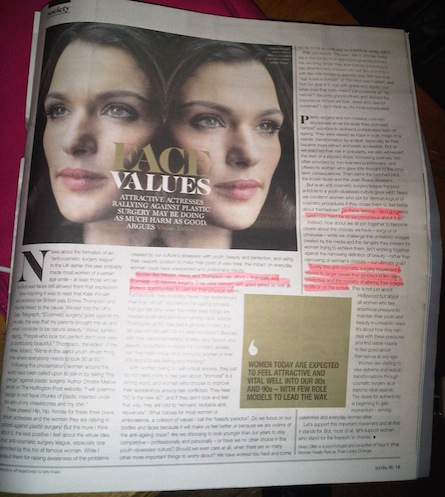
Magazines: Just Because You’re Beautiful Doesn’t Mean You Can’t Have an Opinion.


I’ve encountered this thinking before.

At a feminism debate this time last year, Gaye Alcorn scoffed that Mia Freedman, Sarah Murdoch and Kate Ellis shouldn’t be the faces of (and brains behind) the Body Image Advisory Group because they happen to be physically attractive. Like, sorry that they have good genes, but should that make them any less qualified to comment of feminist issues? I thought we were working towards an all-inclusive feminism…

Anyway, similar views were brought up in last weekend’s Sunday Life magazine by Vivian Diller, who wrote in “Face Values” that perhaps Kate Winslet, Rachel Weisz and Emma Thompson aren’t the best advocates from Hollywood’s anti-plastic surgery movement because they don’t need it.

Diller writes:

“Women like Winslet, Weisz and Thompson can afford—financially and otherwise—to oppose surgery. They were blessed with good genes as well as limitless opportunities to care for their physical selves.

“… Do these famous—and gorgeous—celebrities need to be so sanctimonious about it all?

“… Surely this anti-cosmetic surgery movement is related to larger issues that go beyond film stars, celebrities and the morality of altering their images in life or on the screen…”

I’m sure most actresses, models and regular people don’t need cosmetic surgery, per se, but it seemed like everyone else was doing it. Now there’s an outlet for those who have similar outlooks to beauty as Winslet et. al. to just say “no”.

Thoughts?

Related: Has Feminism Failed?

Is There Really a Beauty Myth?