TV: Top 11 TV Moments of 2011.

Paper Giants.

One of the best shows this year. Unfortunately, it only ran over two nights.

The Kennedys.

Wow. Just wow. I loved this miniseries that was cancelled by the History Channel in the U.S. because it allegedly portrayed the Kennedy family in too negative a light. Luckily, it was picked up by the ABC here. I am now officially in love with Greg Kinnear.

Go Back to Where You Came From.

Apart from Sarah Ferguson’s Four Corners expose on the meat industry (below), SBS’s Go Back to Where You Came From was the most groundbreaking television this year. Unfortunately, I don’t think it changed anyone’s minds about the plight of refugees in this country, because those who already empathise with asylum seekers were the show’s target audience, and those who think refugees should go back to where they came from snubbed the show.

Sookie & Eric Finally Get Together on True Blood.

While I’m more of a Sookie and Bill fan, and an Alcide-in-general fan, Eric’s turn as sensitive Sookie-lover in True Blood’s fourth season was a must-watch. But thankfully, the Nordic vampire is back to his old, heartless self.

Charlotte King’s Rape in Private Practice.

Private Practice is an oft-shunned show, in favour of its Seattle counterpart, Grey’s Anatomy, but season four dealt with abortion and rape particularly sensitively and realistically.

Four Corners’ Expose on the Meat Market.

This was probably one of the most talked about news stories in Australia, if one of the most poorly rated episodes of Four Corners. Not because people didn’t care, but because it was so hard to watch. It’s perhaps too soon to tell, but I think we are seeing a chance in meat practices in Australia because of this story.

The Slap.

I found one of ABC’s most anticipated shows of the year to be a spectacular letdown. I’d had Christos Tsiolkas’ novel on my reading list since it was released, however I missed out on reading it before the show premiered in October. Perhaps if I had read the book first I would feel differently about the show, but I found it to be stereotypical and tokenistic, and a massive disappointment from the screen version I had hyped up in my mind. Fail.

MamaMia Gets Its Own TV Show.

Probably not many TV watchers outside of the insular community of MamaMia and Sky News would have known about Mia Freedman’s lifestyle website making the switch to TV. I don’t have pay TV but, luckily, the shows are available to watch on the MamaMia website, YouTube and Facebook, where the panelists talk about all manner of things, like sex, mental illness, celebrity, porn, religion, parenthood and more.

Angry Boys.

I hadn’t watched any of Chris Lilley’s stuff before Angry Boys and, while a lot who had thought the show was a bit of a letdown, I really enjoyed it.

Housos.

Another one that was a bit hit-and-miss, I’d anticipated the show all year. While some moments were gold, others were just supremely unfunny.

At Home With Julia.

Finally, the cherry on top of a parody-tastic television year. I really enjoyed Amanda Bishop’s portrayal of Julia Gillard, but I still found the fact that there was a show about a sitting prime minister pretty offensive.

Any TV moments I missed here that you thought defined 2011?

Related: Paper Giants: The Birth of Cleo Review.

My Response: Go Back to Where You Came From.

Private Practice: Pro-Choice?

The Slap & Men Who Cheat.

At Home with Julia: Funny or Disrespectful?

TV: Gossip Girl—Life Begins at Love?


So Blair’s pregnant and she doesn’t know who the father is. Oi vey, as her Jewish stepfather Cyrus would say.

Naturally, even though she’s only 20, is still in college as her mother points out, and doesn’t know if her fiancé Louis or past love Chuck impregnated her, she’s keeping the baby. Of course!

Dan tells her  “has options” and Blair replies that she’s considered them all but, ultimately, the foetus was conceived out of love. I’m sure a lot of foetuses were conceived out of love, but that doesn’t mean it’s in the best interest of both the embryo and the parents to keep it.

Interestingly, while searching for some online articles on Gossip Girl being pro-life (there aren’t any that I could find), I came across a web entry for the actress who plays Eleanor Waldorf-Rose, Margaret Colin, who is a noted pro-life activist and has even been involved in (I won’t say propaganda) a pro-life made-for-TV movie. I wonder if her stance, which is well-publicised, had anything to do with the character of Blair deciding to carry the pregnancy to term…?

Related: Gossip Girl Season 4 Final.

Breaking Dawn: Sex is Bad, Okay? And You Will Be Punished for Having It With a Life-Sucking Vampire Feotus. Sorry, Life-Sucking Vampire BABY!

Is Jersey Shore Anti-Abortion?

Private Practice: Pro-Choice?

Grey’s Anatomy Final Asks “When Does Life Begin?”

Image via MegaVideo.

On the (Rest of the) Net.

Julia Gillard is anti-marriage, period:

“After reading all of Gillard’s statements on this issue and after speaking to those who have talked to her about it, I am convinced she doesn’t believe in marriage at all, for anyone.” [ABC Unleashed]

The “Born This Way” versus choice debate continues:

“But I think the most serious problem with this argument is that it reinforces the idea that we need an excuse to be queer. As a result, using this line subtly supports the idea that being queer requires excusing in some way. Don’t use it. Don’t allow straight people to generate an understanding of queer sexuality that sounds like: ‘Well, of course Bob wouldn’t wish to be queer, but he was born this way. I guess we better give him equal rights—poor Bob, he just can’t help it. We shouldn’t punish him for something he didn’t choose!’

“Meanwhile the real reason that you shouldn’t punish Bob for queerness is because there’s nothing wrong with it!” [Social Justice League]

If you’re unfamiliar with the personhood debate, or just unclear on what it all means, this article by Jill Filipovic is a must-read. [Guardian]

Here’s another great article on Personhood and what it means for abortion laws:

“… As the Personhood message penetrates, then society will understand why women need to be punished just as surely as they understand why there can be no exceptions for rape/incest [bolded text mine].” [Salon]

Why Kyle Sandilands is a dickhead. [The Punch]

“Rethinking the Strong Female Character.” [Canonball]

Kelly Osbourne repents for her past “tranny” wrongs. [HuffPo]

And Warren Beatty and Annette Benning’s transgender son thinks Chaz Bono is a misogynist. [Super-Mattachine]

“27 & Unmarried? In China, You’re One of the ‘Leftover Women’.” Gah, only three years left for me! [Jezebel, Ms. Magazine]

What White Ribbon Day means for men. [MamaMia]

The double standards of talking about what goes on down there. [Owning Pink]

Knowing all the evils facing women in our society, would you want to bring a baby girl into the world? [Jezebel]

My, what lovely lady lumps Kristen Wiig has. All the better to be named GQ’s “Bro of the Year” with, my dear. [Jezebel]

“Eve as Literary Hero”. [Imagine Today]

Ms. Piggy as feminist and Kermit as douchefrog. [Jezebel]

Meshel Laurie on the Matthew Newton saga. [MamaMia]

On being single. [Girls Are Made from Pepsi]

Gah! “Pro-Life Feminism is the Future”. [Washington Post]

Images via Jezebel, Lara Croft Tomb Raider Costume Resource.

Movies: Breaking Dawn—Sex is Bad, Okay? And You Will Be Punished for Having It With a Life-Sucking Vampire Foetus. Sorry, Life-Sucking Vampire BABY!*


Much has been made of Stephenie Meye’s Mormon ways in the Twilight saga.

Breaking Dawn was the first installment in the franchise I’d seen since I started this blog and steering it in a more feminist, gender studies-related direction, so I was thoroughly looking forward to all the anti-feminist sentiment the film would be imbued with.

Sure, there was the inspiration for the title of this post—that sex is bad—along with pro-life and abusive partner-sympathising messages, but all in all, the movie bombed. Big time.

The first half was meant to fulfill diehard fans’ fantasies of Bella and Edward’s wedding, which was filled with angsty Bella’s fear as her father walked her down the aisle, which dissipated when she saw Edward because, you know, she’s nothing without him who keeps her grounded and ready to face her life-altering circumstances, and their first bed-breaking love making session, which I will return to momentarily.

The second half consisted of talking CGI werewolves, a life-sapping foetus—sorry, “baby!” as Rosalie so adamantly reminds us—turning Bella into a shell of her former self (who was fairly shell-like to begin with) and her transformation into a vampire.

I have many problems with Bella and Edward’s relationship, but I’ll try to confine them to the bounds of Breaking Dawn’s storyline.

On their honeymoon, Edward and Bella have sex for the first time. Even though Stephenie Meyer did her darndest to save the consummation of the relationship til the confines of marriage, she makes clear, by Bella getting pregnant, that any kind of sex that’s not solely for reproductive purposes is bad. And if a wife tries to seduce her husband, who is so selfless that he forgoes his own pleasure so as not to hurt his new bride, she will be punished with a fast-growing, nutrient-depleting, monster foetus—sorry, baby! On her very first try at lovemaking! Talk about anti-sex sentiments!

(I will say that the role reversal here was interesting; when do you see the female essentially begging for sex from a withholding husband?)

The bruises and the broken bed that occurs from Bella and Edward’s first night together seem a little too close to what might eventuate from a domestic violence incidence. Bella has been brainwashed by her emotionally abusive partner so that she rationalises that his violent behaviour was somehow her fault that he couldn’t control himself. Classic Stockholm syndrome if ever I saw it.

And, of course, there’s the pro-life proselystisation that comes with Renesmee’s accelerated conception and birth. Fitting, considering the hullabaloo in the States, particularly, over abortion and “personhood”. (Does “personhood” apply when the foetus—sorry, BABY!—is only half human?) Under the failed personhood amendment, abortion would be outlawed, even in the case of rape, incest and when the life of the mother is threatened. Stupidity reigns supreme. I would like to think anyone in their right mind would terminate a life-threatening pregnancy, especially when the baby could potentially be a monster. At the very least, I’m sure a rich doctor who has an operating room (albeit one with floor to ceiling windows. Privacy much?) could have delivered the baby prematurely and placed it in an incubator.

Finally, what is up with Jacob imprinting on a newborn? And does Renesmee even have a say in Jacob’s undying love for her? Does Jacob’s imprinting mean that Renesmee essentially imprints on him, too? Or does she have to go about her life with Jacob waiting in the wings, whether she wants him there or not? If you though Edwards stalker tendencies were bad, you ain’t seen nothing yet!

Thank God there’s only one more movie left!

*Blanket spoiler alert.

Related: The Catholic Church is Not a Force for Good in the World.

Elsewhere: [Nightmares & Boners] Feminism, Sex, Abortion & Twilight’s Breaking Dawn.

[The Vine] Twilight Saga: Breaking Dawn, Part 1 Review.

Image via IMDb.

Movies: I Don’t Know Why They Keep Making Chick Flicks Like This*.


Even though I’m still young and don’t have a potential baby daddy on the horizon, I’ve been contemplating children lately. How many I want, whether they’ll be biological or adopted, and how I’m going to handle (a) tiny human(s) demanding my attention 24/7. I just don’t know how parents do it!

In this day and age, with the rise of the stay-at-home dad, it’s not always the mothers’ responsibility to look after the home, the family and her workplace.

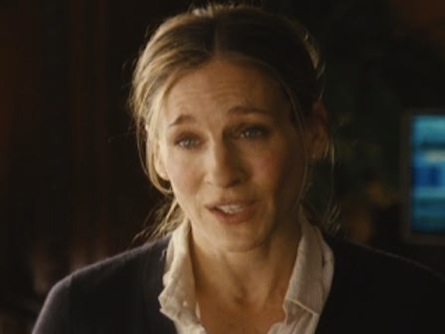
I Don’t Know How She Does It would have you think otherwise, though. Sarah Jessica Parker’s Kate Reddy is a high-flying investment banker who has a nanny during the day, but tries to spend as much time as she can with “the cutest guy she knows”, her husband, played by Greg Kinnear, and her two kids. I got the feeling that she never slept (the constant list making in bed at all hours of the night probably lent itself to this), was a walking zombie, spent minimal time with her husband and kids, spent her weekends hosting kids’ birthday parties and never had a spare moment for herself. If this is what motherhood and family life is like, I’m withdrawing my application.

But it’s not just the “out of touch”-ness of IDKHSDI, as Dana Stevens called it in her Slate review (my friend, Tess, who I went to see the movie with, drew ire with Kate’s “chronic over-apologising” and “persecution complex”, and I have to say I agree), nor the unrealistic and polar opposite portrayal of stay-at-home mums (Busy Phillips’ character, Wendy, attends the gym from 8am to 2pm every school day. My mum was a stay-at-home one and I can tell you THAT JUST DOES NOT HAPPEN! I’m insulted on behalf of housewives everywhere.) that infuriated me. It was the blatant pro-life message the film pushed.

Kate’s junior co-worker, Momo, played brilliantly by Olivia Munn, was all about work, with some occasional no-strings-attached sex to balance it out. Momo is socially awkward, hates children, and thinks Kate’s family compromises her ability to do her job.

So when Momo finds out she’s pregnant and tells Kate she’s going to “take care of it”, Kate launches into a “creepy pro-life proselytisation”. In the next scene, Momo is keeping the baby. If that’s not a unabashed punishment for a young, attractive woman enjoying sex without commitment, I don’t know what is.

As Irin Carmon puts it, “… Why, if having a choice was so awesome, the young woman in the movie couldn’t have made another one. You know, the one she convincingly would have wanted to make.”

*Blanket spoiler alert.

Elsewhere: [Slate] I Don’t Know How She Does It Reviewed: Sarah Jessica Parker Rides the Rapids of Upper-Middle-Class Parenthood.

[Jezebel] My Group Therapy Session with Sarah Jessica Parker.

Image via BoxOffice.com.

On the (Rest of the) Net.


The male body image crisis. [Details]

“Geeks Get Eating Disorders, Too” [Jezebel, via Geek Feminism Blog]

“The Joys & Sorrows of Being a Misfit.” [Musings of an Inappropriate Woman]

“Princess Bitchface Syndrome” in politics, the media and celebrity culture. [Girl with a Satchel]

In defence of the feminist blogosphere:

“As writer Amanda Marcotte says, laughing in recollection, ‘We had a running joke about how every three months, another guy would publish a post about “Why don’t women blog?” And we would all comment, “We’re out here; fuck you!”’” [New York Magazine]

What the seventh billionth human, and babies in general, mean for the environment. [Sydney Morning Herald]

Ahh, my two MamaMia crushes in the one post: media wunderkind Sean Power on Sam de Brito.

Is there such a thing as “sexy” costumes for men? (More on this to come as the Christmas party season gets into gear.) [Ms. Magazine]

Still with costumes, next Halloween why don’t you go as your favourite victim of domestic violence?! [Ms. Magazine]

Think you’re too smart to care about beauty? Think again. [Eat the Damn Cake]

Drag queens VS. drag kings. [Rachel Rabbit White]

“A Tale of Two Rape Prevention Campaigns.” [We Mixed Our Drinks]

The problem with the Occupy protests: sexism. [Global Comment]

“Should Michele Bachmann Quit?” Probably, because “barring everyone else dying or converting to Islam, it’s pretty obvious at this point that Michele Bachmann will not be the Republican party’s 2012 Presidential nominee.” Yay! [Jezebel]

Birth control can apparently bring us world peace but, in the same instance, it makes sex bad. [Jezebel]

Choice, and the politics of being hot:

“Until the woman who doesn’t want to be seen as sexually available can go out with certainty that she won’t be harassed or ogled, your choice to turn heads and revel in attention is a privileged one. Until the woman who doesn’t prioritize appearance gets taken just as seriously in just the same contexts, it’s a privileged choice to achieve certain standards of beauty. You may be doing what you love, but you’re also doing what you’re told.” [XOJane]

Gah! Now this is enough to give me nightmares for the rest of my Halloweens: “Woman Trapped in Anti-Abortion Haunted House”. [Jezebel]

“Obamanalysis.” [New York Magazine]

Another black girl woman is filmed giving a blow job; heralded as “the next Amber Cole”:

“At this point, the most noteworthy thing about someone doing something with someone else’s privates is the fact that we still make such a big fucking deal about it. Yes, that’s a penis. Yes, that’s a woman’s mouth. Yes, that’s ejaculate. Let’s all carry on with our daily lives and quit acting like we’ve never seen a blow job before. Move along, folks. Nothing to carry on about here. Literally hundreds of people are getting blow jobs right this second. By the end of the day, thousands of people will have received blow jobs. Maybe you’ll get a blow job! Maybe you’ll give one. Maybe you’ve already given or gotten one today. But enough with the gathering, giggling, judging, and Tweeting.

“There are real things going on in the world. Kardashians are getting divorced.” [Jezebel]

Speaking of Kardashians, an attempt to decode them. [MamaMia]

Feminine hygiene product ads with actual blood in them! Who woulda thunk it? [Jezebel]

Don’t tell me to love myself:

“It’s a lot of pressure. Stop feeling unattractive! Just decide to love yourself! And then you’ll look good! If you look bad, it’s because you’re insecure. Get secure!” [MamaMia]

On being sex-positive. [The Pervocracy]

And masturbation means you’re gay, didn’t you know? [Feministe]

Also from Feministe, the “Hot Chicks of Occupy Wall Street” gets all rapey,

Cheerleading is a sport, dammit! [Fit & Feminist]

Cutting off “gender studies” to spite “women’s studies”? [The Good Men Project]

Images via Details, New York Magazine.

On the (Rest of the) Net.

How to make friends and not alienate people whilst working at the morgue, Lindsay Lohan-style. [Gawker]

Mitt Romney’s history with abortion. [New York Times, via Jezebel]

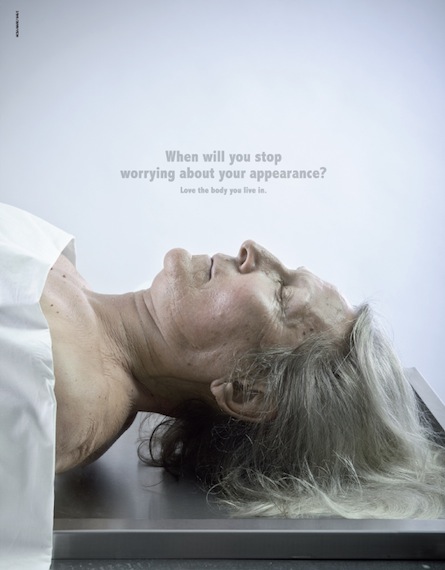
South African Marie Claire attempts to draw attention to body image with their most recent campaign, to lukewarm effect. My pick for the most hard hitting design is the one above. What’s yours? [MamaMia]

How does the word “fat” affect others’ body image? [Jezebel]

Gala Darling, her husband and their Halloween costumes.

E-book VS. real book. [MamaMia]

It’s all about me, I mean you, I mean me. [Already Pretty]

“Accidental rape” and enthusiastic consent:

“While the legal standard of rape is increasingly well-defined… common sense suggests that at its most basic, rape is nonconsensual sex. Too many of us, men and women alike, define consent as the absence of a clear ‘no,’ rather than the presence of a clear, unmistakable, eager ‘yes.’ The opposite of rape, in other words, is mutual enthusiasm.

“The root of consent is the Latin consentire, which means ‘with feeling.’ Consent is not just about words ‘no’ or ‘yes’—it’s about the unambiguous presence of desire.”

[The Good Men Project, via MamaMia]

The case for vaccination Barbie! [Washington Post]

A history of slutty Halloween costumes. [Jezebel]

Still with Halloween: costumes and racism:

“Halloween was the day where women could bring out their inner sluts… Halloween is also the day where people can bring out their inner… racism…” [Eternal Sunshine of the Spotless Mind]

“Who Cares About Amber Cole?” the black teenage girl who was caught on camera by two male friends giving her boyfriend a blowjob, which subsequently got circulated around the internet, thus distributing child porn. [Jezebel]

Images via Gawker, MamaMia, Gala Darling, High Snobiety, Toys R Us, Clutch Magazine.

TV: Is Jersey Shore Anti-Abortion?


For all their gender-stereotype-busting, Jersey Shore equally upholds the sexual status quo.

They slut-shame, “cock block” and are anti-abortion, apparently.

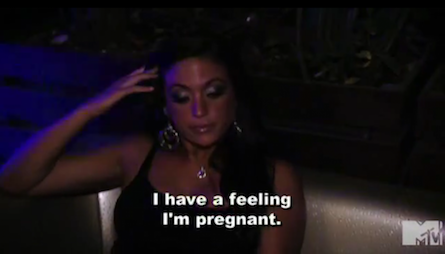
On last night’s episode, Deena thought she might be pregnant as she’d missed her last period. Instead of weighing up her options and realising she’s too young and irresponsible for a child, she got upset about how angry her family would be and lamented that she didn’t know how to take care of a baby.

I’ve said it before, and I’ll say it again: if the stigma of abortion were removed, Deena would have realised that she had an option other than going through with the pregnancy, and wouldn’t have hesitated to schedule herself an abortion if she had in fact been pregnant. Because, yes; having a baby is a huge responsibility, and with no job, no partner, no family support (from the way she describes how upset her parents would be), and a party-hard lifestyle—not to mention the binge drinking her and Snooki had partaken in during their time in Italy whilst Deena might have been growing a bun in the oven, thus endangering the health of the foetus—she certainly isn’t ready for it.

The fact that these Jersey Shore guidos/ettes relish their single, carefree, eternal alcohol-fuelled childhoods (“Don’t fall in love at the Jersey Shore” is their motto) makes it all the more likely that they should view abortion as a guilt-free, necessary and legal procedure to make a woman not pregnant.

Thoughts?

Related: Snooki & the Jersey Shore Girls as Feminists?

Images via Megavideo.

Book Review: Never, Ever, Again… Why Australian Abortion Law Needs Reform by Caroline de Costa.


Abortion activist Caroline de Costa gets the name for her book from the Queensland trial of young couple Tegan Leach and Sergie Brennan, who were charged with procuring an illegal abortion by using the “controversial abortion drug”, RU486, which is a situation that should happen “never, ever, again” (p. 24).

This unique case garnered so much media attention because it was the first time since 1959 that a woman was charged, under section 225 of the Queensland Criminal Code, with procuring her own abortion. This section of the criminal code hasn’t been changed since it was written… in 1899.

The couple were declared innocent after the trail came to a close on the 14th October last year, but it brought to a head the debate surrounding the aforementioned “controversial abortion drug” RU486.

de Costa has also written another book on RU486, and a lot of that material is rehashed in this publication. Before this case, I only ever thought there were surgical abortions, performed in a hospital using suction. I supported them nonetheless. Now that I’m aware there is an “abortion drug”, which not only assists in the safe termination of pregnancy, but “could help treat, among many other things, certain inoperable brain tumours, breast cancers, burns and, ironically enough, the fertility-inhibiting condition of endometriosis” (p. 151), I’m even more in favour of allowing access to abortion to women who don’t want to be pregnant.

de Costa continues:

“Mifepristone/misoprostol [RU486] is also an effective way of starting labour in women when it is found that the fetus has died in the uterus at any time up to mid-pregnancy, and this is now recommended practice in many countries overseas.

“Mifepristone has also been shown in trials to be useful for Emergency Contraception (EC)” (p. 152).

de Costa is quick to point out that RU486 is not the same as EC, as one assists in abortion while the other prevents an egg being fertilised in the aftermath of unprotected sex.

The drug has also been seen to be effective in small doses as a contraceptive pill, assist in the treatment of Cushing’s syndrome (the “over-production of glucocorticoids”), depression, dementia and Alzheimer’s, arthritis, “certain types of hypertension”, glaucoma, and even HIV and AIDS (p. 152, 154).

But RU486 is only available from a few medical practitioners in a few locations in Australia, hence why Leach and Brennan decided to purchase theirs from overseas. It is also a fairly recent development.

Before medical abortion was available, women tried all sorts of treatments and home remedies to abort their foetuses, a cacophony of which are detailed in Never, Ever, Again. Most of these cases resulted in the desired death of the unborn child, but also in the death of the mother.

Whilst Victoria, New South Wales, Western Australia and the Territories have abolished abortion as a crime, Queensland still considers it an illegal and punishable offence. So do, to a lesser extent, Tasmania and South Australia. Seriously, people: when some third world countries have no problem with mifepristone, why should a progressive country such as Australia?

The book talks about the majority of Australians who think abortion should be legal, and how Queensland residents and the media came out in support of Leach and Brennan during their trial. For example, “as journalist Emma Tom wrote in 2009:

“Like many people who believe women should have the right to safe, affordable and legal terminations, I don’t like being described as pro-abortion because it sounds like I think terminations are fabbo things that women should hop into as often as possible. The truth is I’d like to see a whole lot less of them, but via sex education and contraception rather than by robbing women of their right to decide whether they’re up to seeing through a pregnancy” (p. 24).

Now that’s something everyone can agree on, no?

In the final chapter of the book, a recent addition to this second edition, de Costa writes in a much more relatable and personable tone than the rest of the book. Perhaps that’s because the final chapter is an account of the trial of Leach and Brennan, which de Costa attended.

de Costa also repeatedly writes the assertion that abortion should be a matter that exists between a woman, her partner and her doctor, and not the government, the police and the legal system. In the final sentence, de Costa writes:

“It [the second chapter of abortion law reform in Australia] will be written when finally State Premiers and Attorneys-General have the wisdom and courage to remove abortion from the too-hard basket and agree on uniform decriminalization of abortion law across the country. Then, and only then, can abortion truly be a matter for a woman, her partner and her doctor.”

Amen to that!

Related: Melbourne Writers’ Festival: Never, Ever, Again: Why Australian Abortion Law Needs Reform by Caroline de Costa Book Launch.

Feminism Respects Women More Than Anything, Including the Catholic Church!

Image via Fishpond.

Guest Post: Feminism Respects Women More Than Anything, Including the Catholic Church!

Just over a week ago I was reading this here blog when I came across an article that shocked me. It was a response to a feminist blog that stated that the Catholic Church disrespects women. The response was supposed to demonstrate that “[the Catholic Church is] one of the few places in the modern world where women can find true acceptance and respect.” I almost choked when I read those words. Surely a Solidarity Salon or feminist society would be a more accepting place.

The Catholic Church has systematically stripped away women’s rights from the outset. Before people go asking for evidence, permit me to quote the Bible:

“That they may teach the young women to be sober, to love their husbands, to love their children, to be discrete, chaste, keepers at home, good, obedient to their husbands, that the word of God be not blasphemed.” Titus 2:4, 5 (emphasis mine).

According to this, women are subservient to men, must marry, have children and behave in a particular way—chaste, pure, with loving eyes only for him. The most important point here, however, is that wives must be obedient to their husbands. This indicates that women are viewed as being unequal to men. I cannot see how we can possibly feel respected if we do not feel equal.

Women in the Bible, and therefore in the eyes of the Catholic Church, are always presented in one of two ways: the Madonna or the whore. The Virgin Mary (mother of Christ and most famous of all biblical “vessels”), Priscilla (devoted wife of Aquila who extended her hospitality to St. Paul when he was in need), Ruth (loyally took care of her sick mother-in-law) and Elizabeth (who bore a son, John the Baptist, despite being well past child-bearing age) are all examples of the Madonna; the virtuous woman in the Bible.

So some of the examples are a little stretched for goodness—I’ll gladly look after my mother-in-law but I doubt that alone makes me a good person. That is because women are painted as sinners and whores far more frequently in the good old pages of the Bible. A small list of examples include: Eve (duh, she started it all by defying God and eating some fruit), Jezebel (worshipped false gods and murdered her husband and sons), Delilah (betrayed Samson, lured him with her sexuality and maimed him by cutting off his hair in which his strength lay, effectively leading to his death), Salome (flirted and danced seductively for her step-father to persuade him to execute John the Baptist—at the age of thirteen! [Scarlett Woman note: so the sexualisation of children isn’t just a raunch culture, Internet-age thing!]), Mary Magdalene (one of Jesus’ most reliable disciples, however she was painted as a prostitute until 1969 when the Pope recognised her as a true disciple). I could go on. Is it just me, or are the stories about the “evil” women just so much more fun? Now that we’ve had a who’s who of female biblical figures, I’d like to address some of the points that were made in the article.

The first point, predictably, is abortion. Apparently, because a high percentage of women having abortions reported using contraception and it failing “there is a huge problem with contraception—something the Church has said all along.” The Catholic Church is against contraception because they believe that every union between sperm and egg is a life and that only God has the right to give or take away life. Jennifer Fulwiler’s argument seems to be more centred on the science of contraception, an aspect of the argument that the Catholic Church has never really looked into being clouded with the morality angle. There were a few comments written in response asserting that if feminists want to be environmentalists as well, they shouldn’t pump their bodies and waterways with chemicals that inhibit pregnancy. Aaah, psedo-science!  As both a feminist and an environmentalist, I endorse the use of the Pill. All medication carries a risk, even aspirin. I received a very competent education on the menstrual cycle and how the pill works to inhibit the release of an egg by adding more oestrogen and progesterone, hormones that are naturally produced in the body, at a particular time in the cycle. If you are educated on how it works, you won’t be afraid of it. I would like to ask a question about sperm, though. If the church posits that the union between egg and sperm is a human being, do they believe that individual sperm and unfertilised eggs are also people? If this is the case, how can they condone the reproduction process, considering how many poor innocent sperm die in the hostile environment of the womb? [Scarlett Woman note: Or in “masturbatory emissions”, as Elle Woods would say?! Oh, that’s right: masturbation is evil.]

The article goes on to say that—shock, horror!—women are having sex for pleasure, not procreation. Really? In 2011? I had no idea! This is blamed on being “bombarded with about a zillion messages a day that portray sex as… pleasure and fun” and that you only have to “turn on the E! Network or flip through an issue of Cosmo” to see this message being touted and lauded as positive. I must admit, I always go to Cosmo for the best sex tips! The hyper-sexualisation of society is something that religion in general often uses as a way of renouncing feminism.  In a Google search of feminism, the third option is a website called Feminism is Evil. Not only is the sheer ridiculousness of the “argument” against feminism laughable, the only evidence appears to be quotes from the Bible. Feminism is Evil also blames the media for the unfeminine behaviour of women:

“The television is about as false and misleading as can be nowadays… People are being indoctrinated, especially our youth, to have a false view of reality. Television nowadays is being used as a weapon to promote agendas that go 100% contrary to the Word of God; such agendas as homosexuality, feminism and abortion.” (Original emphasis removed.)

At one point, the site makes the argument that men are more pure than women because “not one man has ever had an abortion”! I still believe that the mainstream media presents a patriarchal, homophobic lifestyle as the norm. Whilst there may be more divorced characters on television, they still promote impeccable family values. In CSI: Crime Scene Investigation, I would argue that Catherine works extra hard on her relationship with her daughter, Lyndsay, insisting on things like eating dinner together at the table and having movie nights. If anything, she is the most family-oriented character on the show. Similarly, Glee deals with a gay character, Kurt, by placing him in a highly supportive family. He has a great relationship with his father and becomes integrated into a full family unit with the marriage of his dad to fellow Glee clubber Finn’s mum.

Whilst I am the first to discuss the objectification of women in advertising that portrays them as sexual objects, it’s strange how we actually agree on something but think that it’s wrong for completely different reasons. I still maintain that most adverts place women in domestic spheres. This is completely compliant with the church, according to Feminism is Evil, as “biblically a woman’s place is in the home.” If I have to see one more advertisement for cleaning or cooking products in which only women appear, or in which they are exasperated at the incompetence of their husbands (and they are always husbands), I feel I might scream! The media systematically proliferates society with these wholesome messages of propaganda for “traditional” gender roles as a response to the increasing feminist and homosexual rights movements. People just don’t see it, as the message is more subtle than the ads of the ’50s and ’60s.

Back to the article at hand, and Fulwiler falsely states that “secular feminists are not willing to stand up for all women.” This is a sweeping generalisation. She cannot speak for everyone, and neither can I, however I was offended by this statement. I, personally, am willing to stand up for all women, even ones who, like her, are victims of the patriarchy. I actually feel that women who have been indoctrinated into a repressive and unequal culture need to be represented more, as they have lost their own voices.

As the article goes on, however, I realise that I don’t represent all women, if Fulwiler is to be believed:

“Pro-choice feminism only respects women once they’ve reached a certain age, usually about 36 weeks; the ones who are younger than that are not considered worthy of consideration as human beings, let alone worthy of respect. The Catholic Church respects all women, no matter how small and voiceless.”

Oh, right, I see what she means. I could not disagree more. This issue is, undoubtedly, highly subjective based on when one considers a foetus becomes a person.

I am not speaking for any other secular feminist at this point but I don’t consider an aborted foetus a woman that I have failed to represent. This is not about neglecting women here; this is about terminating a pregnancy, not a life.  I believe that the person to focus on is the woman who should be given the choice as to whether she wants to continue the pregnancy and eventually give birth to a fully-fledged human, or terminate that pregnancy and not bring an extra child into the world. Each case is individual and should be treated that way, however, at the end of the day, the choice should only ever be that of the woman’s.

Once again, there is a misconstrued notion that the Catholic Church educates women on abortion better than pro-choice organisations or abortion clinics. I disagree, and I went on quite a few websites to discover what they say the procedure consists of. According to Better Health Victoria, two types of abortion are currently available:

  • Surgical abortion: a low-risk procedure most commonly used for first trimester (7–12 weeks) abortion in Australia. Known as suction aspiration or suction curette, it involves removing the lining and contents of the uterus (womb). A range of other surgical techniques are used for abortion later in pregnancy.
  • Medical abortion: a low-risk alternative to surgery used for terminating pregnancies earlier than 7–9 weeks (depending on the clinic). RU486 (mifepristone), also known as “the abortion pill/drug”, is the most widely known medication used for this procedure. It’s available in some clinics in Australia and is up to 98 per cent effective when used in the first nine weeks of pregnancy.

This seems to be the general consensus on most abortion websites I visited. I did come across several problems, though, as most of the sites had been hijacked by religious pro-life propaganda. One website, called Pro-Choice.com, was full of pictures of foetuses and religious messages. If you can’t go to a site labelled “pro-choice” without it being corrupted by religion, where can you go?  I find it quite insulting to read that apparently the Catholic Church provides more accurate information on abortion. Women undergoing the procedure are given accurate and thorough information regarding the process just like any other medical procedure. The Church’s scare mongering and twisting of the facts are not scientifically- or medically-based enough to be considered “information.”

Now, Ms Fulwiler is not saying that “secular feminists intend to disrespect women”; she thinks we “mean well but are simply misguided.” How nice of her to be concerned!  She says she knows how we feel because she used to be the same until she found God was brainwashed. She then says that she started “questioning assumptions.” For someone who questions assumptions, she sure makes a few herself. the first being that the Catholic Church has moved into a modern world in which Eve and Jezebel are not real but allegorical so that women are really seen as respectable in the eyes of the Church. According to Feminism is Evil, even female ministers are going against the word of God and should get back to the kitchen!

The second assumption she makes is that women are being blindly led to the abortion clinic the second they get pregnant. As I stated earlier, every case is different and I feel that there is a tendency to sweep over that and assume that pro-choice women relish in the devilry of their abortive practices.

The third and final assumption is that God exists. I understand that this is a faith-based claim, as there hasn’t been an awful lot of concrete evidence that He has spoken to anyone of late, yet the whole church system relies on the fact that he’s real. If the assumption is wrong, as I believe, then the reasoning behind the oppression of women and the pro-life argument go completely out the window.

Oh, and one final assumption: that secular feminists care what you think.

—Laura Money.

Related: On Stalking.

On Stripping.

Elsewhere: [National Catholic Register] Feminists Don’t Respect Women; the Catholic Church Does.

[YouTube] Legally Blonde Part 5.

[Feminism is Evil] Homepage.

[Better Health Victoria] Abortion.

[ProChoice] Homepage.