On the (Rest of the) Net.


Post of the week: Catherine Deveny on body love. [MamaMia]

On sexual harassment and “nightclub feminist success”. [Musings of an Inappropriate Woman]

Atheists are just as bad as rapists… and feminists. [Jezebel]

Lingerie football. What do you think? Personally, I’m not a huge fan of playing sports in underwear, but I don’t have much of a problem with it. [MamaMia]

“The Problem with My Week with Marilyn.” [Jezebel]

All long-term monogamous relationships are a transaction, says Ms. Elouise, so what’s the big problem with “paying your wife for sex”? [Feminaust]

Facebook, girl-hate and “I’m a better feminist than you” tête-à-têtes. [Howling Clementine]

XOJane on the message Breaking Dawn sends to virgins.

The Manic Pixie Dream Girl trope extends to indie films, too. [The Atlantic]

iPhone 4S’ Siri is pro-life, apparently. [Gizmodo]

When hemlines rise, so does bitchiness. [Jezebel]

Stella Young on the disability pension myth. [MamaMia]

Former Wordsmith Laner Sarah Ayoub-Christie tries to reconcile her modern marriage with her traditional Lebanese upbringing. [MamaMia]

“Teaching Good Sex” in school. What a novel idea! [New York Times]

Men in porn:

“The straight male performer must be attractive enough to serve as a prop, but not so attractive that he becomes the object of desire. As [porn publicist, Adella] Curry puts it, ‘No one wants to alienate the male audience’.” [Good]

Image via MamaMia.

Revisiting Erotic Capital.

A few weeks ago I wrote in response to Rachel Hills’ thoughts on erotic capital, and the questions she asked.

But I feel like I didn’t really get to the crux of what I wanted to say, and that’s deciding whether erotic capital affects my life and how I experience beauty privilege or beauty disadvantage.

This isn’t the first time I’ve written about beauty, and I’ve noted before that I have been negatively judged on my beauty (beauty equals vapid bimbo, apparently), deemed “not pretty enough”, played up my beauty and flown under the radar by playing it down.

But in general, when the way I look gives me more benefits than it does hassles (except when it comes to street harassment!), beauty positivity, as Hills puts it, isn’t such a bad thing. I’d rather be underestimated and prove people wrong than overestimated and let people down.

But I’d be interested to hear from those who have experienced the negative effects of beauty privilege. What are they?

Hills also raises the idea that erotic capital isn’t so much about how beautiful you are, but how much effort you put in. I put in more effort when I attended a party over the weekend that I did when I went to work the next day, tired and sore. But there’s a recently released study that shows even at work, going makeup free gains you less respect than a slick of lipstick and some cover-up. (I tried a sans-mascara look at work over the last few days, and no one noticed the difference. Whether this is due to the natural fantasticness of my eyelashes or the ineffectiveness of the product is another question…) In the workplace, I’d say more emphasis is put on beauty privilege that there should be.

Outside the workplace, I certainly get more of a response when my hair’s out, I’m wearing feminine clothes and I’m not wearing my glasses, but the effort I put in in these scenarios also garners me more attention from those less fortunate.

I’ve had some awful experiences in the city, where beggars have approached me asking for money. I was happy to oblige until I was swindled out of $30 by an expert con artist. Now, don’t get me wrong: I’m more than happy to give a few bucks to a homeless person, whose life is tragically laid out before them on the street, but they’re usually so downhearted and -trodden that they don’t approach people for money. It’s the ones who don’t actually need money (though who’s to determine who’s more in need?) and scam people out of their’s that give the poor a bad name. But that’s a post for another day…

Back to erotic capital and beauty privilege: to finish, I’d like to quote a paragraph or two from Hills’ Sunday Life article on the topic:

“Erotic capital, as [Catherine Hakin] describes it, isn’t just a signifier of wealth and power—it is a ‘personal asset’ that can be traded for those things, no different from a university degree, a good professional reputation or a strong network of friends or acquaintances.

“

According to Honey Money, good-looking junior employees who sleep with their bosses to get ahead are neither exploited nor exploitative: they’re just engaging in a simple exchange of pleasing aesthetics for social introductions and mentoring. Husband-funded ladies who lunch are no less powerful than women who bring in 60 per cent of their household’s income … so long as they maintain their erotic allure.”

And there’s the very “beauty privilege” Hills is talking about: you can use your hotness for your own personal gain, and that’s fine. But don’t ever lose what got you there. That’s what gives beauty-positivity a bad name.

Related: In Response to Questions About “Erotic Capital”.

So Misunderstood.

Picture Perfect.

I Ain’t No Hollaback Girl: Street Harassment in Cleo.

Elsewhere: [I Blame the Patriarchy] New Study Shows Makeup is Not Optional.

[Musings of an Inappropriate Woman] The Erotic Economy.

UPDATED: Why is Feminism Still a Dirty Word?

From  Rachel Hills’ profile on Caitlin Moran in Sunday Life, 7th August 2011:

“Part of the problem… is that we just don’t agree on what it [feminism] means anymore. ‘I understand what I mean by feminism, and all my girlfriends—my girl Vikings—understand it. But if you say it to someone like a man or a younger person, they wouldn’t really understand what you meant.’”

“‘I want to reclaim the phrase “strident feminist” in the same way the black community has reclaimed the word “nigger”,’ she writes. ‘“Go, my strident feminist! You work that male/female dialectic dichotomy,” I will shout at my friends in bars, while everyone nods at how edgy and real we are.’

“Why do labels matter? Isn’t it enough to just take on the ideas? ‘Saying, “I’m a feminist” is just the quickest, shortest way of saying, “Get out of my face. I am not going to take your bullshit,”’ Moran retorts.”

*

Recently, when asked in an interview with UK Harper’s Bazaar, Beyonce said she wanted to invent a new word for feminism, because she doesn’t feel it “necessary” to define whether she is one or not.

Why, in this day and age, do we still distance ourselves from the word “feminism”?

And it’s not just Beyonce.

Keri Hilson, Lady Gaga, and even (kind of) Tina Fey, have been called a feminist in one instance, and tried to backtrack on it in the next.

In response to all this, Jezebel ran a contest to come up with “a catchy new word for feminism”, like Beyonce suggested she should do. Some suggestions were “FUCK PATRIARCHY”, “Flesh-Hungry Young Slutism” (seemingly appropriate given it has been the year of the SlutWalk, if you will), “Vaginist”, “Diva-is-a-female-version-of-a-hustla-ism” (how you like that, Beyonce?), but the one that came out on top was “Equalism” which, in my experience, is what young feminists today strive for.

Speaking of young feminists, I would probably only define a handful of my friends as this, and even they are hesitant to describe themselves this way.

One says she’s not a feminist because she wants to “cook for her boyfriend”. Since when did not cooking and feminism become mutually exclusive?

Another says he’s (yes, he’s) could never truly be a feminist because he doesn’t have a vagina, so therefore will never know what those who do have to go through on a daily basis in a patriarchal society, and have gone through for centuries in patriarchal societies.

I have another who, just by looking at her, screams feminism before she even opens her mouth. Yet sometimes, when she says things I morally disagree with, I think, “she’s not feminist enough”. (Abhorrent, I know, and something I strive not to think and say as a feminist. And, by my own admission, some might say I’m “not feminist enough” because of the way I talk and how I dress.)

It’s a far cry from Beyonce, Keri et al., who try to distance themselves from feminism, while young feminists (and old!) bicker amongst themselves about who’s more feminist! And it perfectly illustrates the discrepancies between what self-described feminists project onto the movement, and what lay, non-feminist Generation Y believes it to be about.

Camilla Peffer over at Girls Are Made From Pepsi writes:

“I think most women associate feminism with radicalism and the whole bra burning hulla-balloo. Which is RI-DUNK-U-LOUS. And a lot of people see the term feminist [as] biased towards females in the sense that the whole movement promotes this idea of women being better than men.”

Indeed, there is a far cry between the first wave suffragist movement, second wave “bra-burning” and the sexual revolution, and current third-wave feminism. Some would even say that we have passed third-wave feminism and are now living in a post-feminist society.

When I first started getting into feminism about two years ago, I subscribed to this notion. Now, having been exposed to all manner of blogs, academic articles, events etc. to put the sexism, discrimination and harassment I’ve experienced as a woman into perspective, I can see that we sure as hell aren’t living in a post-feminist world and that we still need feminism, perhaps more than ever with the rise of the Tea Party and Michele Bachmann and the closure of Planned Parenthoods in the U.S., the blatant harassment most women experience on the street and in their workplaces every day, the attacks on SlutWalk, and the atrocities facing Third World women, to name but a few.

Taking on these battles shouldn’t be seen as something “dirty”; it should be seen as something we can all get behind, if it leads to our daughters experiencing a world free from harassment and discrimination based on what genitals she possesses and what she looks like, no matter what part of the world she hails from.

Sadly, as Rachel Hills muses, “it can be a bit uncool to care. Feminism means caring and wanting to change things, ergo it makes people uncomfortable—especially people who are comfortable with the status quo.”

Are you comfortable with the status quo? Do you think feminism is still a dirty word?

Related: Why Young Feminists Still Have “A Long, Long Way to Go” in the Eyes of Second-Wave Feminists.

Slut-Shaming as Defence Mechanism.

So Misunderstood.

Melbourne Writers’ Festival: A Long, Long Way to Go—Why We Still Need Feminism.

Has Feminism Failed?

I Ain’t No Hollaback Girl: Street Harassment in CLEO.

The Taboos of Sexual Harassment.

SlutWalk: A Smokescreen of Lies, Misinformation & Those Old Myths About Males.

Ain’t Nothin’ Gonna Break My Slutty Stride.

Elsewhere: [Jezebel] Let’s Invent a Catchy New Word for Feminism.

[Jezebel] Keri Hilson is a Feminist, Not That She Wants to Say So, Exactly.

[Jezebel] Tina Fey on the Message of 30 Rock’s “Joan of Snark” Episode.

[Feministe] Time to Check In With Tina Fey’s Feminism.

[The Frisky] Tina Fey: Not Feminist Enough?

[Girls Are Made From Pepsi] The Post in Which I Talk About Beyonce, Feminism & Equality for All.

[Musings of an Inappropriate Woman] Caitlin Moran Cover Story Sunday Life.

In Response to Questions About “Erotic Capital”.

A few weeks ago, Rachel Hills blogged at Musings of an Inappropriate Woman about “beauty positivity” and “erotic capital”. At the end of the post, she asked these questions of the blogosphere:

“Am I on the right track with the idea that it’s not valuing beauty that’s the problem, but the fact that we’re socialised to believe that we’re never beautiful enough? Is this experience of ‘lack’ just a ‘neurotic Rachel’ thing, or an ‘other people’ thing as well?

“Moreover, is it just a female thing, or do men experience it as well?

“Have you managed to develop a positive approach to the way you look? What did it look like and how did you get there?

“How do we stop beauty positivity from turning into beauty privilege?”

So, here I will attempt to give my opinions on “erotic capital.”

Firstly, I have to start by saying that, miraculously, I feel I have come away from my media-influenced adolescence relatively unscathed. I love my body and the way I look, and enjoy dressing to reflect this. Sure, every now and then I have my “fat”, “ugly” and “bad hair” days, but on the whole, I am happy with how I look.

But, I have to agree with Hills’ summation that liking beautiful things and people isn’t the problem, as everyone has their own unique perception of beauty (the way the media tries to influence this to make it a “one-size-fits-all” lens is another problem—and blog post—entirely), but that, as women especially, we’re never good enough.

Again, I have high self-esteem and I will never let anyone or anything make me think I’m not “good enough” or deserving of the things I want. But often I will go out of my way to “prove” these things. When I go out dancing or to parties, I make an effort to wear the tightest, sluttiest thing I own. If I’ve been a bit lax on the work out regimen, I’ll double up on the control underwear, or wear something a bit more flowing.

My most insecure point is probably when I’m seeing someone new. I’ll have thoughts of, “I can’t get naked with this person until I’ve eradicated all my love handles and cellulite,” which is something that I’ve never been able to do nor am interested in doing since they appeared when I was about 13 or 14. I enjoy having a curvier figure, but I guess that’s the influence of “pornification of culture”, and all the pretty young things we see getting their kit off on TV manifesting.

But, in my experience, this isn’t exclusively a “female thing”. Two of the most in-touch men I’ve ever met are two of my closest friends, and the fact that they aren’t afraid to voice their body image concerns or the pressure put on men to look and be a certain way is a refreshing change to the stereotype of either “ripped football bogan” or “beer-bellied goofy bogan”. While it can certainly be an either/or representation of ripped men (NRL players and the True Blood stars come to mind) versus the incompetent, pudgy father seen most commonly in advertisements for nappies and spray and wipe, at the end of the day that’s nothing compared to what women have to deal with in the media. As Mia Freedman put it in her book, Mia Cupla:

“Pretend the world was full of pictures of naked men. On billboards and the sides of buses, in magazines and ads for beer, cars and deodorant. Imagine there were penises everywhere you turned and you couldn’t escape seeing them every day.

“And all the images of nude men were fake. Every male model and celebrity had had penile enlargement surgery, and afterwards, his penis had been extensively photoshopped to make it look even bigger. So now, all the penises you saw in the media every day were knee-length and as thick as an arm.

“One day, next to a magazine article about a celebrity with a foot-long penis, you read the headline: ‘This is what a 43-year-old penis looks like’. The caption underneath read: ‘Asked for the secret to his long schlong, former male model Markus Schenkenberg insists he was just born that way. “I wear cotton boxer shorts and I exfoliate in the shower,” he shrugs. “That’s all I do.”’

“After reading a hundred stories like that and being bombarded by 10,000 images of men with surgically altered and digitally enhanced penises, do you think you might look down at your natural, un-photoshopped trouser snake and feel a little… deflated? Inadequate? Insecure? Angry?”

As I said before, it is amazing that I managed to emerge from adolescence without a lingering negative thought about my body. Sure, I don’t like my legs or my stomach, but I dress to reflect this, and try not to get too paranoid about it. I prefer not to lounge by the pool in a bikini all day, and won’t wear a miniskirt without stockings or pantyhose to hold everything in place, but I won’t let these insecurities stop me from having fun.

My mum was very insecure about the way she looked, and this was projected onto my sister who, I believe, suffered the beginnings of an eating disorder a few years ago. Considering I was the one who was very into movies, TV, magazines and pop culture in general, it would be more likely—at least in the eyes of body image scaremongers—that I would be the one with the eating disorder.

One thing I did inherit from my mum, though, was her bad skin. She’s had skin conditions like dermatitis, allergies and surface veins all her life, and I was (un)lucky enough to get these, too. However, while she’s had relatively clear skin, pimple-wise, I suffered for several years with huge, painful zits which left scars, some of which I still have today. After years of trying to find products to prevent and get rid of these pimples, I finally realised that simple is best when it comes to skincare. I still get a large pimple every now and then (unfortunately, it’s large or it’s not there at all), but I’ve learned how to manage them. But the scars on my face are my biggest insecurity, and the humiliation was exacerbated by both the media, where the aforementioned pretty young things would frolic “make-up free” at the beach or when they woke up, and by people I encountered in my everyday life, who wouldn’t look me in the eye, but rather in the eye of my pimple.

Sometimes I look back on my younger years and I want to kick myself for being so typically self-conscious. I would apply a mask of makeup every day when I didn’t need it at all. I think age and wisdom are the only ways to really appreciate what you’ve currently got.

Finally, I have no idea “how to stop beauty positivity from turning into beauty privilege”. Personally, I don’t think the media plays the most important part in this. I think it starts at home: if parents, teachers and close family and friends can encourage “critical thought” about representations of not just beauty, but stereotypes of women and men, in the media, then young people have a better chance of understanding that what we see on TV, in magazines and advertisements isn’t real. This can be found elsewhere, in books, on blogs and using resources such as the Body Image Advisory Group, chaired by Freedman.

Of course “beauty privilege” is something we see more of in the media than in real life, as beauty campaigns and the lead role in movies like She’s Out of My League depend on the calibre of physical beauty a person woman possesses, whereas friendships, romantic relationships, business partnerships etc. involve other aspects.

So, I will now pass on Hills’ original questions to you, reader: what are your thoughts on “erotic capital” and beauty privilege?

Related: Mia Culpa: Confessions from the Watercooler of Life by Mia Freedman Review.

Is There Really a Beauty Myth?

Will Boys Be Boys When it Comes to Objectifying Women?

Elsewhere: [Musings of an Inappropriate Woman] Some Questions I Have About “Erotic Capital” & Beauty Positivity.
On the (Rest of the) Net.


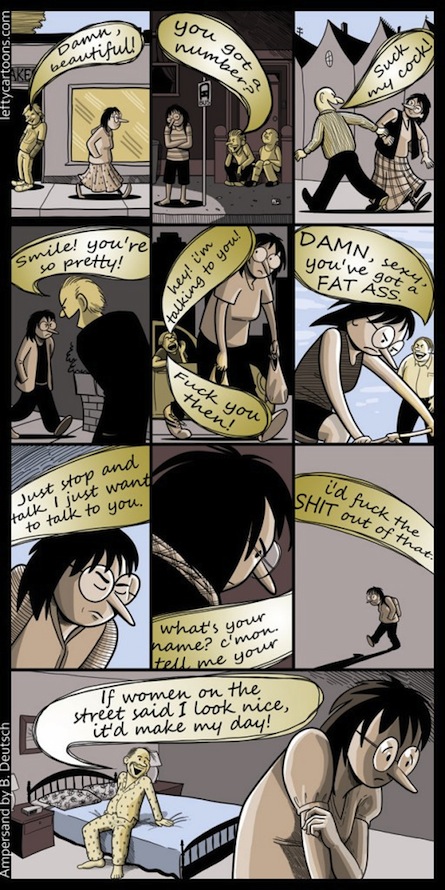
Street harassment in pictures. [Sociological Images]

There may be a link between professional athletes and domestic violence. [Jezebel]

Gay men have body angst, too. [MamaMia]

Naked children: pornography or art?:

“It would be more dangerous and damaging to tell this child that it’s not okay for her mum to photograph her naked, that she should be afraid [of] a loving parent who finds her body beautiful and artistic and that she should avoid being naked with any audience because of the potential to arouse someone predatory.” [Feminaust]

On girl love:

“Don’t be a hater. Try girl-love for a change.  It doesn’t mean you have to hug women with your legs, but try dedicating less of your energy to shit feelings of self-hatred and jealousy, and more towards being supportive of your fellow sistahs.” [Girls Are Made From Pepsi]

Yet another reason not to become a teacher! Parental disrespect. [MamaMia]

Julia Gillard on women’s rights. [MamaMia]

Also at MamaMia, “how women bond by bitching about their looks.”

Erotic capital. Very thought provoking, and something I might return to on this here blog at a later date. [Musings of an Inappropriate Woman]

The aftermath of 9/11 for an Australian kid aged 10 when the World Trade Centre came down. [The Punch]

Some more 9/11 “perspective” from The Punch.

Lady Gaga justifies her love of Madonna, YSL’s “Mondrian” dress, and Salvador Dali, amongst others, in her “Born This Way” video. [V Magazine]

“The Time I Became Hated on the Internet” for being a feminist. [Air or Fire or Pizza]

To trust or not to trust when it comes to birth control. [HuffPo]

Image via YouTube, Sociological Images.

Why is Feminism Still a Dirty Word?

Recently, when asked in an interview with UK Harper’s Bazaar if she’s a feminist, Beyonce said she wanted to invent a new word for feminism, because she doesn’t feel it “necessary” to define whether she is one or not.

Why, in this day and age, do we still distance ourselves from the word “feminism”?

And it’s not just Beyonce. Keri Hilson, Lady Gaga, and even (kind of) Tina Fey, have been called a feminist in one instance, and tried to backtrack on it in the next.

In response to all this, Jezebel ran a contest to come up with “a catchy new word for feminism”, like Beyonce suggested. Some suggestions were “FUCK PATRIARCHY”, “Flesh-Hungry Young Slutism” (seemingly appropriate given it has been the year of the SlutWalk, if you will), “Vaginist”, “Diva-is-a-female-version-of-a-hustla-ism” (how you like that, Beyonce?), but the one that came out on top was “Equalism” which, in my experience, is what young feminists today strive for.

Speaking of young feminists, I would probably only define a handful of my friends as this, and even they are hesitant to describe themselves this way.

One says she’s not a feminist because she wants to “cook for her boyfriend”. Since when did not cooking and feminism become mutually exclusive?

Another says he’s (yes, he’s) could never truly be a feminist because he doesn’t have a vagina, so therefore will never know what those who do have to go through on a daily basis in a patriarchal society, and have gone through for centuries in patriarchal societies.

I have another who, just by looking at her, screams feminism before she even opens her mouth. Yet sometimes, when she says things I morally disagree with, I think, “she’s not feminist enough”. (Abhorrent, I know, and something I strive not to think and say as a feminist. And, by my own admission, some might say I’m “not feminist enough” because of the way I talk and how I dress.)

It’s a far cry from Beyonce, Gaga et al., who try to distance themselves from feminism, while young feminists (and old!) bicker amongst themselves about who’s more feminist! And it perfectly illustrates the discrepancies between what self-described feminists project onto the movement, and what lay, non-feminist Generation Yers believes it to be about.

Camilla Peffer over at Girls Are Made From Pepsi writes:

“I think most women associate feminism with radicalism and the whole bra burning hulla-balloo. Which is RI-DUNK-U-LOUS. And a lot of people see the term feminist [as] biased towards females in the sense that the whole movement promotes this idea of women being better than men.”

Indeed, there is a far cry between the first wave suffragist movement, second wave “bra-burning” and the sexual revolution, and current third-wave feminism. Some would even say that we have passed third-wave feminism and are now living in a post-feminist society.

When I first started getting into feminism about two years ago, I subscribed to this notion. Now, having been exposed to all manner of blogs, academic articles, events etc. to put the sexism, discrimination and harassment I’ve experienced as a woman into perspective, I can see that we sure as hell aren’t living in a post-feminist world and that we still need feminism, perhaps more than ever with the rise of the Tea Party and Michele Bachmann and the closure of Planned Parenthoods in the U.S., the blatant harassment most women experience on the street and in their workplaces every day, the attacks on SlutWalk, and the atrocities facing Third World women, to name but a few.

Taking on these battles shouldn’t be seen as something “dirty”; it should be seen as something we can all get behind, if it leads to our daughters experiencing a world free from harassment and discrimination based on what genitals she possesses and what she looks like, no matter what part of the world she hails from.

Sadly, as Rachel Hills muses, “it can be a bit uncool to care. Feminism means caring and wanting to change things, ergo it makes people uncomfortable—especially people who are comfortable with the status quo.”

Are you comfortable with the status quo? Do you think feminism is still a dirty word?

Related: Why Young Feminists Still Have “A Long, Long Way to Go” in the Eyes of Second-Wave Feminists.

So Misunderstood.

Melbourne Writers’ Festival: A Long, Long Way to Go: Why We Still Need Feminism.

Has Feminism Failed?

I Ain’t No Hollaback Girl: Street Harassment in CLEO.

The Taboos of Sexual Harassment.

Ain’t Nothin’ Gonna Break My Slutty Stride.

Elsewhere: [Jezebel] Let’s Invent a Catchy New Word for Feminism.

[Jezebel] The Catchy New Word for Feminism.

[Jezebel] Keri Hilson is a Feminist, Not That She Wants to Say So, Exactly.

[Jezebel] Tina Fey on the Message of 30 Rock’s “Joan of Snark” Episode.

[Feministe] Time to Check In With Tina Fey’s Feminism.

[The Frisky] Tina Fey: Not Feminist Enough?

[Girls Are Made From Pepsi] The Post in Which I Talk About Beyonce, Feminism & Equality For All.

On the (Rest of the) Net.


“If Male Superheroes Posed Like Wonder Woman.” [The Bleeding Cool, via Jezebel]

“An Open Letter to Fred Nile”, member of the Christian Democratic Party, who said the baby being expected by Federal Finance Minister Penny Wong and her partner, Sophie Allouache, has “human rights” and should not be brought up in a home with two mummies. [MamaMia]

The anti-child-model argument. And it’s a good one. [The Guardian]

The navel-gazing of the Gen Y writer. [Harvest Magazine]

Latoya Peterson “On Being Feminism’s ‘Ms. Nigga’”. [Racialicious]

The old Hollywood deception that was Rock Hudson. [The Hairpin]

The case for spoilers. I’ve been guilty of giving away the ending of movies and TV shows, saying things like “Oh yeah, and then it grows back” about Jessica’s broken hymen in her first sexual encounter—as a human or vampire—with Hoyt on True Blood, when I asked a friend which episode they were up to. Oh, you haven’t seen it? Whoops! [Jezebel]

The (Real Life) Help. [Jezebel]

And if The Help, the DSK case and Arnold Schwarzenegger’s love child have taught us anything, it’s that domestic workers are treated like shit. But hope may be on the horizon… [The Houston Chronicle]

As per Beyonce’s suggestion, a new word for feminism: equalism. Though one suggestion seems to have been submitted by Voltron… [Jezebel]

Where have all the good men gone? Not posting on Twitter thread #reasonstobeatyourgirlfriend and not being all “Post Gender Normative”, that’s for sure! [Tiger Beatdown, McSweeney’s]

Reproductive rights, consent and organ/egg donation. [Feministe]

Feminism and superheroes conference in Melbourne? So wish I was there! [The Age]

Six myths about terrorists. [MamaMia]

It’s (not) all about popular(ity) at Girl with a Satchel.

Rachel Hills on motivation and the fear of failure. And success! [Musings of an Inappropriate Woman]

Classism on True Blood. [Tiger Beatdown]

Caroline Da Costa on why we need RU486 (the “abortion drug”). [MamaMia]

A step in the right direction to welcoming asylum seekers to Australia. [MamaMia]

Still with asylum seekers, along similar lines as my post this week. [The Punch]

Larry David as “feminist hero”? [Jezebel]

“Revolution” is what we call riots we like:

“… Guilt ridden white first-world bloggers… love protests in Syria and Iran and elsewhere because they can cast those people, members of an alien culture, race, and religion, as the perfect representations of resistance while totally stripping them of the actual thorny reality of political rage. Theocratic preferences are stripped away; violent behaviour… is ignored; the re-instantiation of sexist Islamic doctrine within the structures of protest movements are conveniently elided. This is the way of all patronising attitudes from the overclass towards resistance: in order to preserve its romanticized view, it has to occlude the particular grievances and goals that make the protest meaningful in the first place….” [L’Hôte]

In the wake of the death of a toddler attacked by a pitbull, The Punch’s Anthony Sharwood decrees “pitbulls should all be killed. Every last one. It really is as simple as that.” Hmm, not sure I agree…

Do zoos have a place in 2011? [The Punch]

This profile on 2012 Republican presidential frontrunner Michele Bachmann makes me want to pray to the God she so staunchly believes in that there’s still a little bit of sense and belief in President Obama left in the U.S. [The New Yorker]

Image via Jezebel.

On the (Rest of the) Net.


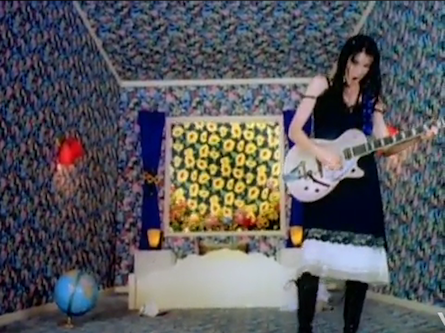
In praise of Meredith Brooks’ “Bitch” music video fashion. Takes me right back to grade six… [XOJane]

Rachel Hills laments the lustre of the It Girl. [Musings of an Inappropriate Woman]

Should recreational drugs be decriminalised? [MamaMia]

Consent, ignorance and “The Unintentional Rapist”. [Persephone Magazine]

Charlie Fine: boy wonder. I hope my future 11-year-old is a switched on as this kid. [MamaMia]

“Your pussy isn’t pretty enough” and other vulva-shaming myths. [Rachel Rabbit White]

The perils of being a black woman dating. [Jezebel]

Feminism is NOT a dirty word, Beyonce. [Jezebel]

The feminine girl geek mystique. [Persephone Magazine]

New show The Playboy Club as feminist text? [Jezebel, via NPR]

“When The Rapist is a She.” [Salon]

“Lest we forget” about asylum seekers? [MamaMia]

Muslim Americans: they’re just like other Americans! [Salon]

Mitt Romney’s abortion history. [Salon]

On Generation X nostalgia. [The New York Times]

Breastfeeding: a feminist issue. [Persephone Magazine]

In defence of Rihanna’s “Man Down” video. [Persephone Magazine]

“What Happened to Obama’s Passion?” [The New York Times]

Does “sport get way too much attention in Australia to the detriment of other national heroes?” [BBC News]

Clark Gable’s old Hollywood “Scandal that Wasn’t”:

“But the studio didn’t quite have a handle on his [Gable’s] image, casting him as an unrepentant villain and a laundryman. This was akin to casting Channing Tatum as a bad guy or smart person, when everyone knows he should only be taking off his shirt and/or doing dance moves, preferably while in the rain. Even cast in the wrong roles, Gable was remarkable. MGM’s head of publicity thus decided to further refine Gable’s image, capitalizing on his rural past and six-foot frame to create Clark Gable, The Lumberjack in Evening Clothes.” [The Hairpin]

How to be a dead body on TV. [The Wall Street Journal]

Fashion’s next big thing: a 10-year-old French girl. [Jezebel]

Image via XOJane.

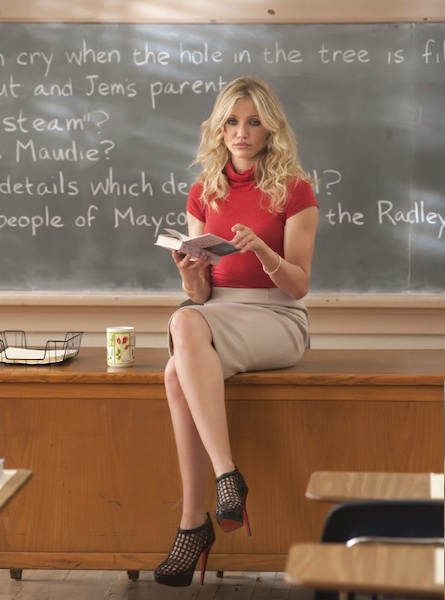
Movie Review: Bad Teacher*.


Bad Teacher was released at an inopportune time, having to follow in the footsteps of Bridesmaids, a movie that has been deemed revolutionary for the simple “fact that two women hav[e] a realistic conversation about sex in a café,” as Caitlin Moran told Rachel Hills in her Sunday Life profile last weekend.

In comparison to Kristen Wiig’s “realistically weak female character” in the Judd Apatow hit, who acts exactly how a real down-on-her-luck woman would act, Cameron Diaz’s Elizabeth Halsey has been called “a lazy, lying, scheming, slutty, and obstinately materialistic [character], whose sole redeeming virtue is her hard body… who is so delusional that she thinks her ostentatious assholery is rock-star sexy, and whose delusions are essentially validated by narrative resolution,” by Karina Longworth in Los Angeles Weekly.

And while this was true (she gets away with stealing the results to the state test in order to win money to get a boob job, and gets the sweet and goofy guy she’d been treating like shit the whole movie), it was no way near as bad as I envisioned it to be in terms of it being anti-women, or at least anti-Bridesmaids-esque-feminism.

It was horrifically racist and downright disturbing in some parts, though. Unhinged goody two-shoes Amy Squirrel is forced to transfer to one of the most dangerous and underprivileged schools in the state, Malcolm X High School. Her boyfriend, Justin Timberlake’s pathetic character, Scott Delacorte, praises Elizabeth for teaching her kids that they should never stop working on themselves by getting a boob job. He also has a thing for “oriental” food. And don’t even get me started on the dry hump scene. It was as pointless as Timberlake’s appearance in The Love Guru. Or his whole acting career in general.

It was hilariously funny in some parts, but if you’re looking for a strong narrative with diverse and realistic female characters, maybe seek out Bridesmaids again. If you’re looking for some mind-numbing 90-minute escapism (as opposed to all these two-and-a-half-hour wastes of time), Bad Teacher’s your movie.

*It has come to my attention that I give away too much in my movie reviews, so the asterisk will now serve as a blanket *spoiler alert* from now on.

Related: Bridesmaids Review.

Elsewhere: [Musings of an Inappropriate Woman] Caitlin Moran Cover Story Sunday Life.

[LA Weekly] You Want a Raunchy Comedy Starring Women? Be Careful What You Wish For.

In Defence of Mia Freedman.


Mia Freedman’s copped it pretty hard in the media the last couple of weeks, ever since her comments about Cadel Evans and sports stars being held up as heroes.

It’s no secret that Freedman is my idol, so I will go to bat for her til the cows come home. She’s the reason I became a writer. She’s the reason I did work experience at Cosmo. I share a lot of her views. Whether it’s just a happy coincidence, or I’ve shaped my views around hers (I started reading Cosmo at 15, a very impressionable age, so it’s more than likely the latter), I don’t know.

I’ve written about my love for Freedman, followed closely by former Girlfriend and Cleo editor, and current Sunday Life editor, Sarah Oakes, numerous times, and how the incestuous nature of the magazine world ensures a similar writing and editing style from those who work together. Take Freedman and Zoë Foster, for example. Or Oakes and Girl with a Satchel’s Erica Bartle and Musings of an Inappropriate Woman’s Rachel Hills.

Speaking of Sunday Life, Freedman’s column last weekend solidified why she’s a woman after my own heart.

She wrote about spending time with her family, and how planning big events are always a disaster and it’s the little, “mundane moments” that are memorable.

But back to the issue at hand: sportspeople as heroes.

I agree wholeheartedly that sportsmen and women aren’t heroes. (I threw up in my mouth a little bit when Karl Stefanovic and Lisa Wilkinson stood for the national anthem after Evans won the Tour de France.) Yay, they can “swim fast”, “kick a ball with accuracy”, “run quickly” and “jump over high things”. But how does this make them heroes? It makes them superficial “heroes” or emblems of sporting events in which they did good, but not actual heroes. We can leave that title to soldiers, doctors, activists, social workers, firefighters and others who face death and social injustice to save lives and make the world a better place.

As Freedman reiterates:

“I roll my eyes every time another Australian of the Year is named and it’s a sportsperson. I cringe at the CONSTANT sycophancy and praise heaped on sportspeople and the way they are forever lauded as heroes… How does being highly physically capable make you a hero?”

I read somewhere that it is highly likely Evans will be named 2011’s Australian of the Year, so start warming up those eye sockets, Mia!

I brought this notion up with a coworker last week, who said doctors aren’t heroes just because they’re saving lives. But what about Doctors Without Borders, or doctors and nurses with the armed forces? “Well, that’s different,” he said. Why? Because they’re facing their own death whilst trying to prevent someone else’s? But sportspeople aren’t facing death (okay, sometimes they are), and their payoff is purely selfish.

Said coworker mentioned some AFL “hero” who, back in the ’70s (I think; don’t quote me on this), finished the grand final with a torn ligament and brought the premiership home. Some might call it heroism; others stupidity.

And I think the sportsperson=hero dichotomy is abhorrent, considering the extracurricular allegations levelled at some of them. Is Nick D’Arcy a hero for punching some guy and leaving him with irreparable facial damage? Are the Collingwood FC guys heroes for winning last year’s premiership, with some of them subsequently going on to allegedly sexually assault one or some groupies? How about the world class douchebag Brendan Fevola? Or Tiger Woods? O.J. Simpson? Hardly heroes.

Perhaps we should be looking to sportspeople like Glenn McGrath, who works tirelessly for his late wife’s breast cancer foundation. Or the Essendon FC, who work with schools to improve literacy. While not exactly heroes per se, at least they’re doing something other than hitting and kicking balls.

Freedman writes in a related piece:

“Sporting stars may have great physical skills but that’s all. They’re no smarter or better or nicer or more well intentioned than the average Australian. In fact, I would argue that generally (and of course this is a generalisation), they are less informed, less aware and less street smart than the average bear.

“This is because to become a great athlete, you have to spend many years from the time you are very young, refining your skills. That’s years swimming up and down a pool. Years running around a track. Years kicking a ball or hitting it with a bat.

“Years…

“I’m happy for anyone who CHOOSES to spend years of their life dedicated to their sport. Go for it. But let’s not pretend it’s a selfless or noble pursuit.

“Professional athletes do it for many reasons. Sponsorship dollars. Personal satisfaction. A desire to represent their country or be the best at swimming or kicking or hitting or whatever it is they’re good at.”

Without humiliating anyone, I find the “less informed, less aware and less street smart” contention is particularly true of one of my physically gifted friends.

While he has a Masters and is one of the most book-smart people I know, he admitted to me that until he was in his late teens, he was completely sheltered by his parents. So much so that he didn’t buy his first CD until around this age. Up to that point, he listened to whatever his parents wanted to listen to, because it was pretty much school, practice, competitions, and the only musical exposure he got was in the car on the way to said school, practice, competitions.

Now the kind of sports he plays aren’t exactly your true blue AFL or cricket (in fact, they’re so obscure I won’t mention them here at the risk of giving him away!), so he’s in another boat altogether: his sports would be, and have been, ridiculed by both your Aussie bogan and your highbrow cultured Australian.

Now, from what I’ve read, Cadel Evans is involved in other noble pursuits, like charity. Unfortunately, I think Freedman’s point was sullied by using Evans to bring it up on national television. Perhaps if she were talking about Stephanie Rice or Ben Cousins her contention would have been more well received. But that’s the risk you run when you voice an opinion that’s not of the norm.

And that’s why I love her. Sure, she got crapped on by most of Australia for making a valid point. But she was able to return to voicing her opinion on Today the same time the following week, joking about going into witness protection, but getting a haircut instead. She was able to find the humour in the situation, and see where she might have been wrong.

For the record, I don’t think she was wrong.

Related: Everything They Touch Turns to Gold.

Mama Mia: A Memoir of Mistakes, Magazines & Motherhood By Mia Freedman Review.

Mia Culpa: Confessions from the Watercooler of Life by Mia Freedman Review.

Elsewhere: [MamaMia] Cadel Evans: Is He a Hero?

[MamaMia] Cadel: Here’s What I Learned.

[MamaMia] Is Being Australian Really So Much About Gold Medals?

[MamaMia] Stephanie Rice. Enough With the Hero Worship.

[MamaMia] When Family Time is a Nightmare.

Image via ArtsHub.