On the (Rest of the) Net.

Clueless_053

“Can We Just, Like, Get Over the Way Women Talk?” [The Cut]

Why women shouldn’t change their names in the internet age. [Cosmopolitan]

After Jackie: What’s changed since “A Rape on Campus”? [Media Matters]

Matt McGorry is the poster boy for how to be a male feminist. [HuffPo Women]

How to deal with the green eyed monster that’s eating you up inside. [Musings of an Inappropriate Woman]

What happens when two men create a podcast about Gilmore Girls? Gilmore Guys. [NYTimes]

Why we shouldn’t judge Go Set a Watchman so harshly. [The Guardian]

Image via I Love Wildfox.

On the (Rest of the) Net.

When-She-Just-Lying-Naked-Smoking-Trunk-Full-Money

“To be Rihanna… To be a black woman and genius, is to be perpetually owed.” [Pitchfork]

Why we find the sexualised violence of #BBHMM so disturbing. [HuffPo Women]

The Supreme Court of the United States’ landmark decision to legalise marriage equality nation wide is great, but the freedom to marry should also mean the freedom not to marry. [The Cut]

The Kim Kardashian sex tape flag at Kanye West’s Glastonbury set shows women’s sexualities aren’t their own. [The Guardian]

Has Kim changed… or just the way we think about her? [Daily Life]

Orange is the New Black and a defence of rape scenes:

“My hope is that going forward we can have a Pennsatucky Test for rape scenes much like the Bechdel Test. Is the victim’s point-of-view shown? Does the scene have a purpose for existing for character, rather than plot, advancement? Is the emotional aftermath explored? As long as sexual assault continues to be a scourge of our society, TV shows ought to mine the subject; it’s important we keep the conversation going. Just take care of your characters. Don’t rape ’em and leave ’em. They deserve to have their trauma acknowledged. They deserve to have their stories told.” [Vulture]

“The Personal Politics of Public Bathrooms.” [The Cut]

Grief in the time of social media. [Kill Your Darlings]

Why does TV suck at understanding the internet? [Junkee]

To celebrate U.S. series UnREAL‘s renewal and debut on Australian screens on Stan, read about how the show flips the reality TV script and how it’s pushing the boundaries of female masturbation. [Vulture, TV Tonight, The New Yorker, HuffPo Women]

Mums with guns. [Jezebel]

Magic Mike XXL was released this week and I wrote about the original here. [TheVine]

The latest Down Under Feminists Carnival has much more Aussie and Kiwi feminist goodness to keep you satisfied. [A Bee of a Certain Age]

Image via Pop Sugar.

On the (Rest of the) Net.

“Barack Obama is not the first president to say ‘n*igger’—he’s merely the first one not to utter it as a slur.” [Talking Points Memo]

Why white women need to stand up against racism. [New Republic]

It’s time for equal-opportunity nudity on TV. [Spook Magazine]

Further to that, why do the breasts of Game of Thrones all look the same? [Fusion]

Accessing Disneyland with a disability. [New Mobility]

On the (Rest of the) Net.

Britney Spears and Iggy Azalea’s “Pretty Girls”‘ emphasis on looks dates the song. [Pitchfork]

The reemergence of talking about abortion. [WaPo]

Jurassic World didn’t have to be “overtly feminist”, just “overtly not sexist”. [Vulture]

The return of the teen movie. [The Dissolve]

Just when you thought Mad Max: Fury Road couldn’t be milked (pardon the pun) for any further feminist viewpoints, someone writes a breast milk article. [Bitch Flicks]

The rise and rise of In Touch magazine. [Buzzfeed]

ICYMI: “The Perception of Power in Orange is the New Black.

The Perception of Power in Orange is the New Black.

orange is the new black season 3 piper

*This piece contains spoilers for the third season of Orange is the New Black.

In the lead up to last Friday’s debut of Orange is the New Black’s third season, promos littered the internet about how the show would deal heavily with faith and motherhood this time around.

The motherhood motif bookends the season, with the inaugural episode opening with a Mother’s Day fete at Litchfield while the requisite flashbacks deal primarily with each prisoner’s relationship to motherhood, whether as a parent or a daughter.

But one of the less obvious but just as imperative themes of season three is power and the perception of it.

Power manifests itself in many guises this season but takes root in several main storylines.

Piper, using the money in her commissary account (a privilege her upper middle class pre-prison lifestyle affords her in itself), buys out all the noodle flavouring packets the prisoners have taken to seasoning Litchfield’s new, inedible menu with as an incentive to the other inmates to give her their used underwear to sell in her prison panty business.

Of course, she supplies the underwear that she steals from the new prison “sweatshop” which has Piper, new inmate Stella (played by Ruby Rose), et al. earning $1 an hour sewing “$90 bras” for lingerie company Whispers. And when Stella betrays her by stealing her profits two days before her release, Piper exercises her dominance over her new lover by planting contraband in Stella’s cell and it’s off to max(imum security) she goes.

Piper had originally pointed the finger at Flaca who’d been agitating for “fair pay for skanky panties” in a parallel storyline to the power plays prison manager Joe Caputo has to make as Litchfield becomes privatised. The guards turn to him as they attempt to unionise in the face of pay cuts and lost benefits, however rumblings of Caputo’s internal struggle to be a good guy versus being paid his dues that we saw last season (when Officer Bennett confessed his relationship and subsequent pregnancy with Dayanara Diaz and Caputo told him to sweep it under the rug) reveal themselves and he throws the guards under the bus.
orange is the new black season 3 norma

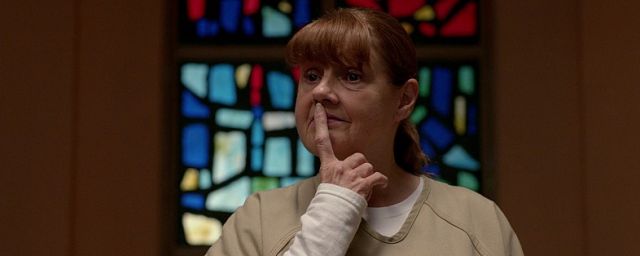
Religion presents as a powerful currency inside as mute Norma is held up as a deity to the meth head laundry crew, Soso and even Poussey. Being the one lorded over in an abusive, polygamous relationship in her backstory, we see Norma relish her newfound religious power.

Meanwhile, Cindy leads her friends in their quest for Kosher meals. While the others are claiming Kosher ’cause it tastes good, Cindy actually has a religious revelation of sorts, and becomes a Jew by season’s end.
orange is the new black season three pennsatucky rape coates donuts

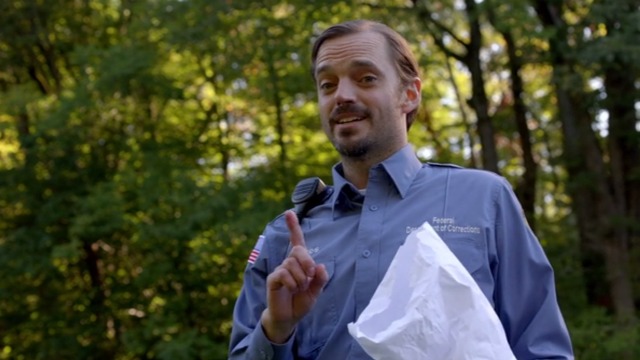
Perhaps one of the more harrowing exhibits of power and just how little female prisoners have is in Tiffany “Pennsatucky” Doggett’s trajectory. Her backstory paints a depressing picture of trading sex for soft drink and after her sensitive and sexually giving high school boyfriend leaves town, she’s raped by a former paramour who didn’t like that she cut off his supply of sex.

Food acts as a snare in Doggett’s relationship with a new guard who also works at a donut shop. During their errand runs off prison grounds, they stop to feed their uneaten donuts to ducks in an uncomfortable violation of prisoner-guard relations. While nothing funny happens for a few more episodes, and it’s unclear whether the guard had designs on assaulting Doggett from the beginning, it reinforces that even if a prisoner is willing, the imbalance of power between guards and inmates is too great for there to be a clear choice. (This is echoed in Daya’s pregnancy.)

Other, arguably less obvious manifestations of power can be seen in the ignorance and violence that further marginalises the already marginalised as rumours about Sophia’s transition circulate; Taystee’s newfound role as the “mumma” of her friendship group; Red’s return to the kitchen; Angie’s escape and, later, the entire prison population’s Litchfield Redemption.

Despite the fun, sisterly environment Orange is the New Black can sometimes portray Litchfield to be, women in prison—and, by extension, women in the outside world—have a lot less power than this article might suggest. In back to back episodes that look at perception, Flaca says of her counterfeit LSD business that “people will believe what you tell them” while Chang is told by a business associate that it’s not whether the exotic animal parts they’re smuggling “work, but whether you think they work.” Even Norma seems incredulous to her apparent religious powers, with her fellow inmates perceiving her hugs when she sees them as their “morning blessing”. Cindy might not have chosen Judaism had she continued her frivolous pre-prison lifestyle, but freedom of religion is a small exertion of power she can express in incarceration.

These seemingly small grabs at power, or the perception of it, is crucial in an environment where lives may depend on it. And in Litchfield, it’s all the women have.

Related: Physical & Mental Health on Orange is the New Black.

Orange is the New Black‘s Morello’s Fractured Relationship with Romance.

Elsewhere: [Vulture] Orange is the New Black Season Three Will Be Lighter, Focused on Faith & Motherhood.

Images via Screenrants, She Knows, IMDB.
On the (Rest of the) Net.

amber rose how to be a bad bitch

Amber Rose’s feminism. [Feministing]

I raged against the dire state of Aussie TV, particularly in terms of storytelling and racial diversity. [Spook Magazine]

Miss Piggy, ourselves. [Fusion]

Rape jokes are not “just how the internet is”:

“… [T]he idea that the Internet is static and that everyone’s experience of it is the same, and nothing can ever be changed or fixed is an excuse to not fix a system that keeps certain people comfortable and other people uncomfortable.” [Cosmopolitan]

Orange is the New Black and How to Get Away with Murder‘s Matt McGorry is a feminist. [Jezebel]

Black teens using swimming pools need to be saints lest they get arrested. [Pandagon]

Looking at Hot Girls Wanted from an alternative perspective. [Medium]

More links are over at the 85th Down Under Feminists Carnival. [Ana Stevenson]

Image via Slumz.


On the (Rest of the) Net.

Caitlyn Jenner Vanity Fair

Trans women like Caitlyn Jenner and Laverne Cox have the visibility, power and acceptance to “lift up” trans people who don’t have such privileges. [Laverne Cox]

Fixating on Caitlyn’s perceived “hotness” hurts the trans community:

“… Be conventionally attractive and feminine, and you get reduced to your appearance like any cis woman; don’t, and people won’t accept your identity as legitimate.” [Vocativ]

I asked if Kris Jenner is a bad mother. [Bitch Flicks]

The age gap between some of Hollywood’s most in demand young actresses—Scarlett Johansson, Emma Stone and Jennifer Lawrence—and their much older on-screen love interests. [Vulture]

How Mansplaining, the Statue went viral. [Weird Sister]

To ladyblog or not to ladyblog? [Slate]

The dawning of the age of a new (female) action hero. [Vulture]

The language we use to speak about rape may be part of the problem.

Sport is the “great equaliser”. Except when it comes to race:

“Indigenous players are ‘Australians when they’re winning and Aborigines at other times.'” [Overland]

Australia “reserve[s] a special disdain for ‘uppity blacks'” like Adam Goodes who don’t know their place. [New Matilda]

To all those busybodies who enquire when you’re going to have children: “I am writing my final no-thank-you note.” [Longreads]

ICYMI: “Writing About Taylor Swift Ruined My Friendship!”

In defence of the apparently unintelligent lyrics of pop and rap music.

Writing About Taylor Swift Ruined My Friendship!

BlankSpaceLogo_FINAL_DomBoldBT_BLUR_neg_small

This is a version of a post that originally appeared on Writer’s Bloc as part of their May series on balance. Republished with permission.

A few years ago I wrote a blog post about Taylor Swift’s anti-feminist lyrics. Perhaps ill advisedly, I used an example from my friend’s love life to illustrate my point about Swift’s detrimental view of gender roles in her music without my friend’s consent.

This friend has a soft spot for Taylor Swift, along with Twilight, Glee and young adult fiction, and I believed these biases informed her actions when she started hooking up with my roommate. When their courtship fizzled out a short time later, she revealed to me that because they were friends first, she didn’t feel that as lovers their relationship was any different: where were all the grand gestures on his part, she wondered?

Now, at the time I thought this observation would perfectly prove my assertion that Swift’s lyrics and anti-feminist rhetoric in interviews enforced an ideal that heterosexual relationships must take the shape of fairytale romances that are performed primarily by the guy, while the woman is just a passive receiver of surprise weekend getaways, jewellery and flowers.

In hindsight, perhaps my opinion about my friend’s love life wasn’t something I should have published on my blog, or even passed judgment on in the first place. Needless to say, she didn’t think so either as we’re no longer in contact.

Funnily enough, after that shit went down, I suffered a bout of writer’s block that lasted the better part of a year. Karmic retribution, perhaps?

This is not the first time I’ve gotten into trouble with a friend for airing their dirty laundry in my prose. About a year and a half before the post that ended a friendship, I wrote about how I thought one of my friends wasn’t very socially adept due to a sport-focused sheltered upbringing and how this informed my broader point that sportspeople shouldn’t be held up as heroes (a topic that was doing the rounds in the news that week). Understandably, he was very hurt that I used personal details he’d told me in confidence to further my agenda and that I had those opinions about him. He’s a bigger person than both myself and my former friend, though, as he was able to see both points of view and hash it out with me like an adult and our friendship has since recovered. (Yes, I ran his inclusion by him prior to publication!)

The irony is that the singer herself is all too familiar with mining her and others’ personal lives for her work. I’m not trying to equate my writing with Swift’s or that using other people’s stories is the same as using your own, but I’d like to think she could relate. Either way, we both wrote and write about people who are no longer in our lives, a feat some writers are more adept at that others.

But how much of the personal anecdotes of the people in our lives do writers have the permission to share? Obviously, I had permission to share neither experience, but in the absence of anything happening in my own love life and the desire to act as therapist to another friend, respectively, I crossed a line.

And it’s a fine one to write on when you’re crafting memoir. Increasingly, I’ve been delving into the personal essay and wondering whose stories and lives I share I have the permission to make public.

How specific can you get when using identifying details in your writing? At the time of publishing the pieces in question, only a few of my friends were reading my blog and would have realised who I was writing about. The majority of people who read my work are unknown to me. But just because only a handful would recognise the subject in question doesn’t necessarily mean writers have free reign over how they’re represented.

Writers such as Lena Dunham and Janet Mock share that problem on a global scale. Dunham’s memoir, Not That Kind of Girl, drew controversy last year when she wrote of her curiosity about her sister’s body parts and an alleged date rape in college. Though names and other details were altered, a fellow student of Dunham’s alma mater was falsely identified as her attacker. Mock shared concerns about the portrayal of her family in Redefining Realness, her memoir about growing up trans in Hawaii. When the stakes are that much higher—being perhaps the most influential millennial in a decade and coming out as a gender identity much of the world is yet to accept as legitimate, respectively—there’s an increased likelihood that your audience and subjects take issue with your words.

Call it the life of a writer or chalk it up to my own narcissism or lack of imagination but it would seem that I haven’t learned my lesson as I’m still writing about the people and situations that caused friction in my personal life in the first place.

Related: Taylor Swift—The Perfect Victim.

In Defence of Mia Freedman.

Elsewhere: [Writer’s Bloc] Writing About Taylor Swift Ruined My Friendship!

Image via Blank Space.

In Defence of Pop & Rap’s “Unintelligent” Lyrics.

10_years_average_genres_logo

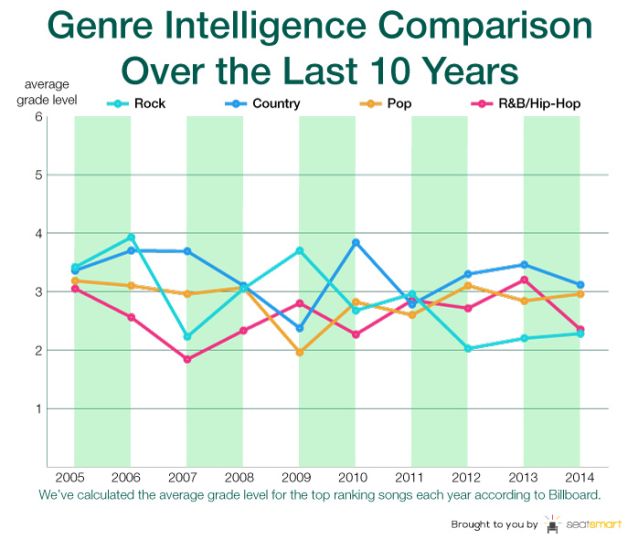
Last week I posted a link to a study by Seat Smart about the most unintelligent songs of the past decade in which the genres of pop and R’n’B/rap/hip hop featured heavily.

Word length and the amount of syllables therein were factors in pushing a song over the edge from unintelligence to intelligence. From the study:

“Country music is full of words like Hallelujah, cigarettes, hillbilly, and tacklebox. Add to that long place names like Cincinnati, Louisville, Mississippi, and Louisiana, and [c]ountry has a serious advantage over the competition.”

Country music coming out on top as the most intelligent genre is laughable; this is the inherently sexist genre that brought you such gems as “Thank God I’m a Country Girl” and Taylor Swift before she found feminism. Just because country originated in parts of America with really long names don’t mean jack. (I tried my hand at some country-esque parlance there.)

Though you wouldn’t think it from the flashy and oftentimes nonsensical rap styles of Pit Bull and Snoop Dogg phoning it in on tracks like Katy Perry’s “California Gurls”, rap and hip hop were spawned in some of the poorest and most downtrodden parts of major cities where their primarily black and Hispanic residents were oppressed and discriminated against and where drugs and crime were rampant. In his younger days, Tupac Shakur rapped about police brutality (“Trapped”, “Changes”), slut shaming, sexual assault and STDs (“Brenda’s Got a Baby”, “Keep Ya Head Up”, “Baby Don’t Cry”), and drugs (“Changes”), while N.W.A. produced songs with similar content.

As is evident in the popular music that the study chose to… erm… study, the rap that makes it to the top 40 charts isn’t necessarily an accurate depiction of the genre as a whole. Take, for example, Kendrick Lamar. I’m not super familiar with his work but I do know that the most commercial success he’s seen came with his recent cameo in Taylor Swift’s (of country music origins) video for “Bad Blood”. And while we all have an opinion on Kanye West, he raps intelligently—although this study would seek to disprove that—about fame, money, racism. (His inclusion on Katy Perry’s “E.T”, making it one of the past decade’s smartest songs, while Perry’s “Wide Awake” with no obligatory rap interlude makes it the 10th dumbest song of the decade should be indicative of rap’s—or at least Kanye’s—value.) This is not to mention the copious amounts of underground and unreleased rap out there.

When it comes to women, Mariah Carey (“We Belong Together” is finally getting its due as one of Mariah’s more artful arrangements) and Nicki Minaj (again, her unreleased stuff is far more sophisticated than “Anaconda” and “Starships”) are topping the intelligence scales while Beyonce makes an appearance in both intelligent and unintelligent lists. That the biggest and best artist in the world today could be described using the word “unintelligent” is a crime. It just goes to show that word length alone doesn’t demonstrate the myriad aspects that go into creating music.

hip_hop_logo

It’s also interesting that many of the artists who rank high in intelligence are appropriating the music of other cultures, ie. Eminem and Macklemore. (My mother recently said she thought Eminem was the best rapper, despite the high rotation of rappers of colour on my and my sister’s CD players in our youth.) On a related note, Iggy Azalea is nowhere to be found in this study.

pop_logo

country_logo

Sure, songs like “California Gurls” and “Tik Tok” may indicate our lowering intelligence as a culture (though, having said that, these are two of my favourite songs to get down on the dancefloor to, so do with that what you will), but artists like Lady Gaga, Beyonce and Taylor Swift (despite what the study says!) who are changing the game would suggest otherwise.

What do you think? Do you agree with the study’s assertions or would you counter them like I have?

Related: On the (Rest of the) Net: 29th May 2015.

Taylor Swift: The Perfect Victim.

Elsewhere: [Seat Smart] Lyric Intelligence in Popular Music: A Ten Year Analysis.

[Jezebel] Country Music Dude: In Radio, Female Performers Are Basically Garnishes.

[The Guardian] Taylor Swift: “Sexy? Not on My Radar.”

Images via Seat Smart.

On the (Rest of the) Net.

tumblr_mqpicreI5x1qagxv6o1_500

I wrote about how writing about Taylor Swift ruined my friendship. [Writer’s Bloc]

I also recapped Outback Championship Wrestling’s latest show.

And I hosted their podcast, chatting to Ricardo Rodriguez.

While we’re shamelessly self-promoting, I’m also at Bitch Flicks writing about Shondaland’s bad mothers. More bad mother content to come in next week’s collection.

How to talk to random women on the street: don’t. [The Nib]

The history of masculinity in fraternities. [The New Criterion]

The problem with #StellasChallenge. [Daily Life]

The Good Wife‘s Alicia Florrick’s wardrobe changes as her character does. I’ve just started watching this series so it’s interesting to see the looks I’m familiar with and how Alicia changes over the subsequent four seasons I’m yet to watch. [The Hairpin]

These lyric intelligence ratings from pop songs from the past ten years made my blood boil. More to come next week. [Seat Smart]

“Follow that”: a #WomensWrestling roundtable. [World Wrestling Entertainment]

More HIV-positive characters on TV will lead to an increase in awareness about the disease. [HIV Plus Magazine]

ICYMI: The death of McDreamy will allow Grey’s Anatomy‘s other characters to grow and change.

Image via One Week One Band.