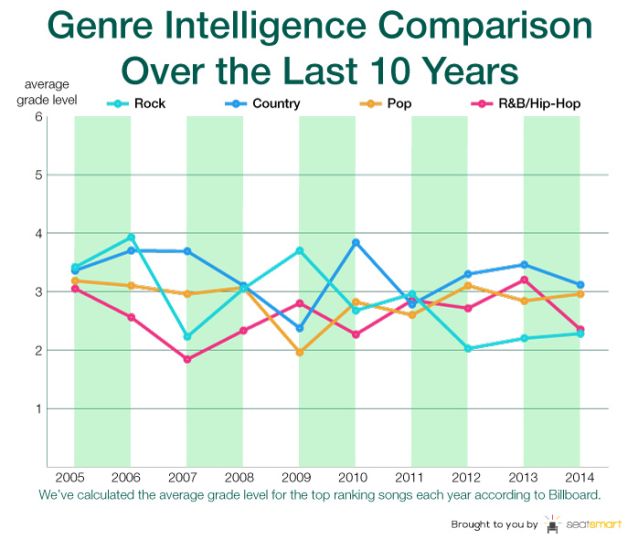
Last week I posted a link to a study by Seat Smart about the most unintelligent songs of the past decade in which the genres of pop and R’n’B/rap/hip hop featured heavily.
Word length and the amount of syllables therein were factors in pushing a song over the edge from unintelligence to intelligence. From the study:
“Country music is full of words like Hallelujah, cigarettes, hillbilly, and tacklebox. Add to that long place names like Cincinnati, Louisville, Mississippi, and Louisiana, and [c]ountry has a serious advantage over the competition.”
Country music coming out on top as the most intelligent genre is laughable; this is the inherently sexist genre that brought you such gems as “Thank God I’m a Country Girl” and Taylor Swift before she found feminism. Just because country originated in parts of America with really long names don’t mean jack. (I tried my hand at some country-esque parlance there.)
Though you wouldn’t think it from the flashy and oftentimes nonsensical rap styles of Pit Bull and Snoop Dogg phoning it in on tracks like Katy Perry’s “California Gurls”, rap and hip hop were spawned in some of the poorest and most downtrodden parts of major cities where their primarily black and Hispanic residents were oppressed and discriminated against and where drugs and crime were rampant. In his younger days, Tupac Shakur rapped about police brutality (“Trapped”, “Changes”), slut shaming, sexual assault and STDs (“Brenda’s Got a Baby”, “Keep Ya Head Up”, “Baby Don’t Cry”), and drugs (“Changes”), while N.W.A. produced songs with similar content.
As is evident in the popular music that the study chose to… erm… study, the rap that makes it to the top 40 charts isn’t necessarily an accurate depiction of the genre as a whole. Take, for example, Kendrick Lamar. I’m not super familiar with his work but I do know that the most commercial success he’s seen came with his recent cameo in Taylor Swift’s (of country music origins) video for “Bad Blood”. And while we all have an opinion on Kanye West, he raps intelligently—although this study would seek to disprove that—about fame, money, racism. (His inclusion on Katy Perry’s “E.T”, making it one of the past decade’s smartest songs, while Perry’s “Wide Awake” with no obligatory rap interlude makes it the 10th dumbest song of the decade should be indicative of rap’s—or at least Kanye’s—value.) This is not to mention the copious amounts of underground and unreleased rap out there.
When it comes to women, Mariah Carey (“We Belong Together” is finally getting its due as one of Mariah’s more artful arrangements) and Nicki Minaj (again, her unreleased stuff is far more sophisticated than “Anaconda” and “Starships”) are topping the intelligence scales while Beyonce makes an appearance in both intelligent and unintelligent lists. That the biggest and best artist in the world today could be described using the word “unintelligent” is a crime. It just goes to show that word length alone doesn’t demonstrate the myriad aspects that go into creating music.
It’s also interesting that many of the artists who rank high in intelligence are appropriating the music of other cultures, ie. Eminem and Macklemore. (My mother recently said she thought Eminem was the best rapper, despite the high rotation of rappers of colour on my and my sister’s CD players in our youth.) On a related note, Iggy Azalea is nowhere to be found in this study.
Sure, songs like “California Gurls” and “Tik Tok” may indicate our lowering intelligence as a culture (though, having said that, these are two of my favourite songs to get down on the dancefloor to, so do with that what you will), but artists like Lady Gaga, Beyonce and Taylor Swift (despite what the study says!) who are changing the game would suggest otherwise.
What do you think? Do you agree with the study’s assertions or would you counter them like I have?
Women-hosted podcasts are the next big thing. Glad I’m on the bandwagon then, as I just hosted my first podcast for Outback Championship Wrestling, interviewing TNA star and Amazing Race contestant, Robbie E. I’ll post it here when it’s available. [Bitch Magazine]
And I also recapped last weekend’s Outback Championship Wrestling show featuring Robbie E.
Clementine Ford writes about the Girls on Film Festival in Melbourne from the 12th to 14th of September: “Where are the men’s film festivals?!” [Daily Life]
Evelyn Enduatta writes about “a pivotal time in the local history of my adoptive Yolŋu family…. [and] the introduction of wage labour relations in north-east Arnhem Land[;]… a case study in the nature and violence of alienation.” [Upswell]
Clementine Ford sheds light on the savage beating of adult actress Christy Mack by her mixed martial arts fighter ex-boyfriend War Machine. [Daily Life]
“Perhaps it might be more useful for the Government to focus more on things like housing affordability, availability of jobs, and letting young people access the welfare system rather than funnel millions of dollars into a counselling voucher scheme.” [SBS]
Clem Bastow writes heartbreakingly about never being “enough”:
“You don’t tell your boyfriend, or your parents, or your friends, or your kind therapist that you’re thinking about all these things, because you figure it’s not worth being upset about after all these years, even though you are. You see people go through far worse things and continue the ‘It could have been much worse!’ charade, even though some days you feel so sad you want to lie down on the carpet for a week. Why can’t you just get over it? Why can’t you Think Positive About It All? Why would anyone write you a letter about such small things that it’s not worth being upset about, Dear Young Person?
“Young Person, you think a lot about all of these things. There are so many others: you laugh off your Bipolar 2 diagnosis as ‘the straight-to-video sequel to a real mental illness’; your plummeting weight during a two-year spell overseas is just ‘Los Angeles, lol!’; the nights you eat Vitamin C tablets for dinner are fine because ‘Other people are poorer’; the guy who makes you wear a horse-bit to bed is ‘great comedy material!’; the death of your dear dog at just five years of his young life ‘isn’t as bad as it would have been if he’d been around for 15 years, I guess.’ It never seems to be quite enough to be upset about, not really, truly upset, like some people have the right to be. Not poor enough, not depressed enough, not beset by grief enough, not abused enough.” [I Believe You, It’s Not Your Fault]
My Decision/Kei a au te Whakataunga is a New Zealand-based campaign to shed light on health care professionals who refuse to provide or refer productive health services. [The Hand Mirror]
And there’s no shame in making these health care professionals known so that people in need of reproductive health care don’t make the mistake of visiting them. [The Hand Mirror]
“There’s a bigger debate to be had here about whether care work is valued enough (it’s not), whether the needs of children are prioritised appropriately (they’re not), and whether the desire by both men and women to spend time with their children is accepted (it’s not), but let’s at least agree that eliminating child care struggles is crucial for undoing sexist gender-role divisions. Where women can’t get to work they can’t achieve personal career goals, but nor can they claim the kind of decision making power that comes with income.” [Daily Life]
It’s all well and good to feature a panel about the politics of sex work as part of Sydney’s Festival of Dangerous Ideas, but perhaps it should, I don’t know, feature some sex workers? [Sex, Lies & Duct Tape]
Melbourne schoolgirls were inspired to Kickstart their own “feminist collective” in the wake of Women Against Feminism and after “studying the character of ‘Curly’s Wife’ in John Steinbeck’s Of Mice & Men.” [ABC]
“Do you want to know how many pictures I shot before I actually captured a photo that both accurately (and attractively) displayed how happy I was in this moment? 56. I hope you’re judging me, because I am.” [Bustle]
My piece on physical and mental health on Orange is the New Black is cross-posted over at Bitch Flicks.
Katy Perry is pretty well known for her cultural insensitivity. When she’s not spurting whipped cream from her breasts in a Teenage Dream, she’s appropriating Asian, black and Middle Eastern culture, and the video for her latest single, “This is How We Do”, is no exception.
In a candy coloured world so similar to much of Perry’s other work, “This is How We Do” features cornrows, baby hair, bleached eyebrows, watermelons, “Japanese-y” manicures, “big hoops, maroon lips” and “throw[ing] up peace signs and cock[ing] her neck in a bubblegum version of chucking the deuces”, as Jezebelputs it, all of which are not necessarily positively associated with the abovementioned races in one way or another.
When asked in a recent Rolling Stone cover story about her penchant for cultural appropriation, Perry feigned indignation at being left behind in a political correct era. She responded thusly:
“I guess I’ll just stick to baseball and hot dogs, and that’s it… I know that’s a quote that’s gonna come to fuck me in the ass, but can’t you appreciate a culture? I guess, like, everybody has to stay in their lane? I don’t know.”
Perry hasn’t managed to “stay in her own lane” when it comes to her Prismatic world tour. For her performance of “I Kissed a Girl” she surrounds herself with big-bootied, big-lipped and dark-haired mummies in what looks like a half-assed homage to Lily Allen’s “Hard Out Here” or Miley Cyrus. Perry says, “As far as the mummy thing, I based it on plastic surgery… Look at someone like Kim Kardashian or Ice-T’s wife, Coco. Those girls aren’t African-American. But it’s actually a representation of our culture wanting to be plastic, and that’s why there’s bandages and it’s mummies. I thought that would really correlate well together… It came from an honest place. If there was any inkling of anything bad, then it wouldn’t be there, because I’m very sensitive to people.”
Because if something comes from an honest place, it can’t possibly be racist, right? (Not to mention the fact that whether or not the white privileged lady thinks something she did wasn’t offensive is irrelevant.)
Recently I pointed out on a friend’s Facebook comment thread that an exchange about Khloe Kardashian and her ex-husband, Lamar Odom, could be construed as racist. There was some back and forth about how that wasn’t the intention, but in the end the defence was very Perry-esque in nature. Cultural ignorance shouldn’t be an excuse for cultural insensitivity.
To use an example I heard spewed from the mouth of a colleague, just because you personally think Indigenous footballer Adam Goodes looks like a monkey, doesn’t mean the young fan who called him this at a game was right in doing so. Sometimes the harmful trajectory of terminology—that black people were compared to monkeys and thought of as less than human throughout history—is more important than freedom of expression.
As Supreme Court Justice Ruth Bader Ginsburg said in a recent interview with Katie Couric (which you can watch here), “You can exercise your right to free speech until it is affecting other people”.
While Perry’s at her cultural appropriation game, maybe she can take a page out of Notorious RBG’s book…?
So misogyny may be running wild in the real world, but on TV, girls are calling the shots. We’ve had a bevvy of shows with “girl/s” both in the title and the storylines this year, with 2 Broke Girls and New Girl carrying their success over from 2011. While a lot of the subject matter is problematic, both shows have women carrying the comedy. Which brings us to just plain Girls, which is the brainchild of actor, writer and director Lena Dunham. Girls is not without its problems, either, but its portrayal of young urban women is almost faultless. Rounding out the representation of leading ladies in 2012 we have Don’t Trust the Bitch in Apartment 23, Homeland, Revenge, The Mindy Project, Are You There, Chelsea?, Smash, GCB (farewell!), Scandal, Nurse Jackie, Veep, Emily Owens, M.D., Whitney, The Good Wife and Hart of Dixie.
“Call Me Maybe”.
Until “Gangnam Style” came along, the YouTube Zeitgeist was dominated by one runaway success: Carly Rae Jepsen’s “Call Me Maybe”. Justin Bieber’s protégé came out of nowhere with the catchiest song of the year, which was subsequently covered by the guys from Harvard’s baseball team, Barack Obama and the Cookie Monster! Talk about diversity!
2012: Apocalypse Now.
2012 was the year of the apocalypse, with the 21st of December long determined by the Mayans (or Mayan conspiracy theorists) as the day the world ends. You know, until the 7th of December tried to steal its thunder as the apparent recalculated date. Apart from the natural disasters, warfare and massacres, the 21st passed without a nuclear bombing, ice age or attitudinal shift, putting rest to the apocalypse panic. Until the next rapture, anyway…
Shit ___ Say.
It started with a sexist albeit funny YouTube video of a guy in a wig quoting “Shit Girls [Apparently] Say”, which snowballed into “Shit White Girls Say to Black Girls”, “Shit New Yorkers Say”, “Shit Christians Say to Jews” and “Shit Nobody Says”. Cue offence.
Snow White.
Snow White was everywhere this year: Mirror Mirror, Snow White & the Hunstman, Once Upon a Time… Note: overexposure isn’t necessarily a good thing. In fact, I hated Mirror Mirror and Once Upon a Time, and Snow White & the Huntsman was such a snooze-fest I can barely remember what happened (not including Kristen Stewart’s affair with director Rupert Sanders).
50 Shades of Grey.
On the one hand, E.L. James’ 50 Shades of Grey has singlehandedly revived the flailing publishing industry, so that’s a good thing. But on the other, it has falsely lulled its legions of (mostly female) fans into a state of apparent sexual empowerment: it’s a book about sex targeted towards women, so that means we’re empowered and we don’t need feminism anymore, right?
The Macarena of the 21st century, Psy’s horse dance took the world by storm, being performed in conjunction with Mel B on The X Factor, with Hugh Jackman in his Wolverine gloves, on Glee and at many a wedding, 21st birthday and Christmas party.
Misogyny.
Misogyny has long been the focus of feminists, but the word and its meaning really reached fever pitch this year.
After Julia Gillard’s scathing Question Time takedown of Tony Abbott and his sexist ways, people everywhere were quick to voice their opinion on her courage and/or hypocrisy. At one end of the spectrum, it could be said that Gillard finally had enough of the insidious sexist bullshit so many women in the workforce face on a daily basis and decided to say something about it, while at the other, many argued that the Labor party were crying sexism in a bid to smooth over the Peter Slipper slip up.
“Her electric speech on misogyny in parliament went beyond the sordid political context to firmly press a button on the chest of any woman who has been patronised, sidelined, dismissed or abused. It crackled across oceans, and, astonishingly, her standing went up in the polls, defying political wisdom that no woman would benefit from publicly slamming sexism.”
The viral doco that had millions of people rushing to plaster their neighbourhood in “Kony 2012” posters on 20th of April to little effect (the campaign’s goal was to catch Joseph Kony by years end) illustrated our obsession with social media, armchair activism and supporting the “cool” charities, not the thousands of worthy charities out there who could actually use donations to help their cause, not to produce YouTube videos and work the press circuit.
I’m Not a Feminist, But…
While Tony Abbott is clamouring to call himself a feminist to gain electoral favour despite the abovementioned misogyny saga, it seems famous women can’t declare their anti-feminism fast enough.
First we had new mother and Yahoo! CEO Marissa Mayer jumping at the chance to shun feminism despite the fact that without it she wouldn’t be where she is today. My favourite anti-feminist campaigner Taylor Swift said she doesn’t think of herself as a feminist because she “was raised by parents who brought me up to think if you work as hard as guys, you can go far in life.” Um, Tay? That’s what feminism is, love.
The cronies from Sutherland Shire were all over our boxes, primarily on Channel Ten, this year. There was the widely panned Being Lara Bingle, the even worse Shire, and the quintessential Aussie drama set in the ’70s, Puberty Blues.
While these shows assisted in shedding a different light on the suburb now synonymous with race riots, it’s not necessarily a positive one, with The Shire being cancelled and Being Lara Bingle hanging in the balance.
So I’m not the only one who has a problem with Katy Perry’s MuchMusic Awards pre-tween entourage wearing her most famous outfits: including her cupcake bra from the California Gurls video. But why is it so outrageous that a young girl is essentially playing dress up?
I think kids are naturally curious. I remember playing, and watching other children playing as part of a psychology class, the “sex game” at the age of five to about eight. There was nothing sordid about the sex game: it was more of a fun way to use the word without really knowing what it meant.
I developed physically quite early: I grew breasts at about ten years of age, and got my period when I was eleven. I remember being looked at by boys my own age and men who were old enough to know better. I remember dressing in a way to emphasise this, a style of dress I still favour.
But the difference between these two acts and the ages I did them at are innocence and at least seven years. I wasn’t aware of the social implications child “activists” would draw from my primary school sex games.
I dare say the girl—who looks about six—dressed in Katy Perry’s cupcake boobs outfit has any idea how inappropriate her costume is. That falls to the adults around her, a responsibility which they’ve obviously shirked.
Had she been a few years older and was more aware of the kind of attention the costume has brought her, it would be a whole different story.
By the same token, it’s really only pedophiles who are going to get any kind of satisfaction from five year olds playing “mummy and daddy” or “doctor and nurse” and dressing like Katy Perry. Not to trivialise the horrors of pedophilia, but it’s when a girl hits puberty and starts dressing like a 20-year-old that the dangers of acting like and attracting and older set come.
Further to that, maybe a costume is just a costume. Katy Perry is a grown woman with agency and the choice to offer her body up for consumption, but does a little girl really understand this? Is there a difference between her wearing this costume to an event that happens to be broadcast across the world via television, the internet and print media and a backyard birthday party that is photographed by parents and friends? That we make such a big deal about something like this perhaps gives too much meaning to the sartorial choices* of a child and encourages them to put emphasis on an issue that, to them, is non-existent.
What do you think about Katy’s mini-me? Outrageous or some harmless fun? And what about child sexualisation on the whole?
*Yes, I am aware that this little girl didn’t “choose” to be dressed up as Katy Perry and attend an awards show with her.
In the wake of Katy Perry’s breakup anthem, “Part of Me”, Naomi Wolf had this to say on her Facebook page:
“Have you all seen the Katy Perry Marines video? It is a total piece of propaganda for the Marines… I really want to find out if she was paid by them for making it… It is truly shameful. I would suggest a boycott of this singer whom I really liked—if you are as offended at this glorification of violence as I am.”
Secondly, while I think calling Perry’s video “shameful” is a bit unnecessary, and there are plenty of other issues Wolf could use her feminist voice to speak out against, she’s not entirely wrong when she says it looks like Perry’s been paid by the Marines to endorse them.
I somewhat enjoyed the film clip and can appreciate its tokenistic message of girl power, but at the beginning when Perry’s in the service station and sees the bumper sticker on the noticeboard for the Marines, I have to agree with Wolf that it does look like a four minute musical advertorial for the armed services. There’s nothing necessarily wrong with this, but if the aim is to glorify war then that’s another story.








 The Scarlett Woman